← 80,000 Hours Podcast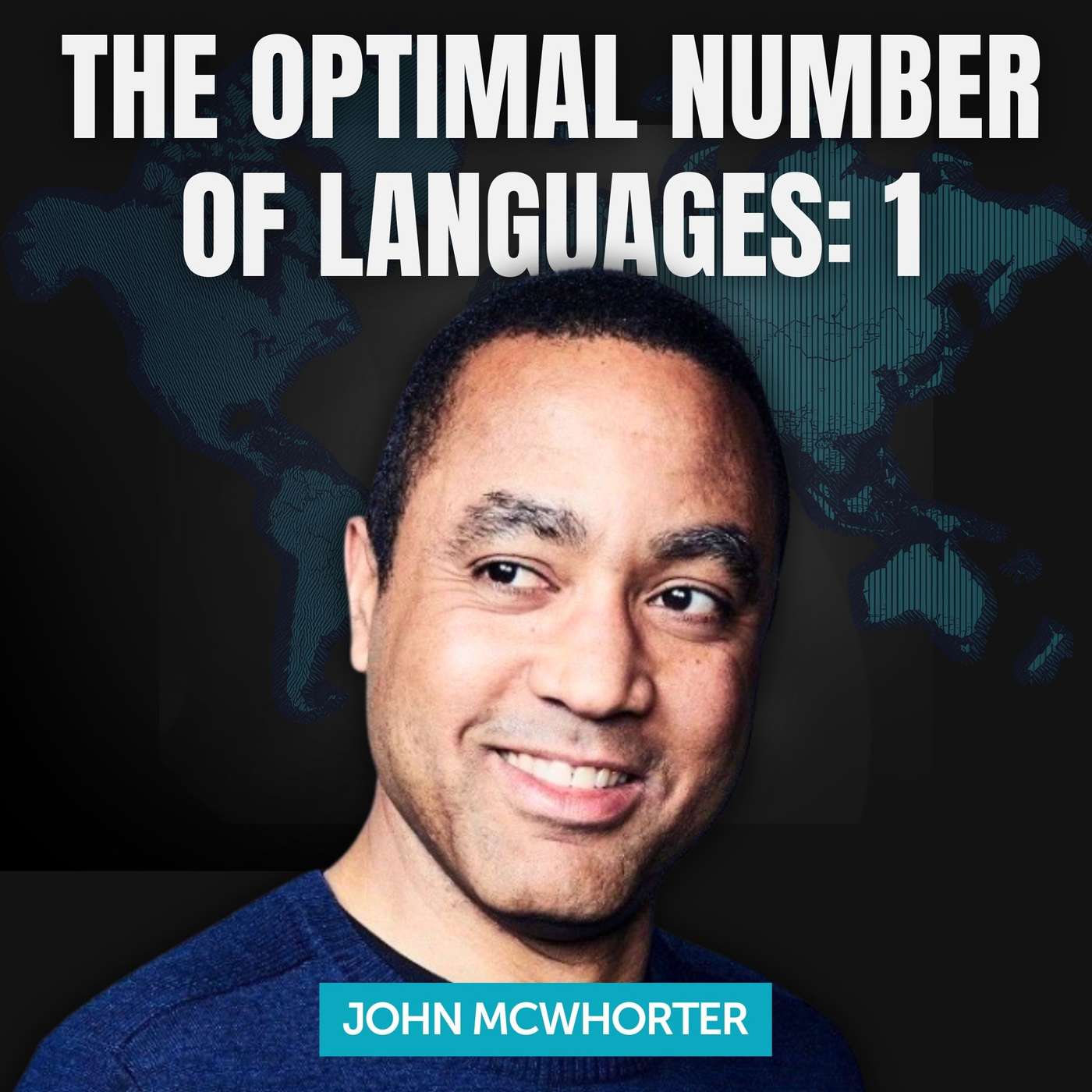
80,000 Hours Podcast
#142 Classic episode – John McWhorter on why the optimal number of languages might be one, and other provocative claims about language
01:35:05
Loading summary
Transcript120 lines
- [00:00]
A
Welcome to our holiday classic episodes for this year, this time around, covering the year 2023. This show is mostly about the world's most pressing problems and what you can do to solve them. Recently, mostly AI, to be honest. But what is the point of hosting a podcast if you can't, at least once in a decade, talk to someone really fascinating whose work you really appreciate? We've covered, I think, enough intense stuff this year and over the last 10 years that I do not feel too bad at giving you an hour of something completely different. In this episode I speak with the very popular author and professor of linguistics, John McWhorter about the most consequential language related topics that I could figure out how to drum up, including whether some languages are simply objectively better than others and whether it actually matters that thousands of languages are on track to go extinct pretty soon. This episode came out right around the point that ChatGPT 3.5 first became available and was kind of a sensation. So we also at the time threw in this imaginary conversation where ChatGPT was played by John McWhorter at the end of the episode. At the time, that was a remarkable showcase of what LLMs could do that kind of blew people's minds. But today I don't think it would really impress anyone. It was more of historical interest than anything else. So we've cut that extra bit out. But we will very much be keeping in John's talk why the world looks the same in any language, where he explains why he does not buy the sepia Whorf hypothesis that the language you speak affects how you perceive the world. It's very funny and I think pretty insightful and it was persuasive to me. So thanks to Polyglot Conference for letting us reproduce it here. Once again, that is all coming up in a second, but if you'll bear with me, let me give you a few reflections on how the show has gone over the last year. This year we've made a lot of changes to the program. Most notably, most episodes are now recorded in person and on video, and we've made a hard pivot to focusing on AI and AGI much more than we ever had before. The videos are, I think, simply looking beautiful, thanks to the blood, sweat and tears of our production team, Katie, Simon, Luke, Milo, Dominic, that is you. Thanks so much for your work. I usually listen to interviews rather than watch them, but if you haven't at least checked them out for a bit on YouTube or Spotify, you really ought to go take a look. I'm also glad we managed to work through a backlog of really pressing AI topics that we'd never covered on the show before, in some cases never even discussed on the show before, including AI scheming, inference, scaling, mechanistic interpretability and the rapidly growing complexity of tasks that AI can handle, among other things. We also had literally the best in depth coverage of the attempt by OpenAI's business arm to sideline its non profit owner that was available anywhere as far as I'm aware, beating, I would say, the Financial Times and the Wall Street Journal, which I'm pretty happy about. At the same time, this year has turned out to be less eventful in AI than I would have guessed or forecast back in January. As you might have seen or heard many analysts forecasts of when we're going to achieve some version of AGI or some standard of recursively self improving AI have extended out by a couple of years over the course of 2025, so timelines have been extending. It's kind of funny and a little bit first to me that that's the case, because over the last 12 months I've gone from straining to get much valuable work out of interacting with AI, but feeling like it's something I ought to be trying to figure out in order to keep up to basically collaborating with Gemini and Claude all through the day for everything in both at 80,000 hours and in my personal life, and finding it to be really smooth and enjoyable rather than the slog it was before. And the hyperscalers are famously investing a greater share of American GDP in their data center buildout than was spent on the Manhattan Project or the Apollo Project or the Interstate highway system, though oddly, they're still actually far short of the peak share that went towards building railway lines during the railway boom in the 19 century. But I think the 19th century was probably a crazier time in many ways than we remember or give it credit for. But despite those two bullish indicators, there simply hasn't been another of the holy shit moments that many of us felt when reasoning models landed in late 2024 and felt like a dramatic step up on what we had seen already. And integration of AI into ordinary work for the vast majority of people remains remarkably shockingly slow, at least relative to what I would have predicted. So for those reasons, among others, I think that next year we'll be doing a larger share of episodes on non AI topics or topics that intersect with AI, like the history of revolutions in Military Technology, but aren't about AI. Not really. I know a lot of listeners will enjoy having a wider range of topics back in the mix once again. And indeed I can assure you that I as a host will enjoy that as well. Anyway, thanks for letting us your ear once again this year. I always say that we are blessed to have one of the sharpest and most discerning audiences out there, which is something we do always put in our gratitude journals when we remember to Gratitude Journal.
- [04:52]
B
I hope you have a lovely rest.
- [04:53]
A
Back from work over the next week or two, and I and the rest of the team will see you again in 2026.
- [05:02]
B
Thanks for coming on the podcast, John.
- [05:05]
C
My pleasure.
- [05:06]
B
So this show is typically about horrible things in the world and how to solve them. And over the years I've been fairly disciplined about not just interviewing public figures who I'm a massive fan of. But you're so good, John, that I've had to make a partial exception in your case, because between Lexicon Valley and your linguistics courses on audible, I have listened to you talk about language and communications for absolutely hundreds of hours. And to be honest, hearing your voice was a big comfort for me and my partner during some pretty challenging times during the extended COVID lockdowns in 2020 and 2021. So on top of having learned some crazy stuff about language and finding you super amusing, your work is also. It's like a comfort food for me now. Hearing your voice just. It soothes my soul somehow.
- [05:49]
C
You just made my week. That was. I never thought about that. That's good to hear.
- [05:52]
B
Yeah. I'm sure I'm not the only one. Let's look at a couple of common ideas that people have about language. Does learning another language make you smarter?
- [06:01]
C
I want to say yes. And there is an idea out there that to be bilingual is to have a healthier brain in certain ways, to have better executive function. And, you know, you can even find me saying that in a ted talk about 400 years ago. But the truth is, the research has not borne that out. To be bilingual apparently holds off dementia by a few years, which somehow isn't as handy a nugget as the idea that makes you smarter. Is learning a language something that makes you smarter? To the extent that learning a language is a matter of working out a certain kind of puzzle or practicing something that you didn't know before, I'm sure that it makes you smarter in the sense that it creates new, you know, neuron connections, etc. I'm not sure that it necessarily raises your IQ. However, I'm being a bit of A sour puss on this, because I think there are many people who would say that if you learn another language, then you're learning to process the world through a different code, you're learning different shades of meaning in a different code, et cetera, and depending on what you call intelligence, sure, that is adding to your mental candle power. But the general idea that if you speak Polish and English, that probably makes you, in a sense, smarter than somebody who only speaks Greek or somebody who only speaks English. God, you wish that were true. Especially since probably most people in the world are bilingual and, you know, we boring monolingual Anglophones, we kind of want to put ourselves down, especially if we're educated. The research just doesn't bear it out.
- [07:35]
B
But you just said that it potentially delays dementia by a couple of years, which. That sounds like a massive win. I've had family members of dementia. It's like, spent a bunch of time improving my Spanish over the last couple of years, but I've kind of fallen off the wagon. But, yeah, if we can delay dementia by a couple of years, then maybe I should. Maybe I should get back to those flashcards. Sticking with the education theme.
- [07:54]
C
Yeah.
- [07:55]
B
When I read or when I read or listen to Shakespeare plays, I basically can't make heads or tails of it. Why that?
- [08:04]
C
Yeah, that's always a difficult subject. Because what I'm supposed to tell you is that. No, you're just not understanding that it's supposed to be poetry. No, you just haven't seen a good performance. You'll be interested to know that here in America, it's often said that, well, you know, if you hear Shakespeare done by British people, it's completely different because somehow they really know how to do it. Whereas if you do it in an American accent, somehow it's just not as good. And none of that is true. What the issue is is that with Shakespeare, almost all of the words are ones that we've heard. Or you can make it so that the ones that we haven't heard, you can kind of quietly snip them out, but we recognize the words. And yet you sit there and you get very, very tired very, very quickly. And there are many people out there who don't like to admit it, because if you say that you didn't get King Lear without having read it very closely beforehand, it means that you're not cultured or something. No, it just means that you're a modern English speaker. The problem is that to Shakespeare, for example, the word generous meant noble. It didn't mean magnanimous. It meant noble. So somebody says something about generous, and what they mean is noble. What they're saying doesn't quite make sense to you. You stub your toe, but they kind of keep going. And so you've lost something. And then about 30 seconds later, there's another word like that, with that piling on. That's why the Tempest is incomprehensible. Or if you enjoyed it, it's because of all the tricky things they're doing on stage. And you like seeing Jude Law in it or something like that. It's a really interesting issue because Shakespeare is English, but it's gotten to the point that we cannot comfortably understand what the person is saying unless you're lucky. There are lucky passages, and those are the ones that people recite over dinner. But to actually go to King Lear or to Hamlet without having read it beforehand, it. You're not meaningfully getting it. And so I've argued that we need to have not translations, but we need to have adjustments. And needless to say, certain people think that I'm just this uncultured boob. But no, it's just that I like theater and I don't like pretending to like things that are difficult, or I should put it differently. It's not that it's difficult, it's impossible. And I think that that's just not fair.
- [10:11]
B
Yeah, so. So just like the natural gradual evolution of language means that so many of the words mean different, mean different stuff than it used to. It feels like. So it's been 400 years or so. It feels like, yeah, Shakespeare is like a third or maybe a half of the way to being just a different language, to being, say, the difference between Portuguese to Portuguese and Spanish. I always show lots of Shakespeare plays in high school, but I think people would rightly have thought it was a bit crazy if I was just given French plays in the original French, not knowing any French, and was asked to study these plays in French rather than a translation. But people are so reluctant to just translate Shakespeare just to update a bunch of the words so that it's in English of 2020 too, rather than English of 1600.
- [10:52]
C
It's such an easy score to say Shakespeare. If he were here and apprised of the current situation, we know he would say, oh, yeah, you have to change it now. Some people would say, well, that only works if he does the changing. But no, he would say, I'm dead. And so let's have somebody else adjust it so that people can actually enjoy Much Ado About Nothing and not Pretend to. Yeah. It's a funny thing. Many people who resist this, and I understand why they do, would be interested to see how it feels if you happen to be good enough in another language and you get to attend Shakespeare in that, to see Julius Caesar in French, where it's not in French of the streets, but it's in a French that's accessible to modern people. All of a sudden it's just a play. It's like you're watching Tennessee Williams and then you go back to hours where you're sitting there pretending to have a good time. Yeah, it's a really, really funny thing. I remember the last time I saw Macbeth, which I only enjoyed because I sat down and read the damn thing over, you know, a week beforehand. Otherwise it would have been like attending something in Hungarian. I was listening to these Russians behind me and they're sitting there reciting lines from it in their version of it. The 14 year old is enjoying it. And the reason was because for them it's in Russian, not in the Russian of 500 years ago. And I just thought it should be like that for us. It's the weirdest thing.
- [12:09]
B
Yeah. Okay, different question. Should we bother teaching foreign languages to school children? I mean, like primary and high school children in America or British or Australian schools?
- [12:22]
C
That is becoming such a fraught question because of how rapidly translation technology is advancing. And I'm supposed to say, yes, we should teach children other languages because another language gives you a different perspective on the world. But I'm not sure if that's true. I've argued against that idea that each language gives you a different kind of acid trip. Because for every jolly thing about a language where you say, well, if you learn Russian, you're more sensitive to gradations of blue or something like that, there's something else about a language where it's negative. It's something that casts a negative light on the speakers. And it all kind of comes out at par. We're all seeing the same world. The languages are what change now. They are different cultures, but it's not language and grammar and vocabulary that create that. And so the question is, should we be teaching children languages? And certainly if we want people to learn languages, we've got to get them going much earlier than we do. Once you turn about 13, you start to ossify in that ability. But the question is, why? And as a language head, my feeling is, oh, yes, because it's just so interesting to learn other languages and be able to talk to other people. But that's not how all people feel. So I'm kind of sitting on the fence at this point. So, for example, I live in a neighborhood where probably every second person speaks Spanish and probably would rather speak Spanish than English. My girls, 7 and 10, are very monolingual in English. Neither of them seem to happen to have been bitten by the bug that I have. They're not just fascinated to hear somebody speaking Hebrew and want to grab it for them. Speech is what we speak. And I'm thinking, okay, do they need to know Spanish? It'd be good because they could communicate with a certain warmth with people in this neighborhood. But then the question is, would they? Is that really how sociology works? Is that where their friendships are most likely to be? It's a tough one, actually, because my real answer is yes. But then on the other hand, I don't want to impose my interest on other people. And many people don't really care about speaking other languages, including people who don't speak English. So, yeah, it's hard.
- [14:22]
B
Yeah. I mean, I think another argument is that even though it might be very beneficial to actually learn to speak another language, I guess, I guess we can question that. How large are the benefits? But I think I looked in the US General Social Survey, only 1% of people claimed to have learned to speak another language well at school. 0.7% say they speak it very well. 2.5% say they learned another language in school. Well, so we're talking like 1 in 100 to 1 in 40 are actually getting to the point where they can use the language from school. So you're wasting enormous numbers of people's time. And then they mostly just forget it because they don't use it in order to get the kind of diamond in the rough to occasionally learn to speak something properly.
- [15:01]
C
Yeah, what's the point of, you know, that? You know, for example, in America, and I think still there too, the idea is that you're supposed to know a little bit of French as kind of a middle class marker of, you know, genteelness. But you know, why really? And I'm not putting down French, but that's something that made a lot of sense in the time of Henry James. But why now, when, frankly, you're going to forget it? And what you see if you look at Europe in particular, is that learning other languages in any real way is something that happens mostly when you really need to. It's not an accident that Scandinavians and Dutch people, et cetera, if we meet them, tend to speak English well, because frankly, nobody else speaks their languages, whereas the bigger the country, the less likely that is. So, yeah, it's a matter of utilitarian force for a lot of other people. And the question is, can we get better at teaching languages? And I think that there's something to that. I had many teachers, many language teachers who were doing their very best, but, you know, like you said with the flashcards, the truth is, you know, what they did, didn't, didn't stick and it wasn't their fault. It's because only so much is known about how to really do it. Right.
- [16:05]
B
Yeah. Okay, hopefully we find a few people out, but let's turn to a more serious and sad topic, which is the very rapid extinction of actually, I mean, I think the ari majority of the world's languages. So we won't have time to do this topic full justice. But yeah, you had some lectures on this topic a couple of years ago, which got me thinking about it, because to start, how many living languages are there in the world now? And roughly how many might we expect there to be in 100 years time if things continue as they are?
- [16:32]
C
There are about 7,000 now and in about 100 years, 500, 600.
- [16:37]
B
Yeah. How many languages have already died out over, say, the last 3,000 years?
- [16:41]
C
I'm not aware of the number, but many fewer than are dying out now. And so language death is natural. There are all sorts of historical developments where you read about some group of people being overtaken by another, where you can assume that some languages probably died out, like Chinese is spoken over this huge swatch of territory. That's a magnificent thing, Mandarin in particular. But you can just know that there were hundreds and maybe thousands of languages spoken in that territory that the Han and other people overran. So language death is a natural thing. Just like species death is a natural thing. But it's happening so quickly because of globalization and technology that there really is a crisis if we care about the magnificent diversity of language that exists.
- [17:27]
B
Yeah. Do you know the main reasons that these languages are going extinct? I mean, I guess we can guess, but do we actually know what the.
- [17:36]
C
Primary drive us on that same thing? We were talking about the utilitarianism. You and I think it's really cool that there's 7,000 languages and that languages can be so different from English. But for most people, language is about what you need, who you need to talk to, and what we now call globalization. But it goes from long before we started calling it that there are certain big giant languages that are most advantageous in that way. And they can make the smaller languages seem not only rustic, but insignificant, not useful. And so a classic example is one linguist, Peter Latifoget, the late, great Peter Latifogen was asking a Dahalo speaking tribesman in Tanzania, dahalo's one of these languages with a certain number of clicks, et cetera, very interesting to those who don't speak it. But he liked the fact that his son was leaving Dahalo behind and was more comfortable in Swahili and in the city making money. And the tribesmen said, dahalo is something we speak here, but we're poor. I want my son to make money, and so I want him to speak Swahili in English. And Peter Latifolk had said, well, you know, who am I to tell him he's wrong? And that is a really tough question. And so I think often, as most linguists do, about documenting languages, and, boy, it would be nice to keep them alive. But that is a tough, tough proposition to make to some people who are interested in getting in touch with their language. But how do you make it so that they're going to pass it on to children in the cradle and speak it to toddlers? And that can be a real challenge. You speak a very small and probably therefore fascinating and very complicated language. You marry somebody who speaks another one from several villages over the two of you, move to the city, because maybe there's more money to be made in the city. Maybe you think of the city as a more cosmopolitan place. In the city, there's going to be some big, giant lingua franca. And so you two probably already speak it. Now you have kids, what are you going to speak to your kids? You might speak a little of those village languages, but you two don't share a village language. You're going to speak that big fat language. It might be, for example, Swahili. That's what your kids are going to know. They're going to know bits and pieces of the village language. Those kids are going to marry other people who speak Swahili. That kills languages, because after a while, there are very few people left in the village. And the people who are left in the village would rather speak Swahili than. Because modern media makes it so that you hear the big language all the time. The big language is the language of songs. The big language is what you text in. That's a very hard thing to resist. That's happening all over the world.
- [20:03]
A
Yeah.
- [20:04]
B
So that's a story in which kind of people are voluntarily giving up these languages. Because they just don't provide so much benefit to them relative to the enormous cost potentially of learning them and keeping them up. Is that almost all the story, or do you know how much of these languages are being lost due to kind of explicit government coercion or other kind of active decisions that are being made to kind of kill off languages?
- [20:25]
C
I'm not aware of active efforts these days to kill languages. That was a standard situation for Native American languages in the United States and also in Australia for a long time. That is largely a thing of the past. And I'm not aware of a government movement to actively get rid of small languages. But it can happen through just neglect. Many governments really don't have the funds to put towards something like that. And then it's easy just not to be concerned once you get beyond a certain circle. The idea that a small language is exotic and therefore interesting, as opposed to just something strange that some people speak and that you don't know is increasingly common. And so I hope nobody's listening to this and thinking that I'm saying we've just got to let these languages go. I think that we should try to keep them alive as much as possible. But the sad thing is that in many cases, especially when the language is almost gone, documenting it is probably the best that can be done. But no, I'm not aware of active efforts to suppress the languages now. Progress happens slowly, but it does happen. But the issue is how do you foster them? And this is the thing, because I'm sure that I'm making some people mad now who are going to hear this. The question is, does the revival movement work? And I really hope that the answer is yes, especially with modern technology. But over the past several decades, it's been very rare that you could say that a revival movement made it so that a significant number of toddlers grew up speaking the language and were on their way to passing it on to their toddlers. That's really hard to do, especially if the language doesn't have a written history. So I think we have to be both compassionate, we have to be forward thinking, but we also have to be realistic as to what we mean by revitalization and preservation.
- [22:07]
B
Yeah, if you're making people mad, I'll run the risk of making them even madder. So I think a very natural framing, and the framing that I've mostly encountered this discussion of language extinction in, is that it's a tragedy and an injustice and an imposition that these languages are disappearing. It's the rest of the world Forcing people to give up their language. But inasmuch as kind of the story that you're telling is right, that it's kind of voluntary individual choices adding up, where people, they're not sufficiently passionate about learning and keeping up these languages that only a few other hundred people, possibly thousands of other people speak, that they want to put in the time to learn what are in these cases the most complex languages in the world. Generally, the. Generally, the fewer people speak a language, the more incredibly complex or it is. So they're making a personal decision that the benefit doesn't exceed the cost for them. And of course, I'm coming in as someone who is interested in language personally and finds these languages fascinating and wishes that they would continue existing in the same way that you might love for the rainforest to continue existing, because it's this beautiful thing that's been there and you don't want to see it irrevocably destroyed. But what do I have to do in order to make that happen? Nothing. I'm not asking anything of myself. I'm saying to people who often are very poor and very marginalized, who presumably don't have tons of time to be going and doing study courses in order to learn these languages, that they should take large amounts of time away from their lives, not taking care of the children or doing something else to learn these languages so that I can know that it still exists and be satisfied by that, even if they're not super interested. I don't know. What do you think of that reversal of the framing?
- [23:34]
C
Yeah, there is that diorama aspect to it, and I want to add something. It's partly voluntary. So there are people like that farmer, but as often as not, it's something that doesn't get talked about enough. I'm not completely sure why, but you touched on it, which is that the languages that need to be saved tend to be extremely complex. And the simple fact is that after the age of 13 or 14, to learn a language like that in any real way is almost impossible, unless you are a language obsessive yourself. You might get really good at it if you dedicate yourself to it, like you might dedicate yourself to learning to ride a unicycle. But yes, most of these people don't really have time. And I think that it's easy to think, especially if you're a Western European and you're not a linguist. And for linguists, I'm not sure what they're thinking, but it's easy to think that all languages work kind of Like English, where you've got words, you know, separate words, and not too many suffixes, not too much verb conjugation. Or if there is, it's kind of like Spanishes. And maybe you have to learn a little bit of meaningless gender, but that's pretty much it. You have a subject and a verb and an object, and there you go. That's not the way an awful lot of languages work. You've got tones, you've got much more complicated grammar than anything we can imagine in English. I would be interested to see how revival movements would go if the whole idea had been started by, for example, Lithuanians, or if the whole idea had been started by Navajo speakers, where people realize that how really different and how really challenging a language can get. Where they might think, wow, after about 14, who's going to be able to do this? And then there would be a whole new set of predicates that people would talk about. But yeah, and I don't mean to sound dismissive of any of these things, but it's hard to bring a language back when toddlers are speaking it in droves. That's tough.
- [25:20]
B
Yeah. So we're going to throw in a clip where you explain that you think the degree to which language itself embodies important ideas and cultural aspects is greatly overstated, but it's not 100% made up. In as much as language and culture are intertwined, to what extent do you think people can save most of the cultural part as they switch to a new language? Like voluntarily is all the wicked one, but voluntarily switching to a new language. But they import type of tons of new words and concepts into the adopted language and maybe even fiddle with the grammar a bit here and there. In as much as I'd like to, to me, that seems very valuable to preserve those cultural aspects that otherwise might just be gotten rid of for no good reason. But it's way more practical than trying to save these languages, which is we don't really seem to have a path to do it.
- [26:09]
C
Yeah, I think I'm right with you on that. If you want to save the culture, and that is very important. The truth is that it is healthy for a culture to have a code of its own. Having a separate language is a vibrant part of being a culture. But if that can't happen, that doesn't mean that the culture isn't there. Because, for example, there are a great many people in the United States who would consider themselves to be quite Jewish who do not speak anything but English. And to say, well, you're not really Jewish because you don't speak Hebrew and you don't speak Yiddish would not work for them or Native Americans here. I would be very reluctant to tell a Native American, a person of Native American heritage here, you're not really quote, unquote, Indian because you no longer speak chinook, etc. So it's not ideal. But I think that, yes, you can have a very vibrant culture in what was originally the dominant language, which maybe unfortunately was forced upon you, but if it happened generations ago, you can't reverse the process. So, yeah, and you're right that sometimes you get whole almost new languages based on using all these different words and maybe even influence from the language that's no longer there. That might be the way of the future. Not as vibrant as what we would prefer, but that might be the practical solution in many cases.
- [27:30]
D
Yeah.
- [27:30]
B
I think Paraguayan Spanish, for example, I think like almost all Paraguayans, they speak this slightly merged version of Spanish which, with I can't remember the name of the local language.
- [27:38]
C
I think it's Guarani.
- [27:39]
B
Guarani, yeah.
- [27:40]
A
Right.
- [27:40]
B
And they've absorbed a whole bunch of words and concepts because there was actually tons of intermixing between the Spanish colonists and the locals. So maybe that's kind of a possible path forward that allows a lot of these ideas and cultural ideas to be preserved.
- [27:55]
C
Hopefully that can happen.
- [27:57]
B
If we were choosing from a blank slate as kind of alien engineers who engaged in some sort of panspermia project, I guess, like in the Alien movies, when they're kind of seeding the Earth with humans. But before humanity has gotten started, what would we think? Was the optimal number of languages for humanity to speak.
- [28:15]
C
Going to get in trouble again? I honestly think that if we started all over, the optimal number of languages would be one. I really don't think that anybody would think if language weren't so changeable and that 7,000 languages had developed, I don't think anybody would say, wouldn't it be nice if there were 7,000 different languages and most of us couldn't understand one another? I don't know if anybody would even say, wouldn't it be nice if there were 7,000 different ways of talking, even though we all shared one? That would take a great leap of imagination. And so I delight in all the languages that there are, but the truth is they developed via the accident of how language change works when groups separate. And so the idea that we need 7,000, I think that becomes attractive if you believe in the Warfian idea that each one of those Languages gives you a different lens on life. But if that idea's importance is exaggerated, then I would say as a linguist who delights in the 7,000 languages, that if you roll the tape back, it wouldn't be the worst thing if everybody could speak just one. In which case, I think the language heads among us think, yeah, okay, there would be this one. But wouldn't it be nice if then everybody had this other one that they use at home and with their friends? But I don't think most human beings would think that way. They would think there is one way to talk and we use it with anybody who we meet. And then there's another thing people will say, which is that people would deliberately change the way they talked in order to reinforce their sense as a group. Okay, maybe, but not to the degree of creating a whole new language. It would be different slang, it would be different sounds. I think most human beings would prefer that everybody could talk to one another. That's so mundane, but I think that that really is true in the grand scheme of things.
- [29:57]
B
Yeah, it is interesting that both preserving 7,000 languages is both kind of an idealistic goal that warms people's hearts. But so is Esperanto in a way. So is having this universal language that would allow everyone to communicate and get along and understand one another better, even though these are kind of diametrically opposed ideas. Let me offer one counter argument, though. Might it not be bad to have more communication between countries that are potentially otherwise somewhat hostile to one another? So imagine if Russians and Americans all interacted on the same social media platform, all using the same language, they could perfectly well understand the things that one another was saying. Might that make those countries more likely to go to war rather than less likely to go to war? It's kind of an argument that good fences make good neighbours. Maybe like good linguistic barriers, good linguistic fences potentially make a comity between nations.
- [30:42]
C
You know, I never thought of it that way, that if there were richer communication, people might like each other less. It's definitely possible. Like you imagine Donald Trump in Korea, you know, what kind of communication was happening between them, and it must have been very slow and very stunted. Imagine if they could actually have communicated in one language. Would they have, quote, unquote, fallen in love or actually had more of a sense of what one another were like? It's an interesting speculation. Those two people communicated basically in somebody, you know, standing there and kind of dumbing down the things they both said. What would have happened if they could have both spoken English or Korean? Yeah, it'd be. Or Esperanto. It would be very interesting to see.
- [31:23]
B
Let's talk about a couple of big ideas in linguistics. At a fundamental level, do people conceptualize and reason about the world using language and words, or do they do it using underlying concepts that are embodied in the brain themselves, apart from words before language, and then only get translated into language when we want to communicate, or I guess when we want to engage in occasional deliberative thought in kind of the prefrontal cortex.
- [31:49]
C
Yeah, that is a grand debate. And I think that we have to say that thought comes before language to an extent, because language would have evolved as a way of communicating thought more efficiently than snarls and bodily postures and bites. There had to be some feelings, there had to be some thoughts. The thoughts probably had to do with, let's all band together and scavenge on that large dead elephant or something like that, and then you're off to the races. But then, on the other hand, once you've got language, it changes the quality of your thought. And so, for example, you can't respect someone without being told. You need language to instill not just being afraid of somebody, but respect. As in, grandma is this old lady, but she's very important because she saved us from this and she knows all about that. Respect her before that. The closest thing to respect is, don't bother him or he will kill you. That's not respect. And so there are various emotions and positions that only work if you can talk, not to mention just passing culture along and there being an encyclopedia of knowledge, even if it isn't written down. And so there is a kind of thought, there's a caliber of thought that can't happen until there is language. But certainly there were thoughts before language. And that's why we can see that a bonobo has thoughts. The question is just whether the bonobo can express them.
- [33:17]
B
Yeah. To what extent does it kind of settle the issue that we can see that babies are thinking, they're kind of reasoning through things and making decisions, and we can see animals are doing this as well, and they presumably aren't thinking in language? I mean, I guess I also recall this argument that I'm not sure I can fully put it back together again. But, for example, when you say a word that has homophones, we don't then often confuse the underlying concept. It seems like sometimes we reach for a concept and then we struggle to find the word. But kind of not the other way around, where we confuse the word with the. The underlying idea, which kind of suggests that it's these primitive concepts that are thought.
- [33:50]
C
Yeah, exactly. Yeah. And then the homophone is just a kind of accident, but we're being channeled by what we were thinking. Exactly. And that's why these sorts of things are funny. You know, a lot of jokes, especially low level jokes, are pretending to be confused by the homophones because the fact is we aren't. We're thinking.
- [34:06]
B
Yeah, yeah. So is it kind of settled then that we don't really speak a language? I guess. Are there people who advocate that in fact, language is more fundamental to thought and we do think in words, not in concepts?
- [34:18]
C
I don't think any linguist would think that, because it's clear that language is a tool that is designed to allow us to express thoughts, which means that just ontologically the thoughts must have come first. It's just what language can do to thoughts once language exists. I mean, for example, there have been some people who have proposed that language emerged so that you could talk to yourself, so that you could more eloquently express your own thoughts. But no language emerged for conversation. And once again, that means that there must have been some thoughts that people wanted to share. Thinking. Thinking to yourself in language is something that comes later, after something has evolved in order for you to say things to other people. That would have been how it emerged.
- [35:04]
B
Yeah. Can people communicate meaningful information more quickly in some languages than others?
- [35:11]
C
No. Rather, from what I've heard, the issue is that if a language squishes units of meaning more closely together than another one, it often is spoken a tiny bit more slowly, and so everything comes out at parents. So I'm not aware of a language where you can get across more in less time. Because, for example, if there's what's called a polysynthetic language, where one sentence is basically one word, the word is not said at a bullet's pace. The word is stretched out to a certain extent, Whereas a different language, like for example, Spanish or English, might go by faster because we have fewer units of meaning within one word, and so we can go faster. So I'm not aware of that. However, I've also never thought about it very hard.
- [36:05]
B
Yeah. Why do you think it would be the case that all languages communicate at roughly the same pace, that there wouldn't be significant differences?
- [36:12]
C
Because if there is an evolved specification for language, part of it, it seems, involves processing chunks. It's not about processing words going by, it's processing chunks of meaning that are formed by words and what we call morphemes, which are units of meaning. And so not only walk, but, say, the ed ending. And that would be something where there'd be limits on how quickly you could process. And it's interesting how quickly we can process language, but for it to go by too quickly would go beyond what it would seem the brain is specified for. Presumably, there is one specification in the brain for that kind of thing. This is not about the Chomsky and conception of universal grammar, where apparently we're supposed to be genetically specified to have these bizarrely complex tree structures, et cetera. But whatever it is that makes it so that humans do have language, there must be some genetic specifications. They're going to be broad and maybe less dramatic than what the Chomsky and propose. But one of them would be that capacity for chunking information given to us through our ear. And this would have started possibly with, you know, being able to hear sounds and music. And I would imagine that that would be one speed and you couldn't go beyond it. That's my guess.
- [37:28]
A
Yeah.
- [37:28]
B
I guess I have a pet theory. So it's just like, what is creating the speed limit here? So the fact that I listen to podcasts on 1.5x or 2x speed all the time without very much comprehension difficulty suggests to me that in normal conversation most of the time, if we could speed people up at least like, 50%, maybe 100%, then we could still largely track what they're saying, and it wouldn't be that bad. And obviously, people can't. Some people speak much faster than other people in principle, if they're reading something off the page really quickly, so it doesn't seem like it's the tongue or the mouth that's presenting the speed limit. My guess is that it's the speaker can only form their thoughts and think through what they're saying and put things into language at a particular pace, because that's the most challenging part. Like producing speech, I think, is more challenging than understanding what someone has said, because you actually have to have the ideas. And so maybe it's just that the human brain is only. Only good for so many thoughts in.
- [38:20]
C
So many seconds, and you can only produce so much. Yeah, it's interesting. If you speed up a podcast and you're listening to, you know, how quickly speech can go by. Sometimes that happens in real life, you know, at a party or a certain kind of person. One can speak that quickly and one can be spoken to that quickly and understand it. Yeah. The question is whether you could continue producing language at that speed constantly, all the Time and express anything worth expressing. Yeah, it's an interesting question.
- [38:49]
B
So, yeah, can you describe what a Creole language is? Because I hadn't heard about this before. I listened to your lectures and it's super fascinating and I imagine many audience members have not heard of them.
- [38:58]
C
Oh, Creoles are really fascinating. It's the closest thing to language starting again. What happens is that, let's say there's some situation where somebody learns another language only partially, you know, a few hundred words, some shards of grammar. Most of that's frankly what most of us do in school. Suppose you have that, but for some reason you end up having to live in that. And you're with a whole bunch of other people who've learned the language to that level, speaking probably a few different languages. And you're not going to default to any of them. Like you don't know Polish, the Polish person doesn't know English, and all of you speak this low level, say German or Russian. And the situation is that you're going to live in that language, talking to each other in that language forever. What happens is not that everybody just stays speaking with a 300 word lingo. What happens is that people naturally expand it by using the words, by using bits of grammar from their native languages, and you fill it out into this brand new language, and that's a Creole. Often you hear that it's children who turn it into a Creole. But the truth is, if you look around the world, grownups can go a very long way towards expanding a pidgin, as you call it, into a real language, a Creole, as you call it. And the truth is that that situation happened most in the previous millennium under conditions like slavery, orphanage, labor, military conscription. It was people who for some reason were in the frankly, rather eldritch situation of speaking a language badly and needing to make it into a real language. So a lot of these languages were born in tragedy, an awful lot of them with plantation slavery, for example. But the result is a brand new language. And these are languages that are less gunked up with the needless complexities that languages that are older have. And so it's not that they are, you know, absolutely elementary, but they show that they've only existed for a few hundred years. They don't challenge you with a whole lot of nonsense in that way. And there are several dozen creole languages spoken around the world. There is some controversy in linguistics over whether creoles start as pidgins and their language is born anew, or whether Creoles are just what happens when language is mixed together. And there's no reason to think of them as anything different. I believe the first version, that was what people thought about Creoles until about 20 years ago. And to be very glib, I think that the linguists who think that creoles are just what happens when two languages meet are wrong, I have to say that. But I'm not going to pretend that they do not have their say as well. But creoles are much more interesting than that. And so Haitian Creole and the creoles of Suriname in South America, like Saramakin, that's the one that I have most studied. Slaves escaped from plantations into the rainforest and their descendants live there today speaking the new language that these people created. And Cape Verdean Portuguese. That's a creole. There are many creoles in Australia and surrounding Oceania. They're very interesting languages, but they tend to be non standardized. They tend to be spoken alongside some big fat monster language. And so it's easy not to know that they exist. But they are some of the newest languages in the world and I find them mesmerizing.
- [42:18]
B
It's kind of language born afresh, borrowing vocabulary and some grammatical aspects from the languages that these adults originally spoke or their native languages when they were forced together as adults. Let's give a couple of examples, I guess, of the kinds of things that get stripped away in these languages. So I guess in most Indo European languages, including Spanish and English, I guess Spanish and French and so on, you have gender, so you have like noun categories, masculine and feminine and so on. If you have a creole based on Spanish, that's going to go almost certainly.
- [42:49]
C
That's one of the first things, right?
- [42:51]
B
And it's because adults, when they're learning, when they're putting together this language, trying to communicate with one another, like, why would you add that in? Basically there is no reason, it's not necessary. They're just trying to communicate. And these noun categories aren't helping, I guess. You know, lots of, most, most non creole languages have lots of different tenses. You know, like I did, I had done, I had had. Yeah, like I was doing all of these different, like many different past tenses.
- [43:15]
D
Actually.
- [43:16]
C
Actually a Creole will have a lot of that sort of thing, really, but it'll do it with one word. So what the Creole will get rid of is the long list of endings, depending on whether it's I or we or they that goes. But there will be a difference between I was going and I am going and I went. But it's with one suffix or usually it'll be with one Separate word. And so you can get across that nuance, but without the nonsense of it changing because of whether it's we or you or he or she.
- [43:45]
A
I see.
- [43:45]
B
Okay. So they don't necessarily shrink the number of tenses, but they're easier to form because the irregularities are stripped away.
- [43:52]
C
Precisely.
- [43:52]
A
Interesting.
- [43:53]
B
Yeah. Are there any other kind of classic things that disappear as a Creole is born?
- [43:58]
C
Yeah, those things are very important because they are what make learning, for example, European languages hard. And then also another thing that gets stripped away is if you are a tonal language where it's like Chinese, where the tone determines what the word is just on one syllable, that is something that gets undone in what's called creolization, because that's really hard to learn. And if you're going to create a language anew, why would you start it that way? So that sort of thing has to kind of creep in gradually all over again. But you strip that away and you get rid of things like the word understand, where, you know what under is, you know what stand is, but what are you standing under? Or something like, everybody turned out. Well, did they turn? You know, in what sense did they rotate? You know, we don't think about that. But that sort of thing has to start all over again. In a Creole, words are more transparent in that sense, because you've just gotten it down to a collection of 100, and you're trying to make us three or 400. You're trying to make as much sense as possible. So Creole languages do not have the grammar of Esperanto. You know, it's not that grammar disappears to that extent. But then, on the other hand, the Creole language's structure is much less gunked up. And so, for example, Haitian Creole is very much a real language. You have to learn grammatical rules, and it's got, you know, vocabulary way, way, way, way, way beyond six or 700 words. It's now tens of thousands. But it's still true that Haitian Creole is French, but with all of the things that make French hard to learn stripped away because people, frankly, had better things to do. And so it's a much easier language to learn the basics of.
- [45:42]
B
So they're much easier to learn than lingua francas like English, and much, much easier to learn than languages that were never lingua francas like, I don't know, Welsh or Hungarian or Iroquois or whatever. But does this much greater simplicity, this much greater ease and streamlining, come at much or any cost to comprehension or functional communication between its speakers?
- [46:03]
C
No. It's interesting Functional communication between speakers and expressiveness in general are all about a language having what are called constructions. So you've got words, you've got basic grammar, you've got expressions like, what are you doing here? Or the longer the better. If you think about it, the longer the better. That doesn't necessarily have to mean what it means. We just know that. The. The. We just know that. That's called a construction. What are you doing here? You say, and you're watching the person doing it. What you mean is, why are you here? That's something that you pick up. All languages have a massive collection of that. Where the shit hits the fan is that languages differ in how much of the ablo, hablas, abla, hablamos, hablis, hablon. That you have all of the verb conjugations, the meaningless grammatical gender, the verbs that change shape for no reason, like am, are, ben, be, all of that stuff. There's some languages that have almost none of that. There's some languages that have way too much of that. And that is where you get the needless kind of complexity. You can have a language that has none of the. Of what I just described. And you are the same human being communicating with all the nuance of the person who's got lots of it. That lots of it is like the cans dragging behind a car after a wedding. And yet it's so fascinating, but it's not needed.
- [47:27]
B
So when I listen to your lectures on creoles, it's like, okay, so you've got these languages that are way easier to learn, much more regular, much more streamlined. It comes at no cost to communication, as far as anyone can tell. It turns out that marking the gender of pronouns, not helpful. It turns out that all of these subtleties of tenses, context takes care of it. None of it was necessary, like, you know, marking whether this object is moving or who owns it and how they own it and how they know something. All of this stuff.
- [47:51]
C
You have listened to my.
- [47:53]
B
More than once in some cases. All of those things gratuitous. Gratuitous to actual communication. Aren't creoles the best languages? They're cheaper and just as good.
- [48:05]
C
You know, I should have put it that way many years ago and I would have made fewer creolists angry. Yeah, they are the best languages in that way because they're not gunked up with stuff that make them difficult for second language learners to learn. And in terms of efficiency, in an aesthetic sense, you could say that they are very much that, because there just isn't all this stuff. And yet what's interesting is to see that those languages are very much real languages. If you wanted to have a universal language, ideally you would choose a creole because they are much easier to learn than languages that have been around for a while getting all gunked up. Yeah, Creoles are better. And you know what's interesting is that the ones that are forming now tend to be sign languages. Sign languages form in that way, too. They start as pigeons and then they become creoles in a sense. But that's less accessible to the rest of us, you know, who are hearing people. But it's that same process. Sign languages are better in that way because they aren't gunked up because they tend to be young. Yeah, definitely. I'll put it that way.
- [49:03]
B
Yeah. Just before we finish this, I'll just say one other thing is I was amazed that creoles form basically within one, maybe two generations. You throw together people who don't have a common language. They will produce a full language, a fully functional language with all of the words they need and all of the grammar. Sometimes in the first generation, or if not, then their children will all speak this language, which is just incredible how. I mean, I think it speaks to. So people want to communicate, and if the language doesn't have a function, they just add it and then they all kind of agree on it very quickly. And it. And it appears just like that. It's beautiful.
- [49:35]
C
It's funny how quickly it does seem to happen. It does seem to happen in one generation. And, you know, if I were going to make a movie of it, I suppose for drama's sake, I would have it being that the first generation of toddlers all of a sudden are speaking much more fluently and quickly than the grownups. But truth is, the grownups can do it too. There would be drama in watching teenagers and grownups gradually getting to the point that they can have a real conversation. Because that's exactly what happened, for example, in Australia and Oceania. You have to reconstruct it for the plantation creoles, you have to guess. But all evidence is that that's the way it happened there, too. Then the kids come, and it's already a real language. The kids make it a real, real language. But it isn't as dramatic as one might think, because even the grownups. To be a human being is to want to do better than me. Sit under tree, you want more and you create it. Yeah. That's what people do.
- [50:24]
A
Yeah.
- [50:24]
B
And I think it's the same thing that makes people talk about that they worry that English is going to degrade or languages are going to degrade. It's basically not possible because if it isn't serving our purpose, we just fix it. We just add words. We just add. We just disambiguate when language degrade. If you wanted to.
- [50:38]
C
No, even if you wanted that to happen, you would end up subconsciously resisting it. When language breaks, we fix it. Exactly.
- [50:45]
B
Okay, final section. I want to talk a little bit about artificial intelligence and the possible future of language. An audience member had this question. How will language adapt to use by artificial intelligences with different patterns of strength than humans? For instance, it's routine for language models to to read more books than could be read in many human lifetimes already. They may have much greater working memory and encode language directly in characters rather than in sound. So how different might an efficient language for use by super capable artificial intelligences be? And how much of an efficiency penalty might there be for keeping it easily human comprehensible for communication or transparency reasons?
- [51:22]
C
Well, to tell you the truth, this goes a little bit beyond my pay grade. But I can speculate that for something with that kind of power, we might want to study all of the different semantic shades that a language can indicate. No language does them all. But it'd be interesting to construct one that really did get everything in kind of like this Ithquil that one person has developed. And then the issue would be for humans to be able to deal with this language slowly. As in we would be able to read it and we could go at our own pace. But machine translation AI could handle that kind of super packed information at, you know, mind blowing speeds. There would just be that difference. So it'd be interesting to see a language in that case could pack in more information about world conditions than any language I think a human being could handle. Which is why languages get complicated. But they only get so complicated.
- [52:18]
B
If humans settled space, do you think we'd end up with different languages on Mars? Or if not Mars, maybe if we went to other stars?
- [52:27]
C
No, but only because presumably there would be constant communication between the stars. There would be written language, all of those things. Widespread literacy and print discourage the kind of language change that would lead to new languages. If there were the constant kind of communication that one imagines there would be, then let's say, you know, just let, just let's guess that English was brought up there. It wouldn't be that there would be brand new languages in a thousand years because of the nature of the way humans communicate. Even now down here, if it had happened 500 years ago, where the analogy is getting strained. Yeah. Because people would be separated, but with the way things are now, everybody would keep speaking more or less the same thing. There'd be dialects, but not different languages.
- [53:16]
B
So I think one thing is that I think you can send a message to Mars in a couple of minutes, eight minutes or something. But to send a message to another star system, the delay is, I think, maybe years. I don't know. It's a long time. And so maybe the level of.
- [53:29]
C
And it'd be hard to get beyond that.
- [53:30]
A
Really low.
- [53:32]
C
Yeah.
- [53:32]
D
If that's true.
- [53:33]
C
And if there's no way to get beyond that distance and travel it faster. Yeah, if we're talking about that kind of distance. Yes. Different languages would emerge. Although you couldn't know that it was a different language for a very long time because of the slow. But. Yeah, I'm lacking imagination on that.
- [53:52]
B
Yeah, I mean, I guess if that's the case, then we could potentially be at an idea for languages pretty soon. And then if we did go out and settled space, then we could have a flourishing. Then we can get some more languages. Yeah, exactly. We'll get some more.
- [54:01]
C
That's a nice spin to put on it. Yeah, that's true.
- [54:03]
D
Okay.
- [54:04]
C
Yeah.
- [54:05]
B
We do much more communication in writing now, which means that there's less potential for people to kind of mispronounce things or say things slightly incorrectly. Does that mean that the rate of evolution of English or mostly written languages has massively slowed down relative to the past, such that maybe we'd still be able to understand people speaking English in a thousand years time?
- [54:24]
C
I would say that that is definitely likely to be the case. Vowel change in particular continues. And that will always be something where, as a certain amount of time goes by, will make us sound peculiar to one another. But the difference between what vowels were like for Shakespeare and what vowels were like for George Washington and what vowels were like for George Washington versus what ours are, it's a huge difference in how quickly language change used to take place. And it's at the point where we can hear people. We can watch people walking and talking 100 years ago. Basically, the first time that we can actually see people singing, talking and moving is film made in 1922, except for some marginal attempts. And so that means we can see, we can hear people for 100 years. And, you know, it can be weird listening to how somebody talked in 1922, but they're quite comprehensible. And there's a reason for that. And with British, I mean, to the extent that I've seen early British talkies, there's actually been more change since then. Listening to people like Jack Buchanan or listening to the classic example is Elizabeth, but you can go even 20 years before that. British people sounded really weird in 1928, but not incomprehensible to British people now.
- [55:43]
B
So computer translation of languages is getting incredibly good. And we've got these enormous language models now that can translate websites and make them really comprehensible, even in not major languages like Swedish or something like that. Imagine that we get to a future where people can speak easily across language barriers. So I could talk to someone who spoke Chinese as easily as I could speak to someone else in the uk. And most of our communication is now mediated by these translation models. Would those models have their own concepts, their own underlying ideas built inside them that somewhat correspond with the concepts that humans have, but aren't necessarily identical to them? And they're not necessarily identical to any of the concepts that are embodied in any particular words in any particular language. And in fact, we would be communicating in this bizarre AI language that's inside the neural net and the input that we put in in English and then out in another human language, those are just kind of skins being put over the thinking and the ideas that are being stored in this AI language that we're using as an intermediation, like as an intermediation between any two people. Does that make sense?
- [56:50]
C
It does. But wouldn't the crystallization of that language be impeded by the fact that you are always getting more feedback from the actual languages themselves, such that the corpus of the language in question will be getting bigger and ever more authoritative and ever more sensitive in itself, as opposed to there emerging this AI translation layer that ends up being what everybody hears, or wouldn't it always be changing? You know, what would crystallize it into being its own set of thoughts and nuances? If I understand.
- [57:28]
B
Yeah, I guess the way I'm thinking about it is if you had a single model that could translate in between all 20 different languages, it can't use the concepts in any one language. It has to look at things on a more fundamental level and then realize that, you know, this word in Norwegian is like, is this concept with, you know, with positivity associated with it? It has to break it down into more fundamental things, more fundamental aspects, and then the words come out of combinations of different concepts like that and positivity, or that and speed and I mean, so we could never speak this AI language, but it would be a language in a sense with many more words because it has to embody all of the underlying things that then in combination produce actual human words in languages.
- [58:07]
C
Yeah, I guess I'm just stuck with the idea that these things are based on translated sources where the Norwegian word is something and then that it's clear that the English is something else and you just keep on building this kind of Google Translate kind of corpus. But you mean something different far in the future where we're talking about some sort of intermediating platform which then itself ends up shaping the way humans end up communicating because of its meanings, which are different from any individual language. That's a, that's a fascinating notion because what. Unless that platforms, quote unquote thoughts and biases were relatively broad and uninteresting, you might end up shaping history on the basis of this language that we think we're understanding each other through. Yeah, that's an interesting concept that a really good sci fi writer should work on, should take up, and there should be a movie.
- [59:06]
B
I'll ask an ML person about it, a machine learning person about it in some future interview. So on this show we edit out most of the ums and ahs and likes from the final podcast, which over a three hour interview that adds up to about half an hour of these filler words, more or less, or filler words and spaces and so on. Are we right to save our audience time like that or are we potentially destroying something important from the conversations?
- [59:30]
C
Wow, that's really interesting. Some likes are grammar. It's at the point where the way people use like sometimes is conveying some of the same shades that pragmatic particles in Greek convey. The ums are often just hesitations. Yeah. Or the uhs. I could imagine cutting them out because language is just aesthetically more appealing without those. And then you would get into other things such as the you knows and the rights and the the sort ofs and it's interesting. I am a very descriptive linguist and I try very hard to hear everything as just a novelty. I must admit though that I don't mind like, but the extent to which many people, at least in America, use sort of these days, I must admit I hear it as an unnecessary hedge. And if I were editing the person, one part of me says that the sort of is considerate and articulate in its way. Another part of me says, say what you mean. And I would quietly excise the sort of, because I know that many people who use sort of a lot in the media today, their equivalence wouldn't have just say, 30 years ago. And I'm beginning to be imprinted by what National Public radio sounded like 30 years ago as opposed to now. But, yeah, I get what you mean. But I would be careful because sometimes when people sound like they're hedging, what they're doing is trying to get into your brain and they're trying to be considerate. And sometimes what they're saying. For example, my favorite example of like is I'm listening to a teenager and he's saying, we tried to get in there because it was supposed to be our room. It was reserved, but there was a whole family in there. It was like grandparents and like kids and like aunts in there. Well, the likes weren't hesitation. What he meant was you might be thinking it was just two or three people, but actually it was a big family. I mean, like this. I wouldn't cut those likes. I think it was just. It was aggressively articulate. But there's a Where do you draw the line quality to this. So, yeah, I get it. The outright hedges sure make language sound better and smoother, but sometimes it's really just a kind of articulate modernity, I think.
- [61:39]
B
Well, I'll let you go off to your students. I'm super happy we managed to get through so much in just an hour. Managed to pack it, I think basically all of my questions.
- [61:46]
C
Good, Very good.
- [61:48]
B
Well, it's been a pleasure to talk to you. I'm glad I went into podcasting so I could get an interview.
- [61:54]
C
Very nice to meet you and it's been. Been a joy. Definitely.
- [61:57]
B
My guest today has been John McCorda. Thanks for coming on the 80,000 Hours podcast, John.
- [62:00]
C
Thank you. Happy to be here.
- [62:08]
B
All right, now, as I also mentioned in the intro, we have a fun presentation From John from 2016 at the Polyglot Conference about his book the Language why the World Looks the Same in Any Language. It will add a bit of context, useful for understanding our conversation and hopefully entertain you as well. Of course. Thanks go to John and the Polyglot Conference for allowing us to reproduce it here.
- [62:30]
A
Enjoy.
- [62:44]
D
Thank you for being here, folks. I want to share with you that and it is the language hoax. Why the World Looks the Same in Any Language. And what I mean is, let's just get right down to what I'm talking about. It's this Sapir Whorf hypothesis that if we are language fans, we have probably heard of. And it also gets out into the media. It's part of Educated Blue America Upper west side Brie eating discourse at this point, which is that the language that you speak gives you a worldview. It shapes the way you see life. And so the different languages of the world, the six or seven thousand of them, are all different glasses, different acid trips that we're all having. That is a deeply narcotic, so to speak, idea. You want that to be true. I remember learning it as an undergraduate about the Hopi Native Americans and thinking, I'm glad that that's true. And the problem is, it's not. Not the way you've been given it in a lot of sources, not the way the very innocent anthropology or psychology or linguistics teacher gave it to you. It's not true. And especially with the Internet, it's getting to the point where ideas like this take on a life of their own that's beginning to shape the way a whole generation of people see the wonder of language. It worries me. Here's what I mean. Benjamin Lee Whorf was the person who got this started. It was back in the 1930s. He died young, actually, so we can't hear from him. I can't play you a film clip, but he wrote beautifully. And one of his quotes was this one. Users of markedly different grammars are pointed by the grammars toward different types of observations and different evaluations of externally similar acts of observation and hence are not equivalent as observers, but must arrive at somewhat different views of the world. And the somewhat seems to muffle it. But really, he had an extreme idea. He was passionate about this, as one should be, but it has shaped how we look at these things in ways that can be slightly alarming, and I mean alarming. I'll show you in a little while why it's alarming. But he said, we cut nature up. We organize it into concepts and ascribe significances as we do, largely because we're parties to an agreement to organize it in this way. An agreement that holds throughout our speech community and is codified in the patterns of our language. The agreement is, of course, an implicit.
- [65:19]
C
Oh, that's a typo.
- [65:20]
D
He did not write and implicit. His English was marvelous. That's my issue, because I have trouble with the language. The agreement is, of course, an implicit and unstated one, but its terms are absolutely obligatory. The italics were his. They were actually those small, elegant capitals in the original. We cannot talk at all except by subscribing to the organization. Cannot talk at all. Now, if you read the original work, it's very compelling. Apparently he was also a great speaker, and yet he got around, and that idea has been kicking around ever since, because you want it to be true. So if you learn French, for example, que netre versus savoir to know from English, you find it kind of weird that there are these two different ways of knowing in French. And it's a short step from there to your anthropology class to thinking what, for example, journalist Mark Ably thought in his wonderfully readable book Spirit, spoken here From, I believe, 2003, he's talking about English. My language allows me somewhat clumsily to get the distinction across. On the one hand, factual knowledge, on the other, acquaintanceship and understanding. But to a French speaker, that distinction is central to how the mind interacts with the world. You can't help liking that. You want it to be that way. Or you're reading the times in 2004. The Coastcar are people who live way down in Chile. It's a small and it's a threatened group. And there was a journalist, and he's, you know, top of the line. But language is just one of the things that he was interested in, and he wrote, because of the Koheskar's nomadic past, they rarely use the future tense. Given the contingency of moving constantly by canoe, it was all but unnecessary. And so the idea is that these people don't have a future tense in their grammar because for them, apparently that which is to come is not important because they have canoes. But you keep reading. For all I know, that guy is out here today. But you keep reading and you're still just thinking. Well, people's grammar has something to do with the way they think. And you know what? That has been shown to an extent. There have been some psychological experiments that show that language can influence thought to an extent, but not the extent to which we're often taught it does. And so, for example, if you're speaking English, you talk about a long time. If you're speaking Indonesian, you say that too. Just trust me that that's what that means. Or in Spanish, you say mucho tiempo. So you talk about a lot of time. In Greek, it's the same thing. Now, that seems like a minor difference, but it turns out that if you are an English speaker or an Indonesian speaker, and you are presented with a screen where what you're shown is a line that's gradually filled in until the blue part of the line hits the wall and. And then an empty cube where water is coming up in the cube as if somebody was caught in the shower. And then finally, the navy Blue hits the top. If you're looking at those two things, somebody who speaks English or Indonesian is better at predicting when the blue hits the end of the line than the blue hitting the top of the square. Because English and Indonesian, it's thought talk about a long time, whereas in Spanish and Greek, you talk about a lot of time. Time is a quantity and. And so it becomes more intuitive that you can predict when a line is going to hit the top of a cube and this thing is going to be more full in terms of a lot of or less of. Now, this is true of English speakers and Indonesian speakers, Spanish speakers and Greek speakers. And it couldn't have anything to do with their cultures. And of course, the people who are put through this experiment aren't told anything about it having to do with their grammar. And there are more languages involved than this. If you say long time, you're better with the line. If you say a lot of time, then you're better with the cube. That couldn't be an accident. It's clear that grammar, the way you put things, vocabulary, can affect thought to an extent. So if you are an English speaker or an Indonesian speaker, you're somewhat better at estimating when you're going to get to the end of a certain kind of line on a computer screen. That is certainly true. Is that a worldview? We'll talk. Or a better example, Japanese. This is a fun experiment. Imagine that there's a table. Now take some Nivea and put some droplets of it like you're doing some sort of nouvelle cuisine, like bloop, just some droplets. Then take some Nivea and give the bottle a good hard squeeze and it goes bloop, blats and you've got a clump of Nivea. Then take something called dippity doo, which was more popular about 40 years ago. I forget what it was for, but you can tell what it was like hair or something. And so take a big clump of that and splat that out there. Now loosen a big bunch of Japanese kids and then a big bunch of American kids on that table. And before everything is erased or eaten or on their faces. It has been found in a very robust experiment that if you ask the kids which two things go together, for the Japanese kids, it's the drops of nivea and the clumps of nivea that go together. So nivea goes with nivea. Then there's this dippity doo. For the American kids, almost to a man or woman, boy or girl, it's the clumps that go together. So big blotch of nivea, big blotch of dippity doo. Now again, is that cultural? It seems to have to do with language. In that Japanese is the kind of language where you do have to be very sensitive to what things are made of. And so two, you can see from those sentences that the word for two is ni. Now, if you look at the middle word, even if you don't know Japanese from your elbow, you can see that biru means beer. And so you can kind of look at the other sentences and get a sense of what word means dog and what word means apple. And we don't really care what that word no means. But look at the ones that are in bold. You have to use those little words. It means that the number is different depending on whether something is of animal material or beerly material. Really, it's things that are long appley material. So that business with the Japanese and the American kids again shows that how your language works does affect how you process certain aspects of existing in very subtle ways that have nothing to do with what most of us would call living or significance. That is very much true, but that's just me saying it, and I have a bias. Suppose someone said, well, what's wrong with calling even differences of those kinds worldviews? And I just gave you two experiments because of the limits of time. I am aware of about 25 cases like that. There are probably 75. It's been shown definitely that grammar can affect thought slightly. But the question is, where we take information like that, who's to say what a worldview is? As with so many things, it's a matter of where you draw the line. A worldview, all the nivea goes together. Well, it's not going to be only the nivea. Maybe that's a whole worldview. To be Japanese is to see things in a way that we would call a worldview. So why harp on this? For the book version of this that I did called the language Hoax, one interviewer asked me, so John McWhorter, why does this get into your trash so much? Why do you care so much about this? Here's why. There are four reasons. Reason number one, that's the first reason, which is you can see that I'm just trying to think of how I'm going to put the next thing. Language features do not correlate with what their speakers are like. And so if you take the Warfian hypothesis, the way it's presented, then what you're expecting is that you're going to learn the grammar of a language. You're going to learn how it goes. And in learning that grammar, you're learning a worldview. You're learning a pair of glasses, that the way people's languages work has something to do with what they are as people. But you end up being wrong in ways that don't taste good. You want it to be that way. So do I. But if you look at it from a global perspective, which, unfortunately for infrastructural reasons, no Warfan fan I'm aware of ever has, if you look at it from a global perspective, you end up really stumbling on your shoelaces. So Amazonian languages, one of them is called tuyuka. They're these markers. You can't just say, he's chopping trees. You have to add a little ending that indicates how you know that. So we can do that in English. But in Tuka, you have to do that. So you look at these endings. He's chopping trees. I hear he's chopping trees. I see he's chopping trees, apparently, but I can't really tell. He's chopping trees. They say all of these, and as you can imagine, that's not all of them. These things differ according to tense and sometimes according to the sex of the speaker. It's magnificently complex. And you look at those, they're called evidential markers by linguists. And it's not only tu yuka. There are many languages in the world that have these. And you think, and I've heard this said, that that must be in the language because these Amazonians are uniquely sensitive to sources of information that whether you see it or whether you hear it, has more meaning to them than it does to we. And, you know, there's an ideological aspect to it. We spiritually bereft Westerners who are focused on our iPhones and our psychological problems. But if you're in the Amazon, then you are sensitive to your environment in a way that we're not. We couldn't catch a moose, but they can hear a parrot and spit, and they've got it. That's the idea. One likes that idea. But then you have to look. You have to look at the whole world. Is that really true? And it just doesn't go through. So evidential markers. In Europe, there are really only two languages that have these evidential markers. And really those two languages are one language. And if a Macedonian is here, I apologize, but you know what I mean, Bulgarian and Macedonian are the same, same language, and they have evidential markers. Are Bulgarians really the most skeptical, environmentally aware people in Europe? Does that make any sense? Have you met any Bulgarians? I happen to be good friends with a whole family of them. They are wonderful people. I would not say that. The first thing I would think of them is that they would be good at yanking a parrot from a tree or that they are especially skeptical. Skeptical. Wouldn't that be, for example, the French, maybe the Greeks, if we're going to deal in stereotypes. But instead. So in Bulgarian and Macedonian, Native American languages? These are languages developed by people who were living on the land. It helped to be sensitive to one's environment when one lived in it, unlike many of we Westerners. But then, if you look, the evidential markers are most common on the west coast, but not the East Coast. Now, really, I think living would have been easier on the west coast than the East Coast. If I was going to have some evidential markers, I would hope that I would be somebody who was living in New England when it's snowing and it's hard to find a bear or something like that. Wouldn't you want to be sensitive to whether you saw it or heard it or whether it was hearsay? But no, it's most common out in sunny California and Whaley, Oregon. Does that suggest that these evidential markers are cultural, or does it suggest that they're distributed according to something that science has such trouble with? Chance? It's just fortuitous. Some languages develop evidential markers because some languages develop all sorts of things like a subjunctive marking, set of endings in many European languages. Kind of odd around the world. I don't think Europe is an especially subjunctive place. It just happened. It's the same thing with evidential markers, and especially since evidential markers are extremely rare in Africa and Polynesia. Now, to say that people are extremely aware of sources of information is another way of saying that they're skeptical. Frankly, it's another way of saying that the people are intelligent. Well, there don't seem to be very many evidential markers in Africa or Polynesia. What are we saying about the people that don't have them? Isn't it a little more congenial to the way I think most of us think to say that these things happen by chance and to marvel at that? So the cultural problem doesn't work. Reason 2 often we're told that the language creates the thought pattern when it would seem rather obvious that it's the other way around. And you're not supposed to say that, but you know you have to say it. So, for example, culture is certainly expressed in language. It's not that there aren't different human cultures. The question is whether it's your grammar that creates it. So, for example, it's been said that the Inuit have a great many words for snow. The exact number seems to differ. That is given, but they have more than we do. Now, one way of looking at it is to say that they do not have more words for snow than we do. To tell you the truth, from what I've seen, and I happen to have been caught in the crosshairs between the extremists on both sides of this, I would judge that the Inuit do have more words for snow than we do. It's not 300, but it's at least twice as many words. But the question is, is it really that they have so many words for snow and that that shapes their thoughts, that they have so many words for snow and that's why they're so sensitive to different snow forms? Or is it really that because they live in snow, because snow is in their shoes all the time, they make their houses out of frozen snow. Snow is what they do. It's what they are. So, of course, that would create more words for snow. But it's not that the language creates the thought or there's something that's really cool. There are people in Australia, and it's not only this group, it's many others, where they don't say that something is in front of them. They don't say that something is behind them. They always say something is north of them or south of them. You don't talk about in front or behind. And so if I were standing here and I turned around and then I would say, not that something was behind me, but that this was still north of me. And these people, do you make them dizzy? They can still do it. They do it in the dark. They talk about direction. They are sensitive to north, south, west, east. Now, to us. That's cool. I mean, it's really a different way of being human. You like to know that. But there's a school of thought that says, well, the language is what creates their perception. So the language doesn't have words for in front of and behind, and therefore they don't think of it that way. But no, these people live on very flat land, and so it would behoove them to be constantly aware of north, south, west and east, because otherwise they might fall down a hole. And if you look around the world at people who have this kind of system. It's never somewhere where there are a lot of trees or a lot of mountains or a lot of buildings. And with these people, as soon as you bring them somewhere, for better or for worse, where there are a lot of trees, mountains or houses, that's the first thing that falls out of the language. And so living on flat land will make you process north and south rather than front and back. But to go meet the people and think their language shapes their worldview is just a kind of horse cart, back ass words way of looking at the matter. Reason number three, warfism is a real put down to a lot of innocent people. And what I mean by that becomes clear with something like the Chinese question. Chinese, if you see my sister, you know she pregnant. That sentence, yes. If you say that in Chinese, in Mandarin, that can mean, if you see my sister, you know she's pregnant. It can mean, if you saw my sister, you'd know she was pregnant. It can be, if you had seen my sister, you would have known she was pregnant. Now, there are ways of being more exact, but idiomatically, you can use that very telegraphic sentence that I put there and you can say all of those things. You can express the counterfactual with much less overt material than we're used to in a European language like English. Now, there was a psychologist about 35 years ago now who was a good Warfian. And what he took from it was not that the Chinese were more sensitive to information or something that we enjoy seeing said about people. He thought this must mean that to speak Mandarin Chinese is to be less sensitive to counterfactuality, to the hypothetical than an English speaker, because the grammar channels their thoughts in different directions. Now, that's a perfectly logical outcome of the way Whorf taught us to think. And yet what it's really saying is to be Mandarin Chinese, to be a Mandarin Chinese speaker is to be.
- [83:39]
C
Now, just slightly.
- [83:40]
D
Nobody's claiming with morpheanism that these things are absolute. Just slightly. It means that to be a Mandarin Chinese speaker is to be just slightly dimmer than other people. That's what it means. I mean, if you don't understand the hypothetical, then you know there are things you're going to miss. So, as you can imagine, there was a long string of articles against poor Alfred Bloom. The idea was, we must have disprove this. And really it all came down to a draw. It was hard to say that it hadn't been shown that to speak Mandarin Chinese does make you a tiny hairlet, less sensitive to counterfactuality under very artificial experimental conditions. But then you think, does that mean that to be a Mandarin Chinese speaker is to be less sensitive to the hypothetical in any way we would consider significant? And of course, all of us think, certainly not Chinese civilization. Chinese people, no, they're not dim. No, that's not what the data mean. But if we agree with that, then all of the positive, cool implications that you get out of the other things about Nivea and parrots and all the rest, all of that has to go too. It must mean that these very slight differences that you find in these experiments can't be taken as indicating a worldview, because you can't keep the good worldviews and throw out the bad ones just because they don't taste good. Here is Manambu. Manambu is spoken very, very far away on the island of New guinea by a small group of people. Now, look at these. This is a cool thing about their language. But then the worldview thing messes us up. Look at the census. So I'm drinking water, I'm eating food, I'm smoking tobacco. Now, you can look at how this goes, and you can guess that if you need to have water, food and tobacco be different, then you can see what water, food and tobacco are. It's the first words in these sentences. We don't need to pronounce them. I don't frankly know how. But then you've got this other word that's the same in all the sentences. It's kunawun, kunawun, kanawan. But we've got three things that are different again. The drinking and the eating and the smoking. And the reason is because in Manambu, those words are all the same. There is no such thing as a word for drinking. Or if there is, nobody uses it much, and it's probably considered pretentious. Smoking, same thing. You're taking something in. So if you snarf it, if you gulp it, if you toke it, all of it is the same little words. Now, that in itself is cool, and it's common in a lot of languages of that area. It's not just something freaky about Manambu. But frankly, if we're going to take the Whorfian view, it means that they're not very sensitive to things like the gustatory. They're not exactly gourmands, are they? They just kind of take it in. Is it smoke, Is it water, is it food? Who gives a Damn, we're just going to snuffle it all in. And that's not what they're like. I mean, they have feasts with armadillos or whatever it is. They differentiate the things that they eat. They know that smoking is fun and they drink things. They're just like us. It's just that there's this wrinkle in the language. Then the fourth reason, imagine focusing it on yourself. Imagine taking this microscope and focusing it on us. We're speaking a language. It's called English. It's a language just like any other one. So imagine some person asking, what is the world view from your language? Imagine somebody asking that. And we're sitting here living our lives, well, goodness, how do we view the world? And we think, well, no, we all view the world differently as individuals. It's a very peculiar question, what's the worldview from English? Especially remembering how many people speak English. So it's not just, what's the view from English? As Jon Stewart speaks English, many, many different sorts of people speak English. Here's some English speakers. Mary Tyler Moore, she speaks well, Sting, he talks. William Jennings Bryan, you can listen to recordings. And he was speaking English. Margaret Cho can speak herself some English. Charlie Chaplin was an English speaker. He did not speak any other language. Lena Dunham has a native language. That language is English. Then there is yourself. All those people.
- [88:15]
C
What's the worldview like?
- [88:17]
D
Imagine meeting Mary Tyler Moore, and then Lena Dunham comes in. And then you're kind of sitting there wondering what to say. What is the worldview? Because then a dead person from the past walks in. Franklin D. Roosevelt walks in. What. What is the worldview of the four of you? Notice that the whole conception is absurd.
- [88:34]
C
Okay.
- [88:35]
D
Why is that different when it's applied to some other language? I don't really see how it is. And so languages are like soup. And what I mean by that is that they're all much more complex and specific than they need to be. It's not about culture. All languages overdo it in some ways in ways that are no more predictable or connected to anything psychologically specific or cultural. Then where in a pot, a soup bubble emerges at any given time. Have you ever looked at soup? It's kind of going. And eventually there's going to be a bubble. And it might be in the front, it probably won't. It might be in the middle, but not exactly in the middle. And once you've processed that one bubble, there's going to be another one somewhere. And you can't know Nor could any scientist. It's called Chaos theory, which is a cover for really, one doesn't know. One can't know. Languages are just like that. So some languages have evidential markers just because what's interesting is the markers. Some languages, it doesn't matter how you take things in. Just because some languages distinguish he from she, like English, just as many languages don't. Why do we and they not. There's no more reason than that that dust particle happened to go up your nose instead of down your shirt. These things cannot be predicted. Language is marvelous this way. So why does Warfinism get into my trash? In summation, like, who cares? Why does this matter so much? Why would anybody write a whole book about that? Instead of the joy of the history of the English language or, you know, whatever you're going to write about? 1, it's not true. It's not true. And with the media as it is today, you hear everything more. And to hear somebody say, well, the structure of your language influences your worldview, I listen to that and what I hear is something like, well, early humans lived with the final dinosaurs. And you just have to keep hearing this, but you know, the Flintstones, not true. And neither is this. So one needs to get the word out. Two, it's dangerous because frankly, if you like Warfianism, then you really have to believe that almost everybody speaking most languages of east and Southeast Asia is a bit of a dum dum, because those languages are much more telegraphic than European languages. You know, plurality is optional. And if you learn anything about them, if you're thinking that certain people are wonderful because they have evidential markers, you have to think, well, then these people don't think as much about basic gradations of life as we do. I'm sure it's been thought, and it shouldn't, because if we have a real understanding, we realize that the Whorfian idea, beyond these infinitesimally significant psychological experiments just doesn't go through to give you one that is a little closer to the ground. Black English, Ebonics, African American, vernacular English, whatever you call it, can leave out the verb to be. She, my sister. Now, if we're going to take warfianism as we're supposed to, that means that to be an inner city black person is to not be as proficient at thinking about the notion of equation as other people. How could you not? It happened in the late 60s. There were a couple of thinkers who used that paradigm to suppose that why would they not? They were just going on the basis of what we're often told is science. Warfism is dangerous or it's condescending. So it's one thing to say, well, you guys know how to catch a parrot. You guys know that that waterfall is over there and not right in front of you. You're so sensitive to your environment. Wow. But, you know, are we not sensitive to our environment? We're sitting here in Manhattan, we're going to walk outside the. You know where that bus is coming from. You know, when it's about to rain, you can smell that kind of vaguely fecal kind of smell that comes and think, well, it's gonna rain. You're down in the subway, it's hot, you see the dust. You can kind of tell when you're probably gonna get a signal from your phone by how high up the vent is. We're very sensitive to our environment because we are homo sapiens. We are protecting. Tending to think that it's amazing to be sensitive to whether somebody said something or whether it's hearsay or whether you saw it because of a noble impulse we have, which is to not consider ourselves to be cognitively advanced over non industrial cultures. That is an important thing. But to do it by pretending to think these linguistic frills make people better than us rather than equal. Ultimately, I don't think it's real. I don't think that we hate ourselves as much as we often pretend to in saying, well, they know the difference between a sponge and a piece of wood in a way that we don't. We know. I mean, think about it now. We're quite sensitive to it. We don't try to wash ourselves with a log. We wouldn't even think of it. It's that we're trying to be moral westerners and, and that's very important. It was more important in Whorf's day. I mean, in Warf in 1930, you can go to an enormous edition of Webster's Second International Dictionary and read some of the most hideous things. I mean, it's that book that's the size of a human being and you can open it up. It's often in many older libraries and you'll look up, say, Apache, and it will say, primitive tribe of warlike disposition. Okay, that won't do. And WHORF was working within that tradition. We're not there yet, but I think we can do better than thinking of people as magnificent for things that we know we do too. So in sum, culture demonstrates our diversity. I'm not saying that people aren't different. I think it's clear that people all over the world are quite different. And there's a study of that. It's called anthropology. God bless anthropology. But language demonstrates not our differences, but our similarities. Both of those things are worth celebration. Please celebrate with me. Thank you very much.
- [95:00]
C
Celebrate.