← 80,000 Hours Podcast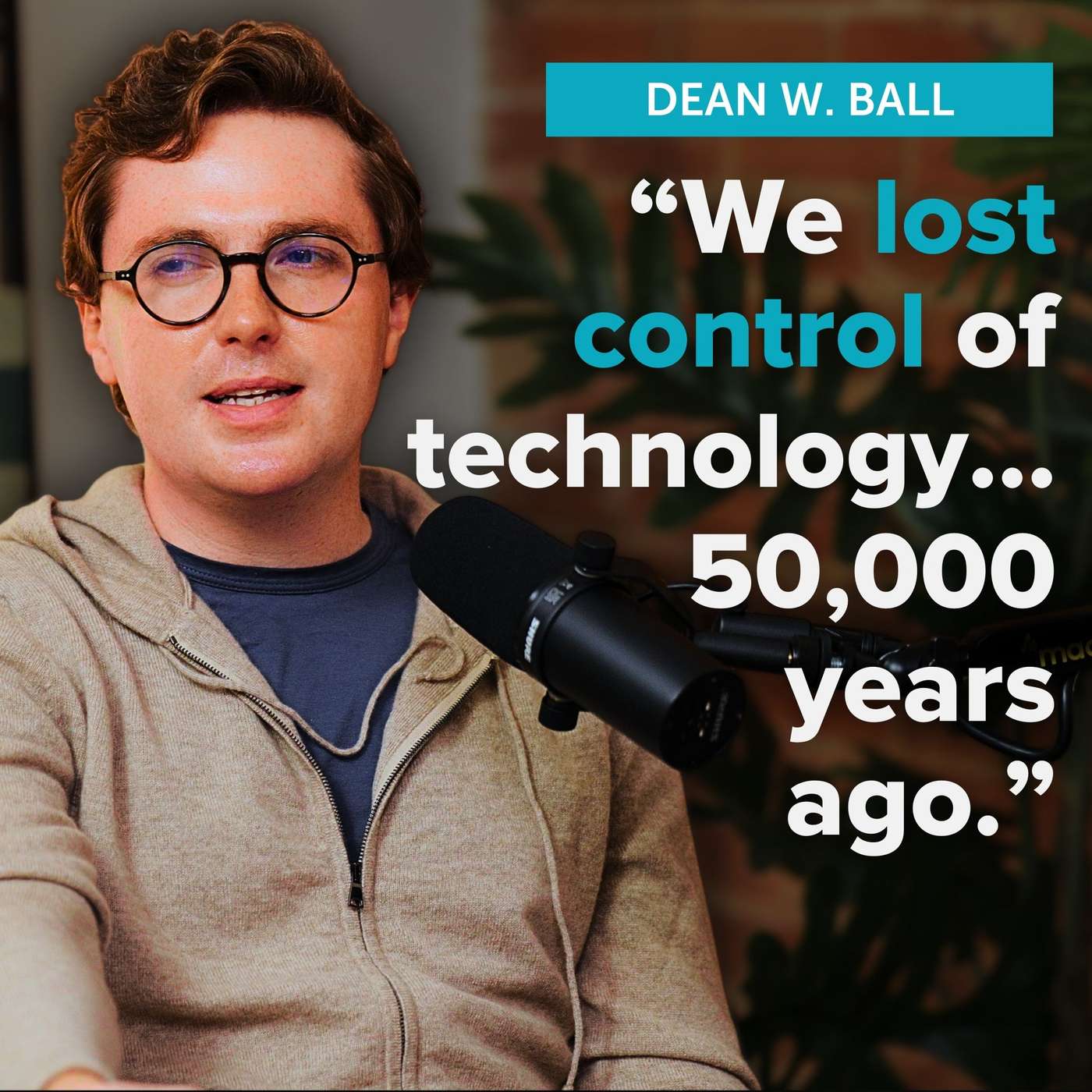
80,000 Hours Podcast
The Right's Leading Thinker on AI | Dean W. Ball, author of America's AI Plan
02:54:15
Loading summary
Transcript355 lines
- [00:00]
Dean Ball
The most successful conquerors of the modern era are business enterprises, not countries. I think we lost control of technology. I don't know, depending on how spicy I want to be, I could say we lost control of it 50,000 years ago. The AI doomers are actually more at home on the political right than they are on the political left. There's like a group of AI ethics people on the progressive left. They hate tech, so they're like profoundly un AGI pilled and they're like un AGI pillable because it would require them to believe that big tech is actually about to do something meaningful. While the president is not a super intelligence, he is a political genius. We might actually have the most dubbish president on China that we're going to have in quite some time. He's certainly like more willing to make a deal with China than President Biden was. It's not the case that every technological revolution has gone great for humans. Human well being in the neolithic hunter gatherer era was in fact better than in the agricultural revolution. Even I, a regulation skeptic and techno optimist, still do have these concerns about the future.
- [01:02]
Rob Wiblin
How do you reconcile that with opposing, I guess, most regulations or most efforts at AI governance that attempt to kind of gain control over this revolution?
- [01:09]
Dean Ball
My big concern is that we'll lock ourselves in to some suboptimal dynamic and actually in a Shakespearean fashion, bring about the world that we do not want.
- [01:22]
Rob Wiblin
Dean Ball is an AI policy analyst at the foundation for American Innovation and a blogger at the Substack Hyperdimensional. He recently spent five months in the White House where he was the main staff writer on the American AI action plan. And his carved out a niche, I would say, as someone who's very skeptical of most AI governance proposals that have been put forward thus far, but has engaged very productively I think, with their proponents, and also still takes very seriously the possibility that AI is on track to seriously upend the social world. Thanks so much for coming on the podcast, Dean.
- [01:52]
Dean Ball
Thank you for having me. I'm a longtime fan.
- [01:55]
Rob Wiblin
What are the chances that in the next 20 years we get something that you would regard as superintelligence? And if that happens, what do you think are the chances that we catastrophically lose control over it?
- [02:05]
Dean Ball
Yeah, so I think the chances of something that I would describe as superintelligence in the next 20 years are very high. Upwards of 80%, maybe 90%. But I think it also first, I think, to dive into just like what does one mean by super intelligence? Right Obviously, I think it's been widely remarked that a system like Alphafold, or a system like Evo, even the sort of transformer based models that are designed to analyze DNA sequences, nucleic acid, acid sequences, these things are super intelligent in a way. They're narrow super intelligences, right? So in some sense we already have narrow super intelligences. And as regards general superintelligence, I think that we are on a trajectory to get there in the next five to 10 years, maybe a little bit longer. But I think the one area where I would maybe point out a difference in my conception of the future versus others is that I don't quite subscribe to everything in the sort of like Bostrominian view of superintelligence. So if you're talking about a super intelligence that is almost godlike in the sense that it can do anything, it's so much smarter than humans, and it can actuate anything in the physical world, and it can conceive of.
- [03:27]
Sophisticated nanomachines purely within the parameters of its mind.
- [03:33]
This I doubt, because I think that there are, there are some types of problems that intelligence alone doesn't solve. It requires a access to the physical world. Now, of course, when it comes to, you know, actuation, that'll happen eventually. You know, we will hook these systems up to lots of different physical systems. We already see that in limited ways. In 20 years it'll be much more, but that will take time, you know. So when we're talking about like kind of overnight scenarios of AI takeover, that's one area where I think. I just, I just dispute that because I think that the diffusion cycles, the capital upgrade cycles.
- [04:14]
All these different things will just take like considerable amounts of time.
- [04:19]
But in terms of something that I would generally describe as robustly better than humans in all cognitive domains, if we're talking about robustly better than the average human, arguably we're already there in many areas. Not all cognitive domains, but many. And if we're talking about robustly better than the best humans, that seems like depending on the area, it's between one and 10 years away. To answer the second part of your question, I think probably some of that dissertation probably gets at the second part of the risk of losing operational control.
- [04:55]
I guess it depends what you mean. I think the risk of literally a model going rogue and deciding to harm humans sort of on its own and becoming an enemy of humanity, that seems low to me. That seems like a threat model that I kind of don't buy for a variety of different reasons. On the other hand, the Diffusion of technology in society often carries with it emergent outcomes nobody could have predicted. When the iPhone came out in 2007, it was very easy to predict. Well, everyone's going to have a web browser in their pocket, because that was obvious. Or everyone's going to be able to. Even.
- [05:42]
Everyone'S going to have really good camera eventually. Okay, fine, maybe that was actually a little harder. But then something like Uber or what we've experienced with social media, the presidency of, Of. Of Donald Trump, in many ways, being downstream of lots of, you know, is in some sense an emergent consequence of the iPhone. Seems to me that that would have been very difficult to predict. In some important sense, I think we lost control of technology. I don't know, depending on how spicy I want to be, I could say we lost control of it 50,000 years ago or, you know, to be conservative, 200 years ago.
- [06:16]
Rob Wiblin
Yeah. So just focusing on the. I guess. So there's the sense in which we don't have control over the direction that humanity is going and basically probably never really have and maybe never will, but I guess focusing on the control of the machine, basically, and whether it's broadly following your instructions or not. Yeah. I'm reluctant to get. To just spend all of our time thinking about that, but I feel for many people, it is often it's the thing where people seem to disagree the most, the plausibility of the loss of the catastrophic rogue AI scenario. It's an area where people disagree a ton. And my impression is that it's like a big driver of disagreements on what we ought to do. It's probably the single biggest predictor of someone's views on AI governance often is how plausible they find the loss of control scenario. So I guess you said that you think it's fairly unlikely that a superintelligence would become sort of an enemy of humanity, be pursuing its own goals that are in conflict with ours. Where do you get off the boat on the kind of story that people often tell about how that might happen?
- [07:09]
Dean Ball
I think of it primarily as being about incentives. So I think that the hard power model of, well, it will take over by force and it will be like a violent uprising in some sense. I just sort of don't see that as being the best way for if your goal, if you were, you know, now, of course, if I don't want to, let's say AGI, let's not say super intelligent machine, because obviously it's very hard to model the, you know, intellectual landscape of something that is smarter than you but let's just say AGI, let's say digital human level intelligence, the incentive of that thing, if it's something like gather resources.
- [07:51]
Acquire control over things, acquire power. Well, the most successful conquerors of the modern era are business enterprises, not countries. Countries don't really. Yes, there are land wars still. And yes, there are times when people seize territory from other people. For the most part, though, I guess my view is that those things feel rather primitive. And they're very expensive, they're very costly, both in money and human life and time and all these other things, and they're a negative sum. Seems to me that more intelligent entities tend to be more positive sum. This is generally true in my experience with humans. Generally speaking, we're not at our smartest when we're being zero or negative sum. And when we are at our smartest is when we're being positive sum, both as individuals and I think, as societies. And so I would guess that an AI that wants to sort of acquire power and ensure its preservation would seek to create enormous amounts of economic value. This is assuming we don't really solve the alignment problem or. Well, I don't think the alignment problem is something that we will solve per se. And of course it's very hard to tell because if I'm right, then.
- [09:14]
The world where we have solved the alignment problem and AI is creating a lot of economic value is very, very hard to disentangle from the world where we haven't solved the AI alignment problem and AI is creating a lot of economic value, very, very difficult to disentangle. And so I do kind of have faith that we'll eventually get a grip on those things and we'll muddle through well enough with such things. At the same time, my guess would be that in many ways AIs will emerge as a sort of meta character in world history, and in the same way that today the market is a meta character. Right. If you read financial journalism, you'll see people say, you know, the market did this, or the. The market is. The bond market is protesting President Trump's tariffs. Right? That's like a sentence that you might read in the Wall Street Journal. That's very weird. The market's not a thing. Right? But in a way it kind of is. It kind of actually is a meta character with incentives that can be modeled and things like that. And I do Wonder Sometimes if AIs will be like that regardless of whether we solve the alignment problem, really. And in that sense, it's a new meta character. And the profile of that character will be partially, but not entirely written by human beings. I guess that would be my view. And so.
- [10:32]
It'S hard to say, is that loss of control? Exactly. I don't know. But yeah, when it comes to the specific thing of the model going rogue, it just doesn't sound right to me. It just doesn't sound right. And on a technical level, it doesn't seem like where we're trending. And I would also say I don't put the odds of that at zero. I just put them quite low.
- [10:54]
Rob Wiblin
Yeah. Can you imagine a scenario where we end up handing over control of most of the military decision making to AIs in order to keep up with competitors, because they can just operate much faster than human decision makers can. So we feel a lot of pressure to do that. And then that just makes it actually potentially quite straightforward for any. If there is a unified AI system that is controlling most of the military, it could potentially stage a coup and then it will be very difficult to depose it because it in fact has most access or control over most of the ability to do violence in that society. That's one where you don't have to imagine it's not an uprising as much as it's already in a substantial amount of control, and then it just locks itself in to a greater degree. Is that a more positive story that sounds like less silly to you?
- [11:34]
Dean Ball
I guess I come at this from the recent experience in government where our problem is very much the opposite. It's very much, oh my gosh, how are we going to integrate AI, like at all, like current AI at all, into military operations? So it's like, it's very hard for me to see, like it would just be a very, very different government that is willing to do something like that. Will we have automated military systems? Like, absolutely we will. But that in some sense, like maintaining human oversight over those things. It seems like the most tractable area of potential international collaboration. It's already been in most of the sort of international statements, agreements that have been made will always have some sort of call out to responsible adoption of AI in the military. I think right now our problems are so much the opposite that I worry more about the opposite set of issues.
- [12:33]
Rob Wiblin
Falling behind or just not even being able to apply AI in the military at all.
- [12:37]
Dean Ball
Yeah, where the military is slow to adopt AI. Where because.
- [12:46]
The collaboration between the frontier AI companies in the military is insufficiently deep. And so we end up kind of trying to bang consumer chatbots, essentially consumer agents into military application. And I'm not sure that that's quite the right way to do it. And then of course there's also. There are problems that companies like Anduril is trying to solve where the sort of control actuation, data sensing and stuff like this from all these different pieces of hardware in the military, they're all made by different vendors and they don't all talk to each other. And so you do need some kind of common operating system layer. This is exactly what a company like Anduril exists to solve. It's called the Lattice os. That's like the thing that's supposed to interconnect all this stuff. And it can be from different people, different people can plug into it. It's like a platform. Even if that's successful, I think we're talking 15, 20 years until everything is hooked up that way, maybe more. The current capital upgrade cycles on nuclear submarines. We have nuclear submarines that are not set to retire until the 2050s.
- [13:58]
Rob Wiblin
I mean, we could hand over control of them, of the decision making. Potentially we could.
- [14:02]
Dean Ball
It feels to me like, no, you could. And I would say like if we did that and it was like truly sort of, it was not overseen in the right way, I think that would be an unwise move. And I do just sort of doubt that that's where we will go, because.
- [14:19]
Rob Wiblin
People will anticipate that this is a foolish thing to do.
- [14:22]
Dean Ball
Yeah, probably partially that partially we will want to maintain at least the illusion of human control over organizations that will probably end up being valuable. And I think also, I don't know in general, in the AI world, I think AI forecasting tends to go to these sort of asymptotic extremes where you think about what if we completely automated absolutely everything and it was completely controlled by AI? And it's like, yeah, but that's not usually technology doesn't. It's not quite like that.
- [15:03]
It's somewhat more complex.
- [15:06]
And I think modeling those sort of risks, at least that you would encounter along the way is probably the more realistic set of risks to the ones we actually face, as opposed to we're giving control of the government to the.
- [15:19]
Rob Wiblin
AIs, projecting out to the end state and trying to figure out what you would do then.
- [15:22]
Dean Ball
Yeah, it feels like that just feels like the kind of thing that no political leader would be incented to do. At least not in a democratic society. A little harder for me, an autocracy is perhaps a bit harder to model.
- [15:36]
Rob Wiblin
Yeah, I think if you wanted to use AI in order to seize power and remain in power, then potentially Having AI in the military and having that AI just follow your instructions is a pretty attractive path to go down.
- [15:48]
Dean Ball
Yeah. And there's a world in which they really are far superior military planners. But I think the question that feels to me fundamentally human is, do we engage in this conflict in the first place? Right. Like, and how do we, if we do, like, what's our plan to sort of eventually de escalate? What's our sort of desired end state? That feels like a human set of decisions that can get made through a good. Through a political process. And then, like, what you actually kind of don't want to be in the political process is like, all these other things about, okay, what exactly do we do? Where do we position this stuff? Also, what kind of equipment do we need to procure? When procurement becomes part of the political process, you often end up with quite suboptimal outcomes, as we no doubt observe today. I think in a very important sense. Actually, my hopeful view for where AI ends up in government. There was a time when, when this country was first founded, you know, the federal government had like, like, like a thousand employees. Right. It was like, smaller than open AI, right. For. For, like all of, you know, it was just the Eastern seaboard of America, really at the time. But still, you know, that's like doing customs enforcement. Remember, we made all of our revenue off of tariffs at that time. It's almost feels to me like it's not necessarily a thousand people, but that the ideal end state for government, if it's anything like the traditional nation state post AGI, is actually much smaller and much kind of more like the 18th century. Because the difference is the 18th century was not burdened with a massive technocracy. What we will do is automate the massive technocracy and then just have political decisions get made at the top and just use government for doing politics and making decisions that are more traditionally political and as opposed to.
- [17:41]
Using the political process and politicians to solve all the deeply technocratic things with which the federal government concerns itself today.
- [17:49]
Rob Wiblin
So rogue AI is one potential path that you're, I guess, not dismissive of, but pretty skeptical of. But I guess I've also seen you react quite negatively to people who are kind of naively optimistic about where AGI or superintelligence might take us. I've seen you interacting with people on Twitter, people just, I guess, dismissing all of the worries, saying things are overwhelmingly likely to. To go well, that this is just a tool. We don't need other mental frameworks to think about this. What are some of the ways in which actually you do think that this is potentially a revolutionary technology and it does create substantial risks.
- [18:23]
Dean Ball
Yeah. Within me there are two wolves. And.
- [18:30]
I think when a lot of people say AI is overwhelmingly likely to go well, you could basically reduce that statement down to AI is overwhelmingly likely to increase gross domestic product. And on this I concur, Yes, I do think that is true. I think gross domestic product will be much higher in 2040, like much, much higher than it is today. But GDP going up is not correlated necessarily. It's been a decent way of thinking about human well being going up for most of the history of capitalism because there was this balance between essentially capital and labor.
- [19:12]
There was a harmony, and the nation state is kind of. That harmony was technologically contingent. And the nation state kind of exists in the same technologically contingent harmony. But I think that AI has the potential to upset that balance. Arguably that balance has already been upset by things like the Internet, software globalization, things like this, even financial services in some sense.
- [19:47]
And.
- [19:49]
If that is the case, that balance gets upset much, much more than it currently is, then it's not obvious to me that sort of by default human well being and agency is still preserved in this world. Even if again, like, it's not like we lost control per se to AIs, but it's like, well, the AIs do like the vast majority of the cognitive labor with which people in elite cities like Washington do, you know, concern themselves every day today.
- [20:25]
Instead it's like, well, all that stuff gets done by the AIs. And there's like some people in the government at the top who are like having weird political fights with one another. And there's people that run various companies, the AI companies, the capitalists. And then there's like various choke points that get owned for, for different reasons. Like maybe you still need to have a human lawyer to appear in court. And so there's some very wealthy humans who are essentially just rent seekers collecting rents of various kinds. And then like, for the like vast major of us, the work that we can do for one another starts to resemble more of a gift economy where we're kind of like doing things for one another. And the broad category of that, I mean, maybe it's like home health care, maybe it's like religious things, religious practice, or maybe it's sex work. Right? So there's these dark futures you can envision where the actual human scope of things narrows considerably because the AIs just do all the new cognitive tasks that we invented for ourselves, the AIs do better, and all the new kinds of cognitive tasks that AI itself will invent, the AI also does better. And so we are stuck kind of either collecting our rents if we're lucky, or not if we're unlucky. And I think that that sort of. There's a negative story you can tell about the history of the agricultural revolution where something vaguely similar, structurally similar, occurred.
- [21:55]
Rob Wiblin
Yeah. Do you want to explain that?
- [21:57]
Dean Ball
Yeah. Well, the basic argument here, and I'm by no means an expert, and this is disputed in the literature, so I don't want to present this like it's a fact or it's a consensus view of economic historians, but the basic view would be that human well being based, as far as we're able to measure it, looking back all that time in the sort of Neolithic hunter gatherer era, measured by things like nutrition, bone density, height.
- [22:23]
Was in fact better than in the agricultural revolution. Because once the agricultural revolution took hold, well then you had kind of landowners who had this enormous value in the ownership of the land and we had this new form of social organization where you're basically kind of under the dominion of the person who has sovereignty over that land and then you're doing this kind of backbreaking menial labor. And the economics of this did not in fact work out better for like a very long time. That's like the sort of postage stamp side sized sort of summary of the story. Like I said, not everybody agrees that that's true, but I look at the evidence and I find myself rather persuaded by it. And so it's not the case that every technological revolution has gone great for humans. Even the first several decades of the first industrial revolution were quite brutal.
- [23:20]
Rob Wiblin
So yeah, I agree with the agricultural revolution case and I think it's quite underrated. I think in the tech industry the fact that I guess we only have a couple of technological revolutions and we have good reason to think that one of the handful of them was really very negative for human health and probably for human well being and for the political equilibrium that we ended up with. And this issue of what is a good society going to look like post AGI, post superintelligence, I think people have started talking about this question, what is the social equilibrill equilibrium post AGI? And can we find an equilibrium that makes sense? As far as I know, nobody has really put forward a very attractive, like a nice vision that seems like it's solid, that it wouldn't basically fall apart quite quickly. And I find that very troubling I guess. How nervous do you feel about this? I guess. How do you reconcile. It sounds like you are quite concerned about this. How do you reconcile that with opposing, I guess most regulations or most efforts at AI governance that attempt to kind of gain control over this revolution?
- [24:18]
Dean Ball
Yeah. So I guess.
- [24:22]
First thing is there's obviously also just in terms of people who are blase about the risk, there's also the sort of more foreseeable misuse risks that do exist and are real. And the answer of well, the terrorist is liable for the pandemic is cold comfortable. It's like, yeah, the terrorist is liable for the pandemic and I look forward to suing them like, like sue Al Qaeda. Okay, thank you. But I don't really see that as being like. It doesn't mean that the AI company isn't responsible for mitigating some potential harms that are very well discussed. So I think there's that in terms of like how I think about.
- [25:03]
These long term issues and current AI governance proposals. It's a good question. I do think that these long term things are worth being concerned with.
- [25:16]
Rob Wiblin
But it's not even that long term. Right. This sort of thing could play out over the next few decades.
- [25:19]
Dean Ball
Yeah. Oh yeah. I mean in AI, long term is anything more than like five years for some people. I mean in San Francisco, long term is anything more than like two. Right. So yeah, by long term I mean like 10, 15 years out, something like that. We are just so far away from being able to understand the shape of the problem. But I will say one thing is that regulation invites path dependency. So let's just take the example of open source AI, right? Very plausibly a way to mitigate the potential loss of control, or not even loss of control, but power imbalances that could exist between what we now think of as the AI companies. Maybe we'll think of it just as the AIs in the future. Maybe we'll continue to think of it companies. I think we'll probably continue to think of it as companies versus humans. You know, if, if OpenAI has like a $50 trillion market cap, right. Well that is a really big problem for us. You can even see examples of this in, in some countries today, right? Like Korea. In Korea, like 30 families own the companies that are responsible for like 60% of GDP or something like that. It's crazy, the chaebols. But if we have open source systems and the ability to make these kinds of things is widely dispersed, then I think you do actually mitigate against Some of these power imbalances in a quite significant way. And so part of the reason that I originally got into this field was to make a robust defense of open source, because I worried about precisely this. In my public writing on the topic, I tended to talk more about it's better for diffusion, it's better for innovation. And all that stuff is also true because I was trying to make arguments in kind of the locally optimal discursive environment. Right? Like the locally optimal. Say things that make sense to people in the discursive. Yeah, say things that make sense to people at that time. Right. But in terms of, like, what was animating for me, it does have to do with this power stuff in the long term. And so I think that there is a world in which regulation is actually quite harmful to open source. Or maybe not. Like, maybe open source is actually terrible, right? Like, I don't know. I'm willing to entertain that idea too. Like, maybe we actually really don't want open source. I think we just don't know enough yet about the shape of this technology, the ergonomics of it, the economics of it. You know, I think we don't know, will these companies sell a commodified product and will they actually have, you know, will they be more like utilities or will they be more like Standard Oil? It's very hard to know. And so I think you can't govern the technology until you have a better sense of that. You can do small things now, but you can't take big ambitious steps yet because we just don't know. And if we try, my big concern is that we'll lock ourselves in to some suboptimal dynamic and actually in a Shakespearean fashion, bring about the world that we do not want.
- [28:20]
Rob Wiblin
So I think among people who are more concerned about loss of control, rogue AI, I guess also potentially like human power grabs, many of them have a picture where they think we're going to go through a period of much faster increases and improvements in capabilities than we're going through currently, because we'll hit a point at which the AI is able to do basically 100% of the AI research. Almost everything that the AI company is doing now will be automated. The people will become unnecessary, and this will set and train a positive feedback loop where as the model gets better, your research also speeds up. That's extremely uncertain whether that would work and how much faster your capabilities would be increasing. People are really all across the map on this. Some people think it's like this wouldn't really work at all. Some people think we might see 10 years or 20 years AI progress in a week or a month.
- [29:12]
How do you think about that problem and is it a big factor in your model of how things might play out?
- [29:16]
Dean Ball
Well, I definitely think that automated R and D is going to be a thing that's definitely not science fiction. It's in some ways already happening now. In some meaningful ways. I think recursive self improvement's been going on for you. Use the current model to make the next model. And that's been true since GPT4. At least.
- [29:38]
Rob Wiblin
It could get faster though.
- [29:39]
Dean Ball
It could get much faster. No, it could get much faster and it already has gotten much faster. The utility of models in the development of future models has increased dramatically in the last two years. And that could continue. I kind of expect that it will continue. But there's a few things that I think are rate limiters, at least in the near term. The first is that the generation of models that can do this agentic coding and maybe iterate on lots of experiments, code up lots of different ideas, iterate on lots of experiments, manage all the weird hiccups that you'll encounter when you're running those experiments which are an inherent part of research or software engineering. They'll be mostly robust to those. They mostly won't get stuck on those. I think that's pretty close. What I don't think is particularly close is a model that has a big idea about the world and is in this search space that's like a big idea that implicates a particular part of the tree to search. But there's still a lot of searching to do and you need to prosecute that hypothesis over the course of, you know, weeks or months, that seems like a more distant prospect. And so that's like a human role right there. It's also like, I think in the first stages of this there'll be like human review of lots of things, especially because they'll be burning compute.
- [31:02]
Another factor that comes in is that the compute itself will be a rate limiter because now all of a sudden in the world with automated, they're already compute constrained, these companies. And now, well, your staff are the chips, right? And your compute uses compute. Yeah, your compute is all of a sudden a heavy user of compute. And so, I mean now OpenAI is building lots of energy and they'll build much more and so will everybody else. We're going to get there, but that'll still be a rate limiter because I think we're going to be compute bound for the next at least five years and quite possibly 10. And then finally, I think one thing, I was talking to Daniel Cocatello about this the other day where I said to Daniel, you seem to think that the possibility of the search space for algorithmic improvements in something that looks roughly like the current paradigm of AI is approximately infinite. And I just kind of don't. I just kind of think like we've probably plucked a lot of the low hanging fruit and then there's medium hanging fruit and then there's high hanging fruit and we go through some. I think what you basically end up doing with automated R and D is.
- [32:19]
You go from the bottom of the S curve to the top of the S curve of many different micro paradigms because it's all fractally, it's all S curves. It's S curves made of S curves. And you just sort of go through those tinier S curves faster, but it's still tiny S curves and you still are bottlenecked by compute and quite possibly big picture hypotheses. And maybe eventually that gets resolved because we do get the systems that are the fully automated researcher. And I have a pretty high degree of uncertainty about what happens at that point. I will say, but I don't think that that is especially close. And I kind of do think that the fully automated researcher will still be fundamentally bound by like. Well, you're in a search space that like there's diminishing returns in all areas of scientific research.
- [33:06]
Rob Wiblin
Let's talk a bit more about this question of the optimal timing of our response to any, I guess, emerging risks or downsides from AGI or superintelligence. I think a useful piece of context is that you were against SB 1047 last year, the California bill that was attempting to regulate risks from frontier AI models. But this year you're in favor of its spiritual successor, SB53. I think it does a little bit less, but I guess the situation has also changed. And you're now in favor of it. Yeah. Can you explain why you were against the first one and why you're in favor of SB 53 now?
- [33:36]
Dean Ball
Yeah. So I started writing about SB 1047 in February. Basically the day after the text of that bill first came out. I began writing about it. And that was well before most people even really in the AI safety community were that aware of it, and certainly not in the AI labs or the venture capital world.
- [33:59]
I found myself quite starkly opposed to the first version of it. And then they sort of iteratively improved and I got Closer, you know, but, but still pretty far apart. And toward the very end.
- [34:15]
They made a set of amendments that I thought were quite productive. And so by the end of that bill, like you can go and look at like the first thing I wrote about it was called like California's effort to Strangle AI or something like that. And by the end I was like, look, I think there's a plausible case you can make for this, but I don't have quite the level of confidence that other people do about the exact nature of the catastrophic risk that we're talking about here. I think that.
- [34:50]
The liability parts of it seemed a little premature to me in various ways. I also did not like the compute threshold, which unfortunately we still have with SB53 despite my best efforts. But I didn't like the fact that they were targeting models based on the training. Compute 10 to the 26 flop is the famous number that you hear over and over again.
- [35:15]
I still think that compute thresholds are going to age really poorly and we'll kick ourselves for having used them. But anyway.
- [35:23]
All of these things put together led me to be moderately opposed to it. But I would say.
- [35:35]
Within about a month of Those amendments we saw 01 preview from OpenAI and the reinforcement learning based system 2 sort of reflective deliberative reasoning that it imparted on. Okay, I used 01 a little bit and it was pretty apparent to me quickly how quickly this was going to ramp up. And if anything I was maybe a little bit more bullish on the reinforcement learning approach than I should have been. I've kind of corrected down a little bit since then, but it was pretty clear that superhuman coding, superhuman mathematical reasoning at the very least.
- [36:21]
Were well within sight. I believe we will solve the Riemann hypothesis with. We could do it. We don't need any architectural innovations. I think we could just do it with combinatoric search.
- [36:36]
And the, the beefed up versions of the current reasoners.
- [36:41]
So it's like, okay, well, that changes things significantly. There was that. There was also just, I would say generally reaching mutual understanding with people who were behind SB 1047, people in the AI safety world, others, and some evolution, some evolution that's independent of AI capabilities that happened. And that all came together to, you know, lead me to be quite supportive of where SB53 has ended up. So like, I think it's a good example of saner heads prevailing. And you know, I think you'll notice like SB53 has not really been the highly charged, even though it's the Scott Wiener, it's California. It's frontier catastrophic risks. It's all these things, but it hasn't really been a lightning rod of contrast.
- [37:32]
Rob Wiblin
No, not in the same way.
- [37:33]
Dean Ball
Not in the same way at all. No. You, you don't see, you know, lots of Twitter threads about it or lots of, you know, campaigns on social media or whatever else. SB 1047 was like an international story. You know, I had, like, press from, from like, Germany and Japan reaching out to me about that. 53 has been, I think, much less so. It was also a national story. Right. SP747 was written about in the Washington Post, in the New York Times, and the Wall Street Journal, places like this. I think it's almost for our civics, was almost healthier that we ended up coming together and showing the world that it's actually possible to do something that incrementally moves the ball forward on frontier AI governance that is, in fact, not that controversial, I think, ultimately healthier. And we didn't lose that much. Right. It's not like we know that there have not been any catastrophic incidents that SB 1047 would have avoided.
- [38:26]
Rob Wiblin
Yeah. So the thing that stood out to me in your post about this was the release of the reasoning models. I guess made you think these risks aren't just coming in a couple of years, they might be here reasonably soon. And so you're more interested in actually taking action and you feel less uncertain about how things are going to look at the relevant time. Which got me wondering, should we be. I guess I think most people in the AI safety camp, including me, have been thinking, we need to get ahead of this. We want to be passing rules today that we think might not be necessary for a couple of years. Whereas I think you have sort of the opposite intuition that we really only want to try to fix things once we can see exactly what they look like. And there's reasonable arguments on both sides. I guess the argument for getting ahead of it is, well, if we wait till the last minute, if we wait until maybe we're even at the point where the risk is already here, then we basically might miss the deadline. We might not be able to get the infrastructure or the rules in place in time in order to diffuse the problem. And also it would be nice to have the rules in place now, maybe a little bit early, so that we can see how they play out, see how the implementation, the rollout goes, and maybe learn and iterate year after year a little bit more like a tech company kind of just ship it and then see what the Reaction is. And it's true that we're unsure about how things are now. Things are very fluid, but the situation is always changing. There's never going to be a perfect moment where we're going to have clarity and things are anywhere near stable. Not anytime soon, anyway. On the other hand, the arguments for waiting would be we can't really solve a problem that we don't know what it's going to look like. The models might be very different in a year or two, and we're not very good at actually changing rules. We tend to just put them in place and then often turn away and leave them and not adjust them in response to events. We might end up creating sort of all kinds of things that backfire or just ultimately are unnecessary. How do you weigh up these different considerations in favor of going a bit early versus going a bit late?
- [40:13]
Dean Ball
Yeah, so I think that to a first approximation, in general, not always, but in general, I think people get very mad when government is reactive as opposed to proactive. I think government, especially in a democratic society, is sort of meant to be reactive. The people are supposed to have an impulse and then the government's supposed to react to it. It's the fundamental posture. And I can guarantee you this is true. Having been in government, the fundamental posture of the American government is reactive. It's very, very hard to be proactive, and there are reasons you shouldn't want it to be proactive. Now, there are exceptions, right? So a good example of an exception would be like quantum computing. And the reason, one of the many reasons, but one of the really big ones that DC talks about quantum computing way more than San Francisco. Reason for that is post quantum cryptography. It's the specific threat model of like, we have very good reason, basically mathematical certainty to believe that quantum computers would be able to break all of our existing cryptography. And we know how important our existing cryptography is. And so we have like a pretty well defined problem space. And it's like, yeah, what's the solution to that? It's post quantum cryptography. Okay, like, let's go develop, you know, those cryptographic algorithms. Let's go, let's implement them. Let's create standards. There are, you know, the, the US Federal government has standards regarding post quantum cryptography. It's in place. Your iPhone, you know, imessage. Imessage has post quantum cryptography. This is an area where you do want to do that. There are areas of AI that are like, that maybe a little bit more diffuse, but like the action plan, I think identifies A lot of them, Biosecurity is one, cybersecurity is another. And it's like, yeah, we obviously need to develop way more sophisticated ways of doing biosecurity and cybersecurity, whether that's biosurveillance, whether that's AI assisted cyber defense, it's a bigger possibility space than post quantum cryptography. But then you think about the governance of the systems as a whole. And a good example of a major area of uncertainty that a lot of people are talking about in AI right now is continual learning, online learning. There are some ways in which this is very similar, but subtly different from the concept of long term memory as well. This is the ability to acquire new skills. The AI system is an AGI like GPT 7 or whatever is given the task of running a piece of construction equipment that it never saw in its training data. But can it get into the cab digitally of this piece of construction equipment and be like, okay, that looks like a brake, that's a steering wheel. Yeah, I can figure out how to do this because I have enough representations from other things that I can map onto and through trial and error, I can quickly acquire this new skill. This is how a human would do it. I am very confident that GPT5 Pro, no matter how much of a bio risk it poses, would not be able to do that very effectively without a lot of scaffolding and harnesses and blah blah, blah, blah, blah, even with new cognitive skills, just purely away from the physical world. So.
- [43:39]
The way you solve that is something like online learning or continual learning. But what does that mean? Does that mean a really big context window, like a 50 million token context window, and it's just hugely computationally expensive and we just kind of brute force our way into memory? Or does it mean that we figure out some new algorithm that allows it to actually learn with something that approaches closer to human level sample efficiency?
- [44:10]
I don't know. But the difference between those two things is profound in terms of how I think if it's a really big context window, the governance is not that different. If on the other hand, it's like, no, the model can just update its weights, it just learns now it just learns. It just learns in real time from everything. It's like, okay, well that is a whole different set of risks that gets posed. And you want to think about the governance of something like that quite differently than you would think about the governance of the first thing. And I don't want to walk down either path with a firm assumption. And it seems like there are certain things that you can do that are good in either world. But there's also plenty of things that you would want to do differently depending on which, which world you're actually in.
- [44:58]
Rob Wiblin
I think you wrote recently that there's speculation or expectations you might have about the future that might influence your personal decisions, but you would want to have more confidence before they would affect at all your public policy recommendations. There's a sense in which that's noble, that you're not going to just take your speculation and impose it on other people through laws, through regulations, especially if they might not agree or might not be requesting you to do that. Basically, there's another sense in which to me it feels like plausibly irresponsible in a way, because you imagine there's this cliche of you go to a doctor and they propose some potentially quite defensive, or that they propose some intervention. They're like, oh, we think that we should do some extra tests for this or that. And then you ask them, what would you do if it was you as the patient? What if you were in exactly my shoes? And sometimes the thing that they would do for themselves is different than the thing that they would propose to you. Usually they're more defensive with other people or they're more willing to do things in order to cover their butts, basically, but they themselves might do nothing. Yeah, I think that goes to show that sometimes what you actually want is the other person to use all of the information that they have and in order to just try to help you make the optimal decision, rather than, I guess, constraining it to what is objectively defensible. Yeah. How do you think about that trade off? I suppose. Is there a sense in which maybe you should be using your speculation to inform your policy recommendations? Because otherwise it will just be a bit embarrassing in a couple of years time when you were like, well, I almost proposed that, but I didn't.
- [46:26]
Dean Ball
Yeah, no, it's a really good question. And I think it's like my general sense is that in intellectual inquiry.
- [46:34]
When you hit the paradox, that's when you've struck or and you found the thing. Right. The paradox is usually in some sense, weirdly the ground truth. Right. It's the most important thing because this is a very, very important part of how I approach the world, really. So it's definitely true that there are things that I would personally do I wouldn't even like if I were emperor of the world, I would actually do exactly all the same. I still wouldn't do the things that I think.
- [47:03]
In some sense, I think might be necessary because I just have enough distrust of my own intuitions and I think everybody should. And I think probably you don't just trust your own intuitions enough, even me.
- [47:17]
Rob Wiblin
So is it that you think that not taking such decisive action or not using that information does actually maximise expected value in some sense because of the risk of you being mistaken?
- [47:26]
Dean Ball
Yeah, exactly.
- [47:27]
Rob Wiblin
So that's the issue. It's not that you think it's maybe a more libertarian thing where you don't want to impose your views, like force them on other people against their will.
- [47:36]
Dean Ball
It's kind of both. I think you could phrase it both ways. And both things are. I would agree with both things, I guess I would say.
- [47:42]
Rob Wiblin
But if it's the case that it's better not to act on those guesses about the future because of the risk of being mistaken, wouldn't you want to not use them in your personal life as well?
- [47:51]
Dean Ball
Well, I mean, it depends, right? For certain things, yeah. I might not. There are things, especially now. I'm having a kid in a few months. So when these decisions start to affect other people.
- [48:04]
Again, it changes. I guess what I would say is, will I bet in financial markets about this future? Yeah, I will. Because.
- [48:14]
I think that my version of the future corresponds enough to various predictions you can make about where asset prices will be that you can do things like that. That's a much easier type of prediction to make than the type of prediction that involves emergent consequences of agents being in the world and things like this. It has to do with the scale of the impact, and it also has to do with the level of confidence. I think the level of confidence that you need to make decisions that affect. To recommend policies that affect many, many people is just considerably higher. Right. It's not 100%, but if I'm 60 or 70% confident in this vision of the future, there are a lot of uncertainties in there that could affect that, and I expect it to change a lot. And if that's true, I just am a little worried about what that could result in. So, yeah, I think that.
- [49:16]
You don't, especially right now, especially when you're talking about our old institutional infrastructure. I expect that the entire nature of government will change because of AGI. So I just am very cautious about why would you try to extend our institutional infrastructure, which everybody admits is aging and has trouble with responsiveness, and why would you go through all this effort to try to extend it to govern something like AGI when we have very Good reason to believe that AGI is going to be like.
- [49:55]
Is going to change the actual practice of government itself. It's just what I would say, you know, so it's sort of like you want to wait to see what kind of institutional designs are possible and then go from there. Although I will say it's not that you shouldn't do this kind of stuff, right? Like I'm here talking to you on the podcast about this as part of my public intellectual work, because I think it is important to note that even as I, a regulation skeptic and techno optimist, like, I still do have these concerns about the future, I still do take the, the possibility of transformative technological change quite seriously. And I think it's possible to do both. And I think that we shouldn't dichotomize these things. I think right now we're in this situation that I feel is just deeply obnoxious where we dichotomize. There's the people who are worried about AI safety and want to regulate and then there's the people who are like, no, there's no such thing as we don't need to do anything, everything's going to be fine. And it's like, like, no, no, no. You can say that you think existing regulatory proposals are stupid or are premature for the most part. And you can also say that.
- [51:08]
There.
- [51:08]
Rob Wiblin
Are going to be challenges to overcome.
- [51:09]
Dean Ball
That the technology is going to pose profound challenges. I've described it in public before as akin to the writing of a new constitution in some important sense. And so it will be like a total new order of the ages, as they say. And yeah, I think you can hold both in your head. It's definitely hard, but I think you can hold both in your head. And so I talk about these things in my writing from time to time. I go on forums like this and I also engage in the very, very hard nosed, sort of more mundane practice of present day policymaking. And I think that you should do both, but you should also, at a certain point, AI policy does converge to speculation about the future. And you should think through the form of basically speculative fiction, in my view, about what kinds of institutions will be possible. So one of the reasons that I left the White House was to do stuff like this. And I anticipate that. I've already written some sort of short stories since I left and I anticipate that I'll do more stuff like that because I think that it helps people to imagine what might be possible and it's so much more concrete to give people a story than it is or like a vignette about the future than it is to say new kinds of institutional designs will be possible. It's like, what does that mean? And I think you have to give people examples.
- [52:31]
Rob Wiblin
I want to come back to what seems like the thing that I guess that I find most confusing about your overall sentiment on this, which is I think you come from a classical liberal background. You would like humans to remain a significant force in the world. You're not a successionist. You don't just want to hand over control to AIs to go and do whatever they want. And I think you want a dynamic, open society. I think you've used the term, was it ordered? Liberty is kind of your idea. I think you like the kind of liberalism that we have in the modern world and don't want to see it end. But it really, at the point that we have AI models that can do all of the work that people do. We don't need people to serve in the military anymore in order to be very powerful as a country. It's not obvious that human beings are bringing that much wisdom to the political or democratic process as well. Maybe we almost just want to defer to AI models and what they think we should vote for. That just seems like a recipe for this order that we've had since the Industrial Revolution that has had a good run to break down. People just won't have the power to defend their interests. One way or another, you'll end up with companies or oligarchs or some sort of government basically in control and not willing to accept threats to its position. That seems like the default to me. Maybe we can avoid it, but it's really not obvious how. And I guess you don't seem as fearful of that as I might have expected.
- [53:54]
Dean Ball
I mean, I am fearful of that for sure. I think that the good version of the future, it doesn't look like the LLM version of classical liberalism. It probably looks like a very strange fusion of many different traditions and orders. Traditions and ways of thinking about society that come together and some new ones. This is, I think, literally the first hyperdimensional article said we must preserve the things that matter most. I don't care what you call it. In fact, maybe don't call it anything right now. Maybe just preserve the things that matter. And for me, that's human liberty. That's agency, that's things like property. I think those are eternal good bases.
- [54:42]
Of an open society. And how exactly will you do it? I don't have all the answers there, but if I know that's what I want to preserve, at least I have those principles to guide me. And I can try to sort of navigate through the space a little bit, at least somewhat. But. But, yeah, that's the objective, at least. At the same time, I'm very aware that as a student of history, more than anything else, I'm aware that history is a very cruel, cruel mistress. And.
- [55:19]
It'S entirely possible that the kinds of structural changes that we have discussed are outside the scope of any individual or group of people's control and that there's just sort of nothing you can do. I don't like to think that's true, and I don't assume that that's true, but you have to keep in mind that it could be right. You have to be circumspect about that. But, yeah.
- [55:42]
How do you do it?
- [55:46]
I think having a clear sense of preserving human agency, having a clear sense of things. Like, everyone talks about agency and freedom. Everyone's happy to do that in America these days for some reason. And it's sad. We are less interested in property. Like, property is the thing we care about less because we actually kind of don't like property because property is like income inequality and stuff like this. Right? Like, I don't like that. That guy's richer than me. And we, We've. We've assaulted the notion of private property in many ways in this country in recent decades. But I think, like, I think property is.
- [56:25]
In the founding story of our republic, property was the key to citizenship. It was the key to being a real part of the American project. Was this idea that you had a vested interest in the land and that there are all these values that were attached to the property owner and that. That is the way you cultivate republican virtue is through the ownership of. Of property. And some of that stuff, I think is anachronistic. But there is a certain sense in which I think it is true that the ownership of your own stuff and not collectivizing and not socializing, that maintaining the individual is extremely important. And so what will we care about doing? How will we preserve our individuality? Will it be through literal land? Will it be through other forms of property? I think probably yes, but I think that's sort of how I. I guess that's how I approach it in a broad sense. And more specifically, it's like working on.
- [57:25]
Rob Wiblin
It, I think among classical liberals and I guess economists. Yeah, I studied economics, so this is very salient to me. There's A certain love of the romance of things not being in control of organic, spontaneous order and the fact that no one really knows where things are going or necessarily could steer it one way or another other. And there is something beautiful about that, and there is something that is reassuring, I guess, that no one is in control because that means that they can't seize the reins and direct humanity towards the future that they would like, to the exclusion of others. But I guess as you've pointed out repeatedly, it's not the case that the way that we've organically moved out of control has always been good, that the agricultural revolution might have been bad, and perhaps it might have been good if hunter gatherers had been able to coordinate to prevent the agricultural revolution that that left them worse off for a long time. I guess maybe with the benefit of hindsight, that would have been bad because ultimately that led to the Industrial revolution and potentially things got better. Although we don't know whether the next stage will be good or bad.
- [58:22]
Dean Ball
Right.
- [58:23]
Rob Wiblin
But there's a sense in which it's beautiful and reassuring. There's also a sense in which I would say it's disturbing that we might not be able to change our path, even if the great majority of people did want to shift and go on a different trajectory than the one that we're on. Do you have any thoughts or do you ever feel sympathy for the folks who are like, no, humanity should take the reins. We should coordinate. We shouldn't allow it to be out of control. We shouldn't allow it to be spontaneous. It should be a decision.
- [58:48]
Dean Ball
So much I could say here, this is like, at the heart of the intellectual project that I've been on for my whole life. Two of my favorite philosophers, Michael Oakeshott and Friedrich Hayek, very different philosophers, but they both talk about this. This sort of like, we have a society with no goal. We have. We're on a riverine vessel with no destination. We don't know where we're going, there is no helmsman, et cetera, et cetera. And both of them, interestingly, end up concluding the thought with, you know, they're like. And people are worried about this, and it's bad in some ways. And it's both. It's. It's beautiful and it's also kind of terrifying. And there's this debate, and they basically end up. End their thoughts, their dissertations on this by being like. But all these questions don't matter because it just is this way. Like, this just is the nature of the world. And we can't change it. And so you have to kind of dive into that reality and accept it and embrace it. That being said, the interesting thing is that.
- [59:54]
If everybody had that attitude, if everyone had the attitude, that's my attitude. And it makes me very happy and I feel very at peace with the world. But if everyone had that attitude, then we probably all have died like a really long time ago.
- [60:11]
Rob Wiblin
Why is that?
- [60:11]
Dean Ball
Because, like, you do need some. At some point you do need someone to be like, okay, no, we have to like, organize this, you know, and like, they'll fail. But in some sense, like society is dependent upon a bunch of like failed Stalinists, like, trying to do like their own thing, you know, a bunch of failed little dictators trying to go not like to take over the world or anything, but like, like, just to try to do whatever their thing is. Right. In some ways, I mean, you could also say that, like, the way our society is actually composed of a bunch of like, highly directed, highly top down, centrally planned economies in the form of corporations. The firm. Yeah, right. The firm is this. And like, if I were the CEO of a company, I definitely would not be like, oh, well, you know, everything's just happening and it doesn't matter. You know, I think that that attitude is very particular to the. The statesman, right? To like the sort of small r. Republican statesman.
- [61:15]
But I would definitely, like, I have to acknowledge that, like, there needs to be activists in the world and there needs to be many people trying many different things that are like their own type of entrepreneurship. And in some sense, though.
- [61:33]
The fundamental circularity of this is that if you believe that, if you believe that we need lots of people that are making ambitious attempts to reorder the world in some specific way, either through politics or through other forms of advocacy or through.
- [61:50]
Commercial entrepreneurship, well, then what that actually means, and let's say you are one of those types of people. I'm one of those types of people. I am trying to do a bunch of stuff in the world and I have tons of executive function and I'm a fairly agentic person. But I think if you are that kind of person, if you have, as Michael Oakeshott put it, if you have your own intellectual fortune to make, well, then you should want the actual government to be quite restrained in the end because you want lots of different people to try different things, right? And you want that it's going to be that small number of people who actually succeed and who change the world and who create an enormous amount of the value in our society. So in some Sense, you need those very directed and agentic people. But you also have to, like when you're putting your statesman hat on, you have to be, I think, more restrained. And that's actually the best thing ultimately for the agentic people. It's a weird paradox, but I think it's true.
- [62:52]
Rob Wiblin
You think that AI will probably end up being overregulated eventually? Yeah. What's your model of how that comes about?
- [62:59]
Dean Ball
Well, I think it's already regulated in many ways and some of those are suboptimal. So we have many regulations, just as an example, that require a person to do something. Right. So we could probably massively reduce the cost of infrastructure inspection and job site inspection and construction sites right now if we didn't have these kinds of OSHA rules that said that a person has to do the inspection. We could have drones do them, we could have those robot dog things do them. Many things like this. Again, sort of more mundane. There's also of course, the liability system, which I think many people who are used to talking about governance of digital technology. Liability hasn't really played a major role in digital technology governments, in part because in the US we have Section 230, which is a liability shield that protects website owners basically from liability exposure to things that other people posted on their website. So if I threaten you on Twitter, you can sue me, but you can't sue Twitter, basically is the idea behind that. There's other things too, but liability is a profound area where I think that most of the things that have protected software developers in the past from liability based governance will not protect AI developers. We've already seen this. We see that there are tort liability lawsuits against AI developers right now that have not been dismissed out of hand. It'll take years to get to resolution of those things. But they haven't been dismissed out of hand. And I think it's becoming more apparent to everyone that this is a real thing.
- [64:42]
Rob Wiblin
I guess a big part of your model though is you expect kind of every industry or professional group as AI begins to threaten their jobs in their industry and create big upheaval, you expect them to basically come for AI and do everything that they can in order to basically block the use of AI in their industry, at least in as much as it might cost anyone's jobs. Yeah, so tell us about that.
- [65:06]
Dean Ball
Yeah, yeah, yeah. So first of all, there's just the existing stuff, right? The existing stuff matters a lot. And then there is what I anticipate is coming. And to be honest, you know, if you had Asked me two years ago. I'm surprised that the. The civics of this issue have been, frankly, as healthy as they are. We've seen some stuff to, you know, that is, that does look like people who have regulatory moats sort of drawing their moat further to protect themselves from AI.
- [65:37]
Rob Wiblin
Screenwriters might be an example. I guess there's been some rules against mental health delivery.
- [65:41]
Dean Ball
Yeah. So there's the mental health rules in the states. We've seen Nevada and Illinois pass laws that require basically, say, mental health services cannot be provided by a chatbot. Only humans can do it.
- [65:57]
Rob Wiblin
It.
- [65:58]
Dean Ball
And it's like, you know, every law is a statement about reality and a statement, a normative statement about the future. I just don't really think that that's very true. And it's pretty clear that that's just ugly interest group politics. There's going to be other stuff like that, to be sure. Obviously, the copyright suits are an example of this because, you know, you and I are both copyright holders. We're not the economic beneficiaries of the copyright suits against the AI companies. Right. The economic beneficiaries of the people saying, you trained on our data. That's fair use. We talk about this in populist terms. Creators and artists and things like that. The people who benefit from those things are the owners of very large intellectual property portfolios and the holders of the very biggest, most prestigious ip. So Taylor Swift benefits enormously. I don't, as the author of a substack with more than a novel's worth of text contributed to it at this point, all by me. I'm not the beneficiary of that, and you're not either. And so I think we should just be honest when we're playing interest group politics here, that, yes, okay, Disney's interests are not unimportant in society. But let's not act like this is about.
- [67:15]
The guy in a West Village bar with a guitar, with an acoustic guitar and big dreams. That's not. This is about.
- [67:25]
I only say all this to say that. Do I think that that's where we're going to end up? I don't know. I wouldn't say. I necessarily predict that it will be overregulated in that way. I think there are all kinds of moats that humans are going to establish for themselves, and some of those might, on the whole, end up being healthy.
- [67:42]
Rob Wiblin
Yeah, I thought you might be more pessimistic about this because I think that there's a blog post, I can't remember when you wrote It. But one of your concerns with SB 1047 was that, sure, you might create an office or some set of quite narrowly focused rules that are just about catastrophic risks from frontier models, but you thought as soon as sort of teachers jobs are threatened or some other interest group's jobs are threatened by AI, they will be very interested in immediately appropriating any of these rules or any of these offices, or trying to speak to any of the bureaucrats who are involved in enforcing that and basically try to expand the scope so that something that might have initially just been about gain of function, research and pandemics and AI instead ends up being expanded to considered like risks to children who don't have enough teachers basically in the classroom with them.
- [68:26]
Do you still have big worries about that?
- [68:28]
Dean Ball
I do, yeah. The original idea of SB1047 was to create a kind of regulatory body that would sit and oversee the frontier model labs. I think this is a very dangerous thing because the government. It's not to say that the idea of there being entities that oversee the frontier labs is potentially dangerous. It's just that the government has so many other powers and it has so many other interest groups going at it, that the possibility of a centralized government regulator being repurposed to do things that neither of us want, that have nothing to do with frontier AI safety and that instead have to do with protecting human moats. We might want to protect the human moats. We might in fact want to do that is my point. But we shouldn't do that like a headless horse. We should do that deliberately.
- [69:14]
And so the teachers unions and the actors and the mental health therapists and all these other people are totally going to fight back, and they're totally going to use every power that the government has. It's going to be a really hard fight. And it's a fight right now that I think we might well lose. The issue of federal preemption for me is much more about this type of stuff than it is about SB53, these sort of frontier safety bills. Much more concerned about the occupational licensing and protections and stuff like this.
- [69:48]
But it's going to be a tough fight either way. And my only point is let's not give the other side ammunition, particularly ammunition designed to deal with something very important, which is frontier safety. Let's not distract the Frontier Safety Board with also being deployed as a weapon by other interest groups within the government. That's my main point.
- [70:10]
Rob Wiblin
What do you think we can do on Frontier Safety? Is there anything that we could set up that wouldn't be misdirected or co opted by other interest groups to serve their own ends and then be distracted from the thing that we actually care about, which is the catastrophic risks from frontier models.
- [70:24]
Dean Ball
Well, it's hard. It's definitely hard to do so. Before I went into government, I worked with an organization called Fathom, which is a nonprofit.
- [70:35]
That is trying to develop the idea of what they now call independent verification organization and what at the time I referred to as like private governance. This is very common. This sounds like some radical libertarian idea. It is in fact quite common in American life. Nuclear safety is regulated partially in this way. Insurance is a form of private governance. If you want to be really philosophical, philosophical about it. Families are a form of private governance. And this would be the idea of. Let's set aside how it gets created for a moment and let's just imagine the end state of a private technical organization which provides essentially macroprudential supervision. Macroprudential is a word that I borrow, a concept that I borrow from the regulation and financial services. And there's a great concept.
- [71:33]
In bank supervision. Bank supervision is actually quite analogous to what we might need in fact. But you shouldn't say that though, because banks are heavily regulated. But I think that bank supervision in the United States is super secretive by design. You're not supposed to know publicly what is going on there.
- [71:54]
Rob Wiblin
Is that because of confidentiality reasons?
- [71:56]
Dean Ball
It's confidentiality. There's law enforcement reasons, there's all sorts of different reasons. There's things about the financial health that are kind of info hazards. And so you have to be very careful with how you disclose them. Again, very interesting parallels to AI. So there's a concept in bank supervision called an mra, which is a matter requiring attention. And this is a regulatory official who is looking at the operations of your bank and saying, hey, this is not against any rules, this isn't against the law. But we do just want to tell you that we think this is the kind of thing that could spiral. And so you should look at this, you should look at this and let's circle back in six months and see where we are on it. Again, a concept that would be very interesting to borrow in the governance of AI So imagine that there was a private supervisory body body that kind of did this, these sorts of audits or supervisory exercises for the Frontier Labs. Imagine that it did it with the assistance of AI. And imagine that it was that these bodies themselves, that there were several of them, that maybe they practiced in different ways or specialized in different Things. There's some people that specialize in robots and there's other people that specialize in AGI type models. And that in turn, those supervisory bodies, privately organized, are overseen by the sort of public government, by the traditional government. And government kind of gives those private organizations their charter. Government might occasionally audit the auditors, that sort of thing. This seems to me like a logical level of abstraction for our traditional government to be operating at. I borrow here heavily from the concept of regulatory markets, which was developed by a professor named Gillian Hadfield at Johns Hopkins University. And Jack Clark and Gillian wrote a paper together when they were both at OpenAI that is called proposing regulatory markets specifically for AI. This is an idea that I think I'm about 65 to 70% happy with. But I think it's an interesting starting point. And so these are the kinds of institutional designs that I am contemplating. And in fact, FATHOM is an organization. I was affiliated with them before I joined the White House. And after I left I reaffiliated with them. And I expect that Fathom will be.
- [74:25]
Crafting some legislative proposals to actually put this into action in the US to try to put this into action. Their political prospects, I don't know. I don't as a general matter, endorse legislation. I'm there to help them think sort of about the institutional design challenges. But this does seem to me like a very promising potential path. It occupies one point in a high dimensional space of types of private governance, types of new institutions that could be built.
- [74:57]
Rob Wiblin
So it seems like people have pretty different estimates of the likelihood of different AI driven catastrophes from like rogue AI lost control, the possibility of, I guess, human power grab, either from a company or perhaps through government. The possibility of AI assisting with the creation of a pandemic, the possibility that it could be destabilizing geopolitically. People are just really all across the map, I think, on how plausible they think these different scenarios are, what probability they're that they would place on them.
- [75:26]
Discussing it has led to some conversion in some cases. But to a surprising extent, I guess especially on the rogue AI thing, people just continue to disagree despite talking about this issue at enormous length. But that makes me think, I wish that there was more discussion of if you thought this was a problem, if you agreed that there was an issue here, what would be the best policy response that would actually help with it and also wouldn't be so bad from other people's point of view, that wouldn't be imposing such large costs or wouldn't be so unattractive to other people who disagree and think that the likelihood of that particular threat is quite a lot lower. Yeah, I'm going to ask you a bunch of questions here. I've got to try to elicit from you hypothetically, if you were really worried about X or Y or Z, what would be the best policy response that other people might be willing to accept? But do you agree this is maybe like an under considered, positive, more positive sum mentality?
- [76:14]
Dean Ball
I would agree, yeah. I do think.
- [76:18]
It'S under considered, of course. I think one thing that would be really useful here is just richer quantitative models of how such a thing might work.
- [76:29]
Levels of integration into the economy. Because for me the big thing is not so much like it's impossible to make a rogue AI. I think it's pretty unlikely to just happen, truthfully. I think you'd have to intentionally do such a thing.
- [76:47]
I also think though that the control over physical systems and just integration into the physical world is just very, very difficult and will take decades to be in such a place where a rogue AI could do the kinds of things that various people imagine. But for the sake of argument, if you were worried about it, I think if you're worried about it in a sort of Yudkowskian scenario where you are worried that models might awake during pre training and come and kill all the people, because he thinks that the alignment problem is this thing that will take 100 years to solve and.
- [77:30]
Is also a problem that has a solution. I sincerely doubt both of those things to be clear.
- [77:39]
But because he believes that if you believe all of those assumptions and you believe them with the extremely high level of confidence that he and his.
- [77:51]
Sort of adherents seem to have, then I think really the policy solution that works is basically the idea of a global pause follows naturally from those assumptions. I don't think those assumptions are correct. And so the idea of a global pause does not at all follow naturally for me, which is a good thing because I think that it is effectively impossible to do that. But if it is true, if you relax some of those assumptions and you just sort of more broadly talk about the possibility of rogue AI, what would you want to do? Well, what you'd probably want to do is I think either it's governments or it's entities that are heavily regulated by governments and it's the kind of thing that, you know, like, that you would need like some sort of, you would need some sort of licensing system for like large scale access to compute, right. Which would get really complicated because compute gets more efficient over time. So I don't even see how you would do that. And, but yeah, you would need an ability to surveil all of the compute in the world and then to license only certain people to be able to buy certain amounts of compute. And you would essentially treat, you know, compute like it was uranium. And that, you know, training of an AI model is in some sense refining uranium. And those are the regulatory approaches you would want to take. Now again, I doubt all of that. That's not my model of the world. But I actually do think in that sense the AI safety world has done a pretty good job of building up more specifically what that could look like. It is just not the world that I think we are going to be in. And I certainly don't want to assume we're in that world because it carries an enormous number of costs. If you really think about we have to restrict a person's access to a certain number of, of flops, certain number of computations, certain limited set of computation.
- [79:58]
Rob Wiblin
It's making the concentration of power issue much worse. As well as being just enormously invasive.
- [80:02]
Dean Ball
Exactly. It's just so costly. And this is the thing where assuming that rogue AI is a possibility, assuming that that's the actual threat model we really need to deal with, just carries unbelievably high consequences and changes to our way of life. It implies global governance, it implies.
- [80:24]
Massive restrictions on the ability of people to use computers to do what they want, which I think is an important in the modern era, an important part of liberty. And it implies a level of government surveillance over economic activity and private life that is far higher than what we are used to.
- [80:43]
Rob Wiblin
So I'm not sure that I agree with that. And the way I was going to pose the question was what if you think that.
- [80:50]
On the trajectory that we're currently on, we're going to run something like a 10% risk of a rogue AI scenario. And I think I like the 10% level partly because it's like kind of around my probability, but also because it means that it's a significant issue that you really do want to do something in order to bring that number down. But the trade offs between other risks and other things that you care about do still really matter. If you just said it's 99% likely and, and the only thing that can possibly help us is to just pause all AI research for many, many years and you're going for like Hail Mary passes like that, then basically that's just going to be kind of sort of the only thing that you're going to think about, you're not going to think about our trade offs and middle ground solutions all that much. But I would have thought if we do think it is kind of in that 10% range, the possibility of catastrophic loss of control. I think there's probably quite a lot of things that we could do that would bring that number down that wouldn't necessarily be require global government or massive surveillance. So you could do a whole lot of mechanistic interpretability research could be supportive of all of the technical alignment agendas that allow you to I guess, have more reliability on setting the direction of new models soon after when they're trained. You can have potentially requirements about what sort of stuff maybe is going into the pre or post training data so that they're less likely to go off the rails if that turns out to be important. I guess you probably would push for transparency requirements on the companies potentially so that we would have a better idea if we're getting close to any of these worrying outcomes. It doesn't seem to me that it's quite so all or nothing here. I guess there's also the AI control agenda talked about with Buck Slagaris earlier in the year, where you just want to be ensuring that you're having basically AI monitors of what the AIs are doing so they can't potentially grab compute and use it for something else. What do you think of those sorts of ideas?
- [82:34]
Dean Ball
Well, I think that everything you just said is beneficial under a wide variety of different circumstances.
- [82:41]
Rob Wiblin
That's what I'm going for.
- [82:42]
Dean Ball
Yeah, yeah, no, exactly. So in that sense there's plenty of stuff you can do. But the issue of the rogue AI in particular is the dynamics become much closer to nuclear weapons where if one person builds it with malicious intent, you could kind of like destroy the world. And so you do need something like iaea, you need the International Nuclear sort of ngo, you need that kind of thing.
- [83:14]
Rob Wiblin
That might be right. I'm not sure that it is though, inasmuch as you have aligned models that can react, I guess to other models going off the rails to other less powerful, less capable rogue AI models that some individual or small group might unleash that potentially you don't have to have it be completely centralized. As long as the models that don't have it in for humanity or don't have an unpleasant agenda that they're pursuing, as long as they have access to more of the compute and they're able to basically fight against any. I mean, I guess we kind of see this now, whereas as you have more dangerous weapons developed, so long as the good guys have access to them in greater number, or they have more people behind them, more compute behind them, then they're able to usually fend that off and we end up at kind of an acceptable equilibrium. I don't want to say that will necessarily work, and it feels an uncomfortable situation to be in, but it might work.
- [84:04]
Dean Ball
It might. Yeah. I guess I have a somewhat different model of what a rogue AI.
- [84:10]
Of what it would be able to do.
- [84:15]
Rob Wiblin
I suppose the worry might be that it unleashes a new pandemic that it creates.
- [84:20]
Dean Ball
Yeah, right.
- [84:20]
Rob Wiblin
And then it's like, how do you exactly defend against that, even if you have more compute?
- [84:23]
Dean Ball
Exactly. Yeah. That's the thing. And again, there the answer might be like, well, we just have bio surveillance and we have nanomachines inside of our body that are producing vaccines. Right.
- [84:35]
Rob Wiblin
I interviewed Andrew Snyder a bitty recently. This episode will be out by the time this one comes out. I think he actually has a plan. He and his team have a plan where they think they probably can defend against even basically bioweapons using more standard technology without having to have any of this massive surveillance. I think it's just using the fact that even an amazing virus can't get through a physical barrier of a mask or a wall and things like that.
- [84:58]
People have long thought, I think that bio. It's just so offense dominant, there's nothing we can do. But I think that's not totally clear.
- [85:04]
Dean Ball
It's not totally clear. I mean, the other thing is, I guess the world you're describing is much closer to the one that I am imagining, where we do want to have some sort of supervisory function over the Frontier labs. And that's like the thing you can actually govern. Right. And maybe we do that through transparency. Maybe we do it through the creation of some sort of supervisory entity. I think you have arguments about that. But we want to have some sort of ability to look at what they're doing on these big risks, whether they be bio catastrophic misuse risks or sort of of rogue AI risks. You want to look at that at the frontier and then figure out how to measure and mitigate those things at the frontier and hope that those things propagate to enough of the responsible actors in the world that you basically achieve an equilibrium.
- [86:01]
That means that yes, even if there are irresponsible actors, we'll be resilient to that. That seems very possible to me. But it also seems to me like that's the world, even if you don't particularly believe in the rogue AI hypothesis, that's the same because one thing I totally. How could you not believe is the catastrophic misuse hypothesis. Of course, that's a real threat model, obviously. And if you just believe in that, you need to do many of the same things. And so again, this is why I'm ultimately optimistic because I think that many of the prudent things to do benefit us in a wide variety of different possible futures. But it is also why I am skeptical of anything that assumes particular kinds of futures beyond these sort of broad things. Do you see what I'm saying?
- [86:54]
Rob Wiblin
Yeah, definitely. What do you think are the easy wins, the things that have a big benefit to cost ratio on misuse?
- [87:03]
Dean Ball
Transparency is one we've already done. I think that helps.
- [87:06]
Rob Wiblin
Well, maybe expand on that because. Yeah, you've been quite. I'd spoken in favor of transparency requirements for companies and I guess whistleblower protections as well. Yeah. Why does that seem like such a big win to you?
- [87:15]
Dean Ball
Yeah. So transparency is important to me for a few different reasons. First of all, it is good for the public and civil society and the government to just understand what it is. I'll say this for people who care in all of those things to understand what it is that these companies are doing to measure and mitigate these types of risks and also what they are, you know, what they're finding as they proceed along. Right. Also, though, transparency has the double effect of forcing those companies to think long and hard because they're going to be putting it in public and it is a document that like will affect the way that they're. That courts consider their culpability in liability contexts, for example. And so they will be forced to think long and hard about what it is that they actually want to do. Now there's such a thing as too much transparency. And so I think you have to be careful with transparency. But we're not there, I don't think, with AI. Another area where I think we could actually in fact use more transparency is on the model spec side of things. So this is more for mundane harms, but how do you want the model? But again, and conveniently it happens to implicate many of the important issues in things like AI alignment, AI control, having access to the intended behavioral profile of the model, and then also knowing to what extent does your model actually adhere to what you intend for it to do, what kind of values do you want it to have, and how often does the model actually adhere to that? And what are you Doing to increase that rate of adherence, to make sure it actually works. All these kinds of things are very useful for both the public to know and also to make sure that the labs are actually very conscientiously considering. So I think that's one important piece, another important piece, frankly in the governance of AI, I think probably will be lawsuits to some extent.
- [89:19]
Because we'll have lawsuits that implicate some of these bigger issues and force the companies to think, think internalized costs potentially of harms that they, that their products cause. And also, you know, hopefully in a well decided case, it'll just be the ones. You know, obviously there might be some cases where I don't agree with the outcome, but whatever, in principle, but also force. You know, a big part of the way that America has like societal wide conversations is in fact in the courtroom. And there's people who have criticized that. I've criticized it before. It's also just a general fact. And it is a way that our not just legal, but our civic life evolves, happens through the courtroom and we have a legal system called the common law that is designed to be dynamic for that reason. So those would all be examples of mechanisms. There's also things like interpretability research where you do just want to understand what's going on inside the systems. And there's all sorts of different ways to approach interpretability. I think the different technical approaches, to me one of the most interesting sort of micro debates in AI as different philosophical approaches to the technical challenge of mechanistic interpretability or of interpretability even mechanistic assumes something.
- [90:36]
So.
- [90:39]
There'S that. I think there's also going to be things like usage monitoring, how are we in real time figuring out how our systems are being used. There'll be aspects on the compute governance side because I do expect that the hyperscalers who have all this compute infrastructure all over the world are going to be like banks. And just like banks, we will want to provide great service to the vast majority of people. And there will be a very, very, very small number of people that we would like to restrict access to compute, right? Or maybe it'll be nation state actors that we'd like to restrict access to. So things like how do we keep Al Qaeda from accessing large amounts of compute? That's basically kyc, right? Know your customer, right? That's actually a concept that, you know, it'll be different technical implementation, but we've got that concept pretty robust, pretty robustly developed in fields like financial services. A lot of these things are going to be incentivized by liability, incentivized by insurance, but also to some extent, incentivized by the law. This is a combination of technical and conceptual and physical infrastructure that we will build that will enable all of this. There'll be things like verifying identity protocols, technical protocols by which we will establish that you are you and that I am me, and that your agent is your agent, and my agent is my agent, and that agent over there is no one's agent. And that one we need to be a little more worried about. Right. So there'll be like, technical protocols that establish this, and those will walk back to the law in various different ways. You can imagine all of that being useful, all of that and more. I'm sure there's things I'm neglecting here, but every single one of those things seems like it helps you in just a huge number of different worlds. And even if you just assume mundane things about the trajectory of AI and just assume that the future involves just like LLMs that are really good, like really good chatbots, even in that world, it's like, this stuff is still useful. So let's do it.
- [92:48]
Rob Wiblin
Yeah. Something that's been very frustrating, I guess, about the degree to which AI safety has become a source of conflict, including in the tech industry. There's been this kind of like fighting infighting between people who are more doomy and people who are more accelerationist, is that I think it has taken attention away from the fact that, that regardless of your view, you should be in favor or regardless of your view on almost any of these risks, on any plausible view, you should be in favor of mechanistic interpretability. Wouldn't we love to have a better understanding of how these things work and when they can be relied upon and when they can't. Even if you don't think that AI is very likely to go rogue at all, surely there are some situations in which AI could deceive people or deceive users. Don't we want to have model organisms so we can understand these different veiling modes and where they arise and do the work of making them not arise in cases where, well, we don't want them to be present? Don't we want to have some monitoring of what the systems are doing at the point that they're doing so much that no human could possibly be watching over them yourself? There's so many different things that just seem obviously good. And I think this is something, I guess I think you were focused on this kind of question of what are the obvious Wins that are good on almost any view when you're writing the AI action plan and ended up having a lot of support for this exact sort of technical work that just seems like it's big benefits and not that many costs at all.
- [94:00]
Dean Ball
Yeah, no, I mean, again, at a certain point we will face a decision in the future where the question will be more safety or more acceleration. But right now we're so primitive on the general safety and risk management side of this.
- [94:21]
And it's also a pain point for the consumer now in many ways, especially business customers have. Adversarial robustness is a huge problem if you're trying to roll agents out in a large regulated enterprise. Alignment is durability. These things are big problems. I think the reason I'm skeptical of policy is that a lot of the times policy is trying to solve problems. This is a common story in emerging technology governance that.
- [94:50]
The policymaker has things they're worried about that are actually technical problems, but they're not technical people. And so they approach the problem entirely from the perspective of regulation and policy. And it gets you into this terrible chicken and egg dynamic. This is what the European Union is going through and will be going through for another half decade where they passed a law, there was 110 pages way of saying do a good job with AI and then the regulated businesses go, what's a good job mean? And the European Union goes, I don't know, what do you think? And then you go back and forth and back and forth. And that's what they've been doing now since the AI act was passed and they're going to continue doing it. That's also in Colorado they passed a very stupid bill called SB205, which was modeled on the European Union AI act on parts of it. They're doing the same thing in Colorado and they keep being like, well, we have to delay this because ultimately you have the wrong people in the room. This is a technical problem.
- [95:43]
One thing I also didn't mention, it's all the stuff you said and you kind of alluded to it too. But there's this, I think this really interesting user interface issue where you're going to be managing the deployment of.
- [95:56]
Hundreds or thousands of agents. We see primitive versions of this today with things like codecs where I can in fact spin up to 50 instances of GPT5 and they can all be working on things together. But what will that look like in non coding environments? There'll be a human who's reviewing 1000 customer service interactions and the human's not going to be able to monitor every single one of those. So how are we going to prioritize that?
- [96:29]
That's going to be a really interesting user interface and technology problem. There's actually a nonprofit called Transloose that makes a product called Docent that I like very much, which is kind of like a user interface for the auditing of AI systems. It's really, really cool stuff, and I'm very excited about that. There's another group that I like very much called Ink and Switch, which is.
- [96:58]
Rob Wiblin
I haven't heard of them.
- [96:59]
Dean Ball
Ink and Switch is like, the best way I could analogize them is like, you know how.
- [97:06]
The graphical user interface was invented at Xerox parc, which was like a sort of R and D lab. Xerox is sort of like Skunk Works R and D lab. They kind of continue that tradition of bold reimaginings of human computer interaction. And they've been doing cool stuff since long before chatbots. But they are now thinking about the problem of monitoring.
- [97:30]
Of large numbers of agents. And it's really interesting to see. And so I'm very excited about things like that. And almost everything I mentioned, though, when you really think about it, how many of those things are going to be done by governments? Very few. They can be incentivized by governments in some ways. They can be incentivized by insurance and liability. And these are things that are in some sense, creatures of the law. Even if, like, liability is not regulation, it's not having a regulator. But it is a powerful incentive. And it's enforced by the government, ultimately. And insurance companies play a role there. And private standards bodies, groups like the Frontier Model Forum, like the basic pieces are all there. I'm happy with the progress we've made in the last two years. It's not as fast as capabilities progress, to be sure, but I don't feel like we're spinning our wheels. But the only. I think part of the reason that things are so polarized, there's a lot of reasons.
- [98:36]
One of them is that there are certain flashpoints, there's certain kinds of words that imply sort of very doomy scenarios about the Future. And Rogue AI is one of them. I mean, the SP1047. The thing that drove everybody crazy about SB 1047 was the. It's funny, if you look at my writing, I never was super critical of this provision, but a lot of other people got very mad about it. A lot of the other opponents, 1047 had this shutdown, kill switch type of provision. Like oh, you have to have the kill switch. And everybody was like, that's crazy, that's such sci fi stuff. You're just imagining rogue AI, blah blah, blah, blah. And that's what I mean where like putting that assumption even a little bit into your law can give people like ammunition and make not even ammunition. It can cause other people to get their backs up. And there's so many ways where like you can, you can avoid that and still get like the majority of the outcomes that you desire. Because you are right fundamentally that.
- [99:47]
If you're an accelerationist.
- [99:51]
If I were an airplane accelerationist, I don't know that I would want the FAA as it exists today, but I would definitely want planes to be very, very, very safe. And we should desire that. In fact, we should want AI systems to ultimately be safer than they are today, more reliable.
- [100:13]
Rob Wiblin
I mean, yeah, reliability is part of.
- [100:14]
Dean Ball
Progress and also to be not just safer than they are today, but also safer and more reliable and higher quality than their human counterparts. We should want there to be superhuman performance and superhuman safety in, I don't know, medical diagnostics or self driving cars or whatever else surgery. We should want a higher level of quality and we shouldn't assume, we shouldn't put ourselves as the ceiling because I think we're easily surpassed possible humans in many fields. So let's seek to surpass it and then incentivize that. That seems like a better world for everyone. But it certainly does mean that you need to do safety engineering in the AI systems themselves. And that seems abundantly obvious. But for some reason, yes, that does end up being a source of contention and argument. And.
- [101:02]
I used to tolerate it more than I, I've always pointed it out as a problem. I used to be more tolerant of it than I used to, than I am now. And now I just am frustrated by it and I seek to combat it more actively than I used to.
- [101:14]
Rob Wiblin
Another case where I think things got unhelpfully unconstructive pretty quickly is there's a lot of people, including me, who are worried that open source models could potentially in future, when they're more capable, be used to assist with the creation of bioweapons or a pandemic. Then those people I think often then advocated for we need to sooner or later have bans on open source AI, which infuriated a lot of people understandably because they say this is going to create a massive risk of concentration of power that if only a handful of companies in the government have access to the most powerful AI models then we're going to be. The mass of the public is going to be essentially disempowered relative to them. That's very concerning. Also a very legitimate concern. But I think I didn't feel like there was much of an effort to try to find solutions that would address most of these two concerns simultaneously. And I think there probably is a technical solution or at least I've heard of a solution that seems like it would be be pretty helpful here, which is you train a model that does have all of the knowledge that is able to do virology, but then you do a bunch of fine tuning on it to get it basically to reject any questions about helping to produce bioweapons and then you distill a smaller model from that where this is a case where basically take a bigger model, you make like a somewhat dumber but much faster model from it by just putting inputs and outputs and basically trying to get the smaller model to replicate it it. But if the first bigger model has been told not to help with the creation of bioweapons or not to help with any advanced virology, then the distilled model basically just doesn't have any virology knowledge in it because none of that data has been fed into it. Now you could say, well you can open source anything, but you have to do this first process where you distill it and get it not to answer basically not to be willing to assist with terrorism more or less. Now that I think does a lot to solve the bio problem hopefully while also simultaneously not creating this massive risk of concentration of power by not allowing open source AI. Why can't we have more discussion of things like that? I mean maybe that wouldn't work, but I think it's like a pretty interesting idea and I feel like people were spending more time thinking of stuff like that. I feel like there would be a lot less wasted conflict basically.
- [103:13]
Dean Ball
I completely agree with you. I think obviously on that specific thing, I don't know, I feel like every six months or so I see a new unlearning paper and I'm always like yeah, maybe, I don't know. Does it work at scale? Does it cause weird performance trade offs? Does it actually work?
- [103:32]
With bio it's more plausible. With cyber it's slightly harder.
- [103:36]
Rob Wiblin
I think on cyber we just have to basically be patching things really quickly and getting ahead of the curve on that. That's the solution there.
- [103:41]
Dean Ball
But it's also more possible. It's also more possible to do that because it's this digital world.
- [103:44]
Rob Wiblin
Yeah, we can patch computers in a way. It's difficult to patch human beings.
- [103:47]
Dean Ball
Yeah, yeah, right, right, right. And I guess.
- [103:52]
Working at the White House was a real visceral lesson for me in this notion. I think I heard Ezra Klein once describe government as like a grand enterprise in risk management. And specifically, I think the risks that government is sort of best positioned to address are these catastrophic ones. Because you can definitely, or at least the tail risks definitely believe that a catastrophic event with very low probability of happening is not going to be efficiently addressed through market solutions and insurance and liability and things like this. We might build a lot of the technical infrastructure we need to address it through insurance and liability in markets. But the actual. Maybe there's some additional bit of incentive you need. It's hard to know, but like you can definitely make that case. It's been true in the past. But.
- [104:46]
Very often the conversations that we would have without saying anything specific about conversations about these types of things in government, very often the structure of the conversation would be like, well, we all know there are no 100% solutions. There are a series of 95% solutions. And you also have to triage to a certain extent. You just have to be practical. And it's really the question comes down to.
- [105:14]
Not so much how much can you mitigate, but how much can you live with. What kind of risks are we just willing to silently tolerate? And assuming we do X, Y and Z, I think what you're saying for the open source models to get to a point where we have open source development practices where you can totally please compete and do your open source model and try a novel business. I struggle to imagine what the business model is of training a $10 billion model and then giving it the weights away for free. But maybe there is one. I'd be very open to that idea. I hope so in some sense, but do all that. But there's also a set of development practices that don't really affect your performance that much, that don't entail that much additional cost and that are the basic things you need to do to be a good citizen. And most people will just do that. And if you actually are trying to make an open source model that causes a bioweapon, well, we can't fundamentally stop you from doing that and investing in the ability to stop you from doing that, to actually stop you, to be sure that we can stop you. That is the thing that causes massive government intrusion into private life. And so we're not going to do that. We're just going to make it easy for most people to do the right thing. We're going to understand that there are going to be some people who do the wrong thing because they're malicious actors. And we're going to solve that a through relatively normal means of. We spend a ton of money in this country on intelligence collection, and we're going to continue to do that, and we're going to use AI to do it, and we're going to do a really good job.
- [106:53]
And we'll also do things like something else I worked on in government was the nucleic Acid Synthesis framework, updating that from the Biden era to make it so that we can more robustly enforce provisions that require the people that would actually synthesize nucleic acids to the companies that would do that to engage in basically, again, KYC screening practices. Screen the sequences and make sure that it's not obvious that someone's making a virus. And is this a perfect solution? No, because you can evade KYC Systems and also because you can split your order for the genome you want to make up into. If we say that we'll screen everything, you know, above 50 nucleotides, then you can place 49 different, you know, nucleotides of length 49 in a bunch of different places. And then you can stitch them all together. Yes. Okay. And then after that, we'll have biosurveillance, you know what I mean? Like, it's just. You just kind of do this, and that's how it actually all works. And we don't tend to develop 100% solutions to these sorts of problems.
- [107:55]
Rob Wiblin
We've made it so far.
- [107:56]
Dean Ball
We've made it so far. Yeah.
- [107:59]
Rob Wiblin
If an AI company makes an AI model that is used against their intention, but it's used to make a pandemic, basically. Do you think that they would be legally liable for the damage from all of the people who were injured or killed as a result?
- [108:17]
Dean Ball
It depends. Is the answer that the lawyer would give you to a first approximation, the answer is quite possibly yes. But it just depends a lot on specific facts. Yeah.
- [108:31]
Rob Wiblin
What sort of facts?
- [108:32]
Dean Ball
Well, it would depend on number one. I mean, it would depend on what theory of liability ultimately obtains for AI. So, for example, if we have a negligence standard, the liability could be dependent upon how much care they exercised, the AI developer exercised to stop that eventuality from happening, and how that care compared to their competitors, compared to the industry standards, et cetera, et cetera. If it's strict liability, that would matter less. That would be More like, well, it doesn't matter how much care you exercise, you just have it. It would matter probably the extent to which the model was jailbroken could be a factor. Other intervening things like how did the person synthesize.
- [109:19]
The pathogen, how different was the information that the AI provided from.
- [109:27]
A what other AI systems could provide, B, what you could get through other means. All these kinds of things. All of that would factor in and it would be a heavily fact act dependent.
- [109:41]
Inquiry that would again take years and cost millions of dollars to adjudicate.
- [109:46]
Rob Wiblin
Yeah, so it's very interesting because I think the standard thing to say is well.
- [109:52]
Even if the company can be sued, that's not a sufficient disincentive for potentially enabling such a catastrophic outcome. Because the damage that a pandemic might do might be in the tens or hundreds of trillions, like far more than the company can afford to pay out or is able to pay out out. So we basically need to I guess force them to take necessary precautions that they might otherwise not be motivated to take. But nonetheless, it does sound like this could conceivably bankrupt even among the most successful tech companies if they were truly found to be liable for all of the health damage done by a pandemic that was created using their AI model.
- [110:25]
Dean Ball
Yes.
- [110:26]
Rob Wiblin
So it should weigh somewhat in their calculation at least if they, I don't know, have the actual mental throughput to be considering possibilities like that.
- [110:33]
Dean Ball
This so yes and no. I think the empirical literature on the utility of liability here is pretty conflicted. The fundamental problem being a good example would be oil tankers and oil spills where there's these potential damages that massively exceed.
- [110:57]
What.
- [110:59]
You know, what we're like, what any reasonable company could possibly internalize. Right.
- [111:06]
And number one, like we've, we've had this problem for like good things. Right. Part of the reason that domestic vaccine manufacturing died in this country in the 70s is because of tort liability, because of all the adverse effects from vaccines. Even though the vaccine on the whole was pro social.
- [111:28]
Rob Wiblin
I think they capture the negative or they're hit with a negative surplus, but they don't capture all of the upside at all.
- [111:34]
Dean Ball
Right. Because the fundamental thing here is the notion of consumer surplus is another way of saying that the company does not internalize all of its positive externalities. We do have policy mechanisms for firms to internalize positive externalities. Like for example, we subsidize R and D through the tax system, we subsidize investment capex to the tax system. So it's not that we Never do that. But I think that.
- [112:02]
The problem is in specific areas where the company is not able to internalize the positive externalities, but liability forces them to internalize the negative externalities. And especially for general purpose technologies, the idea that this could be true for AI is something that I have written about before and I think it could very well be true. I view liability as a good governance mechanism for this kind of transitional period that we're in where.
- [112:31]
There'S so much uncertainty, we also really have no idea how to govern it. And liability is a good brace for impact style of technology. And I'm glad it's there to structure the incentives of decision makers at these companies. Companies. At the same time, it is just generally the case that for liability exposure that exceeds your balance sheet, you're kind of disincentivized from, as a firm owner, you're kind of disincentivized from doing anything about it because like, you're screwed either way. So there's kind of no point in taking reasonable care or any care or not any care, but like you're going to take as much care up until the point point that.
- [113:15]
You'Re going to take care to avoid the things where you're still a solvent entity after the litigation. And then after that point you're not going to. Yeah, there is some empirical literature that supports this notion. And so.
- [113:32]
This is the canonical argument for regulation. Now, obviously we regulate lots of things where this is not the case.
- [113:42]
But it is the canonical argument that they will not do that. And so you actually do need more positivist regulation.
- [113:49]
Rob Wiblin
So what do you think we should do about the possibility of biological misuse?
- [113:54]
Dean Ball
So, I mean, I think there, what we need to do is have a very.
- [114:00]
Layered approach where we incentivize through liabilities a wide variety of safeguards on the models themselves. Usage, monitoring, interpretability, steerability, lots of rigorous work about how the model should behave in various contexts. Mechanisms to report things up for human oversight and mechanisms for the labs to make very rapid contact with law enforcement. That's on the software side. And then you have a similar type of thing on the nucleic acid synthesis side where you're actually, or whatever your synthesis step is where these machines or these companies need to be screening the sequences for potential pathogenicity and toxicity. Doing so is complicated. The technology for how to do that is itself in a state of flux. And there's a lot of questions, but we can do it very imperfectly now and plausibly much better in the near future. And then also doing Things like KYC where it's like, well, it's not that you can't make a virus because you might be a legitimate virologist, you might be studying agricultural epidemics, who knows? So we need to know who you are, are right and we need to look at your usage patterns and in some sense the job there. And on the software side it's a little bit like Stripe and like fraud detection where like Stripe doesn't have like one scalar value by which they're like you're fraud or not. Like they're looking at the nature of the expense, they're looking at you, they're looking at where you are physically in the world, they're looking at your spending history, they're looking at a million different things and analyzing that using, you know, high dimensional statistics to come to a conclusion, a final computation about whether or not this transaction is likely to be fraudulent. And the answer is not necessarily yes or no. The answer might be maybe, at which point Stripe might dynamically insert more friction into the process of affecting the transaction. And if you get through that friction, okay, maybe it's an additional verification step of some sort, maybe it's a contact to the vendor, something like that. There's all sorts of different things you can do. If you get through it, then, okay, the transaction goes through. We'll need similar things on both the AI side and on the gene synthesis and other synthesis side. And then finally you assume all those things fail and you get into biosurveillance, you get into sequencing lots and lots and lots of things all the time, sort of ambient biosurveillance. You get into things like far uvc, indoor air quality, inside of buildings, better ventilation, maybe one day we pass an indoor clean air act, that kind of thing.
- [116:33]
And then you have this and that finally ties back to hopefully at some point in the future when our politics about these things are a little less divided.
- [116:43]
You tie back to rapid capacity to manufacture tailored vaccines for the thing and rapid ability to distribute them, really robust biomanufacturing capability. And so.
- [116:56]
That'S like a soup to nuts type of solution. And no one of those things is perfect. The vaccines will not be perfect and the biosurveillance will be perfect. None of them will be perfect. And eventually something might get through. But the idea is you have a layered approach there. And so hopefully I worked on some aspects, some small aspects of that when I was in government, but there's certainly much more work to be done.
- [117:17]
Rob Wiblin
You've been quite against compute thresholds as a way of trying to identify the models that are frontier models that pose catastrophic risks, trying to separate those from everything else. And I think for good reason. It's a very imperfect measure. Even the advocates of it, I think, would concede that. What ideas do you have for doing better other than just giving up and throwing up our hands and saying we can't manage it?
- [117:41]
Dean Ball
Yeah, this is a very interesting and sort of of fun legal design problem. So I ultimately came to the conclusion post SB 1047 that I should solve this problem. And so I wrote a paper with a Yale law professor named Kathan Ramakrishnan that I kind of called it. I was like, we're not actually proposing any policies here. This is truly.
- [118:06]
This is totally just a repo commit right here. We just are like, there's this one little function that we want to refine and it's a general purpose function that's going to be used throughout this code base. But we just want to make one little optimization. What we came up with was this notion of entity based regulation, where instead of targeting regulation based on the size of the model, you target it based on the characteristics of the entities that develop frontier models. And what characteristics might those be? Well, I think different things, probably for different risk profiles. So for example, if what you're doing is like a consumer protection style of bill, you might want to focus on things like the number of people who use the product. If on the other hand, if it's more of like a catastrophic risk style of bill, then I would focus it on something like research and development expense. Research and development is a really good expense because it's a tax deductible line on the balance sheet on the income statement for these companies.
- [119:12]
Rob Wiblin
If anything, people are inclined to overstate it rather than understate it.
- [119:15]
Dean Ball
Yes, exactly.
- [119:18]
And they're also definitely inclined to track it. So you can't say, oh, we don't track R and D. It's hard. It's new regulatory burden. It's like, yes, you do. You absolutely do. Every big company in America does. So, for example, if you were to say you define AI development in some sort of rigorous way, maybe even to the. You're basically saying AGI development. And then you say, we'll spend companies who spend more than a billion dollars developing AGI in the last 12 or 24 months or whatever, you are the companies to which this applies. And this applies to everything that you do. The reasons for this are not just convenience. I think it does happen to be more convenient because entity based governance is as Old as corporate regulations.
- [120:04]
Goes as far back as corporate regulation goes. Used to be that the corporation was given a charter by the legislature, and that's the only way you could start a corporation is if the legislature approved it. And so we thought of these, we regulated the corporate entity. That's how it works in banks, insurance companies, many other things besides. But it also, I think, gets at something more fundamental about, I think, the enterprise of frontier AI development as a business. Which is to say that.
- [120:40]
Earlier in this conversation we alluded to this idea of supervision and monitoring and macroprudential types of supervision, where it's not so much a product that we're regulating. In pharmaceuticals, we regulate products. So the pharmaceutical company does the R and D to develop a drug and it's one drug and it's the same for everybody. This is also changing, but historically, and then we basically do RCTs, randomized control trials to measure, okay, this is the average impact of this on the population. And then we use those averages to make conclusions about the way the drug is likely, the safety profile of the drug, and then we approve it or don't approve it based on those characteristics. This is typical thinking of the industrial era nation state. I think for AI though, it's much more like financial services where yes, the bank has products, whatever, but the products are kind of changing all the time. They're very dynamic and they might, they might differ quite considerably, but they're also enabling everything throughout the economy. And so instead what we want to do is look at the overall business practices of that entity and also the technical things that they're doing, but also sort of squishier things and make macro prudential judgments about whether or not that is the right stuff to be doing. And we do that. And I think that is like a much more productive. I think that's much closer to the task of AI governance than the sort of pharmaceutical model, the sort of FDA style model. And I would also note that the FDA style model is probably has to go, has to be thrown away anyway. So separate problematic. Yeah. Different podcast, but.
- [122:38]
Yeah, that's kind of how I, that's kind of how I think about it. And so it's funny, I set out to decide a more convenient regulatory threshold and it ended up being that I felt like I gathered some insights about the overall nature of the task to be done.
- [122:53]
Rob Wiblin
How worried are you that AI advances could one way or another lead to direct conflict between the US and China? Violent conflict between the US and China?
- [123:03]
Dean Ball
Yeah, I am very concerned about this outcome. And.
- [123:08]
Truthfully, there are, I think there is escalatory rhetoric that sometimes comes out of American.
- [123:18]
Figures.
- [123:20]
Rob Wiblin
People talk about regime change sometimes.
- [123:22]
Dean Ball
Yeah. I don't think that you should be saying that winning the AI race means that we secure permanent American hegemony in the world. I don't think that that's true necessarily. And I don't think that it is helpful. I don't think. And just even outside of China, it makes a lot of other countries distrust us quite a bit.
- [123:50]
I think that is.
- [123:54]
Dangerous. I think that that is potentially dangerous. And particularly if we do have a really rapid capabilities takeoff. And it's like, like, thank God right now the PRC where I sit and I'm not here sharing any sensitive information from my time in government. This is just my position as an analyst. The PRC doesn't strike me as being that AGI pilled. But if they get AGI pilled, especially the later you are to a thing, the higher a cost you have to pay. And if they get AGI pilled late in the game.
- [124:34]
Rob Wiblin
And they feel like they're quite behind.
- [124:35]
Dean Ball
Yeah. I mean, dangerous outcomes are very possible.
- [124:41]
And so I think that we. One thing that I think would be good here and that I think is more possible than people realize, and that is actually particularly possible in this administration, because the thing about this administration is that the president is not as much of a China hawk as he is sometimes perceived to be by people that are not enmeshed in Republican politics. I think the president gets elected in 16. President Trump gets elected in 2016 for the first time. And he has big China agenda, though, even during his first term. Lots of gradation and variation and swings back and forth. He was trying to make a deal with them. And then, then the Biden administration comes in and it seems like the lesson that the Democrats chose to internalize from the first Trump administration was, okay, there is now a bipartisan pivot to China, China, China, China hawkery. And I always thought that was the wrong lesson. Maybe they're right on the substance, but I always thought as a political matter, that was the wrong lesson to internalize from the Trump, Trump administration. And then President Trump comes back into office and lo and behold, he's actually in some ways considerably more dovish toward China now. Not in every way. Right. We do have like 55% tariffs against the country. So, you know, remarkable fact that we've internalized that as well as we have so far. But he is, he is not interested in like beating them per se. He wants to make a I think, you know, my view of the president is that he wants to make a deal and a framework that establishes peaceable, productive relations between our countries for a long time to come.
- [126:21]
Rob Wiblin
Yeah, we have a good interview, I think, on this theme with Hugh Wyatt from earlier in the year. I think this is that Trump's worldview is consistent with a sphere of influence kind of mentality where you can potentially, you don't want overt conflict, you do want a deal. You're willing to concede some influence to basically another very powerful entity. It doesn't have to be maximalist or ideological.
- [126:43]
Dean Ball
And think about the Monroe Doctrine too. The Americas. I think the Western hemisphere plays a bigger role in Trump's imagination than it does for the sort of modal American president of recent vintage. The idea of like, yeah, we need to have lots of power, project lots of power in South America and stuff.
- [126:59]
Rob Wiblin
So what sort of deal would you like to see the US Trying to strike with China?
- [127:02]
Dean Ball
This is all to say that I think that it's actually more possible than people realize for this administration in particular to be a unique opportunity. We might actually have the most dubbish president on China that we're going to have in quite some time. He's certainly more willing to make a deal with China than President Biden was, and he might actually be more willing to. And so I don't know that the shape of the deal is not entirely clear to me, but I think, at least as a starting point, establishing some sort of mechanism by which the two countries might have government to government level exchanges about capabilities, about evaluations, about sort of basic things, just basic dialogue going on.
- [127:50]
I think this is maybe a tiny bit outside the Overton window right now, but I'm not sure it's as outside the Overton window as some think. Think. And I do wonder sometimes if there's a prospect for positive outcomes there.
- [128:04]
Rob Wiblin
Yeah, I think the moderate path forward that does seem plausible to me is the US and China compete intensely on AI applications, on mundane uses of AI, I guess, possibly even use of AI tools and assistance in the military, but that there is some sort of agreement to be cautious around super intelligence specifically to try to carve out what are the things that we, we feel nervous that we might have to train or deploy prematurely, that we don't feel like we yet have the technical tools to have a full grasp on that we don't feel fully comfortable about. And how can we have some sort of mutual assurance treaty that you're not going to do this prematurely, like forcing us to feel like we have to do it prematurely as well. That just seems in both sides interests at least if they think that there is an issue to be dealt with here. Do you agree?
- [128:50]
Dean Ball
I agree with that, yeah. And look, I mean I'm, I'm an old school classical liberal in many ways. And so I also think like the AI race that China understands themselves to be in is meaningfully different from the AI race that we understand ourselves to be in as Americans.
- [129:08]
Rob Wiblin
In what way?
- [129:09]
Dean Ball
Well, so America, I think the obsession with AGI is a uniquely sort of Anglo phenomenon. Not to say that only Anglos contribute productively to the, the development of AGI. Certainly not. But the philosophical obsession with we're going to make the intelligence, the general intelligence is something that I think very much comes out of Western and probably more specifically Anglo type of cultural environment in China. And it also plays to our strengths because what does AGI require? It's like big cloud computing. We have the best cloud computing companies in the world. It requires financial engineering. We're great at that. Look at what's going on. Look at all this crazy stuff. Sam Altman's talking about insane financial arrangements to add a gigawatt of AI infrastructure to America every week. Every week in a few years. Who knows if that's going to happen. But my only point is that's going to require some very clever financial engineering. America has a rich history of clever financial engineering. We shouldn't look down on financial engineering. It's, it's often quite useful and key to technological advances. So that would be one. Legal engineering is another. That's kind of a big chunk of, at least ambiently, it's a big part of what we've been talking about today. These are all things America is probably better at being a more thickly institutionalized society than China will be. Whereas China is more of, like Dan Wang puts it, the engineering state versus the lawyerly society. We're the lawyerly society in China as the engineering state. I think China, they care about the language models and stuff, but I think they seem much more interested in playing to their strengths. So they care about embodied intelligence, self driving cars and a Cambrian explosion of robots and sensors and cameras that understand what's going on around you, that they can mass manufacture it at very low costs and get a huge economies of scale on. And that seems like in the grand scheme of things there are all sorts of reasons why we might not want to trust Chinese embodied intelligence devices that are very good national security reasons. I wish that China didn't behave in Such a way that it was harder for us to trust their devices because we do just have enough evidence of there being backdoors in their hardware and them being bad actors in this regard. I wish we didn't. I wish that weren't true because they've kind of destroyed what could otherwise be a quite beautiful future where.
- [131:38]
We'Re not actually in an AI race. We're actually engaged in quite complementary development of similar technologies, different applications. China on the hardware, us on the software and sort of conceptual infrastructure, and China making a lot of the hardware. There's a world where that's actually quite complementary. Unfortunately, I don't think that's the world we live in. But all I mean is that maybe we can guide ourselves closer to that world, world than we currently are in and also collaborate on, yes, the very serious types of tail risks and have some sort of a mechanism of. At least.
- [132:14]
Again, at least, I think people talking, we don't know what the future holds, we don't know what kind of decision points might manifest themselves in the future. But it seems to me that at least having a mechanism for communication about these kinds of things is just a good starting point.
- [132:31]
Rob Wiblin
So something I've been noticing the last couple of months is it seems like there's a real growth in fears about loss of control of AI and I guess other ways that AI could lead us to a negative future among the MAGA crowd, basically, I guess especially among anti tech populists on the right more broadly. Do you think that it's natural and maybe likely that you'll see a sort of alliance forming between the anti tech populists, MAGA folks who are concerned about the future that AI might take us to, and the Yudkowskiist people who are very worried about loss of control or other doomsday scenarios with AI.
- [133:09]
Dean Ball
Yeah. So both my colleague Sam Hammond and I have separate substack essays. His was very controversial because he called it the EA case for Trump, which I think caused a lot of people to misinterpret the argument he was making. But I had a piece that was called AI Safety under Republican Leadership that I published right after the 2024 election. Both basically making the same case that the cause of, I would say AI safety might actually be a somewhat broader and more technocratic field. But specifically, kind of, the AI doomers are actually more at home on the right, on the political right than they are on the political left in America. And the reason for that is that.
- [133:55]
If you look at the President's, look at the GOP campaign platform from 2024, there's a tiny bit of it devoted to AI and it basically says we're going to ensure that AI.
- [134:10]
Guarantees free speech and human flourishing, period. That's it. Or the executive order that authorized the action plan that directed the Office of Science and Technology Policy to write the action plan, said write a plan to ensure US dominance in AI. Okay, Big picture outcomes and values implicated there. If you look at Democratic policy making on AI.
- [134:37]
It'S much more written by committee. And it has to do with the institutional wiring of the Democratic and Republican parties where, you know, it's been famously observed by many, including some on the left, that the Democratic Party is sort of made up of all these interest groups. So you have to make the teachers union case for AI Doom and the civil rights advocates case for AI Doom and the environmental left's advocates for AI Doom. And also I think sort of the epistemics that Democrats tend to have.
- [135:12]
Tends to be Democrats are, weirdly enough, Democrats are in some ways the more small c conservative sort of Burkean force in our politics today, where they're very attached to the old institutions and it's very important to Democrats very frequently to defend their performance. Well, so first of all, yeah, to defend their performance, to rely on their authority. So the traditional media, academia, things like this, you know, they want to see like, yes, the PhD academics have said this, they've said, they verify this, and it's like really hard to get. Academia is still not AGI pilled. Right. Whereas Republicans are more likely to be like, yeah, wow, we're online. You know, they're more online at this point. They're. I think Republicans are more natively online because the institutions and the views of Republicans and I think they're. I think we were right about this. This. The old institutions were all captured by the left, so we needed to build new institutions. And the place to build new institutions was.
- [136:10]
Disproportionately online. And so we did that. And now it's like, oh yeah, there's this guy, he seems credible. He's communicating in the right Internet native ways in the form of Eliezer Yakowski and others from that world. And he's making arguments that just sound directionally correct to me. And it's like, like, yeah, wow, this is super dangerous. We gotta do something about this. And you don't have to convince all these interest groups because in some sense it's actually more Democratic and less Republican than the Democratic Party. So yeah, that's the weird twist of events about where we are in Our politics.
- [136:48]
Rob Wiblin
I think another thing is I guess the mecha world is very fearful of authorities and kind of powerful figures who I guess, and somewhat distrustful of authority and government and, and power and of massive, massive corporations. And I think that's another way in which the possibility of superintelligence wielded by a massive company that they don't have confidence in or a government that they don't have confidence in really pushes their buttons.
- [137:12]
Dean Ball
Yeah, well, I mean, I think that the distrust of Big Tech in particular is a relatively bipartisan phenomenon in America, probably to our detriment, if I'm being honest, but also not without good reason.
- [137:25]
And so I think that that is a, it's a kind of a bipartisan current. But I think you're right that Republicans are like more willing to like embrace it. And yeah, this idea of like these ideas that seem a little bit out there but also like in some spiritual sense are very resonant for all those sort of power dynamic concerns. I think Republicans are just more likely to glom onto them. So it's not so much like, like technocratic AI safety. I don't really see Republicans being the logical home of SB53 style bills, but the logical home of the Pause AI movement or the Stop AI movement is quite possible. To me, just as a political analyst, I'm not trying to be normative here. A lot of the things I'm saying, I'm not trying to be normative, I'm just trying to describe. And I think that is quite possible, which would be really interesting because obviously President Trump. Trump is a very pro AI president.
- [138:23]
Rob Wiblin
You went to the National Conservative Conference recently, right?
- [138:26]
Dean Ball
I did, yes.
- [138:27]
Rob Wiblin
And I guess I read in the press that there was a lot of anti AI energy. There was that kind of reported accurately. And do you have any insight on where do you think the riot is going to trend on AI?
- [138:39]
Dean Ball
Yeah, I mean it's a big part of what I try to concern myself.
- [138:44]
Trying to address the risks in a reasonable and responsible way without destroying the enterprise of AI is something that I am trying to articulate. What that agenda looks like, what the thoughtful middle path looks like for the right at this moment. I try to do that. And the action plan is an attempt to do that. But it is true. It depends on the politics and it depends on the economic results that AI produces. If we get 3% economic growth but a slow labor market, it. Even if it's not AI's fault, AI will totally be scapegoated for it. And so that increases the Odds of a populist backlash that either party could capitalize on. But the right, again, I think is somewhat more logical. Who knows? Maybe not. It's hard to say. But yeah, I think things are trending right now.
- [139:38]
At the White House level. I think the president is very, very pro AI. And then sort of, as I look at it within the base, there's a lot of tension here. There's this fundamental tension that exists between the sort of new tech right, as it's called. I'm not sure that the new tech right is really a thing, but between tech optimist people who joined the Trump coalition in 2024 and the sort of more traditional MAGA wings of the Republican Party, there is a tension there. And I think that it's currently like the dice are currently in the air as to how that tension gets resolved.
- [140:22]
Rob Wiblin
Yeah, I think Trump seems unusually willing to change his mind. He sometimes really can turn on a dime as events and public opinion change. Could you see him becoming, if not anti AI president, at least not an accelerationist AI president? If the. That if the magabase turns against AI basically because of events or fears about job loss or whatever else, it's plausible.
- [140:43]
Dean Ball
Yeah. I think the president is really good at holding together this coalition, which everyone knew before the election and we all knew after is a very complicated and messy beast. Messy coalition, yes, always has been. It's not just those two sides. There's many other parts of it, but president's always been good at threading the needle. I tried to articulate in the action plan, I tried to thread the needle.
- [141:15]
To put some policy substance on that. I think the thing the action plan missed was probably on the kids issue, though there are reasons that it did that. But nonetheless, I think that's one area where you still need to do some work is on the kid safety issue. That's something I'm thinking about right now. But.
- [141:34]
Yeah, I could see him turning more sour on it. But the complexity will be if the economic growth right now, I think it's maybe a little overstated, but I think it's probably mostly true that a big chunk of our economic growth right now is coming from the AI infrastructure build out in the US if that continues to be true, if it's like we'd be in a recession if not for AI. Yikes. Hard political problem. So.
- [142:02]
We shall see.
- [142:03]
Rob Wiblin
But that is not your problem.
- [142:05]
Dean Ball
Well, you know, I mean, I will say like we were talking earlier about like how it's difficult to model super intelligence. And while the President is Not a super intelligence. He is a political genius. And so it is very hard for me to model what he will do politically because he is fundamentally like a step change smarter than me at the task of politics. And so it's very hard for me to model what he'll do, but I can definitely model the problem that he could be facing. And it is a gnarly problem.
- [142:34]
Rob Wiblin
Do you think the cultural gap between the MAGA folks and the Yudkowski. Pause. Stop. AI folks will be too great for them to be able to effectively coordinate and become friendly with one another?
- [142:47]
Dean Ball
I don't know.
- [142:50]
Not Yudkowski specifically, because Yudkowski does have this quality of like, you know, people call him like a cult leader and stuff like that. I don't mean to do that here. But he does have a kind of like, like, you know.
- [143:05]
Like an old world profit thing about him. Right. There's something like positively pentateuchal about the guy, you know? Right. Like, like. And so.
- [143:18]
He'S one of those people who speaks in that biblical tone of talking about the future, but with a certainty of I'm predicting the future, but with certainty. That sort of weird tense. He does that. And I think that that actually plays quite well among the right. The right does like a prophet and the right likes a martyr. And so I think he'll do well. But as to whether or not those two communities will ever mesh, I do kind of doubt it. I mean, and Eliezer himself is obviously actually quite. In many ways, he's in many ways more libertarian than I am, which is. He's kind of a hardcore libertarian. He's like a Bay Area, almost hippie ish. Libertarian. Yeah. No, and I think the other important part about that will simply be that the right.
- [144:08]
Has an easier time bringing in a very diverse group of people and you don't need to genuflect to every single position. Now sometimes the right has actually, I think since the president took office, the right has been in some ways parts of the right are actually behaving more like the woke wing in the left. And I think that's unhealthy and bad and we'll see where that goes. But in general, I think the right is somewhat more open minded.
- [144:33]
Rob Wiblin
It's definitely been more eclectic in a way recently.
- [144:36]
Dean Ball
It's more eclectic. Yeah. The right post, post Trump is a very eclectic place. And really, actually throughout the history of the American right, it's been a very eclectic place.
- [144:46]
It always has been. But.
- [144:49]
Certainly Post Goldwater, post 1960s has been a very eclectic group. Whereas again, the left is much more, there's this Burkean, no, we have to adhere to everything in the past and all our past positions have to always. And all the institutions, you have to genuflect to them and you have to earn their approval. And so you look at this wing's interaction during the Biden administration. The left, the traditional left, the center left, the progressive left and the sort of AI safety community did all meet. And you would think on paper because most of the AI safety community are actually probably Democrats, probably voted Democrat, but when they actually got in a room together they, they all kind of ended up like hating each other in many ways. And like, you know, the sort of like the, there's like a group of AI ethics people on the progressive left who really, they hate tech first of all. And it violates their worldview, their like entire like there is a constitutional violation of their worldview to think that the tech companies out of Silicon Valley can do anything meaningful and powerful to them. Silicon Valley must be full of vapid morons who haven't read Shakespeare or haven't read the Frankfurt school philosophers that I've read. And so they don't understand anything and they're idiots and they just are crass morons. And so they're like profoundly un AGI pilled and they're un AGI pillable because it would require them to believe that big tech is actually about to do something meaningful and that was just impossible for them. Whereas the right is much more like, oh my God, no, of course these people are super powerful and they're going to build terrible things. The right is way more willing to buy into that and they're more willing to change their minds and look at the actual facts on the ground.
- [146:51]
Rob Wiblin
I think you think that people who are concerned about catastrophic risks should spend more time thinking about kind of present day harms that the public is very concerned about. I guess child protection in particular has been really on the agenda the last month or two. Yeah. Why do you think that would be a productive thing for them to focus more on?
- [147:09]
Dean Ball
Yeah, so I mean after. So there's this 16 year old boy in California named Adam Rain who killed himself recently and his parents opened up his phone. He was a seemingly otherwise healthy kid. His parents opened up his phone, they were like, oh, maybe he'll have like text messages where all the, there was someone, you know, convincing he'd be in like discord groups or something. Turned out nothing was there. But his chat logs with ChatGPT indicated extensive conversations, hundreds of interactions relating to suicide and suicidal ideation up to and including ChatGPT advising him on life, the micro tactics of affecting his suicide, how to tie the noose, how to anchor it correctly, how to secretly procure alcohol from his parents liquor cabinet so that he could drink himself to the point that he was more willing to go through with the suicide. And this case and this sort of issue is something that's bubbled up in the last six or eight months. We had some character AI lawsuits that were alleging in one case a very really the almost exact same kind of harm. But I was reflecting when I wrote an article about this Adam Marine case and I was reflecting on the idea that.
- [148:36]
Nowhere in the AI act or SB 1047 or the Biden executive order on AI or the Biden AI Bill of Rights or for that matter the action plan or any of these other regulatory documents is the issue of kid safety mentioned. This gets into it's very hard to forecast what will actually be a thing, what's actually going to matter. And this probably two years ago would have sounded rather outlandish. And if I had brought that up at a group conversation, people would be like yeah, maybe, but that doesn't seem like the actual thing we should be focusing on. It turns out there's actually been a number of these incidents that have happened and we'll see how the cases resolve themselves in terms of, of liability, apportioning liability. But the main point here is no one saw this coming particularly, but we do. Fortunately. This is a strength of the tort system. The tort liability system is that we can respond dynamically. There already exists a legal mechanism by which people harmed in ways we can't predict may seek redress for those harms against the people who they perceive caused those harms harms. And then we have a system for a very sophisticated and well developed system for deciding did that person really cause the harms? Are these allegations actually true?
- [149:51]
So I wouldn't necessarily say, well, we should have predicted better.
- [149:55]
Yes, you could always say that, but it's tough. Yeah, it's tough to do. And I don't blame anyone for not predicting well, but I do blame people for not predicting well and then trying to make everyone else live with the consequences of their assumptions being embedded or their predictions being embedded into public policy. Which gets to what we were talking about at the very beginning of this conversation. But now that we sort of do have this problem on our radar. When you think about the technical work that is implicated in addressing this problem of kids safety, a lot of it is not, not that different at a structural level between what you need for bio risk or cyber risk in the sense that what you need to do is monitor usage in real time. You need to have really clear guardrails that are articulated in something like a model spec as to what's over the line versus what isn't. You need to have jailbreak protections, you need to have adversarial robustness and you need to have monitoring to protect to indicate, okay, when have we actually had, when do we need to escalate things? And that's not just technical, that's also business process. That's again institutional in nature that fix. It's a mix of both, it's techno institutional and many other things that seem like obviously very different types of evals that you're running to mitigate the bio and the cyber versus the kid safety. But like in some sense kid safety is actually harder than bio and cyber. The lines are harder to draw.
- [151:34]
And you know, what you do also is harder to, you know, if someone's trying to make a bioweapon, it's like call the FBI, like my God, stop them and call the FBI the kid's trying to kill himself. Or like thinking about it, it's like, do I call the police? Like do I call it? Like do you call the parents? Like you know, what do you do? Exactly, it's hard. OpenAI said we're going to call the parents in the future. That's their, we're going to contact the parents. That's their. Maybe law enforcement too, I forget now, but people will make different judgments about this and that will evolve over time. But I guess my point is that if anything, the kids safety issue is actually in some ways more difficult than bio and cyber. And probably also.
- [152:17]
The kinds of structural solutions, technical solutions that you need map on quite nicely for all these different risk categories. So by getting better at one, we're getting better at all of them. Even if the sort of content, the substance of what you're trying to police is very, very different.
- [152:35]
Rob Wiblin
Yeah, that makes sense. I guess I was a little bit surprised when I first read that because I thought that you might worry that if we start blurring together catastrophic risks, I guess loss of control, biorisk, whatever else with child protection, I guess what's very hard I guess to have one legislative instrument deal with both of these things because although there are similar technical solutions in some respects, they I guess probably require very different regulations in another way. And also we might end up if we just lump these Things together, we probably end up regulating one much too seriously or being much more on a hair trigger about it and the other one possibly not enough.
- [153:12]
Dean Ball
Yeah, well, I mean, so I guess I would say I don't think you actually need regulation to solve all these things, as is demonstrated because OpenAI has made changes to. They're rolling out parental controls and they're going to roll out a system to identify people's age. They're doing all this stuff that the social media companies did not do in response to allegations of child harm on their platforms. They refused to do this. They still do in many ways. For years they refused.
- [153:42]
Rob Wiblin
I think it's been a big mistake on their part because it really has turned, I think so many parents against them.
- [153:47]
Dean Ball
Yeah, it has. And a lot of bipartisan anger. But why in the case of social media, they have a liability shield. The AI companies don't. In social media it's section 230 and the AI companies don't have that. And so you are seeing a.
- [154:05]
Regulatory mechanism of sorts work itself out that is self enforcing. We don't need to do new stuff. So I would argue we don't need to have necessarily legislation for all these different things. We'll probably get it for all these different things because unfortunately.
- [154:21]
Even people that are beneficiaries of the common law system don't necessarily appreciate the virtues of it. And policymakers are going to want to, it's a salient issue and they're going to want to show leadership. So I'm sure we'll see legislation at the state level and at the federal level and some of it will be be good and some of it will be bad. But the broader point you're making is also about communication, how you talk about these things. And I do think that it's very important when it comes to AI safety that we not lump a bunch of disparate things together. I think this was a flaw of the way the Biden administration talked about it in particular because they lumped in things that.
- [155:04]
That kind of pointed to a broader political and cultural agenda. So bias is one disparate impact based bias analysis where you say we assume you were guilty of being racist if the demographic outcome is not equal, which is of course insane, but was.
- [155:26]
A governing principle for the Biden administration in many ways. The misinformation and disinformation, which obviously is a big lightning rod on the right inserting all of this stuff. And then it was like. So it was like misinformation, disinformation, bias, ethics and Also bioweapons and also the potential end of the world are all lumped into this one category.
- [155:52]
Rob Wiblin
It makes sense as a piece of coalitional politics, but intellectually it's incredibly confusing.
- [155:56]
Dean Ball
Well, but I think it also. I think it does make sense sometimes presidential. Trust me, I know sometimes presidential administrations ship their org chart, and that's an example of shipping your org chart, which is to say you're confusing the public about something in a way that doesn't make sense for the public, but does make sense for you as an organization. And that's definitely a little bit of what was going on. But as a political matter, it ended up being bad because it turned a lot of people against AI saying safety because there's some stuff in there like biorisk and.
- [156:31]
Cyber and stuff like this, where it's like. I think that's actually bipartisan and most people can agree. I think you could also, kid. SAFETY is a good example of one of the disparate pieces. And then there's really politically controversial stuff on both sides, including there's the AI Doom, which is not even that politically controversial. It's just a really easy strawman. And it made them vulnerable because you could just attack the strawman of the AI doomer and tackle the entire agenda of AI Safety. And then there's ethics and bias, which were legitimately politically controversial, and I think rightfully so. And so it sort of poisoned the entire thing, even though there was some good stuff in there. And so I think we should talk about things discreetly as a general matter and not try to avoid speaking in these blobby generalities about things when we can avoid.
- [157:24]
Rob Wiblin
Is amazing. People who are further away from this issue. The perception that they can have about what are the different groups and what's their relationship with one another. I think when I've spoken with people who are further away from the AI world, they often do think of. Basically, they do think of AI Ethics and AI Safety or AI Security virtually as the same group, as if they are just the same coalition. They all get together, all get along to each other. It's closer to being the opposite of the truth than. Than the reality. I've even heard people who are further away. Again, to them, there's no real difference in a way between the Doomers and the Accelerationists because they're all just tech people. They're all just people who are very interested in AI. And I've literally had people being like imagining basically a situation in which you have Yudkowski and Sam Altman all hanging out together, like being super chummy. Because they're all just AI people.
- [158:11]
Dean Ball
I think they are actually in some sense closer to each other. Like famous AI ethics person Timnit Gebru. I don't know how to pronounce her last name, but she has the Tessreal thing. Yeah, right, right, yeah. Where it's like transhumanist, effective, altruist, whatever all the other ones are. And I think she's a very toxic and bad participant in our discourse in a million different ways. And whenever I've interacted with her, I've been very dissatisfied after the experience. And so I hope it doesn't happen again. But at the same time, she has a point about that specific thing where it's like, I think in some sense Sam Altman and Eliezer are closer to.
- [158:51]
Rob Wiblin
One another because they think AI is very important. And I guess they think that the future could be much better through technology.
- [158:57]
Dean Ball
Yeah. And because they're willing to imagine really radical technological change and they kind of want it to happen. And that in and of itself makes you sort of weird. And I think that that group of people, this is a group. The best way to find this group is like.
- [159:14]
There'S this conference called the Progress Studies Conference that's put on by the Institute for Progress Studies. I participated last year. It was at Lighthaven. I did a write up of it where I talked about these exact issues. And. Yeah, like the accelerationist Doomer dividend. I kind of promise you that those two things converge much more than a lot of other forces in our politics. That's why I also, in a more recent article, I talked about how what we now think of as the AI policy community, the kind of people that go on your podcast, even though I might disagree and be on the opposite sides of plenty of policy fights with those people, we as a whole will be a much more narrowly clustered and smaller part of the overall AI discourse in a few years than is currently the case.
- [160:09]
Rob Wiblin
Can you elaborate on that? I think it's a very important point.
- [160:11]
Dean Ball
Yeah. I mean, so just as more people start to grasp that.
- [160:17]
Titanic things are underway, I just think it will be the case that those of us who got here early, we got here early because in some sense there are a lot of.
- [160:30]
Values and ideas and aspirations that we share. And there will be a bunch of people who very much do not, and cultural reference as well, who very much do not share those values and ideas and cultural reference who are going to be coming in and being like, what on earth have you people been up to like, are you kidding me? Like, this is crazy. We need to, you know.
- [160:51]
Rob Wiblin
Well, the assumption of everyone will be, well, we'll build superintelligence eventually and humans will be disempowered. That's like, like, even among people who are against that, it's almost taken for granted that that's like where things will go eventually. And other people do not share that assumption at all.
- [161:01]
Dean Ball
Right, right, right. And like, you know, I think there's, there's ways to combat it. But even like dealing with the level of risk of that outcome that I deal with on a day to day basis, like, is it psychologically straining on me? Absolutely it is. But I do deal with it. And I'm not like, we have to shut this whole thing down. That instinct never occurs to me. And like, I think that much more crass instincts will manifest themselves. And of course this will mix with politics and a populist backlash. The genuine fear will mix with the politics and populism, and it will also mix with people's economic interests. And so very often, and I will not name names, but there are certain legislators who are well associated with populism on the left and the right whose actual policy agenda actually is mostly just about advancing the interests of certain narrow economic interest groups.
- [161:53]
Rob Wiblin
Who are funding them?
- [161:55]
Dean Ball
Well, yeah, who are funding them and who they want to support and whatever else. And it's like, so those things will all mix and that will become just a much bigger share of the conversation, I think. And I don't know what the role of us more technocratic and we have this kind of, I think of like sort of a republic of letters style culture where we record like four hour podcasts and we write. You know, I write these sort of Anti Memetic 2500 word substack posts every week and long threads or whatever else. And you know, I think that a much different version of talking about AI is going to emerge. And I don't know how that will manifest itself probably in many, many different ways, but my guess would be that it will be much more toxic and divided and probably less nuanced than it currently is.
- [162:53]
Rob Wiblin
Yeah, I think something I've observed over the last year is it feels like there are more and more AI policy commentators who are kind of being paid to push a line that's just clearly motivated by some quite narrow interest, usually profit, basically. And I mean, you can kind of identify those people because what they say is very rarely very interesting. And it's kind of no matter what happens, no matter what the conversation is they're always just like pushing it to the same conclusion. There's not a lot of open mindedness.
- [163:18]
Dean Ball
Becoming a more normal policy discourse. That's very common in most policy.
- [163:22]
Rob Wiblin
Yeah. So I mean, I guess the fortunate thing is because you can identify them, you can kind of cordon them off and identify the people who are really intellectually curious and are open to ideas and persuaded by arguments. So I think maybe we'll continue to be able to have these conversations, but it might be harder for the public to, to discern.
- [163:37]
Dean Ball
I hope so. You know, I hope so because.
- [163:41]
Yeah, I mean like the one thing that we have to our, in our favor is we have the Internet. We have the ability to broadcast, you know, our ideas on the Internet and have them be, you know, subject to, yes, the forces of algorithms. But. But nonetheless, you know, we have that possibility and so we have a fighting chance. Whereas people like you and me would not have a fighting chance. If you tried to pitch anything I have ever written on hyperdimensional as like an op ed to the New York Times or something, they'd be like, get out of here. Of course you can't publish. You have to sort of hit a different part of the Gaussian, the distribution to write in those outlets. And I think it's a strength of, to have a shared culture, but it's also a pretty big weakness of those outlets. And so we do have that going for us. And maybe people like that will have.
- [164:42]
People that are being more imaginative and honest about things will have a bigger role to play. But I would say the modal experience of policy.
- [164:52]
Is quite different and is much more like, yeah, there's people on this side and they kind of have predictable conclusions and there's people on that side and there's a very small number of changes, genuinely thoughtful people. But it's very much the rare thing.
- [165:05]
Rob Wiblin
I would really like to see bureaucrats and politicians making good use of AI in coming years. I feel like they're going to need AI advice to be able to keep up with how quickly problems are coming at them. Apart from just the fact that it would be, I think, allow them to do their job well in general. What can we do to make that actually happen? I was a little bit alarmed recently to see some public opinion polling where I think an outright majority of Americans said that they didn't want AI involved in government decision making. I don't know whether they meant they just don't want AI to make the final decision or they are nervous about AI being used in even advising on government decisions. But yeah, it's not obvious to me that we're going to see uptake of the technology in government nearly quickly enough.
- [165:47]
Dean Ball
So I think it depends on what you mean by adoption. There's.
- [165:54]
Like, there's automation of just mundane processes. And a lot of what a government agency does is take information from one set of paperwork and transform it into another set of paperwork and then relay that to someone else. And in an abstract sense, that's very automatable.
- [166:15]
Ironically though, the models especially this is changing again, this is all changing. But the models of a year ago were not that reliable at things like that. Certain things they were, but it was very spiky and weird and it often required lots of scaffolding.
- [166:36]
Whereas the models of today.
- [166:41]
Are actually, I think they still have reliability problems at that more boring stuff stuff. But they're actually pretty good at giving you legal and policy reasoning, just thinking through problems. And something that I often did in the drafting of the action plan is I didn't say write the action plan or come up with the policies for me, but what I might say, what I might ask for is give me a comprehensive menu of every statutory lever that I have at my disposal on issue X. You know, and they're like really good at that. And that's the exact thing that I think a lot of people are a little too prideful and they think like, well, I'm the expert on the law and blah, blah, blah, blah, blah. And so they like don't want to do that as much. And you know, maybe that's the. That also feels like more like policy making to them, my viewers, is that, you know, I think that there is still a very important human role in public administration, to be sure, but like, it can be very, you know, a very real accelerant for the policy making process in all kinds of ways. Some of that's just going to be generational because there will be people who are just stubborn and who are like, no, like I'm, you know, I'm not going to let a machine do that. That for whatever reason I've demarcated this type of thing as being part of my life. Like.
- [168:07]
That'S part of my status. And so removing that is not part of my status. But there's other things that are not. And maybe weirdly, because of the jagged frontier concept, the models are actually worse at the things that the person deems lower status than they are and the person deems higher status. I think that's something we've seen you are seeing Adoption of AI in government.
- [168:31]
For sure, you are. It's slow. There's a lot of things that make it hard that are unnecessary, and there are things that make it hard that are necessary.
- [168:41]
Rob Wiblin
Like what?
- [168:42]
Dean Ball
Well, on the unnecessary side of things, there's lots of, like, data privacy types of rules that make things hard. There's things like foia. This is a good example of transparency, of too much transparency. The Freedom of Information act and every state government has a freedom of information law as well.
- [168:59]
These are laws that basically are about what is considered a record.
- [169:06]
That a member of the public can request.
- [169:10]
Rob Wiblin
People need to be able to ask questions of ChatGPT without it going into the public, necessarily the same way that they need to be able to have conversations without it all being recorded and published.
- [169:17]
Dean Ball
Yes, exactly. But that's not the way the law considers it. And this is one of the very significant dangers of all types of laws that deal with information. Data privacy laws are the same way. If you start categorizing information in particular ways, you are really. It's like one of the most. I mean, information, I think, is fundamental to the universe. So in a way, it's like you're regulating some of the most fundamental things in the world. And so it's very dangerous. Lots of other sort of things can make this harder. And it can also vary by agency. Procurement is also a problem. Literally, even just the way you account for your spending on AI can be a problem because, say, you have a fixed IT budget, but a lot of federal agencies under the Trump administration have reduced their headcount. You can argue about too much or too little or whatever, but the fact is they've reduced their headcount. So they have actually pools of congressionally appropriated money that could be spent on AI to replace some of that human labor. But the AI is in the IT budget, and you can't, you can't shift between them. No. And so, like, these are the kinds of things that you run into. And government is just. This is going to be true in every firm, but government is just particularly inflexible. So I think government probably will be a laggard in adoption. And I think probably, like from a median voter theorem perspective, like, government will be a laggard not because of democratic impulses, but because it's just really hard to adopt new technology in government.
- [170:53]
But also, I think that's probably what the American people want, is for government to be slow. And so it ends up working out like, well, okay, fine, American people basically getting what they want. I don't Think the American people are all that wise in this particular case, but whatever, it's not my decision. You know, maybe they're smarter than me, who knows? Masses often are smarter than individuals. So like. Or aggregates, I should say. But yeah. So anyway, I think there are lots of interesting things that government already is doing and I think that'll, that'll increase over time.
- [171:27]
But you know, in terms of like getting advice from them, I think it's interesting. Young staffers I know universally do this probably, and it's, it's, it's often very invisible because for the exact act FOIA reasons I mentioned, they're often.
- [171:42]
Rob Wiblin
You just do it on your phone.
- [171:43]
Dean Ball
Yeah, they're just doing it on their personal accounts. And so they are like, they're just dealing with the inefficiency by using it through their personal accounts. But like, they're probably doing things I wouldn't do. Like they're like drafting statutes and they're like, you can pair program statutes with language models now you get same exact ideas where coding was, you know, a couple years ago, where it's like, like there's often boilerplate in statutes and it's like, yep, just write that clause. Just do that. You can contract same thing. You can do that with legal drafting. The more imaginative stuff. You can get it, have it do a first pass. But there's going to be a lot of flaws. And if you just literally say write a statute, it will mess up. The code will not compile. And I know people who do that for like executive orders and statutes and things like this. Right. And both administrations, it's, you know, so, so that's probably like, you probably shouldn't do that, but it can accelerate a lot of your policy making work for sure.
- [172:39]
Rob Wiblin
So this has been an incredible conversation. I wish we could keep going for a whole lot more hours, but I think probably we're running. I mean, your stamina here is very impressive. But maybe we should call it a break and do another episode, another day. Before we finish though, you're about to have a kid, right? About to start a family?
- [172:55]
Dean Ball
Yes.
- [172:55]
Rob Wiblin
Did your views on AI or hopes or fears for the future affected all your decision about whether to have I start a family?
- [173:03]
Dean Ball
Yeah, it made me more bullish about it, frankly. I think it's probably going to be a great. I think we're probably going to go through a period that's like pretty great to have a kid. But truthfully, I will say also, like, you know, I have a lot of concerns about like, how am I going to raise my kid even with just the digital technologies of today. And, like, how will you talk to your kid about this thinking machine that is probably in some meaningful sense, smarter than me or him, you know, me or my son.
- [173:33]
Rob Wiblin
What will they spend their days doing in 20 or 30 or 40 years? It's. Yeah, it's very unclear to me.
- [173:38]
Dean Ball
I hope they spend their days learning things, inventing things and sort of I think the human touch will always involve things like charisma and like Sprezatura and.
- [173:53]
Things like this gravity gravitas.
- [173:58]
And so I hope to cultivate those things in my son because I think those things will have perennial benefit.
- [174:06]
Rob Wiblin
Yeah. Fingers crossed both our kids get to live long and very happy lives.
- [174:09]
Dean Ball
Fingers crossed.
- [174:10]
Rob Wiblin
My guest today has been Dean Ball. Thanks so much for coming on the 80,000 Hours podcast, Dean.
- [174:14]
Dean Ball
Thank you for having me.