← 99% Invisible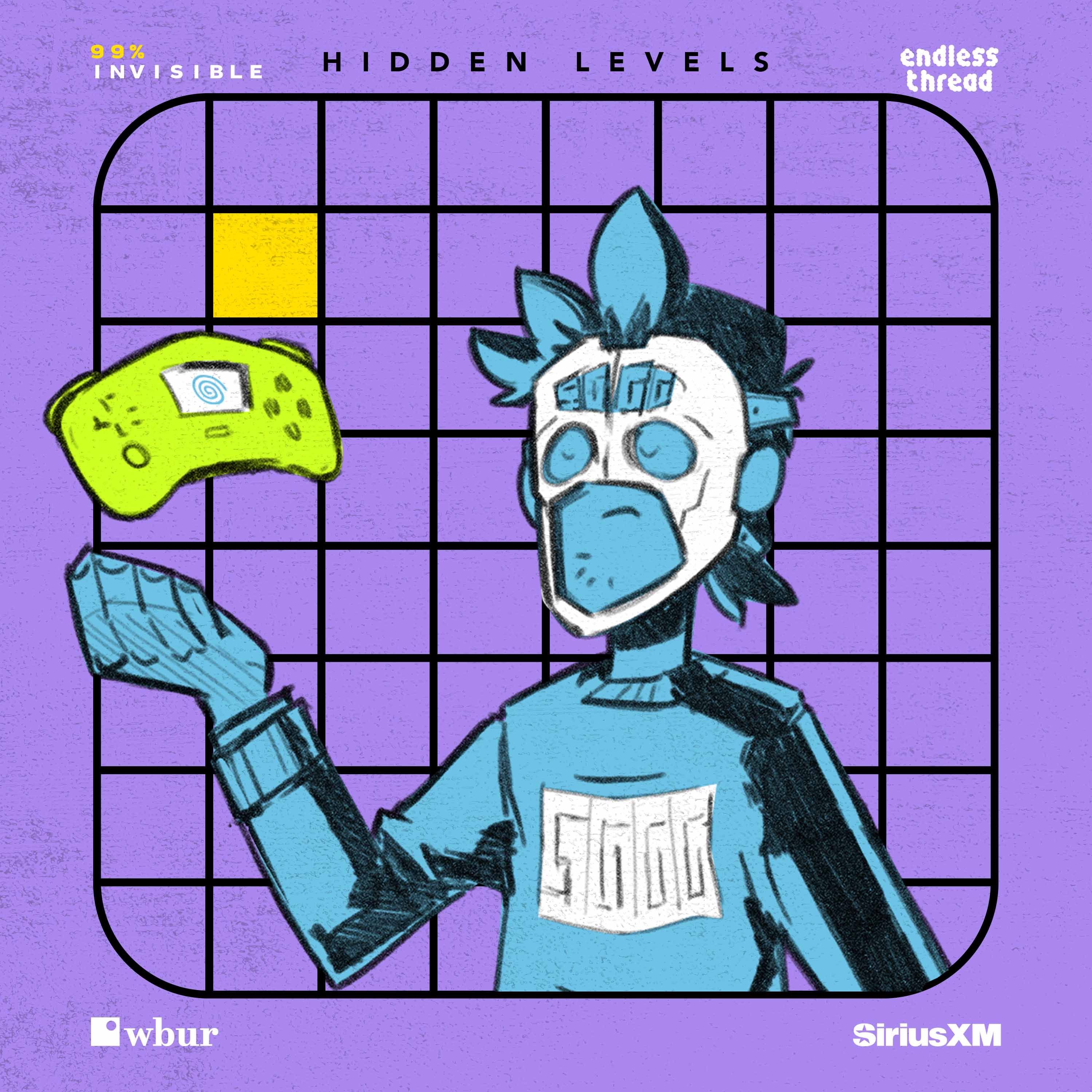
99% Invisible
Hidden Levels #6: Segagaga
00:41:20
One SEGA employee chronicles the company’s struggles the only way he knows how: by turning it into a game.
Loading summary
Transcript157 lines
- [00:00]
DSW Announcer
Holiday PSA from dsw. This is your reminder that shoes are a gift.
- [00:05]
Ben Brock Johnson
Literally.
- [00:06]
DSW Announcer
So unwrap something good, like boots that inspire your next big adventure, or cozy slippers that give you an excuse to stay in, or sneakers that feel like pure joy. Because shoes aren't just shoes, they're exactly what you wanted. Let us surprise you so you can surprise them. Find shoes that get you and everyone on your lips at prices that get your budget at dsw stores or dsw.com have you ever wondered what the stars have to say about your favorite artists and writers? Listen to Stars and Stars with Issa, where I, your host and astrologer Issa Nakazawa, read and interpret astrological birth charts of luminaries like W. Kamau, Bell, Gia Tolentino, and so many more. You'll discover how astrology can unlock fascinating insights about these stars. And who knows, maybe you'll learn a little bit more about yourself. Listen to Stars and Stars with Issa wherever you get your podcasts.
- [01:08]
Roman Mars
Hello Bay Area beautiful nerds. Join me Monday evening, November 3rd, at the Alamo Drafthouse in the Mission in San Francisco for a special screening of the brilliant documentary Drop Dead City, followed by a Q and A with me and the filmmakers. If it sounds familiar, Drop Dead City is the movie that Elliot and I covered a few weeks ago as part of our Power Broker series. Now, I don't do that many live events these days, so I hope you'll come hang out with me at the movies on Monday, November 3rd. Tickets are cheap. They're under 13 bucks. Sign up for your seat using the event link in the show notes or on our website 99pi.org.
- [01:52]
Ben Brock Johnson
Roman Mars from.
- [01:53]
Roman Mars
99% invisible Ben Brock Johnson from Endless Thread.
- [01:57]
Ben Brock Johnson
Here we are, final boss of Hidden Levels. Are you ready, Roman? Do you have all your legendary items? Do you have full life? Did you save the game in case we lose against the final boss?
- [02:07]
Roman Mars
That's an important consideration, yes. I am so excited for this because I think this might be the first final boss I've ever encountered. Like, I've never reached the part of the video game that you actually hit the final boss. So this is thrilling for me to be here at the very end.
- [02:21]
Ben Brock Johnson
All right, well, get ready to have a huge sense of accomplishment for beating a final boss that maybe means nothing to anyone except for you. That's a very video game feeling. Let's talk about something we've been touching on through this series, but maybe never said explicitly. Video games are art. How does that sit with you, Roman?
- [02:40]
Roman Mars
It sits Very well with me. I think video games are absolutely art. They have beautiful visions that bring worlds alive for people. They teach people how to think. They change your perspective. Video games are absolutely art.
- [02:52]
Ben Brock Johnson
Totally agree. And just like other kinds of art, video games are full of reference and homage. So for instance, I think maybe you've heard of the game Metal Gear or Metal Gear Solid. That series of games, I've never played.
- [03:05]
Roman Mars
It, but Metal Gear, I'm aware of Metal Gear, so.
- [03:07]
Ben Brock Johnson
Metal Gear was created nearly 40 years ago by game designer Hideo Kojima. Kojima is now one of the most loved and respected auteurs of video games, in part because he has always put his own personality into the games that he makes. He's got strong ideas, he's committed to them, even when they're basically referencing other pieces of art. The main character, Roman in Metal Gear Metal Gear Solid is named Solid Snake. Solid Snake. He wears an eye patch. He's got a stubble beard on his chad like jaw. When you look at this game character Roman, does he look familiar to you?
- [03:44]
Roman Mars
So I'm looking at a picture of Solid Snake and he is a dead ringer for Snake Plissken from the movie Escape from New York.
- [03:51]
Ben Brock Johnson
Nicely done. I think we'd have very few arguments on movie night. Roman.
- [03:55]
Roman Mars
It's a great movie.
- [03:56]
Ben Brock Johnson
It's a great movie. Solid Snake was inspired by Snake Plissken, as you say, the character played by Kurt Russell in that 1981 side Sci fi classic. You gonna kill me now, Snake?
- [04:08]
Jason De Leon
I'm too tired. Maybe later.
- [04:11]
Roman Mars
So Kojima is obviously like a movie fan for sure.
- [04:15]
Ben Brock Johnson
And Kojima actually has this new set of games that is also turning into their own franchise. Death Stranding and Death Stranding 2.
- [04:23]
Roman Mars
Okay, well those are new to me. I've never heard of Death Stranding.
- [04:26]
Ben Brock Johnson
So this game goes further than just references and homage. The game has been described as sort of a. A walking sim because the main character is not a warrior, he's not a sniper, he's not a smash and bash him kind of guy. He is a courier, Roman. So in the game you are delivering packages. That's the game.
- [04:46]
Jason De Leon
I love this.
- [04:47]
Roman Mars
I love this. This does seem like my kind of game. I'm having a hard time imagining why a game about a courier is called Death Stranding. That doesn't quite make sense to me.
- [04:58]
Ben Brock Johnson
Yeah, I mean, it does all take place in a post apocalyptic environment. You're currying babies.
- [05:05]
Roman Mars
Oh my goodness.
- [05:06]
Ben Brock Johnson
In this game. So its stakes are. Stakes are high for sure.
- [05:09]
Roman Mars
Well, that makes sense. The stakes are high when you're delivering babies in a post apocalyptic environment.
- [05:15]
Ben Brock Johnson
Yeah. And you know, we're laughing about this. But the game is also like a piece of commentary. You can see Kojima thinking through big questions like the dangers of living in a society where we barely physically interact. And he's doing it through this delivery guy, this courier in Death Stranding. So Cojuma is an example of how an artist's personality, their point of view, can get coded right into the game itself. And today, Roman, we're going to talk about another one of these examples, a game really coming from the inside of one man's brain. His anxieties, his hopes, his fears about the industry he works in and the company he works for. This is where we're going to start our final boss episode of Hidden Levels with a Sega employee who had a front row seat to all of the chaos of working in the gaming business in the 1990s. And we're going to learn how he turned his experience into the most strangely iconic meta video game, maybe of all time.
- [06:22]
Roman Mars
99Pi producer Jason de Leon brings it home for us.
- [06:31]
Jason De Leon
When I first met Tez Okano, I wasn't sure what to expect. I had reached out to talk about a video game he created nearly 25 years ago, an obscure and fun Japanese title that had become a sort of fixation of mine. It's a game that you can't really begin to understand until you get to know the person who made it.
- [07:03]
Tez Okano
So I'm a country bumpkin. I live in Tokyo currently and have lived in Tokyo for a while, but I am not a Tokyo person.
- [07:11]
Jason De Leon
Through an interpreter, o' Connell told me about his early life in rural southern Japan and how growing up in the 1970s, just as video games were taking off, set the stage for everything that was to come.
- [07:29]
Tez Okano
Like, I really have to insist on it. I am from the country. There's like nothing, literally nothing in terms of entertainment. What we had was like the great outdoors. So anything with a hint of, you know, the city lingering on, it was just something that we all, like, longed for.
- [07:48]
Jason De Leon
As a kid, Okano dreamed of leaving the countryside, but often video games were his closest escape. He remembers playing versions of the classic Tennis and Brick Breaker titles of the 70s, which were fun, but those games didn't really move him. He says his love really started when one iconic title landed in his hometown. Space Invaders. Do you know Space Invaders? When Okano first played Space Invaders, he was struck by something he had never experienced in a game before. It had characters and stakes. It felt Alive. Space Invader is creature. It's embedding. It's a story. Yes. Story world. Emotional. Emotional. Some people might only see an 11x5 grid of pixelated aliens when they play Space Invaders. But Okano saw a whole new world. And that passion led him away from the countryside and into a university where he studied game design. As a student, Okano created games on MSX, a type of home computer that helped shape the 80s Japanese gaming scene. MSX.
- [09:04]
Tez Okano
Daisuke and I love MSX. I love, love, love MSX. It's burned into my brain making games like that.
- [09:14]
Jason De Leon
One of Okano's MSX games was a silly 8 bit shoot em up called Saladman. The game was a spoof of a famous Japanese game called Salamander. MSX magazine wrote about Saladman and said it was funny and kind of crazy. And ultimately that playful oddball spirit helped Okano land the job straight out of college at sega.
- [09:41]
Tez Okano
And you know, like, you can see, you can tell that I'm kind of a weird gu.
- [09:45]
Jason De Leon
Okano joined Sega in 1992. At the time, the company was riding high on the success of the Sega Genesis. It was the first console to challenge Nintendo's grip over the home gaming industry. This kicked off what we know today as the console wars. A decades long competition between companies for gaming supremacy. Early on, Sega and Nintendo competed over who had the better 2D graphics.
- [10:11]
Simon Parkin
Graphics.
- [10:12]
Jason De Leon
But by the mid-90s, video games were heading in a new direction.
- [10:21]
Tez Okano
Right after I started working there like it was, everything was 3D. It was the era of 3D. You want to do pixel art or anything pixel, Anything flat. No, it's over. That time is over. You can't sell pixels. You can't sell that kind of stuff. 3D is what sells.
- [10:39]
Jason De Leon
When Okano created Salad man, he had to meticulously draw and color each individual graphic on msx. This meant following a strict set of rules on the number of pixels he could use and how to color them. But 3D required a very different skill set. So when he arrived at Sega, o' Connell recalls that a bunch of pixel artists suddenly needed to adapt or they might find themselves out of work.
- [11:08]
Tez Okano
And that really rubbed me the wrong way. It made me sad. You know, I got into games because I like pixel art. But by the time I got my start in this industry, the world of pixels was already on its way out.
- [11:22]
Jason De Leon
Okano feared that with the whole industry pushing towards 3D, pixel artists like him would become a thing of the past. He described it to me as watching the collapse of an Empire and his fears were warranted. Sega couldn't be concerned with all that meticulously drawn color, each pixel, artsy, fartsy stuff. They needed to innovate or risk falling behind their rivals. But in Sega's push to bring new technology and 3D gaming into homes, the company just kept screwing up. Make. Make my video ski.
- [11:55]
Roman Mars
Peace.
- [11:56]
Jason De Leon
I'm out.
- [11:56]
Simon Parkin
Like Shout.
- [12:00]
Jason De Leon
Ye, for example. Are you a fan of Marky Mark and the Funky Bunch? No. Well, too bad. Here's a game Sega put out on the Sega CD where you make Mark Wahlberg's music video.
- [12:13]
Simon Parkin
You want to make my video?
- [12:14]
Tez Okano
Give me more shots of Marky with.
- [12:16]
Jason De Leon
His shirt off, honey. The Sega CD was an add on to the Genesis that tried to cash in on the popularity of CDs at the time. But the device just didn't have many games. And big surprise, the Marky Mark one wasn't flying off the shelf. Sega followed this debacle up with yet another doomed piece of hardware called the 32X. It was a device that you literally stuck into the top of your Genesis to supercharge its processing power. Just stick it in your Genesis.
- [12:47]
Roman Mars
Alright, baby.
- [12:49]
Jason De Leon
Can we say that again? The 32x was too little, too late. People were ready to move on from the Genesis. They were ready for a true 3D console. But the company's next system, the Sega Saturn, totally missed the Mark.
- [13:05]
Simon Parkin
So the Sega Saturn is really a machine that's very, very good at moving sprites. So that's the 2D bits of art around a screen very, very quickly. It's less good at handling 3D. And this is a miscalculation on Sega's part, because by the mid-90s, everyone wants 3D games.
- [13:25]
Jason De Leon
This is Simon Parkin, a game journalist and host of the podcast My Perfect Console. Simon says that with each new piece of hardware, Sega further confused and alienated their audience. After all, the company hyped the Saturn as an era defining 3D console. But when they couldn't deliver the goods, a total newcomer to the industry stepped in and did.
- [13:49]
Simon Parkin
Sony's PlayStation is the first really, really capable 3D machine.
- [13:55]
Jason De Leon
The PlayStation was Sony's first console, and it was a massive hit, selling tens of millions of consoles worldwide. Pair that with the release of the Nintendo 64, another console with 3D graphics, and suddenly Sega was in crisis. The high times of the Genesis were only a few years in the rear view, but it was fair to ask if Sega was going the way of Marky Mark and the Funky Bunch. Gone were the Good Vibrations and so long went to sweet sensations. Sega needed to hit the reset button and that's exactly what they did with the Dreamcast.
- [14:33]
Simon Parkin
The ads emphasize firstly an apology, almost like sorry for how far Sega has fallen and also then switching it to be all about the return of Sega. And I think that was the name of the campaign in Japan, the return of Sega.
- [14:49]
Jason De Leon
The Dreamcast was Sega's response to the PlayStation and the company's biggest punch in the console wars yet. It was the world's first console with a built in modem for online play. It also had a graphics card that blew the competition out of the water. Not just 3D but the best looking 3D by a long shot. With the Dreamcast, Sega was looking ahead to the new millennium and leaving its recent tumultuous past behind.
- [15:17]
Simon Parkin
So yeah, this is the gamble that Sega is making. We'll get out early, we'll have the most powerful machine on the market and we'll also invest in our own designers here in Tokyo with the view of not only pushing the technological boundaries of what the Dreamcast can do, but also the kinds of games that are being made. There was this atmosphere of experimentation and freedom and you know, you had the chance to try something new and see if it paid off.
- [15:44]
Jason De Leon
The late 1990s are known at Sega as the Dreamcast years. And during the Dreamcast years, Sega's developers could, as one executive put it, do whatever they wanted. The mandate was to be original, to make games and create experiences that people had never seen before. Sega was throwing everything behind the Dreamcast to salvage their position in the console wars. And a lot of Sega's developers took that to heart, including Tezo Kano.
- [16:23]
Tez Okano
Sega was the challenger, right? Sega was never the king. Sega was just coming up to the king and asking for a fight. So we had that kind of attitude, that underdog attitude at Sega.
- [16:37]
Jason De Leon
Okano told me that the first few titles he worked on at Sega were not a commercial success. There was a Dragon Ball Z game that just didn't do great. A game where you ride in the back of a runaway rail car that was kind of a bust. And a dirt racing game.
- [16:55]
Tez Okano
Which also did not do that great, was not a winner.
- [17:00]
Jason De Leon
When the Dreamcast years arrived, Okano was eager to try something new. But he was also aware of his not so stellar track track record developing games. So any idea he had needed to work on a shoestring budget.
- [17:17]
Tez Okano
And you know, like after my string of failures and like I was just a total loser basically no one's going to come along and Be like, oh, here, here's 700 million yen. Make whatever game you want. Like, no, that wasn't going to happen. No one was giving me any money.
- [17:29]
Jason De Leon
The console wars had left their mark, both on Sega and on Okano. For years, developers like him worked long hours trying to make the company relevant again. They slept at their desks and showered at the office. Okano himself had to work extra hard to learn all the new techniques 3D games required. The stress was high and the deadlines were relentless. And all of this gave Okano the idea for his next game. What if he could give people a peek behind the curtain? What if he made his next game a video game about making video games? No, more than that. A video game about making video games during the console wars? Actually, no, no. What if he went full monty and made a game about making video games during the console wars while working at seg?
- [18:26]
Tez Okano
Nothing I was making was really coming across too well. Until finally we get to Sega Gaga Ga.
- [18:35]
Simon Parkin
He sort of mangles the name of the game and makes it segaga GA or whatever. Segaga?
- [18:42]
Jason De Leon
Yeah, it's the three GS.
- [18:43]
Simon Parkin
Yeah, yeah. So you know, that's. He gets away with calling it that.
- [18:48]
Jason De Leon
Sega Gaga is part role playing game, part management simulator. A game in which Tezocanno hands the controller to us, the players, and says, look, SEGA is a mess. Do you think you can do any better?
- [19:02]
Simon Parkin
Like it's really a sort of active, self parodying documentary really about Sega's fortunes during the 1990s.
- [19:12]
Jason De Leon
Sega Gaga is a game that ticked all the boxes. Dreamcast had just launched and Sega wanted developers across the company to create original games. And well, this was that. And yeah, he was one developer with a run of bad games under his belt. But Sega Gaga wouldn't need a lot of resources. He would create the story, the characters and all the ins and outs of the gameplay himself. Because after all, he had lived through this whole experience. For Okano, it was just a matter of crafting his pitch to get Sega's executives to say yes.
- [19:52]
Tez Okano
I had my presentation set up and it was really funny. It was really like just hilarious. Well received. The whole room was like busting a gut and just like, oh, you really got us. And they thought it was a huge joke, so they didn't give me any money.
- [20:09]
Jason De Leon
Okano actually had to go back another day and give the whole presentation again.
- [20:18]
Tez Okano
And I was like, no, I was serious the other day. Like I was being for real. This is not a joke. And it was such a stupid, like ridiculous kind of story that they just couldn't believe that I was serious.
- [20:34]
Jason De Leon
There are a lot of reasons Sega would probably want to say no to Okano. But chief among them is that the game is acknowledging a pretty embarrassing fact about the company. It spent a lot of the 90s missing the moment. And maybe it was just the ethos of the Dreamcast years, or maybe it was Okano's charm, or maybe it was just the fact that the cost of the game was more or less a rounding error. But to Okano's delight, Sega said yes. So were you surprised when Sega gave you the green light?
- [21:09]
Tez Okano
Yeah, no, I was desperate. I was like back against the wall at the end of my rope. But at the same I was really certain that I could make a good, like fun, interesting game. And when they came back with a yes, I was just like over the moon.
- [21:26]
Jason De Leon
Sega Gaga is the kind of idea Okana would hear floated after work at a happy hour. Something so zany and out there that people would laugh and joke about it and then, you know, just get up from the table and go back to doing whatever they were doing.
- [21:41]
Roman Mars
Nuggets.
- [21:44]
Tez Okano
But I did not walk away from it. I spent two years in that drunken state working on this game.
- [21:51]
Jason De Leon
In the opening title card to SEGA Gaga, you the player are given the marching orders. SEGA is in bad shape. So it's time to put the company's top secret plan into action.
- [22:08]
Existence DC
All right, let's go ahead and dive into the game.
- [22:11]
Jason De Leon
Yeah, let's do it. This is Existence dc a gamer that's working on an English translation of SEGA Gaga and he's going to help me explain it because honestly, there's a lot going on in this game.
- [22:25]
Existence DC
We can always bounce around. But I'll start like a brand new.
- [22:27]
Jason De Leon
Game here in SEGA Gaga, you play a bright eyed and bushy tailed development. Someone who hasn't been run down by the console wars and the business of creating games. And your goal is to win back Sega's market share from the Dogma Corporation.
- [22:43]
Existence DC
Dogma's supposed to represent like Sony, the.
- [22:45]
Jason De Leon
PlayStation is what they're trying to nod at here.
- [22:48]
Existence DC
Yeah, exactly.
- [22:50]
Jason De Leon
In order to make games that will eventually bury PlayStation dogma, you, the hero developer, have to recruit a team to make hit games. The problem? Almost all of your potential teammates have turned into mutants who live in the dungeons below Sega headquarters.
- [23:07]
Existence DC
So we're going to go into our first dungeon.
- [23:09]
Simon Parkin
Okay.
- [23:11]
Jason De Leon
It's obvious that the stress and pressure of creating games has gotten to them. Some of these characters are over caffeinated employees with bottles of energy drinks lying around them. Some have just been reduced to a gigantic blob of pixels.
- [23:26]
Existence DC
Other characters are SEGA employees with their faces blurred. And it's literally a photo of them where it's like, let's take a photo of you, blur out your face, and put you in the game.
- [23:35]
Jason De Leon
The development dungeons are 3D environments, but you and the feral developers moping about are made up of 2D sprites. This gives the game an odd sort of look from the jump. It's slapdashed with pixel art and other 2D elements that Okano has carefully pasted into the game. For example, one character you run into in this dungeon lab has a big 3D over his head and he's actively weeping.
- [24:02]
Existence DC
That's basically supposed to be like a guy who does 3D modeling. So an artist on the project, and they're being crushed under the weight of 3D.
- [24:10]
Jason De Leon
Like, just like how difficult it is to render things in 3D.
- [24:14]
Existence DC
Yeah, yeah.
- [24:15]
Jason De Leon
If this sounds absurd and insanely meta, that's because it is. And for Okano, that was the whole point. He wanted the game to reflect what life in the development lab was really like. Take another example. One key part of the game are these battles where you, the hero developer, are trying to convince people to join your team. But there's a catch. You want to convince them to join on the cheapest salary possible. Because of course, the cheaper your team's overall budget, the higher the profit margin. In these battles, you try to weaken your opponent by basically launching insults at them. And instead of a typical life meter, these characters have a will meter, and it decreases as you unleash hell on them by saying their previous games suck or that they'll never get a girlfriend. Here's Tezo Kana again.
- [25:15]
Tez Okano
I actually all of the like attacks in the game where there's the fighting, those are all like, lines, actual things that people in the office were saying that I just picked up and put in the game. Like, these are actual quotes from. From my co workers. So basically, it's almost all true. Like, the whole game is basically just real life. The panic, the running, the whole busy atmosphere of everything and deadlines approaching. That's all real.
- [25:57]
Jason De Leon
Depending on the team you've assembled, you can make big hit games which take longer to produce, but win you back a bigger piece of market share. Or you can quickly make a bunch of trashy titles that barely keep the company afloat. And all of this is happening on a timer. You have deadlines to hit. And this, by the way, I think is the funniest part of the game. Right next to your deadline is an additional deadline titled More Realistic Deadline. But even these extended deadlines are hard to hit because occasionally you're thwarted by a totally random event. Maybe one of your developers loses their mind and walks off your team, or maybe someone downloads a bad attachment and suddenly your team is dealing with a computer virus.
- [26:42]
Existence DC
It kind of goes back to the larger kind of idea with Sega Gaga is that it's not just kind of about SEGA culture, it's also about development and the challenges of getting a game to the finish line and the things that happen.
- [26:54]
Jason De Leon
Sega Gaga also has a whole story that unravels as you clear the different development stages. In these animated cutscenes, you watch Dogma or PlayStation attempt to sabotage Sega. And as if that isn't enough, between each of these chapters is a. How do I describe this? A puppet show that Okano filmed with his co workers.
- [27:29]
Tez Okano
Oh, yeah, that's so. The puppet scenes are so funny. I love them. I love them so much.
- [27:33]
Jason De Leon
I know, I know all of this sounds kind of batsh, but the game is also, like, pretty fun.
- [27:40]
Existence DC
I do think it's a good game. I definitely think. I think it holds up. I think the variety makes it great. It's almost better than I expected it to be, and it's more modern than I expected it to be. And I enjoy the story more than I think I expected. So, yeah, I actually really love the game.
- [27:56]
Jason De Leon
To Okano's credit, when he first showed Sega Gaga to Sega's executives, he didn't try to hide anything or make it something it wasn't. He just showed them the game. This absurd, bizarre game.
- [28:12]
Tez Okano
I guess in a word, the reaction was, what kind of idiocy are you doing here? Basically, with SEGA Gaga, I did everything that SEGA hates. So the concept of the game was everything that SEGA hates. It's like, not really well made, it's cheap, it's sort of sloppy. It's weird. So it didn't fit in any boxes of the company, which was the beauty of it.
- [28:39]
Jason De Leon
Look, Sega's executives could have just killed this game right then and there. It didn't cost much money to make, and it would have been pretty easy for them to just take the link. But that's not what happened. Okano's strange game actually made it to market under the SEGA banner, and that's partly because of a big development in the console wars. Okano completed Sega Gaga in 2001. By that time, the Dreamcast had been out worldwide for almost Two years here in America. The launch was the biggest ever for a console, bringing in nearly $100 million in 24 hours. Things were looking up well, at least for a second.
- [29:23]
Simon Parkin
But the big problem is people know the PlayStation 2 is coming.
- [29:27]
Jason De Leon
Here's game journalist Simon Parkin again.
- [29:30]
Simon Parkin
And Sony is very, very effective in trailing the PlayStation 2 and saying essentially, oh, look, Sega's got this new system that's coming out, but it's really a stopgap, you know, if you, you'll pick this up, it'll be dead in the water in two years because then, then the PlayStation 2 will be here. And it runs on something called an emotion engine, which is a great piece of marketing.
- [29:54]
Jason De Leon
Wow.
- [29:54]
Simon Parkin
Yeah, it's got an emotion engine. You know, this is a console that's going to be so powerful it can make you cry, all of this nonsense.
- [30:03]
Jason De Leon
Is that a real thing they said?
- [30:05]
Simon Parkin
Yeah, they did say that.
- [30:06]
Roman Mars
And.
- [30:06]
Simon Parkin
But it's, you know, it was extraordinarily effective.
- [30:09]
Jason De Leon
With the PlayStation 2 on the horizon, sales of Sega's Dreamcast basically flatlined. Sony's marketing team convinced enough people that the system just wasn't worth it, that the PlayStation had something even better in the works. And suddenly, the story in Tezocanno's game crept closer to reality. Dogma, or PlayStation, was squeezing Sega out of the console market. And then it actually happened.
- [30:40]
Simon Parkin
Sega formally announces that it's ceasing production of the Dreamcast and that the Dreamcast is going to be its last piece of hardware that is exiting the console business. It continues to make games and publish games, which it still does to this day, but it's no longer going to build any video game hardware.
- [30:57]
Jason De Leon
When Sega called it quits on consoles, it was a shock to the gaming industry. This was like wonder getting out of the bread business. Reese's saying, sorry, everyone, we're done making pieces. But in a strange twist, the big move actually benefited Sega Gaga. After all, Tezocano had finished the game, it was already paid for, and it would be one of the last games released for a console that had already been discontinued. Instead of being laughed at, why not join the gag?
- [31:31]
Simon Parkin
So the timing is extraordinary. Completely prescient and weird. Okano sort of has proven to be a little bit prophetic with all of that.
- [31:44]
Tez Okano
Sega comes out and announces the end of Dreamcast, which is like all the free publicity you could ask for. I mean, the whole world was talking about Sega pulling out of the console business. So it's on tv, it was in the newspapers, and of course they're Talking about us because we're a game and we're the last game. So it was really great in that way.
- [32:05]
Jason De Leon
Still, with Sega moving out of the console business, it wasn't about to support Sega Gaga that hard. The company gave Okano 30,000 yen, which is about $200 to promote his game. He and his publicist took that money and commissioned a friend to make a custom wrestling mask. One with big letters on top that read SGG SEGA Gaga.
- [32:33]
Tez Okano
So I just drew the design. That's all I did. I drew design and then the idea was that I wear masks and go places.
- [32:40]
Jason De Leon
If you happen to be in the famous electronics district of Tokyo when the game launched, you might have seen Okano running from game store to game store in that mask, mask, signing autographs for all of the Sega diehards who showed up. When Okano was making Sega Gaga. He wasn't expecting Sega's console business to collapse. But when it did, his game took on a whole new meaning. Now it wasn't just a self parody of life at SEGA during the console wars. The game acted as a sort of memorial for an era. As you move through the story of Sega Gaga, you meet characters from the company's past, like Alex Kidd, Sega's mascot before Sonic took the world by storm. There's even an Easter egg for the real retro gaming heads out there. A 2D shoot em up made in that classic 1980s Sega style. Only the bosses in Okano's game are all of Sega's old failed consoles. The Sega CD that's in there, the 32X Huge Boss, and it all culminates with the SEGA Saturn, the daddy of them all. In a literal sense, you're trying to defeat Sega's history.
- [34:00]
Tez Okano
So Sega Gaga is like a practical joke of a game. You know, it's poking fun of the things we made. It's self deprecating warts and all. But like, I love games, you know, like I'm really proud of my work as a game creator.
- [34:20]
Simon Parkin
The moral of the story is that, you know, in the game's ending, the character decides to keep making games even after he's seen how challenging it could be. You know, it's a industry that for better or worse thrives off the passion of the industry. Individuals who pour their creativity and energy into it. And I think that's the ultimate message of the game.
- [34:44]
Jason De Leon
While Okano repeatedly and pointedly pokes fun at his employer, he also wants the people who made the games to know that he sees them creating is full of frustration. There's Never enough resources and there's never enough time. You can do all the right things and sometimes the work just still falls short. But that's okay because you made it. You and your team turned an idea into something that people can experience, maybe even enjoy. And in Okano's world, that is a cause for celebration.
- [35:34]
Roman Mars
Tez Okano is still making video games. His latest is an MSX style shoot em up or shmup as I'm learning right now as I read this, which was released in August. It's called the Girl from Gunma Kai and actually the song you're hearing right now is from that game.
- [35:50]
Ben Brock Johnson
You can find Okano's new game and the rest of its soundtrack on Steam. He also recently released a pixel art movie called Final Request. Learn more about what he's up to at his studio's website, hugastudio.com that's hug a-studio.com when we come back from the break, we're gonna wrap up Hidden Levels.
- [36:20]
DSW Announcer
Holiday PSA from dsw. This is your reminder that shoes are a gift.
- [36:24]
Roman Mars
Literally.
- [36:25]
DSW Announcer
So unwrap something good, like boots that inspire your next big adventure or cozy slippers that give you an excuse to stay in. Or sneakers that feel like pure joy. Because shoes aren't just shoes, they're exactly what you wanted. Let us surprise you so you can surprise them. Find shoes that get you and everyone on your lips at price prices that get your budget at dsw stores or dsw.com.
- [36:57]
Ben Brock Johnson
Roman Mars. I think we got past the Final Boss episode of Hidden Levels.
- [37:01]
Jason De Leon
We did.
- [37:02]
Roman Mars
And what a doozy it was.
- [37:03]
Ben Brock Johnson
Yeah, that's right. That Jason De Leon guy, he's a ringer man. I heard he was actually once such a heavy video game player that he was globally ranked.
- [37:12]
Roman Mars
Yeah. If I'm not mistaken, Jay was a ranked Halo 2 player.
- [37:16]
Ben Brock Johnson
That is amazing.
- [37:18]
Roman Mars
And he used to like fight Jiu Jitsu too. Like he's for multi talented.
- [37:22]
Ben Brock Johnson
Don't mess with Jay in the digital or the real world Fair. Well, Jason's story was a perfect, I think, final video game cinematic to our collaboration. Roman at the end of our long quest to explore the hidden levels of how the video game world influences the real world. How you feeling? What are you thinking about?
- [37:39]
Roman Mars
I mean, I loved this collaboration. It was so much fun to explore video games in depth. And it's particularly because video games are this place in which every pixel, every decision, every piece of design came out of someone's brain and it tells you so much about their values, what's important to them. What's important to the gamer. It's just this great way to explore a lot of things that I like to think about all the time.
- [38:05]
Ben Brock Johnson
Absolutely. And I think we're in a really interesting moment to look at video games in this way.
- [38:09]
Roman Mars
Right.
- [38:09]
Ben Brock Johnson
Video games are going through some of the disruptive change that so many creative industries are going through. Film, art, animation, AI, other technologies conglomeration. These kind of larger tectonic shifts bring a lot of uncertainty to how we do and think about, I guess, telling stories. So it's been wonderful to celebrate that. And what Jason's story I think typifies and what gives me some hope is that humans are endlessly amazingly creative, whatever the larger trends in the industry bring.
- [38:39]
Roman Mars
Yeah. And I think it's important to note is that so much of our premise was that video games influence the real world. But video games in and of themselves are just worthy of study. They are fascinating. They tell you so much about what life is like and what life means to people. It's a rich text. So this is where our couch co op of hidden levels ends for now. I think my mom got us some chicken nugs that we can heat up in the microwave. I brought the Mountain Dew. This is where gamers and I see eye to eye about just the virtues of Mountain Dew, the greatest drink that was ever invented. Do the Dew. The Dew. Yeah, I do the Dew way too much for a 50 year old man. But regardless, this is not the end of hearing from us. At 99% invisible on endless threat, we have new stories coming to listeners every single week. Make sure you follow both of our shows. Subscribe to both shows because we are both people who like to describe and interact with and engage with the world and explain it in cool ways with people that you'll like to hang out with so you can get endless thread and 99% invisible wherever you get your podcast.
- [39:47]
Ben Brock Johnson
Like Chicken Nuggets and Mountain Dew man. Perfect together. Reminder to folks as well that if you want to keep playing along, we have two, count them, two side quests in the Endless Thread feed. If you haven't listened to those yet. And now, like any good AAA video game or podcast, roll credits.
- [40:08]
Roman Mars
This episode was produced by Jason De Leon, edited by Meg Kramer, mix by Martine Gonzalez, fact checking by Graham Haysham, original music by Swan Real and Paul Vaitkas. Extra special thanks this week to Jocelyn Allen who helped translate and interpret our interview with Tez o'. Connor. Truly the best. And also special thanks to Lewis Cox and and Tom Charnock over at the Dreamcast Junkyard. Their insight on Sega the Dreamcast and Sega Gaga was extremely helpful in making this story. Simon Parkin has a book about the history of the Dreamcast called Sega Dreamcast Collected Works. It's rich and beautiful and has even more details about Sega Gaga that we could not fit into this story.
- [40:50]
Ben Brock Johnson
Additional thanks to adam Kaplowski and 17 bits, Jake Kasda. Tez Okana would also like to thank the small team that supported segaga, especially Hisao Oguchi, Tadashi Takazaki and Taku Sasahara. The managing producer of Hidden Levels is Chris Berube. Endless Threat is a production of WBUR Boston's npr. Our team tackling unsolved mysteries, untold histories and other wild stories from the Internet includes my illustrious co host Amory Sivertson, managing producer Samata Joshi, producers Grace Tatter, Franny Monahan, sound designer Emily Jankowski, and our production manager Paul Vikas. Thanks by the way to Ian Bogost, one of the great video game thinkers and writers of our time. His work you can find at the Atlantic and in many books. You should check it out and Marajam did. She's a gamer, developer and author who has a great book on a similar subject subject to our series. It is called How Video Games Are Changing the World. It's full of amazing stories. You should totally read it.
- [41:52]
Roman Mars
And for 99 invisible Kathy Tu is our Executive producer, Kurt Kohlstedt is the Digital Director, Delaney hall is our Senior Editor. The rest of team includes Emmett Fitzgerald, Christopher Johnson, Vivian Lay, Lashma Dawn, Jacob Medina Gleason, Kelly Prime, Joe Rosenberg and me, Roman Mars. The 99% and as a logo was created by Stefan Lawrence. The art for this series was created by Aaron Nestor. We are part of the SiriusXM podcast family now headquartered six blocks north in the Pandora Building in beautiful uptown Oakland, California. By the way, where is WBUR like what neighborhood is that?
- [42:31]
Ben Brock Johnson
Roman Mars it is in beautiful lovely rainy Boston or Brooklyn depending on who you're asking. You can come visit anytime.
- [42:41]
Roman Mars
Ben thank you so much Roman.
- [42:43]
Ben Brock Johnson
Thank you. I'll see you in that video game lobby.
- [42:46]
Roman Mars
And thanks everyone for listening. Hello beautiful nerds. It's Roman here. If you're loving 99% invisible and you want to hear new episodes ad free and get access to exclusive bonus content. Subscribe to SiriusXM Podcast plus on Apple Podcasts or visit siriusxm.com podcastplus to start your free trial today.