Loading summary
Transcript198 lines
- [00:03]
A
You're listening to A Book With Legs, a podcast presented by Smead Capital Management. At Smead Capital Management, we advise investors.
- [00:11]
B
Who play the long game.
- [00:12]
A
You can learn more@smeedcap.com or by calling your financial advisor. Welcome to A Book with Legs podcast. I'm Cole Smead, CEO and Portfolio Manager here at Smead Capital Management. At our firm, we are readers and we believe in the power of books to help shape informed investors. In this podcast, we speak to great authors about their writings. The late, great Charlie Munger prescribed using multiple mental models and analysis. We analyze their work through the lens of business markets and people. Hosting this alongside of me is our Chairman and Chief Investment Officer, my dad, Bill Smead. Dad, thanks for joining me today.
- [00:51]
C
Great to be here.
- [00:53]
A
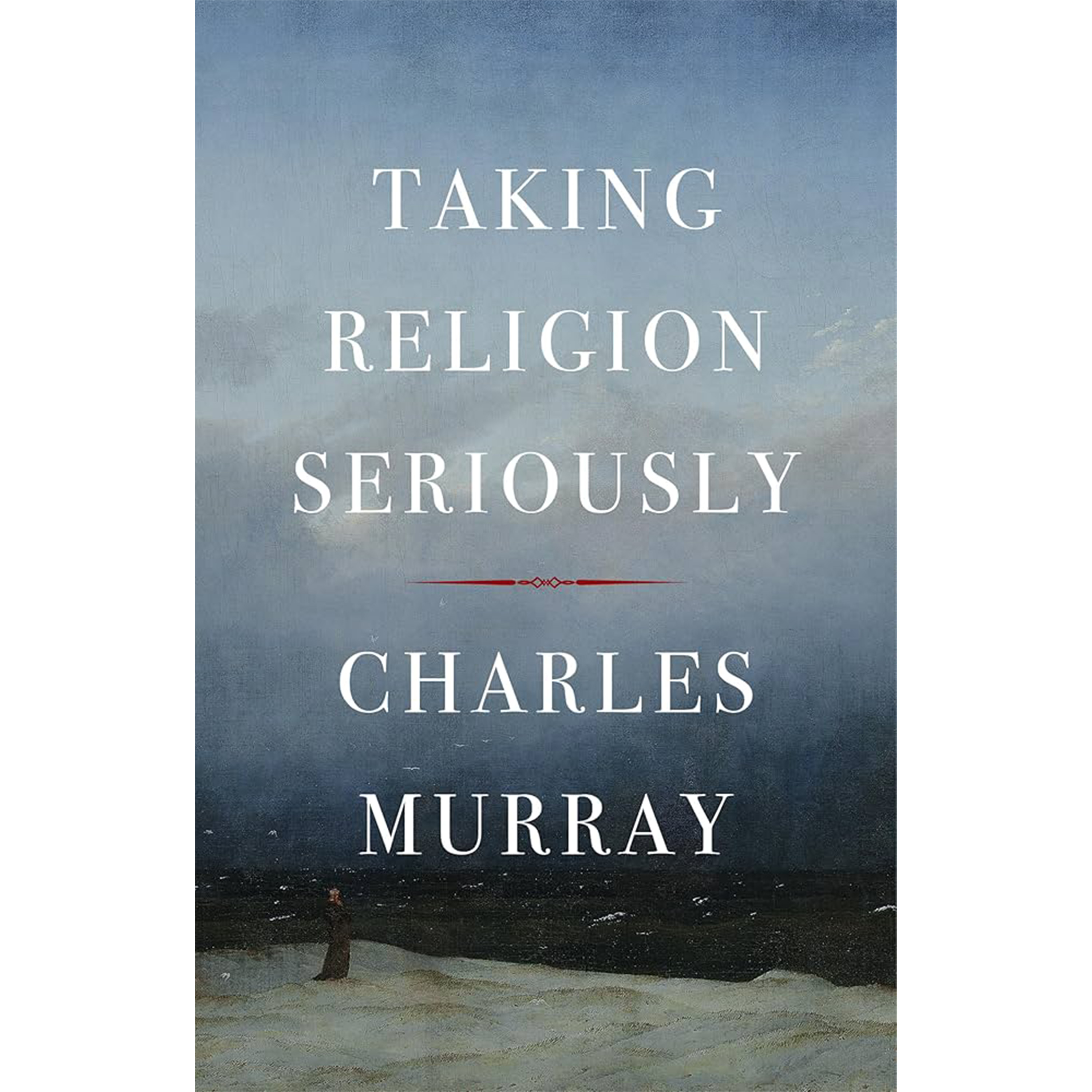
In this episode, we will discuss the whole part of the human being, not just the material part. I'm reminded that Dr. Martyn Lloyd Jones, who is a famous pastor, was also a trained doctor. He left a successful medical career after witnessing the limitations of physical healing and realizing the spiritual needs of his patients were more profound. We will discuss this same concept today. Charles Murray is joining us to discuss his newly released title, Taking Religion Seriously. A little background some of you might be aware of. Charles he first came to notoriety with his work the the book losing ground in 1984. His 1994 book Bell Curve argued the role intelligence currently plays in America's social structures. His other titles include Coming Apart In Pursuit, Human Accomplishment, and Others. He is currently the Hayek Emeritus Scholar at the American Enterprise Institute. He also has a PhD from MIT and a BA from Harvard. Charles, thanks for joining us today.
- [01:54]
B
Glad to be with you.
- [01:56]
A
So just to start, I mean, you know, this has been ruminating for a while, obviously in your mind. You know, you talk a lot about your own personal experience in, you know, where you've come. But what caused you to write this title, particularly at this time?
- [02:09]
B
It was an accident. I had been interviewed for a video interview at AEI American Enterprise Institute to summarize my career at aei. Kind of an institutional history thing. And Nick Eberstadt, my colleague there, was one of the interviewers. And somehow late in the interview we got to talking about religion and I described my rather eccentric evolution toward religion. Nick has been a devout Catholic all his life, and if the interview ended and the video camera was turned off, Nick turned out to me and said, it ought to be your next book. And it had never crossed my mind to write this because this is a very personal experience I've had. I don't consider myself an expert on religion.
- [02:57]
A
Sure.
- [02:57]
B
And yet as soon as he said that, I said to myself, you know, there are millions of people like me. And by people like me, I mean were educated, well educated, a lot of times, advanced degrees. We're professionally successful, and religion simply has not been a significant part of our lives. We aren't militant atheists.
- [03:23]
A
Sure.
- [03:24]
B
We just don't pay any attention to it. It's not important. And I said, they're like me. I have gotten a great deal of reward out of taking religion seriously. And maybe my story is worth telling for them. So I wrote the book. I kept it very personal and far more personal than anything I've ever written. And it was fun. I enjoyed doing it.
- [03:51]
A
Yeah, it's a very fun read. It's a very cerebral read because again, you're thinking a lot about self reflection as a reader. But let's kick it off. You mentioned this at the top of your book. What does it mean to be a happy agnostic?
- [04:09]
B
Well, I was a happy agnostic, and I'll tell you what it consisted of. I was. I'd written Losing Ground. It had gotten favorable attention. Unexpectedly, I was married to a wonderful woman. Never been happier in my life. We just had a new baby, and that was a delight to me. Life was pretty much complete, and I felt no need for any religious element to make my happiness complete.
- [04:42]
C
Yeah, Cole's dad was a happy agnostic until he got prostate cancer in 1981.
- [04:49]
A
Your dad? My grandfather.
- [04:51]
C
Cole's grandfather, my dad. So I saw that live firsthand, but myself wasn't at the time that he got cancer. What does it mean to be tone deaf harmonically versus tone deaf spiritually?
- [05:10]
B
You know, I only think I have one fairly original contribution in this book, and that is to say that spiritual perceptiveness is a trait. It's a trait like the ability to absorb great music fully. Like the ability to absorb great art fully. A lot of people, again, are like me. I listen to Mozart and I'm not tone deaf, but I treat him as background music sometimes, and I kind of enjoy it. I am not mesmerized. And I have professional violinist friends who are mesmerized by that music in a way I'm not. They are seeing things I'm not. I have friends who can stand in front of a great work of art for half an hour and constantly be seeing new things in it, being moved by it. I look at that same picture for 15 minutes and nod my head and walk on to the next one. Well, the same is true of Spiritual perception. Some of us are tone deaf, the equivalent of tone deaf. We aren't able to perceive realities, not made up stuff, but realities of people with greater spiritual perception can proceed. And here's where the difference lies. I think most people who are not moved by great music because they don't have that ability recognize that the music really is great. It's them that has the problem. Okay? But I think a lot of people who are tone deaf spiritually assume that people who do have spiritual perceptions are making it up or they're deluding themselves. The people who are tone deaf spiritually see themselves as the ones who are living in the real world and the people who are spiritually engaged as those who are living in a fantasy world. And I think probably the opposite.
- [07:15]
C
Let me backtrack a bit. You said in the book you were sophomoric with your parents. Explain how kids can go to college and be sophomoric with their parents.
- [07:26]
B
The better question would be, how can they go to college and not be sophomore with their parents? In my case, I had been raised a Presbyterian, and I came back from Harvard to my small town in Iowa, where I grew up and went to services with my mom and dad and said, I'm happy to go with you to services when I'm visiting back here in Newton, but you really should know that I don't believe that anymore. I thought I was being very adult and I was being very sophomore. To whereupon my dad surprised me. He said, oh, well, neither do I. And I said, well, why have you been dragging us to church all these years? And he said, well, it's a way of reminding ourselves of our responsibilities to others. And it's a discipline, and it keeps us from shirking any of those responsibilities. You have to understand, the idea of shirking a responsibility had never crossed my father's mind in the 80 years that he had lived. At that time, he was extraordinarily conscientious, but still, that's the reason he was doing it. And to say I was surprised was an understatement.
- [08:48]
A
Sure, when something, you know, this is in my notes, Charles, but it's something we've often talked about among ourselves is, you know, at a time when people believed, and I'll call it just the order of religion and maybe a possible, you know, call it morality, that was a common law. In a way. Society was very different. They all use Western societies. They were just very different. They had different discourse and disagreements and things like that. And to your point, like the folks like your Father who showed up out of. I'll call it rotness and respect and practice and structure and things like that. They're not there in society anymore.
- [09:30]
C
Yeah. And Cole, I've got something to add to that. I try to explain to people the way things were when I was a kid. So my dad was a successful person, a ship pilot, and he was not going to church, but he was sending us kids to Sunday school. So I went to Sunday school because.
- [09:47]
A
That was the right thing in that era.
- [09:48]
C
So in my dad's era, the people.
- [09:52]
B
That.
- [09:55]
C
Weren'T going to church were envious of the people that were. They kind of knew, like your dad, that it was the right thing to do. Okay. Today's society, the church people are envious of the ones that aren't going to church.
- [10:14]
B
Sometimes that's true.
- [10:15]
C
Right.
- [10:16]
B
Or they feel embarrassed about going to.
- [10:17]
C
Church or embarrassed or, you know, so.
- [10:22]
A
And I want to pivot a little bit because to your point about the agnostic, so you mentioned, and I want to ask you this. How can prayer be scary? Because again, you're speaking this from your own personal experience and you know, I'm a different animal than you and I've been attending church regularly. But this is like. I really like this because this can be very scary. You are doing something that is not material.
- [10:45]
B
In my case, I was attending Quaker meeting with my wife after a period of time, even though I did not consider myself a believer. But of course is a very non doctrinaire sect, Quakers. And so you can be very lay. Yeah. In fact, you could be even openly atheist and attend Quaker meeting because you think it has other values and nobody will object to you being there. But one time, for reasons I cannot remember, we're talking the mid-1990s, I suppose something had been bothering me. And so I prayed for one of the only times in my life that I consciously, earnestly prayed. And over the next couple of days, whatever it was that was bothering me resolved itself. And I never prayed again. And I. And when I said I was scared, it was, here is this thing that seems to have worked that I always assumed was meaningless. And have I been missing out on something? Have I. It was just a case of I had opened up a door that had way more in it than I expected it to have. And who knew monsters might lie in there? And I was scared of it and I'd backed off from it. The same reason, I think when I tried to meditate when I was younger in the 60s, and meditation was a big deal, and whenever I got Close to a meditative state. I could feel myself resisting getting into it deeper. And I think that probably reflects an individualism that has been part of my makeup since I was a little boy and is probably too extreme. But I kind of felt that if I really entered a meditative state, I would lose some of my autonomy, I think. So that's true of a lot of things in spirituality for people who are not spiritual, they're comfortable in their nice materialist confines.
- [12:53]
A
But we would also sit here and say that just the word materialism bothers us in some way, doesn't it?
- [12:58]
B
Well, it didn't bother me.
- [13:03]
A
Well, as long as it works for you. If it works for you, why have you.
- [13:07]
C
Didn't bother my dad either.
- [13:08]
B
No. From the time I was in college and I learned that smart people don't believe that stuff anymore.
- [13:16]
A
Sure.
- [13:18]
B
Materialism seemed to me to be so obvious that it didn't need to be defended. I'm thinking especially materialism when it comes to consciousness.
- [13:28]
A
Sure.
- [13:28]
B
And that consciousness exists entirely and exclusively within the brain. Well, that's the case. And the brain stops functioning. Consciousness ceases. There's no afterlife in that respect. We know that all the major religions are wrong. And that was just so obvious to me. Consciousness cannot possibly exist independently of this physiological grounding for it. Sure. That it never, never crossed my mind to doubt it. And it never crossed my mind either to take into account that. Guess what, Charles? Before the Enlightenment, everybody in the world was absolutely certain consciousness did exist independently of the brain. Sure. And so what makes you so confident that everybody before the Enlightenment was wrong and everybody since the Enlightenment is right? That did not occur to me for a while. Sure.
- [14:24]
A
You make the point. And I've heard this term used a lot. People talk about God sized holes. You'll hear people explain that in their own personal experience. But you use it differently in your book. You say that in your eyes, modernity has hidden God sized holes. In other words, it's the thought, it's the cultural view that's covering that up. Can you explain that?
- [14:50]
B
Well, I think it has to do with Bill, your father, not getting serious about religion until he had serious cancer. We in the 21st century and basically in the 20th century as well, sort of assume we've got 80, 90 years coming. I mean, odds are we're going to live that long. We're probably going to live pretty healthy lives. Yeah. We know people who don't do that. But there is kind of an assumption we're going to be okay just the same as in Wartime soldiers assume I'm going to be okay, even though everybody else around me dies. Sure. And. And in doing that, you are enabled to put off all sorts of things that you're more comfortable putting off, such as the prospect of death, such as taking the serious questions about human existence and the human condition seriously. And in addition to being protected from a lot of the miseries that people had before the 19th, 20th century, their children dying, very commonly, a spouse dying, very commonly, terrible diseases that left you helpless and couldn't be cured, we've also developed in the 20th century the ability to amuse ourselves constantly. And that's grown by leaps and bounds in the 21st century where you can entertain yourself 247 with no problem at all. Right. So in all of those situations, you can kind of shove the big questions out of your mind. And a crisis, such as a health crisis, such as the death of a loved one, is one of the few ways remaining in which you are driven to the depths of despair. And in that depths of despair, you discover you do have a God sized hole after all. You're not making it up. The hole was there all along, but you were never forced to recognize it before.
- [16:54]
C
Yeah, I like to think about it. When you're living your life, you're writing an obituary is what you're doing. And so you asked the question, why is there anything in the book? Can you help us with that thought?
- [17:08]
B
Oh, why is there something rather than nothing? Correct. Yeah, a great line. It was originated by Heidegger, the philosopher Heidegger, but it was actually variants of it had been said long before that. I didn't hear it until the mid-1990s and I heard it from Charles Krauthammer, the late columnist.
- [17:28]
A
Sure.
- [17:29]
B
And it just hit me. Why is there something rather than nothing? And I had no ready answer to that because I am a good Aristotelian, or I was, when? Even when I wasn't. Religion. Religious. And things have to have a creator. This had to come from somewhere. Well, where did it come from? And one way out of that, of course, is that you could say, oh, if you try to answer that question, you just enter an infinite regress. You know, it's God created it. Okay, who created God, Et cetera, et cetera.
- [18:08]
A
Sure.
- [18:09]
B
Well, that doesn't deny that there's a mystery here. It just means that maybe it's a mystery with a capital M instead of a small M. Sure. And that's what I came to believe. And that was one nudge that kind of pushed me off dead center in my attitude toward religion. And it said to me, you've got to take the idea of a creator seriously. That was a big step forward. At the same time, something else crossed my mind that wasn't as powerful, but it's the regularity of mathematics, the simplicity of mathematics, where you have very profound physical phenomena that can be explained by laws that give you exact results from very simple equations. E equals MC squared is the most famous, sure. But Newton's law of motion, they're also very simple, and same is true of many others. Mathematics is way too elegant to have been produced by chance. And that leads you to say, well, if it wasn't produced by chance, what produced it?
- [19:22]
C
Well, it's funny you mentioned that because you're talking to two men that make their living by doing a better job, hopefully of using simple mathematics in the investment process than our competitors. They're much greater math minds in the investment business than us, much more technical and more elaborate. But we're kind of in the camp that says the simple has a tendency to be right in front of your eyes.
- [19:50]
A
It's Occam's razor, tends to win time and time again. Hi, I'm Cole Smead, CEO and Portfolio Manager here at Smead Capital Management and host of this podcast. If you enjoy this podcast, I'd like to invite you to check out smeecap.com at our firm. We are stock market investors. We advise investors who play the long game with a discipline that has proven success over long periods of time. Learn more about our funds@smeecap.com Past performance is not indicative of future results. Investing involves risks, including loss of principal. Please refer to the prospectus for important information about the investment company, including objectives, risks, charges and expenses. Read and consider it carefully before investing Smead Funds distributed by Smead Funds Distributors llc. Not affiliated so you mentioned Aristotle's unmoved mover. Like as I read that I understood what you said, but I asked myself kind of a higher level question and this gets, I think, kind of fighting at some of the things that might be the current tension with a statement like that. Charles, does anyone actually know who Aristotle is today?
- [21:01]
B
Yeah, of the degree to which we have, we being the average college educated person, let alone those without college educated, sure. We have simply forgotten some of the wisest, greatest, most profound works in human history is just disgraceful. And the, you know, you hear philosophical debates going on during the BLM movement and with the WOKE movement and the rest of the. And you say to yourself these issues were discussed with far More nuance, far more depth 100 years ago. Sure. Than they're doing it now. As far as I'm concerned, discourse today on serious topics is teenage level compared to what it was, let's say, in the 19th century or even most of the 20th century.
- [22:11]
A
Well, and I mean, what you're getting at, you didn't mention this in your book. Obviously you talk a lot about C.S. lewis in a couple of the chapters, but C.S. lewis refers to that as chronological snobbery. Right. The idea that in our modern age we're so sophisticated and we have so much better tools to dealing with these problems. And to your point, from an intellectual perspective, we are more elementary, even though we have far greater technology.
- [22:34]
B
Yeah, yeah. The great ethical systems point. The great ethical systems, first place, are very similar to one another.
- [22:45]
A
Sure.
- [22:45]
B
Confucius ethics, Buddhist ethics, Judeo Christian ethics are very similar to each other, even though they were created independently and they were created in all those cases more than 2,000 years ago.
- [23:03]
A
Sure.
- [23:03]
B
And it's when people say that all of philosophy is footnotes on Plato, they're exaggerating a little, but not much in terms of the great issues. Human beings started thinking about the great issues a very long time ago, and they made the big discoveries a very long time ago. And a lot of what we're doing is sometimes not even icing on the cake. It's irrelevant to the cake.
- [23:29]
A
Agree. So you give this analogy of you and your dog, and you kind of use this analogy as your understanding of God. You said it would be like your dog trying to understand you. And that's the same concept of you relative to understanding God. Now, the only thing I would add to your analogy. Okay. What if you wrote a book to your dog through your dog, could understand to explain you? Wouldn't that explain how much you love your dog? And isn't that more reflective of what we get to experience in the case of at least the Bible?
- [24:03]
B
Well, you're giving a version of what C.S. lewis gives in near Christianity when he talks about the moral law. Yep. And he says he's the talking there about how for God to communicate with humans. He's very constricted in what he can do. And I, I can't use language nearly as elegant as C.S. lewis.
- [24:32]
A
None of us can, by the way.
- [24:34]
B
None of us can. He says that what God can do is to make us feel in nudges toward feeling in certain ways which are consistent with his love. I'm using love in the sense of agape, the Greek word. Yeah. And since that's what we do feel in our sense of right and wrong, that we are being nudged toward. This is the right thing to do, even when you don't want to do it. That is evidence of God expressing his essence to us.
- [25:17]
A
Sure.
- [25:17]
B
Now, in terms of God writing a book or inspiring a book, one of my problems with the Bible is it anthropomorphizes God too much.
- [25:28]
A
Sure.
- [25:28]
B
And in the Old Testament, especially of God, is jealous, gets angry, feels remorse. You know, he's. He's a guy. He's a guy. And masculine, for that matter.
- [25:49]
A
Sure.
- [25:49]
B
In all sorts of ways. Yeah. Yeah. And to me, it just is axiomatic that any God worthy of the name is unknowable to us, has to be unknowable in his essence. Because how do you think about a being that exists outside time, for example?
- [26:18]
A
Sure.
- [26:19]
B
And not every religious tradition, but a lot of the major religious traditions think that's an aspect of God. He exists outside time. Well, right there you're talking about something that we can't comprehend. The idea of being everywhere at one time. Can't comprehend.
- [26:41]
A
Sure.
- [26:41]
B
And putting that together with a personal God, how does that work? All of this is very hard to get our heads around. In the same way that I mystify my dog when I sit in front.
- [26:53]
C
Of my computer, you just made me think of a question that I'd like to ask you. Because it's my own experience coming to know the Lord later in life. Don't you think in a way it puts us a little bit more on fire than we would have been if we'd have been involved the whole time? Don't you feel a sense of fortune that you woke up at a point in time and changed the way you thought about it? Didn't you feel very fortunate from that?
- [27:27]
B
I'm hesitating because I think it could work both ways. Suppose you are a person who does have a lot of spiritual receptivity. And suppose you are an environment from childhood on where you are encouraged to use that. I can imagine that you could, by adulthood have built up an edifice of spiritual insight and understanding, which, if you start later in life, it's going to be harder to build that same edifice.
- [28:07]
A
Sure. The cumulative advantage.
- [28:09]
B
Yeah. And I can also imagine that an alternative scenario would be no, you have to be a certain age of maturity before you can begin to process a lot of this stuff effectively. So the short answer is. Beats the hell out of me. I just don't know the answer to.
- [28:29]
C
Your question because my experience was I didn't come to know the Lord till I was 29 years old. And then I taught first and second grade Sunday school for 12 years. I sang in the choir, I sang in the praise. I mean, I just couldn't get enough.
- [28:43]
B
You know what I mean?
- [28:43]
C
It's like I was, like, making up for lost time because I couldn't get enough Bible studies and so forth. So let me pivot a little bit. Why are space and time so important for thinking about the potential of God? You've already kind of intimated.
- [28:58]
A
Well, yeah, because you talk a lot about in the book. This is kind of in the science section of the book where you say, like, you know, these things could have happened. But you have to start with those two elements that Bill just mentioned, space and time. And how do you get those?
- [29:15]
B
Well, that's the mystery of the Big Bang, that the universe originated in a dimensionless point, and out of that dimensionless point came all the energy that led to the universe. But God existed at a time when the universe was a dimensionless point. So he existed not only outside time, he also existed. Existed outside space, independently of space. Sure. That's pretty mysterious.
- [29:50]
A
Well, to your point, I mean, any matter has to have space because you. You can't have matter in a void.
- [29:56]
B
Right.
- [29:56]
A
Obviously. And so it's like saying from void came matter without space. In a way.
- [30:04]
B
It'S not. Void implies space. And at the moment of the Big Bang, space did not exist.
- [30:13]
A
Sure.
- [30:14]
B
When I say dimensionless point, that's the way it's usually described. And what drives the physicists crazy is that they are driven to describe it as that.
- [30:24]
A
Sure.
- [30:24]
B
Not theologians.
- [30:26]
A
Sure.
- [30:26]
B
There's a wonderful quote by. I think it's Robert Jastrow, who was an astrophysicist, who talks about the slow acceptance of the Big Bang theory. And he has a passage I'm paraphrasing where he says, we have climbed up the mountain of knowledge about the creation of the universe, rock by rock, and we clamber over the rock, last rock to the top, and there he says, it ends like a bad dream. A band of theologians have been sitting there for centuries, and they have. What they have done is recreate the story of Genesis. Sure. Let there be light.
- [31:09]
A
Sure.
- [31:11]
B
And that drove physicists nuts. I mean, to say there was a beginning of the universe just is way too spooky for physicists who don't want to believe in God.
- [31:25]
A
Well, to your point on the scientific method. So post enlightenment, right. We come up with the scientific method. And one of the main Thesis is of the scientific method, is that you have a repeatable process that you can test over and over again. And to your point, this is not repeatable by definition. And I think you point out some of the interesting tidbits of that I think you use in your book. Like the heat needed. You talk about the kelvins, like the exponential amount of heat via the kelvin system that you would need. And I think you point out that it's fairly unimaginable. It's like fantasy, almost a belief. Is that fair?
- [32:02]
B
Yeah, yeah. You're alluding here to the multiverse theory, which was advanced after the Big Bang was verified, and they were stuck with saying that the universe originated out of nothing. And since then, the physicists have been trying to concoct a physics that would produce multiple universes. Okay. The same size as ours.
- [32:27]
A
Sure.
- [32:28]
B
And they use quantum mechanics to do this. I am not qualified to critique their use of quantum mechanics. It's way out of my pay grade. But here's the bottom line. Somehow they've got to say quantum burps or quantum anomalies can generate that kind of energy out of nothing. Come on, that's.
- [32:56]
A
Well, you. You added to that by saying that in this theory, it would be that effectively stardust has created us as matters, as matter and beings at some point.
- [33:08]
B
Well, actually, no. The stardust thing is. That's another story.
- [33:15]
A
Okay.
- [33:16]
B
We were created the. The process of the stars evolving, burning for millions of years, then becoming black holes, and then blowing up, filled out the table of elements. That's why we have 92 or whatever it is. Naturally occurring elements is these repeated processes of stars evolving and having different generations. And they then burst these materials out into the cosmos. Well, eventually it's those materials that make up our bodies. And that's the sense in which you and I are composed basically of stardust. All of the. Because it was the. It was that process that enabled planets to exist. And the fact that the planet exists is what allows foliage to exist and all the rest of life of the rest of it. So, yeah, we are stardust in a very, very long process. But what they're saying with the multiverse theory is somewhat different. They aren't talking about the evolution of the universe. They are talking about the creation of universes, lots and lots of them. Because the chances that we would live in a universe that would permit the development of life are less than one in a trillion. And that's not a religious statement. That's the statement calculated by Roger Penrose, a Nobel laureate.
- [35:00]
C
Well, you've brought me to something that is part of the next question that we're going to ask, which is I talk to people all the time about. From 1968 when Star Trek came out to today, there has been unbelievable advancements in computers and computer science and we have in comparison made very little headway into space. So therefore, so that in your book you talk about kind of the perfection of this life or this world or this world. And you know, am I wrong to think that, gee, that all these, you know, listening to Musk and Bezos and what they want to do in outer space and all that, to me it almost feels like God has a bit of a wall there for them to.
- [35:54]
A
Well, and you explain also, like the anti gravity things stay together because of anti gravity.
- [35:59]
B
Well, there's. Now here you're pushing me to the limits of my knowledge and maybe a couple of steps beyond. One of the things that has been discovered recently is that there is a mysterious force in the universe that seems to be holding back the galaxies from expanding outward as fast as they should.
- [36:19]
A
Sure.
- [36:20]
B
Who knows what that is? I think that a couple of things are technically possible that would get around that wall. I would say that the identification of the phenomenon of entanglement where two particles, if the state of one particle changes, the state of the other particle changes instantaneously, apparently faster than the speed of light at a great distance, that sort of suggests the possibility that maybe the speed of light is not the limiting factor that we thought it was and there's a very long way to go. But is it possible, given Nardum's current theory of physics, that there might be ways eventually of bridging these gigantic gaps? I don't consider that beyond the realm of possibility. I also don't consider that to be competitive with religion. I think that's two separate worlds.
- [37:17]
A
Sure.
- [37:19]
C
Explain what your view of terminal lucidity on the spiritual nature of humans is.
- [37:26]
B
Oh, Bill. That's part of a discussion I have about how consciousness is undergoing a tough time these days. I mean, the materialist view of consciousness and there are several bodies of data that call it into question. One of them is the large body of data on near death experiences which I think most people have heard about. You know, the cardiac arrest, no respiration, no heartbeat, and yet people have vivid memories of what happened to them thereafter. That's a very large body of evidence that suggests something's going on independently of materialism. You have a large body of evidence of children having memories of past lives that are verified as to be Actually, things that happen to people who are now dead. Suggestive of reincarnation without quite proving it. And then there's this thing called terminal lucidity, which most people haven't heard about. And that is, it happens often enough that if you work at a hospice for several years, you probably have run across it a couple of times. Okay, you have somebody who has advanced dementia, which means they haven't spoken, they don't recognize their families, they don't recognize friends, they don't have memories. Their brains are no longer functional. The damage that has been done to those brains is such that the networks for speech and organized mental activity have been broken, destroyed. And about a day before death, in a case of terminal lucidity, that person is back, sometimes 10 minutes, sometimes an hour. They are back in terms of remembering who they are, remembering their spouse and children, having other kinds of memories, having their own personality characteristics. They're the same people they were before, and then they're gone again and die within a few hours. And what's that all about? Because you have had an exhibit of this person's capability that requires the brain in the same way the circulation of blood requires the heart. And yet we have consciousness existing. And to me, that's serious proof.
- [40:01]
A
We hope you're enjoying the podcast. You know, we work hard putting together this show, but we work even harder for our investors at SMEAD Capital Management. At smead, we believe in disciplined investing, which is why the SMEAD funds have a proven track record of long term outperformance. If you're an investor who plays the long game and want to invest in wonderful companies to build wealth, we invite you to visit smeedcap.com Past performance is not indicative of future results. Investing involves risks, including loss of principle. Please refer to the prospectus for important information about the investment company, including objectives, risks, charges and expenses. Read and consider it carefully before investing. Smead funds distributed by Smead Funds Distributors llc. Not affiliated. Beethoven acted as if he were God's gift to humanity. Quoting your work, obviously, as it happens, he was. The problem is that subsequent generation of artists who weren't gifts from God emulated him. I loved this because it's just true. He's remarkable in the sense of human history. To your point, something incredible in the chronological timeline of humanity. And yet every human in modernity that's followed with skills and gifts at some level have thought they're Beethoven.
- [41:19]
B
Yeah, I've came up with that just because we saw the arts fall off the edge of a cliff starting in the late 19th century. I'm just thinking about Beethoven's music. Yes, he was irascible. He was very egotistical and all that. But look at his Ode of Joy. Look at the Ninth Symphony. Look at all the ways in which he is celebrating the true, the beautiful and the good in his music and celebrating God for that matter. And then. So he had that personality. But boy, was he doing great stuff. Sure. Okay. You take away an environment in which the true and the beautiful and the good, all of which are Christian values, are no longer defining what artists are supposed to do.
- [42:12]
A
Sure.
- [42:12]
B
And what does it turn out that artists do? They decide, well, I'm a genius and I'm going to challenge the audience. I'm going to challenge the audience. And if the audience doesn't appreciate it, that's not my fault, it's their fault. They aren't worthy of my art. It's an incredibly solipsistic, selfish way to look at it. And it also produces really bad art.
- [42:39]
A
You explain it. It's a very nihilistic view presently for artistry versus more of an artisanal view. In the 19th century.
- [42:49]
B
It's the novels are lifeless, the pictures are not beautiful, the music is not listenable. I mean, there's very simple ways of thinking about it too, which is, it's really bad stuff in terms of what is supposed to be the high culture. Oddly enough, in the 20th century, popular culture was much more vibrant than high culture.
- [43:13]
C
Charles, I don't know if you've watched the Billy Joel documentary, but both his parents were concert pianists. And this guy has got God given, just unbelievable God given talent. And you can just, you watch the documentary and you can just see God's hand on. All over him. But yet, you know, he.
- [43:37]
A
He's a train wreck.
- [43:38]
C
But his life has been.
- [43:39]
A
He's nihilistic.
- [43:40]
C
To your point, he's nihilistic. Constant train wreck. His. His dad divorced, was the leader of the Vienna Philharmonic and. And his brother, half brother, then became the head of the Vienna Philharmonic, which explains why the song Vienna Waits for your. But anyway, just incredible picture of what God does in, in a life, all that talent. In an evolutionary framework, wouldn't morality lead us to weak impulses?
- [44:09]
B
Well, it would depend on what the impulses were. If we're talking about the impulse toward sex, I think that evolution is going to produce very strong effects on that. Sure. For something like altruism, I think evolution is very selective about what is good at generating. It can generate altruism between kin because if you're blood related and you are helping out your kin in some sense. You are increasing the likelihood that your genes get passed on, which is kind of the key test of evolution. And you can also generate some kinds of reciprocal behavior that are altruistic. You know, I'll scratch your back if you scratch mine.
- [44:59]
A
Sure.
- [45:01]
B
But evolutionary theory has a very hard time saying where does this impulse to help people which put me in danger with no evolutionary reward. Where does that come from? But we see it all the time. People who sacrifice themselves for other people, sometimes people they don't know out of a kind of love. Evolution has a hard time explaining that.
- [45:31]
A
Sure.
- [45:32]
C
Don't we all hear the tune of goodness whether we want to recognize it or not?
- [45:38]
B
That's a position that I have increasingly been drawn to take. Again, my mentor in this and originally was CAS Lewis. That there is a standard of decent behavior out there that we are aware that we are either following or not following even when we're violating it. So that when we run away from battle or that when we double cross a friend who has helped us, we have a very hard time not recognizing part of our souls that we have done bad.
- [46:17]
A
I want to pivot a little bit because you get to some of the. I'll call it. You know, it's like the million dollar word that you often hear is the historicity of portion of your book. You talk about the writing of papias to explain kind of the truth of Christ. Can you explain what's intriguing about some of these early authors, their timeline, the accuracy and significance of who they were interacting with to get this information?
- [46:44]
B
Well, I was aware in the 1990s of the Jesus seminar and of a whole lot of other revisionist Christians who had decided that we knew very little about the historical Jesus, that it's very unlikely that the words in the New Testament actually reflect anything he said because the text had been fiddled with by all sorts of people for a long time. And the Gospels themselves are sort of arbitrarily chosen. And we really don't know who wrote the Gospels. And anyway they were all composed after 70 CE. And when I started to read into what we know, I was much more impressed by people who took a more traditional position. Sure. And they would talk about the historical tradition that the author of Matthew was a disciple Matthew. The author of John was the disciple John. Luke was this physician who traveled with Paul. And Mark was the man who was transcribing the memories of Peter. And so I got curious thinking I'd like to read what these historical traditions were where do they come from? And it turns out that we have writings from Papias, which are among the earliest who was actually new, personally, people in the first and second generation after Christ. And then you have Clementine, the second century, who had access to lots of written materials we no longer have.
- [48:22]
A
Sure.
- [48:22]
B
And they have very explicit descriptions about how it is that Matthew wrote the Gospel because he was going to have to go preach elsewhere, and he was preaching in Jerusalem, and those parishioners in Jerusalem said, please write it down. So we will have this after you leave. You know, it's very specific. And so was. So the testimony that Mark was writing down what Peter said.
- [48:46]
A
Sure.
- [48:47]
B
And as I further went into it, I was struck by the evidence that the Gospels were actually written probably in the 40s and 50s. And that evidence is not conclusive, but it sure seems a lot more plausible to me than the evidence that they weren't written until after 70. And so I came away from all this with a general opinion that the revisionists of the 20th century were sort of like the postmodern literary critics and postmodern novelists. They love to come up with complex explanations for things that had simpler solutions.
- [49:33]
A
Well, they were the skeptics, in a way.
- [49:36]
B
Yeah. But also they love complexity. They love the complicated way of saying that so and so didn't write the gospel.
- [49:48]
C
And you just reminded me of the place in the New Testament where I think it might have been. Paul says, you know, there's 500 people alive and wandering around today that saw Christ after he rose from the grave. Right. And there were 500 witnesses. You could go talk to him at the time he wrote that, and he.
- [50:11]
B
Has that one mention of them. And we can also assume that back in that era, you had lots of other people talking about that. So when he said that, he assumed his readers of his letters would know what he was talking about because it was being talked about elsewhere. There were so many things that were taken for granted back then that can't be taken for granted anymore because we don't have access to the wealth of information that they had access to in the first century.
- [50:42]
A
Hey, I want to give a big shout out to everyone who's been working so hard on this show. You know, we recently hit the top 10 in investing podcasts on Apple Podcasts, and even number one in the business category in several countries. As you may know, this show is brought to you by Smead Capital Management. Smead Capital Management understands how frustrating and illogical the stock market can be. If you're searching for funds with a proven track record. Give the SMEAD funds a look. Or better yet, reach out@smeedcap.com and don't forget to mention you're a fan of the podcast. Past performance is not indicative of future results. Investing involves risks, including loss of principal. Please refer to the prospectus for important information about the investment company, including objectives, risks, charges and expenses. Read and consider it carefully before investing. SMEAD Funds distributed by SMEAD Funds Distributors, llc. Notification affiliated. You caused me to come up with a new theory in your book, and I'm going to use what you wrote and I'm going to add to it and see what you think about it. So you, you, you argued that, you know, you know, prior to really the Enlightenment, but you know, our continued learning of science, if there was a gap in learning, we would just ascribe it to God. Right. So why is there an earthquake? It's God as an example you used in your book. Now, we've learned a lot. We know the purpose of a lot of things scientifically. Okay. Now, if someone said to me, cole, why is it that in Western culture children seem to be becoming an extinct good or process or being? My number one evidence is God. In other words, it's our lack of relationship with God that's creating that, because man doesn't seem to create the solution for lack of children. Is that a fair way of applying your gap theory?
- [52:38]
B
Well, I guess I would express it differently.
- [52:41]
A
Okay.
- [52:42]
B
I mean, I'm struck by your observation. I think that secularism is intimately connected with falling fertility rates.
- [52:52]
A
Okay. And I don't disagree. I'm with you.
- [52:54]
B
That's so and, and so. But in terms of the God of the gaps, I see it as having reversed the relationship of science to religion so that you're 1500 and you have believers in God and you have a whole lot of natural phenomena that are really weird. Thunderstorms and earthquakes and all sorts of things. And God provides an easy explanation for that.
- [53:26]
A
Sure.
- [53:27]
B
Science comes along in the 16th, 17th century, and one by one, it starts to explain all these gaps scientifically and explain them correctly.
- [53:36]
A
Sure.
- [53:37]
B
And with each one, you reduce the number of things that you need God to explain. And that's why the phrase God of the gaps developed. That God is that thing which we use to explain what science has not yet explained.
- [53:53]
A
Sure.
- [53:54]
B
So the number of things the science couldn't explain keeps shrinking. And then in the 21st century and the late 20th century, that changes. Science starts discovering phenomena that nobody knew existed before that science cannot exploit.
- [54:14]
A
Sure.
- [54:15]
B
So science Has a pretty good handle on quantum mathematics. They can calculate effects very precisely, but if they try to describe how it is that a particle can behave as a wave in one instant, as a particle in the other instant, they have no good description for that. Sure. They don't really understand it. They do not yet understand dark matter, the missing mass of the universe. Possibly they will, but right now they sure don't. And they do not have explanations for terminal acidity and near death experiences. So they have discovered brand new phenomena that humans did not know about before, but that science does not have an answer for. And religion does.
- [55:02]
A
When, to your point, I mean, like, I think if you tell a story of your wife and, you know, you guys having your daughter and her relationship with her daughter being something of a love that she'd never, you know, experienced before. And so to your point, in a secular world, or I'll call it a, you know, kind of modern or postmodern world, children are actually mostly spiritual. Like in terms of the experience of the father and mother. It's a very spiritual experience. And if spirituality is denied, you won't have children.
- [55:35]
B
I'd have to think about that.
- [55:37]
A
Okay.
- [55:38]
B
Yeah. I have no problem explaining falling fertility rates. I think there are a variety of things that we can identify that contribute to that.
- [55:48]
A
Sure.
- [55:49]
B
The experience of people who do have children, I think more often leads them to God than away from it.
- [55:59]
A
Oh, I agree.
- [56:01]
C
No question.
- [56:01]
A
But back to use your father, and I think your father's a very interesting way of thinking about, like, you know, like there was a structure. Your father believed in a structure. And to your point, he didn't necessarily need it. He just believed in that structure. And so. But there was, you know, he obviously had children. And so, you know, there was like the idea of an order. And the further we get away from that idea of an order, or really what you would argue in your book is this moral law that is spiritual. It's our relationship, our spiritual relationship with a creator. The further we get away from that spiritual idea, it draws us away from humanity because our children are nothing more than pro humanity.
- [56:45]
B
But our children remain at the center of our lives.
- [56:49]
A
Correct.
- [56:51]
B
I don't know very many parents for whom their children are not the center of their lives. And as far as I know, that applies to secular parents as well as religious parents.
- [57:02]
A
Sure.
- [57:03]
B
I think that it draws you away from understanding the importance that children play in living a full life.
- [57:12]
A
Agree.
- [57:12]
B
I think it pulls young women away from understanding what a deep phenomenon and what a rich phenomenon. The act of Bringing a child into the world is. And they think they can substitute a career for that. They think they can discover they could, you know, replace that with getting a cute puppy, and they can't.
- [57:38]
A
Well, by the way, we're just, we're just as critical of, of young men because ultimately there's a responsibility that comes with a family. And that responsibility not taking up might never cause a maturity among men in society.
- [57:52]
B
Yeah. Well, and also here we're getting into what I'm convinced is the truth, which is that men are socialized by women.
- [58:00]
C
Amen.
- [58:01]
B
And that when you have a young man 20 years old, if he does not particularly want to find God, at that point, he wants to get laid. And the. And if the only one. I'm going to put this.
- [58:15]
A
How did you come up with that?
- [58:16]
C
Yeah, Charles, I see. I've been trying to tell people, I've been trying to explain this to people. I'm so glad you said that.
- [58:22]
A
I'm trying to explain to people, welcome to only fans and Tinder and everything under the sun. Right.
- [58:27]
C
You take a 20 to 30 year old male and regardless of whether they do it in a healthy relationship and marriage, they are going to be sexually active. And that's a lot of our problems as a society are rooted in that.
- [58:42]
A
It's just earlier, Charles, I want to touch at something because I think this is a really interesting point. Bill's going to ask a question, but I wanted to ask this question about smart people because you touched at this. And I want to ask kind of a philosophical question on the idea of smart people.
- [58:56]
C
Is the goal of being part of the tribe of smart people more about finding truth or is it more about acting or thinking like other smart people?
- [59:05]
B
It's more about acting and thinking like other smart people. You're referring to a phrase that my wife originated when she said that I went to college and I learned that smart people don't believe that stuff anymore. And it's not that she was taught that they don't believe it anymore. That was the atmosphere. That was the zeitgeist.
- [59:25]
C
Yeah.
- [59:25]
B
Her friends weren't religious, her professors weren't religious. Nobody was religious. And when the subject of religion came up, it was treated dismissively or as a subject of humor. Smart people don't believe that stuff anymore. And that's very much of wanting to be part of the crowd. And there was no. And that's the process I went through. I didn't reflect upon whether that was intellectually the correct position to take. I just wanted to fit in Sure. I think that explains a lot.
- [60:01]
A
And we would agree. The question is, are you seeking truth or are you seeking to be part of the cool kids? I mean, that's a very simple way of putting it, but I think that's a constant battle in many forms of truth, not just this.
- [60:16]
B
Yeah, I, I, well, I have had personal experience with that in terms of the topic of iq, where, whereby there are things that if you believe certain things about iq, you definitely are not cool. And so you don't believe those things, regardless of what the data may say all the time.
- [60:37]
A
Yeah, yeah, yeah.
- [60:38]
B
So.
- [60:39]
A
So, Charles, we love the book. You know, we didn't talk. There were certain things we didn't have time to talk about. You know, you have some really interesting stuff just about the Gospels in general. You talk about the nickname of James and John, the sons of thunder. I love that. The Shroud of Turin. I highly recommend our listeners to read the book and go into the Shrouds of Turin.
- [61:01]
C
Fantastic.
- [61:02]
A
You got me kind of mentally gigging out as I was reading the book. I want to ask for our listeners, where can people follow you going forward? Obviously, you know, we mentioned you're involved with American Enterprise Institute. Do you, do you write often, you know, online, or do you have a substack or is anywhere on social media.
- [61:20]
B
That people can follow you if you go to aei? Well, no, if you just search in your browser, aei Charles Murray. It'll take you to my AEI page, which has all of my recent writings. And then if you follow me on X, I'm very active on X. And so.
- [61:39]
A
So you're a degenerate as well.
- [61:41]
B
Oh, yeah. Oh, yeah. Listen, I never claim moral superiority over anybody.
- [61:48]
A
Me too.
- [61:49]
B
You had to catch me on a day when I wasn't playing poker, so there you are.
- [61:52]
A
Yeah.
- [61:53]
B
Yeah.
- [61:54]
A
Awesome. Well, Charles, we really appreciate our time. Your book teaches us all that there is faith required in God and faith required in an ungodly world, too. You also explain our innate ability to recognize what is good. This is not explainable by anything else than a moral law at some level. And as Aristotle might have said, an unmoved mover. If you enjoyed this podcast, go to Apple, Spotify, YouTube, wherever you listen to a book with legs, give us a review, tell others about the books and great authors like Charles Murray that we have the opportunity to understand and study the world with and through for our tribe. If you have a great book that you like to recommend, email podcastmeedcap.com that's podcastmeedcap.com. you can also send your suggestions to us on X. Our handle is meekap. Thank you for joining us for A Book with Legs Podcast. We look forward to the next episode. Thank you for listening to A Book.
- [62:52]
B
With Legs, a podcast brought to you by Smead Capital Management.
- [62:55]
A
The material provided in this podcast is for informational use only and should not be construed as investment advice.
- [63:02]
B
You can learn more about Smead Capital.
- [63:04]
A
Management and its products@smeadcap.com or by calling your financial advisor.