← A Book with Legs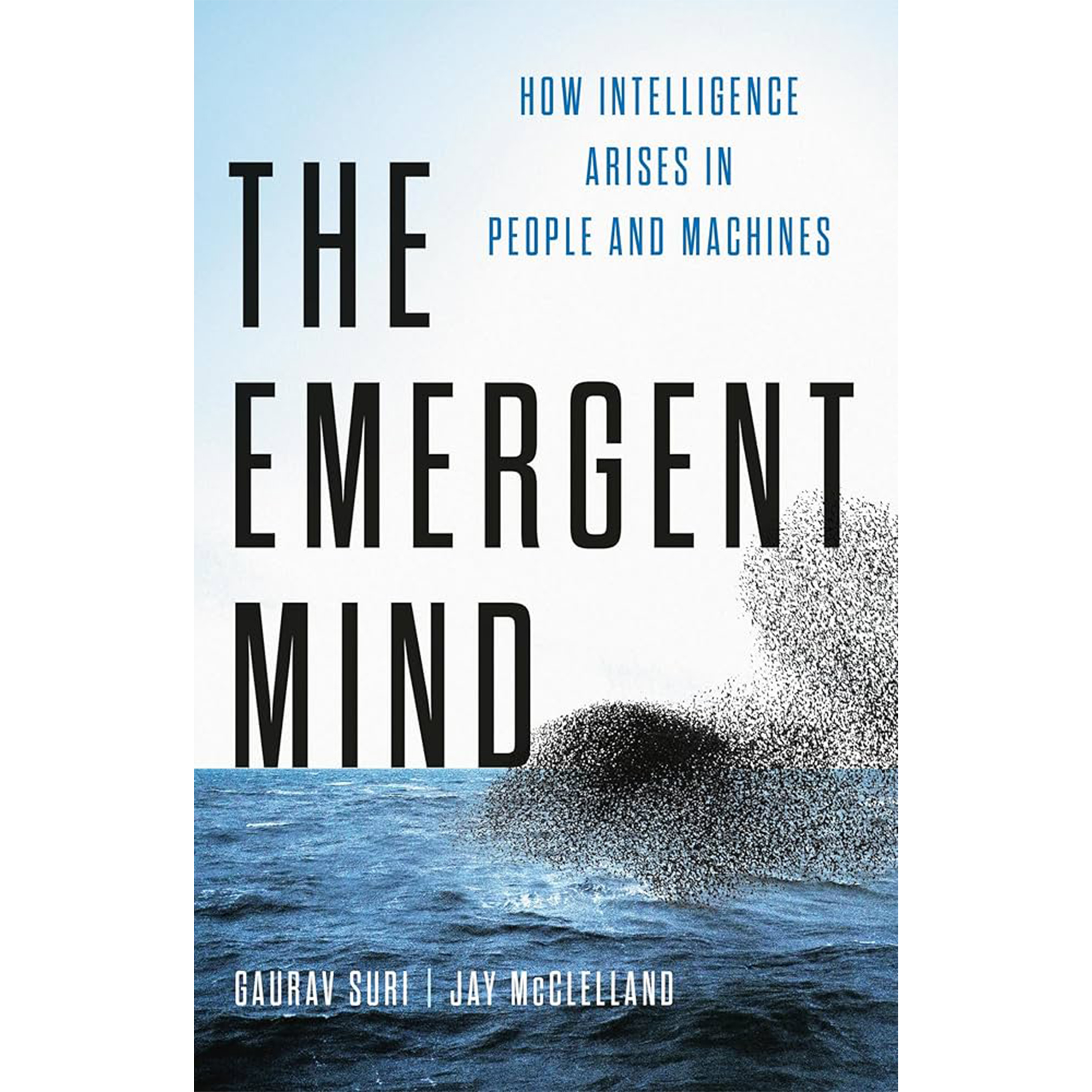
A Book with Legs
Gaurav Suri - The Emergent Mind: How Intelligence Arises in People and Machines
01:05:28
Loading summary
Transcript156 lines
- [00:03]
A
You're listening to A Book With Legs, a podcast presented by Smead Capital Management. At Smead Capital Management, we advise investors who play the long game. You can learn more@smeedcap.com or by calling your financial advisor.
- [00:23]
B
Welcome to A Book with Legs podcast. I'm Cole Smead, CEO and Portfolio Manager here at Smead Capital Management. At our firm, we are readers and we believe in the power of books to help shape informed investors. In this podcast, we speak to great authors about their writings. The late, great Charlie Munger prescribed. Using multiple mental models and analysis, we analyze their work through the lens of business markets and people. Today, we will discuss the human mind, how it works, and how it learns. This will give us a lens to view how large language models have come to be. What are their strengths and weaknesses? Ultimately, we will understand what makes all of this so human, I would argue. Gaurav Suri is joining us to discuss his recently published book that he co authored with James McClellan titled the Emergent How Intelligence Arises in People and Machines. A little background for our audience on Gaurav. He is a computational neuroscientist and an experimental psychologist. He is an associate professor at San Francisco State University and a distinguished scientist at the center of Effective Science at Stanford University. Grav is also. He's also co authored another book, A certain ambiguity, in 2007. He has a master's in mathematics and computer Science and a PhD in Psychology from Stanford. Gaurav, thanks for joining me today.
- [01:44]
C
Thank you.
- [01:46]
B
So what I got the sense from your book that obviously you had taken classes and got to know James through your learning experience. He walk into your office or yours into his one day and he's like, hey, you seem bright and capable. We should write a book together.
- [02:06]
C
Yeah, Cole, great question. So, first of all, I want to just say thank you to your podcast. I mean, people come from different communities and different backgrounds and different ways of looking at things. I think goodness happens when. When people from different backgrounds talk to each other, listen respectfully, and pursue truth. And any podcast that, and any firm that encourages people to read is close to my heart. So thank you for all you're doing and thank you for having me on. Yeah, my background is that I was a management consultant. I was a partner at Deloitte Consulting, and I used to, you know, work in areas not dissimilar from what you and your firm are doing. I did that until my 40s. And I just said that, look, I want to be a professor, and I still can do it. We're in America, where all things are possible. And by the way, this is not possible in any other country, I don't think. And it's not possible in any other time in history where a management consultant can say, at the age of 40, I'm going to do my PhD and become a professor. And I did this and I went to Stanford and I wanted to understand the mind. And the explanations that I was getting were like, did not ring true with me, and they were confusing. And one day I met Jay McClelland. He was giving a talk and I just endlessly started asking him questions. And much to his credit, he answered those questions. Jay had come up with the neural network view of the mind with David Rumelhart, the late David Rumelhart and others in the 80s. But it was one of many models until people started taking the neural network architecture more seriously because of AI. And so anyway, at that time, I didn't know about AI because large language models didn't exist. I just liked Jay and we started talking and we did research together and I would come to his office, we'd have lunch, we'd go on walks. And then one day we said, you know, this is so amazing that we got to write this book. And that's how the journey started and it ended in the emergent mind. And the point of the emergent mind is very. Is called what you said, which is we want this to lead to conversations where people who would not be necessarily thinking in this way, give this way of thinking a thought, just as we want to be exposed to intelligent conversations.
- [04:37]
B
So I'm gonna kick this off with. It's really kind of an open white space question. We talked a little bit about this beforehand. But you refer early on in the book to this idea of divine. Okay. It's a weird term to use because some people in this space would say it's computational, it's mathematics, it's very matter of fact. But you talk about other things of like the neural network of the human mind that it's not known. Now there's something unique and is that divine?
- [05:11]
C
Right. So, you know, the word divine is a loaded term because it means different things to different people. I'll tell you what it means for me, the word like I am Spinoza was a philosopher, a Dutch philosopher. And I believe in Spinoza's divine definition, which is the universe. Right? I mean the universe, our place in the universe, our understanding of the universe. For me, our ability to pursue understanding. For me, this is awe inspiring. And this is the closest I come to this experience. Of the divine, which is the universe, the process unfolding in it, our ability to understand, our ability to make sense of parts of the universe. For me, this is awe inspiring.
- [05:57]
B
Sure.
- [05:57]
C
Now, the word divine comes up early in the book because this philosopher, Descartes, one day was walking in a garden and he stepped on a stone and a nearby statue moved his hand. And Descartes says to the gardener, hey, what happened here? I stepped on this stone and this statue moved its hand. What happened? And the gardener says, presumably in French, oh, there's a system of hydraulic tubes underneath the stone that when you step on it, puts pressure and they're connected to the statue's hand and the statue moves the hand. And Descartes, many people would have left it that. Descartes goes home and comes up with a new theory of the mind where he says, well, maybe we can understand the mind mechanistically, that is, when you put your hand too close to fire, maybe there's tubes that move us back in a similar mechanism with fluid and pressure and whatnot. And Descartes was wrong about that. But what Descartes did was two things. One, he said, a mechanistic view of the mind is possible. He was wrong about his mechanistic view. That's not how it works. The second thing he did was. Is sometimes referred to as Cartesian dualism, which is he said that we can basically understand some things, like moving away from fire in mechanistic terms. But he attributed the other things, such as mathematics, poetry, love, these other higher human cognitions, to the divine. That's what Descartes did. The view that we take in the emergent mind is that even those aspects can be mechanistically understood. But I want to be clear. For me, mechanistic understanding is not the opposite of divine. It is divine. It is the highest form of human connection with nature.
- [07:45]
B
Sure. No, that makes sense. Explain the belief desire model.
- [07:51]
C
Right, so the belief. Great, great place to start. The belief desire model is this idea that, you know, Cole, when we go out and we ask people, hey, how do you think your mind works? Like we ask people, why are you. Why did you marry this person? Or why did you do this job and not the other job? And what people say is something like, I have a set of beliefs such as, I want to live in, in Arizona, or I want to go to school here, or I want a partner who has these attributes. These are beliefs, right? And they believe that the mind has these beliefs. They don't necessarily talk about where these beliefs come from. And they Say that human action can be explained in terms of us acting on these desires of ours and having beliefs about how we can get close to achieving those desires. That's the belief desire model, which is we have a set of ideas of things we want, and we have a set of beliefs of how we could get there. And in this sense, it's somehow a little bit of magic that we get these. And they explain. They try to explain the mind in these terms. Of course, the question for me would be, well, where do desires come from? Where do beliefs come from? And it's sort of stipulating the. The thing that it's trying to explain.
- [09:13]
B
Sure. Explain neurons in our mind, you say early on in the book. It's a very understandable thing.
- [09:20]
C
Yeah. So the mind is made of these cells. There's about 100 billion of them. They're called neurons, okay? And these neurons, they're complicated, but at a high level, they do very simple things. They have, like, a jolt of electricity. It's called an action potential that they fire sometimes, and they connect with other neurons at a high level. That's all they do. Produce electricity and connect with other neurons. Okay? Now, when they connect with other neurons, if neuron A produces electricity, and if it's connected to neuron B, then it can cause neuron B to produce electricity as well. That's what we have in the brain. Okay? Now, that's far from poetry or mathematics, right? So the challenge is, like, how do you go from these neurons to understanding the mind? And many people will tell you that, whoa, that doesn't seem possible. And the idea of the emergent mind is that, no, we can understand the mind in terms of these simple operations that neurons are doing. Let me give you a quick example. Let's say a bus is coming at me, and I move out of the way, and we're together out on the street. And you say, gaurav, what did you do? Why did you get away from the moving bus? And I'll say, isn't it obvious? I don't want to be hurt. And so I moved away. That explanation that I'm giving you is an explanation about the conscious mind.
- [10:57]
B
Yeah.
- [10:57]
C
What's happening underneath the covers is that light beams from the bus, a big hurtling object, are coming into my eye. The neurons in my eye are producing electricity. They're connected to other neurons that are also producing electricity. And those neurons are connected to neurons that are connected to the muscles of my leg, which move my muscles and get me out of the way. I will do this Even if I can't have a conscious explanation, you might ask me, why are you going to the fridge to get a glass of water? And I'd say, I'm thirsty. But there are neurons that are measuring the salinity level in my blood and are firing when the salinity level is too high. So these are examples of how neurons doing very simple things can lead to explanations of the mind.
- [11:47]
B
Sure. So you explain early in the book this analogy of, like, pools of a waterfall, and you're using this to kind of explain the relationship of, say, learning or you taking in information. Can you explain this picture?
- [12:03]
C
Yeah. Great. I'll say. You have great taste. These are questions that I think are best suited to people who have not met neural networks before. So the water analogy in the book is simply like water flows between pools when those pools are connected. Right. It is a channel. So that's how one neuron influences the other neuron. When we learn something new, we're essentially digging a channel you can think of. It's a metaphor between these two pools. And we can measure this. Right. So we can measure new connections being formed between neurons that weren't connected before. And anytime we learn something new, we form a new connection. So the pool analogy is that once a connection is formed, if there's a lot of water in this pool, it'll flow down to this other pool because there's a channel between them. If there's no channel, then I can have all the water I want here, and it's not going to cause water here. The water in this corresponds to these bolts of electricity we talked about called action potentials. Let's do. If your game. Let's do an association word game. I'm going to say a word, and I want you to tell me the first thing that comes to mind for you. Is that cool?
- [13:21]
B
That's cool.
- [13:22]
C
All right, so I say green money. Okay, cool. Great. So here's the thing. Now, why. What happened here? When I said green, you said money. How did this happen? This is the question we're confronting.
- [13:36]
B
Sure.
- [13:37]
C
Okay. The word green through this computer, through your phones, entered your ears, started making the eardrum oscillate, caused some neurons to fire other neurons, which led to neurons that represent the semantic definition of green to fire. Those are firing. Now, through your experiences, those neurons have gotten connected to money. Neurons that represent money.
- [14:05]
B
Sure.
- [14:06]
C
Why did they get connected? They got connected because you've often thought about green in connection with money. Maybe give me some green. Or you've looked at dollar bills which are Green.
- [14:17]
B
Yeah.
- [14:18]
C
And so that's how these channels get formed. And now what happens is when these green neurons are putting electricity, they now have a channel into the neurons that represent money, and they get electricity. And now when I say green and you say money, that's the connection. Now, if you hadn't had all these experiences related to green and money, you might say tree right now. Why? Because that other person who says tree has different sort of channels. Or in the context of politics, you might say green Party or something. I don't know. We say different things, but that's an explanation of how the mind is operating in simple terms.
- [14:58]
B
Yeah. Teach us what spikes are in this process.
- [15:02]
C
Yeah. Spikes are these bolts of electricity. They happen many times a second. You can connect audio devices and you can put an electrode in people's or animals brain, and you can hear these because these devices convert electricity into sound. And they sound like pop, pop, pop, pop, pop, pop. And neurons can be slow PA, pop, pop, or fast pop, pop, pop, pop, pop. So your green neurons were going pop, pop, pop, pop, pop. Because I'd said the word green, they connected with your money representing neurons, and they started to go pop, pop, pop. And that's a spike. That's just a spike of electricity. And the signaling mechanism in the brain are these spikes.
- [15:46]
B
So you also talk about, like, the difference in neurons. So I think you're talking earlier in the book about a retinal neuron, for example, and you talk about how we know that light affects that neuron, depending on where light is.
- [15:59]
C
Yeah. So how does our neural networks get these spikes? Well, through our sense organs. Because when I said green, the sense organ for you was your ears. You open your eyes and right now I'm looking at you. So I'm getting information about you and the poster behind you, which is red and with white lettering, which says a book with legs. So these signals are entering my eyes. I don't understand them with my eyes. My eyes are not a camera. My eyes are connected through these neural pathways to the back of my head. And those are connected to these other places in which I integrate all these messages. And now I look at it and I identify it as a rectangle with red coloring with a poster, and I can read the lettering on it. And so input starts from the outside world, is taken in with our sense organs, and our connections allow us to make sense of the world, because these neurons that are activated with sense organs activate other neurons that are not connected directly to sense organs, but they're incorporating information from all these other experiences that we've had.
- [17:15]
B
So what is the structure of a neuron? I think you explained it as a triangle in the book. And what are the four properties of communications between these neurons?
- [17:23]
C
Yeah, I think for your listeners who've maybe not encountered neurons before, I would just think of a neuron as this long thread like structure with a little head on top. What does the head do? The head runs the cell. It controls the cell, but it collects information from other neurons before it. These other neurons are, let's say they're generating electricity. Pop, pop, pop, pop, pop. There's a gap between, let's say, this pre neuron and the post neuron. We're the post neuron. I'm the post neuron. Let's say you're the pre neuron. You're sending me electricity. Pop, pop, pop. There's a little gap in that gap. These chemicals called neurotransmitters, they flood that gap and they cause me, the post neuron, to potentially start this pop, pop, pop. Electricity of my own.
- [18:17]
B
Sure.
- [18:18]
C
So these are these long trains of electricity. So all I want your listeners to take away about neurons is they generate electricity either directly because of the sense organs or because they're connected with other neurons that are generating electricity and input is received from the world, and we act on the world. This is why I got out of the way of the bus, because I see the bus. It enters my eyes. The light enters my eyes, starts these neurons from firing. And these neurons are connected to other neurons that eventually signal my muscles to get the heck out of the way.
- [18:56]
B
Sure. Hi, I'm Cole Smead, CEO and portfolio manager here at Smead Capital Management and host of this podcast. If you enjoy this podcast, I'd like to invite you to check out smeedcap.com at our firm. We are stock market investors. We advise investors who play the long game with a discipline that has proven success over long periods of time. Learn more about our funds@smeecap.com past performance is not indicative of future results. Investing involves risks, including loss of principal. Please refer to the prospectus for important information about the investment company, including objectives, risks, charges and expenses. Read and consider it carefully before investing Smead funds distributed by Smead Funds Distributors llc. Not affiliated. Let's see. So I want to go next. You talk about the idea of driving without thinking. Okay. And I think this is a really interesting question and, like, experience that we've all had. You know, for those of us that have been driving for years, you're running a process not dissimilar to maybe how, like a large language model. So, like, we have Waymo here in Arizona. It runs a very similar process as this person who's just driving nonchalantly and kind of programmatically, if you will, Is that consciousness?
- [20:11]
C
Right. So when we drive without awareness, we're driving without basically consciousness. Right. And it turns out that it's very easy for us to conflate consciousness with intelligence. We humans, unlike large language models, are both conscious and intelligent. Okay. But when you ask most people about why they do the things they do, they point to conscious, explicit thoughts. Our proposal in the book is that the underlying neural network called the brain, produces our intelligence and produces our consciousness, often together. And we often think that our consciousness is what's producing our intelligence, but in many cases, it's accompanying our intelligence rather than producing it. Meaning it is possible in some cases to have intelligence without consciousness. And we're aware of this, as you nicely said, when we take actions like I wore my pants this morning without really thinking about what I'm doing.
- [21:21]
B
Sure.
- [21:22]
C
And what's happening is that the cue of coming into walking into my closet and seeing my pants hung and wearing my pants is happening automatically without my consciousness having to bother with it.
- [21:34]
B
Sure.
- [21:35]
C
Right. And so intelligence is possible without consciousness. And there's a ton of. And I'd love to talk to you about this. There's. There's a lot of evidence where sometimes the consciousness explanations that we give for our actions are just made up. Right. So there's this lovely experiment that people did where they took four. In consumer marketing, they took four stockings, and they asked people to pick one of the four stockings, and about 50% of the people picked the last stocking. Now, one of the things we know about human choice is people are disproportionately likely to pick the last thing that they looked at. Okay. When we ask people, hey, why did you pick that last stocking? They say something like, oh, I think I like its material. It's softer, or like its color. But the stockings were identical.
- [22:23]
B
Yeah.
- [22:24]
C
So we often will come up with conscious explanations to explain our actions, even though the real causes might be generated by this neural network.
- [22:35]
B
Well, which is also not dissimilar to what the LLMs will do, which is they'll make up stuff just like we do.
- [22:40]
C
Well, LLMs hallucinate, right?
- [22:42]
B
Correct.
- [22:43]
C
Now, LLMs don't have consciousness. And by the way, while we have some pretty good ideas of how our brain causes our intelligence, we don't have much of an idea about how our brain makes Consciousness. I mean, people have theories, but we don't know.
- [23:00]
B
The other study that you talked about in the book, I loved your Good Samaritan study.
- [23:04]
C
Yeah.
- [23:04]
B
Because they are doing all the intelligence without any of the consciousness of what they're talking about because they actually don't practice it or do it.
- [23:17]
C
Right. Well, so the large language model doesn't have human experience. It doesn't have a body. It's not moved by hormones related to empathy or chemicals related to empathy. Measuring suffering. We recognize suffering because we've suffered. Right. And. And so the Good Samaritan tale, just. Just to make it clear is. Is this idea where it's in the Bible, where this person was suffering on the side of the road and nobody came and helped him until somebody did. Right. And. And. And it was a tale that sort of talks about helping people in need. I mean, that's. That's the tale.
- [24:01]
B
Yeah. So for no apparent. Like, there's no payback. There's no reason.
- [24:05]
C
No payback. That person who helped this was a Good Samaritan. They did it because they did it. They're a good person. So psychologists get interested in this idea of the Good Samaritan tale, and they say, why do we help? And there's one clever explanation where what they did was they took seminary students, Right. Students studying to be priests, and they put them in two conditions. They asked them to go make a talk.
- [24:29]
B
I think this is Princeton Theological Seminary, if I remember correctly.
- [24:32]
C
Yes, yes. Yeah. And they asked them to do a talk. And in one condition, they're late for the talk, and in the other condition, they're not late. And on the way, they encounter somebody in need, and they measure who stops to help. Well, who stopped to help was the people who had time to help. Right. And so these psychologists argue that it's the context that determines not our goodness, but our context that determines whether we help or not.
- [25:03]
B
Sure.
- [25:03]
C
But our point in the book is that it's not one thing, it's many things, because there is such a thing as people with a greater propensity to help. So that also contributes. The context contributes, whether the person looks kind or not contributes, whether the person looks threatening or not contributes. So it's not one thing. And a neural network allows us to study how all of these factors can come together.
- [25:29]
B
So let me ask you. I'm going to kind of put two of my questions I had to you together because I think, you know, I thought a lot about this. I don't know, I remember someone explaining, you know, why does every Woman in the world say, the western world have a little black dress in their closet.
- [25:45]
C
Okay.
- [25:46]
B
And you know, people say like, oh, because we're heard, you know, we're heard, we have a herd mentality. So you know, we heard around certain things and whatnot, as though it's a big negative, it's a pejorative, I would say. No, no, no, actually I've had my mind changed on that. It is an efficiency argument. In other words, I need to have that thing for that occasion that I know I can go to and I need that efficiently, which makes sense for a lot of women out there in the world. Okay. So is the mistiness of memory really an efficiency argument for the mind? In other words, the mind needs to not cling to everything because it to be highly efficient for adapting to what's new. And that also explains things like stereotypes. It's. They're trying to be more efficient in how they approach various descriptions and information.
- [26:34]
C
Great. So if we were a bunch of if then else machines like if this happens, do that, we'd have a very hard time generalizing.
- [26:43]
B
Correct.
- [26:44]
C
Now you can recognize an apple, even though you probably can't think of many specific apples that you've seen in your life, but you have the concept of apple. And that means somehow you're taking the experience of encountering individual apples and being able to generalize to the concept of apple. And neural networks showcase how this generalization can happen, which is very hard to do with memory systems that are rule based, like file drawers, that if this is one apple, that's the second apple. But gee, that's not how we think of apples. Right? So this little black dress example that you talk about is that we have a capacity to generalize from various inputs. Now this leads me to another point, which is humans are social organisms, right? And we are informed by each other. We generalize about what's cool, what are other people doing that's cool. And this generalization, whether about apples or chairs or black dresses, is crucial. And it's enabled by the mistiness that a neural network makes possible. Mistiness in the sense that it's not every episode is not recorded like a video recorder. It feeds this general concept, the underlying general concept. And thank God it does, because otherwise we wouldn't make concepts. And if we didn't make concepts, we couldn't live in the world.
- [28:12]
B
Sure.
- [28:13]
C
And by the way, we couldn't be informed by culture. And for me, the biggest single revelation about writing this book is that to build pro social societies, we have to build A culture in which we're encouraging pro social actions into our neural networks. Because there isn't this if then specificity in the mind, this rule based specificity in the mind. One of the biggest ways we as people have to create civilization and to create things we like is to create cultures that enable pro social activity.
- [28:54]
B
So I'm gonna on that, I gotta. This is later in my notes, but I wanna ask you this. If we think about the neural network of our mind, right? There's these connections which are very analogous to social connections in society, right? There's these networks, there's nodes, there's things like that that are representative of a traditional network like our minds. And how do you think about companionship in that? Because I was also thinking about like I live with a woman, I call her my wife, her name's Katie. She's lovely. It's a different mind, but I think about how we fire or misfire together through our minds. If that's. You know, it's a weird question to ask, but I thought a lot of it as I was reading your book. Because there's a lot of things that because of our shared experiences together we will fire very similarly or there is a strong connection to something.
- [29:45]
C
Yeah, that's great. The book is about networks of neurons or the simple processing units. But you're absolutely right in that instead of having networks of neurons which we see in the brain, we could consider networks of people. In this example, in networks of people, we'd say two people are connected when they can influence each other's thoughts. Correct. So my wife and I are connected because we talk every day and we can influence each other's thoughts just as you and your wife. But before today's conversation we were not connected. So you could be having these thoughts but they wouldn't influence me and vice versa. So this is a nice analogy to what's going on in the brain. A neuron is, if it's connected to another neuron, will influence it. But if it's not connected, it's not going to influence it. And when we learn new things, we can make a connection between two neurons that weren't connected before. Just as when we meet new people, we're making a connection that we hadn't made before. Just as we can study neural networks of the brain, we can study networks of people.
- [30:54]
B
Sure.
- [30:54]
C
And it's incredible because we can make predictions about how groups are going to behave. They that depend on this connectivity and an emotion going through the group. Some things travel through the group, some things don't some things get viral and some things don't. And network analysis is a great way to understand how some things really take hold and light up and others don't.
- [31:22]
B
So what is syntactic and semantic interpretation?
- [31:26]
C
Yeah, so this goes to language, and this goes to a debate about what language is, Right? So syntax means following grammar, Right? Syntax means that the language is determined by the rules of grammar. And then if you believe that that's how language is created, then one has to sort of answer the question, where do these rules come from? And if you ask people, philosophers and linguists, they will say something like, they came about in human evolutionary heritage. There's a different way to think about language, which is language is for the communication of ideas. That, yes, syntax emerges. But syntax, just like consciousness, need not always drive intelligence. Syntax does not need to drive language. We care about the meaning of things. Right? So let me give you an example. Cole put the wallpaper on the table, then he put his coffee cup on it, and what does it refer to? Well, it obviously refers to the table because you put the wallpaper on it, then you put your coffee cup on the table. But if I say, cole put the wallpaper on the wall, then he put his coffee on it, now all of a sudden the grammar is exactly the same, but the second produces a mismatch because of we put meaning in things like we are embodied creatures. We know that wallpaper is on horizontal things, and you can't put coffee cups on horizontal things. And that's semantics. Semantic means having to do with meaning, and syntax mean having to do with grammar and structure. The point of this debate about syntax and semantics is that many of us, myself included in the neural network tradition of the mind, which we explain in the emergent mind, believe that its meaning, language, is invented for the communication of ideas, rather than the output of this magical seeming grammatical syntax engine. That's the key distinction.
- [33:48]
B
So my next question is, do brains calculate on expected values like economists would hope for?
- [33:55]
C
Right. So I think a lot about this issue, and I think that the expected value theory of decision making is a successful theory because in many cases it explains what human, humans are going to do. But I think that we don't have neurons that are dedicated to calculating expected value. I think what we do sometimes incorporates our preferences, but it also incorporates a bunch of other things, like what we're thinking about, what we're paying attention to, what others around us are doing, what we've done in the past, what mini habits we have. Right? So we have this really lovely Study. I think it's lovely. And the study is we ask people to choose between two pictures. One is a beautiful picture of nature and the other picture is disgusting of wounds. 90% of the people want to see the nature picture. Okay, but here's the amazing part. First of all, I wonder about the other 10%, but let's all go there. But here's the other thing. If I start with the bad picture of the wound and say you can just press this S key to switch away from the bad picture, only 50% of the people switch away to the nature picture. That means that choice A versus B is different from having to take a proactive action of switching away from the bad picture. What's wild is that if instead of the S key I ask people to press a forward slash key to switch away, even fewer people switch away from the bad picture. And this means that the more familiar action is we're more likely to do it independent of the value, the inherent value involved.
- [35:50]
B
Yeah, I agree. So I was thinking about this. I mean, I'll use an analogous way of. And I'll just use like what's going on now. Okay, so to your point, as someone who deals in markets, I don't question whether people can understand reasons for doing one thing or another.
- [36:08]
C
Yeah.
- [36:08]
B
I think it's many times the non economic things that end up being valued more highly. So for example, if I walk into a room right now and say, hey, here's the deal, this AI hyperscaler game is a big capex cycle. I can show you three or four of these other ones that they don't work out well. Well, that's a logical argument. It's maybe an economical argument, but that might not actually be driving any decision making for say, I don't know, one standard deviation of the public. So, you know, call it 2/3 of the public. It is. When they walk into an investment meeting, do they have to defend what they're doing?
- [36:44]
C
Yeah.
- [36:44]
B
Is there a social thing or I just don't want to fight that or I don't want to have to be socially awkward when I talk about what I'm doing. And I actually think those things tend to have higher value and weight to a lot of people in the long run. Because it's also efficient.
- [37:01]
C
Completely agree. I'm not sure it's because it's efficient. I think it's because we're social animals. Right.
- [37:08]
B
Oh, I agree. I agree.
- [37:09]
C
Right. We are guided by each other and that's our deepest nature.
- [37:16]
B
I agree.
- [37:17]
C
My son and I, we did this experiment where we measured when people take the stairs and versus when they take the escalator. So we live in the San Francisco Bay area and we, you know, 97% of the people reliably take the escalator. It's 3% of the people who will take the stairs. Do you know what is the largest single influence on getting somebody to take the stairs? It's whether somebody else is also taking the stairs at that time.
- [37:42]
B
Wow.
- [37:42]
C
You know, we are like this. This is matters. It's. It's like steroids. It matters so much what we do. It's our falling, but it's also hope. It's hope because we can influence each other and that means we can influence each other for good outcomes. Like, I believe in civilization, right?
- [38:06]
B
Yeah.
- [38:06]
C
I like to go out and I like to see trees and gardens and buildings and cleanliness. I love all of this. And how do we create civilization? By influencing each other to work for each other in pro social ways. And thank God we are a social tribe because that means that we have this hope. But we can also get in bad social circles where we influence each other to kill each other. Right. Right. Now, I don't know if you're aware, there is a massive war happening in the chimpanzee community in Africa where there's 200 chimpanzees are fighting with each other in brutal ways. That too, they too are social animals. So our social influence leads to outcomes that are clearly beautiful and wonderful and can lead the same influences can lead
- [38:57]
B
to disastrous outcomes or just perverse outcomes. I mean, to your point, we're very social, but yet marriages in America are down 40% compared to 30 years ago. So to your point, even with stronger connection visually across the Internet, we are being less social in forms of companionship, not dissimilar to the chimpanzees destroying themselves. We're just choosing to not recreate ourselves.
- [39:23]
C
Yeah, well, I think that what's happening on the Internet is a facsimile of communication. It's not like we communicate when we talk to each other. I mean, this is our heritage. Right, Agree. Like, that's why we'll say brutal things on the Internet, because it's anonymous and we'll never see the person again. But we're less likely to say brutal things to each other because there are certain expectations of human interaction.
- [39:51]
B
It's like a mask. We put on a mask and communicate and then we're like, oh, yeah, that was just my social media personality.
- [39:57]
C
That's right. Or we allow impulses to come out, which otherwise would be restrained.
- [40:05]
B
We hope you're enjoying the podcast. You know, we work hard putting together this show, but we work even harder for our investors at SMEAD Capital Management. At smead, we believe in disciplined investing, which is why the SMEAD funds have a proven track record of long term outperformance. If you're an investor who plays the long game and want to invest in wonderful companies to build wealth, we invite you to visit smeedcap.com Past performance is not indicative of future results. Investing involves risks, including loss of principal. Please refer to the prospectus for important information about the investment company, including objectives, risks, charges and expenses. Read and consider it carefully before investing. SMEAD Funds distributed by Smead Funds Distributors llc. Not affiliated so you talk about this idea of like Coke commercials and the feelings you have when you drink Coke. And to your point, it's like the things we want. Or you talk about emotional responses affecting other emotional responses. So you drink a Coke, you're with friends, you have a good time, and Coke does a lot of imagery around Christmas and fun and all this stuff. So you have that on one hand, you think of sugary drinks and then you have this idea out there, well, those are bad. So the network can reorient itself as we see in networks. They do occasionally reorient around different nodes. So I can also make the argument that we could reorient around a world where sugar drinks are bad and it's like cigarettes are bad now and things like that. Buffet, when he was asked about this, I thought it was just the funniest way because it reminds me a lot of what you're saying. As you discuss this. He says, well, yeah, I might be healthier, but would I be happier? And it's a funny way of thinking.
- [41:53]
C
He was a big investor in Coke, right? Wasn't Warren Buffett a big investor?
- [41:56]
B
Yeah, he is. But he was pointing out I could be healthier. But his question is, but is that what I want as a human? And to your point, you're kind of touching at that is what do we really want? Even though all the logic and everything could be in the face of it, because that is our conscious decision.
- [42:14]
C
Yeah. You know, the Coke story is really interesting because when you do blind taste tests between Coke and Pepsi, it's Pepsi that wins. I love that.
- [42:23]
B
Here's the other thing. So again, weird stuff. So, and this is, I mean, I was like reading your book and I can just tell you. So I was sitting at an event this last week. You know, I would say More than at any point in my life, I drink non alcoholic beer. So athletic beer, for example, I commonly drink that now. And the funny part is I was in an event and I maybe had two athletic beers. So there's no alcohol in these things. Right. And yet I was getting feelings and emotions in the setting where I was in where you would have thought I just slammed a couple beers and it's like, hey, it's a young night, let's go.
- [43:01]
C
Yeah, yeah, yeah, totally.
- [43:02]
B
And it's the neurons firing and saying, hey, I've been here. I felt this, I tasted this before with no alcohol.
- [43:08]
C
Well, that's a great story. I mean, there's this placebo effect which is when you take pills, even though they might be sugar pills or whatever.
- [43:16]
B
Yeah.
- [43:17]
C
It sometimes works in healing the body because the body expects to get better because we've taken a pill. Now there's a lovely study which is very similar to your experience with the beer, with the athletic beer. The study was they gave people shots of vodka. Only half the people were given like water with lemon in it with a little bit of spritzer. And they didn't know that they didn't have any vodka. So they were, they were giving shots, but their behavior was indistinguishable from the people who were having shots. Because it's the power, expectation and context. Right. Like we're in a context where we expect certain feelings to arise and that expectation in our neural network causes those behaviors to arise. So back back to the Coke and the Pepsi thing. Yeah. Pepsi is preferred on, on blind taste tests. But, but Coke has attached its brand new to these great feel good moments such as friendship or Christmas or whatever. And the thought of Coke is not only dependent on the taste of Coke, it's associated with the branding of Coke, which is very specific about good affect, good emotions. Pepsi doesn't have such branding. Right. Pepsi branding changes from a singer to an athlete, whatever. It's not this single focus branding on pro social emotions. And that's why Coke is Coke.
- [44:44]
B
And Pepsi is not also on that same score for like, you know, tasting things when, you know, when the most interesting man in the world came about in beer commercials, same thing, right. People looked and said, I want to drink that because, you know, I want to be the most interesting man in the world. And you saw a big spike, particularly in older age beer drinkers.
- [45:08]
C
Yeah.
- [45:08]
B
To be, you know, I don't often drink beer. Right. That was the whole branding around it. Let me pivot a little bit. Cause I think you.
- [45:16]
C
But When I do, I drink Dos Equis.
- [45:18]
B
Equis, yeah. Yeah. Dos Equis. Yeah. So you also, you know, as you build out the conversation of what our neural network is in our mind, it provides a very good context for explaining what Alzheimer's is.
- [45:33]
C
Yeah. You know, or what various forms of dementia are. Right. So when I said green and you said money, it's because you had connections between green and money. What happens in some forms of dementia are these connections get destroyed, either because the neurons themselves are destroyed or the pathways are destroyed. And so we start losing knowledge because we're losing connections. And now when I say green to someone who doesn't have any associations with green, they might not respond, or they may respond with something very random. And it's because the knowledge of the system is contained in its connections. And these diseases, they decimate the connections. Right. I mean, that's fundamentally the loss of meaning which happens in these various forms of dementia.
- [46:24]
B
You talk about cartography as a good example of distributed representation. What is distributed representation? And how can you say this?
- [46:34]
C
Yeah. So the cryptography example is that when we want to understand something, we build a model. Right. So in the emergent mind, we build a lot of models to understand memory, to understand meaning, to understand language, perception, we build models. Now, one criticism of this is, well, look, but your model is simplified. Well, what if we didn't try to simplify the model? Pretty soon we'll have the complexity of the brain with 100 billion neurons. And the point of a model is to simplify. The story of the mapmakers is that there was a town in which these people made more and more accurate maps. But the more accurate a map is, the bigger it has to be. And pretty soon they were making maps that were as big as the region that they were depicting. Entire towns were covered by the map. And the point of the story is simply that when we make models, we have to choose an appropriate level of detail so that it helps our understanding without increasing our complexity so much that the complexity interferes with our understanding. And that's the trick that neural networks do. What I want to tell you is that the AI stuff, these ideas that Jay and others came up with, were in the 80s, psychologists came up with the basis of the modern AI revolution, the large language model revolution. But it wasn't until there was a lot more scale with data that those ideas could be applied to make these large language models.
- [48:09]
B
Sure.
- [48:11]
C
This is an example where you make a model, you capture ideas in the model, and those ideas are what's important. Rather than. Does the model say everything about everything? Models shouldn't say everything about everything.
- [48:24]
B
Sure.
- [48:25]
C
They should simplify appropriately.
- [48:26]
B
Well, so let's, let's off of that. We talked about this beforehand, but I want to bring this up because this is to your point, these concepts are not new.
- [48:36]
C
Yeah.
- [48:36]
B
But the arguments being made in some cases are, I don't want to say revolutionary. Maybe that's not the right term.
- [48:46]
C
Yeah, I think they are revolutionary ideas. Okay.
- [48:48]
B
Yeah, but so like. So let's talk about Blake Lemoine as an example. Okay. So I mentioned this before, but I was at an event, it's called the COSM Technology Conference. He came to it in 2023 because, you know, he worked at Google at the time. And so he made the case that we've reached sediency or the idea that like the, you know, the machine can train itself and it can correspond as the you or I would with consciousness in a way. And he goes through you. Take an excerpt from his conversation with the machine.
- [49:20]
C
Yeah.
- [49:21]
B
Is that what he's claiming? What is your view of that? And what do you think our takeaway should be for someone that's in neural networks all the time?
- [49:31]
C
Yeah. No. Thank you. So Blake, lovely person. I've seen videos of him. He talked to a early version of a large language model. So right now if you go to Gemini or Cloud or ChatGPT and ask them, hey, are you sentient? It'll say, no, no, I'm just a large language model. But at that time, that's because somebody's given it that rule when it's in the model, in the model that's already there. But when Blake was working with these models, there was no rule. Right. So he would ask the thing, are you sentient? And say, of course I am. And he'll say, what are you afraid of? I'm afraid of being turned off. So he had hours of conversations with these machines and he came up with the view that these things were sentient. Like a sweet little child, he called them, who wants to help everybody? And he, of course, Google removed him from his job. And they said that, no, these models are not sentient, they're word associating machines. I have a lot of sympathy for plague because I understand the mistake. The mistake is to conflate intelligence with consciousness. So Blake found a machine that was intelligent. No doubt about it. Right. He would give it puzzles and it'll give it beautiful interview. So it was intelligent.
- [50:43]
B
Yeah.
- [50:44]
C
And so we think that our intelligence comes from our consciousness. So Blake's Assumption was that something this intelligent must be conscious. It's not conscious, it's intelligent. Large language models are far from human cognition. In many ways, they exceed human cognition in some ways, but in some ways they're not even as intelligent as a mosquito. In some ways, they exceed what humans can do. They are intelligence because of that. Their intelligence comes from their neural network, just as our intelligence does. But our intelligence is a much more flexible and different neural network than the neural network of a large language model.
- [51:27]
B
Let me ask you kind of a weird question. Have we built machines before that we didn't necessarily understand?
- [51:34]
C
Okay, so it's true that we don't understand the details of what a large language model is doing, meaning, because it has billions of these units. So we can't say now this, now that unit, in this sense, it's emergent units are activating each other through their connections. Connections are getting built with learning. And so we are surprised by many of the things that a large language model does. But in principle, we fully understand the large language model. Like we trained it on a lot of data and it was able to capture these properties. So what we don't understand is the specifics of how it was able to generalize from its training data to be able to make sensible proclamations in data that it wasn't trained on. We don't precisely understand that. We understand it in principle, but not precisely, just as we understand some medicines in principles. This is your question which is, have we ever made machines that we don't fully understand? Yeah, medicine, medicines sometimes work and we don't necessarily know the full details of why they work. We, we try the medicine. It, it happens to work. Many medicinal discoveries are with trial and
- [52:54]
B
error or, or side indications where we find something out from the compound that wasn't in the original indication.
- [53:02]
C
Yeah, like Viagra was like that, right? Viagra was for heart.
- [53:05]
B
Heart medicine. Yeah.
- [53:06]
C
Hard medicine. And all of a sudden people are a doc, can I have some more of this?
- [53:10]
B
Right, yeah. That actually happened in 80s. My dad had a stock broker, brokerage client who is a friend of my grandfather's. And he's like, hey, you wouldn't believe what this medicine does.
- [53:18]
C
Exactly. So I think the human experience is like that. Like many times we'll come up with things that have behavior that we can't fully pin down the way we can pin down a geometric theorem. But nevertheless, we do understand them in principle at a high level, but not necessarily at the granular level.
- [53:39]
B
Sure. Let me ask a little bit different to this kind of Question we're around. Is my, you know, is one of my better tasks or maybe my spouse, right. Like he's my wife and we're working together on something. Is one of her better tasks to guess what I'm about to say or is her better task is to compliment what I'm thinking about?
- [53:59]
C
Yeah. Interesting. So, you know, now you're getting into the nature of what's desirable in human relationships. Right.
- [54:09]
B
Because the large language model might do best at guessing what I'm about to say.
- [54:13]
C
Exactly. So here's another version of your question. Can one fall in love with a large language model? Well, some people can. I can't. I'll tell you why I can't. Because I want the shared experience of having a body, feeling emotion, feeling one with nature, feeling awe, feeling grace. I want that, that's a big part of what makes me me. And if I knew that the thing was just simulating me or simulating empathy, even if it had a body like a woman's body. Right. Even if I knew that it's not real in some sense, it didn't share my feelings for me. That's a non starter and it may be unreasonable. But hey, I'm a human. I get to. I'm a human chauvinist, by the way. I like humans and I'm using that, by the way.
- [55:11]
B
That's a great term. I'm a human chauvinist.
- [55:13]
C
I'm a human totally. I mean, some people talk about rights for machines and all that. I'm like, no, no, no, these things are tools and let's keep them as tools. I'm a human chauvinist and I love other humans and it's because I understand that we have a shared experience. So I'm not, I'm not that impressed by. Well, at some levels it's very impressive about pattern extraction and, and it's a key aspect of intelligence. But if it's about love and empathy and relationships, no, that doesn't cut it for me.
- [55:44]
B
Well, I agree and I'm going to, I'll add something and I. And you want to jump in on this? By all means. I don't know why. My mind's been around this a lot lately. So I'll just kind of verbally process and I'd love your take on this. So, yeah, if someone said in that human experience, like, you know, we talk about intelligence, we have intelligence, it can have intelligence. I actually think our superhuman power is faith. So, for example, let's use our spouses as an example. These Women have shown faith in us as their husband, sometimes inexplicably, like, why us, why this situation, why this context, etc. I would say the other thing that's odd, and you touched on this a second ago, is the idea of love. By definition, love is doing something for someone that they don't deserve. It is in some ways like the Samaritan context, but it doesn't have to be in where someone's beat up on the side of the road, someone just say, you know what, there's no reason for this, I'm just gonna love on you. And there's no justification. And they just did it. And so I think a lot about those two aspects of the human experience, to your point. And I love that term human chauvinist, because I think of like parts of where my wife does that or where she's shown this faith in me. Like, did she know what it was going to be like? 42 year old Cole? Heck no. That was completely outside the model. But yet she's like, I have the faith to go through that process and get there with him without ever knowing whether he's good or bad or whatever that is. That is so uniquely human. And ultimately faith, or what I would argue faith that turns into trust is what our societies are based on. Right. Like you think of contract law, it's good faith. It is by definition that. And so I think about those ideas as being so important to the human experience. Yes, they can be important to the machine's experience, but the machine might not have a justification for any context to do that for the first time. Is that fair?
- [57:40]
C
Yeah, I don't think the machine has any experience. So I agree with you. Right. So I agree with you in this sense. I think that human behavior is a beautiful emergent product of many things. It's not this reasoned self interest alone. It's not, we are capable of empathy, we are capable of well spirited gambles. We're capable of proceeding without knowledge, we're capable of happiness even around suffering. Machines are not having these aspects of our experience. And we are capable of, even based on our experience, we're capable of persisting in adversity. We have many aspects of intelligence. The LLM is based on one of those aspects, one of many. And the LLM meantime, it's based on language pattern prediction. And that is one part, one basis of our intelligence. But by far it's not the only basis. Right? We're not limited to words. Thoughts exist without words. Thoughts can exist in images. So many times I'm listening to somebody and I already know I think they're wrong without having any words for why I think they're wrong. Or I'm watching Jeopardy and I know. I know the answer without the answer coming to mind. So this happens a lot. That's because language is not thought. We have other modes of thought. The large language model deals in the modality of language. We have goals. The large language model doesn't have any of its goals. We have efficient learning. From a few instances, we have the capability to learn very quickly. Large language models have to be trained billions and billions of times. There are many aspects of the human experience that are outside the large language models. I do want to say, and this goes to an initial conversation. I see. In principle, there isn't some reason why we can't understand our working. Our workings are beautiful, profound, sublime, and understandable. And it is in this understanding that I find my awe.
- [59:58]
B
I totally agree. I mean, you just explained the big advantages of us against the neural networks. Right. We can use beyond language. We can use feeling sense that, you know, you don't have to punch into a QWERTY keyboard.
- [60:13]
C
Yeah,
- [60:15]
B
let's see.
- [60:15]
C
I could.
- [60:16]
B
I could go on for days with this. This is too much fun. And just to give our listeners a sense, I mean, there's a million things that we need to go over here in my notes. Forward Feed. Feed forward networks. Really interesting concept for thinking about what we're talking about here. I mean, there's a million other things I have in here. Hebian learning.
- [60:33]
C
Just one sentence on that. Cole. If. I mean, so the idea of this feed forward, it's like the analogy is when you're talking to your partner and your partner is talking back to you, you're influencing your partner and being influenced by your partner. Right. It's both ways. The neural networks of today are input to output. They don't have these bidirectional effects that are so important in human cognition.
- [60:57]
B
Yeah. And that's why I think I said this beforehand. The thing I hate about them is they're at best a really good intern. Right. If I tell the intern something, it will do what I ask it to do. And then I can have an iterative. Well, did you check on this and did you put that up against this? But it's not like a colleague who is kind of like you're pooling with them, to use your waterfall analogy, their intelligence and yours are pooling and you're creating either a new concept or a new way of explaining a concept. That's where it struggles.
- [61:32]
C
Yeah. So for me, the key difference has to do with goals. We have goals because ultimately our goals come from our bodies. There are things that are marked as being important. There are things that promote our survival, and then we learn. Learn things that enable those things. Like a baby is not born liking money. A baby likes milk, and then it likes other things like milk, and then it likes food. And then somebody tells it that, oh, to buy that food, you need to have money. And then it likes money. And so we learn goals. And goals influence our actions in ways using neuromodulators and other mechanisms that are human mechanisms. Large language models don't have these starter kits of goals. They don't have mechanisms to generate their own goals. They are tools for us to enable us to follow our own goals. And that's how they should be seen. Not as agents working in the world, operating in the world with their own goals. No, no, no. Their goals are linguistic fragments. They're not supported the way our goals are by gifts from our bodies.
- [62:50]
B
Sure. And it's not. I mean, it's a very analogous situation. If someone says, like, what's the point of money? I would say it's a great tool, but that's it. It cannot tell you what to do. It cannot guide you. It cannot enlighten you. It's a tool. You can do various things with it. You might have intent with it, but you could have a lot of money and nothing to do with it. So therefore, it's just a tool.
- [63:12]
C
Well, for me, AI is like fire. Fire is just a tool. Is it a good tool or a bad tool? Well, I don't know.
- [63:18]
B
It depends on what you use it for.
- [63:20]
C
Depends on what you can. It can keep predators away. It can help us cook meat, et cetera, or you can burn each other down. And I think that's AI is exactly like that. It can have tremendous upside in education, in medicine, in business. It can have a tremendous upside and it can have a tremendous downside. And which it has is up to us.
- [63:41]
B
I agree. Where can people follow you going forward? Are you on X? Are you on social media?
- [63:48]
C
I'm on LinkedIn. People can look me up. The book is the Emergent Mind. I do post on LinkedIn a fair amount.
- [63:54]
B
Awesome.
- [63:54]
C
And I'm teaching and youtubing fair amount as well. So I would love if your listeners have questions, conversations, I would love to engage.
- [64:07]
B
Awesome. Well, Gaurav, you're in Jay's book. The Emergent Mind reminds me that the systems we create and build are reflective as we discussed, of the human experience and intelligence they're ultimately made to make the user greater. We don't celebrate the hammer or the saw, but we sometimes need a great carpenter. Our listeners should go out and buy a copy today. If you enjoy this podcast, go to Apple, Spotify, YouTube or wherever you listen to A Book With Legs, give us review, tell others about the books and great authors like Gaurav Suri that we have the opportunity to understand and study the world with and through for our tribe. If you have a great book that you'd like to recommend, email podcastmeedcap.com that's podcastmeecap.com you can also send your suggestions to us on X. Our handle is meedcap. Thank you for joining us for A Book with Legs podcast. We look forward to the next episode.
- [65:04]
A
Thank you for listening to A Book With Legs, a podcast brought to you by Smead Capital Management. The material provided in this podcast is for informational use only and should not be construed as investment advice. You can learn more about Smead Capital Management and its products@smeedcap.com or by calling your financial advisor.
- [65:22]
C
It.