← A Book with Legs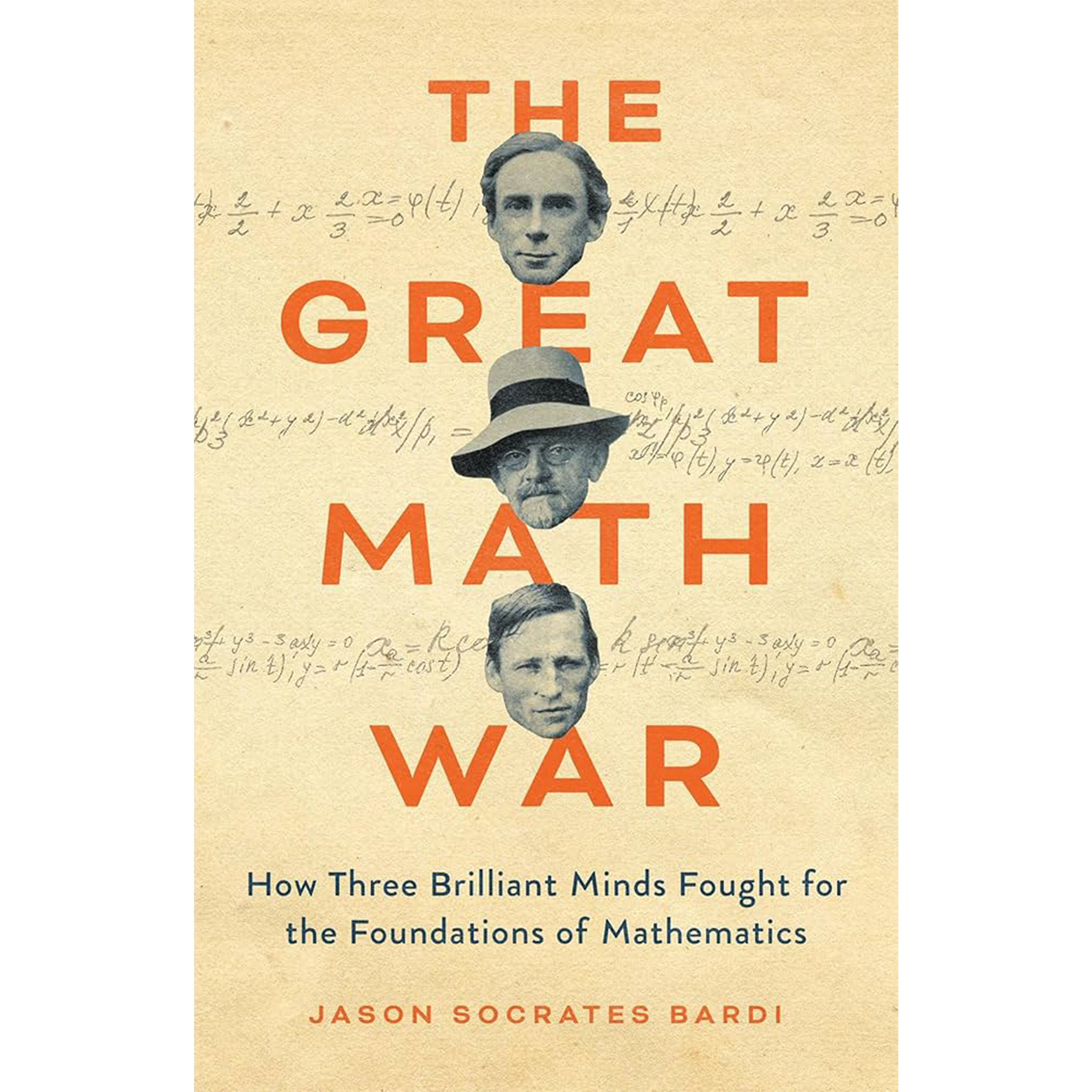
A Book with Legs
Jason Bardi - The Great Math War: How Three Brilliant Minds Fought for the Foundations of Mathematics
01:19:39
Loading summary
Transcript65 lines
- [00:03]
A
You're listening to A Book With Legs, a podcast presented by Smead Capital Management. At Smead Capital Management, we advise investors who play the long game. You can learn more@smeedcap.com or by calling your financial advisor.
- [00:21]
B
Welcome to A Book with Legs podcast. I'm Cole Smead, CEO and Portfolio Manager here at Smead Capital Management. At our firm, we are readers and we believe in the power of books to help shape informed investors. In this podcast, we speak to great authors about their writings. The late, great Charlie Munger prescribed using multiple mental models and analysis. We analyze their works through the lens of business markets and people. Today we're going to discuss a work that in so many respects is big because of the people that are in it. It's big because of the personalities that are in it. It's big because in many ways it's informed a lot of the mathematics, the logic, and really the compute that we think of today. Jason Socrates Barty is joining us to discuss his new book, the Great Math Brilliant Minds that Fought for the Foundations of Mathematics. A little bit about Jason for our listeners. Jason. Pardon me. Jason is an award winning journalist who has written two books about the history of math. Those two other titles are the Calculus wars and the Fifth Postulate. He has published hundreds of articles about modern science and medicine, outlets including the San Francisco Chronicle, Good Morning America, U.S. news World Report, and the Lancet. He holds a bachelor's degree from the University of Hartford and a master's in molecular biophysics and also in science writing. Jason, thanks for joining me today.
- [01:48]
C
Thank you.
- [01:50]
B
So, you know, based on your prior titles, I can make assumptions. But, but what inspired you to tell this story? You know, this is really, you know, it's like you're building on three big ideas in this book. But what caused you to draw this out? Was there something that caught your eye in an article or a book?
- [02:09]
C
It was actually a cocktail party conversation, if you can believe that. So about eight or nine years ago, my father retired. He was a professor at the University of Pennsylvania, I'm sorry, the Penn State University. And at his ret retirement party, which was at a faculty member's house, I was there and I met one of his colleagues who is a mathematician and I was telling her about my first book, the Calculus wars, which is about the invention of calculus and the subsequent fight between Newton and Leibniz over who deserved credit. That was a very interesting knockdown, drag out kind of fight between two intellectual giants. And, and I'll tell you a funny story about that. I Mean, I got the idea for that from a little tiny box in my old calculus textbook. When I was first looking for ideas, I remembered reading this interesting little. It was one of these little sort of factoids did, you know, and it talked about that. And I discovered there had never really been a book about this, and so I wrote that. So here I am at this party in 2017, and I'm telling my dad's colleague about the calculus wars. And she said, well, that reminds me a lot of another story called the Foundational Crisis in Math. I don't know if you've ever heard about it. And then she told me, nobody's ever written about this. And so as a writer, that set off alarm bells in my head. Ding, ding, ding. So, you know, kind of like if somebody said to you as an investor, there's this. There's this property, it's worth a lot more than. Than it's selling for, and. And nobody notices it, you know, so.
- [03:59]
B
Yeah, well, that reminds me of the parable of the Hidden Treasure as an example. So, so you start out, you. You start us out in the future. Oh, this would be kind of tongue in cheek, but in the future of 1900, right, you say, quote, that, my friend, is what the future smells like. The fresh cut grass of perfumed hope. End quote. What was the sweet smell that year that you begin with?
- [04:26]
C
Yeah, so futurism is really what I started with. So 1900 was a very significant year, both because it was the, you know, the sort of the end of the century, the turning, the beginning of a new century. And because of that, I mean, people had a very optimistic outlook. It was very, I think, very different than you remember our own millennium. When the 2000s rolled around. There was a little bit of despair at that time. People were afraid. There was this kind of the threat looming of the Y2K bug and all these kind of things. It was very different in 1900. In 1900, people really thought, they thought the future was a bright and wonderful and glorious place. They had no idea, of course, right around the corner what was about to meet them and greet them was World War I, the singular horror of World War I. But in 1900, 14 years before that, the war started. It was a glorious summer, and Paris was housing what was called the Paris Expo. And it was basically a world's Fair, if you will. They had a bunch of pavilions and they had some amazing artwork, and they had. Had incredible food, and they had all these devices, all these technologies, the first X rays, the first portable cameras, all these Things were kind of rolling out. Automobiles. In those days, most people had never even seen an automobile. And here we were, Paris was flush with all kinds of cars and trucks and tractors and mechanized things. The first escalators actually rolled out that year. And so the future seemed very bright. And that's why I said fresh cut hope and grass. The thing is, what I was really trying to do was sort of parallel the futurism that was around in 1900 with Futurism Today. Because one of the things I do with this book is I sort of have a critique of futurism and not futurism as in trying to predict and define what the future is going to look like, prepare for it, plan as you do in your line of work, but more this idea of the future as being unlimited wealth, unlimited happiness, everything's going to get better, we're going to be living on Mars, we're going to cure all diseases. There will be no more diseases. These are the kind of things that you hear people say today. And they were saying similar things in 1900.
- [07:22]
B
That's also interesting because, I mean, mind you, at the same time, in a parallel part of the universe that was the Gilded Age. Right. So you not only had this belief in the future, but there was just a lot of wealth that had accrued and therefore, to your point, not dissimilar to today, where we know who the very wealthy people are. They're very big, they're very, some respects, powerful. And yet at the same time, isn't it shocking? We think the future's really bright when there's a lot of wealthy people.
- [07:51]
C
Yeah, no, I mean, I think that those two things go hand in hand. And they definitely did them.
- [07:57]
B
Yeah, you start with Hilbert. So he first publishes Grunlagen der Geometric as a rising star. Who is Hilbert and what does he bring to this mathematics discussion at that time?
- [08:10]
C
Yeah, so he's a German mathematician and he's widely regarded as one of the greatest mathematicians of all time. He's also regarded as probably the best mathematician of his day, although some people would argue there was a very famous French mathematician named Poincare who. They were sort of the twin giants in those days. In the late 1800s, early 1900s, Poincare was a little bit older and Hilbert was sort of a mathematician's mathematician. He's somebody who a lot of mathematicians, politicians who knew him at the time, years later, would remember. He was the greatest genius they ever knew. And he was an interesting person because he wasn't just a genius, but he was also Hardworking. And that was kind of part of his ethic, was he wanted to. He thought any question in the world could be answered, any problem could be solved. He was an optimistic genius. You know, at the time, there was a popular philosophy in Europe in philosophical and scientific circles called Triumphant Pessimism, which basically said that there are limits to human knowledge. There are questions we will never be able to answer, There are things we will never know. There are things we shouldn't even try to answer because it's going to be impossible. And the interesting thing is, I think, you know, I think that there's something to be said for that today. I mean, I think we should go back to that, but I'll return to that in a second. Hilbert's idea was completely the opposite. He thought there were no limits that we would be able to penetrate. Through mathematical intuition and hard work and working out proofs, we would be able to solve any problem. And so to. To jumpstart the process of this, when he was 39 years old, he was invited. He had written this famous book on geometry that people regarded as a breakthrough. This was in a subject that was 2,500 years old. And he sort of reimagined it. I mean, everybody appreciated his genius. And so he was invited to give a keynote speaker at only the second International Mathematical Congress that ever took place in 1900 in Paris, which they planned to have during that Art and Tech Expo. And so he was there and he delivered a talk that people refer to as the 23 problems talk, where he laid out, these are the problems that you as mathematicians should be thinking about and should be solving. And if you solve these, it's going to push our field forward. And so he went on and he detailed 23 problems in the talk. It was actually 10 problems. But then he published an article a couple weeks or a couple months later, and he adopted to 23. And some of these problems were very old for math's last theorem, things that had been around for hundreds, if not thousands of years. Some of the problems were more contemporary and new, but that really changed the nature of the scientific lecture. And so that's kind of why I started in 1900, because this was such a profound moment. So prior to this talk, it's hard to appreciate this today because we have podcasts, we have TED talks. People will go and listen to an interesting intellectual speak to a general audience on a general topic. And that was definitely the case in the 1800s. I mean, science was popular. People liked to hear science and go. And they would do These demonstrations and blow things up and that sort of thing. But this was different. This was not. Here are some parlor tricks and here are some things that we know. Here are some things that I've done. People had only ever talked about what they had done, what had been done. Nobody ever gave a lecture like this where they focused on what should be done, what the future looks like. And nowadays it's commonplace. There's not a single scientific organization or university in existence where the CEO or leader doesn't get up in front of an all hands meeting once a year and talk about the future. That sort of thing is commonplace. But in 1900 it wasn't. I mean, Hilbert was really the first mathematician to really embrace the future and shove it in people's faces.
- [13:03]
B
Sure, Euclid was the reigning champion of geometry prior to this. How did this change what Euclid had given us obviously many years prior?
- [13:14]
C
Well, Hilbert didn't come up with different results than Euclid. Euclid's geometry was the classic text. The book is called Elements. It's been compared to the Bible in terms of being the most successful best selling book of all time. They don't actually have analytics on that kind of thing, of course, because you're going back 2,000 years. But the fact that it's been around through all these years, through all these governments, through all these generations, hundreds of generations of people have read these books, the Bible, Euclid's Elements. So it's up there, it's important. He didn't reimagine the results of geometry. He didn't take square triangles and make them different. What he did was he came up with a different way of deriving geometry based on first principles and working out the proofs in a different way. And this was sort of fundamental to his approach to math. He believed that you should be able to approach things algorithmically, to kind of break them down, build up the pieces into a proof and get definitive results. And so that's kind of what he did with geometry. And it's notable also that his book is still in publication today.
- [14:43]
B
Sure. You call his optimism exuberant solutionism versus a second ago you talked about the triumphant pessimism, the triumphant pessimism. There's still, this is totally debated, even right now. And let me give you an example and I'd love to hear your thoughts on this too. So we had done a book here with Amar Bede and it's called Uncertainty and Enterprise. And he comes from the old Chicago school of thought and the great thinker of the old Chicago school is Frank Knight. And so what it's typically termed to be is Nydian uncertainty. It's truly like unpriceable or, you know, to use your Donald Rumfeld quote, the unknown unknowns. Right. The future, for example, is an unknown unknown. And so there are some people that believe that we can go out and price those things and model those things and ultimately there's no unknown unknowns. Right. But you and I wake up every day and we think, I wonder what will happen today. It's like these things, there is some level of uncertainty or unknown unknowns. And so I find it really interesting that, you know, here, you know, if you take that debate like to a subject like that, you know, you'd have, you'd have, you know, someone like Hilbert who would say, oh, we can solve all that. And we still see that in like insurance pricing. Right. Because if we can figure those things out, we can price it. And if we can price it, then it reduces the risk to society because it's priced into how we live, if that makes sense.
- [16:20]
C
Yeah. And you hope that you don't make mistakes and you hope that's the second part, a black swan built in that's going to wreck your model. And I'm a big believer in this. I mean, I think that applying basic quantitative analysis to any problem is very helpful, even if in the end you're not strictly looking at a model. And I think sometimes you don't have to. I mean, so if you're going to invest $5, you're going to be willing to take a lot more risk than if you're investing $5 million. If you're investing 5 million, you're going to run those numbers backwards and forwards. It's a measure 2000 times cut once kind of situation. If you're investing $5, I mean, that $5 might be gone in two minutes, you know. Yeah.
- [17:15]
B
DraftKings or other betting websites. Right?
- [17:18]
C
Yeah, yeah, yeah.
- [17:19]
B
You also mentioned at this time there was even like a dissection or not dissection, but there was a rift in the mathematicians that were leading at the time. There really was because of their, you know, their dominance and empire. There was the British mathematicians and then there was the European mathematicians. It really wasn't the same group at, you know, at this time because of really Britain being walled off in some respects. Is that, is that fair?
- [17:45]
C
Yeah, yeah, yeah. And this, this is sort of the time period when I start 1900 is when that's starting to end and, and Britain and, and I would Say not just Britain, but the whole world is becoming smaller for, for mathematicians, as it is for, for many other academics. So the, the first scientific societies are, are forming. The first big journals started in the mid-1800s and later. And so the journals bring people together, the societies bring people together. And initially, it's kind of what you would expect. Paris has a society, London has a society, Berlin has a society for mathematics and for, for science. But then eventually lots of cities get them, and eventually you start to form these larger groups, the American association of Mathematics, the European societies, and then you start to have these major conferences. And that's where Hilbert was, and he presented his 23 talks at the International Congress of Mathematicians. And so it's not just Britain, but a lot of, of mathematicians from different places are starting to interact, to meet, to publish together, to read each other's work, to work as editors. And so it's a very changing time. But, yeah, for 200 years before that, Great Britain was suffering what some people call a splendid isolation, where the British approach to mathematics was somewhat separate to the European continental approach. And this really had its roots in what I was describing in my first book, the Calculus Wars. There's this big rift between Newton in Great Britain and Leibniz in Germany. And eventually that led to the mathematicians on both sides of the English Channel kind of walling themselves off from each other. It was Britain's misfortune that all the really great work in calculus, most of it was done on the other side of the English Channel. So Euler and Lagrange and all these great mathematicians who extended calculus in the centuries after Newton died, they were living on the Continent.
- [20:21]
B
Sure. Hi, I'm Cole Smead, CEO and Portfolio Manager here at Smead Capital Management and hosts of this podcast. If you enjoy this podcast, I'd like to invite you to check out smeedcap.com at our firm. We are stock market investors. We advise investors who play the long game with a discipline that has proven success over long periods of time. Learn more about our funds@smeedcap.com past performance is not indicative of future results. Investing involves risks, including loss of principal. Please refer to the prospectus for important information about the investment company, including objectives, risks, charges and expenses. Read and consider it carefully before investing Smead Funds distributed by Smead Funds Distributors llc. Not affiliated. Bertrand Russell was told, there's no way of proving some of math. You must just accept them. Teach us about Bertie and what he sought to change initially in his work.
- [21:21]
C
Right. So Bertrand Russell was a very interesting figure, famous as A philosopher and a speaker and an anti war activist. But not many people realize that early on he was actually, he started out life as a mathematical philosopher. He was a mathematician, essentially, he was a logician and he went to Cambridge. He grew up, I should say, in the most immaculate trappings of a silver spoon upbringing that you could imagine.
- [21:56]
B
The old world, as they say. I mean, he was an old world rich person.
- [22:00]
C
Yeah, ancient regime, as they like to say. So his family, his ancestors had made a fortune. They were aligned with Oliver Cromwell. You know, riches and lands came into their possession after the, the English Civil War and, and fast forward a couple centuries in the early 1800s, Bertrand Russell's grandfather, John Russell was an important member of Parliament in London. He was actually the, the British speaker of the House for a long time, and I mean Prime Minister, speaker of the Houses in America. And he was noteworthy, passed voting reform laws, he passed labor laws, and was seen as a very incredibly influential liberal politician. And so much so that Charles Dickens actually dedicated A Tale of Two Cities to John Russell, Bertrand Russell's grandfather. And John Stuart Mill was good friends with Bertrand Russell's parents and he was actually Bertrand Russell's godfather. So what I'm trying to say, what I'm trying to paint the picture of here was that this was somebody, he was from a very privileged upbringing and he grew up in that. But there was a major tragedy that happened early in his life where when he was 4, they were coming back from a trip to Italy. His brother had caught a dangerous disease and then passed it to his sister, passed it to his mother. The mother and the sister both died. The brother recovered, but the father never recovered from this. Bertrand Russell's father was devastated. This was the love of his life and his daughter. And he died a year later. And so at the age of four, Bertrand Russell was there, left alone in his family with just his brother and his grandmother, who then took over the responsibility for raising him. She sent the brother away because he was older. She thought he had already been corrupted by public schools. She didn't want him to be a corrupting influence on young Bertrand Russell. She poured all of her hope into young Bertie. She saw him as the future. She expected him to be Prime Minister. I mean, it was a given. It wasn't like, you know, oh, I hope my son plays in the NBA someday. This was, you know, she's already buying season tickets and lining it up. But at the same time, by all accounts, she was a very cold, traditional Victorian lady who, it was not a warm household. And so Here he was one of the warmest people, I think, probably ever to walk the face of the earth, living in this cold. In these cold confines of this old manor house with nobody there but his tutors and his grandmother. And it was, you know, I mean, her routine was. Was to take an ice bath every morning. I mean, literally an ice bath. It was, you know, mommy dearest all over again.
- [25:39]
B
Yeah.
- [25:40]
C
So that was Bertrand Russell as a kid. And he started to come out of his shell in this very important moment in 1883, when he meets his brother Frank, who's coming back from school. I think he's about to start art at university. And Frank decides to take it upon himself to teach Bertie a thing or two about geometry. And so he shows him Euclid's elements, and they start to go through. And Bertrand Russell, who has a very analytical mind, he falls in love. In an instance, math becomes his first love. He can't believe how cool this is. And in the course of this afternoon, learning these things, he asks his brother a question about the parallel postulate, the fifth postulate. And he says, well, how do you know? And his brother says, well, it's an axiom. Here it is. It's given to us. And Bertrand Russell asks, well, how do you prove it? How can you prove this? And his brother says, you can't. And that was a strong motivating factor in everything that happened later in Bertramos life.
- [26:57]
B
So then you bring up Sophia, and I want to make sure I say this right. Kovalevskaya. Why is she so important to the story? There's obviously the female element, which you touch also with another character in the story, but she just seems incredibly intelligent and yet has a brick wall that she has to deal with for much of her life.
- [27:17]
C
Right. So, you know, I. I did want to. I did want to focus on. On some of the female characters in the story. Two of them happen to be great mathematicians. Amy Noether is the other one. Sophia Kovalevsky. Sophia's story is fascinating, like it should be a movie. I'm actually shocked that she's not. She's not more well known in the West. I had never even heard of her before I started doing this research. I stumbled upon her story tangentially, and in fact, I would say she's not really central to the story. So she appears in chapter two, I tell her story, and that's basically it. I would have gone further, of course, if I had the time, but I had to keep it dense. I had to keep it real. Why am I so fascinated with her. So she was part of this new wave, pre revolution Russian revolution in the 1870s, where there was a liberalizing of ideas, a questioning of the sort of the power structure in Russia, and also fundamentally questioning this awful, pernicious societal norm in Russia in the days, which was that women shouldn't be educated. And so she had to fight at every stage of her life for her education, and I mean, really fight. She was successful, I think, probably only because she was rich. Her father was an aristocrat, and he was an artillery officer in the Russian army. And he retired when she was a little girl. And this is an interesting story. So they moved to the family estate in the Russian countryside, and it was. It was far out in the middle of nowhere, hundreds of miles from St. Petersburg. They relocated there, and when they got there, they discovered that they had not brought enough wallpaper with them to paper the entire house that they were moving into that they were one roll short. And so the old general, her father, he blew his stack. He was furious. He considered sending somebody back to St. Petersburg just to buy one roll of wallpaper. But then he decided, you know, that's going to be too expensive. It's too time consuming. Let's do something else. So they were talking about, could we put newspaper on the wall? And then somebody found an old box of his notes in the closet. It was his old college notes from when he was a young artillery officer learning the trade. So these were trigonometric analyses and weight and gravity effects on falling objects, that kind of thing, physics and math. And they decided, okay, let's use these. These are kind of cool. He's got an artistic hand. Let's paper the walls in one room with these math notes. And so they decided, well, let's do, you know, let's do the nursery. Sophie is the youngest. She's only seven. We're going to paper her wall with these math notes. And that was how she learned mathematics. She learned it off of her walls, off of her wallpaper, which is crazy. She was a little girl, and she never would have learned mathematics otherwise. It was, you know, total freak accident.
- [30:55]
B
I was gonna say Emmy has some similar touches because I think you point out in her life, I mean, it was. Again, her father, right?
- [31:04]
C
Her father was a famous mathematician. And so. So through him, she was able to have a place where she could work in the periods in between her degrees and after her degree. I mean, so she was a generation older than Sophia. And so she actually came of age right when the laws in Germany changed and Said, okay, women can now enroll in university programs alongside men, math programs. And so she studied math, and she was in. Out of a freshman class of 1,000 students, I think there were four or six women. And so she got her degree in math, and when she graduated, the laws changed again, and the laws now said, okay, women can go to graduate school. School. And so she went to graduate school and she got a doctorate in math, a PhD. So she finished her doctorate around 1904, maybe, 06, I can't remember exactly, but she worked for years at different universities, some of the top universities, working for some of the top mathematicians. And she herself was one of the top mathematicians. She wrote a postgraduate thesis on something that's now called Noether's theorem, which is considered central to particle physics, and it's considered one of the most fundamentally important physics breakthroughs of the 20th century. And she was unpaid, paid at that time. In fact, she did not get paid anything as a professor until the 1920s because there were German laws basically forbidding women from holding those positions. There was a pernicious belief that women had a corrupting influence and that young men would be led astray. And, you know, so it's because of her, and it's because of Sofia Kovalevsky. I mean, I really wanted to tell the stories of some of the women in this, you know, who were involved in this. And, you know, because I think that we still have a ways to go today. I mean, people still sometimes hold on to this belief that girls can't do math, that men are better at math.
- [33:48]
B
So I was gonna say, if we go to Cantor next, because he's obviously, you know, a character in this story. Why does he draw a distinction between potential infinity and actual infinity?
- [34:01]
C
Yeah. So Cantor was another interesting figure. He was a German mathematician who was kind of in his prime in the 1880s to early 1900s. He invented set theory, which is considered one of the great breakthroughs. It's a cornerstone of modern mathematics. And he. He kind of came up with these ideas out of thin air. Nobody had ever done anything, nobody had conceived of mathematics in the way that he did. And the big thing he took on was infinity. And so I talk a lot about infinity in this book, and I could talk about infinity forever. It's an interesting subject. And the. One of the most fascinating things about infinity is the idea that there are multiple types of infinity. And so this idea had been around for a long time. So the ancient Greeks actually struggled with how to understand infinity and what to do about it. And Aristotle the philosopher came up with this idea originally of there being a potential infinity and an actual infinity, where he talks about the idea of infinity and then an actual infinity in the earth, in the world. So he considered the universe to be infinite. People did. We didn't realize it was finite back then. And so that was an actual infinity, a potential infinity was the sort of infinity that you can contemplate. It's the idea of infinity as opposed to infinity itself. The whole notion that we can conceive of infinity suggests that this sort of thing is real. So essentially, he punted. What Aristotle did was he sort of avoided the problems with infinity by explaining it away in this philosophical way. And it kind of stayed that way for, you know, for better part of 2000 years. But Cantor came along, and he realized we can actually talk about actual infinities and not just talk about them, but we can actually deal with them mathematically. And so his work came up with a lot of. I mean, there were all kinds of crazy things that came out of his work defining infinity, but the most profound was this concept of. Of two types of infinities, not being actual and potential. But he defined a countable infinity and an uncountable infinity. And those are represented by the whole numbers and the real numbers. And so the idea of a countable infinity is one that we're very familiar with. I mean, you know, 1, 2, 3, 4, 5, 6, go on and on and on. I have infinity pieces of gold, that sort of thing. This idea that you could count forever, and eventually you have an infinite set in that counting. Well, there's another type of infinity which is uncountable. And so this is where, for instance, if you take the number line, you look at the end points, 0 and 1. So all the numbers between 0 and 1, how many are there? Well, there's an infinite number, but the point is, it's not countable because you can take one and divide it in half. You've got 0.5 divided in half again, 0.25, 0.01, 0.001,001. You could have an infinity of steps in the first tiny little fraction of a step in that number line. And so that's where the idea of uncountable infinity was. And, you know, it's interesting to note if any of your listeners are fascinated by this kind of thing. Cantor really thought that there were religious implications to this idea. In fact, he was convinced that he was sort of a Moses figure among mathematicians, that God was revealing to him some of the truths of the universe, most notably this idea of the two types of infinity, the absolute infinity and the countable infinity. And so he actually, for many years he spent time trying to foster relationships with cardinals and bishops and high officials in the Catholic Church to sell them on this idea of the two types of infinity. One infinity being the domain of man, one infinity being the domain of God.
- [38:49]
B
I was gonna say you mentioned the cardinal responded to him in one case, or is it the cardinal or bishop? And he says, yeah, I find that interesting, but never send me any mail ever again.
- [39:01]
C
Thanks for note. Thanks. Yeah, no, it's. I love reading stuff like that because you see how, you know, people, people were polite as they were, as they were brushing somebody off then as we are now. It's, you know, you can imagine somebody writing a letter like that today.
- [39:18]
B
Yeah.
- [39:18]
C
Thank you very much for your inquiry. We will keep it on file.
- [39:24]
B
We hope you're enjoying the podcast. You know, we work hard putting together of this show, but we work even harder for our investors at Smead Capital Management. At smead, we believe in disciplined investing, which is why the SMEAD funds have a proven track record of long term outperformance. If you're an investor who plays the long game and want to invest in wonderful companies to build wealth, we invite you to visit smeedcap.com Past performance is not indicative of future results. Investing involves risks, including loss of principal. Please please refer to the prospectus for important information about the investment company, including objectives, risks, charges and expenses. Read and consider it carefully before investing. SMEAD funds distributed by Smead Funds Distributors llc. Not affiliated. So what was Kronecker's view in comparison?
- [40:12]
C
So Kronecker was another mathematician in Germany who was a contemporary of Georg Cantor. And he was sort of an older, almost father figure to George Cantor in a way. They had a falling out over their work. Kronecker didn't buy Cantor's ideas at all. In fact, he was vehemently opposed to them and they kind of fought a nasty dispute and there was a lot of gossip and Cantor fared poorly in this. I mean, it was the stress of this and the stress of the work. And he felt like somewhat of a failure in his career because he was stuck at a small university. He couldn't get a job at the big university. He was convinced that Kronecker was keeping him back, damaging his reputation, holding back his career. He also had apparently some psychological problems. It's hard to diagnose, in a sense, assess exactly what was going on de post facto, as it were, but there are articles out there by psychologists who look at him and who talk about his mental health woes. He was in and out of clinics, out of nerve clinics, for most of his adult life. After the 1880s, he had several mental breakdowns. And partly this was due to the stress of work, thinking about infinity. You really lose your mind a little bit when you start really contemplating infinity. And then it was also partly because of personal tragedies. He lost his brother. His son died. So Cantor suffered these things, and Kronecker was no big help in his mental woes. But Kronecker had a different, different view of the world. His view was that nothing mathematically was real unless it could be constructed. So the idea is, if you can take one and you take two and you add those together, you take three, what is that? That's real? To Kronecker, that was what mathematics was. That encapsulated it. And so in order to do anything in mathematics, you needed to have this way of sort of constructing using actual numbers, using real reason, your argument. And that was very much flying in the face of the convention at the time in mathematics, which was people were looking more and more at doing these very unconventional proofs where you would do things like you would say, this is true, because if it weren't true, it would be. Everything would be impossible, so therefore it's true. These kind of indirect proofs and things like that. And Kronecker was not a fan.
- [43:25]
B
How did the Peano postulates come about?
- [43:28]
C
The piano postulates? Yeah. So those were basically. So Pino was an Italian mathematician, and he was working in logic, and he came up with some ideas for how to represent statements logically using mathematical symbols and came up with postulates. And he was sort of a visionary, too. I mean, he bought a printing press and he created his own journal. He became the media for himself and decided to. To promote his ideas. If Pino were alive today, there would be a Pino podcast, I have no doubt. But his ideas influenced others, primarily Bertrand Russell. So when Bertrand Russell discovered Pino's work, incidentally, at the same conference in 1900 in Paris that Hilbert was at, he was blown away. And he. He went back and he started working on a really big problem, which was, can we establish the fundamental solid foundations of mathematics? And that's really what my book is about. That's where it starts. And it starts with Hilbert and Bertrand Russell.
- [44:56]
B
You bring this up, and there's a current event that I think. I think in light of this. So you talk about the fallacy of pure process data you use the Boer War as an example of this fallacy. In other words, the data was all correct and yet the outcomes are pretty perverse or the desired effects aren't received. I mean, we just watched Meta go through a court trial where they consider to have an addictive product and it affected children. Some would argue those kind of platforms have incredible vast troves of data and the ability to manipulate that data, et cetera. Is it somewhat similar in that the outcomes from some of that stuff might not be what we want, despite the data being so pure?
- [45:46]
C
Yeah, yeah, that's a great question. I had never really thought about it in terms of Meta. I was thinking the contemporary example I have thought about related to this are the ice raids and homeland security. So let's step back to 1900. So Britain is fighting its biggest, most expensive war in a century. Not since the times of Napoleon has Britain put together this many soldiers on the field. And they're fighting a war in South Africa. So at that time, almost every country in Africa is ruled by a European colonial power. And Britain has several countries, including the Cape Colony, which is where Cape Town is today. But to the north of the British territories are two independent nations ruled by the Afrikaner, the Boer. These are the Orange Tree State and the Natal. So these are countries that are populated and ruled by basically white European descendant settlers, but who had been there for many years, decades, centuries. They first came when the Dutch were exploring around the, the tip of Africa in the 1600s and had been colonizing and living there ever since. So these two nations were sitting on a mountain of wealth. The largest gold strike ever discovered was in the Natal. And within a few years of its discovery, that country went from being a landlocked, backwater, dirt farming nation to one of the richest countries in the world. And it was on the basis of this incredible wealth. Now, historians argue, was the war about gold? Was it not about gold? Britain had fought a very expensive. War in Asia just a few years before. There was economic Malays all around London. And so there was a need for wealth. And so to me it seems like that was part of the issue, even though a lot of historians will tell you it was a much more complex thing. Okay, that being aside, what happened in this war was the Boer army numbered around, I don't know, 50 or 60,000 soldiers. Britain was able to send in an initial expeditionary force of around 40,000 soldiers. And they were sending in more and more soldiers every single month on troop transports. Eventually, Great Britain had something like 400,000 boots on the ground in South Africa fighting this war which took place, it started in late 1899, it ended around 1902. So in 1900, they had essentially subdued the Boer army. They captured its major general, its field marshal, they captured a third of all the soldiers. They were in military prisons. And, and what was left, however, was the war changed into a guerrilla war. And so Britain was forced to fight against these kind of hit and run guerrilla tactics. And so they changed their strategy. And their strategy was. And this was all. Let me take a step back. This was all based on numbers. It was a very expensive war. And the British commanders had a mandate. You've got to end this thing soon. We have to end it. This is so expensive. You've got to end this war. But they knew they couldn't do it as long as these commandos were out there. So they started exploring other tactics and they started looking at, what can we do? Well, let's start burning farms. Scorched earth was an approach to warfare that was common in the 19th century. The Germans had done it, the French had done it, so the British did it there. In South Africa, anytime there was a raid by commandos, they would locate that raid and they would go to all the farms in the area and burn them down and kill the livestock and displace the farmers, largely women and children. And the reason that they were doing this was to deprive the commando soldiers from having a safe house, having a place to go and craft. And so they started doing this and this was a numbers game. They were looking at the number of farms we burn every day, the number of people we displace. But very quickly it became apparent that there's another problem. You're displacing all these people. Where do they go? They're suddenly homeless. You're suddenly creating a refugee crisis. And so what the British did was they set up these so called camps of refuge where people could go and they would put people in these camps. We know them now as CONC Concentration camps. They were the first concentration camps in the 20th century. No, they were not anything like the Nazi concentration camps in terms of the sheer horror. But they were nevertheless brutal and dehumanizing places. And in my book I talk a lot about it and there's references at the end. You can go and read about this history, it's fascinating. But here's the issue. So there's something I call the fallacy of pure process data. And what that says is that it's very similar to an idea that I love in economics called goodhart's principle, which says that when a measure becomes the goal, it ceases to be a good measure. And so, for instance, if you say, how popular is, is this? Let's look at web hits. To take a contemporary example, how many clicks do we get on this post or this story? And then what can we do to increase that? And if you start focusing only on increasing the hits, it ceases to be a useful metric for your outcome. And that's the sort of thing that is similar to the fallacy of pure process data, but the fallacy of pure process data is much more fundamentally psychological. So it's not just saying that an outcome is worthless or useful. What it's saying is we get fooled into thinking that the process outcomes are the things that we want to measure. And so in this case in the Boer War, what they were measuring were the number of farms burned, the number of people displaced, the number of soldiers captured. These are process measures. Ending the war is the outcome. But there's no connection. There's no mechanism that says you're necessarily going to get there from here by pursuing these process measures, nor is there even a sense that you're going to get there successfully by doing those things. And so.
- [53:55]
B
Well, by the way, we run that all the time in our industry. I mean, for example, like, to your point, if someone says, you know, what are sell side analysts on Wall street really good at? They're really good at predicting quarterly earnings, to your point. Like that is their metric, if you will. And some of these pod shops that are out there for these big multi strat hedge funds, they love this idea of like, I predicted the number and they're good at it, by the way. Way, like they're the kid when, you know, they're sitting there as a child and they drop like, you know, gummy bears in the ground like a whole box. And the kid, like Rain man style says like 54, and then the parent picks them up all up and they're like, oh my gosh, that was 54. You should be a sell side analyst. Right? That's the kind of kid, right? It's kind of funny, but I say that because to your point, that they might be right in their goal, but the outcome that's received from that goal can be vastly different, different than what was hoped for. In other words, they succeeded in that and yet the outcome for, say, the investor might have nothing to do with that.
- [54:55]
C
Right? Exactly, exactly. And so in the case of the Boer War, what happened was they won the war, but they lost the battle. In some ways, for public opinion, because they created this human horror, a refugee crisis that resulted in concentration camps and unbelievable mortality. I read a statistic that infant mortality in one of the camps was 92%. I mean, that's unheard of in any record that I've ever heard of. And it really turned a lot of people in the British public, Bertrand Russell, especially, against the war effort. Sure.
- [55:47]
B
Let me pivot a little bit on that, because I want to get to this idea that you had next in your book, because this is like, it's philosophical, but it's mathematical, too. If I am a Cretan and I say all cretins are liars, how can I say that while not being a liar?
- [56:07]
C
Right, yeah, that's the famous liar's paradox. And there was a philosopher named Epimenides who I think is the most famous liar in history. And he's actually described in the Bible, in the New Testament. They describe him in this quote, basically saying, all Cretans are liars. And it's a famous paradox because. Because as you point out, if he's telling the truth, then he's lying. And if he's lying, then he's telling the truth. Right, but how do you work that out? And so Bertrand Russell was fascinated with this, and he came up with something very similar called Russell's paradox, which was really at the heart of mathematics. And it was a flaw, fundamental flaw, that showed that mathematics is not on solid ground because it has a paradox at its very foundation. Now, a paradox is not something where it's an ambiguity. I don't know. It could be this, it could be that. A paradox is not an uncertainty. A paradox is a certainty. A paradox says that two things that shouldn't both exist. Both do. And that's a lot of. A lot of problems arise out of this mathematically, if you start thinking about it. So to take an easy example, one plus one equals two. One plus one does not equal zero. But what if I told you one plus one equals two and zero, that would be a paradox. Those two things can't possibly coexist. And what Russell discovered was that there was a paradox at the heart of mathematics, which he explains in various ways, but it sort of butts up on this idea of the liar's paradox. And what he did to solve it was he came up with a new way of sort of thinking about what Epimenides said all those thousands of years ago based on classes. So he said, okay, it's not that Epimenides is talking about himself. He's talking about other Cretans. So when he says all Cretans are liars, what he's really saying is all other Cretans are liars. And therefore it's not a contradiction, it's not a paradox. And that's how he worked out the system. And this is, I mean, I'm simplifying this. This was really years of Russell's hard work along with. He worked with Alfred North Whitehead, who was another famous mathematician.
- [58:51]
B
Correct. They did Principia together.
- [58:54]
C
Yeah, yeah, exactly. So Russell and Whitehead spent years working on a series of three books that they published that are considered the most groundbreaking work in logic to that date. And that was really at the heart of what allowed him to move forward. What they were trying to do do in these books was establish finally solidly the fundamental foundations of mathematics. They were going to base mathematics on logic. They were going to derive all of mathematics on purely logical means. And the books, surprisingly were a success. They sold well. They continue to sell well. I bought my copy. They're still on sale today. The book succeeded, but Russell failed. He was not able to solve the foundations of mathematics based on logic. He couldn't get there.
- [59:57]
B
Hey, I want to give a big shout out to everyone who's been working so hard on this show. You know, we recently hit the top 10 in investing podcasts on Apple Podcasts and even number one in the business category in several countries. As you may know, the show is proper to you by Smead Capital Management. Smead Capital Management understands how frustrating and illogical the stock market can be. If you're searching for funds with a proven track record, give the Smead funds a look. Or better yet, reach out@smeedcap.com and don't forget to mention you're a fan of the podcast. Past performance is not indicative of future results. Investing involves risks, including loss of principal. Please refer to the prospectus for important information about the investment company, including objectives, risks, charges and expenses. Read and consider it carefully before investing. Smead funds distributed by Smead Funds Distributors llc. Not affiliated. And then the next character, obviously that, that presents itself with that point right there is Brewer. Brewer reminds me like, you know, when you're talking about like where this guy's coming from and the baricum and, and where he's coming from this swampy place like Amsterdam. He's like the Grizzly Adams of Amsterdam, right? Just kind of coming out of nowhere. Not necessarily the person you'd expect to be this earth shattering mathematics person, but yet at the same time he was Terribly drawn to this. He comes, he said that mathematics is independent of logic. Right back to your point of view, like you tried to solve mathematics with logic. And he said, no, it's independent of logic. And his early success didn't even come from mathematics. It was like topology, if I remember correctly.
- [61:39]
C
That's right. Yeah. Yeah. He was famous. He did some groundbreaking work in topology, which is the field that looks at shapes and morphing shapes into other shapes and that sort of thing and surfaces. He, He. He published the. Excuse me, the very first article ever published with color pictures was. Was one of his articles in topology. He also developed some of the most, you know, groundbreaking cornerstones of that field, and he became famous because of it. He was. He was something of a genius. And I read that he. He graduated high school at the age of 12, I believe. Wow. He was in the Guinness. And he may still be in the Guinness Book of World's Records for the youngest person in the Netherlands ever to graduate high school. And he was an interesting person, too. He had a lot of different quirks. He had strange dietary practices. He had strange exercise practices. He liked sunbathing in the nude, for instance. He was a nudist, which in those days seems pretty uncommon, although in the area in Holland where he lived, there were a lot of sort of hippie colonies, if you want to call them that, at the time. And so he fit right in. But mathematically, he had this idea of the foundations of math and an approach to math. Math that was based on sort of building things up in a countable way. Kind of like what we were discussing with Kronecker earlier, this fundamentally different approach to math that he took and that ultimately put him at odds with David Hilbert. So after World War I, Brewer and Hilbert come into conflict with each other because they have sort of diametrically opposed ideas for how to solve the foundational crisis. So what happened right before World War I? Bertrand Russell finished his books realizing he hadn't solved this problem. But it was more than that. He was falling in love. His marriage was falling apart. He started having an affair. He fell in love with a woman.
- [64:15]
B
He's like a Jerry Springer episode. I mean, the guy is chaotic.
- [64:20]
C
From 1912 to 1914, he's kind of a hot mess. And he's also sort of figuring things out. He's at the peak of his field. He's considered a hero in philosophical circumstances circles. Harvard in 1914, early in 1914, they invite him to come give a series of lectures, and they're wooing him. They're trying to recruit him, they want to hire him. He has all kinds of possibilities, potentials for jobs. He's really at the height of his career and he gives it all up essentially because When World War I breaks out, he becomes a peace activist and stakes out a very unpopular position by doing so and eventually loses his job at Cambridge University and he loses some of his friends and you know, it's a really tumultuous time for him. He's eventually put in jail in fact for his anti war activities. So he's kind of out of the game. When World War I ends, Bertrand Russell is still sort of, he still has a toe in the mathematical world, but not really. Really he's moving on to other things. But Breuer and Hilbert are very much ready to pick up this issue. Hilbert, during World War I, discovers Bertrand Russell's book and his work and he starts thinking about it, he starts working on it and he quickly convinces himself that Russell is on the wrong track, that this isn't the way to solve the foundations of math at all, that we don't need to think about logic, what we need to think about is our rules and games. And so Hilbert's idea is to treat mathematics like one big game. And it's just a matter of figuring out what are the rules, define those rules, and then work out the proofs that you need to according to the rules. So again, this is somebody who thinks, thinks that we'll be able to solve anything, there's any problem in the world can be solved. And so he starts working on that. He develops an idea called metamathematics, which is sort of treating mathematics as a game, an abstract game with just rules. He starts approaching mathematics through what we call now today formalism, which is defining these rules and finding ways to algorithmically establish the foundations of math. And he couldn't be happier. He's nearing retirement. He feels that he's getting close. He thinks that he'll be able to do it. There's only one problem, and that problem is Brewer, his former friend, who's younger. Brewer's younger than him, but Breuer looks up to him. Brewer idolizes Hilbert. He thinks Hilbert is a genius. They work together, by the way, they're both editors on the same mathematics journal. It's the most prestigious journal in mathematics in the whole world. Hilbert is the chief editor. Brewer is the section editor for Topology, and in some ways, so they're colleagues, they're friends. When there's an opening at Hilbert's university for a new math professor, he Turns first to Breuer. He tries to recruit Brewer into that position. Brewer says no. And then a couple years later, they fall into this nasty dispute over the right approach to mathematics. Because Brewer has a completely different idea of how to approach. He develops a concept called intuitionism, which I won't go into now. It's a little bit complicated. I describe it in the book. But the basic idea is to develop mathematics. Kind of like what I was saying with Kronecker, where you're thinking about one plus one equals two, two plus two equals four. Find a way for any mathematical question to develop an actual series of. Of. Of choice sequences that are going to. That are going to define that. And that's. That's his approach. He actually, you know, he doesn't. He doesn't think that. He doesn't think much of. Of. Of Bertrand Russell's work either. He says, you know, mathematics is not based on logic. Logic is based on mathematics. So in the 1920s, those two, you know, fight a nasty battle between each other. And that I describe in the later part of the book.
- [69:13]
B
Well, you also, because this is really the war, if you will. And it seems like a game of intellectual minds among friends that are battling. I thought of it as kind of like the term sometimes used is frenemies, right? They are friends, they are peers, but they have great disagreements over very unique things. I mean, these are not what you're typically fighting over. Your buddy, like, what kind of beer are we gonna drink? This is like, you don't understand how the world works, my friend. And here's how my world works. And so I say that because one of my favorite parts of the book is you're talking about. Brewer had rejected some advice. So he wrote to Blumenthal several times that summer to complain about Lebesque, who's a new. Another person on the other side of this. And you have a poem in here. You say, here's my interpretation of Brewer's perspective in a spike of a few lines, Lebesque. Oh, Lebesque. And you put in parentheses, rhymes with Tisk. Tisk. While he's in motion, his brain's at rest. You can barely even call his stuff proof. More like a dumb goof. Okay? Which I love that because you know that. That there's times that they're interacting with each other, they're smiling, they are trying to push back while trying to be respectful and walking away thinking, that guy just. He's never going to get it. And your poem really touches this idea of what's going on in the mind maybe, not what's going on in the relationship.
- [70:47]
C
Yeah. And I think that, you know, it's interesting. I, I'd love, I wish we had a psychologist here who could talk about human emotions and interactions because I think sometimes we hear what we want to hear, other times we hear something we think we hear, but it's often never exactly what the other person is saying. And so somebody who is trying to hold out an olive branch, trying to meet you halfway, it may seem to you like they're doubling down. They're twice as obstinate as they were before the apology. And I think that that's a case here where Breuer is somebody who he's given to kind of lavish hand wavy arguments. People love to go and listen to him talk because he's somewhat of a revolutionary in terms of mathematics. And so I think that sometimes he says some things that get him in trouble that are perceived as much, much harsher than they should be.
- [72:00]
B
Well, the other thing with Brewer too is I think you talk about his writing. His writing is just not fun to read. It's tough. And so also you could have a great idea. If you can't communicate that well, it's just not going to be accepted by some because of the style of communication.
- [72:16]
C
That's right. People either won't read it or they won't want to read it. And that was the case with Brewer. People describe his papers as being inconsistent, at the very least, awful at the worst. Some years he would publish several papers, some years none at all. He was kind of all over the map. He would dive into really arcane, obscure subjects and wouldn't really spend the time to kind of explain it in a way that generalizes it for a lot of people. That makes the ideas accessible. That was part of the problem. Another part of the problem was that his approach to mathematics was just fundamentally complicated. There was something about what Hilbert was doing that is basically what the modern mathematician does. Developing proofs to, to demonstrate ideas. And it was, you know, Hilbert was all about brevity. He was about beauty. In fact.
- [73:19]
B
Well, you called it simple elegance.
- [73:21]
C
Yeah, yeah, yeah. I mean, the idea that math should be elegant is one that, you know, he really embraced. Whereas I think Breuer, he didn't really care about the elegance. He wanted, you know, sort of ideological purity in our approach. This is how we need to approach it and this is how we should do it. And so Brewer didn't care if that meant we throw away some of the greatest mathematical results of the last 30 or 40 years. He was fine with that. He said, if you can't prove it using my methods, then it's not proven. He rejected it.
- [74:02]
B
Sure. Obviously Hilbert, you pointed this out a second ago, but Hilbert ends up on that journal. Was also. Einstein was an editor to that journal. Yeah, there's this whole. And not for our discussion, but they effectively take Breuer off the journal, causing this big blow up. Lawyers get involved. Can we fire them? Well, you've been paying him, but he hasn't had a contract. I mean, it was like labor law being thrown out in Germany in the early 20th century, which I thought was terribly interesting. And then you make the case that really Hilbert kind of wins, at least in the setting of the moment. And then Kurt Godel shows up and just kind of rolls that.
- [74:42]
C
Right, right, that's right, yeah. So Hilbert wins, but right on the heels of him, you know, essentially ousting Brewer. And Brewer is suffering in silence and he sort of gives up mathematics for a number of years. And Hilbert is entering his retirement and he feels like he's won. And right when that happens, he publishes an article just a year or two before he retires that's basically laying out some of the things that need to be done still in mathematics. This idea of here are some problems that need to be solved. And he calls for we need proof of some of the fundamental ideas and logic. And then a graduate student actually does exactly what he wants. Within a year, this young graduate student in Austria, Kurt Erdel, comes out with the proof of, you know, some of the, some of the basic logical ideas. And it seems like a step in the right direction. It seems like we're getting ever closer to establishing the foundations of math and being able to essentially solve any problem that can be solved. And then right on the heels of that, the same young graduate student does something that is completely mind blowing. So Kurt Godel comes up with this idea of incompleteness and he actually proves that there are things which we cannot prove, questions we cannot answer and problems we cannot solve. He proves that and it basically shuts. That's the book on Hilbert's dream of having a fundamental foundation of mathematics that's going to allow us to solve any problems. Godel shows that there are actually indeed problems that we cannot solve.
- [76:45]
B
Sure. I was going through my notes here. There's so much that we didn't bring up. I mean, Klimt was in your book. I was just at the Museum of Modern Art and got to see, you know, Klimt's work there. So I was Just like, gosh, I feel like this is just such a fun book to read. Right on the back side of that, we didn't really talk about Wittgenstein. He was interesting in this. Again, came from a very successful family. I was going through other parts of this. We didn't really talk about Hilbert's role in relativity and that he was right there with Einstein. But we associate the theory of relativity with Einstein, not Hilbert at all, even though they were effectively Hilbert was in between the days, if you will, according to your work. So I would throw that out to our, let's see, other paradoxes. We did not talk about the Barali 40 paradox. We did not talk about Zermelo's paradox. I mean, there's a bunch of stuff in this book that I think is totally great and also just really good breadcrumbs that I want to leave out there. Where can people follow you going forward?
- [77:46]
C
Jason, you can find me on LinkedIn. I have a Twitter account.
- [77:52]
B
And what's your handle? JasonBarti okay, JasonBarty.
- [77:59]
C
And I'm actually starting to toss around ideas for my next book and so starting to work on that as well.
- [78:09]
B
Okay, well, this has been a total treat. Jason, your book the Great Math War proves that life isn't necessarily logical or purposeful. As we learn, some of these things these characters did in their life was incredibly logical and some of the things they did were just whatever. Humans are drawn to interests and attributes that they intensely love but may not be a blessing to you in relationship or them or even their family. Madness and pride haunts the edges of us all. If you enjoy this podcast, go to Apple, Spotify, YouTube or wherever you listen to a book with link Legs, give us review, tell others about the books and great authors like Jason Barty that we have the opportunity to understand and study the world with and through for our tribe. If you have a great book that you'd like to recommend, email podcastmeedcap.com that's podcastmeetcap.com you can also send your suggestions to us on X. Our handle is meedcap. Thank you for joining us for A Book with Legs podcast. We look forward to the next episode.
- [79:15]
A
Thank you for listening to A Book with Legs, a podcast brought to you by Smead Capital Management. The material provided in this podcast is for informational use only and should not be construed as investment advice. You can learn more about Smead Capital Management and its products@smeedcap.com or by calling your financial advisor.