Loading summary
Transcript213 lines
- [00:00]
Tim Wu
Foreign.
- [00:03]
Podcast Announcer
You're listening to A Book With Legs, a podcast presented by Smead Capital Management. At Smead Capital Management, we advise investors who fear stock market failure. You can learn more@smeedcap.com or by calling your financial advisor.
- [00:23]
Cole Smead
Welcome to A Book with Legs podcast. I'm Cole Smead, CEO and Portfolio Manager here at Smead Capital Management. At our firm, we are readers and we believe in the power of books to help shape informed investors. In this podcast, we speak to great authors about their writings the late, great Charlie Munger prescribed using multiple mental models and analysis. We analyze their work through the lens of business markets and people. Very specially co hosting this episode with me is our founder, chairman and chief Investment officer, or as I like to call him, dad Bill Smead. Thanks for joining me today.
- [00:57]
Bill Smead
Great to be here.
- [00:59]
Cole Smead
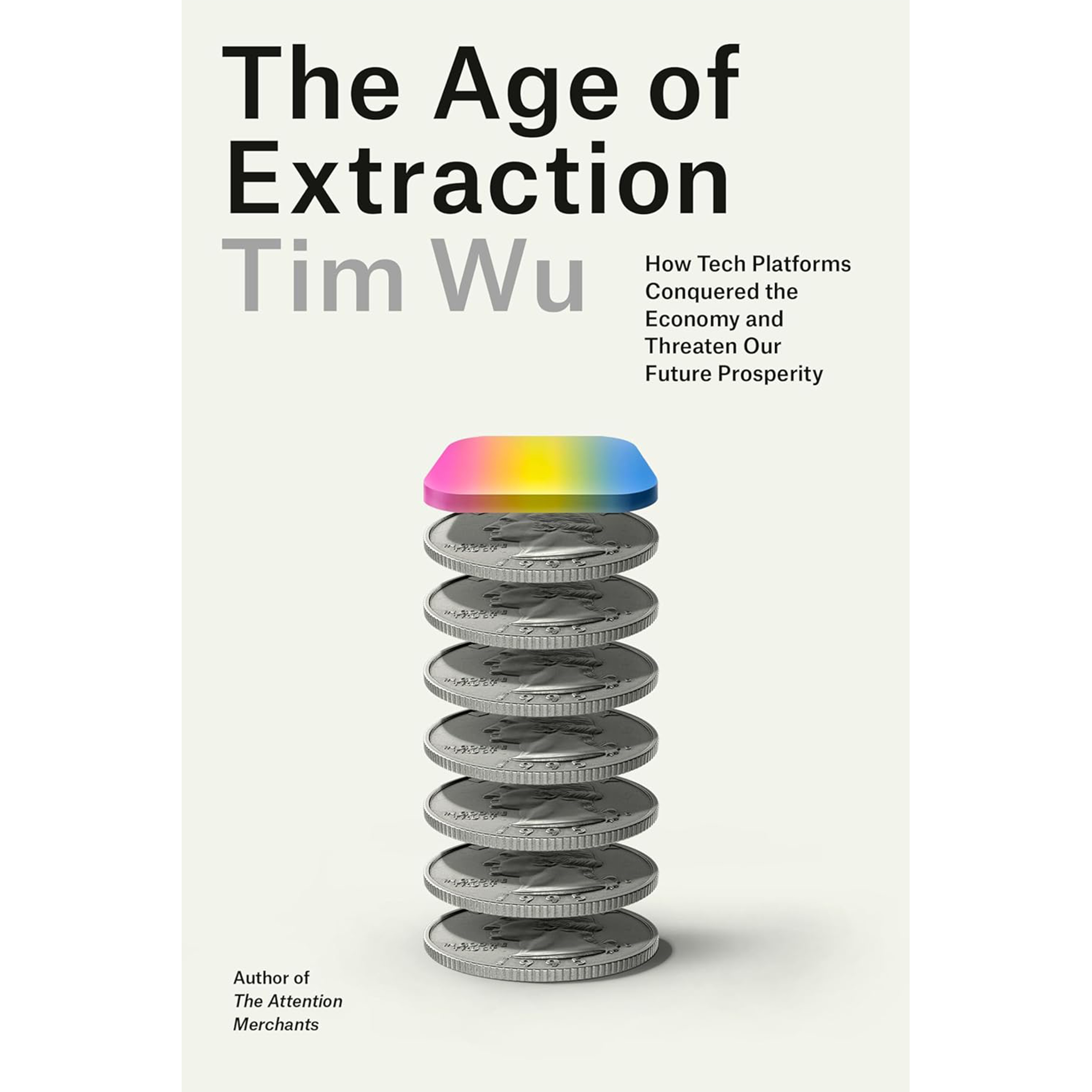
So this is an exciting day. We are sitting here on a stage which is very not normal. We don't have any mics pivoting in our face. We're here. We haven't mentioned the other people that are with us sitting here in front of us, three gentlemen. I'm very proud to be sitting here with the investors of Smead Capital Management and proud to have them join us live from this 2026 Smead Investor Oasis. Thank you. Thank you for all being here and great round of applause, please. One other thing. Let's see. I'm trying to make sure I get through all my notes here. Yep, we're good. All right, so in this episode, we'll discuss the role of technology, competition, monopolies and regulation in our society. Joining us for a live podcast, the Smead Investor Oasis, is Tim Wu to discuss his recently published book, the Age of Extraction, How Tech Platforms Conquer the Economy and Threaten Our Future. Again, one more round of applause for Tim Wu being here today. Ladies and gentlemen, I'm gonna give you a little background on Tim just to make sure you're familiar with him. He's a professor at Columbia Law School. He's known for developing the term net neutrality, which came about during the 2010s. He has also published four other books. He previously worked in the Obama White House, and he's a veteran of Silicon Valley. He was a law clerk for the U.S. supreme Court. He graduated from McGill University, another Canadian connection, and also Harvard Law School. He has written for many publications including the New Yorker, the New York Times, and Forbes Magazine. Tamin, thanks for joining us today.
- [02:32]
Tim Wu
Sure, pleasure. Thanks for having me on.
- [02:34]
Cole Smead
So we always ask authors this. You know, you've written on these subjects. You know, you obviously have Done a lot of work in this area. What inspired you to write this? And you can't just tell us that the publisher came with a check and said to do it?
- [02:48]
Tim Wu
No, it didn't happen that way. I wrote this book following on some of my other books to try to get at the kind of fundamentals of prosperity and wealth creation and how they manifest in modern times. I mean, I've been studying technology and tech platforms and the evolution of. Of the tech industries over the 20th century. What I've constantly been interested in is this question of what here is truly new and what here is old and has always been with us. What can we understand from the lens of history and economics in this book? It's the third in a series. I'm particularly focused on the platform. Now, platform is a concept I think we throw around. We talk about all the time. This big platform that's a successful platform, but we often use it without really getting deep into the meaning of the word platform, the concept of the platform and its effect on competition, freedom, and markets. So that's kind of what I was trying to dig into with this book.
- [03:54]
Cole Smead
Sure. You opened the book with an Apple commercial that you talk about. And I'm using this as kind of like a storytelling opening, if you will. I'm going to use a quote out of your book. We'll use some quotes during our conversation today. You say quote, but as Freud once said about jokes, advertisements often reveal uncomfortable truths. End quote. Explain what was important about this advertisement and what you see as uncomfortable.
- [04:16]
Tim Wu
Sure. So Apple ran this advertisement pretty briefly, and it featured this giant kind of press. And this press was coming down on an array of musical instruments and paints and other sort of creative sort of tools. And it slowly crushed them one by one by one, until what was left at the end of the ad was this very thin iPad. And it said, apple's thinnest product ever. And I guess what was symbolized by that was this idea that maybe humanity is just not going to play an important role in our own future. A sense that we're all kind of replaceable, even the most skilled and talented and cultured among us. And Apple was just sort of saying it kind of as a joke, but kind of not as a joke. And I guess part of another. I wrote this book for a lot of reasons, but one of them is I, like many people who think about technology, kind of want to know what our role's going to be. Humanity. And are we going to be the masters of our own destiny, or are we going to be replaced in some way.
- [05:21]
Bill Smead
Chad, you get into a philosophical question which we agree very much is being begged on by the public, which you pose as whether technology is, quote, some kind of omnibenevolent godhead that will act by itself to solve humanity these problems, unquote, flush that explain it a little bit for us.
- [05:39]
Tim Wu
Yeah, sure. So one of the things, I'm a close observer in Silicon Valley, I spent some of my career there, and one of the things that has interested me is a rise of almost a religious kind of belief in Silicon Valley, particularly centered around AI, on the sort of deliverance power of technology. And it comes with a theory that technology can never sort of go wrong. You know, there's always kind of going in this positive direction. And, you know, I think that's often true. I think our lives are incredibly benefited by technology. Modern medicine, you know, conveniences, cars, whatever. But technology can go in bad directions too. I mean, I don't think fentanyl was the greatest invention. I think people struggle with that. Sure. You know, take another example. I talk about in the book the cotton gin in the 19th century Fortified plantation slavery and kind of reinforce the economics of slavery. So we had to have this crazy civil war over it instead of slavery ending naturally. So technology is not, I don't think, God, godhead. I think it goes in different. And I think we can choose and we have to play a role in trying to decide what kind of future we want to have. And often that's a very prosperous direction. And I think as we have these technologies that are as powerful as we are, we need to make sure they're sort of doing what we want for humanity.
- [07:04]
Cole Smead
It also reminds me of like our favorite, one of our favorite characters from Napoleon Dynamite. Right? Kip. Kip, right.
- [07:10]
Bill Smead
I love technology, but I love La Fonda more.
- [07:13]
Tim Wu
I did not expect a Napoleon Dynamite.
- [07:15]
Cole Smead
Yeah, he got it.
- [07:16]
Bill Smead
Oh, no.
- [07:17]
Cole Smead
You get everything here.
- [07:18]
Bill Smead
You get everything. These technology platforms are made for matching before ebay and Amazon buyers and sellers went unmatched, Correct?
- [07:26]
Tim Wu
Yes, that's true. I think swinging back to the platform and the theme of the platform, the genius of every platform. And this book goes back to ancient Greece and ancient Rome. The Chinese market states is putting people together. I mean, that's the fundamental thing that a platform has always done. And in some ways, I'm very interested in history. And every successful, prosperous civilization at its core has something we would now call a platform.
- [07:58]
Cole Smead
Sure.
- [07:58]
Tim Wu
I was with my kids in Rome this fall. I was walking around. You walk around the Forum near the Coliseum. And there it all is, all the markets, the courts, the places gave people. They all have these central spaces. And I guess the point which I want to emphasize is sometimes when you study economics in college or whatever, you have this idea that transactions just happen. I think you guys know better than this. But everything has to happen somewhere. There has to be a market, there has to be a place. And the shape of those transactional spaces, in my view do a lot to determine what kind of civilization we live in. More open, more prosperous kind of civilization or something a little more closed, controlled and ultimately feudal.
- [08:43]
Bill Smead
The tulips were in the Netherlands.
- [08:45]
Tim Wu
That's true.
- [08:46]
Cole Smead
So information trust you talk a lot about. The idea of trust is important. We don't trade with, you know, as a company, our investors wouldn't want us trading with brokers that we don't trust.
- [08:55]
Tim Wu
Yes, right.
- [08:56]
Cole Smead
Trust is implicit in any marketplace, the town square. You go out and you sell your goods, you're going to give credit to someone. Trust is key in that element. You know, I think of the invested business as a disclosure based business. Right. You can have a conflict, but if you disclose it, it's known. Same with the law, the world of the legal realm, as I'm sure you know, is there any accountability to track the trust or is there not because it would require disclosure? In other words, as we look at these companies and they say, hey, we're going to do this new. Why? Why? What is that going to cause things of that nature? Do you think that there is pure disclosure that just is missing?
- [09:33]
Tim Wu
This is a good point. The successful platforms through all of history, whether it's the stock market, whether it's the ancient Roman forum or the Greek agora, they had standardized weights and measures. It was one of the few. And they kicked out the people who were fraudsters. So successful trading platforms throughout history have always done a lot by increasing the level of trust. And when you think about securities laws in the 30s, I know not everyone loves them, but the main thing they did is they forced companies to say a lot more about what they were doing. And the question is, as we realize today, that our main platforms are basically the tech platforms. As we move away from traditional platforms, and particularly when you think about AI mediated transactions, where is the full disclosure of what's going on? I mean, I don't know if you guys use LLMs or not a lot, but when you go out and say, find me these things, how do you know what they're not looking at? It's very hard to know really what's going on. And sometimes the companies themselves say they don't really know. Sure. So I think as we go forward, you can survive for a while on low trust Systems. In the 20s, the stock market was kind of a low trust system, but then, lo and behold, it turned out people were lying about stuff and there was a huge crash. So we can coast for a while. But one of the things, I think if we want our current tech platforms, and particularly if we want AI transactions to work better, we need to make sure that they are high trust systems. And right now, I don't think we have that. Right now it's basically, you know, trust Claude, because he knows what's good for you.
- [11:08]
Bill Smead
People are still lying, by the way.
- [11:10]
Cole Smead
It gets back to the whole. The idea of, like, technology.
- [11:14]
Tim Wu
Impossible.
- [11:15]
Cole Smead
No, it gets back to the idea of the godhead. Right, the godhead, you know, it's computing at a higher level than you and me, Tim, and therefore it probably knows better than what we do. As though it's like a. It's like the eternal being, it's the unmovable mover, et cetera. You talk about how these platforms are enabling platforms. Explain that to our audience.
- [11:35]
Tim Wu
Yeah, sure. I just want to pick up on your Godhead comment right now for a second because the amount of capex going into AI right now is. Everyone else here is massive. It's, I think 400 billion last year or something like that. The weird part about those investments is when you get deep into them and you listen carefully, there is a lot of what I think cannot be described differently than his religious faith in it. That this.
- [12:03]
Cole Smead
Oh, we agree, yeah.
- [12:04]
Tim Wu
That this thing is going to come, you know, there's going to be this thing. I mean, some of this I was reading, I was listening to one of the chief scientists and he was talking about artificial general intelligence and what's, you know. And it started like we're going to do. And then it started. And then it started going into, well, in 10 years we're going to cure all these diseases and then we're going to, you know, prolong life. And he said, then the final step is we need to go out into the galaxy and colonize the rest of it. And I was like, wow. I mean, we're pretty far from that when ChatGPT is, you know, well, give me advice on my, like, relationship.
- [12:37]
Bill Smead
LeCun has said that there needs to be a world model where they pour all the information into one place, you know, to be the best this can be. But everyone is spending the money to do their Own large language model.
- [12:50]
Tim Wu
Yes.
- [12:50]
Bill Smead
And I, we were at the COSM conference and we were having dinner after the conference with George Gilder. I said, george, I said, the people built the Tower of Babel up to the sky because they wanted to be like God. And don't you get the sense that the Elon Musk's and Mark Zuckerbergs and these people want to be God. Right. So they're effectively. But God looked down, he said, gosh, if these people get together, there's no end to how much sin they could do. So he jumbled their languages. So Lacun says that if they are each making their own language model, they're volunteering to do what God did by. Because if your large language model is different than the other guys. So Lacun says that's a bad idea. And so I got a kick out of that. So George Gilder says, you know, you're right, can I steal that? And that's the best thing that happened to me.
- [13:38]
Cole Smead
That was a shameless George Gilder plug, by the way.
- [13:40]
Tim Wu
Yeah, yeah, no, I'm sorry, maybe I'll get off religion. But I just want to say that I feel like, you know, if I can get back to enabling platforms in a minute, we should be hedging our bets a little bit because there's a little, there's a definite cult like thing.
- [13:55]
Cole Smead
At the core of, There's a culture on Elon Musk.
- [13:58]
Tim Wu
I didn't know that. No, I don't even mean Elon. I mean at the core of what people think artificial and general intelligence will achieve. And it could be true. Like, I don't want to say no. I just think when something sounds like really fantastic, then I think maybe it's time to hedge. I'm not sure. So I am a private investor, but I'm, you know, I'm not professional like you guys, but you asked me about enabling platforms.
- [14:17]
Cole Smead
Yeah. So just explain the idea of enabling platforms.
- [14:19]
Tim Wu
So I think. So I said before, I think platforms are the core of any successful civilization and generation of wealth. And I think the big change over the last century have been platforms that enable sellers and sometimes buyers to do things they might not otherwise do. Now we're totally used to these. This is basically whatever every tech platform looks like. For example, if you think about the basic idea of an operating system or the Android or the Apple iOS, they allow companies to be on there and sell in a way they wouldn't be able to otherwise. So enabling platforms are maybe the most important innovation of the last 50 years or so that's what is at the core kind of of the mobile platform of the web itself, is they. Yeah, I mean just take, take the web and the Internet is the most obvious example of enabling platform. It means a seller, as opposed to reaching people in their vicinity, can reach millions of people and offer them different kinds of services. So that's what enabling it.
- [15:28]
Bill Smead
Yeah, yeah.
- [15:29]
Tim Wu
So.
- [15:30]
Bill Smead
So you talk about the town square as future proof.
- [15:33]
Cole Smead
I love this idea by the way.
- [15:34]
Bill Smead
How do tech platforms need to use this same paradigm?
- [15:37]
Tim Wu
Yes. So I think not all platforms are created equal and some platforms are better able to stay relevant or stay useful through changing technologies. And believe it or not, like Main street or the City Square are good examples of frankly fairly future proof cloud platforms in the sense that you can have a Main street full of stores and that Main Street 150 years ago might have been selling, I don't know, cowboy boots, I don't know, horse and tackle, things like that.
- [16:16]
Cole Smead
Like an old town Scottsdale here.
- [16:18]
Tim Wu
Yeah, maybe they still sell it here, I don't know. And then it can evolve to selling typewriters and so forth. And then now these days maybe you're doing iPhone repair and things like that. In other words, the platforms, Main street stays the same, the uses of it change. And tech platforms have not always been able to do this. I'll give an example, if you don't mind. So if anyone went to France in the late 80s or early 90s, they might have been surprised to find that a little bit like in a Monty Python skit, the French got there first. In other words, they already had an early version of the Internet that they invented themselves. It was called Minitel. And the French Communications Authority distributed little terminals all over France and you could shop. They had an early version of Amazon, they had an early version of ebay, they had everything in the 80s and 90s. The problem is they built it kind of in a French way just to be optimized for the applications of that day.
- [17:20]
Cole Smead
Sure.
- [17:21]
Tim Wu
So it was all text based, whatever. And it was unable of incapable of evolving. And so that's what I mean about future proof, not future proof platforms. The Internet is remarkably future proof, I will say. I mean, we'll see. But the basic, you know, I don't want to get too technical, but the basic underlying TCP IP protocol was invented in the early 70s and back then, if you ever maybe. Did anyone here use the. Sorry, I know we're on podcasts so shouldn't call the audience, but we. In the 80s, 90s, it just supported these crappy text games and weird stuff like that. Then suddenly it got graphics. Then it started hosting TV with Netflix and things like that. Now it's like AI is on top of all. So it has survived all this through stuff that was built in the 70s. So I guess my lesson for that is the civilizations need to do a really good job in the platform they design so they don't have to change out the entire platform every whatever years.
- [18:18]
Bill Smead
Now Apple spies on me. That's the thing I hate the most.
- [18:21]
Cole Smead
And your Samsung TV is.
- [18:22]
Bill Smead
I'll just be like walking around and they're listening to whatever conversations I have and then they throw me some kind of advertisement from just spying on me. It makes me really happy.
- [18:35]
Cole Smead
Hi, I'm Cole Smead, CEO and portfolio manager here at Smead Capital Management and host of this podcast. If you enjoy this podcast, I'd like to invite you to check out smeedcap.com at our firm. We are stock market investors. We advise investors who play the long game with a discipline that has proven success over long periods of time. Learn more about our funds@smeecap.com past performance is not indicative of future results. Investing involves risks, including loss of principal. Please refer to the prospectus for important information about the investment company, including objectives, risks, charges and expenses. Read and consider it carefully before investing. SMEAD funds distributed by SMEAD Funds Distributors llc. Not affiliated. So IBM sought to stifle competition at a prior time.
- [19:22]
Tim Wu
Yes.
- [19:22]
Cole Smead
And you kind of use them as they used to be called. I'm like way too young to know this, but they used to be called Big Blue, Right? That's what IBM used to be called in the stock market, Big Blue. They sought to stifle competition. Teach us how this, how they did that. And what happened in 1969, that kind of forever shifted the compute world.
- [19:42]
Tim Wu
Yeah, there was this moment in the late 60s, early 70s that really set the stage, I would say, for the incredible software and basically tech industry in the United States. If you went to the tech industry in the 60s, it was basically about IBM and a few other companies and they controlled every layer of. Of computing software, hardware, you name it. They were sort of like the counterpart to AT&T and its monopoly over everything. In fact, I would say, you know, just to put these. Maybe we'll get to AT&T.
- [20:15]
Cole Smead
Well, to go there next.
- [20:16]
Bill Smead
Yeah.
- [20:18]
Tim Wu
So the thing. So in that period, it was very hard for outside software companies to do anything because it was all. Everything came with IBM. IBM, design, your software, they occupied all these markets The Justice Department had decided that IBM was a monopoly and had decided that they wanted to break up IBM into various parts. So they brought a lawsuit. And the thing that IBM did to try to settle the lawsuit that I think made such a difference is IBM agreed for the first time to open the software markets to allow software to be sold and allow other software to work with it. Sure, it didn't work at first, whatever, but the big. Who was the biggest beneficiary of that? Bill Gates. Bill Gates also I would say Oracle, Larry Ellison, Sun Microsystems. All these companies that launched in the 70s launched because of the opening of this software.
- [21:11]
Cole Smead
What we know is SaaS today wouldn't be there without AI.
- [21:13]
Tim Wu
Yeah, I think, I don't know if. I mean, eventually things would have developed, but IBM was a little bit like this French Minitel. It was designed for a certain time and place, the 60s. It wasn't very evolutionary. And maybe that's why IBM is not the biggest player anymore. Although they still manufacture mainframes.
- [21:29]
Bill Smead
Mav McNeely wouldn't be playing in the golf tournament this week. So talk about the AT&T1 system. A little background when I was in college because it was a regulated monopoly. If you called your parents after 10 o' clock on Sunday night, it was 10 cents a minute. So that was my. Yep, once every two weeks. Hi mom, hi Dad. I'm alive.
- [21:52]
Tim Wu
You know, I feel like I have pretty young kids and they have no idea of this idea of long distance versus local. I don't know if maybe this, maybe other people here don't either. Like, you know, like that was once such a thing. As you say, the AT&T story is similar in some ways to IBM in the 60s and 70s. You know, American tech was mostly two companies. It was basically two large monopolies who controlled every part of everything. And I think part of the book about platforms and my theory is that competition better, open markets are better. And the most important thing I think we did for the us not the only thing, but one of the most important things for tech at least was breaking up and opening up these areas so a lot of other people could come in. And you see this after the AT&T breakup, you have see companies like a very early version of AOL which was run by some weird crackpot people. But whatever, in the early days they got better later. But they started. All these companies started because there was.
- [22:55]
Bill Smead
This opportunity, this openness, and they sued Microsoft.
- [22:58]
Tim Wu
Yeah, that was the 90s.
- [23:01]
Bill Smead
I've been told by many people at Noem That Bill Gates has the best photographic memory of any person they've ever met in their entire life. And you have no idea how many times he answered a question. I don't remember that.
- [23:12]
Tim Wu
Yeah, you know, I'll tell you a little answer.
- [23:14]
Cole Smead
It was a profitable answer for him, though. I mean, to call space paid if.
- [23:17]
Tim Wu
You have time for it. I have an anecdote. I once kind of subtly quartered, cornered Bill Gates at a cocktail party at his house. And he was open to it and we talked about it. It was very interesting talking to him about that case and the effect on him and also the markets because he actually, he said to me, you know, I never lost anything before. He said this was the first time I'd ever lost when he lost that case. Then he said, I quit earlier and I got into philanthropy. Maybe that's good. But he admitted it did sort of set him back and it opened things up. And what it did was create this window. At that time, it kind of removed some of Microsoft's influence over the early Internet and let all these little cute little companies like Google, Amazon, Facebook, all those guys get started back when they were in their more beneficent, cute little phase, their little toddlers, the adorable part. But there was pretty clear. I don't think Microsoft would have ever let Google get going but had it not been under lock and key.
- [24:22]
Bill Smead
But this time they've let these monopolists pay big money to sit on the days at the inauguration with the President, United States, which in my opinion was one of the worst things I've ever seen in my life in business. Am I wrong about that?
- [24:38]
Tim Wu
Well, I don't know if I want to comment on politics, but I wouldn't say the optics were ideal. How's that?
- [24:42]
Cole Smead
Yeah, you want to.
- [24:45]
Tim Wu
I mean, I'll say a little bit more. I don't think we should have a government that feels like it's pay for play. Let me say that we have that going on.
- [24:52]
Bill Smead
That's happening. Is there a grant?
- [24:54]
Tim Wu
Particularly not when it's like other countries. And so I'll just.
- [24:57]
Cole Smead
You must live in a different America than I did.
- [24:59]
Bill Smead
How did the common carrier rules that Nixon administration required cause competition.
- [25:04]
Tim Wu
You know, we're talking about AT&T now. We're talking about AT. Yes. So one of the things that the Nixon administration did, a Republican, by the way, just.
- [25:14]
Cole Smead
We're all on the same page. Yeah, regulation.
- [25:17]
Tim Wu
That's true. I think today Nixon would probably be in the considered on the far left or something. I'm just kidding. No, that's joking. So no, Nixon is undercredited. He meddled like Nixon administration is deeply undercredited for its work in tech and telecom. Because one of the things that Nixon's people realized is like, if AT&T continues to just be everything in tech, if we have this one company that decides everything and they think they know what the future is, that's not going to work. There's other little guys starting. There was this little company called Microwave Communications Inc. Mci and they had this weird idea, maybe we'll do long distance by microwave towers. All right. So it was a new idea. @&t was like, that's a terrible idea. Never work. You can't connect with us or it's kind of like a threat to us. So at and T that period was kind of this sort of like, you know, this paranoid monolith. Monolith is like, that's not a good idea. Our ideas are the best and we basically think what the people need is phones with different colors maybe and long distance, 10 cents out and Sundays. They had a very limited, gradual sense. Tech was just so different. When you read the histories of that period, Nixon administration to its credit, realized there was a bunch of companies that were starting the very early ancestors of Internet services. So their idea was. Does anyone remember this company? CompuServe?
- [26:46]
Cole Smead
Yeah.
- [26:46]
Tim Wu
Companies like that. So their idea is you would use AT&T's line to dial up into a system.
- [26:51]
Bill Smead
It made a funny story.
- [26:52]
Tim Wu
And then you'd be online.
- [26:53]
Cole Smead
14K.
- [26:54]
Tim Wu
Yeah. Oh no. This was like 300 Baht. This was way. That's 90s stuff.
- [26:58]
Bill Smead
This is, you're a kid.
- [27:00]
Tim Wu
This is very early stuff. But people would log in to do like data processing. Some of it was commercial, some of it was consumer. And so they do this. And Nixon administration realized AT&T is just going to kill these guys or it's going to co opt them or make them. They don't want anyone to make money on their platform. It's like, if it's not AT&T, we don't like it. In fact, they had this. They had very strong rules that you could hook up. They didn't believe in answering machines. AT&T, they were like answering machines. Are they actually invented answering machines in the 30s? And they're like, this is a terrible idea. I'm not kidding. I read the eternal memo from AT&T. This is a terrible idea. Because we have done internal surveys and if people can record their phone, make less calls, they will not talk about things A. Because We've done internal surveys, I guess by listening in on people, I don't know, we've done these surveys and if you can record conversations, no one will use the telephone because first of all, maybe people will make contracts over the telephone and someone will try and enforce them. But other we believe that's like 20% of phone calls are salacious, scandalous, sexual, something like that. So no one will do it because they think so. That was their. So what they did is they protected. Sorry, I realize I'm going on here.
- [28:17]
Cole Smead
We do the same thing.
- [28:17]
Tim Wu
Yeah, they decided to protect the online companies, the Nixon administration, that were trying to get started on AT&T's network. And those companies, they were the early, early ancestors of the whole Internet industry. So that was a big important move by the Nixon administration.
- [28:35]
Cole Smead
You quote Tim Berners Lee quite a few times in your book. If you guys don't know who Tim Berners Lee is, he created what we know as HyperText Transfer Protocol HTTP, which is the Internet's protocol that we use for going to web pages. I'm going to use this quote from your book. The goal of the web is to serve humanity. We build it now so that those who use it later will be able to create things that we cannot ourselves manage. End quote. Is this where like the middle aged boomers and young Gen Xers started in this great experiment, like the Internet's here to serve us or is that anywhere near where we're at today?
- [29:14]
Tim Wu
It's very interesting. So one of the reasons I wrote this book and what I was interested in was the optimism of the 90s and early thousands and almost the, I guess somewhat partially related, but also just this, I guess in retrospect quite naive belief that in fact I was collecting the things that the Internet was going to do in the 90s. Number one, it was going to spread democracy around the entire world so every country would be democracy. Two, it would elevate public discourse so we'd talk about civilized matters. Three, it would make every person rich. It did a little bit of that, depending who you are. Four, it would give every person with talent, like a sustainable way of making money for the rest of their lives. With any kind of talent. That was the idea. I think it's safe to say the Internet has changed a lot. But whether it is delivered on these promises, it doesn't seem to me the whole world has turned democratic. Let's just put it that way. Okay, yeah.
- [30:16]
Bill Smead
Explain where Amazon started in selling books in the late 1990s. I literally had a guy in my office was one of the original seed investors of the Seattle people. He comes to Seattle, raises his money in Seattle. We're there now with businesses selling on their platform. Talk about how this evolved and how it changed the revenue for Amazon versus the small businesses they dealt with.
- [30:38]
Cole Smead
You talk about the revenue mix, where their take rate was the beginning versus what their take rate is now.
- [30:44]
Tim Wu
I think the story of Amazon, very interesting story story when it comes to the distributional versus accumulation of wealth through the Internet platform. So Internet Amazon started bookstore idea was a big warehouse. Then it realized there was a lot more money to be made as a marketplace or as a platform. But what that means giving a place for sellers to sell to buyers. And they expanded different things and made two pretty important innovations. One is they nailed fulfillment, which ebay had never done. Ebay was still having people duct taping boxes and mailing them out. That didn't scale very well. They also added a very good search function. And we'll talk a bit about how that got a little corrupted later. But they added a great search function and started making a lot of money. And in the early days, and I guess I'm here about 2010, maybe 2012, the margins were low that they charged to sellers, so less than 20%. So it's a clear advantage over brick and mortar. So what changes is when Amazon manages to lock up both sides of the platform, they shrug off Walmart, eBay is in the rearview mirror. Then they start to raise the prices and fees on everything which is good for Amazon. And you've obviously seen a lot of appreciation Amazon stock, but kind of bad for the idea that the Internet or Amazon is going to enrich a lot of sellers. And I think by the time you get to the 2000s, they have turned up the fees. So it's basically like brick and mortar, I think. Not much different. In particular, the advertising model becomes a mainstay. And I think this is something to watch in the Amazon story. You search something on Amazon, you get sponsored links. You don't always know what you're getting. Those sponsored links have become the biggest, I think the biggest single cash cow in tech. And I include the iPhone, Amazon Web services, because in 2020 they grew 10, 20. In 2024, they were about $56 billion on almost no cost. Was that just that one advertising product?
- [32:54]
Cole Smead
It's called advertising, though. But it's really just placement.
- [32:56]
Tim Wu
Yes, it's placement. Sponsored link. So they have the sellers bidding against each other, bidding down their own margins to try to get in the preferred placement, 70 billion on almost zero costs. I mean, I guess in some ways I admire it in a business perspective.
- [33:13]
Bill Smead
So I can't resist asking that. It's not in the script. Albertsons and Kroger were going to merge. And the Justice Department, who has been doa, okay, DOA says that would be monopolistic. When those companies are tiny compared to Costco, Walmart and Amazon, it's like, is there anybody with a brain in that world? Is there anybody in Washington, D.C. that actually understands what is going on?
- [33:47]
Tim Wu
I don't know how to answer that question directly, but I think it's pretty important. I think it's pretty important that. I mean, when I worked in federal government, which I did, I thought it was a huge mistake to go around, say, finding two hairdressers in Washington state who are like fixing prices or something. I mean, look, that's not great for the people wanting to get a haircut, but we're still just talking about $10. What about the billions and billions? And I think the priorities should be on the big money and the big structure and just with AT&T and IBM. And I guess one of the thesis of the book is I think we're moving or have moved to an overly monopolized state in the tech world where there's not enough opportunity for others. So that's what I'm getting at.
- [34:34]
Cole Smead
So you talk about scaling, and I love this because it got me like my brain was the hamster. Started running really quick. As I like to say, you talk about scaling almost like there's a Soviet air to it, if that makes sense. Because I say that because you use the quote, you point out that it's misattributed to Stalin. Quote, quantity has a quality of its own.
- [34:57]
Tim Wu
Yes.
- [34:57]
Cole Smead
End quote. You then connect.
- [34:59]
Tim Wu
Quantity has a quality of its own.
- [35:00]
Cole Smead
Yeah, yeah. Quantity has a quality of its own. You then connect this with social media. You explain that, quote, many users of social media were and are like tenants who spend hundreds of hours renovating their landlord's home. End quote. I love that. Okay, so here's my question. Is this just like Stockholm syndrome? Does that make sense?
- [35:23]
Tim Wu
I mean, I think people join social media because they want to see their friends and be a degenerate and like, you know, put out their thoughts to the world and didn't fully realize. Let's take the case of Facebook, which is mostly friends and family. Sure. Didn't realize that they were sort of building another business model and giving their information to it. And I mean, you know, early Facebook I was like, oh, yeah, I'll tell them everything and tell them everything I'm doing and everyone I know and that'll be fine. And I kind of wonder, like, what was I thinking? But yeah, yeah, but I wanted to see my friends.
- [35:54]
Bill Smead
I had 850 friends in 2015. I was contemplating hiring employee to wish people happy birthday every day. And I shut the thing down. And the reason I did, because I thought God is the only entity that should be looking into 850 lives at once. Let's see where I'm at.
- [36:14]
Cole Smead
Go to the second.
- [36:15]
Tim Wu
What about the intelligence agencies?
- [36:16]
Bill Smead
Yeah, you talk about the movie business being the end for other businesses like Sony, who stagnated for years after that. We have Netflix as a potential suitor to Warner Brothers. Discovery going on now. Amazon has mgm. Are these production studios a sign of what's to come for these businesses?
- [36:34]
Tim Wu
Yeah. One of the things that's interesting, I write about this in my book. There was a time when if a big conglomerate of companies started buying sports franchises, you knew they were on their way down or TV rights or getting entertainment. You think about Seagram, another material example. Remember, Sony might be before people's time. They're like, oh, we want to get in the movie business. So they bought Columbia Pictures and then they made Hot Tub Number Two. And they made these terrible movies, everything.
- [37:03]
Cole Smead
Hot Tub Machine.
- [37:04]
Tim Wu
Hot Tub Time Machine, the sequel.
- [37:06]
Cole Smead
Classic.
- [37:06]
Tim Wu
They made a sequel. I mean, the first one was, okay, the sequel. I actually watched part of it for writing this book.
- [37:15]
Cole Smead
That's not in the book, by the way, just so you guys know.
- [37:17]
Tim Wu
It is in the book. Oh, is it? Okay, Top Time Machine is in the book.
- [37:19]
Cole Smead
Oh, I forgot about that part of that.
- [37:21]
Tim Wu
No. So that used to be a clear sign that a business was in decline or that something had gone wrong. The other person who really kind of pulled it off was Turner. He bought the Atlanta Braves. But he was a media guys. Yeah, he was reading that book right now, so. But when Amazon and Apple started buying media and investing in sports rights, nobody thought it was crazy. And I still don't think it's crazy. And I think it says something different about the business. It would have, as I said, be really weird if you imagine US steel giant company of the 20th century starting making movies and thinking that was a good idea. But it says something about the platform business model, which in my mind is. I think I say in the book somewhere, it's more of kind of a herding business. In other words, the whole idea is trying to encourage and sustain a loyalty which ideally verges on dependence on as large the population as possible. That is the model. And it really doesn't matter what you do.
- [38:31]
Bill Smead
Run as many things across it as you possibly can.
- [38:34]
Tim Wu
Yeah.
- [38:34]
Cole Smead
When this gets to next question. Because you're touching at something and it's like, okay, we have an aging population, so this is not a crazy idea you're throwing out there. How important is human laziness in the tech of the future? You say we are comfort seeking missiles. I love that line. That's great. You describe it as a stoner that has couch lock and the munchies. I mean this is fire here. Will convenience become boring to us? I think is the question.
- [39:04]
Tim Wu
I think among the many forces in the universe that rule our civilization, Freud had the theory that interest in sex and death were our primary motives. But at least from my perspective, a lot of my people I know, like convenience has got to be number one. I think the most powerful force and maybe among the most powerful forces today is the easier way of doing almost everything. I don't mean that to be disparaging when you think about some inventions like the laundry machine that was in some ways a labor saving technology. But I do think that the battle, particularly in tech, but maybe in a lot of industries the winner is so often that which is even a little bit more convenient. You can't even ask yourself when you think about depends on who you are. But I know a lot of people who just like going to buy something off Amazon just feels like a herculean effort. It's like this. I got to enter in my own credit card and do forget it, you know what I mean? Or even these sort of tiny little frictions. And I think that the tech platform's quite smart about that and understand it and the idea is not fully complete but has gone quite far is to create a complete cocoon around you of all the conveniences you might need. So you never kind of need to lead your proverbial couch.
- [40:37]
Cole Smead
I said very wall esque.
- [40:38]
Tim Wu
Yeah. And I think that's something of the business model of our time.
- [40:42]
Bill Smead
You mentioned the influencers. I'm hoping to get paired with Travis Kelsey in the Pro Am so that I can convince him to have three kids. Because there's 4,4 million women in the United States that are going to want to have a kid the moment that that woman has a child.
- [40:53]
Cole Smead
That's a theory, by the way.
- [40:54]
Bill Smead
That's one of my theories. That's the number one thing to help the home builders.
- [40:58]
Cole Smead
Okay.
- [41:01]
Bill Smead
I'm dead serious. I'M not.
- [41:03]
Cole Smead
That's a little.
- [41:04]
Tim Wu
I believe that.
- [41:05]
Cole Smead
I don't want to get lost on Taylor Swift. Okay.
- [41:07]
Tim Wu
Am I allowed to say no comment? No.
- [41:11]
Cole Smead
We hope you're enjoying the podcast. You know, we work hard putting together this show, but we work even harder for our investors at SMEAD Capital Management. At smead, we believe in disciplined investing, which is why the SMEAD funds have a proven track record of long term outperformance. If you're an investor who plays the long game and want to invest in wonderful companies to build wealth, we invite you to visit smeecap.com Past performance is not indicative of future results. Investing involves risks, including loss of principle. Please refer to the prospectus for important information about the investment company, including objectives, risks, charges and expenses. Read and consider it carefully before investing. SMEAD funds distributed by Smead Funds Distributors llc. Not affiliated.
- [41:56]
Bill Smead
Teach us about the Perceptron and where the ideas of AI really began.
- [42:00]
Tim Wu
Oh yeah. I feel like even though it's all around us, we talk about all the time, the early history of AI is a little bit. Is a little bit lost to us. You know, there was a long period where what we now understand as the dominant AI technologies were really the domain of a couple pretty wacky academics who had the idea, which people thought was nuts, of trying to build an electric model of the human brain. I mean, that's the way they just said it. They're like, we're just trying to recreate a brain and we're going to have pathways and neural networks and all this stuff. And, you know, they had some moderate success. Or Perceptron is related to that, but really went nowhere from the 60s until the 2010s. It just was on the side. And when you think about it, it is kind of a weird idea. And some of you might is that what succeeded? It did. The AI that we see everyone's used was based on the idea of creating an electronic version of the human brain and just letting it go and seeing what happens. And that ended up as wacky as it seems to be the dominant AI technology of our time.
- [43:12]
Bill Smead
Yeah, the PC revolution made humans more productive. We were at COSM Technology Conference here in November in Scottsdale where Ari Emanuel gave a more pessimistic view of the future for humans with AI. Is Orwell right this time? Or will humans flourish with technology like they have in the past?
- [43:29]
Tim Wu
I honestly think it can go both. It could go both ways. I think we're seeing it happening in our lives. Let me tell the optimistic story first.
- [43:42]
Cole Smead
Because Ari gave the negative take, so I want to hear the optimistic take first.
- [43:46]
Tim Wu
The optimistic take is that AI ends up increasing the capabilities and productivities of every human. You know what I mean? It's like as if everyone is the same. I mean, I don't know about you, but if you have a really good assistant, you probably work better. A good assistant who gives you what you need and helps you out and takes care of the tedious tasks so you can make the big decisions and so forth.
- [44:10]
Cole Smead
Sure.
- [44:10]
Tim Wu
So the positive version of it is we have a nation, maybe in a world of better workers, more empowered, who have this kind of assistant with them, and much more productive. So that would be a human augmentation kind of theory. And in some ways the PC was like that. I mean, it did replace some people in the 80s and 90s. Personal computer, I'm saying, but generally speaking, made people more capable and also helped entrepreneurs start a business because you could just get a couple PCs, write something and get going, or having a travel agent, whatever. The pessimistic version, which we've probably heard more about, is a replacement story, which is to say huge swaths of human working becomes unnecessary and replaceable. You have then large, large numbers of unemployed people who are angry. And if there's one lesson that is correct, there's one thing Marx was correct about is that people who are economically unsatisfied tend to get violent or tend to do things that are bad. And so the bad version of the story is huge numbers of people, hundreds of millions are replaced, feel like they've got nothing, and get angry and lead us down a path of destruction and despair.
- [45:33]
Cole Smead
Sure.
- [45:34]
Tim Wu
So I kind of favor the first, but we'll see.
- [45:36]
Cole Smead
Yeah, well, and to your point, I mean, like we said earlier on the onset of the Internet, it was that people are going to be unlocked based on this and the UBI story, like of universal basic income for all that can't carry a job. That's very anti Internet in so many ways. So let me pivot, because you also talk about platforms in healthcare.
- [45:55]
Tim Wu
Yes, that's right.
- [45:55]
Cole Smead
You were in the Obama White House post Obamacare. These platforms grew massively. There was tons of scaling, there was tons of consolidation. I think of like here in Arizona, we have banner, we have honor. Those are two big dominant platforms here in the Valley. I think my main question is, as you look at that, some industries, like I'll use Walmart, Walmart's trying to drive prices down through their scale.
- [46:19]
Tim Wu
Yeah.
- [46:20]
Cole Smead
But you point out that in healthcare, not all platforms that get big are trying to drive prices down per se. Is that because in some cases, like here, they could be dealing in local monopolies and therefore don't have to.
- [46:32]
Tim Wu
Yes. Among markets that are more and less functional, in my view, and I apologize to anyone here who's in health care. Healthcare markets are very broken and I think there's a lot of opportunities and I think it's hurting us as a country, frankly, when we're spending so much of our gross domestic product on health care services. So I think it's a complicated story. Look, so the platform. This is not a book where platforms are all good or all evil. They can be used for different purposes. What I was talking about, particularly in the book, was the model of acquiring a huge number of practices and then both squeezing the doctors and increasing prices at the same time.
- [47:14]
Cole Smead
Sure.
- [47:15]
Tim Wu
I don't know if this book is a full diagnosis of everything in the healthcare industry. I think that'd be another book.
- [47:21]
Cole Smead
Wanna jump ahead?
- [47:22]
Bill Smead
You discussed the emergence of resentment as the third step in the road to serfdom.
- [47:26]
Tim Wu
Yes.
- [47:27]
Bill Smead
John Sherman talked about disrupting the social order when he spoke on antitrust. Is this deeply tied to the belief of people based on what they see as opportunity for themselves and business is not. And just as a reminder to everyone in post Civil War Sherman and the better thinkers, the people that left the Whig party to oppose slavery in 1850 spent like 20 years. What could ruin this? What could, like slavery and slave ownership pit people from the right and the left against each other to the point that they'd want to shoot at each other? Welcome to today.
- [48:06]
Tim Wu
Sure. I go further back, go to the American Revolution, which was my view, a revolution centered on economic freedoms. I mean, when you look at what the colonists were mad about, they were angry about the British Parliament suspending their economic livelihood. And I think it's always been part, a key part of the American creed to have a sense of opportunity, economic freedom, you can do what you want. I think the rising against monopoly in the 19th century mentioned was a sense that economic freedom was disappearing in an economy that was entirely monopolized. I mean, that decade was. That period was different. In other words, almost every industry just gathered into one and created trust monopolies. So they talked about it frankly, in that period as a new kind of slavery. I'm not saying monopoly is slavery. That's what people said. Sherman said that. Justice Harlan said that. So it was. It was a big theme of that period.
- [49:02]
Bill Smead
Yeah. So you talk about the German monopolies and their state Function. The German province of Saxony still is an equity holder in Volkswagen today. How problematic is that versus the Taiwanese business model of tsmc, who is coming to Arizona on a large scale?
- [49:19]
Tim Wu
Yes, I'm.
- [49:20]
Bill Smead
That's a huge building out there.
- [49:22]
Tim Wu
Is it near the Ore? I actually worked on that.
- [49:25]
Bill Smead
Northwest.
- [49:25]
Tim Wu
I worked on that earlier on, I think, just to speak generally, and this I guess is relevant to our things, that it's risky for the state to get overly involved in deciding who's going to be the winners and losers. Sometimes it can be successful. There are moments when it's been well done. I guess the counter argument to this is China and its direction of the economy and some degree Japan. I think it has. This is what I think. I think it's very dynamic. I think the government and the state can have moments, particularly in the beginning, where you have an infant industry and you need to develop it and get it to a certain level. But then at some point you need to let it free and then let it survive in the market. I think when you look at the long history of industrial policy, it has a great role in some ways. We subsidized and invested the US government in the Internet. It's a very good investment, by the way. Much less than the moon investment just to fund the Internet research. But at some point backed off, you know what I mean? And I think that's what we need to be thinking. Sometimes they need credit or maybe they just need these quite kind of incentives, maybe even some aid. But then you gotta back off. That's what I believe.
- [50:47]
Bill Smead
I'm so glad he mentioned that because Star Trek was so popular in 1968. And I often tell people, I say think of how technology developed since then and think of how outer space has developed since then. And there's no comparison. We've gone almost nowhere in outer space relative to what's advanced in technology.
- [51:06]
Cole Smead
Putting more metal in the sky.
- [51:08]
Tim Wu
I will note that our cell phones are better than their cell phones. Yeah, Remember they had those little flip.
- [51:12]
Bill Smead
Things, but you can't beam me up.
- [51:15]
Tim Wu
We didn't get that part.
- [51:16]
Cole Smead
So let's talk about perfect competition. The guy that's becoming the most fashionable economic thinker in these days is David Ricardo, who also came up with the laws of comparative advantage, which have been thrown to the wayside, I might add. You add a slide of Galbraith. We're big John Kenneth Galbraith fans, you know. Is one problem that our main idea is. You touched on this earlier a little bit, is like this idea of capitalism or Just wealth, right? Just wealth itself versus, you know, China has capitalism.
- [51:49]
Tim Wu
Yes.
- [51:49]
Cole Smead
Now none of you want to live in China, but they have it.
- [51:52]
Tim Wu
Right.
- [51:52]
Cole Smead
So is that really not the idea we're going at? I was sitting at a little league tryout for three and a half hours grading 159 and 10 year old kids for a tryout. And the truth is all we're sitting there trying to teach our children is the idea of competing. And competition, isn't that really the goal because that's what drives innovation and prices.
- [52:11]
Tim Wu
Yes. I am a big believer and I think it is the American creed to believe in first, economic freedom and second, competition. And they go hand in hand because in a fully monopolized industry or market you don't really have freedom, you have domination. That goes back to trying to be a telecom guy in the 60s with AT&T ruling everything in partnership with the state. So those are my beliefs. I believe you can have in Monopoly you can have these kind of bursts of productivity and 1920s is a good example. You can have these moments, whereas a sense you've solved all the problem, you have a lot of profit. But in the long term, I think monopoly is a bad bet, particularly state supported monopoly.
- [53:00]
Bill Smead
Sure.
- [53:01]
Tim Wu
In the longer term because they get big. If everyone's really worked at a really huge corporation, they get dysfunctional after a period of time. And I think the better bet for long term prosperity, and I'm not talking about five years, I'm talking about the long term health and fate of nations is in a competitive economy and some means of keeping it competitive.
- [53:24]
Bill Smead
Sure, yeah, yeah. You talk about the idea of the economic pie. You write, quote, that's why a policy focused on only growing the pie was also likely on a systematic basis to have prevented it from being cut in the first place. Unquote, in your view, is the main risk that if we are the markets don't stop. This redistribution would come a regular discussion like we are seeing in places like California and the other west coast.
- [53:50]
Tim Wu
Yeah, I think there's some truth to that. I mean I think that societies with enormous gaps that do not have a strong prosperous upper middle middle class become quite unstable. I think there's even metrics of this, of how instability tends to lead to civil problems and revolution. That's one of the themes of the book. In terms of my own ideology of philosophy, I'm a big believer in distributed wealth. I think that wealth is great, it motivates people. But I think we want is a country where there's wealth all over the country, not just in like one place. And it's spread, you know, broadly. Not, you know, I was looking and I think that is a better bet for long term prosperity is distributed wealth.
- [54:45]
Bill Smead
Yeah. You'll meet his mother later. She's really good at it.
- [54:48]
Cole Smead
Yeah. So I'm going to throw out, maybe.
- [54:52]
Tim Wu
I'm scaring you guys. Distributed wealth. I'm still saying people should be rich.
- [54:55]
Cole Smead
Yeah.
- [54:56]
Tim Wu
I'm just saying we should have like lots of millionaires, 100 millionaires and everything. As opposed to like, you know, people have 500, a couple people with 500 billion. I mean, what are you gonna, you know, $500 billion is a lot of.
- [55:06]
Cole Smead
Money for one person. I agree. But here's the great part about trust fund babies, and I'm sure I can get an amen in the room here, is that they're gonna spend it anyway. So let me ask a kind of a different way of thinking about it. So Frank Knight, who is famous for the old Chicago school of thought, he said something and I think in Mara Bedet's book Uncertainty Enterprise. I know Chase is in the room here somewhere, who recommended this book to me. But he talks, he says that there is no such thing as a natural monopoly. And that got my head just spinning. Now, why can he say that? So I'm gonna give you the. I fully agree with Frank Knight. I'll give you my reason why. And then I wanna kind of ask you if you agree with this. In the infancy of these businesses, we wanted to protect their build and their design, getting them launched. Okay. And we refer to that as section 230 of the Telecommunications Act.
- [55:56]
Tim Wu
Right.
- [55:57]
Cole Smead
Okay. Now, it was there to nurture them like they're little infants. Now they're just the biggest gorillas in the room, for better or for worse. I feel like there has to be something to say that that is unnatural. We don't go to banks and say, hey, we're going to protect your liability even if you're doing something dangerous for your customers. We're choosing to do that with the largest companies in the United States. And so that is unnatural for other businesses and industries, as an example. So in the Frank Knight case, I would say section 230 is unnatural. So are we surprised that we have monopolies with an unnatural term of business?
- [56:32]
Tim Wu
That's an interesting theory. I hadn't thought fully of section 230 being the creation of a natural or the wait.
- [56:41]
Cole Smead
But it's the same for a reason. My big idea.
- [56:43]
Tim Wu
Yeah, no, it's a good idea. I mean, I agree with your point about Section 230. It was done very early on and I don't know if people know what Section 230 is. Maybe I should explain it, please. So Section 230 basically gives tech platforms an immunity from most state laws like defamation and other form. They're never the publisher of that which is on their platform. That's the technical version of it. It was designed. It was like a lot of laws that made sense when it was passed and made less sense 20 years later.
- [57:17]
Cole Smead
Sure.
- [57:17]
Bill Smead
The porn industry kept Bezos alive at Amazon Web Services in the early days. It was the majority of their business at the beginning because the guys that were good at porn weren't good at technology.
- [57:31]
Tim Wu
You know, Amazon Web Services made a lot of money.
- [57:34]
Cole Smead
They don't disclose that.
- [57:35]
Tim Wu
Still makes a lot of money. Prove that. But makes frankly. Well, I think a lot of people aren't good at the technology. But their advertising, their sponsor links now makes more than Amazon Web Services. I just want to say that. But on your side, point about section. Sorry, stick on section 230. It's one of those things that made a lot of sense at the time. And then like 20 years later e feels like a subsidy and has halted development of common law. And honestly, as they I this is a little more technical but as the platforms have gotten. So in the old days, the main way you would interact with the web Internet is you would go there and read stuff. It was still from that old dial up model where you get on your phone and dial up and now a lot of stuff comes at you. I don't know if your experience. There's one day I like Twitter a lot better when it was the stuff I was actually wanting to follow. And at some point I was like, wait, when did I start? When did this guy get able to talk to me? You know what I mean? So they start pushing stuff at you and as soon as they start pushing stuff at you, I think Section 230 should have stopped applying to it. Overall, I think a lot of laws should have a sunset. That is the law should, especially for a new technology. It should disappear after 10 or 20 years.
- [58:50]
Bill Smead
Sure.
- [58:50]
Tim Wu
Because things always change.
- [58:51]
Cole Smead
I think it's really interesting because we're watching this where we are providing and I agree it is a subsidy. It's a subsidy of reducing liabilities. You're reducing the liabilities of these tech platforms relative to other businesses. So when a European country comes out and says, hey, I'm going to charge you a digital tax.
- [59:08]
Tim Wu
Yes.
- [59:08]
Cole Smead
What do we do. Oh, no, no. You dare not hurt our great American businesses that we provide subsidy to. So it's weird. It's just like we have Amber here from Canada and the lumber business, they say, oh, you're getting your timber for too cheap in the softwood lumber dispute, and therefore there's a subsidy there. So we judge other people's subsidy onerously, but we don't introspectively look at our own subsidy that we hand out to these big businesses.
- [59:34]
Tim Wu
Well, who really honestly looks at their own faults the same way they look at anyone?
- [59:38]
Cole Smead
I agree. But this is American exceptionalism. That's true.
- [59:41]
Bill Smead
That was an Amber Alert.
- [59:42]
Cole Smead
So, hey, I want to give a big shout out to everyone who's been working so hard on this show. You know, we recently hit the top 10 in investing podcasts on Apple Podcasts and even number one in the business category in several countries, as you may know, this show is brought to you by Smead Capital Management. Smead Capital Management understands how frustrating and illogical the stock market can be. If you are searching for funds with a proven track record, give the Smead funds a look. Or better yet, reach out@smeecap.com, and don't forget to mention you're a fan of the podcast. Past performance is not indicative of future results. Investing involves risks, including loss of principle. Please refer to the prospectus for important information about the investment company, including objectives, risks, charges and expenses. Read and consider it carefully before investing. Smead Funds distributed by Smead Funds Distributors llc. Not affiliated. Tim, we've had tons of fun. I want to ask for our audience. Where can they follow you going forward? You're obviously teaching at Columbia. Are you active on social media?
- [60:47]
Tim Wu
I am active on Twitter now and then I have a mailing list which, if you search for me, you can find me, which I send occasional updates. I write occasionally for the New York Times, other publications. So, yeah, just look for me and you'll find me. This has been great. Do I have a moment for a closing, please? Yeah, closing remark. No, I think the stakes are big. Writing about tech, talk about business. But I am very interested in this project of sustainable prosperity. And I think that the United States project goes through these long cycles where we have unbalanced economy, more balanced economy. I think we've gone towards a less balanced economy. I think we'll be richer if we manage to introduce a little bit more balance for the entire country. So that's basically the message of the book.
- [61:35]
Cole Smead
Awesome message. I want to give a round of applause to Tim thank you Tim. Tim, thank you for joining Bill, myself and the investors of the 2026 ME Investor Oasis. Your book reminds me of the human element of our society. Things that can't be quantified are still real.
- [61:53]
Tim Wu
That's true.
- [61:54]
Cole Smead
Markets do fail to do what we expect. At times we don't know what the future brings. Our listeners should go out and buy a copy of Tim wu's book the Age of Extraction to contemplate where we have come from to where we are now in the scale platforms that we deal with in our everyday lives. If you enjoy this podcast, go to Apple, Spotify, YouTube or wherever you listen to A Book With Legs, give us review. Tell others about the great authors like Tim Wu that we have the opportunity to understand and study the world with and through for our tribe. If you have a great book that you'd like to recommend, email podcastmeedcap.com that's podcastmeadcap.com you can also send your suggestions to us on X. Our handle is Meadcap. Thank you for joining us for A Book with Legs podcast. We look forward to the next episode.
- [62:37]
Podcast Announcer
Thank you thank you for listening to A Book with Legs, a podcast brought to you by Smead Capital Management. The material provided in this podcast is for informational use only and should not be construed as investment advice. You can learn more about Smead Capital Management and its products@smeedcap.com or by calling your financial advisor.