Loading summary
Transcript42 lines
- [00:04]
Narrator
The Merry Beggars at relevant Radio present Episode 5 the Ghostly Door KNOCK.
- [00:27]
Having serenaded Scrooge with a carol, the young singer fled in terror, leaving the keyhole to the fog and even more congenial frost.
- [00:35]
Ebenezer Scrooge
Enough. Away. Begone.
- [00:39]
Narrator
At length, the hour of shutting up the counting house arrived with an ill will. Scrooge dismounted from his stool and tacitly admitted the fact to the expectant clerk in the tank, who instantly snuffed his candle out and put on his hat.
- [00:52]
Ebenezer Scrooge
End of day, Mr. Cratchit?
- [00:54]
Bob Cratchit
Yes, sir?
- [00:55]
Ebenezer Scrooge
You'll want all day tomorrow, I suppose?
- [00:58]
Bob Cratchit
If quite convenient, sir.
- [01:00]
Ebenezer Scrooge
It's not convenient and it's not fair. If I was to stop half a crown for it, you'd think yourself ill used, I'll be bound. And yet you don't think me ill used when I pay a day's wages for no work.
- [01:13]
Bob Cratchit
It is only once a year, sir, and only on Christmas Day.
- [01:19]
Ebenezer Scrooge
A poor excuse for picking a man's pocket every 25th of December. But I suppose you must have the whole day. Be here all the earlier next morning.
- [01:30]
Bob Cratchit
I promise I will, sir. I'll do the closing up, sir.
- [01:33]
Ebenezer Scrooge
See to it that you do.
- [01:35]
Narrator
The office was closed in a twinkling, and the clerk, with the long ends of his white comforter dangling below his waist, for he boasted nothing like Scrooge's greatcoat, went down a slide on Cornhill at the end of a lane of boys 20 times in honor of it being Christmas Eve, and then ran home to Camden Town as hard as he could pelt to play at blind man's buff.
- [01:58]
Ebenezer Scrooge
Hey there, boys.
- [02:00]
Narrator
Scrooge took his melancholy dinner in his usual melancholy tavern, and, having read all the newspapers and beguiled the rest of the evening with his banker's book, went home to bed.
- [02:18]
Ebenezer Scrooge
Cab. Cabbie. Whoa.
- [02:21]
Cabbie
Where to, sir? Back to your missus.
- [02:23]
Ebenezer Scrooge
Lambeth Marsh and Westminster.
- [02:25]
Cabbie
Lambeth Marsh it is, sir. All set for Christmas. No need to make a stop near the shops.
- [02:29]
Ebenezer Scrooge
Lambeth Marsh, Caddy.
- [02:31]
Cabbie
Very good, sir. As you like it, sir.
- [02:36]
Narrator
He lived in chambers which had once belonged to his deceased partner, Jacob Marley. They were a gloomy suite of rooms and a lowering pile of building up a yard where it had so little business to be that one could scarcely help fancying it. Must have run there when it was a young house playing at hide and seek with other houses and forgotten the way out again.
- [02:55]
Ebenezer Scrooge
Here, cab.
- [02:57]
Cabbie
Here. Yes, sir. Whoa, lads. Steady now.
- [03:01]
Ebenezer Scrooge
Yes, just let me out of the gate.
- [03:04]
Cabbie
That'll be four pence, sir.
- [03:08]
Narrator
It was old enough now, and Dreary enough, for nobody lived in it but Scrooge, the other rooms being all let out as officers.
- [03:15]
Ebenezer Scrooge
Now, where is that confounded gatekey? I know it's here someplace. Oh, if that forsaken chain hadn't broken then. Oh, this is it, I think. Confound this fog. Can't see past the tip of my nose.
- [03:37]
Narrator
The yard was so dark that even Scrooge, who knew its every stone, was fain to grope with his hands. The fog and frost so hung about the black old gateway of the house that it seemed as if the genius of the weather sat in mournful meditation on the threshold.
- [03:52]
Ebenezer Scrooge
Ah, but here's the door, I think. Yes. That's not. Where's the key? This one doesn't want to work now. Both you and Bob Cratchit don't want to work on Christmas. That makes two.
- [04:08]
Narrator
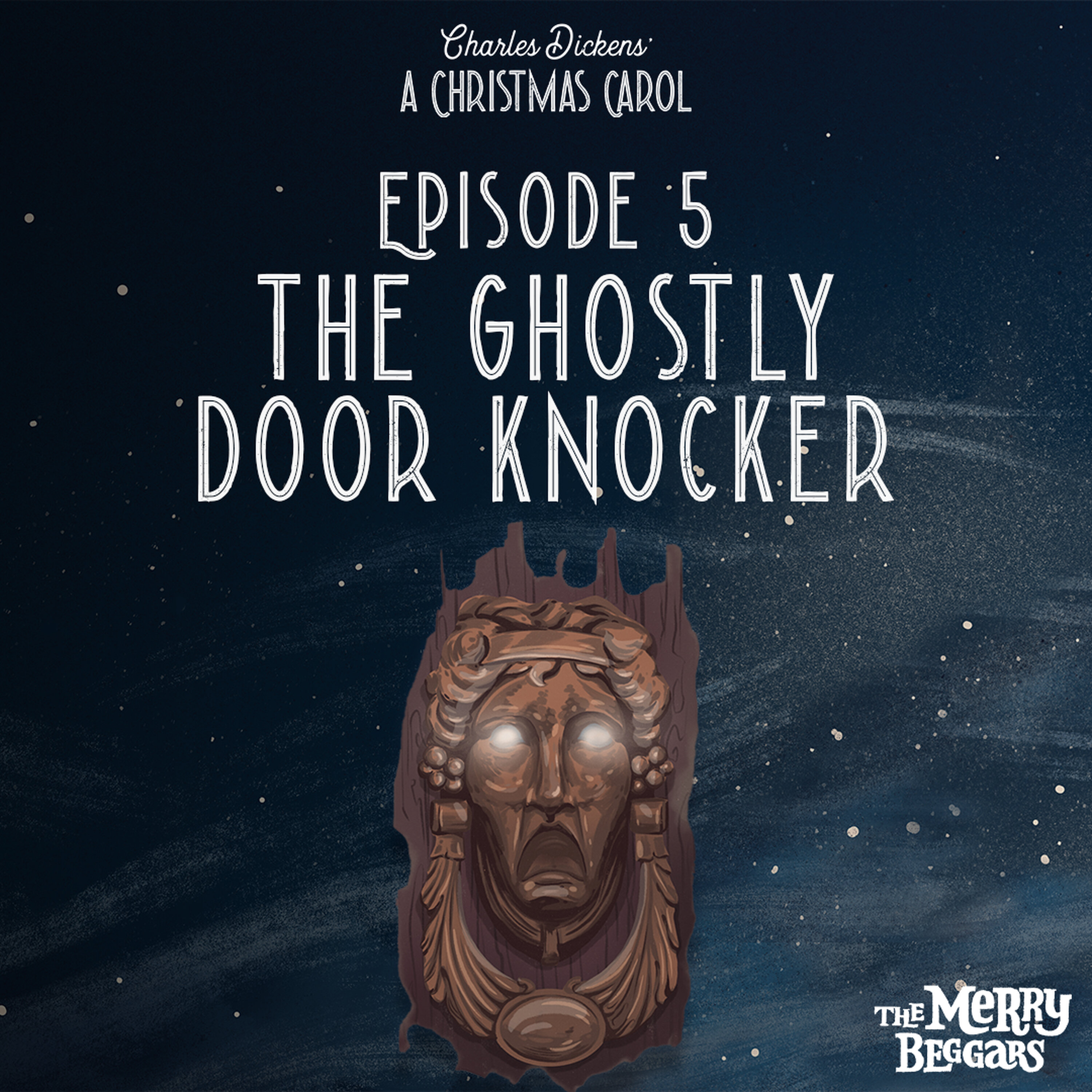
Now, it is a fact that there was nothing at all particular about the knocker on the door, except that it was very large. It is also a fact that Scrooge had seen it night and morning during his whole residence in that place. Also that Scrooge had as little of what is called fancy about him as any man in the city of London, even including, which is a bold word, the corporation, aldermen and livery. Let it also be borne in mind that Scrooge had not bestowed one thought on Marley since his last mention of his seven years dead partner that afternoon. And then let any man explain to me, if he can, how it happened that Scrooge, having his key in the lock of the door, saw in the knocker, without its undergoing any intermediate process of change, not a knocker, but Marley's face, Marley's face. It was not an impenetrable shadow, as the other objects in the yard were, but had a dismal light about it, like a bad lobster in a dark cellar. It was not angry or ferocious, but looked at Scrooge as Marley used to look, with ghostly spectacles turned up on its ghostly forehead. The hair was curiously stirred, as if by breath or hot air, and though the eyes were wide open, they were perfectly motionless. That and its livid color made it horrible, but its horror seemed to be in spite of the face and beyond its control, rather than a part of its own expression.
- [05:38]
Ebenezer Scrooge
Molly.
- [05:39]
Narrator
As Scrooge looked fixedly at this phenomenon, it was a knocker again. To say that he was not startled, or that his blood was not conscious of a terrible sensation to which it had been a stranger from infancy would be untrue. But he put his hand upon the key he had relinquished, turned it sturdily, walked in and lighted his candle. He did pause with a moment's irresolution before he shut the door. And he did look cautiously behind it first, as if he half expected to be terrified with the sight of Marley's pigtail sticking out into the hole. But there was nothing on the back of the door except the screws and nuts that held the knocker on.
- [06:18]
Ebenezer Scrooge
Pooh, pooh.
- [06:24]
Narrator
Scrooge shut the door. The sound resounded at the house like thunder. Every room above and every cask in the wine merchant cellars below appeared to have a separate peal of echoes of its own. Scrooge was not a man to be frightened by echoes.
- [06:40]
Ebenezer Scrooge
Ridiculous. Come now.
- [06:43]
Narrator
He fastened the door and walked across the hall and up the stairs slowly, too, trimming his candle as he went. You may talk vaguely about driving a coach and six up a good old flight of stairs or through a bad young act of Parliament, but I mean to say, you might have got a hearse up that staircase and taken it broadwise with the splinter bar towards the wall and the door towards the balustrades, and done it easy. There was plenty of width for that and room to spare. Which is perhaps the reason why Scrooge thought he saw a locomotive hearse going on before him in the gloom. Half a dozen gas lamps out of the street wouldn't have lighted the entry too well, so you may suppose it was pretty dark with Scrooge's candle. Up Scrooge went, not carrying a button, for that darkness is cheap, and Scrooge liked it. But before he shut his heavy door, he walked through his rooms to see that all was right.
- [07:39]
Ebenezer Scrooge
This is outrageous. Everything seems normal.
- [07:43]
Narrator
He had just enough recollection of the face to desire to do that.
- [07:49]
Ebenezer Scrooge
Marley. No, it couldn't have been Marley. Marley's dead. Molly's dead.
- [08:05]
Narrator
Subscribe@adventwithscrooge.com for the next episode of A Christmas Carol and download a free companion guide with activities, questions and coloring pages. Subscribe for free at advent with scrooge.com adventwithscrooge.com.