Loading summary
Transcript38 lines
- [00:03]
Narrator
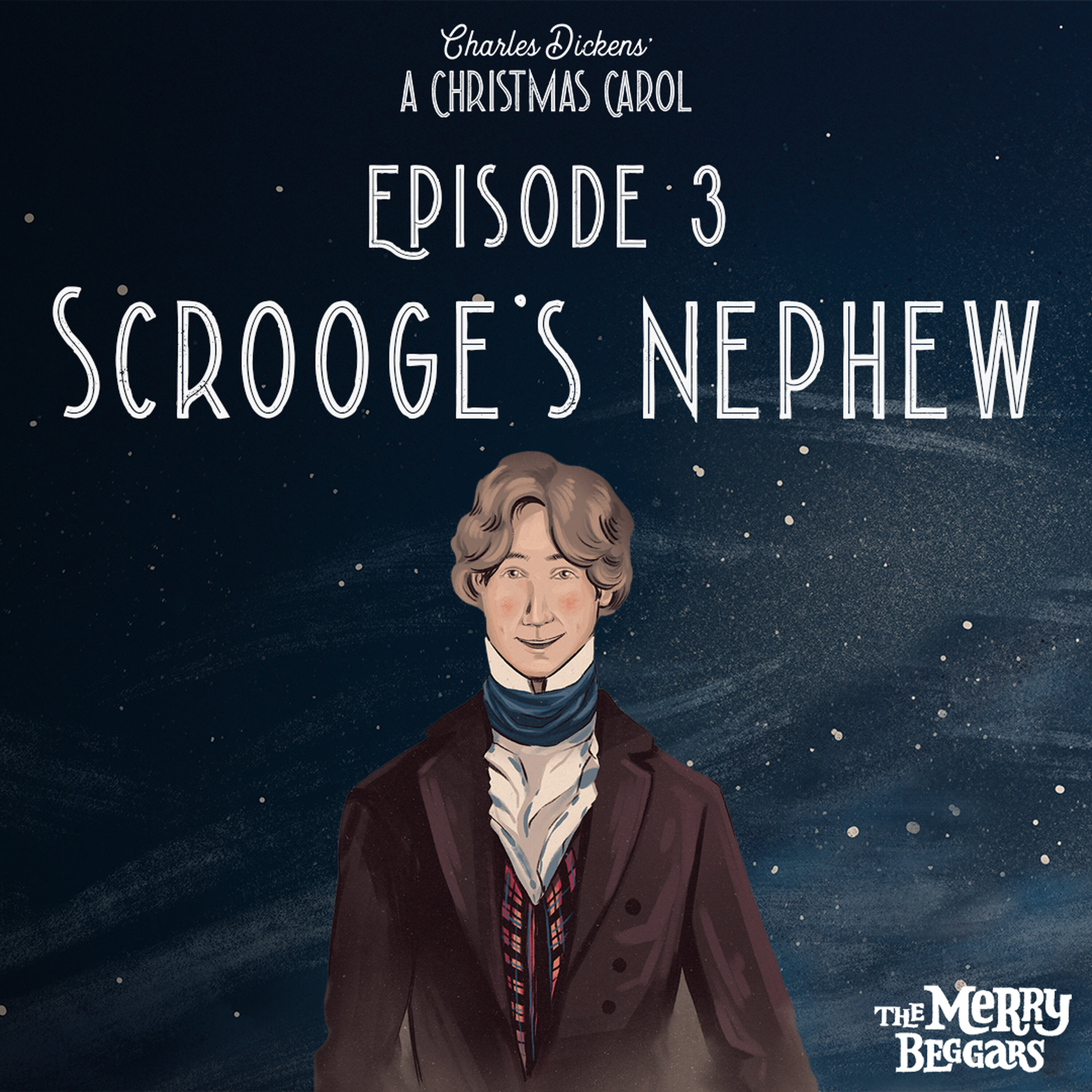
The Merry Beggars at relevant radio present Episode three Scrooge's Nephew.
- [00:27]
The voice of Scrooge's nephew came upon him so quickly. So quickly that this was the first intimation he had of his approach.
- [00:35]
Fred
A Merry Christmas, Uncle. God save you.
- [00:38]
Scrooge
Bah, humbug.
- [00:39]
Narrator
Scrooge's nephew Fred had so heated himself with rapid walking in the fog and frost that he was all in a glow. His face was ruddy and handsome, his eyes sparkled and his breath smoked again.
- [00:51]
Scrooge
Bah, humbug. This is a counting house. If you are not here to conduct financial matters, you find yourself in the wrong place. Christmas. Bah.
- [01:03]
Fred
But it is Christmas Eve, Uncle.
- [01:05]
Scrooge
It is. And I mean to continue operating these premises as if they still were instituted for the primary purposes of financial matters, not indulging indolence. Thank you, but.
- [01:18]
Fred
Humbug. Uncle Christmas, a humbug. You don't mean that, I am sure.
- [01:23]
Scrooge
Merry Christmas. What right have you to be merry? What reason have you to be merry? You're poor enough.
- [01:30]
Fred
Come then. What right have you to be dismal? What reason have you to be morose? You're rich enough.
- [01:35]
Scrooge
Bah, humbug.
- [01:37]
Fred
Don't be cross, Uncle.
- [01:40]
Scrooge
What else can I be when I live in such a world of fools as this? Merry Christmas. Out upon. Merry Christmas. What's Christmas time to you but a time for paying bills without money. A time for finding yourself a year older but not an hour richer. A time for balancing your books and having every item in them through a round dozen of months presented dead against you. If I could work my will, every idiot who goes about with Merry Christmas on his lips should be boiled with his own pudding and buried with a stake of holly through his heart. He should.
- [02:18]
Fred
Uncle.
- [02:18]
Scrooge
Please, nephew, keep Christmas in your own way and let me keep it in mind.
- [02:24]
Fred
Keep it? But you don't keep it.
- [02:27]
Scrooge
Let me leave it alone, then. Much good may it do you. Much good has it ever done you.
- [02:32]
Fred
There are many things from which I might have derived good by which I have not profited, I dare say, Christmas among the rest. But I am sure I have always thought of Christmas time when it has come round. Apart from the veneration due to its sacred name and origin. If anything belonging to it can be apart from that as a good time. A kind, forgiving, charitable, pleasant time. The only time I know of in the long calendar of the year when men and women seem by one consent to open their shut up hearts freely and to think of people below them as if they really were fellow passengers to the grave, and not another race of creatures bound on other journeys. And therefore, uncle, though it has never put a scrap of gold or silver in my pocket, I believe that it has done me good and will do me good. And I say, God bless it.
- [03:28]
Narrator
Oh.
- [03:29]
Fred
Hurrah.
- [03:30]
Scrooge
Oh. Let me hear another sound from you, Bob Cratchit, and you'll keep your Christmas by losing your situation. Well, Nephew. You're quite a powerful speaker, sir. No wonder you don't go into Parliament.
- [03:44]
Fred
Don't be angry, Uncle. Come, dine with us tomorrow.
- [03:48]
Scrooge
Dine with you tomorrow? I'll see you in heaven.
- [03:52]
Narrator
Now, I will not use that phrase myself, nor do I desire for its use to be propagated widely. And yet. And yet Scrooge did indeed say to his nephew that he would see him in that extremity first where our Lord does not desire us to go. But, Scrooge, mind you went the whole length of the expression.
- [04:12]
Fred
But why? Why, Uncle?
- [04:15]
Scrooge
Why did you get married?
- [04:17]
Fred
Because I fell in love.
- [04:19]
Scrooge
Because you fell in love. Good afternoon.
- [04:22]
Fred
Nay, Uncle. But you never came to see me before that happened. Why give it as a reason for not coming Now.
- [04:28]
Scrooge
Good afternoon.
- [04:30]
Fred
I want nothing from you. I ask nothing of you. Why cannot we be friends?
- [04:36]
Scrooge
Good afternoon.
- [04:38]
Fred
I am sorry with all my heart to find you so resolute. We have never had any quarrel to which I have been a party. But I have made the trial in homage to Christmas. And I'll keep my Christmas humor to the last. So, a merry Christmas, Uncle.
- [04:56]
Scrooge
Good afternoon.
- [04:58]
Fred
And to you, Mr. Cratchit. A merry Christmas, too. God bless you and your family. Thank you, sir. And a most happy Christmas to you too, sir. Most happy indeed. Stay as warm as you can in here, Mr. Cratchit, for tomorrow is Christmas Day. We must make merry. That we must, sir. God bless you, sir. Merry Christmas, dear Uncle. And a happy New Year.
- [05:24]
Scrooge
Good afternoon.
- [05:30]
Narrator
Subscribe at advent with scrooge.com for the next episode of A Christmas Carol and download a free companion guide with activities, questions and coloring pages. Subscribe for free at adventwithscrooge.com adventwithscrooge.com.