
Podcast
a fourth star map
Hosted by Tyler La Salle · EN
Tyler La Salle is an ultra-marathon runner, amateur fighter, and free thinker.
10episodes
Episodes
Newest firstAll episodes
#027: EXPLORER ACADEMY I: CAPPADOCIA
Nov 19, 202200:05:48Tap to summarizeCappadocia is an ancient region of Central Anatolia in Turkey that contains underground cities, rock-cut churches, and a phenomenon known in the area as “fairy chimneys.”
Transcribe →
HOLY GRAIL SERIES IV: THE GLASTONBURY ABBEY
Nov 14, 202200:20:01Tap to summarizeThe Glastonbury Abbey is an incredibly important historical religious site as it was quite possibly built by Joseph of Arimathea in the first century. I read archeological findings from 2018 published by Roberta Gilchrist which moves the sites founding back almost 300 years from 700AD to 450AD.
Transcribe →
#025 HOLY GRAIL SERIES III: Elizabethan Religious Settlement
Oct 11, 202200:27:42Tap to summarizeOn Religion, 1559 The next document, also from 1559, is a reply to some English Bishops who wanted to continue Mary's pro-Catholic policies. They maintained that her father, Henry VIII had been influenced by heretics to quarrel with the Pope. Sirs, As to your entreaty for us to listen to you we waive it; yet do return you this our answer. Our realm and subjects have been long wanderers, walking astray, whilst they were under the tuition of Romish pastors, who advised them to own a wolf for their head (in lieu of a careful shepherd) whose inventions, heresies and schisms be so numerous, that the flock of Christ have fed on poisonous shrubs for want of wholesome pastures. And whereas you hit us and our subjects in the teeth that the Romish Church first planted the Catholic within our realm, the records and chronicles of our realm testify the contrary; and your own Romish idolatry maketh you liars; witness the ancient monument of Gildas unto which both foreign and domestic have gone in pilgrimage there to offer. This author testifieth Joseph of Arimathea to be the first preacher of the word of God within our realms. Long after that, when Austin came from Rome, this our realm had bishops and priests therein, as is well known to the learned of our realm by woeful experience, how your church entered therein by blood; they being martyrs for Christ and put to death because they denied Rome's usurped authority. As for our father being withdrawn from the supremacy of Rome by schismatical and heretical counsels and advisers; who we pray advised him more or flattered him than you good Mr Heath, when you were Bishop of Rochester? And than you Mr Bonner when you were archdeacon? And you Mr Turberville? Nay further, who was more an adviser of our father than your great Stephen Gardiner, when he lived? Are ye not then those schismatics and heretics? If so, suspend your evil censures. Recollect, was it our sister's conscience made her so averse to our father and brother's actions as to undo what they had perfected? Or was it not you, or such like advisers that dissuaded her and stirred her up against us and other of the subjects?
Transcribe →
#024 HOLY GRAIL SERIES II: Joseph of Arimathea
Oct 6, 202200:22:29Tap to summarizeJohn 19:38–42 38 After these things Joseph of Arimathea, who was a disciple of Jesus, but secretly for fear of the Jews, asked Pilate that he might take away the body of Jesus, and Pilate gave him permission. So he came and took away his body. 39 Nicodemus also, who earlier had come to Jesus by night, came bringing a mixture of myrrh and aloes, about seventy-five pounds in weight. 40 So they took the body of Jesus and bound it in linen cloths with the spices, as is the burial custom of the Jews. 41 Now in the place where he was crucified there was a garden, and in the garden a new tomb in which no one had yet been laid. 42 So because of the Jewish day of Preparation, since the tomb was close at hand, they laid Jesus there. Luke 23:50-53 50 Now there was a man named Joseph, a member of the Council, a good and upright man, 51 who had not consented to their decision and action. He came from the Judean town of Arimathea, and he himself was waiting for the kingdom of God. Matthew 27:57-60 57 As evening approached, there came a rich man from Arimathea, named Joseph, who had himself become a disciple of Jesus. 58 Going to Pilate, he asked for Jesus’ body, and Pilate ordered that it be given to him. 59 Joseph took the body, wrapped it in a clean linen cloth, 60 and placed it in his own new tomb that he had cut out of the rock. He rolled a big stone in front of the entrance to the tomb and went away. Mark 15:42-46 43 Joseph of Arimathea, a prominent member of the Council, who was himself waiting for the kingdom of God, went boldly to Pilate and asked for Jesus’ body.
Transcribe →
#023 HOLY GRAIL SERIES: "and did those feet in ancient time"
Sep 25, 202200:21:36Tap to summarizeAnd did those feet in ancient time, Walk upon Englands mountains green: And was the holy Lamb of God, On Englands pleasant pastures seen! And did the Countenance Divine, Shine forth upon our clouded hills? And was Jerusalem builded here, Among these dark Satanic Mills? Bring me my Bow of burning gold: Bring me my Arrows of desire: Bring me my Spear: O clouds unfold: Bring me my Chariot of fire! I will not cease from Mental Fight, Nor shall my Sword sleep in my hand: Till we have built Jerusalem, In Englands green & pleasant Land. Beneath the poem Blake inscribed a quotation from the Bible: "I wish to God that all the Lords people were Prophets" - Moses Numbers XI. Ch 29.v9 This poem by William Blake is based on an a handful of apocryphal texts and legends that Jesus may have once visited England when he was a child, also connected to the myth that Joseph of Arimathea was in possession of the holy grail and took it to England and started the Christian church there (which interestingly enough is backed by a letter from Queen Elizabeth I in 1559.) So, who was Joseph of Arimathea? And is there anything to the story that Jesus was in England? John 21:25 Jesus did many other things as well. If every one of them were written down, I suppose that even the whole world would not have room for the books that would be written.
Transcribe →#022: The Boar Hunt AudioStory
Sep 17, 202200:14:37Tap to summarizeGrowing up in Southern California didn't lend itself to many hunting opportunities. In fact, growing up in my family, with our interests in Raiders football, Magnum P.I., music, endurance sports, Lost, and Utah Jazz basketball, there was actually zero talk about hunting, ever. It's not that we were ever against it; we were just a suburban family who went to the grocery store and watched football on Sundays. Listen to the whole audiostory now.
Transcribe →
#021: 50K AudioStory
Jul 24, 202200:13:02Tap to summarizeStep 1: Overcome Yourself “Holy fuck, I can actually win this thing,” I thought as I was dusting the competition, sprinting downhill, above the clouds in Agoura Hills in Los Angeles County on that Saturday Morning in early December 2021. I found myself in 1st place about 8 miles into my first ultra-marathon, a 50k, about 31 miles. I was just taking my phone out to record a video of myself boasting when I looked behind me. Fucking fuck. The guy who was in first place about 3 miles through, who took a wrong turn for a while, was now right behind me, probably by about 800m at the top of the mountain. I felt stupid, put my phone away, and kept pushing downhill. Listen to the whole audiostory now.
Transcribe →
#020 Mirrors
Jul 7, 202200:17:32Tap to summarizeGeorge W. Stocking, Jr. explained that to truly understand an object, which is multidimensional, we have to understand all of its characteristics. Not only do we need to understand height, width, and depth, but time (history), power, wealth, and aesthetics. We have to wonder about our early hominid ancestors’ reactions when they first saw their reflection in a lake or another pool of water. What did this mean for them? It’s impossible to know, but we can conjecture for hours. Mother nature created water as the first true mirror. The idea must have remained in our collective consciousness all of these years to be able to want to mass-produce a “nature mirror” for our own daily use. According to religious historian Mircea Eliade, “If origin is equivalent to power, then "it is the first manifestation of a thing that is significant and valid.” I believe the mirror represents our human aspirations for social desirability, as well as physical, emotional, and mental self-reflection and self-care. The mirror is how we distinguish ourselves as individuals, and maintain desirability to the collective. We can metaphorically “look at ourselves in the mirror” as a means of reflecting on our morality, and mortality. It’s as if our perception of our physical self is reflective of our inner well-being.
Transcribe →
#019 Free Will as the Tool of Destiny
Apr 24, 202200:05:32Tap to summarizeHuman Free Will as the Tools of Destiny -Individual psychological phenomena affect global sociopolitical/religious, etc. events. The latter is reflective of the former. - Firstly, the idea that individual psychological phenomena directly create global socio-political events is grounded in an assumption claiming social events spring forth from the psyche of humankind. A fatalist counter-argument can be made about destiny controlling the actions of individual human beings, which then have a broad societal effect. It could also be argued, destiny controls the actions of society which then have a broad affect on individuals within a society. This would mean: society acts of its own accord, or as a tool of destiny, and controls individual human beings. My claim is, society cannot operate of its own accord without the acts of individuals. But, individuals can operate of their own accord without society. If destiny controls the actions of humans, are we subject to an uncontrollable & unchanging fate? If destiny is a force similar to gravity, when & where is destiny in space & time? Perhaps, destiny is a force with a mass so great, it can guide the actions of the natural world. But, as a human, it certainly feels as if we have a capacity to alter outcome, called free will, and, how would destiny act if it wasn’t on our behalf? A question arises in my mind, assuming that destiny is akin to a gravitational pull: is human free will the tool of destiny? Can destiny be found in the psyche of humans? Would it be located in the subconscious, or more precisely, the preconscious? It seems it can be brought to conscious attention. Since the future is unknown, our destiny cannot be made clear, but we can forage in our minds for clues. These clues may be found in dreams, ambitions, anxieties, & intuitions. Can humans realize & control our destiny? If we can bring destiny to consciousness, and we can’t control it, it would bring nothing but despair. But, it seems we can bring our personal destinies to consciousness & change it by noticing our fantasies, habits, conscious aspirations, & past shortcomings. On second thought, perhaps we can’t bring our whole destinies into consciousness, but we can at least find where we are on our path. Logically, if we can do this personally, we can do it on a grand collective scale. What are our global, collective fantasies, habits, conscious aspirations, & past shortcomings? Well, education is surely the means of achieving the goal of realizing our collective destiny. Because, we can find out where we are on the map of our human journey, and see where we’re going. If where we’re going is not where we wish to go, we can, hopefully, change our course. As destiny uses humanity as a tool, we should strive to be aware & helpful in its quest. Especially if we, as a species, are giving birth to a new, artificially intelligent, tool of destiny. Is destiny like gravity? Can it be located in our collective unconscious? Can we realize & control it?
Transcribe →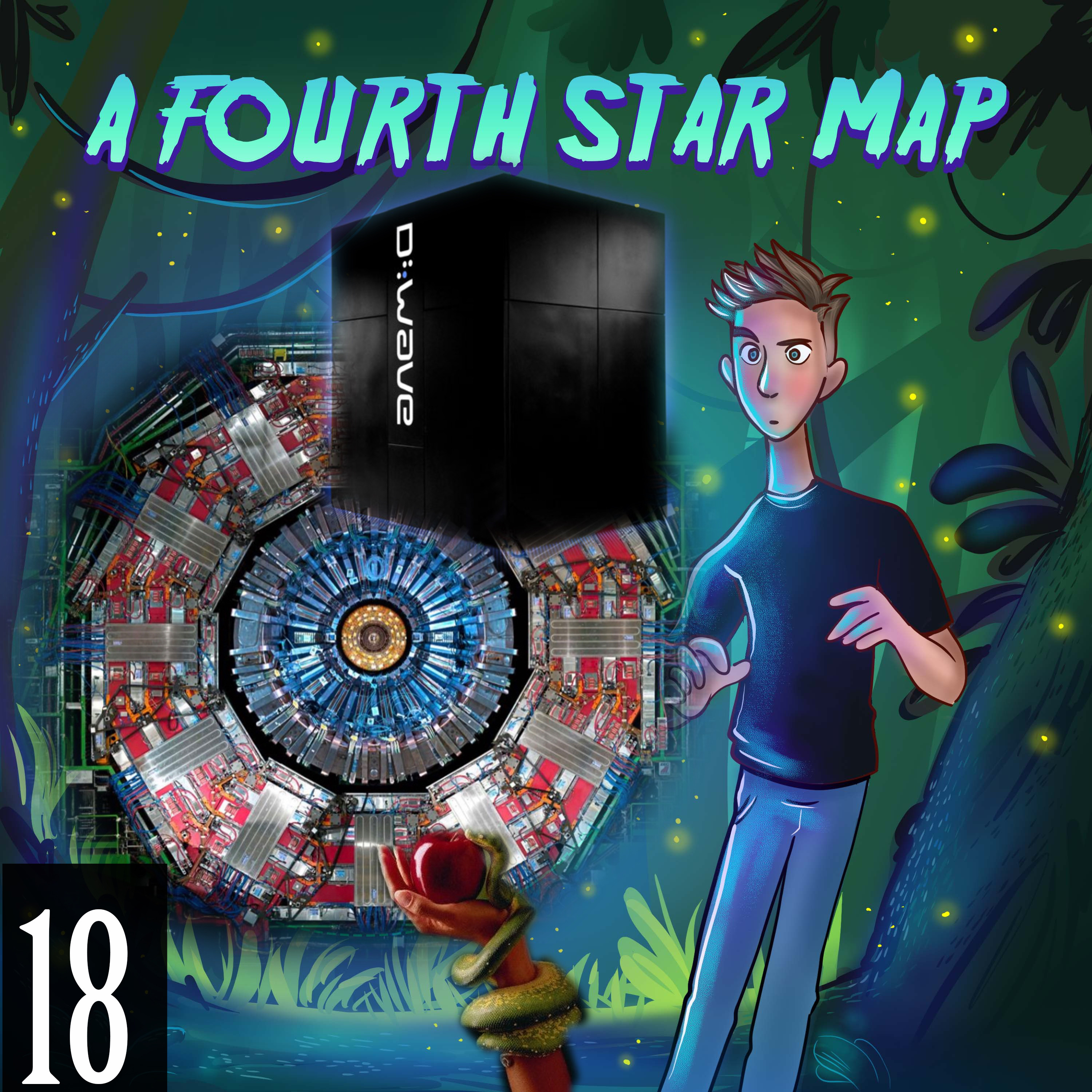
#018 Responsible Free Thought: CERN, D-WAVE, and Apple
Apr 16, 202200:30:42Tap to summarizeIn this video, I discuss the symbolism of CERN and surrounding projects in Switzerland, what D-Wave Systems Founder Geordie Rose says about AI and Quantum Computing, and the symbolism of Apple & the Garden of Eden.
Transcribe →