← A Place of Yes | A Grief Podcast 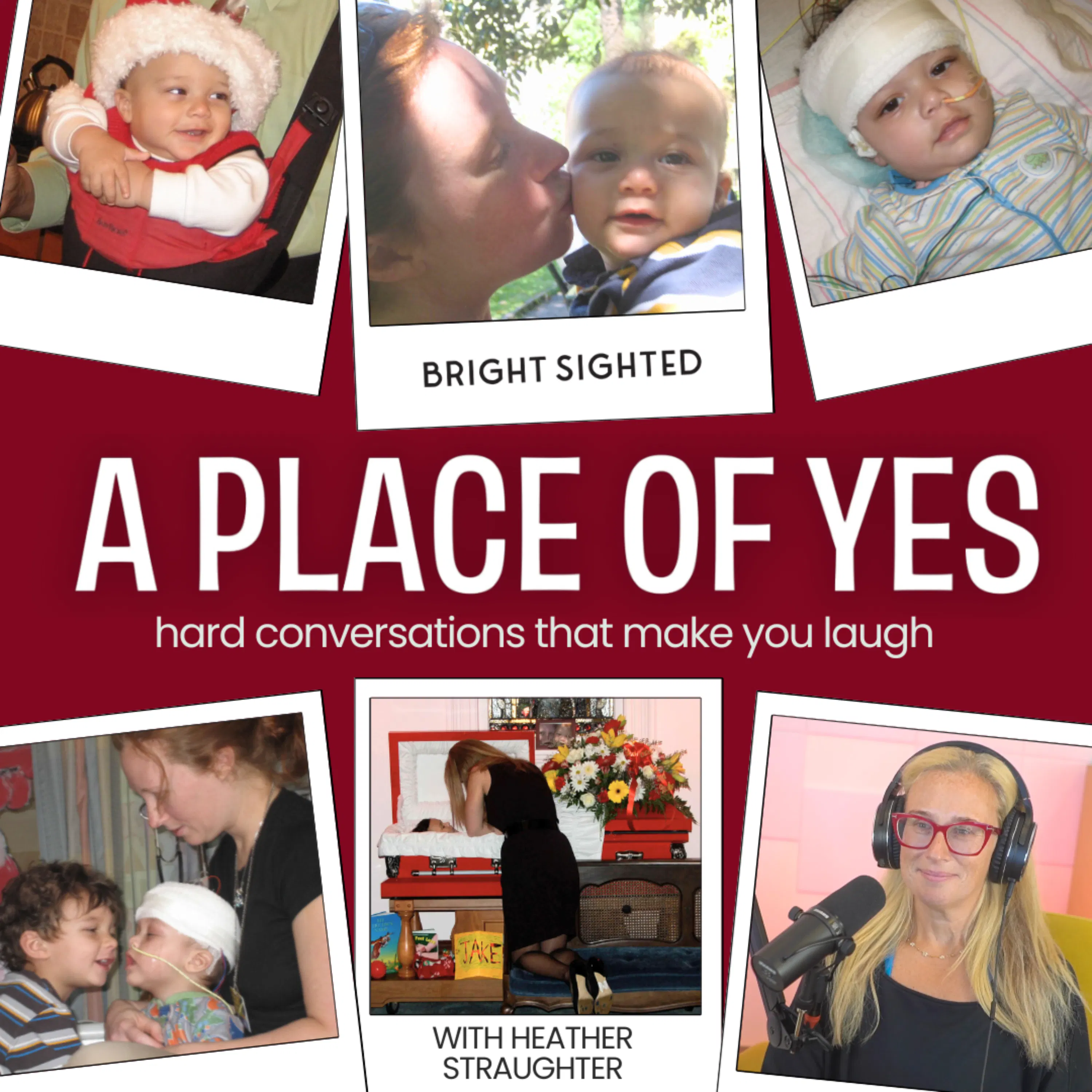
Loading summary
Transcript1 lines
- [00:01]
Heather Straughter
Grief can be so isolating. Even when you're surrounded with people, you're still alone. Because some of the thoughts, at least for me, I don't know that other people have these same thoughts. I don't know that other people go as dark as I do. I think people compartmentalize and they say the things that they think they should say, or they talk about how much they miss people. But once you go deeper than that, which is where I sort of spend a lot of time, it's really lonely. Welcome to A Place of Yes, a podcast about how I moved through my darkest hour. And for me, that was in channeling my grief into good. Welcome to the show. This is Heather Straughter. And this is a different kind of episode of A Place of yes, this is just me. It is something I have actually wanted to do for quite some time, and I finally decided, let's just do it. I'll talk a little bit about my grief journey. I'll talk about where I am in real life, and I'll just kind of talk to you. I've given this so much thought for so many months, and every time I thought I would do it, I chickened out. And then I realized that the formality of doing it in the studio with my producer made it seem entirely inauthentic. And what I actually wanted to do is what I'm doing right now. I'm sitting in my house alone, and I'm having the conversation with you guys that I often have in my head. I spent a lot of time thinking about what room I should record this in, and I was thinking of all the things. I was thinking about some of the shows where moms record in their child's room. Well, that room doesn't really exist. Jake, when he was alive, spent most of the nights in our bed in our room. He had a bed in the room that he shared with Ethan, but he didn't really spend a lot of time there. Filming it in Ethan's room just seems weird. And then I thought about filming it upstairs on our third floor where we have this couch that used to be in our old house. And I was like, oh, maybe that feels right, but it didn't feel right either. So I'm actually here in the front room of our house. And those of us who've known us a long time know that we still sometimes call this Jake's therapy room. It looks nothing like what it did when he lived here. It actually, yeah, it's totally different. But when he lived here with us, when he was part of this house when we first moved here. This was the room where he had his therapies. Xavier came over and did ot. Nadia was here doing pt, Sometimes Karen, sometimes Cynthia. But this front room was Jake's therapy room. And I still think of it like that. So that's why I'm sitting here. It's also the room that I remember so vividly, like it was yesterday that when we came back from the hospital after Jake died, I remember standing in this room and screaming. And I don't think I will ever forget that feeling, that moment, that primal scream of just absolute, I don't know, heartbreak, devastation, all the things. It was horrible. And that was also in this room. I am sitting in a room that I feel so connected to Jake in. I feel a spirit here all the time. I think it's a room that I come to when I want to feel him close, when I talk out loud and when I just overall think of this house and think of him. This is where he had the most time, I think, where he was working hard, where he was kind of in this space. And there's no other room in this house that I think of as profoundly connected to Jake. So here I am. I sound a little crazy when I talk about it because Jake has been gone for so long and he lived here a really short time. But this house is Jake's house. It is all of our homes, but it is also Jake's home. I've said this before and I don't always know if people think I'm serious or not, but this house will always be part of our family. I don't know that I'm always going to want Saratoga Springs to be my full time home. In fact, I'm fairly certain I don't. But this home will always be part of our family. I don't know that I will ever be able to let go of this. I have let go of cars that he was in. I have let go of other pieces that were so connected to Jake. But I don't think I can ever let go of this house. So all that to say I am recording this solo episode in the place in my home where I feel Jake is present. So what am I going to talk about? I. I don't actually know. But what I know I'm going to talk about is obviously grief and where my head's at. And to be honest, I. I've been struggling a bit. I've been struggling more than I typically do. And I've been struggling because a lot of this is self imposed. I'm struggling because what do I do for a living right now? I talk grief. I have a podcast. I have an organization that would not exist had my son not died. I write about grief. I. I meet people. I read books. I. I am so immersed in this right now. More so than I have been, I think, probably since the beginning. Um, I've read more books about grief in the last year than I have probably in the previous 10 years. I read a ton when Jake first died, but then I. I kind of stopped for the most part. I have loved coming back into this world. I have loved it because I feel like I can be of service. I feel like I have people in my world now that understand me in a very different way than have for a while. I have people that I'm connected to. You know, I read things like, I just read this book, you can't do it alone. It was the podcast guest I interviewed just yesterday. And as I was read, I was like, oh, she's my person. Like, she's someone I understand. She. She relates to death in the same way that I do. And there's something I like about that. Because grief can be so isolating. Even when you're surrounded with people, you're still alone. Because some of the thoughts, at least for me, I don't know that other people have these same thoughts. I don't know that other people go as dark as I do. I think people compartmentalize and they say the things that they think they should say, or they talk about how much they miss people. But once you go deeper than that, which is where I sort of spend a lot of time, it's really lonely. So one of the things that I really do want to talk about is what happens when I go dark? What happens when we go dark? So I'm assuming that even though I sometimes feel so alone in this, I'm assuming other people have these thoughts too. And for me, it happens twice a year, for sure. It definitely happens other times, too. But for me, the hardest part is the part that I'm in right now. It is in this time leading up to Jake's birthday. It always creeps up on me. You would think that I would know by now that at some point around this time, I'm gonna feel sad, I'm gonna feel mad, I'm gonna be kind of a mess and, like, not have my shit together at all, but it still catches me off guard every time. So this week is when it all kind of came to a head. Couldn't get out of my own way, made a bunch of mistakes, like, just struggled. And then it was pointed out to me, and I kind of realized that Jake's birthday's coming up. And the thing about it is that every birthday has, for me, gotten harder. And this is why. I don't know that this is for everybody, but this is why it sucks for me. Jake was 4 when he died. He was 8 months when he kind of stopped being the social little guy that he was for the eight month, first eight months of his life. And when he. When he died, he. He was four. And he was really. I hate saying he was really sick because he was a lot more than his illness, but it was not. It was not typical. He was not full of personality. Like, I knew who he was. I knew he was this fighter. I knew he was resilient. I knew he was all of these things, but it wasn't obvious and it wasn't there. And it makes it impossible for me to know who he would be at 19. And that sucks. I have no idea who he would be at 19. I have no inkling of who he was or would have been at 10 or 8 or 14. And that is just this really sad feeling for me. Because I feel like you're supposed to know who your kids are, and I just don't. Like, would he be like Tessa, like Jeff and Heath's daughter, who's, I don't know, 21 right now, full of personality, sick and struggling and seizures and all this shit. But you know who she is. Would she be like Malana? I see so much of Jake and Malana and I. I go hot and cold and I feel bad. Cause I feel like sometimes I ghost them. Cause I'm like, no, I'm coming over. I'm coming over. And then I can't. Because I just. It makes me think that that's what Jake would be like if he was here. But I don't know, right? I have no idea. I mean, sometimes I wonder if he'd be like, Emmanuel. Emmanuel passed away. God, what is it, one or two years? But lived a life up until, I don't know, his early 20s. But he was on a trach, he had feeding tubes. He was hooked up to a vent. Like all of the things. Would that have been his life? I don't know. And I think that's why birthdays are so hard for me. Because I. I get trapped in this, you know, what would he have been at 18? What would he have been at 19? And I get trapped with other 18 and 19 year olds. I know what Ethan was like at 19. I know what that looks like. So then I tried to, like, impose Jake into that, but that's not right either, right? Because that's not who he would have been. He wouldn't have been Ethan. The not knowing kills me. And the not knowing takes up so much space in my head when I let it. That kind of leads me to my next topic, which is the topic of grief and darkness. Society puts this on us, right? Society thinks that you are going to grieve and you are going to move on and that you're going to get over it and that you are going to miss your people, but that life will go on. And there's a huge part of me that in some ways agrees with that right? Mind over matter. One foot in front of the other. Make yourself get out of bed. All the things I told myself, all the things I still tell myself, and frankly, some of the things I believe. But at the end of the day, it doesn't go away. It doesn't get better. And I always feel like such a, you know, Debbie Downer when I say that. But I think people need to recognize that. I think people who are friends with grievers, who are surrounded by people who are grieving and people who are grieving, you gotta give yourself a break, right? Cut yourself some slack because this shit is hard. It sucks knowing I'm never gonna see my kid again. It sucks that I haven't seen my kid for 15 years. But the fact is, it's reality. It's reality for a lot of different people. Whether it's a spouse, whether it's a friend, whether it's a sibling, whether it's a dog. There's a void that we had people who were here and then they're gone. And that void sucks. This is actually sort of funny. And it's the way I think that I have handled my grief. Like, for me. And again, this is my $0.02. This is my opinion. This is actually just me being me. Unfiltered, if you will. For me, I have survived my grief by having rules in general. Like, in my normal life, I hate rules. I don't think anyone. Like, I just don't like them. I've always kind of rebelled against them. I find them annoying. I understand that we need structure to. For humanity and to live and. And yes, rules help us do that. But I always. I always like to skate that line some. I always have. I don't know, maybe it's because I'm an only child. Maybe it's just because I'm a pain in the ass. I don't know. But the fact of the matter is, I have created rules for myself around grief that I think have saved my life, that have made me be able to be in the space, that have made me able to be successful in life and to have survived this loss and continue to survive the loss. For me, I have to let myself go dark. I have to get in my head. I have to get grossly dark, and then I have to know when to get out. I have to know. And that sort of happened to me a little bit this week. I have to know when I am too immersed. I kind of learned this phrase, you know, the intrusive thoughts. I don't know who was talking about that, but the intrusive thoughts, right? Like, my intrusive thoughts are dark, and they're terrible, and they mean everybody that's important to me is gonna die. Sometimes Brian doesn't know what to do with me. We'll be driving, and I, like, I'm not driving. I'm in the passenger seat. But I kind of do this, like, big gasp because it's almost like I see us dying. I see people dying. You know, we jokingly say I see dead people, but I kind of do. And when that gets out of whack for me, I can't breathe. I can't live. I can't be. I'm just too much in my head. And for me, I have to recognize that, and I have to know what I need to do to get out of it. I have to give myself the time alone to kind of work through it. And I have to not allow myself to be alone all the time and force myself into normal life things, because my dark is dark. So the rules help me know when it's time to get out. And I think for some people. Some people do that through therapy. Some people do that, I think, with medication. Some people don't have such higher highs and lows, right? Like, some people are just, I think, more even. But for those of us in grief, I think sometimes those boundaries get pushed. And I will say that I think this is a little bit who I was before Jake died. This is kind of who I was as a teenager, as a young adult, as. As. Like, I remember vividly, like, you know, breaking up with a boyfriend or getting in a fight with someone and spending the whole weekend in my apartment, like, wallowing in my own sorrow and then being, you know, it being Monday morning and being like, okay, get your ass out of bed, get your shit together and go to work. It's a little bit how I process how I do things. So it's not surprising to me that this is how I handle grief. But I just think it's really important for us all to be self aware and to put timeframes or limitations on your sorrow. And maybe some people are listening to this and they're kind of thinking, you are nuts. This doesn't work. I cannot put a timeline on this. I cannot force myself to do anything or I don't want to. And that's all good. I'm just kind of talking about how I handle birthdays and how I handle the darkness. Because I do feel sometimes, like in the podcast or in my work with Jake's hall from Heaven, I think sometimes I come out falsely positive. I come out like, hey, everything's gonna be okay, and, you know, channel your grief for good and make the world a better place. And I, that is me. That's who I am. But this other piece is also me. And I just, I. I feel like it was time to be a little bit more transparent about that for everybody, including myself. One of the things that we did do or that I wanted to do and then we did as a family when Jake first died was, and I've talked about this before, I instantly knew that I needed to do something with my grief, right? And it was not this, you know, pain for purpose, grief for good jargon that exists now. It was really kind of more what I was saying, like, what am I gonna do with this darkness and how am I going to stop it? And I stopped it by starting this foundation and being Ethan's mom. And there was plenty of reason for me to stop it and wanting to stop it. So I don't want to sound too dramatic, but one of the things that we did is we had the foresight to know that his. That Jake's birthday was gonna suck. He died in December. His birthday's in May. Like, we kind of knew that. And we planned our first fundraiser around that. We planned it to be a family fun day, and we planned it at the bowling alley. Cause it was one of the few places that again, whether I made this up as, as truth or it was truth in my mind, when we went to the bowling alley with Jake, he had a good time. There were lights, there was stuff. He. He would sit in his chair and obviously he could not bowl, he could not participate. Like, we didn't even do any of the adaptive bowling things they do now. He literally sat in his chair, and we would talk to him, but he would just sit there and watch. So in my mind, it was a family activity. So that's what we did. And honestly, last year we went bowling, the four of us. It was me, Brian, Ethan and Leah. I don't know what we're going to do this year. I know we're going up to see Ethan in Syracuse, and Leah's running in a track meet, and we're going to do something together. And maybe it'll be at a bowling alley, maybe it'll be having margaritas. But for us, celebrating the birthday, cheersing Jake, having a cake has been something that has helped. We also. And we did not do this last year, and I'm not even sure if we did it the year before, to be honest. But one of the other things we did at a certain point was we would get, like, a family gift. Like, I think we got a Wii or we got Even whatever, a PlayStation or, you know, something like that. Something that, like, we would do. One year, I think we got the basketball hoop for outside. So we would always do something special, whether it was a gift. In those early years, we spent a lot of time either in. In Lake Placid or Montreal. For his birthday, just a. It got harder as Ethan got older and there were sports and there were other things. I think when we can spend it together and remember something simple. And even if it's bowling, I think that's helpful. Some of the other anniversaries, like the death day, those are shitty days, you know, it's hard to make that good. I've actually had a pretty decent time with Christmas. Like, I can treat Christmas completely independent of Jake, so some holidays for me aren't wrapped up in sadness. I can say Mother's Day sucks. I hate Mother's Day. I hate it because I feel like I'm just phony the whole day. I feel like I am showing up for everybody else because they want me to or because I should. I guess that's the thing, right? Like, when you're in grief, there is no set thing, you know? And some of our guests were talking about it. I actually remember talking, I think it was with Sophia Allen, Olivia's sister. She talked about being ready to have Christmas be a hard time. And it kind of wasn't. It was. It was what it was. But New Year's kind of took her breath away. Like New Year's Eve, like this whole, like, oh, my God, we're entering a year that my sister will never have lived in. And that's the thing with grief, too. Like, it's all. A head trip. Like that, for me, is a hard time. I think I talked about it then and I can talk about it again. You know, I didn't see this coming, but when people were doing senior pictures for what would have been Jake's senior year, it broke me and it makes me sad, right? Like, we have this whole wall on our second floor, this whole wall of Ethan's pictures from when he was 2 years old at Beagle School till he was a senior in high school. And we have one picture of Jake, one picture because he was at Prospect when they had picture day, and he only made it for one picture day. And that sucks. So picture day at school when Ethan had already graduated, like, that was a trigger for me. Who. Who would have guessed it? So I guess it's okay, right? Like, it is what it is. I don't know if rules will help you, but, like, if you're in grief and you're stuck there, give yourself a timer. I'm going to feel like shit and I'm going to be miserable for 36 hours. For 12 hours. My windows are shorter because I share a life, right? Like, I share a life with Brian. I share a life with Ethan. Even, you know, he's at school. But, like, I share a life with other people. I try to be cognizant of the fact that I share my life with people. I guess my final thought, and this, I think, has more to do with the fact that I'm 51, has less to do with the fact that I'm a grieving mom or that my son died 15 years or any of that. I think the importance of finding your niche, like finding your people and finding your people doesn't necessarily mean, like, who your besties are. It's those people that make you feel like you are not so alone, even if you don't know them in real life, even if it's just conversations you've had. For me, I've had some great conversations with people on this podcast on a place of. Yes, I have had people reach out to me who I have then turned around and either read their book or interviewed them on the show, or I've reached out to people that I never thought would have responded to me because of the show, because of this connection of this community that we are building. And for me, I love it. I know I need to take a break. I know that there is going to be a pause between season two and season three. We did not pause between season one and season two. So there will be a pause. But I also know that this work, this conversations, this community, I know it means something. It means something for me, and I think it means something for the people who are listening. I hope that something maybe that I shared, resonated. I hope that something made you understand me a little bit better. I hope that if you thought that I was this sunshiny, happy person all the time, you recognize that I'm not. That I'm totally real, that I am, you know, sometimes scared that I'm a fraud, right? Like, that I'm, you know, even hard conversations that make you laugh, yeah, they make you laugh because it's life, and life can be funny. But they're hard conversations and it's dark and it's dreary. What do I say all the time? Two things can be true. And I say it probably so much because I need to believe it. All right. Thank you. Thank you for listening. Thank you for being here. Follow us on Instagram. Place a yes Podcast. Reach out to me, message me, email me all the things. Thank you. Thanks for being here. Thank you for listening to A Place of Yes. Please follow us wherever you listen to your podcasts. If you really like this episode, please share it with a friend. It would make a world of difference if we could just reach more people and share the work that we do and the stories we want to tell. Thank you so much for watching.