← A Place of Yes | A Grief Podcast 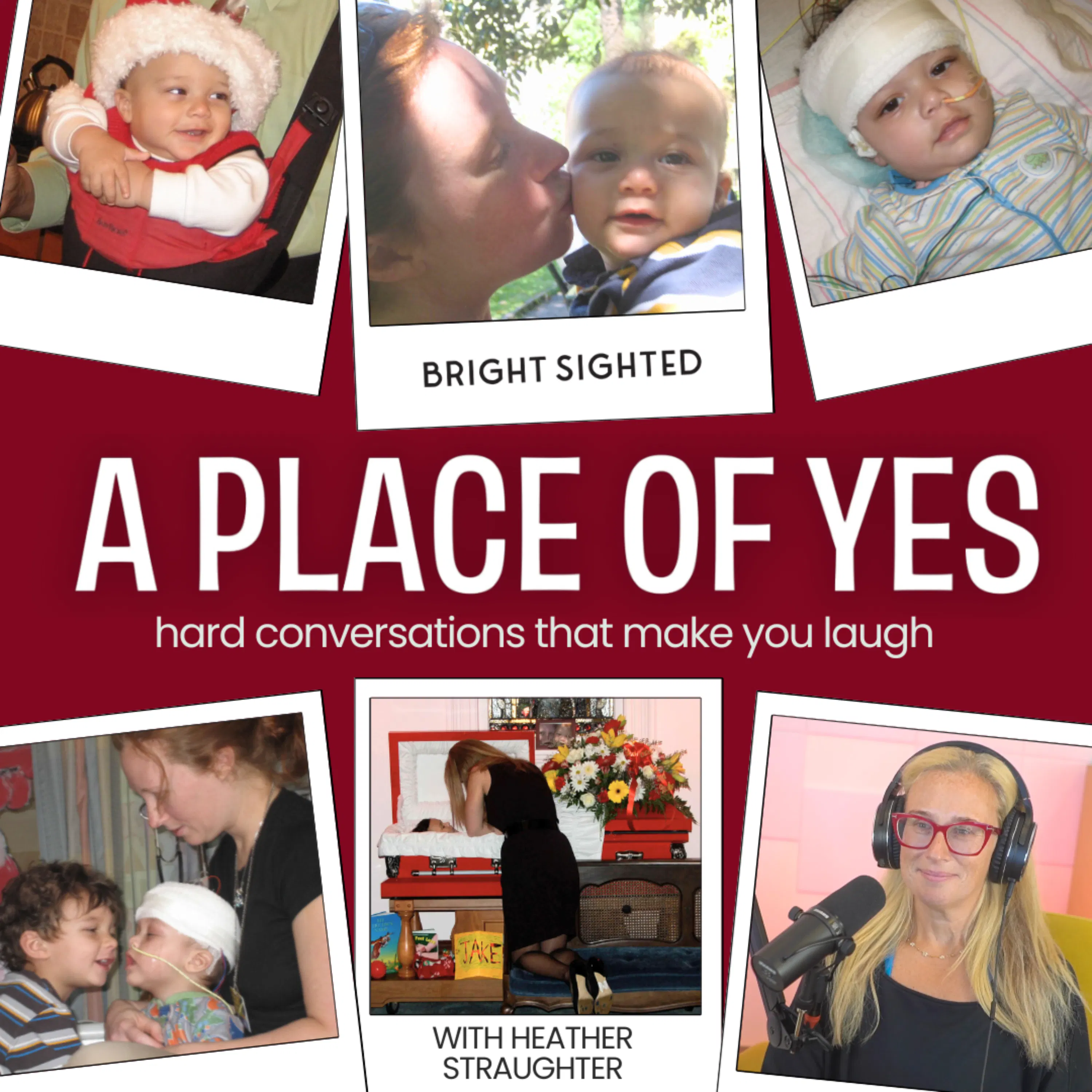
A Place of Yes | A Grief Podcast
My Son Outlived His Life Expectancy: Microlissencephaly & Our Fear of Losing Miles
00:49:51
Loading summary
Transcript219 lines
- [00:02]
Heather
Welcome to A Place of Yes, a podcast about how I moved through my darkest hour. And for me, that was in channeling my grief into good. Welcome to the show today. I am very excited about this guest because we are circling back to our roots a little bit. When we started A Place of yes, we really wanted it to showcase families and the work that we did with Jake's Help From Heaven, it really started as a direct offshoot of that. And in the beginning, we did a ton of conversations with families. And we have since we talked to grief counselors, and we talked to different, you know, authors and doctors and different things. But I always want to make sure we come back to our roots. And I'm excited because I think with today's guest, we are doing exactly that. So I am sitting here with David Robinson, who is. Is better known to me as Miles. Dad, Jake's Help From Heaven has been working with you and your family. I looked this up cause I knew it was a long time. But since 2014, during that kind of research that I was doing to get ready, I showed you when you came in, I found our initial visit with Miles. And he was. He's like a little child. I was there, what, two weeks ago, three weeks ago, and he's a big boy now. He's 10.
- [01:18]
David Robinson
Yeah, he's almost a teenager.
- [01:20]
Heather
He is. He's almost a teenager.
- [01:22]
David Robinson
So.
- [01:22]
Heather
So can you share with the audience a little bit about you and your family and Miles and tell a little bit about your story?
- [01:28]
David Robinson
Well, as you said, my name's David Robinson. I'm married to Jolene, my wife. We have two boys. Oliver, who is 8 and is a typical 8 year old, and Miles, who is 10 and was born with microlissencephaly.
- [01:40]
Heather
You say that much better than I do.
- [01:42]
David Robinson
Well, I remember the doctor sitting with me. He's like, micro Latin for small. Listen, German for smooth. Cephaly. Brain is Latin and Greek. So when you put it all together, it's small, smooth brain. We found out probably two or three months before he was born. We went to our last ultrasound visit. Everything. The pregnancy had been perfect. And in the last visit, they said, oh, something doesn't look right. And then they sent us for a fetal mri.
- [02:08]
Heather
Okay.
- [02:08]
David Robinson
And they determined that his head size wasn't tracking to where it should be. And so they tried to prepare us for. For microcephaly dysgenesis of the corpus callosum. You know, they threw all these terms at us. We went home and googled it and panicked. Jolene and I decided right then and there that whatever the outcome was going to be, we were gonna do this together and we were gonna give them the best life we possibly could.
- [02:33]
Heather
So up to that point, you had no idea?
- [02:35]
David Robinson
No idea. That last two months, I guess, was sort of weird because you wanna maintain that optimism of this upcoming birth and you wanna expect this the best. And we're like, okay, well, maybe he'll be developmentally slow. We may have some issues, but nothing that we can't overcome. We weren't necessarily prepared for the eventuality of how he came. So Miles is non ambulatory, non verbal. I remember when they came to get us to tell us what was going on, they brought psychologists, they brought doctors. Oh, really?
- [03:07]
Heather
It was a whole serious story from that ultrasound.
- [03:11]
David Robinson
Oh, no, this was after he was born, while we were in neonatal. I mean, he looked perfect. Of course he did. Yeah. You couldn't tell. You couldn't tell anything. Everything was small. So a small head didn't look much different than the small body. So they did an mri, and that's when they. They knew the full scope.
- [03:28]
Heather
Okay.
- [03:29]
David Robinson
Of. Of his disease. I remember them asking us what we wanted to do, as if, you know, there was an option. And we had already term. We're bringing him home and they sent us home with a life expectancy of two to five years.
- [03:43]
Heather
I'd like to just reiterate, he is 10 years old.
- [03:45]
David Robinson
Yes, he is 10 years old. But I mean, as new parents, you know how impactful hearing that kind of. You know how impactful hearing that kind of news is. A friend from high school reached out to me on Facebook, like in a day or two after Miles was born, and she sent me a poem, welcome to Denmark.
- [04:03]
Heather
Oh, I know this poem.
- [04:04]
David Robinson
Yeah?
- [04:04]
Heather
Yes.
- [04:05]
David Robinson
And for those of you who share it.
- [04:07]
Heather
Yeah.
- [04:07]
David Robinson
Who don't know the poem. I'll paraphrase it a little bit. You know, when having a child is a bit like planning for a marvelous trip that you always wanted to take, let's say, to Italy. You buy books and you learn languages and you get an itinerary. You think about all the great things. You want to see the Coliseum, you know, Michelangelo's David, the Leaning Tower of Pisa. Like, all these things you want to see. And you get on the plane, today is the day, you grab your bag, and when you're mid flight, they say, welcome to Holland. There's been a change, and that's where you're at. You could wallow in the fact that you never made it to Italy because all your friends are going Back and forth to Italy, and they're telling you how great it is.
- [04:46]
Heather
And you know it is.
- [04:46]
David Robinson
Yeah. And it seems like everybody in the world gets to go to Italy. The poem goes on to say that if you don't stop to recognize the beautiful things in Holland. Holland has Rembrandts. It has windmills. It has dams and dikes. Tulips. Yeah. If you don't take the time to stop and enjoy the things that Holland is over. You know, if you spend your time mourning the loss of going to Italy, which is an incredible loss. The grief of what I wanted Miles. Life to be.
- [05:16]
Heather
Well, that's what.
- [05:17]
David Robinson
Yeah, right. The grief of what I wanted our family's life to be. It's. It's real. And it doesn't go away. I mean, I'm 10 years in. It doesn't go away.
- [05:26]
Heather
When I started this podcast, we were really talking, like, things that I found to be, like, traditional grief. Right. Like, it's. So Jake died. So what is that grief? But what we have explored in so many conversations, which is exactly what you said, it is the grief of what you thought was going to be. And when Jake was sick, I struggled, right. Because I was like, oh, if I feel bad about the life that we now have, then that's kind of mean. You know, it took me a long time.
- [05:50]
David Robinson
The guilt.
- [05:50]
Heather
Yeah, the guilt of that grief. But I have since learned, and I think so many people are doing this so much better than I did at that time, is kind of knowing sort of like the Italy or Denmark route. Right. Like, it is the. It's okay to feel sad for what you don't have. And you can simultaneously be thrilled with what you have. Like, both of those things can exist.
- [06:08]
David Robinson
It doesn't have to be worse. It can be different.
- [06:10]
Heather
Yes. A difference between Miles and Jake that I would love to sort of. Cause I talk about this sometimes because. And I say it in a weird way. Cause I actually sit here and I'm, like, jealous of you and your story. Not because Miles is still alive at 10, but because you had a name, like. Right. Like you had a disease to deal with. And even though there's a horrible life expectancy, like, I can't imagine what hearing that is. We didn't have any of that. Right. Like, Jake was born healthy. He was eight months old. He had a seizure, like a neurological event. No one really knows why. No one really knows anything about it. And then we lived this life with this undiagnosed, like. But he lost everything, lost all his milestones and Then he passed away when he was 4. And we had no answers, like, nothing to Google. So sometimes it's so weird to say, but, like.
- [06:54]
David Robinson
But so.
- [06:55]
Heather
Right. Like, I'm just like. I'm sitting here and I'm like. Like you had a disease to Google.
- [06:58]
David Robinson
But. But I. I get where you're coming from, but. So the first year, I remember, if we went to Boston Children's Hospital, we're getting DNA testing to determine what caused it. We were already told, you know, in. In neonatal, that there isn't anything that's going to fix it. Yeah, right. There isn't any cure. There's no pills. They let us know there aren't any. If, you know, very, very few, if there are any teenagers or adults, and we're seeing that, you know, which we can get to, it's still unknown. And when we go to the doctor, so we don't know what caused it, we go to the doctors and we're saying, well, what can we expect, Right? We're here, he's here. You take an MRI of his brain, you should be able to tell me what to expect. Every family we've encountered with this, they all are getting the same message. Your child is gonna write their own story, which, to a parent in that situation is meaningless. It's meaningless words.
- [07:48]
Heather
It's nothing.
- [07:49]
David Robinson
Right. You know, it doesn't even give you a direction. You know, you want to have some expectation. Is he going to sit up? Is he going to walk? I remember I cried the day they came to measure him for a wheelchair. Because in my mind, I have this dream that we can do anything. We can fix this. Miles, he'll walk. I mean, he was only 6, 7 months at the time. We can walk. You know, we'll practice. We'll get. We started therapies early. I mean, we have therapists in and out of our house for the last 10 years, three or four times a day, which is something else. That's weird. You know, coping with living in a house where you're never alone.
- [08:22]
Heather
No. And it's not your house.
- [08:23]
David Robinson
But you also have to maintain some sense of normalcy for everyone else in the house. You know, for Oliver, who's. This is. This is his only life. This is his only childhood. And I don't want it to be marred by feeling like you're living in a facility or feeling like, you know, there's strangers around all the time. You know, our nurses have been with us six, seven years. They're part of the family, which is.
- [08:43]
Heather
Such a blessing because we Talk to so many families who the nurse like, it's hard to find quality.
- [08:49]
David Robinson
So we're approved and it's really. We're approved for 24 hour a day nursing. We have a nurse that comes in Monday, Tuesday, Thursday and Friday from 8:30 to 3. And we have a nurse that comes four nights a week from 8:30 in the evening to 7 because Miles can't sleep alone. So if a nurse isn't there, then it's either Jolene or I. And you can imagine the impact that that has on a family. But we could have 24 hour nursing if there were 24 hours worth of nurses available. And it's not. I mean, we've been blessed for Lauren and Dettina. Again, they're part of our family. I can't imagine not having them. I don't know if we would have such a positive outlook on things if we didn't have them.
- [09:29]
Heather
I don't have that help. No. I think again, this sounds weird, but like when I'm at your house or at some of our other family's houses, I feel like I know this world so well. Right. And I'm so removed from it at this point, but I know that life. Right. And it's just, you know, you talk about Miles not being able to be alone. Like we had yet to explore like nursing or any of that. And it was a long time ago and it was just things were a little bit different. Jake slept with us every night, like, you know what I mean? So I know like the impact that has on like families and relationships and so.
- [09:58]
David Robinson
Can I ask you a question?
- [09:58]
Heather
Of course. Please.
- [09:59]
David Robinson
No. I'm gonna interview you.
- [10:00]
Heather
I'm ready. I like it.
- [10:02]
David Robinson
So you are on the opposite side of this experience as me. So you had Jake and Jake pass. And since that time you've encountered probably hundreds and thousands of families and you've had to watch them bury their children.
- [10:15]
Heather
Oh God, yes.
- [10:16]
David Robinson
So now for us, we were given a life expectancy of two to five years. We've met families all around the world through Facebook groups, microlissencephaly, and we've watched at least 100 people whose children were born around the time Miles was born bury their children. And each time it always feels like there but for the grace of God. But it isn't even a. A Whew. Thank God. It's. We're going to have our day. It's weird. I always look at it as a dress rehearsal and I watch the other parents to see how they handle it. You know, I, I only Pray that Jolene and I have the level of grace that you've had to be able to handle it the way you do. And I don't know if other families have this experience, but every time we encounter another family that loses someone, that is something I look at is, how are they handling it? What did they do? What do you say to people? How do you form a funeral for a baby? All of these things are foreign to us. We don't talk about it in our culture. We don't talk about death, but it's constantly behind us. One day, our vice president of human resources called me in for an annual review and said, so where do you see yourself? This was after. Directly after Miles was born. Where do you see yourself, you know, in five to 10 years? And it was in that moment I actually started crying in the office. We don't look at the future. We don't see ourselves five or 10 years, because the prospect of what we have to imagine that to be like is not anything that we want to deal with right now. You know, we've always said we'll have time to mourn later, but right now, we're going to live. We're going to sing, we're going to dance. We're going to enjoy our lives. And you can't do that if you're constantly in fear.
- [11:50]
Heather
No. And, I mean, that's a huge part of what I want to talk about with you, too, because. So to sort of address your piece about me, you know, so we. Yes, we had to bury our son. And what I learned in that moment, not in that moment, but in those moments after, was that every moment I had with Jake was so special, and I did not want to lose that. So part of why we do the work we do with Jake's help from heaven, and part of why I sometimes feel like my most authentic self is, is with other families that look like mine used to look like. You know, that doesn't look like it now, but how. Like, that's who I am. Like, I'm Jake's mom. And I know, like, when I'm with Miles, that's why I'm like, oh, hey, David. Hey, Jolene. I just want to hang out with him. Like, I'm like.
- [12:32]
David Robinson
And a smile.
- [12:32]
Heather
Yeah.
- [12:33]
David Robinson
When he smiles at you, it just sort of melts you.
- [12:34]
Heather
It's just unbelievable. And now there's a handful of those kids that are just. But I will tell you that every time in this past summer, we lost four of our Jake's kids, and it just sucks. I Mean, I don't know how to say it any other way. It's like a little piece of me, like, sort of crumbles with it each time because it's just not fair. I mean, it's the simplest way to say it, but it's the most true. Like, it's all these other things, but it's just not right. And it's not fair to kind of flip it back to your story. You've crushed the odds. Like, right. Like, that is awesome. Like, and I read that, though, but I read that with, like, a fear. There was this other girl, Caitlin, that we worked with, and she eventually passed away. And I remember talking to her mom. So she. Her. Her life expectancy, I want to say, was, like, 8 to 12. And that 12th birthday, she threw a party for her. Like, it was a big party, and she had a mermaid scheduled to come that canceled. And she reached out to me. She's like, this is so random, but, like, I need a mermaid. And I was like, you got yourself a mermaid. She's like, I got the outfit. Like, whatever. So I went. Cause I was like, this is unreal. Right? Like, she made it to this age that she wasn't supposed to. Like, this is awesome. But every year after that was just this gift. But you just. She had to balance that life that you're saying, right? And I love that you guys don't let the fear consume you. And I love. One of the things that I did not know about you guys, but that you had shared was that you have your five minutes a day. I love this. There's time to mourn later. But can you share that five minutes a day? Because I think that that's got to make a difference in your outlook.
- [14:10]
David Robinson
And I credit my wife for this. You know, I mean, I was. When Miles was born, I was, you know, really broken up. You know, like I said, you know, the sorrow of what you lost, the guilt over you feeling sorry for what you lost, all of that. She said, all right, David, you got five minutes, right? You could take five minutes a day to cry, to scream, to ask God to do whatever you have to do. But when you're done, you got to pull your big boy pants up and you gotta get to work. You gotta take care of the kid, you gotta take care of us. You have to. You have to live your life. I don't want to live a life of misery. We met a family very, very early on, and Jolene recognized immediately that their child had microcephaly. He was in a wheelchair. And she was so fixated on this child. Right. As I'm sure you experienced this.
- [14:53]
Heather
I totally know this.
- [14:54]
David Robinson
But I was watching the family, and the father looked so beaten down. The other child just looked bored and just uncomfortable and just didn't want to be there. The mother seemed a little unsure as to whether she wanted to talk. They just seemed so, so tired.
- [15:08]
Heather
Yeah.
- [15:09]
David Robinson
And I never wanted that for us. And so it doesn't happen naturally. It's an effort. You have to play some music, you have to sing. You have to be silly. You have to put all of this out of your mind. Yep.
- [15:21]
Heather
I mean, and I love that about you guys, because I've seen those same families. Right. Like, we are surrounded by families who are dealt the same hands we were dealt, and they just can't sometimes figure out how to.
- [15:32]
David Robinson
A lot of them don't make it.
- [15:34]
Heather
They just don't. And I remember, and I don't know at what point it was with Jake, but I remember, like, he had fluid on the brain. He had all these things. Like, we couldn't fly with him. There was like. There was just. We just couldn't do stuff. But what we could do was we knew that he could be okay in the car for three hours. So we knew that three hours from Saratoga, we could go to Boston, we could go to New York City, New Hampshire. We could go to Lake Placid, we could go to Montreal. Like, these were places. These were things we could do. And if we went to New York and spent a night, and then the next day we could go to D.C. like, we could do stuff. And as soon as we wrapped our head around that, you find a way to not be limited. It's almost like we then really started living. And then. I don't know. I say it all the time, but, like, I loved my life. Right. Like, I love that life, and I think you guys do, too. You love that life.
- [16:22]
David Robinson
So I work from home. I've been working from home since a few months after Miles was born. So this is way pre pandemic. So I've been blessed and I've appreciated. I've stayed with that company for just that reason that they gave me that opportunity to be there when everything was so uncertain. But since that point, I work from home, so I'm always there. The nurses are in and out. The therapists are in and out. We are so cautious about everything. Everything is on a schedule. Everything has to be done on time. And he had his 10th birthday this year, and my birthday wish for him was that, you know, I've spent these last 10 years trying to keep you alive. Right. Trying to fight that two to five. But now I want to help you live. So this summer we went to Cape Cod. We spent a week in New Jersey on the beach. We're trying to do as many things as we can. That's what the chair that you brought for us a couple of weeks ago was for. We've had a change in miles condition. We had his annual visit with his primary care last month. Roughly two weeks ago, he was concerned about scoliosis again. A lot of the diseases and things that people worry about down the road weren't our concern. We weren't worried about how caustic the medications were and what they were gonna do to his liver when he's 30. Weren't worried about that. We knew about the scoliosis. We weren't worried about it. We weren't focused on on down the road. In the last year, his curvature has moved from roughly 26, 27% to about 58%. At our visit two weeks ago with the doctor, we were told that we're either going to need to do a horrific surgery or within the six to 12 months, we'll be placing him on comfort care. So we followed up with the orthopedics. They're scheduling three, two to three months out. It'll be a surgery where they go from the base of his skull to his pelvis, down his spine and reconfigure the muscles and the entire spine, fusing each vertebrae all the way up. It's over a 12 hour surgery.
- [18:25]
Heather
So the fear if they don't do that is that the curvature will impact his ability to breathe.
- [18:30]
David Robinson
He's already starting to put pressure on his heart. Next will be the lungs. And it's just a progression from that point. Comfort care is one level short of hospice care. Comfort care is you're not imminently going to pass away within the next day or two, but you are within the process that's going to lead to you passing away.
- [18:50]
Heather
So that was about two weeks ago.
- [18:51]
David Robinson
Yep.
- [18:52]
Heather
You didn't see that coming, Emma.
- [18:53]
David Robinson
So we, we're on top of everything. I mean, we've been dealing with the orthopedics for several years. He had a sculley vest that we've.
- [19:02]
Heather
Been over the past year when I was at your house. Yeah, you.
- [19:05]
David Robinson
Yeah, we've been getting it fixed at least three or four times because it's not quite fitting on him and it's moving and it's also not working, which is what we were told during our visits two weeks ago. So now we're, you know, we're exploring our options that we're definitely going to move forward with the surgery. It's just a matter of where. So we have a referral into Shriners.
- [19:23]
Heather
Okay.
- [19:24]
David Robinson
We have an appointment with New York Presbyterian in a month. But I'm getting pressure from my family, from my network, because I'm pushing hard. I'm. My wife and I play good cop, bad cop, and I'm a bad cop because I know the system. I work in insurance. I, I'm not tolerating any push offs. I'm not taking voicemails. I work my way up the chain of comm. Of this organization. I have all day. All right. No, I, I, so, But it gets uncomfortable for everyone. And I'm trying to explain. I was talking to my dad, he's like, well, just, It'll be all right. Just let everything work out in time. We don't have that kind of time if we're looking at six to 12 months. And, and doctors are scheduling the procedure out three months out.
- [20:04]
Heather
And we're just like.
- [20:05]
David Robinson
Right. And we're trying to just get an initial intake for a second opinion and a possible appointment at Shriners or New York Presbyterian. I need that to happen as quickly as possible.
- [20:14]
Heather
Yeah.
- [20:15]
David Robinson
All right. I have a deadline. And that deadline is Miles Life. And this is the sort of thing we deal with on a daily basis. I mean, whether it's trying to get prescriptions, whether it's trying to get the wheelchair. We went a year without a wheelchair because the provider just wasn't responding.
- [20:29]
Heather
This is, this is exactly why I was so compelled to start Jake's help from heaven. Because I was you. Right? Like, I was, yes, full time caretaker of Jake's, but like full time pain in the ass to everybody. I used to have. Lana Baker was her name. She has since passed away, but she was our CDPHP rep and it was back.
- [20:49]
David Robinson
Your contact?
- [20:50]
Heather
My contact. And I'd be like, hey, Lana. She'd be like, ugh. You know, I was like, we were just in Boston. This is what we need. And then she'd be like, well, I need this. And it was back in the day when actually you could call an insurance company and there was a person assigned to you and you could have a conversation with her. That's a different world now.
- [21:06]
David Robinson
Well, now you only get that when you're me. And what I'll say to you is, you know, I'm going to make everybody's life uncomfortable. That I come in contact with. At the very least, if you're uncomfortable, speak to your leadership about the processes and procedures and change them. If you don't want to deal with me, you don't want to, you know, if you don't want to deal with me, then you'll deal with my wife and she'll get what she wants. If she doesn't, then you're going to deal with me. Then I'm back and I'm sorry. I'll apologize. It's not personal. You know when someone. Look, when somebody tells you, we'll call you back at the end of the day or we'll get to it by the end of this week. We have a terminally ill child. Like, time doesn't work the same for us. You think that's how I want to spend this next week? Do you think that's what I want to do with a little bit of time I have is argue with you for an hour. And I'm quick to point out we are now on the phone for 1 minute and 15. Or 1 hour and 15 minutes. Like this is an hour and 15.
- [21:53]
Heather
Minutes that I'm not with you, that.
- [21:54]
David Robinson
I'm not getting back. It's hard. Health care workers get so desensitized that they forget that at the other end of every line is a parent who is so scared. And fear doesn't always come out, like, cowering in the. In the corner.
- [22:08]
Heather
No, it comes out like, yeah, like.
- [22:10]
David Robinson
We'Re going to fight.
- [22:11]
Heather
You are fighting for his life. Right. When you talk about, you know, like, your dad being like, okay, it's gonna work out. I remember that. And that used to make me want to, like, punch people, right? Because. And no disrespect to anyone who said, sorry, dad, sorry, I won't punch you, I promise. But that piece of, like. Cause my mind works that way too. You're like, okay, so if we don't solve this problem in six to 12 months, someone's gonna try and solve it for us. And we don't like that solution. So you gotta get ahead of it. I know that feeling so well, and I'm so sad and mad that you are in it, but I'm glad that it's you that's in it because you're gon.
- [22:43]
David Robinson
Rather than someone else.
- [22:44]
Heather
Yes. You know what I mean? Because sometimes there's just. Some people lose the fight.
- [22:48]
David Robinson
You remember the emotional toll, like, now it's gotten. We're 10 years in. So now it's, David, I need you to call so and so then the nurse will tell me the next day, I need you to call so and so. And then the next day, my wife will say, I need you to call so and so. I don't know that they realize that I'm taking that time because I need that time in order to brace myself for what I'm going to have to do.
- [23:10]
Heather
And it's the weight of your son's life. It's the weight of your son's life.
- [23:15]
David Robinson
And failure is not an option. You show up at the pharmacy and they're like, oh, it's too soon to get this medication. Look, I have nurses, registered nurses. They know how to measure medication. I don't know why it's not why it's too soon. I just know I can't leave without this medication, period. So however that's going to happen is.
- [23:31]
Heather
Just constant, and it's just exhausting. So back to Miles surgery. So you are in that process now.
- [23:39]
David Robinson
There's a lot of fear.
- [23:40]
Heather
There's gotta be a lot of fear. I wanna say this, and this is old information. He didn't have to have that surgery, but he had to have, like, this pretty complex, like, hip surgery that we had put off for as long as we could.
- [23:50]
David Robinson
Anything can happen.
- [23:51]
Heather
Anything can happen. We were gonna do it at Boston Children's, and I just wasn't comfortable with. I mean, it's Boston Children's, best hospital ever. They did great by him, but I just was like, I don't feel like this is a great match. We went to Mass General, the orthopedics over there, and this, again, was old, but. But Dr. Grotkow is still there because I actually looked him up to see if he would be on this show. He's chief of Pediatric Orthopedics. I would recommend reaching out to them, too. They were so. I mean. And I don't know that I can do any sort of intro now, because they have had a million Jakes since my Jake. You know what I mean? Like, this is what they do. What I loved about that hospital was they took the gravity of the situation, but they also listened to the parents, and they listened. What was hard at Boston Children's was they were like, okay, he's gonna not be able to leave the hospital until he does, like, X, Y and Z. And I was like, jake is not going to do X, Y and Z ever. He is going to be here for, like, six weeks. Like, and some of it was dumb, but, like, poop or this. Like, I was like, he doesn't work on the same schedule. As, like, me. Like, I could follow those. He can't. Mass General saw that, like, we had this surgery. They made it so that we could go home. I would say, like, 48 hours after it. We got the equipment we needed, we figured out what we needed, and we came back. Like, we. I think we stayed in, like, a hotel for a couple days just to make sure everything was fine. And then we came back, like, every 10 days or two weeks, like, for a while. The fact was that we needed to get him out of that hospital and home, because staying in that hospital, the longer we were there, the less likely we were gonna leave. We're gonna leave. I know you are all over it, but, like, those are some of the questions to make sure. Cause a, you need someone who's got the skill to do it for sure, and the experience and all that, but you also need them to understand Miles and, like, you know, I mean, like.
- [25:31]
David Robinson
Yeah, and those are all things that we have to address and deal with. But again, timeline. You know, it's. We're in November.
- [25:39]
Heather
Who can get this done? Yeah.
- [25:40]
David Robinson
Yeah, we're in November already, and we don't have time.
- [25:43]
Heather
And you. And time is the one thing. Right? Like, you can't slow it down.
- [25:47]
David Robinson
But that's always. If we want to bring this full circle. That's also why it's so important that when you're in the moment, you can mourn later. Yeah, Right. You can spend your life crying and laying in bed. You know, morning loss. Once that loss has occurred, we need to enjoy what we have now. And, you know, this latest medical situation is reinforcing that for me. I don't know that after this surgery, Miles is going to be as mobile as he has been, and that's going to change. You know, remember, we got that seat because we're thinking about taking a cruise. We're thinking about taking flights and going places. I don't know that that's the way it's gonna end up going. We're going to make the best of it. I mean, it's not just my. It's not just Miles life. It's Oliver's life. It's Jolene's life. It's David's life. We're all in this together.
- [26:33]
Heather
Have you told Oliver about the surgery?
- [26:37]
David Robinson
So we did explain to him the surgery. We also tried to explain a little bit why there is a decision process that quality of life makes a difference, that if. If it's going to impact Miles quality negatively, you know, drastically. You know, we would have to evaluate that. So we, you know, we told him how dangerous and how painful the procedure is. And his response was, well, death is a lot more painful. So I guess we're doing the surgery. Eight years old.
- [27:05]
Heather
There is something so special about the siblings of kids like Jake and Miles. That is exactly it. And as you were telling the story, I was almost picturing you guys, like, I don't know if you're sitting around a table or not, but that's how I pictured it. And I will tell you, Ethan and he was, you know, younger. Cause they were closer in age. And he came to all the doctor's appointments, and he would sit there sometimes. Like, we'd be sitting around a table, and he would sit there. I mean, he was, like, 4 years old. And he'd be, like, listening and advocating. I don't know if advocating is the right word, because that's not the place at the table. Yes, he. And it was his brother. God damn it. He was going to, like, make sense of it. And I love that because I feel like that is. And it's important, I think, to have our typical kids be part of these conversations. Because I see families sometimes where they try to separate it so much.
- [27:51]
David Robinson
So I'm gonna be honest. Having grown up with a disabled sister coming into this for Oliver, I didn't want him to have anything to do with anything. I didn't want him to help. I didn't want him to feel any responsibility for Miles, because that's what weighed me down, you know, Constantly worried about your sister. I used to have nightmares that something was gonna happen to her and I wasn't gonna be able to do anything about it. I didn't want that for him. But it's not something we forced on him. It's a role that he's asking to take if that makes. And again, he knows how to give Miles his feeding tube. You know, he knows how to stop the machine and all of that sort of stuff. He understands Miles circumstance. I don't know whether he understands or has internalized the gravity of Miles situation, but he is actively involved. He is constantly looking out for his brother. I used to feel embarrassment going out in public with my sister, you know, and maybe bump into friends from school who don't know I have a disabled sister. Like, I remember dealing with all of that. And I didn't want any of that for Oliver, but I don't get the sense that he's getting any of that. I get the sense that he views Miles as an equal, you know, as his brother, you know, Just different. Not worse, not better, just different.
- [29:04]
Heather
It's like they don't know different, right? Like, it's just. It's all they know. It's interesting with kids, right, because they only know what they know. And in our situation, it's different than someone else's. But Ethan wrote his college essay and he wrote about things that I didn't even. He talked about, like how, you know, my friends would go watch their brothers play football or soccer and I would go watch my brother at pt. It was different, but it wasn't worse. It wasn't better. It just was different, you know? And I think it's.
- [29:34]
David Robinson
You know, what's. What's weird is. So we had Miles first and then we had Oliver. And I thought that by having a typical child, it would lessen the pain a little bit. But, you know, we take Miles to school functions, Oliver's school functions, the school picnic. But I find myself when I'm around other children with Miles feeling resentful or that he doesn't have. Doesn't have that experience that he can't run, you know, that he can't ride his bike. He's there, you know, but you wonder, right?
- [30:08]
Heather
Like, is he looking at the kids running, being like, I wanna do that.
- [30:10]
David Robinson
I would do that. Yeah.
- [30:11]
Heather
It's like you want so badly the situation to be different, right?
- [30:16]
David Robinson
You feel guilty for that. Yes.
- [30:18]
Heather
And I was like. But I hate even saying that because then you want them to know that they are 100% okay the way they are and that there is nothing wrong with them. And I still struggle with that. And Jake's almost gone 14 years, so.
- [30:29]
David Robinson
In order for me to deal with it, I view it as blessings. I would want blessings for everyone. I know that not everyone is going to get a blessing. And that doesn't mean that their life is doomed or they're somehow lesser than. But, you know, I love Miles exactly the way he is. I would, of course, would love for him to have been blessed, to be able to do other things, but it doesn't diminish the things that he can do. You know what? You get to experience something he does. Miles is non verbal, you know, non communicative. He has the ability to touch every single person who sits in a room with him.
- [31:01]
Heather
That freaking smile.
- [31:02]
David Robinson
He'll look at you right in your eye and he'll smile. And that is the only form of communication he has. I used to think to myself, you know, with all of this, he still found a way.
- [31:13]
Heather
And that smile, it will almost make me tear up right now because that is. That smile says everything.
- [31:17]
David Robinson
They'll see it if they see the pictures.
- [31:19]
Heather
Yeah, no, they definitely will. Do you guys talk about it? Do you talk about. Or is that part of the push off?
- [31:24]
David Robinson
Yeah, no, Jolene and I don't. So two weeks ago when he went for his annual, she texted me while she was there. It's all doom and gloom. And I remember standing there for a second and I purposely didn't do anything. I didn't text her back. I didn't call her. And I said to myself, I want this five minutes not to know. I don't know what she's going to do because once she's gonna tell me, right? You can't unhear it and you can't. And I could tell by the way she had texted me that the news was going to be altering otherwise.
- [31:53]
Heather
Cause she's used to this too, right? This is the world too. It's not.
- [31:56]
David Robinson
Our doom and gloom is different than anybody else's doom.
- [31:58]
Heather
I was gonna say that is. You know, I talked about it with a guest once and we talked about in a paraphrase, but it was kind of like having to find the balance, right? Like when you have a friend who's like, oh, my God, my kid's homesick, or my kid broke their ankle, or, you know, and it's hard sometimes to be a good friend because I'd want to be like, I would give a million dollars for a broken ankle to be my worst day, worst thing ever happened. Oh, my kid had this happen. Oh. You know, and still, even sometimes I am like, okay, Heather, don't roll your eyes. Be a nice person. Like, find your Zen. And it's hard sometimes.
- [32:31]
David Robinson
So I've seen, you know, we talked before we got here that, you know, I have a sister. You know, growing up, I had a disabled sister. I have two sisters. My younger sister is disabled. And I have an older sister, you know, two years older than me, who also has a disabled child. And I remember when Lisa had Brianna, I remember thinking to myself the hard work that she was doing and everything they were going through. I even said to Jolene, I could never do what my sister does. I don't know how she does it. I remember the conversation I had, and now I'm in that situation. And unfortunately, Miles is much, much more severely affected than my niece and my sister.
- [33:10]
Heather
So Brianna, for the audience, is also a Jake's help from heaven. So we are, like, deeply entwined with your family.
- [33:16]
David Robinson
So let's talk about Jake's help For heaven for a second.
- [33:19]
Heather
Okay.
- [33:20]
David Robinson
You guys are amazing, and I want to tell you why. So like you said, you met us when Miles was. He wasn't even one yet. So you met him in 2014. He was born in July of 2014. So it had to be within those five months. Right. We were bombarded with so much stuff. We're scared, we're hurt, we don't know what we're doing. You guys were there for things like that. The bumble chair. Right, the bumble chair. You got us. I mean, we didn't even understand how important seating options is. Just finding different places to sit non ambulatory kids so that they keep their circulation so they don't get bed sores. So we didn't even. Weren't even aware these things were available. So it wasn't even just about you guys being willing to provide them. You know, knowing what we need, having your. Your loan program where we can try something out and if it's something we like, we can keep it. Yeah, we can keep it. Or get something similar to it. You know, prior to Epidiolex, Miles had. In addition to everything has seizures, we were buying out of pocket. Charlotte's Web. Yes, Colorado.
- [34:27]
Heather
Talking about Charlotte's Web the other day. Charlotte's Web is cbd. That before you could routinely get cbd, we had a lot of applicants who found seizure relief from cbd. And this was when you could only get it in Colorado and you had to have it shipped. And it was not regulated price wise. So one month it could cost X amount, the next month it could cost whatever.
- [34:51]
David Robinson
Usually over $1,000 a month.
- [34:53]
Heather
Yep. And it just. But. But for so many of our families, it was the only thing in so long that had provided relief.
- [35:01]
David Robinson
Yeah, you guys reimbursed us for it. I mean, we had spent years paying for it, thinking it was just something. Something we were going to have to do. The syringes. I'm still struggling with this one. You know, manufacture the. For tube fed children. Children who are fed through a G tube that's inserted into their stomach. You administer their medication through that tube, and they change the type of tube. So it used to be you could go to the pharmacy, get your medication, and they would provide you with syringes. Not the ones with needles.
- [35:31]
Heather
No, but.
- [35:32]
David Robinson
Yeah, a little plastic squ. Squirter things that you can stick in and squirt the medication in. Once the manufacturer of the G tube changed their connector. Nobody has any of the new type of syringes. All of a sudden, we had no way to administer medication to Miles. And we bought them on Amazon and then you guys reimbursed us.
- [35:53]
Heather
This is one of those things though, where I feel like this is exactly where our healthcare system is a cluster and fails.
- [36:02]
David Robinson
Yes.
- [36:02]
Heather
How ridiculous is that? Right? Like, we sit here and laugh about it. Because if you don't laugh about it, it's just one more thing that makes you angry at everybody. Right. And no one wins.
- [36:10]
David Robinson
Hold on. Believe me, there were hours worth of me yelling at different people in different organizations over this issue and their responsibility. I tried to call the McCluson, I tried to call the manufacturer, I tried to call the pharmacy, the only one.
- [36:24]
Heather
Right. But how can this be? Like, how can we take tube fed children and change their tube so that then nothing works? We should be able to do better. We're not working with a system that gives a shit about kids like ours.
- [36:39]
David Robinson
We're the outliers.
- [36:41]
Heather
Yes. And the out, like, where everything is targeted towards a certain demographic that is not our sick kids. We're going back a little bit to that. Like, we only wanna see what we wanna see. And I think that's why we need to be louder and we need to be. You know, and I. I love that you take Miles to like all of Oliver's stuff. We used to do that with Jake, too. And sometimes it's hard. Cause sometimes I think about what you said about when you were the brother and you were embarrassed. Like, I'd be lying if I didn't say that I sometimes didn't have that with Jake because I. And it's not embarrassed of Jake, but it's just that moment of, why can't I just for a minute be like them? Like, why can't I just. Why can't my problems be that my kids, who are 15 months apart, won't stop fighting it with each other, or, oh, I need a glass of wine because the kids have been loud all day and you feel.
- [37:28]
David Robinson
Look, you feel guilty about it.
- [37:29]
Heather
You just feel horrible. I'm saying it out loud, right? You just like, I feel awful. But I also think it's important to be real about it too. Cause other people are having that feeling too.
- [37:38]
David Robinson
Yeah. Sometimes you feel, oh, they don't deserve them. I've had that feeling too. It's a hard place to be. No one is perfect. And in fact. So I talked to my wife as we made our decision about the upcoming surgery. But I've also talked to our nurses and I'm like, so first of of all, our whole house is based on order and schedule. Right now the whole schedule is off. We've added a new feeding which changes the time for all the other feedings. All the medicines were based off the times of the feedings.
- [38:05]
Heather
I think we talked about that offline. So you are giving. Because of this surgery, you have to sort of prep.
- [38:12]
David Robinson
We're bulking him up. We want to make sure that he has enough weight on himself to handle any eventualities, whatever happens.
- [38:18]
Heather
Yeah, like just. He's got a little. He's got a little.
- [38:20]
David Robinson
Yeah, he's a little light. Everything's different now. And there's going to be some drop balls if he's supposed to get a specific medication at 6:30, because he eats at 7:30 and now he's eating at 5:30. You may miss that 6:30, you know, you may be late on it. And we need to all treat each other with some grace over these next few months. Exactly. And it might be me, it might be you, but we all. There's going to be a lot of pressure on all of us. We just need to be conscious to give each other some grace.
- [38:49]
Heather
Let's talk about that a little bit. Cause you just said something that brought me way back. Right. Jake ate by mouth, by the grace of God. I have no idea how he did. Like, it was becoming more difficult. And we were certainly having the conversation about whether he should have a G tube or not. I could successfully feed him with a higher success rate than Brian. But Brian, of course, wanted to feed his kid and did fine. Like did great. But I will tell you, when he fed him and he threw up all his meds and all his food and I was like, he doesn't have the way to do it. I went from like 0 to 800. I had to work really hard. He gave me a lot more grace than I ever gave him, if I'm being totally honest. But it's so hard, right, because. And I still struggle. And I turned 50 this year and I'm like, the year of 50 is that Heather is going to recognize that she can't control everything. Right. And that is my lesson a little bit. Like, I can't do everything. Things are gonna fall through the cracks and you just gotta be okay with it. But I'm getting better. Like, I'm getting more like, life goes on.
- [39:43]
David Robinson
So did you and your husband stay together?
- [39:45]
Heather
Yeah, we are. We just celebrated 20 years.
- [39:47]
David Robinson
Congratulations.
- [39:48]
Heather
Thank you.
- [39:48]
David Robinson
Now how often do you see that within this population? I've seen so many broken families and I think that, that what you're Talking about has a lot to do with it. You have the pressure of dealing with day to day, and then something goes wrong. Whose fault is it? I try to remove that. You know, just deal with whatever happened. Look, somebody didn't close the tube, and we just fed a whole bag of feed into the couch. Got to get the couch cleaned up. You know, one of us will go get a onesie, one will go get towels, you know, rather than did this. Why didn't you. It's.
- [40:18]
Heather
It's hard.
- [40:19]
David Robinson
It's important to do that. I don't. I don't know that a family or a relationship can survive if you're not giving each other that level of grace, that we're all going to make mistakes and we're all living this at the same time in the same space, but coping with it different ways.
- [40:33]
Heather
And the tension, you know, the underlying tension of your dealing with life and death. So I don't. You know, we did. We survived Jake getting sick out of nowhere. We survived him passing away.
- [40:48]
David Robinson
It's not easy, is it?
- [40:50]
Heather
No. God, no. It's still not easy.
- [40:52]
David Robinson
Not always pretty, no.
- [40:53]
Heather
I can tell you it was often not pretty. But I don't. You know, he actually. He was one of my first guests on the show. And we talked about things sitting in these chairs that we hadn't talked about in a really long time. And it was interesting, I think, similar to how you are talking about, like, you and Jolene. Like, we knew our job was to keep Jake alive. That was. At the end of the day, the other shit didn't matter. Cause we were just trying to keep our kid alive. And Jake died on my watch. And I. I worry about that. It's not great.
- [41:23]
David Robinson
I know.
- [41:23]
Heather
At Jake's service, Brian spoke and he thanked me for everything I did to keep him alive for as long as I did and how hard I worked at it. Cause I was the primary, right? Like, I was the. The day in, day out. That was such a gift to me. I needed that because it was my watch. Like, my kid died on my watch. I don't know that I would have given him that grace, right? Like, I don't know that I could suffer. Like, I can suffer this loss because I don't have any blame on anyone else. I'm okay blaming myself. I don't want to put that on anyone. And the fact that he could be okay with that, I think, is why we're together. Because I can. I mean, that's beautiful, right?
- [42:02]
David Robinson
I honestly don't think Miles would be alive today. If it weren't for the relationship that Jolene and I have. And I view our relationship as the linchpin to everything else.
- [42:11]
Heather
It's like you gotta be in it together, I think. Cause it's too much for one person together.
- [42:17]
David Robinson
Hey, well.
- [42:18]
Heather
Cause you need to tap sometimes. You can tap out, right? Like, you know.
- [42:20]
David Robinson
And here's our arrangement. I'm not a morning person, right. I'm a night owl. I can stay up till two in the morning, three o'clock in the morning and be up at six, go to work. Jolene is a morning person. She's not a night person. Her and Oliver are in bed by 8, 8:30, right. So I take the night shift. So from the evening till if we don't have a nurse, I'll sleep with them that night. And in the morning at 8:30, I'm out. Jolene, we're swapping in. There's been times where I've gotten out of Miles bed and went upstairs and got another bed. Just because you can't really sleep.
- [42:55]
Heather
No.
- [42:56]
David Robinson
You know, it's not a full sleep, you know, because you have to be in the bed with him. Because if he has a seizure, he could aspirate, he could suffocate.
- [43:04]
Heather
And you gotta be ready to act. Yeah, you can't be.
- [43:07]
David Robinson
Oh, and you. So I sleep with him laying on my arm, which then goes. Because I have to sleep, right? So. But if you're on me and you have a seizure, your seizure is going to wake me up and then I can wake up. You know, that's just our routine. And a lot of people don't understand. People are like, hey, well, why don't you guys swap and alternate back and forth. Cause quite honestly, I'm not getting up in the morning. I'd rather stay up and do the night shift.
- [43:29]
Heather
Our lives are so different to most lives that like, you know, you said, oh, I have him sleep on my arm. And I'm like, oh, I know that. Right? Because then you can feel when he starts to go, you got it. But then also like your arm goes dead. Right? Like, I mean, I have had times.
- [43:42]
David Robinson
When you have to ignore it.
- [43:43]
Heather
You have to lift your arm because you don't even know that it's still attached to you, have you?
- [43:46]
David Robinson
Or he's been sick and he finally went to sleep and I'm just gonna forget the fact that my arm is asleep because it's the better of the two options of waking him up. And now we're dealing with crying or the whole thing.
- [43:58]
Heather
But it's those pieces that. And I know people mean well, but then they're like helpful hints, and you're like, oh, okay, you're right. I never thought of doing anything different. Like.
- [44:06]
David Robinson
Like this. This was our first choice, right? Let me. Let me prep. I love our life. I don't love this life for everyone. I don't. I wouldn't wish this life on anyone. But I also wouldn't trade it. The experiences, the people that we've met. It brings out the best and the worst out of people, which allows you to surround yourself with the best people.
- [44:24]
Heather
Well, it gives you a real clear focus of who's on your side. And there is a special place in my heart for the people who knew me as Jake's mom, who knew me in that role.
- [44:34]
David Robinson
They knew your best you.
- [44:36]
Heather
And it's a version of me. It's not always, like, I don't know what to do with it sometimes, you know, it's why I talk about all this stuff. It's why I do Jake's Hell from heaven.
- [44:42]
David Robinson
Is it sometimes, like, you're looking in.
- [44:44]
Heather
I sometimes have to keep myself in it more because I don't want to forget that it happened. Right? Like, and it's. As time passes, that's my current fear, right? Because the worst fucking thing happened. But now, what if I forget? What if I can't t into that feeling? What if I can't remember Jake looking at me? What if I can't? Like, that's the fear, right? Because that's all I got now. Like, I've got these memories, and I can't lose them.
- [45:09]
David Robinson
I've thought about that a lot. I don't want anybody to forget that.
- [45:12]
Heather
He was here, David. That is my fear in life. That is why I get on this goddamn podcast and talk every week. He was here, and he was real and Miles is real.
- [45:21]
David Robinson
And they're important.
- [45:23]
Heather
They're so important. They are so important. And I would dare say they are more important than most people, and they are worthy of being remembered. And it is our job to keep them front and center. They deserve it.
- [45:36]
David Robinson
That's another one that bothers me, too. God only gives people. He would have never given them to you if you weren't.
- [45:43]
Heather
You know, it's funny, though, I used to think sometimes along the way, like, right, because I lived this life up until a certain point, and I. So Hillary is Esme's mom, and her and I had this conversation once, and we were talking about it. I was like, up to a certain point in my life, I Wouldn't say it was. I got everything I wanted. That's not what I would say. But, like, I got into the college I wanted, right? I, like, got the job I wanted. I, like, like, was plugging along in this very, like, regular life. And then Jake got sick, and I was like, oh, okay, like, pivot, right? This is. This is a new. I'm finding a new me. I'm finding this new thing. Then he. Jake died. And I'm like, jesus. And there was this part of me that was like, what do you do?
- [46:23]
David Robinson
Who are you?
- [46:24]
Heather
Who am I? But also, like, what did I do? Like, why? Like, before I could separate myself from it, I kind of felt like I must have done something wrong in life to be dealt with this card before I flipped the switch and recognized a. It has nothing to do with any of that, but I'm lucky enough to be Jake's mom. Other people could have screwed this shit up. And I did it. Like, I did it pretty damn good, too. You know what I mean? You're still doing it, and I'm still doing it. You're still doing it, you know, like, so it's interesting. Like, I think other people give you that stuff, but even in my head, I gave myself this, like, what did you do? To, like. And I wouldn't live in that space a long time, but it would creep in, right? You know, like, it creeps in, and.
- [47:00]
David Robinson
I call it many minds. You have to stay focused.
- [47:02]
Heather
You have to stay the course. You gotta lock in.
- [47:04]
David Robinson
Yep.
- [47:05]
Heather
So I want to say this because you guys have a big couple months ahead of you. A couple weeks. Couple months. I want you to know that we at Jakes are here for you guys in whatever you need. I am here for you guys. I have faith in Miles.
- [47:18]
David Robinson
You do. He's an amazing kid.
- [47:20]
Heather
He sure is.
- [47:20]
David Robinson
And he's not done yet.
- [47:22]
Heather
No. I was gonna say his story's not over. He's got this.
- [47:24]
David Robinson
So one of my pet peeves coming into this life and watching other people bury their children was, oh, so and so got their wings. So and so got their wings. Another angel.
- [47:34]
Heather
And now they're running.
- [47:35]
David Robinson
I remember saying miles is not allowed to have wings. I'm forbidding it.
- [47:39]
Heather
He doesn't want the damn wings.
- [47:41]
David Robinson
Exactly. We're not getting any wings. Okay? We're keeping him.
- [47:45]
Heather
He's not running and kicking balls in heaven. He's staying. Right.
- [47:48]
David Robinson
Exactly.
- [47:49]
Heather
Yeah. I'm with you so long as you can.
- [47:50]
David Robinson
We're gonna. We're gonna do our best to. To make sure. Leave On a bright note. Okay, so we went to New Jersey this week or this summer. I spent a week in Long Branch. Okay. So, you know, we stayed at this resort, and we were out by the pool. We had Miles in a little lounge chair. Oliver was in the pool, and there was a woman trying to get a chair through the door. So I went to help her. She had a wheelchair, and she had, you know, a young man in the wheelchair, and he had microlissencephaly, and he was 21 years old. So we sat next to the pool with her and her son. Just a little foreshadowing, you know. Again, when we were born, when he was born, you didn't see any adults, but now we're seeing 10 year olds, we're seeing 12 year olds, we're seeing 20 year olds. So I love it.
- [48:39]
Heather
This is corny. But that is awesome, right? Like, that is awesome that you're at the same place at the same time. Like, I just. There are cool moments.
- [48:46]
David Robinson
There's a reason for that.
- [48:47]
Heather
Yeah, like, there's a cool moment there and there is. There's something to like.
- [48:51]
David Robinson
Yes, I think we needed that to see that possibility.
- [48:55]
Heather
We often end the show with a segment that is called. And you've actually already done this.
- [49:00]
David Robinson
Yeah, I've already asked you questions.
- [49:01]
Heather
Yeah, yeah, I was gonna say the ask Heather anything piece. So you've already kind of covered it well here.
- [49:04]
David Robinson
I will ask you to keep doing what you're doing. You have been helping my sister. I didn't even know you guys existed. The amount of people that you've helped is amazing. And the help that you're giving is help that you can't get anyplace else. You guys are the beacon within our community for anything you can't get through the insurance company. For our family, it means a lot.
- [49:26]
Heather
I'm happy you let me into your lives because it means a lot to me.
- [49:29]
David Robinson
Well, you're stuck now.
- [49:33]
Heather
Thank you for listening to A Place of Yes. Please follow us wherever you listen to your podcasts. If you really like this episode, please share it with a friend. It would make a world of difference if we could just reach more people and share the work that we do and the stories we want to tell. Thank you so much for watching.