← A Place of Yes | A Grief Podcast 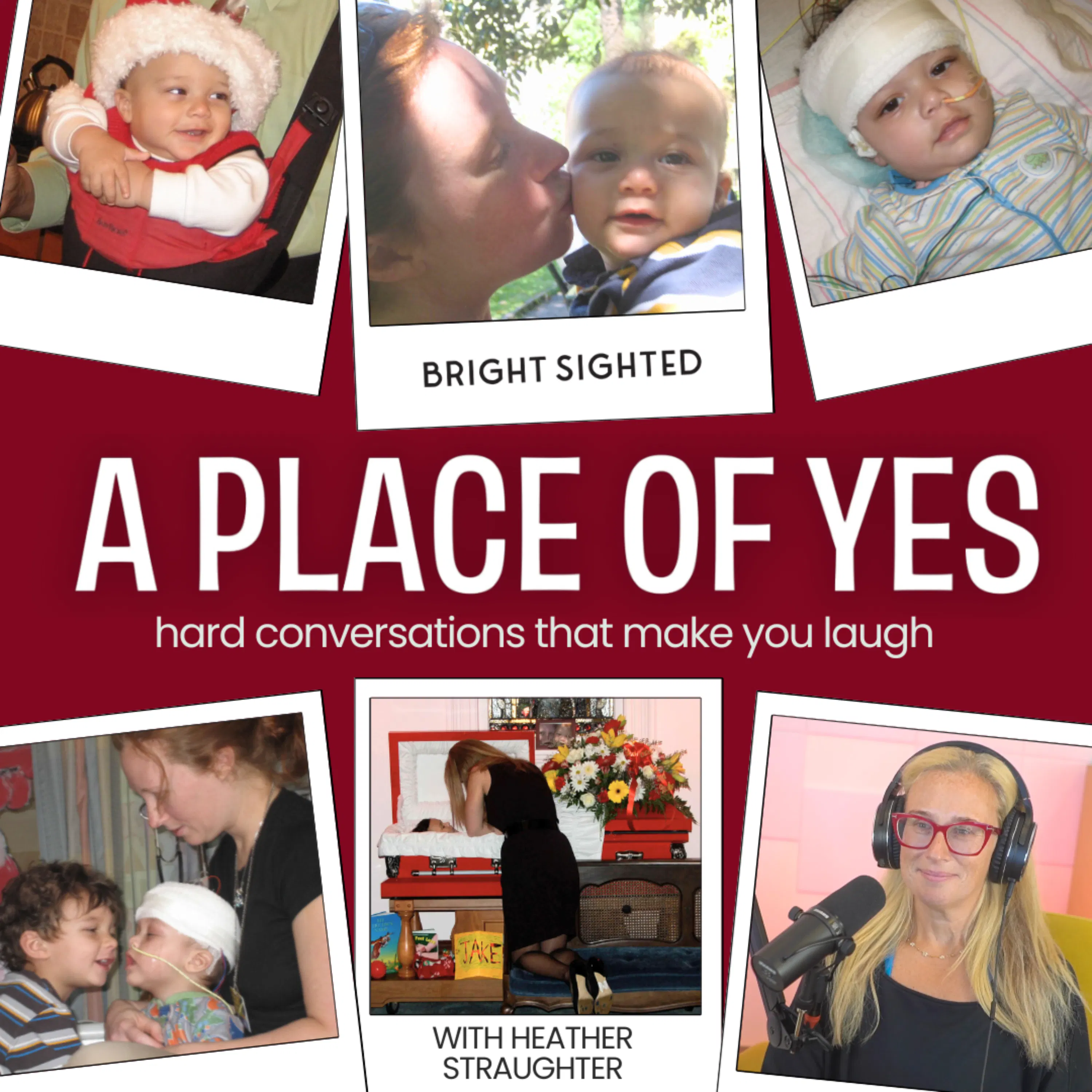
Loading summary
Transcript32 lines
- [00:03]
Heather Stratter
Welcome to A Place of Yes, a podcast about how I moved through my darkest hour. And for me, that was in channeling.
- [00:10]
My grief into good.
- [00:13]
Welcome to the show.
- [00:17]
Hi, it's Heather Stratter, host of A Place of Yes. And I cannot believe it, but here we are at our final episode of season two. In so many ways, the season has flown by, and. And I'm just so grateful for all of you who have been on this journey with me. I feel like season two, we really. We tried some new things. We talked to different types of guests, and we really grew a lot, and I really love that. I actually think we found our focus, we found the areas where we really connected to other people, and we found an audience. So I appreciate all of you, those of you who've been with me from the beginning, just listening because you're my friend or my family, and you have to. To those of you who have found us along the way. And I just am really grateful for you all being here with me. For our final episode, I wanted to do something a little bit different. I had actually listened to a couple podcasts who did something similar, so I am inspired by them. But I love the idea of just reflecting on the season. And for me, there are a handful of episodes that really just stood out. Some of it was because of my personal connection with the guest, some of it was some quotes that came out or just conversations that I thought were really important. So I thought for this final episode, it'd be a little shorter, but we would just reflect on a few of the episodes, and I hope you enjoy it. And if there was one that I missed that really connected to you, shoot me an email, let me know. You can always reach out to us@aplaceofyespodcastmail.com so here we go. David Robinson was an early guest in the season two. He is a friend. He is someone I've known for many years through the work we do at Jake's Help from Heaven. And he's Miles's dad. What stood out in this conversation the most to me was just how raw David was. He let all of his emotions out, and I think that's something that so many people connected with. He let us know when he was angry, when he was sad, when he was scared. But also you could feel the joy when he talked about his family, when he talked about Miles and Oliver and his wife Jolene, you knew how sincere all of his emotions were. He shared with us a pretty raw, just really deep story about this place they were at. In Miles's care. And he shared about an upcoming surgery. And the clip we're going to listen to talks about him kind of working through that process and coming to terms with everything that they've had to endure with Miles illness and just how happy they are that they are still together as a family and what they're willing to do to keep that and to keep Miles as happy and as safe and is here for as long as he possibly can. And it's something that I just really connected to in that conversation. Miles reminds me a lot of Jake and I just love this conversation with David.
- [03:10]
David Robinson
I work from home, so I always there, the nurses are in and out, the therapists are in and out. We are so cautious about everything. Everything is on a schedule, everything has to be done on time. And he had his 10th birthday this year and my birthday wish for him was that, you know, I've spent these last 10 years trying to keep you alive, right, Trying to fight that two to five. But now I want to help you live. So this summer we went to Cape Cod. We've spent a week in New Jersey on the beach. We're trying to do as many things as we can. That's what the chair that you brought for us a couple of weeks ago was for. We've had a change in Miles condition. We had his annual visit with his primary care last month. Well, roughly two weeks ago, he was concerned about scoliosis. Again, a lot of the diseases and things that people worry about down the road weren't our concern. We weren't worried about how, how caustic the medications were and what they were gonna do to his liver when he's 30. Weren't worried about that. When we knew about the scoliosis, we weren't worried about it. We weren't focused on down the road. In the last year, his curvature has moved from roughly 26, 27% to about 58%. At our visit two weeks ago with the doctor, we were told that we're either going to need to do a horrific surgery or within the six to 12 months, we'll be placing him on comfort care. So we followed up with the orthopedics. They're scheduling three, two to three months out. It'll be a surgery where they go from the base of his skull to his pelvis, down his spine and reconfigure the muscles and the entire spine, fusing each vertebrae all the way up. It's over a 12 hour surgery.
- [04:57]
Heather Stratter
So the fear if they don't do that is that the curvature will impact.
- [05:01]
David Robinson
His ability to breathe already starting to put pressure on his heart. Next will be the lungs. And it's just a progression from that point. Comfort care is one level short of hospice care. Comfort care is you're not imminently going to pass away within the next day or two, but you are within the process that's going to lead to you passing away.
- [05:22]
Heather Stratter
So that was about two weeks ago.
- [05:23]
David Robinson
Yep.
- [05:23]
Heather Stratter
You didn't see that coming, Emma.
- [05:25]
David Robinson
So we're on top of everything. I mean, we've been dealing with the orthopedics for several years. He had a Scoli vest that we've been over the past year.
- [05:35]
Heather Stratter
We were. When I was at your house. Yeah, yeah.
- [05:37]
David Robinson
We've been getting it fixed at least three or four times because it's not quite fitting on him, and it's moving and. And it's also not working, which is what we were told during our visits two weeks ago. So now we're, you know, we're exploring our options that we. We're definitely going to move forward with the surgery. It's just a matter of where. So we have a referral into Shriners.
- [05:55]
Heather Stratter
Okay.
- [05:55]
David Robinson
We have an appointment with New York Presbyterian in a month.
- [06:00]
Heather Stratter
So if you listen to the episode and you hear the fear in his voice, know that they are on the other side of that. The loss of Olivia Allen is something that we've explored on this podcast from many different angles. In season one, we talked to Melissa, and we talked to her pretty quickly after the loss of Olivia. For those who don't know, Olivia Allen died at 18. She was diagnosed with leukemia in June of her senior year. She fought with such dignity and such grace, and everybody. And when I say everybody, I mean everybody. I think even the doctors thought she.
- [06:38]
Was going to beat this.
- [06:39]
So when. When she lost the battle, everyone was just crushed and devastated, especially her family. So we talked to Mom. Season one and season two, we invited mom back, and she came with Liv's sister and Liv's best friend, Sophia Allen, and Aubrey Hyde. And we had a roundtable discussion, and it was the first we had ever done on the show. It was really powerful to hear everyone's experiences and how the same thing affected people differently. So then we went on to have conversations with Sophia and with Aubrey individually. And Sophia really focused on sibling loss, and she focused on what happens when your family goes from four to three and what it's like to be that surviving sibling.
- [07:16]
Sophia Allen
A lot of people talk about how there's, like, only child characteristics, and I never had those because I always had my Sister. When I think about those type of situations, I'm like, no, I have a sister. Like, yeah, that's not me. But then like people are talking about their siblings and it's like I don't know where I like stand anymore. I don't feel like I'm an only child. But I also don't have a sister who's like living in like the present in the future. It's hard watching your parents go through that. Did they die? No. But it feels like I'm grieving them too. Like my life is not the same for so many reasons. Knowing my parents will never really be truly like happy again. And like, maybe they will be, but from what I've seen, like, there's going to be so many sad days as like a 16 year old girl. I just like feel stuck because I can't help them. My mom, I do feel good that she's like going to therapy a lot and she's in multiple different like grief groups. It's frightening for like a kid to watch your parents feel the way they feel.
- [08:16]
Heather Stratter
And with Aubrey, she just, she really opened up about what it's like to have such a huge loss at such a pivotal part of your life. To lose your very best friend, the person you had so many hopes and dreams and memories and laughs and all of the things, and to have that person be gone and how she's handled that.
- [08:34]
Aubrey Hyde
I understood she was going to pass away, but she didn't pass away yet. And I, like, I couldn't comprehend that. Like, that's not like I have. We've lived 18 years. Like, what do you mean she's going to pass away? Like, that wasn't really a thought. It was just seeing her like that was the hardest part because I was so used to tan skin. Beautiful Olivia, even when she had cancer, still beautiful, but like she just did not look anything like herself. And I was just so hurt, I think, watching her suffer.
- [09:04]
Heather Stratter
So like I said, we did a lot of talking with the Allen family and with those associated, those who were close to Olivia Allen. Her story is nothing short of inspirational and nothing short of tragic. So I highly recommend, if you haven't listened, to give the roundtable a listen and to listen to each of the episodes. Olivia touched so many people and you can really feel it through her mom, through her sister, through her best friend. And it's just a story that is so relatable for a lot of people and also just an inspiration. Right? I mean, I think we can all benefit if we live like live and live like her family.
- [09:47]
Next is Debbie Waffle. Debbie had sent me her memoir, and after reading it, I knew I wanted to talk to her. We scheduled a call, we chatted, and then I immediately scheduled the interview. The entire episode was so natural and we spoke for so long that it ended up having to be a two parter. Her vulnerability, her honesty, her warmth makes Debbie feel like you are her very best friend. There was something really special about that conversation. I think people really connected to just her complete openness, like she was just completely honest. I still remain in touch with Debbie. I'm so grateful that she sent me her memoir. I'm so grateful that she reached out, and I'm grateful to now call her.
- [10:25]
Debbie Waffle
A friend, a person, a healthy person. That night that Kelsey passed away would have realized something is seriously wrong with me and have gone to the emergency room. She was so accustomed to, to being in pain, to being told, you're okay, there's nothing we can do that I honestly think that she thought, don't go to the emergency room, don't ask mom to come over. This is just the way it is. And I think that if she hadn't lived that way, she would have asked for help, done something. A woman said to me, there's this grief jar metaphor. You should look it up. It basically said that the ball is your grief. When you first lose someone that you care about you, the jar are very tiny and the ball barely fits inside that jar. And with time, the grief never goes away, it never gets smaller. The ball doesn't change size. But you, the jar grow with your experiences. And to me it represents that life has continued since Kelsey left, just like the jar getting bigger.
- [11:39]
Heather Stratter
One of the things that I did love about my conversation with Debbie, and you heard it in that quote, is she references Kelsey's death by saying that she left. And that might seem odd to some people, but to me it was where I think we really connected. Because I talk like that I sometimes say, Jake left. I don't mean it in a bad or sad way. I just, for me, it's a little easier than saying, oh, when he passed away or when he died. I just think of it as like another chapter he left. Debbie talks about in the episode this box that she collects of things that her and her husband and just life experiences they've had since Kelsey left. And she calls it the since you've left box. And it's similar to something that, you know, we do here for Jake. We don't keep it in a box, but we, we Pick up mementos along the way. Sometimes we bring it to his grave. Sometimes we just keep it at the house. I want to take a minute just to mention Debbie's book. Her book is called My Grief Jar Still Growing after the Loss of My Daughter. It's a memoir. You can buy it on Amazon. I highly recommend it. It's raw, it's beautiful, and it gives you a true sense of Debbie's journey.
- [12:51]
Another recurring theme that we have had on the show, not intentionally, just it just sort of happened, was glioblastoma. It was not intentional. It just happened to be something that a lot of our guest loved ones had. For those of you who don't know, glioblastoma is a brutal, fast moving cancer that hits quick and it hits fast and unfortunately often results in death within like 8 to 12 months. One of our guests, Maria Cuban, Weitzel's husband, was diagnosed and lost the battle. She shared what it was like to lose her best friend, her husband, the person she thought she was spending the rest of her life with, the father of her young son. And we had a really open conversation. And one of the things that really struck out to me was when she talked about forgiveness.
- [13:35]
Maria Cuban Weitzel
That's when I really just came to, you know, that place of acceptance of it in a way to forgive them if it offended me or hurt me in some way. I just, I kind of. I take it in for a second and then I let it go. Because they don't mean harm. In fact, they actually mean well. They think they're trying to help and they think that they're offering you some comfort in that way. But so I guess in that sense it's fine. It's fine with me. And I've come to a place of I'm okay with it.
- [14:08]
Heather Stratter
Being one that can sometimes hold a grudge. I learned a ton from her because she really focused on the fact that, you know, we have to see the good in people. And even when people say something that hurts our feelings or that we react.
- [14:19]
Negatively to, they probably didn't mean it that way.
- [14:22]
And if they did, what's the point of it letting us bring us down? She said, just forgive. It's really that simple. That message has stayed with me and it's helped me.
- [14:30]
I highly recommend Maria's book as well. It's called you can't do it, A Widow's Journey through Loss, Grief and Life After. But I would say it is not just for that specific loss. It's actually written in such a unique way. It's written where she writes a chapter and at the end there's a therapist who sort of gives an explanation to some of the things she's writing about and just talks about the process. And I found it really, really helpful. So again, the book's called you'd Can't Do It, A Widow's Journey Through Loss, Grief, and Life After. Thank you so much again to all of you who've listened throughout the season. Whether you've listened to one episode, many episodes, a handful. I'm just happy you're here. Sometimes I feel like I talk out into the abyss, so it's always nice to hear that other people are listening or reflecting or just being part of our journey. We are taking a brief hiatus so there will not be an episode next Thursday. We will be back in October with season three. In the interim, I hope you catch up on old episodes. Shoot me an email again. You can always find me@aplaceofyespodcastmail.com you can find us on Instagram. A Place of yes podcast. You can find me Heather Stratter I would love to be connected and I love feedback. The Good, the Bad, the ugly. Feel free to share it. Anybody you want recommend for a guest for next season. Any type of person we haven't covered that you would love to hear about. I am open to all the ideas. I look forward to continuing this journey with you guys. Again, thanks for being here.
- [15:58]
Thank you for listening to A Place of Yes. Please follow us wherever you listen to your podcasts. If you really like this episode, please share it with a friend. It would make a world of difference if we could just reach more people and share the work that we do and the stories we want to tell. Thank you so much for watching.