← A Place of Yes | A Grief Podcast 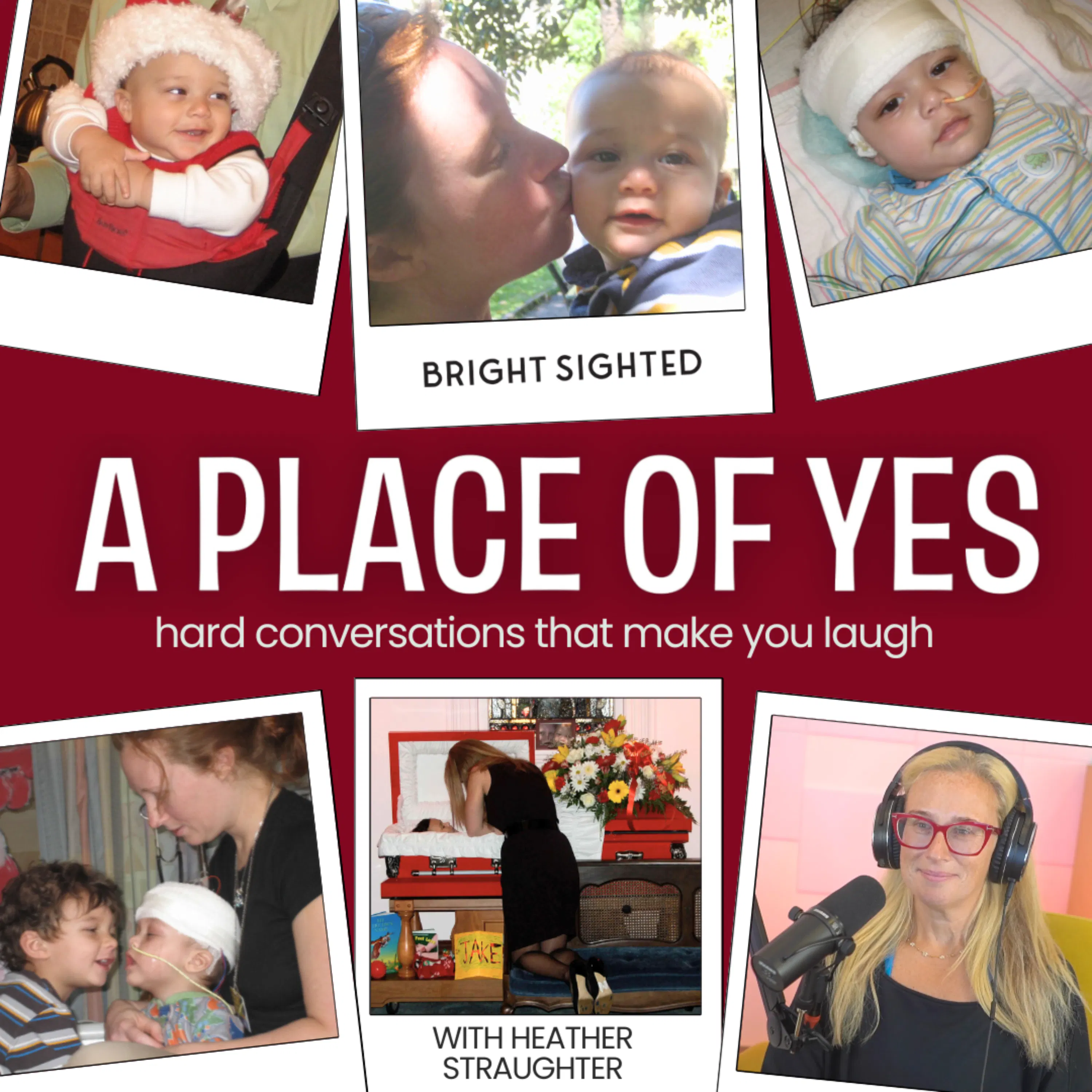
Loading summary
Transcript115 lines
- [00:02]
A
Welcome to A Place of Yes, a podcast about how I moved through my darkest hour. And for me, that was in channeling my grief into good. Welcome to the show. Hi. Welcome to the show. This episode is my conversation with Effie Parks. And for those of you who don't know who Effie is, she is a powerhouse out of Seattle. She is the mom of Ford and Esme, but her son Ford was born with a very rare genetic disorder and she pretty much went public with it. She has her own podcast called Once Upon a Gene, and she has created a community and a network for those of us who identify as rare moms. And I reached out to her and she agreed to be on the show. And I feel super lucky about that. What I love most about this episode is that it's truly a conversation. And it was really just me as Jake's mom having a conversation with Ford's mom. And we were sharing stories. And some of the stories will make you laugh and some of the stories will infuriate you. When you hear about some of the things that moms of rare kiddos deal with, I hope you feel like you're sitting around the table chatting with us when you listen to us. Effie is a mom that just gets it. She understands what it is to advocate to keep your child alive. And what I do love is in this episode, we talk a lot about not being scared of our kids, not being scared of those kids that look a little different. Don't walk around a child in a wheelchair. Don't avoid a child in a wheelchair. How about you say hi the same way you would for a cute kid in a stroller. So in this conversation, we talk about just easy things to help you figure out how to move through life a little bit kinder and gentler for those who need a little bit more kindness and gentleness. So before you listen to the episode, though, I would love to share a little bit about where I am in life. It's January. It is the start of a new year. It's 2025, and I can honestly tell you, I have had a hell of an end to 2024. For those of you who know me or who've been following, you know, December's a tough month to be. Jake died in December. It's not the best month. And then I lost my father in law, although he was 87. It was unexpected and it came pretty quick. And as we talk about in the show, and as is true in life, death sucks, grief sucks. And even when you think you're prepared for it. You're not. It was just a rough end of year and then there was the holidays and the new year and there were great things. There were seeing my parents for Christmas, there was celebrating my birthday. But I feel like I started 2025 exhausted. As a result of that, I am really leaning into doing what I need to do to get my energy back. So Brian and I have committed to kind of leaning into that and just doing what we need to do to rejuvenate. For me, that means allowing myself to get bored. Like, I want to crave activity, but right now I crave inactivity. So that's where I'm at. I will keep you posted on where I'm at next time we talk. Now let's get to the episode. So today's guest on A Place of yes is Effie Parks. Effie hosts Once Upon a Gene podcast. She's also the mom of two and her oldest, Ford, was born with a rare disease. Effie is exactly who I needed 17 years ago when Jake got sick. She's having the conversations that didn't exist then to help those with rare kiddos not feel so isolated alone. But, but the thing that resonates the most for me when I listen to Effie is that she's talking to everybody. She's not just talking to rare disease parents and moms and dads and siblings. She's talking to everybody about how to live a life with compassion and to welcome those who look a little differently into their lives. I love what you are doing in the conversations you're having. Thank you for being on A Place of yes, thanks Heather.
- [04:00]
B
I appreciate it. It's, I'm super honored to be here.
- [04:03]
A
So can you share with my audience a little bit about you and your family? Talk about Ford?
- [04:08]
B
I'll try to make it as concise. Let's see, I have a husband and two kids and we live in Seattle, Washington. My 8 year old son, Ford was born with a rare genetic disorder called CTNNB1. He was 1 in 30 in the world with this disorder and there were no papers and no information and really nothing to to look at for any type of answers or certainty. While the diagnosis did help in, you know, a million ways and still does because I found some of my people, it really wasn't enough in the beginning to feel like I had any solid ground. Not sure if there's still a lot of solid ground, but it definitely brought me some relief in lots of ways. You know, knowing the genetic reasons and then finding community and stuff. But yeah, Sometimes I feel like eight years in, it's been forever. And then other days I'm like, oh my gosh, it's like I still feel like I have baby Ford. So I think the days are, are still very interesting to me and maybe you can speak to that later on or offline about how you feel like things are lasting forever, but they're, but they're also just going by in a blink. But yeah, he has a five year old sister named Esme who is amazing and wonderful and funny and bright and I'm now finally seeing eight years or five years later rather that they're finally starting to connect for various reasons, which is calming my heartstrings. We are just still figuring it out eight years in and how to live our best, happiest lives.
- [05:45]
A
I love that. I think touching a little bit on when you said so as Ford's mom, as Jake's mom, through there are these pieces that just. I remember them so vividly where like, you would hit this stride sometimes and you're like, hey, I'm good at this, you know? And you'd be like, I got this. And I, like, I can manage the sibling and everyone, like, we've got this thing and we're good. And then it'd be something. And then I'd be like deer in headlights and being like, how do I do this? And it's a hard journey. I feel like it's also sort of magical. It feels heavier sometimes, but it also feels good.
- [06:15]
B
Yeah, well, you said a couple things there. You said maybe it was to make myself feel better, which good job. Because that's what we have to constantly do, right? Is make ourselves feel better. Because if we're not figuring out how to make ourselves feel better, we're going to go to the bad place. Yes, that's hard. And then secondly, yeah, I think that. I think that we really sort of have this cover ripped off where we have this luxurious amount of awareness and we can really sort of deepen our sense of like the moment, whereas maybe we wouldn't have been able to before or maybe not as clearly. And it goes to that, all those quips, right? Like not sweating the small stuff and savor the. Savor the moments. But I really do believe that we have a different ability, whereas we might not have had we not had our wild kids.
- [07:07]
A
Well, it's also like you find joy. Like, I, I've told this story before, but it's always. It's kind of a funny story, right? Because Jake for a while was pretty heavily Medicated. And then I wanna talk about diagnosis after this. But, like, Jake was undiagnosed. Like, he was born completely healthy for the first eight months of his life, was keeping up with his big brother, who was 15 months older than him. So it was kind of like this magical baby. Like, he crawled early, he turned early. Like, all he wanted to do was, like, what Ethan did. And then out of nowhere, at eight months, had this seizure, which. Which didn't even present as what I thought a seizure was like. Back then, I knew nothing. I knew nothing about rare disease. I knew nothing really of anything other than an ear infection, If I'm being totally honest. I kind of lived in this world that was just different. And his hand just did this. And it was that mother's. I don't know if it's instinct or what it was, but I was like, this is not. Like, this isn't a muscle spasm. This is something. And lo and behold, we ended up 117 days at Boston Children's. He lost all his milestones. Everything sort of imploded. And he was never diagnosed. They tested and tested and tested, and we kind of almost get in fights with some of the attendings. Cause I was like, how can you not find an answer? We're, like, at one of the best children's hospital in the country. Like, what are you doing to circle back to the small things? One of the things was, you know, we were always playing with his medication, right? Like, what is gonna control the seizures? What is gonna control them, but also let him have his personality. And there was once where we were, like, taking some of this meds off, and then all of a sudden, he was crying and screaming all the time. And Brian and I were literally giddy. We were like, yay. Jake's upset. He. And it was like, we appreciated these very small things. People, I think, thought we were, like, nuts. But because he had been so medicated for so long, he wasn't showing emotion. So I was like, I'll take anything. I will take my kid screaming bloody murder. So it's kind of funny, like, you find joy in the oddest of places sometimes. And I think there's something cool about.
- [08:58]
B
That that makes me remember when Ford started finally saying a couple words in the last year. And he said, damn it, after I said it once, and I was like, say that again.
- [09:08]
A
You're like, all the time. What'd you say? There's nothing else to it than what it is. And it's just. You find that beauty. I feel like our kids teach Us to slow the F down and see the moment as it is, you know? And I do love that.
- [09:22]
B
They absolutely do. Yeah. And it's a practice, right? It's not. It's not that it goes away or anything like that. You. You literally have to make it a practice.
- [09:30]
A
Absolutely. I wonder if you feel this with Ford and Esme. Do you feel sometimes like I used to feel sometimes like I'm Jake's mom and I'm Ethan's mom. I'm rarely Ethan and Jake's mom. Like, you know what I mean? Like, I would feel like it was just different. Do you ever feel like that?
- [09:43]
B
It's absolutely different. And sometimes it makes me angry, and sometimes it makes me sad, and sometimes it makes me feel like an ultimate master multitasker. Like, I think that, you know, I think depending on sort of what your baseline is at and what you've sort of accumulated in ways of coping and sort of processing things, it can be different a lot of the time in. In sort of how you let that marinate. Um, but, yeah, absolutely. I think that it's. I think that it is constantly like this ping pong sort of situation where if you take your eye off the ball, you're gonna go somewhere that you didn't expect that day.
- [10:22]
A
Absolutely. Tell me about Ford and his diagnosis. Like, did you know right away?
- [10:27]
B
Well, I had the most, what I thought, like, perfect, beautiful pregnancy. I had thick hair for the first time ever. You know, I got offered a seat on the bus when I was going to work. Like, I could eat everything and it tasted so good. I thought it was wonderful with my insurance. They just sent me to midwives for affordability purposes, and I didn't think anything different. In hindsight, man, I would have changed so many things. So I never even saw the same midwife. I cycled through, I don't know, a dozen. And every single time they would be like, oh, well, your baby's so small, but you're small, so that's so totally normal. Which I heard a lot. And then later I was like, oh, my God, why didn't I know that? I should have heard that deeper. So anyways, I thought everything was perfect. And my very last appointment, two days before he was due, the midwife was typing away. You know how they do. And she looked at me and she was like, I need you to come back in at seven. We're inducing you tonight. And I was like, go. I'm going to eat some fish and chips tonight. So, like, maybe tomorrow.
- [11:31]
A
Yay.
- [11:32]
B
And she was like, you need to come in tonight or your baby could die. And so I was like, what is happening? I call my husband. I'm like, we're inducing for tonight. Yay. So we're still happy. We're still like, okay, this lady's a little bananas, I guess. You know, maybe my blood pressure is high because it was all the time. And we come in, and I was induced, and it took two days for him to come. So I was in labor for two days. And he came on his due date. He came out, and he was very, very, very small. He was like 4 pounds, 9 ounces. Everyone scurried. Which, again, in hindsight, I was like, everyone scurried. Nobody helped me figure out anything. Ford wasn't latching. Literally, not latching. He hadn't even eaten for a day and a half before someone was like, hey, we need to put this. This feeding tube in him or what? We need to give him this formula or he has to go to the nicu. Like, they were really upset. It was weird. After four days, he still hadn't eaten, but they sent me home. We were pouring formula in his mouth, and then every single moment after that at home, we tried to feed him, and it didn't work, and it didn't work. Hours and hours and hours, you know, pumping, feeding, pumping, feeding, pumping, feeding. Everything was all over his shirt. He wasn't swallowing. He was crying, literally constantly. He wasn't having any bowel movements, Nothing like that. So we were both going in twice a week to see lactation, and the pediatrician saying, he won't eat. He's crying. And we got the same stuff that you would expect of. We're just new parents, and we're worried. We don't know what we're talking about. This went on for a couple months until one of the visits with this pediatrician, she was like, I called ahead. Seattle Children's is waiting for you. Something is wrong with Ford. Which finally, I was like, oh, my God, I am so mad at you. How dare you have not listened to me for so long. Also, thank you. I'm gonna go. We go. They immediately admit him. Failure to thrive stuff, blah, blah, blah. That's when I started hearing weird words I hadn't heard before, like hypotonia, microcephaly, stuff like that. Ultimately, we left with a feeding tube and a referral to genetics. Definitely still, like, blur. Even to this day. I'm like, how did that happen that way? Which ultimately was a lot of just neglectful, like, malpractice among my midwives. I Found later getting my medical records. There's a secret side of your medical records that's all the doctor's stuff that you don't get in your printouts, and it's not in your. My charts. And Ford had been flagged for intrauterine growth restriction months before, and somebody dropped the ball on telling me. So the next person didn't want to tell me, and then the next person didn't want to tell me, and they just kept putting it in the notes and thinking, well, she says she's feeling fine, so maybe we can just roll with it.
- [14:14]
A
Oh, God.
- [14:15]
B
So there was lots of mistakes made, and thank God Ford was alive when he came out, because you're not even supposed to birth a baby vaginally who has iugr. So we got lucky in lots of ways there. But, yeah, we didn't know anything was wrong, but we knew something was wrong. And then obviously, genetics. She looked at Ford and she was like, yes, I'm pretty sure I know what Ford has. He has a form of albinism called Hermansky Pudlak syndrome, which isn't regular albinism, where you'd have an eye disorder and obviously sensitivity to light and UV rays. It's the kind that you die from if you don't get a lung transplant eventually. So for a year, we waited for our genetic test, thinking he had HPS covered him up. We bought super expensive sunblocks and glasses, and even in Seattle, we had to cover him up. And then we got our answer when he was 16 months old. And she was like, it's not that. It's this other thing, and I don't know what it is, so go home and love your kid. Here's a few kids we found that can. Some can say some words, some can take some steps. That's all she could find. Right? That's all that was there. It's something that I've definitely stopped thinking about a lot because there were so many mistakes that were made, and you.
- [15:32]
A
Can'T live in that space and you.
- [15:34]
B
Can'T live in that place. But is it getting better? Do I tell moms now to go to an obstetrician and a different doctor and get another opinion when you're pregnant than just a midwife? Absolutely. Do I know now to look for your medical records? Absolutely.
- [15:50]
A
And it's like, you know, to trust that voice, right? Like, to trust that gut feeling or something, you know? And Jake's story is a little different, but. But I can tell you, and I don't actually say this Often. Cause it's, like, buried so deep. But, yes, the first eight months, he was doing all these great things, but there'd be these moments. There'd be these moments where I was like, oh, his eyes would get kind of funny. Or there'd be something. And I was like, hmm, Ethan didn't do this. Or he was just extra fussy or finicky, like, just. But in a way that kind of, like, had that little pit in my stomach. Like, this is different. But then I'm like, it's my second kid. Like, Ethan was super easy. Like, if you have that feeling, like, that just that feeling, like, in your stomach, like, listen to it, right? And.
- [16:32]
B
Yeah. Yeah. This really teaches you to trust your gut.
- [16:35]
A
Yep.
- [16:36]
B
And, yeah, samesies. Like, you know, you were saying that I wasn't around, but what I'm doing wasn't around really, either. There were, like, a few voices. Families weren't sharing this stuff on Instagram yet. Like, it blew up in the last couple years. Like, I didn't know Ford was having infantile spasms. Like you said, Jake, the seizure, you didn't recognize. I didn't know that for years. Years. Just right in front of my face. And I didn't know that's what it was. Cause families weren't talking about it yet. You know, there weren't videos of it yet. I still felt like I didn't know what I was doing enough to advocate for Ford for a while.
- [17:10]
A
And it's interesting. Like, so I have talked to a couple families where their first child is the. The child. The rare child. With Jake, he was the second. And even though you would think you would know the difference, you kind. Like, in many ways, I didn't. Because they always say kids are different. Like, oh, you had a good sleep, right? Now you might not have a. You know what I mean? Like, it's just. It's so hard to know these other things, and it's really just listening to your gut. But it's that I do get jealous sometimes of the world now, because, I mean, and it's such a weird thing to say, but the isolation, right? It's so real, that isolation of no one else to talk to. Right? Like with Esme, maybe if she's not sleeping well, you can find all these other people that are like, oh, hey, what did you do to help her get a better night's sleep? Or, oh, she's not eating her vegetables. What? You know what I mean? Like, you can. I'm making, like, these really generic. But you can find someone to Talk to. And I felt like with Jake, there was no one else to be. Like, hey, every time I try to feed him, he throws up. Like, what am I supposed to do? Or like, he's still sleeping in our bed because I'm too scared to leave him in his own room. Like, what am I supposed to do? Like, do you know what I mean? Like, there was all these things that there was no one to talk about. And then you're left kind of talking to your husband about it or whatever. But, you know, and that's its own conversation, right?
- [18:20]
B
Yeah. I mean, that makes me think of so many random things, how you talk about that. Yeah, I mean, one, I think families like me could get a. Just a little bit of peace knowing that you also didn't know even after the second kid. I think we can get a little bit of peace from that. But yeah, like you mentioned Ezzy doing things that I might need to talk to someone about. I don't. Because I don't connect with those type of parents even now. Oh, that is like, I. And I don't care. Like, Ezzy definitely gets left in the wind a lot, unfortunately.
- [18:51]
A
And.
- [18:51]
B
And also I just like think this isn't important or I don't care to be fine. Yeah, she's going to be fine. Like they always say, like, so. And again, like, I don't reach out to parents like that. It's still really hard for me to feel like I belong if I'm in a room with Ezzy and her friends and those parents. Like, it feels weird to me still.
- [19:11]
A
I mean, you are taking me like right back to that. Because I remember so when Ethan was, God, maybe two, I don't know, like, he was starting in like a two days a week, like preschool year kind of program. And I remember I would like to drop off Ethan. It was like an ordeal. Cause Jake had to come. But you couldn't leave him in the car. I had to put him into his, like, stroller. Like, I wouldn't necessarily put him in his wheelchair, but I put him in his stroller. And then I'd have to bring him. And then everyone would be like, oh, every time I see him, he's sleeping. Or like, you know, people would just say stuff and you know, some of them did go on to become good friends of mine. And I could separate that. They weren't meaning to be hurtful. Like, my heart would break a little bit each time. So it's like not only getting used to being out in this world where people don't understand you really. Or your kid. But then trying to figure out the right answers and then trying to figure out how to not be irrationally angry. It's all. It's so much. It's a dance. It is a dance.
- [20:07]
B
It's always a dance. And again, it depends on where your baseline's at, too, right? With how much you're gonna absorb of that or your reaction that you're gonna have. It's weird. And it's always something that is like, this elephant in the room.
- [20:21]
A
I was listening to one of, I think, potentially even one of your first, like, podcasts, like, back in 2020, and it was just you talking, and you were talking about Ford wanting to go through, like, a doorway, people wanting to wait, and how, like, basically you're like, everyone's just making it awkward. Like, the doorway's big. Like, everyone can fit. And, like, why are we making this so weird? Like, why does society make it so freaking weird? I loved that because I think there's two things there. One is, why does everyone make it weird? Like, why are we so uncomfortable around people who look like, what is that? And then also, one of the things that some of my listeners have come at me with has sort of been like, I don't have anybody. Like, I knew Jake, but I don't know anybody else. But I want to do better. And listening to this podcast helps me sometimes do better. So when I was listening to you tell that story, and also you talked about, like, when you moved to Seattle and, you know, noticing like. Like, things you noticed as Ford's mom but that you didn't notice before and sort of like, how didn't we notice those things? But I was the same way. Like, you see all the inequity and inequality in the way people are. What are some things that you could concretely tell people that you think would. That they could just do better?
- [21:30]
B
It's so funny that you bring this topic up, because I was with a friend just the other day. I met her at Children's. Ford had an appointment, and her little kid is impatient. And we were just standing in the lobby while Ford has to play with the doors, having our coffee. And, you know, she was like, man, I wish my little buddy could use a wheelchair. And I was like, I hear you. And also, there's this about using a wheelchair. I was like, just look around. Watch. Even here at Children's Hospital, as Ford goes in and out the doors. How awkward all these people are around a kid in a wheelchair. And if you stand there and you watch Ford can literally not even be moving. He can literally just be sitting there in his chair, and people will walk toward him, and then they'll be like. And then they'll make a huge circle around him to get him.
- [22:12]
A
Like, he's contagious or something. Like, what are we doing? Yeah.
- [22:15]
B
Yeah. So, like, you can just watch it even in a place where you wouldn't think that you have to watch it. Right. But not all the parents that go to children's have kids who have medically complex issues. But still, like, it always mystifies me how awkward people are. So I guess your question was a takeaway, though. What do I think people could do? I think that it's. I think that everything should be simple. I think we should all just stop trying so hard and stop trying. Trying to, like, research the wokeness out of every single thing. And I think that it is just easy enough to be like, hi, what's your name? Like, just normal. Also, I really do love chivalry. Can you use that in the terms of women, too? Because, hey, you know what? I appreciate it if you want to come open the door for me if I'm. If I'm going through with Ford, even if I don't need you to, because I have it figured out, and I know how to pivot and turn and do this. If you want to race over and open the door for me while I do it. Thank you.
- [23:09]
A
Yeah.
- [23:10]
B
You just saved me five seconds. And you made it a little easier.
- [23:13]
A
Just made it.
- [23:13]
B
And maybe I didn't snag my shirt on it. Like, simple things like that, I appreciate so much. Just normal, easy kindness. You don't have to. You don't have to ask questions, and, you know, you don't have to be super anything. Just be normal like you would to anyone. Go up in the door, say hi to a kid. You know, don't, like, freak out when you hear him screaming. Like, make a joke. I don't care. But don't be weird and don't overthink it. I think that. I think that people have gotten so in their heads about how to perform in public and how to not make people uncomfortable and how to not offend people that it makes it just even weirder. Dry and crumbly. Yeah. And I would rather just have a warm blanket, and you would just be like, great job. Have a wonderful day. Here you go. I'm gonna open the store. Bye. Done.
- [24:04]
A
Yep. I love that. And that, you know, comes up a lot when we talk about grief, too, because people. Oh, I don't know what to say. I don't know what to say. And I always say, just be like, sucks. You know what I mean? Like, that's all. Like, it's just be a kind, compassionate person and don't overthink it. Cause at the end of the day, there's nothing really. Whether it's grief or whether it's like our day to day. All you can do is maybe make us feel a little bit better. But like, don't. You're not gonna all of a sudden, like, if you bring up Jake, you're not all of a sudden bringing me to a dark place. Like, you're not, oh, shit, I forgot my kid died. Like, you know what I mean? Like, you're not. Like, you don't have to say magic words. Cause we're already there in our lives.
- [24:39]
B
Keep it simple. Nothing you say is gonna be so enlightening and like, cure me of anything that's happening. But you can make me take a deeper breath. You can make me, I don't know.
- [24:50]
A
Have a little faith in humanity. Get out of your head.
- [24:52]
B
Yes.
- [24:52]
A
No, I. I agree with that so much. And I love that that's how you said it too, like, keeping it simple. Because I think 100%, like. And I get people who, like, write it and they're like, they want to make it harder. And I appreciate that they're even thinking about it, to be honest, because I think maybe before they weren't even thinking about it. What's it like? The straightest way is through kind of. Right. Like, you know, let's not like, overcomplicate things.
- [25:12]
B
Totally, totally. I just think that basics are what we can all handle. And I think basics are so comforting.
- [25:20]
A
Tell me about Ezzy. So you had referenced a little bit that, you know, now you're starting to see, like a relationship and like a sibling, like, dynamic. How. How is that?
- [25:29]
B
Well, you know, obviously it's always gonna be complicado. But just up until recently, Ford has had, you know, pretty severe behavioral things. And I think I'm. We might just be in a good moment and it might come back in full force like it always has been. He's not a mean boy. He's not a bad boy. His disorder sort of causes a lot of things. And he has dystonia, so he's very spastic and flingy. So hits right, like, if she gets too close, it's whacking her. He's always been like, he sees hair and he touches it and then he can't open his hands. He's not grabbing you and hurting you. But it's these things to a kid. And she's like, well, I'm not gonna go sit by my brother because he hurts.
- [26:13]
A
He's gonna pull my hair or something. Yep, yep.
- [26:15]
B
Something is happening right now where he's getting better at that. And I think it's a drug we're using. But he's not as swatty and he's not as stiff and like, stuff like that. And so she's able to get closer to him while also, she's growing up a little. So she's getting really good at dodging him. Right. Whereas before, she didn't have, like, that mom instinct. Right. Like, you have this instinct where you know how close you can get to your kid or you're going to get your nose broken.
- [26:39]
A
Right.
- [26:40]
B
So I think she's also sort of evolved in knowing his eyes in where he is and what he's coming hit her and what's coming, and so she can back off. And so I think growing into that is also making her more comfortable. So, yeah, it's a couple of those things, and it's been awesome. Just the other day, I was rewatching a video last night, like, 20 times where I caught her and him playing, and she was racing around our wall and he was trying to catch her. And, like, they never play like that. And I think it's starting to happen. And I'm so thrilled about it because I'm sad for her in lots of ways. Right. I'm happy for her in many others, but she doesn't get to have that typical experience. And she grieves the same way we grieve. So right now we're in this moment where I'm like, oh, my gosh, maybe some awesome stuff is really gonna come right out of this.
- [27:31]
A
Well, I will say that I do think awesome stuff does come out of it. In the sibling points, we grieve the life that we thought we were gonna have. We grieve the life that you wanted, that we wanted for our kids. I grieve for Ethan. Cause he didn't have what his friends had. And not that it's comparison. There's just that peace.
- [27:51]
B
It's so hard. And I'm always still, like, at least once a week, angrily, like, who's gonna finally take care of the siblings? Where's the org that is gonna take care of our siblings? We're not helping them enough. And we're not identifying the levels of grief and sort of all uncertainty and all of the stuff that these kids have to shoulder. I just feel like we're leaving them behind often. But I know they're capable, right? I know they're more capable, and I know they have all of these gifts, but I'm still, like, sad for them.
- [28:21]
A
I would say a lot of the times, like, oh, you know what? Like, Ethan is a much more compassionate person because of Jake, and he is a much more, like, I'd say all the things, and I believe them to be true. Like, I 100% do. But I also. I'm in being totally transparent and honest, I see in him. It weighs on him even now. Like, there's a. I don't know what. Like, there's just. And some of it is that compassion and that kindness and that deepness. But there is a heaviness to him, I think. One kid you're trying to keep alive, and the other kid, you're just parenting. And there's a difference with that, and it's heartbreaking.
- [28:51]
B
They're the most amazing people, right? And most of them do go into, like, these compassionate careers, and they constantly teach us. But again, they are going through every sort of phase of grief continuously, just as much as their parents.
- [29:06]
A
But it's.
- [29:07]
B
In lots of ways, they're caregivers, too. And. Yeah, it's just.
- [29:11]
A
It's.
- [29:11]
B
They're missing out.
- [29:12]
A
The caregiver piece on lots of things is huge, too. I remember, like, Ethan was who, like, if I wanted to take a shower, I'd be like, okay, Jake's on your bed. Read to him. You know, like, don't let him. Don't let him roll off. Like, you know, like.
- [29:24]
B
Like, come and get me. I'm going to shower. Let me know if Ford's food bags beeping.
- [29:27]
A
Yeah, you know, they're just. They. They get out. There's. They're responsible for so much.
- [29:32]
B
So right now, I saw some cool stuff recently, and I'm really excited.
- [29:35]
A
No, that's awesome. And when you see those moments of, like, the genuine. The playing and the genuine, like. Like, you know, I. I would. I used to see it, like, you know, I'd be like, in the kitchen, and I'd be like, out of the corner of my eye, you see it, like, in the other room or something and makes your heart feel good. So one of the things that I also wanted to talk about with you. Oh, actually, I have this quote written down, and I don't even know what show you said it in, but you talked about the moments of suck, and I was like, it's such a thing that I would say that I don't even know why I wrote it down, but I was like, there are just moments of suck. It's real. Like, right. It's the isolation, it's the feeling alone, it's the balancing. You know, I talk about this a lot and I think you've referenced in some of your stuff too. Like, right. It's the grief and joy. Like two things can be true. Like, and I feel that very much right now. Like, I still grieve Jake. Like, I miss him madly. You know, I try to picture what he would be like as an 18 year old, you know, and I would give everything just to have him back. But at the same time, I don't know. I'm happy. I'm happy having these conversations. I'm happy with my husband. I'm like, I'm. Two things exist.
- [30:31]
B
I think that one of the things that we have to again practice and incorporate into our lives for the rest of our lives is recognizing that and fully understanding that our emotions are an important piece to this and we have to let them move through us because not only will they suck a lot, but they'll get stuck.
- [30:52]
A
Yep. Yes.
- [30:54]
B
And it's easy to get stuck when things are bad and it's awful and nobody understands. It's easy to stay there. And it takes a lot of heavy lifting and mindset shifting and self care practices to really be able to stay in that place for a less amount of time.
- [31:12]
A
Do you feel like doing your podcast and talking and advocating and having like doing the things you do? Do you think is that like your self care? Like, does that help you?
- [31:21]
B
Part of healing journey has 100% been not only telling my story, but creating a platform where others can tell theirs. Because you're, you're just, you're going to reach more people who resonate with other people. Right. And everyone deserves that line to be cast to them in one way or another. Even if you never know that it happened, it happened for someone. Right. And I think, I think there's so much fuel to your purpose by not only, only being vulnerable and talking about this stuff, but creating sort of that community around it who builds each other up in it. I mean, we know that stories are healing, right? It's the building blocks of like everything since human beings existed. It's how we connect and it's how we learn and it's how we grow. So yeah, 100%, it has been a healing factor for me.
- [32:09]
A
You know, you talked about like how it's, it's so Easy to get stuck, right? Like, you can be in that moment, and then it's just easy to stay in the dark. And I feel like even all these years later, for me, it's been. I think I've done probably more healing in the last year than I've done in probably the previous 10, because I feel like I was in it, and then I just got, like, into my routine, and you kind of put things away, and all of the talking about it again and bringing it back and meeting so many people who are doing such great things, like, it's just. It is life giving for me. Like you said. Like, you know, like, you don't really hang out with Ezzy's friends because you just. You always feel different. Like, you're always that mom. And then now that Jake's passed, I'm like, that mom with the dead kid. Like, it's like double that mom.
- [32:52]
B
It's like owning it, right? We're owning it, and we're not just letting it sort of simmer in our brains and having that conversation with ourselves and talking ourselves into or out of something or soothing ourselves even, right? Like, when you. When you open your mouth or when you write it down and it just get out of your body, even if no one hears it or reads it, you get it out of your body, you move it somewhere else. And I really believe that that is one of the pieces to kind of help us be balanced in general with our mind and body. I know it to be true for me.
- [33:27]
A
So, Ford, how is he in the scope of things? Like, what's his day to day?
- [33:31]
B
Like, we're in a great district where he has so far been in a wonderful program. So, yeah, he goes to school. He rides the school bus, which is one of the first things he asks for in the morning. He, like, waves this. This means, like, windshield wipers from the bus way back in the day. So that's his bus sign. And I'm like, yeah, buddy, the bus is coming. It's hard to answer that question because.
- [33:53]
A
You know, it's a loaded question.
- [33:54]
B
Sometimes it sucks. So. But right now, right now, we're doing pretty good. He's starting to babble more as a parent. We can understand what he's saying, and if you know for it, you can understand mostly what he's saying. Yeah. So he gets up, you know, he gets all of his meds. I get him ready. I have to help for it. In every aspect of his care, you know, he can't sit or crawl or walk or eat his AFOs. And his clothes and his diaper and his medicine and his teeth brushed and all that stuff. So I get him all ready while he taunts me. He likes to plug his ears when I sing to him. He thinks he's very funny. He is. He is very funny. Even just this week, since he hasn't had school for a couple of weeks now, he's tighter. He's less. He has less of a patience because he needs outside input. He needs people. He needs to go places. He needs to get out of the house. He needs workouts. You see regression so quickly, and that's always like, oh, God, what am I not doing right? I should have done more of this. Why didn't I hit this harder when he was a baby? All those other kids who go to. Who go to intensive therapy every day can walk now. Should Ford have went to more intensive therapy?
- [34:59]
A
Oh, those are the thoughts that can just.
- [35:02]
B
Yeah, those can catch.
- [35:03]
A
Relentless.
- [35:03]
B
And then, yeah, my husband yesterday was like, effie, you've been home for two weeks. You haven't been going to your gym every day like you normally do. The kids have been home. We didn't have power. You're not okay, normal, Effy, right now because you have been missing your piece for two weeks. So just simmered down. Everything's fine. Ford's okay. You did all the stuff you're supposed to do, but sometimes, you know, you get to that spot where you're like, oh, I screwed up. Oh, I didn't do it. I didn't do it enough. I'm getting over that today. Because I'm like, oh, yeah, he's fine. He's fine right now. He's happy. He's not in the hospital. He's not having mad seizures right now. He's okay. He's happy. He loves the Christmas tree. He was chasing his sister.
- [35:48]
A
Like, remember, these are the good things.
- [35:49]
B
Yes, these are the good things. Um, yeah, like, he's funny.
- [35:54]
A
I'd be like, oh, you know, why didn't I, like, put him in his stander longer? Or why did I take. You know, like, you just beat yourself up. And at the end of the day, 10 more minutes in his stander was not going to change the trajectory. Right. Like, it's hard because they're so dependent. Everything 247 is they need help for everything. And that weighs. It's heavy.
- [36:17]
B
Yeah, it's a stander for my family, too, man.
- [36:20]
A
Freaking stander.
- [36:21]
B
Jesus Absolutely, violently hates that thing. And I can't get him in it anymore. And then I'm just Like, oh, cardiovascular issues. Bone density issues.
- [36:31]
A
Density. Like, well, and then Jake had to have hip surgery, and I was like, I should have put him in the goddamn standard.
- [36:37]
B
Yeah, right. Ford's probably going to happen. We just had his hip X ray the other day. He's probably going to have to have that surgery eventually because I'm not putting him in the standard. And then I'm like. But when I have to put him in the standard, not only is he screaming and crying and punching, but then I'm. Yes, I'm crying. Yeah, right. And then as he's watching this, and she's like, what the heck is happening? And please pay attention to me. And then it's over and everything sucks, and you're like, why? Worth it?
- [37:02]
A
Yeah. Why?
- [37:03]
B
I don't know. No, no, it obviously wasn't.
- [37:05]
A
And at the end of the day, the surge, like, the surgery is going to be. Or it's not. And it's not going to be because, oh, if we had only done 15 more minutes a day than Stander.
- [37:14]
B
I think we should get a buffalo jump for all of our Standers and we should just shoot them off of it and just give it up completely.
- [37:23]
A
So one of the last things I wanted to touch on with you was your rare disease manifesto that was on your website from, like, November of 2023. And I will say I read it. I printed it and read it, and I was, like, reading it to Brian, and he was like, this is your person. I was like, I know. I wish she was my person 17 years ago.
- [37:40]
B
I was like, is she a lunatic? I thought he was gonna be the. Stay away from her.
- [37:44]
A
Well, I mean, I feel like he thinks I'm a lunatic, so you might be, like, guilty by association. So I'm not saying he doesn't think you're.
- [37:51]
B
I can handle that.
- [37:53]
A
But I went through this and I. I highlighted a lot of it. But I'm gonna read, like, one of the paragraphs in this manifesto. But you wrote, joy is found in the often overlooked moments, the small victories, the gentle progress, the shared laughter, often through tears. In the midst of challenges, these instances of happiness illuminate our journey through darker times. Now, I can tell you that that brings me right back to, like, the story I was telling about, like, when we're. When Brian and I were giddy because Jake is screaming bloody murder, because he actually felt something and knew enough to be, like, mad. And it brings me back to even him passing, right? Because it's worst day of my life, worst experience of my life, like, still Horrible. Like, I'm very much right now entering into my funk because the 8th is coming up and it just. The pit in my stomach is real, and it sucks. But the joy is in those moments, right? They're in those, like, I love it. The overlooked moments. Because if in our lives, if you are waiting for a big, like, hit you over the head, joyful moment, you may not get it. It's like you said, you practice it, you find it, you make it a habit, like, all of those things. And I love that.
- [38:58]
B
Thank you. And it's so true. And when you have faced adversity, even if it's not rare disease and your kid dying and whatever, if you've faced something like that that has impacted you in a way that is otherworldly, you can't not notice that. And if you've noticed it once, you can't not not notice it again. Like, you know it exists and you can't go back. And I think that it is. It is like a gap, a good gap that is like, you have made it to this side and there's a lot more land in your future that you can go off of. But you know something now, you know something so important that is going to make you live a better life inside and out. We really pay attention to it, and really, we really nurture it. Because this is hard, and it's a long haul. No matter what. If your kids here are not here, it is the entire time that you are here.
- [39:52]
A
It is the entire time.
- [39:54]
B
So how do you find a way to withstand the constant barrage that this long haul brings and the constant impacts? Because it's not just going to be one thing and one surgery and one this. And this seizure, it is constant. And so how can you be more resilient? Take less time feeling better. Take more care of the good moments, because you're gonna do this forever.
- [40:20]
A
And it's those good moments that are the fuel, right? Because it's totally. It's like, I used to always feel like Jake did it and Ford does it. It's like there's some piece of him that's like, you know what? My mom needs a little bit of a break. I'm gonna give her this, you know, like.
- [40:33]
B
Yeah, Yeah. I think they do have that in their heart.
- [40:36]
A
She's like, I'm just gonna give a little bet.
- [40:38]
B
I mean, they're special, right? There's so much good here.
- [40:41]
A
I just love that we are in a world right now that these conversations are happening and they're existing and they're Available for people to find. Thank you. Just thank you for being on this show and thank you for doing what you do. It's awesome.
- [40:55]
B
Oh, my gosh. Thank you right back. I mean, what you're doing is amazing and your show is so fabulous. And obviously reaching the parents who live with grief every day is such important work.
- [41:07]
A
So we do this one segment at the end of the show. It's called Ask Heather Anything. Sometimes it's lighthearted, sometimes it's deep. Sometimes people ask both. So you got anything for me?
- [41:17]
B
I'm always going to ask someone to make this place better for the person that comes after you. So mine's definitely going to be around death and dying, maybe even anticipatory for the families. You know, I'm introduced to these families right away when they find something that's not right or they get a diagnosis. And a lot of the time the diagnosis is life limiting. So I would obviously ask you for your top three non negotiables. For a parent, once they get this diagnosis and they know that ultimately their child is going to die at some point, what are the three things that they must do or think or take or live with?
- [42:01]
A
The first thing I would say is that you have to strip your head of that. Of knowing that there's an end date and just the moment. Like everything becomes about that moment and fiercely fight for. You said this sort of earlier in the podcast, but you're trying to create the best life, right? Like, I feel like we did this with Jake as much as we can. You think outside the box and you do whatever the f it takes to make that best life possible. Like, you don't give a shit. Like, you just, you focus on that and you focus on, you know, not the six months, you focus on the 60 seconds and then the next 60 seconds and you keep it sort of small. I feel like any time with Jake that I got too big. And if you get too big, then you're like, oh, I'm never gonna take him to Disneyland. Like, you know what I mean? Like, if you let yourself get too big. But you know what we're gonna do? We are going to get in the car and we're going to drive to the city and we're gonna see the big lights at Rockefeller Center. You don't wait, you just do. So I think that is a big thing. I think that you balance and I didn't do this very well, but you balance advocating and talking to doctors and fighting hard and getting answers with living. We're so desperate for a solution or a fix or a new med or something that when we get. Or at least when I would get into that mindset, I then Jake was an idea, not a person. Like, so he'd be sitting next to me miserable, and I'd be, like, writing these emails and, like, fiercely trying to get answers and not listening to my own advice of, like, enjoying the moment when he's gone. You're not missing the doctors. You're missing the boy sitting next to you. And then the last thing is, don't give a shit what anybody else tells you to do. Like, just don't. Jake slept with us until the day he died. That's how we felt we could keep him safe. That's how we felt like we could keep him as alive as long as we did that. That's how we did it. And people would be like, oh, my God. You know, everyone had something to say about that, but at the end of the day, that was like, just, you know your kid, you know yourself, you know your relationships, and just. You're never going to regret doing what you know, and your gut is right.
- [44:00]
B
Such good advice. I love all of those so much. And in a way, too, it's. It's getting to have control. Right. Because you get to choose.
- [44:09]
A
Yeah.
- [44:10]
B
I'm so happy I got to talk.
- [44:11]
A
I am so happy I got to talk to you.
- [44:12]
B
I feel like I'm in love with you right now. We should be friends after this. Well, that's.
- [44:16]
A
Actually. I was, like, I said to my husband, I was like, I think I'm going to end the day with a new best friend.
- [44:20]
B
I'm super excited about this. Yeah. Thank you so much. I'm so. I'm so grateful that I got to meet you. And again, you know, we were brought together by one of my favorite people, Daniel. That is really special.
- [44:33]
A
It is special. I love Daniel. Thank you for listening to A Place of Yes. Please follow us wherever you listen to your podcasts. If you really like this episode, please share it with a friend. It would make a world of difference if we could just reach more people and share the work that we do and the stories we want to tell. Thank you so much for watching.