← A Shot in the Arm Podcast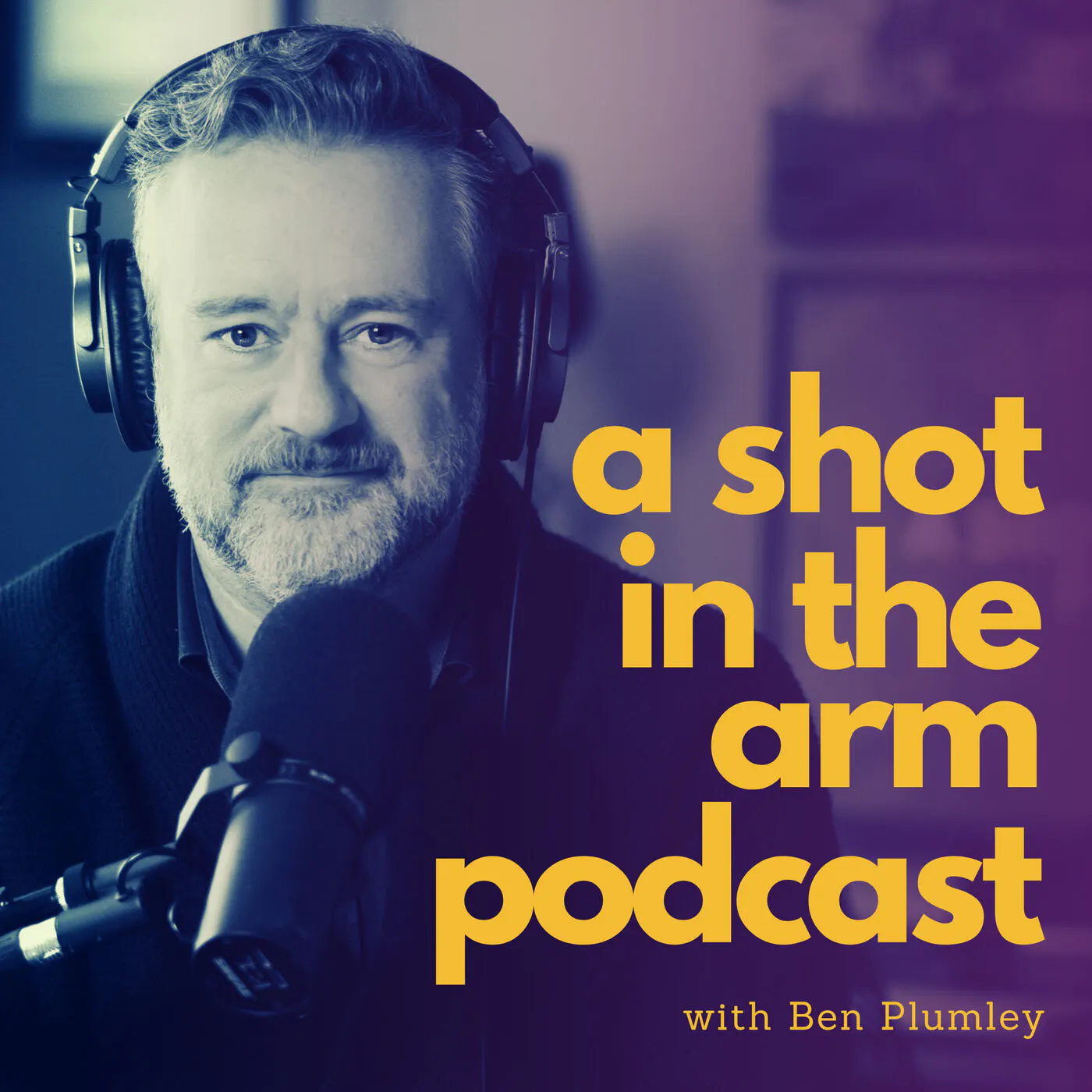
A Shot in the Arm Podcast
Looking Ahead: Global Health in 2025
00:20:28
In this first episode of 2025, A Shot in the Arm Podcast host Ben Plumley explores the major global health challenges and opportunities for the year ahead.
Loading summary
Transcript16 lines
- [00:01]
A
Welcome to A Shot in the Arm podcast. I'm Ben Plumley and this is our first episode of 2025, reflecting on the coming year gazing at our crystal ball through a global health lens. But before we get started, just a reminder to like and follow us on the podcast platform of your choice and a favor to ask you. Be sure to subscribe to our YouTube channel, which we are looking to expand in 2025 to reach more people with accessible global health content, no matter where they are at. You'll find details in the show notes. So onto business.
- [00:40]
First up, Policy versus Politics for most of the post Cold War period, the goals of maximizing health and incentivizing evidence based innovation were largely uncontroversial, seen as a bipartisan endeavour, the only passionate differences being on how to achieve those goals. Questions of whether medical science was to be trusted were limited to the fringes most of the time. This then allowed the global health community to focus on policy rather than politics and to find homes in public service, charities, non profits and academic institutions to further global health priorities and and indeed our own careers. Now, how much of this at all will exist after 2025 is quite the question. Not so very much, I fear, and the world of global health is going to have to be creative to remain relevant at a time when it is more needed than ever. I've been trying to think through how to disentangle policy analysis from political action in how to respond to the slurry of health related nominations from incoming President Trump. What has helped me has been a debate on Blue sky and particularly a thread from HIV activist and Yale academic Greg Gonzalez on the pitfalls of trying to find common ground with denialists. Greg uses a very painful example from the history of AIDS the embracing of HIV denialism. That is to say that HIV does not cause AIDS by the South African governments in the 2000s and that held up the implementation of HIV treatment, causing over 330,000 unnecessary deaths. The issue of policy analysis versus political action is deeply poignant for me, not only because of HIV and of course I was a senior UN official at that time, but also because of Brexit. The debate in the mid-2000s in the UK lies in misinformation, notoriously that big red bus with the promise of redirecting millions of pounds from Brussels to the nhs. It all led to Britain's departure from the EU and leaving the country poorer, crueler and less influential.
- [03:09]
One area of direct concern to us must be the health and well being of the trans community, which faces an increase in unprecedented attacks in many countries around the world. With Global Action for Trans Equality and the San Francisco Community Health center, we're going to have a series of podcasts both to monitor the challenges the trans community face, but also to explain why trans rights are absolutely all of our business while being firm on our values. We're also going to have to ditch our preoccupation with purity, particularly about those we work with. And I'll come back later in the episode on how we in the global health community have to build new alliances and partnerships to face the negative impact of populism down let's also talk about hiv. It's a topic that will demand our full attention in 2025. Whether we like it or not, HIV is not over and AIDS will not cease to be a public health concern in 2030. In our global Health Diplomat series, Eric Goosby and I are exploring what the long term agenda is needed to bring HIV under control beyond 2030. We're looking at R and D service delivery and the need to integrate services for people with HIV into the broader non communicable disease service framework. But this is truly a make or break moment for the response. Will PEPFAR be reauthorized? Will the Global Fund be replenished? Have we blinded ourselves to a sloppy faith in the end of AIDS epidemic by 2030 rhetoric? I know I bang on about this, but I'm worried about it because 10 years ago you could imagine a trajectory that would ultimately consign HIV to history in, say, the way polio has been. I don't have that sense of imagination today. Globally, we don't have the dedication or commitment to long term strategies. Perhaps the biggest perversion the digital revolution of the last few decades has caused society is that we demand immediate gratification. Technology, perhaps like populism, has also made us poorer and crueler on the positive front. And we're talking HIV Biomedical innovation There's genuine excitement at the beginnings of approvals for a new capsid inhibitor that will allow six monthly, even annual injections to treat and to prevent HIV infection. Now, capsid inhibitors are a new class of HIV drugs. They disrupt the protective protein shell of the virus, making it vulnerable at all stages of its replication cycle.
- [06:07]
A shot in the arm Podcast host Yvette Raphael covered this in an episode with one of the researchers back in July 2024, and she's going to continue to explore how innovations like this can fit into a real world HIV prevention choice agenda. It's how you deliver biomedical innovation to the people who need it that makes that innovation a real game changer.
- [06:34]
Let's talk about pandemic preparedness. It's going to be a recurrent priority for a shot in the arm in 2025 H5N1 of avian flu. Now are we walking into a new pandemic that will make COVID 19 look like the Vienna Boys Choir? Certainly there are still some mutations to the virus that are needed before human to human infection that is easily contagious and virulent comes about. But the virus is getting closer to that every day. We're going to need to dig through the signals and the emerging data, stay updated and stay prepared. And COVID 19 is not over. Annual vaccinations to tackle new variants are needed and we need to learn much more about long Covid. It's a battle I've faced. After three infections, I still have residual brain fog and certainly a lack of sense of smell. Above all, I have a deep frustration beyond belief at the lack of research into the impact of COVID on other inflammation related diseases like Crohn's disease, which is something I live with.
- [07:46]
Let's look at preparedness for pandemics and yes, that WHO treaty. If you're on LinkedIn, you may have followed Nina Schwab's persistent and courageous coverage of the negotiations towards the WHO pandemic treaty. She has covered the intrigue and the developments so we don't have to. I'm genuinely surprised that there isn't unanimous consent that the world needs a network of vaccine manufacturing hubs so that the vaccine populism of COVID 19 doesn't exclude poorer countries. Again, perhaps it's the legacy of outdated intellectual property arrangements. Although the pharmaceutical industry is a world away from what it was in the 1980s and 1990s, my sense is that it's also another victim of northern populist politics which brutally refused to see connections with other societies, other ethnicities.
- [08:49]
Last September I chatted with the CEO of Africa's first and only MRNA RD hub, African's Petro Terre Blanche, and we'll be watching Aphrygen's progress very keenly this year. Let's look at other areas of innovation in our crystal ball. A shot in the Arm host Jeff Sturcho will bring his sharp analytic mind to the fruits of the golden age of biomedical innovation we are living in. On the infectious disease front, viral hepatitis is the end in sight. Cancer, we're seeing vaccine and treatment technologies, we're seeing innovations in other non communicable diseases and we're developing our understanding of inflammation, what it is, and what long lasting damage it causes our bodies. But there are other priorities that aren't getting the attention they deserve. Mental Health elderly care now 2024 saw the death of my mother. She had been a sort of Downton Abbey's Lady Grantham to the podcast, and Eric Goosby and Tony Fauci recorded a short clip last year pleading with her to take notice of her doctors, which of course she duly ignored. But the whole experience exposed me to the challenges of elderly care. It's still firmly medieval and barbaric, so watch out for an upcoming episode on the state of elderly care and what has to happen with Natasha Chatto, the nurse practitioner who led the care for my mother, and Pavi Bhatt. Now. Parvey is an extraordinary person. She took time off from a successful career to care for her mother and she's now currently the CEO of the Rosalynn Carter center for Caregivers.
- [10:38]
Service Delivery There's a comment Eric Goosby made in the last episode of the Global Health Diplomats that has stuck with me over the holidays. It was in relation to HIV biomedical innovation, and it was about how we need to prioritize the delivery of products to people in need. We have great drugs, great technology, but it's making sure they reach people. What we need are meds and vaccines that can survive the rough and tumble of being shipped to anywhere in the world, not the sensitive supercooled storage demanded by, for example, the current wave of MRNA Covid vaccines. Better diagnostics are needed with platforms from a range of tests, an innovation all the way to enabling prescribing authority to nurse practitioners in contexts all over the world where doctors are in short supply or are being pulled in a myriad set of directions.
- [11:41]
Another priority for us must be tackling the global trust crisis. The flip side of the political crisis the world finds itself in is the crisis of declining trust in the medical community when the next pandemic hits. We are at a serious disadvantage compared to COVID 19 because of the growing distrust in sources of medical authority. A Shot in the Arm podcast has been partnering with Heidi Larson's Global Listening Project to share insights it has generated from a groundbreaking 70 country study of 70,000 people on who they trust coming out of COVID I'm being overly simplistic. The survey contained a range of questions exploring attitudes, but in summary, Heidi's been asking who do you trust? And who would you turn to in a future crisis? Check out the Global Listening Project website details in the show notes to see the top line results of the survey. It's in an interactive tool and the raw data is being made available to academic researchers and others on request. For me, perhaps the most intriguing thing about the study, which was conducted in 2023, is what we do now. What do we do with the findings? How do we stem the tide of distrust in our institutions and the search for information from unreliable and often malevolent sources that seems to be replacing it? Returning to Greg Gonsalves Blue sky thread, I I'm drawn to the early lessons from HIV, something I was deeply involved in in the late 1980s and 1990s London. We didn't trust the healthcare system, but after fits and starts we learned how to become partners and yes, even its greatest champions.
- [13:39]
Now, bear with me, there is a rationale for where I'm going to go next.
- [13:45]
Have you watched the canon of Aliens movies? 2024 saw the release of the latest instalment, Alien Romulus, and perhaps to coincide with it, on YouTube there were short videos explaining everything about the Aliens universe, including the plot of the somewhat mystical and idiosyncratic Prometheus of a few years previous. Now one of those clips was from the additional material included in the Blu Ray dvd. Remember those of a young Peter Weyland, the founder of the company that funded all those doomed space missions, giving a TED like talk. The confidence and single mindedness brought to mind another billionaire looking at the stars. Yes, you guessed it. Elon Musk. Now Musk and his social media platform that Shall Not Be Named are now focal points for unfettered misinformation and lies. How did he get there? Well, some commentators question whether his new dark far right politicization is the product of the current Gilded Age of unbridled capitalism driven by government contracts, subsidies and ketamine. I raise him in this podcast because I think Covid might have had something to do with it too. Until he railed against the impact of the Californian COVID lockdowns on his Fremont Tesla manufacturing site. He was in essence a moderate Democrat, slightly eccentric, but nothing out of the norm of Silicon Valley. Oh, how things change today, it's clear. For how long, who knows, but he's going to have oversized influence on issues of primary concern to the global health a disdain for development aid, hostility to diversity, equity and inclusion, and particularly and tragically personally, a deep seated hatred for trans rights and services.
- [15:58]
Well, we're all waiting for him to receive the expected comeuppance that befalls all classical villains, that some upstart technology will replace the social platform that shall not be named and that more immediately, new electric vehicles will render Tesla's offerings as obsolete as the Morris et al or the Austin Maxi. But what if the golden age of tech disruption is actually entering a period of consolidation? How do startups compete with multi billionaires able to corner their markets? What if Elon Musk is Peter Weyland now? I think this is important actually for the global health community because we are increasingly excluded from, perhaps ignorant of, and certainly inept largely at exploiting the new digital vehicles of mass communication and outreach. No question the influence of the far right echo chambers have been surprisingly sharp and effective in 2025. We need to expand our reach from not just peer reviewed journals, but to include brash, accessible, short and longer form digital vehicles. Many of our movement are moving en masse to Blue Sky. We included I'm lovin it learning and connecting with biomedical experts as well as medievalists, filmmakers and journalists. But it is also an echo chamber.
- [17:36]
How do we reach others? How do we combat the misinformation merchants thriving on our short attention spans? I mentioned earlier that we need to forge alliances with new partners. As you'd expect, I'm thinking of the business community, but I'm also thinking religions. An interesting Global Listening Project initiative with funding from the Gates foundation is exploring how global health communities can partner with religious leaders in Kenya and Nigeria to address gender norms. Now we're going to be recording podcasts with these leaders and highlighting the insights they share with us, but Heidi and I are absolutely convinced that what we do learn will be relevant to other countries and other issues.
- [18:26]
After five years of podcasting, I continue to be convinced that podcasts are an underutilized opportunity for us in the global health field. I would like to give a shout out to one leader in the field and that is devex, an online news and networking resource for the development community.
- [18:47]
While some of its products require paid subscriptions, nonetheless, it's well worth exploring if you haven't already. Now for a shot in the ARM podcast. This year we will be expanding the range and discipline of the guests we invite on, but we'll also be reaching out to other podcasts in other spheres of interest to see what opportunities there are for cross fertilisation to bring our messages to broader audiences.
- [19:16]
I've been really grateful to you, our subscribers, listeners and viewers. You've been helpfully direct in telling us what you want to hear and what you don't want us to bother with. So I'll wrap up this episode by asking you, what are the issues that you feel we need to address. Leave us a note on Bluesky if you're on there, Instagram, LinkedIn or or on our YouTube channel. It's going to be a year 2025, no doubt about it, but I hope we can all stay engaged, positive and continue to make an impact. Well, that's it for this episode. Thanks to Eric Espera, our director and producer from Musedoc Media. Thanks also to Waisha Raphael, our production coordinator. And of course, finally, finally, a big thanks to you. As I said at the start of this episode, don't forget to like and follow us on the podcast platform of your choice. But also do check out our YouTube channel and subscribe. Let's have a great year and a safe year, everyone.