← A Shot in the Arm Podcast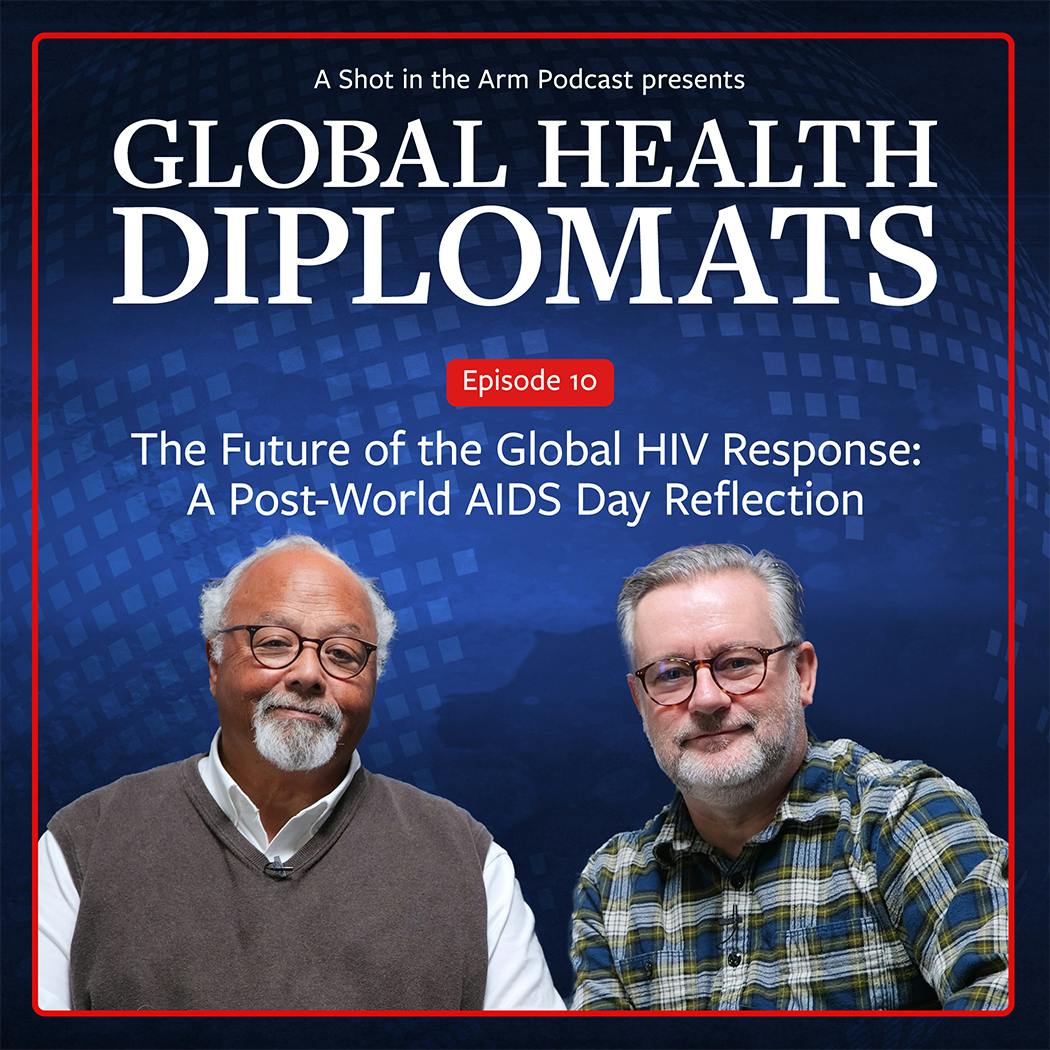
A Shot in the Arm Podcast
The Future of the Global HIV Response: A Post-World AIDS Day Reflection
00:56:31
Following World AIDS Day, this episode's discussion spans a 38,000-foot view of where the HIV epidemic stands, its critical challenges, and the evolving strategies needed for a sustainable, long-term response.
Loading summary
Transcript125 lines
- [00:01]
Eric Goosby
I see the opportunities that have been created by this 30 year sprint have the elements of the end game that's needed for us to preserve the drop morbidity and drop mortality in the populations that we've already aligned with and are following and are part of in our delivering of treatment options to those populations. We become part of those populations.
- [00:32]
Ben Plumley
Foreign.
- [00:42]
Welcome to the Global Health Diplomats brought to you by A Shot in the Arm podcast. I'm Ben Plumley and I'm joined by my co conspirator and co host Eric Goosby. Eric, welcome to the podcast.
- [00:56]
Eric Goosby
Thank you Ben. Happy to be here.
- [00:58]
Ben Plumley
So we agreed in a previous podcast that we were going to start doing a series of dedicated podcasts looking at the future of the AIDS response and where the HIV epidemic is today, where we see it going and really what the sort of long term trajectory in as far as our crystal balls will allow us to look at it, where it goes. And so in this episode we've got all the activities around World AIDS Day itself out of the way. But here we are just after World AIDS Day, looking at the territory, really a chance for us to see at the 38,000foot level, what does the landscape look like? What does the response and the state of the epidemic look like and where we go from there? And I guess my first question to you, if I may, is taking a, a sense of the temperature. How optimistic are you? Are we close to mission accomplished or are we fatigued in the middle of a stagnating epidemic?
- [02:07]
Eric Goosby
Well, I think the honest truth is we have come a long way and when you think of the infrastructure building that has occurred over the last 25 years, it's breathtaking on so many levels. But we have fallen short of what's needed to get across the finish line in 2030.
- [02:25]
Ben Plumley
As always, true global health diplomat, you answered that spectacularly, beautifully, without any controversy. The un, God bless it. Well, actually it wasn't the un it was the member states of the United nations back in 2016, made the commitment in a high level forum that we were going to end AIDS as a public health crisis by 2030. We are five years away. Everybody is still talking about this goal. Are we going to reach it or not?
- [03:00]
Eric Goosby
I don't think that there's really any way that we can reach it, but the advances that have been made are not figments of our imagination, but should be looked at as the necessary structure on which to build the structure to get across the finish line. We are well positioned to strengthen our response and pull that Many more people under the curve of treatment and prevention with the knowledge that we've gained, we can be very specific about that. Now with the long acting antiretrovirals as part of the toolbox yet undistributed, that is going to add a shot in the arm to our ability to prevent infection once infected, to identify, enter and retain that individual in a structure that keeps them connected for their life. And that delivery system need in our HIV positive patients is where we get the need for a primary care platform connection.
- [04:01]
Ben Plumley
And I know primary care is a really, really central part of your agenda post 2030. After we have delivered or not delivered. The end of AIDS is a public health crisis. But let's just talk about targets for a minute.
- [04:18]
We have used them in the AIDS response really since the early 2000s. There was the WHO.
- [04:27]
Target of reaching 3 million people on treatment by 2005. I mentioned this high level forum in 2016 that you know, feels a bit like an albatross around our neck.
- [04:41]
Are we in the era of.
- [04:46]
No more targets? Are we at a point where given the complexities of the world we live in, making these kind of political commitments really doesn't take account of any changes that may or may not be dramatic in countries. Is it really worth our while anymore having targets?
- [05:09]
Eric Goosby
Well, I think we have used them to our advantage. We have always put a target up to give us the leverage we need to argue to political leadership who make allocation decisions for delivery systems to make that investment and expand the delivery system. We've gotten very good at understanding the importance of accommodating groups that are participating in behaviors that are at higher risk for transmission and targeting them to bring them into care early for prevention interventions. But if infected, once infected to keep them connected so their ability to prevent infection in their exposed cases stops with the initiation of antiretrovirals in them. That cascade of events is getting saturated or is saturated in many of the countries in which we had early work. Where it hasn't gone to scale is in is getting out of kind of capital delivery systems that saturate the capital but don't do anything. In the rural settings we're getting much better at understanding that Covid made us look outside of capitals for impact. That allowed us to include how HIV and TB also swam with COVID or didn't. But it reminded us that that surveillance broadly keeps us honest in our decisions for outreach and targeting entry and retention strategies for those patients already in care. But I think that.
- [06:53]
That our ability to.
- [06:56]
Stay steady with a high risk Strategy of high risk groups being what we bring in first served us well both in our domestic response in hiv, but also in the international response. And I think more targeting of high risk groups is what we need to do. In many of the settings where we saw the outbreak of HIV is a heterosexual epidemic, not high risk group epidemic. But there are high risk groups in every epidemic that we just need to understand better and retrospectively turn the machine to target, identify, enter and retain them. When you do that, your numbers start to drop down more aggressively, the slopes of decline increase and you get people that you would normally not get in your outreach and retention strategies. That strengthening that we saw everywhere we did it was impressive for ratcheting down on getting those individuals who we were not getting before, who continued to seroconvert. So I think the primary care component of that becomes obvious when you care for a cohort of HIV infected patients. As a physician, you see the needs of that HIV positive patient turn into issues around coronary artery disease, hypertension, diabetes, early cancer detection. Treatment becomes what is going to kill them. And for us not to allow this system to pivot toward what is causing the morbidity and mortality in our patients that we've already captured and committed to is irresponsible. And for that reason, that primary care platform becomes a, a solution and a destination for all of us.
- [08:49]
Ben Plumley
So much to unpack from what you've said, the top thing I think that I reflect on is that the strategy of reaching high risk populations.
- [09:04]
Marginalized populations at risk populations.
- [09:09]
And let's be honest, who are they? They are men who have sex with men, which is our way of saying gay men and other men who don't identify as being gay but have sex with other men.
- [09:19]
Eric Goosby
Right.
- [09:21]
Ben Plumley
People who use injection drugs, injecting drugs, sex workers, and depending on the context, women and girls as well.
- [09:31]
Eric Goosby
Yes.
- [09:32]
Ben Plumley
And that strategy served us very well in getting to a point probably by.
- [09:40]
Where we are now, where we have a good chunk of people on treatment.
- [09:46]
I recently interviewed Christine Stegling from UNAIDS and the latest report says that, I mean, it's not great numbers. In a sense, 9 million people is a lot of people, but they think that there are 9 million people who should be on treatment around the world who are not. And that's a big difference from say 15 years ago, where it would have been 30 or 4, you know. Yeah, 15 to 2025 to 30 million people in needing treatment. So that served us well. But here we are 2024, coming into 2025, we see an environment where the.
- [10:26]
Rights based approach to.
- [10:30]
Accessing care is under, well the rights based approach period is under threat and being chipped away at. We see it in Uganda, we see it in Ghana, we see it in many countries around the world and not just restricted to hiv. And so the concept of us wanting to bring people who are at risk on the margins of society into services, into HIV awareness testing, prevention and if positive treatment becomes so much harder, doesn't it? So.
- [11:09]
Where do we go from here in looking at.
- [11:16]
The translation of an AIDS response from those early days into a longer term 30 to 40 year trajectory?
- [11:26]
Eric Goosby
Yeah, well, I think Ben, that we need to shuffle those two strategies together. The strategy of identifying the population that is seroconverting all comers welcome, all comers wanted entry access conduits that are open to all without barriers from fear of discrimination or.
- [11:54]
Or rejection for social reasons that have nothing to do with your need to be diagnosed and treated that need with the primary care needs of your general population for any country, your people are dying from non communicable diseases too that are predominating and killing more than the infectious diseases now in many countries. Acknowledging that seeing that the populations maturity in the sophistication of their medical problems now necessitates diagnostics and therapeutics that shift toward coronary artery disease, diabetes, hypertension, stroke type. Abilities to identify early and prevent. That primary care platform is well developed in Europe, the United States, in most of the world because it's killing most of the people on the planet. So it's not that we don't know what to do with NCD type diseases, we do. It's time to shuffle that need together with the what I would say was an extraordinary exceptional approach created for HIV TB like we have done for HIV and tb. But as we did, as we saw with COVID there was an ability to scramble and kind of strengthen your delivery response to accommodate the nuances that the different infectious agents presented to the delivery system doing the same thing for the primary care needs, NCD needs of that HIV positive patient in care for 20 years with our systems of care now need to be.
- [13:42]
Gently presented into a primary care platform that picks up all of the salient data needs of the HIV positive TB infected individual. Not to abandon them, but to incorporate them as we move forward on a platform that can also diagnose hypertension, diabetes and coronary artery disease which is the most likely thing to kill them.
- [14:07]
So it's that shuffle and we need both and we need to do it in a way that respects the fear that individuals have who are in marginalized behaviors that the society does not embrace, accept and indeed rejects. We have to work overtime to create safe spaces to identify and bring them in to a continuous relationship with the delivery system or we're going to miss this opportunity and they go ahead and develop a disease that we could have prevented or stopped and die from it.
- [14:42]
Ben Plumley
All of this is predicated on the fact that they get access to treatment if they are HIV positive. That's right. And I guess there are many settings where that's going to make a lot of sense. And we have a large number of people living with HIV that we are collectively responsible for. You and I have spoken about this in previous podcasts and we have to find ways of continuing to support them so that in the context of a sustainable primary care driven response, we can look at the ways in which non communicable diseases, diseases of older age perhaps are being addressed in a way that's a great place to be at. But, but the issue is at the moment, do you see that the changes in the sort of geopolitical landscape.
- [15:42]
Are going to make it harder for us to bring whoever from whatever setting and population into care? Come back to prevention in a minute. But bringing them into care, do you see that in the next few years that's going to be harder and harder to do?
- [16:02]
Eric Goosby
Without a doubt. And for us to call it any other way would be irresponsible. It is the challenge in front of us now that has matured, evolved into a multi faceted.
- [16:19]
Need that the, that represents the kind of needs across the spectrum. And again that individual that we've already developed the therapeutic relationship with the system needs to accommodate those HIV infectious needs that we have stood up already, but needs to broaden the the system's ability to survey that individual for hypertension, diabetes and coronary artery disease and early cancer detection because that's the most likely thing that will kill them now that they're not dying from HIV and tb. So we have presented and delivered them to a different set of threats as they age and move into that those diseases that go along with those ages. I think it's an opportunity that converges the needs that have always been there in that same individual going back 30 years. These were the needs that that individual at 20 years old, at 15 years old had to the delivery system that as they aged were going to mature and develop and present themselves as a need that the system either recognizes or doesn't responds to or doesn't engages and changes trajectory decline for these chronic Progressive diseases, we don't cure them, we change the rate of decline and they live longer. And we're all experiencing that in our own lives and our patients should too.
- [17:52]
Ben Plumley
So, I mean, obviously we're going to come back to.
- [17:58]
The context of placing rights at the heart of the HIV response. Moving forward, we'll have a dedicated episode to on that. And of course we will have a dedicated episode on treatment. And I guess the key question that I would want us to be exploring in that is do we need an R and D agenda anymore? Do we not have research and development agenda? Do we not have enough medications for HIV to make this a manageable chronic disease that will allow us to look at the diseases of old age that they face?
- [18:38]
Eric Goosby
We do. And we are at the moment where that reintegration opportunity has been one. And it's an achievement that we now have the luxury of thinking about how we reintegrate this unique disease challenge that took individuals and killed them in a way that was unique we'd never seen before. Now we have responded in diagnostic treatment, prevention ways to that disease, less so with TB, but with TB2. And that now needs to not be an exceptional form of treatment, but integrated into an expected portfolio of what you, as a person living in this region, should expect your delivery system to be able to do for you.
- [19:26]
Ben Plumley
So are you thinking that the research and development agenda should really prioritize, both from a therapeutic and from a diagnostic perspective, integration with other.
- [19:42]
Health priorities? So in the context of treatment.
- [19:48]
An evolution of the medicines that we have so it's easier for them to be taken in the context of treatment for diabetes or treatment for heart disease, you're not seeing necessarily a need for innovation in new medications, new therapeutic approaches.
- [20:10]
Eric Goosby
Not as much as I think we have been successful in identifying long acting antiretrovirals, we have been effective in different combinations of antiretrovirals that stops viral replication completely, progression stops completely. It looks to a physician and to a patient like a cure. But we know once stopped they'll rekindle with the virus and go right back to viral replication and destruction. But we now are nimble at stopping that for 20, 30 years in an individual and allowing something else to kill them. That's the need for the primary care platform, because that those diseases that kill them now are all diagnosable and treatable already. And the primary care delivery system needs to ensure that diagnostics and therapeutics are available. And in the formulary of the clinics and hospitals that these patients are now being seen in as they age, the need for the governments to increase their investments, moving it toward the Paris Declaration of you know, 10, 11, 12% higher if able is critical now. It's the moment we're in same old need. We now.
- [21:34]
Are at a point where donors and countries need to think differently about the resource pot that funds these efforts and capabilities and sharing and dividing, continuing funding or receiving funding are all going to be in our next 10 year lives. And those decisions are best made when they're made by the people who are in, who are in front of the delivery systems, looking at the outcomes of those delivery systems with the populations that are retained and in those delivery systems, not a group making a decision, you know, 10,000 miles away.
- [22:18]
Ben Plumley
We'll come on to funding in just a second, but before we leave it on the therapeutic and.
- [22:30]
Or biomedical, let's say component of the long term AIDS response. One of the criticisms of the extraordinary availability of COVID vaccines in such a short period of time after the SARS CoV2 appeared was that the methods of storage of these vaccines was so impractical for massive distribution in resource limited settings. You know, they needed uber super cooling to remain, you know, have that. Yep, remain usable.
- [23:12]
How do we get to a situation where as we move to these long actings, you know, they're likely to be, you know, they're injectables for the most part. How do we make sure that the R and D is reflective of the needs of the masses around the world rather than the short term profit motive? And I'm not criticizing it, but it's there in industrialized world markets.
- [23:44]
Eric Goosby
To me it's all an issue of access that it we as a global society, a global community, and I include the pharmaceutical community in that need to.
- [23:57]
Decide that once the discoveries of a drug diagnostic, therapeutic are made, that it really gets down to an individual's ability to access that new drug, that new innovation for them to benefit from it. We as a global community need to prioritize the ability to benefit from it as the measure of our success in developing this innovation and our ability to apply it and have it have the impact that it was created to have. That continuation to the delivery system to reach the individual who needs it is the delivery system's responsibility still and those who fund it and to abdicate that in our cascade of getting a pill into the right mouth, we always tend to step off the conveyor belt when the conveyor belt stops because we assume that it's not doable. But look at the antiretroviral surge that occurred from the stated needs in the late 80s to the mid-90s as effective antiretroviral therapy became apparent. The inappropriateness of that disparity in access was what drove the global community to call foul. That was what the foul was called on it was that so many of the people who would need and benefit from this drug are not able to access it. That is no longer acceptable. You and Peter in particular, Beat that drum, Pizza Piot. Yeah, sorry. Peter Piat beat that drum hard and crescendoed it into a shame moment for the global community to say. Not on our watch. We understand this. We see issues of access in our local communities back in the United States and Europe. And the tragedy of an individual not benefiting from this is unacceptable to us as physicians, health professionals on the planet. And we are going to say we are part of that problem and we're going to be part of the solution. That feeling and willingness to put yourself in that fight, in that engagement has got to crescendo now as funding lines recede into their respective troughs and are going to get harder to access but need to be accessed in a different way. Those who are at the table with small amounts need to rethink whether or not their, their contribution is appropriate for where they sit in the food chain of both knowledge and the food chain of responsibility for response. Government sits squarely in that spot and they are failing to take that responsibility seriously to heart. And the population that needs and uses and depends on these services is not holding them accountable. Is it because there are not mechanisms to hold them accountable? Is it because voting doesn't really, isn't really seen in many countries as a tool to hold a politician accountable. It's true, it's not often, but we need to reinvigorate that understanding and be part of the message to the person that we've been treating for 20 years that you've got to have an agenda that holds your political leadership accountable for developing and sustaining the service because you're going to die if they don't.
- [27:42]
Ben Plumley
Yeah. And we're going to come back to, we're going to come back to funding with a dedicated episode. And I can see you getting passionate and you know, me too, there are some really tough questions that have to be asked.
- [28:01]
Because again we have a situation where multi or international funding is used to keep people with HIV alive. And there is no way sugar coating this that's not going to continue. So one of the things that has to happen over the course of the next few years beyond 2030 is generating sustainability of access to treatment for the people that we have made the commitment to keep alive.
- [28:36]
Eric Goosby
Yes.
- [28:37]
Ben Plumley
And that's going to require much greater domestic resource. It's going to require innovative resource. When we say innovative, we basically mean private sector, local health, you know, national health.
- [28:52]
Insurers, local manufacturer, all of these things.
- [28:57]
But it also begs the question about whether the big multilateral and bilateral funders are still fit for purpose. And.
- [29:11]
The only thing that I would throw out there at the moment, you know, the Global Fund just had its last board meeting in Malawi, which went extremely well and was interesting because the mission of the Global Fund continues to expand, which is a way of responding to this difficult geopolitical environment that we are in. But, but a funding mechanism, international funding mechanism that focus on, focuses on three diseases, HTB and malaria, that with the US Government basically accounts for the bulk of all the.
- [29:51]
Treatments that people living with HIV require, live on need.
- [29:57]
That just does not seem to be sustainable. Or at least I think we need to have a very honest conversation about what it needs to look like as we evolve to a situation where countries take greater ownership. And it comes to mind as you were talking about the donors on the food chain, those countries that perhaps don't have large development budgets or don't have large health budgets.
- [30:31]
Is that.
- [30:34]
The solidarity that we created through mechanisms like the Global Fund and everyone was chipping into the way that they could do? Yeah. Is that really needed now?
- [30:46]
Eric Goosby
So it is needed to be present and willing to allow those same resources to not evaporate rapidly. They need to be repurposed to support a transition that results in a strengthened ability of the country and civil society in the country, including the private sector, to put together a purse string around the resources that are available and or newly created in the domestic effort to fund a level of services that puts a basement of capability in place and secured and sustained and defines that baseline. And then where more than that baseline can be accessed in the country needs to be crafted and worked out just like we do in our countries that are developed and resourced from private money, from health insurance kind of strategies. All of those strategies need to be resurrected and reimagined in the context of now country X. You are going to be responsible for this expansion of people that are coming in with hiv, TB and that have been seen and followed in your multilateral system or your bilateral system that now are going to be transferred in care formally to your system of care. And that means an expansion of X number of patients, an expansion of procurement distribution needs Formulary needs, all quantifiable, all measurable, not guesses that we can then back.
- [32:35]
Back into a structured funding of those needs that are population driven. Specific for this is the population, these are the numbers that we've got. These are the number of antiretrovirals we need, the diagnostics we need at this interval of testing, spacing, et cetera, over time. And we need to work with the country in a way we haven't historically in our bilateral and multilateral efforts where we work with the country to engage IMF and the World bank to look for and take advantage of low interest loans. They are available, they can be created even for a new need for like a pandemic, pandemic threat need that create a loan repayment strategy that may or may not make sense, but now is the time to look at it to make sense. Will this be willing to reform it? So it does make sense and works because the resources are there is what I'm really wanted to conclude. And we need to be honest about and be brave enough to reconfigure them for purpose.
- [33:48]
Ben Plumley
So.
- [33:50]
This is going to make for a really interesting episode because I'm not sure that the resources are there. And I'm intrigued that you're right. You set out.
- [34:00]
The role of.
- [34:05]
The banks, whether they are the World bank, the IMF or the regional banks. Because one of the problems that we face is that countries are, are swimming in debt repayments, loan repayments. And if we are expecting countries to play more of a role funding and allocating more funding to their health care, we need to make sure that those resources stay in countries and don't go back to the.
- [34:41]
Banks.
- [34:43]
Eric Goosby
Not rocket science. We are smart enough as a global economic community to figure that out and to have it be the sustainable re kind of the, you know, a system that keeps the momentum in it and doesn't decay out, we should be smart enough to be able to create that. And if not, what are the elements and points of supplementation that need to be generated to keep it sustained? The outcome we can be very clear about and explicit about how many people we are talking about. What resources do we need to keep the medications that are sustaining their lives in them available to them and for the duration of their life? And as.
- [35:34]
I would say, new threats present the pandemic threat. That primary care platform becomes the conduit through which education can be targeted to those who need it most, vaccines, therapeutics followed to that to those who need it most. So you've got a pre captured community that is going to be your more vulnerable in a pandemic threat. So you're doing the work of the pandemic all the time by keeping and retaining them in care. So to me it's the solution for a lot of those issues.
- [36:13]
Ben Plumley
So what we are agreeing violently on is that.
- [36:19]
There needs to be a discussion right now in Geneva, in Nairobi, in New York, in Abuja, in Johannesburg, right across Southeast Asia. How are we going to fund this long term? And let's not focus ourselves exclusively on this rash of replenishment cycles that we have created.
- [36:44]
Eric Goosby
We have to stop into what's the long term.
- [36:50]
Program need to do this and not as you say, every five years scramble to get it, you know, have those resources identified by a donor, continue the donor input. We need the donor input. Do not want it to stop. But it needs to transform into being country based, country driven, country prioritized and I would say validated with the resources. Can't be so external to the countries resources that they wouldn't sustain at all without them. We gotta have some hybrid.
- [37:28]
Ben Plumley
So let's change tack a little bit. Another episode we're gonna focus in on is around HIV prevention.
- [37:37]
The poor stepsister, if you like, of the HIV treatment achievements over the last 30 years. And I guess the question that I'll be interested in exploring with you, given what you've said about let's say the saturation of innovation in HIV treatment is the need for innovation in HIV prevention. Because we have done a pretty lousy job over the course of the last 30 years. We've had moments of great success. The gay communities in the US in particular in the 80s prevention, mother to child transmission interventions in Southern Africa and in Southeast Asia and the 2000s and beyond. We have prep now which is potentially very exciting. Of course that is the same medication that was developed research for HIV treatment. But we've not been able to really to get rates down and in fact the rates of new infection down. And in fact what we are seeing from the new data, we saw this in July, we see it a little bit again now from the updates that UNAIDS and WHO are providing is that we see increased epidemics, we see increased infections in Eastern Europe and Central Asia. There are probably very specific reasons for that that truly are geopolitical. But but then you also see, and I raised this with Chris Christine Stegling, extraordinary rates of infection say in young people in the Philippines. And so what will you want to see for a.
- [39:26]
Longer term HIV prevention agenda?
- [39:30]
Eric Goosby
So you know, it is frustrating that the, the unique role that treatment plays in preventing an individual from maintaining an infectious.
- [39:44]
You know, in terms of that the patient, the person is infectious, continues to be infectious with treatment and undetectable. They are no longer infectious, has not had a kind of ad at the kind of additive impact that we thought it was going to potentiate our drop in infection. The problem is, is that we did not do anything to look at the problem of mixing. And mixing is a concept that we used a lot in the early, in the late 80s, really early 80s of watching populations where high risk behavior was evident. But you would not see them seroconvert as a group.
- [40:25]
The virus did not mix into the high risk behavior population, so nobody seroconverted. So we saw high risk behavior in different groups that we followed prospectively and lo and behold, they stayed negative. And it's because it didn't mix in. So there's a mixing component. If you have new people entering the high risk behavior conveyor belt that are not participating in safe behavior, but are participating in high risk behavior, blindly coming in on the front end, unchecked, uninformed, uneducated, untreated, uncondomed, un everything they transmit and seroconvert. The same with hepatitis and there's other infectious diseases that show that, that that is really going on. We never have impacted that.
- [41:16]
So that needs to shift because we couldn't do more with the treatment. You know, the magic bullet approach needs to continue still be available.
- [41:26]
Ben Plumley
Let me just stop before you, before we move on. That all makes sense in the context of, of someone entering into a consensual relationship of behavior. One of our biggest challenges, and you've really, really led on this has been around some of the.
- [41:50]
More harmful gender norms that exist in many countries in the world, including in the United States, where particularly women and girls don't have the same degree of agency that say gay men in urban settings, Berlin, New York have. And so how does that descriptor that you have of making sure that, that people have access to prevention technologies.
- [42:23]
However complex they are at that early stage, how does that take account where you don't necessarily have the full agency that you would otherwise.
- [42:33]
Eric Goosby
Yeah, you know, it's the question. To me, you're asking the right question. It's difficult to know. In many countries now, with changing.
- [42:44]
Reactions to the types of discussions and issues that are brought up in quote, public settings like schools, like churches, like convening and social groups, there's now a lot of consternation around what topics are brought up or what are not and are acceptable. What are not. In spite of that, the need for a more open discussion about people and their behavior is desperately needed in our society. And we as a society need to be committed to going through a maturation process in our willingness to reveal and be vulnerable along these lines because the consequences are still too much for individuals to feel safe in coming forward with, you know, the feelings, the behaviors, the urges that do result in acts, behavior changes that result in a high risk, behavior that results in a transmission need to be understood better. But I'll tell you that it is difficult to get behavior changes. It's one of the last things that seems to happen. It only happens when it has to happen. And most people, and I think we've got a very difficult road ahead of us to get that behavior change before people really perceive themselves as in that risk group. Because you're asking them to understand what's in front of them before their self perception says you are one of them in that group. And I've seen that disconnection so many times. It's usually after the fact that they revisit, you know, how and where they transmitted transmission came in and how their commitment to the behavior relates to them in their self perception. It's something that usually the behavior happens before the rationalization.
- [44:43]
You know, explains it, comes in, justifies it and creates the narrative for the behavior in the future. That's an unusual person.
- [44:51]
Ben Plumley
You know, it certainly says that the HIV epidemic is one that is not just purely biomedical, isn't it? No, it does, it is so. It is so complex and every country.
- [45:05]
Eric Goosby
We see that, you know, if we're.
- [45:09]
Ben Plumley
Going to devote one episode to the broader geopolitical context, the rise of the so called anti rights movement, the influence of.
- [45:21]
Christian religious extremism, which has been extraordinary.
- [45:24]
Eric Goosby
Yeah.
- [45:25]
Ben Plumley
And that's, you know, that's a new wave of neocolonialism coming into countries. The other thing we're going to look at is, and I know globe people working in the global health sphere love this. We're going to look at the global health architecture and what do we mean by that? The institutions that help guide, support. Yay. Fund some of the, or a good chunk of the, of, of, of the interventions in countries. And this happens at a time when the.
- [46:01]
When the joint UN program on aids, UN AIDS is doing a, a review through an independent panel on, on what happens to the UN response.
- [46:14]
After 2030. And I guess we will have some thoughts on that.
- [46:20]
Eric Goosby
I haven't heard much about that discussion. I know you got your ear to the ground in so many different arenas. Is it moving forward or is it just beginning?
- [46:29]
Ben Plumley
Well, they've just started the process. I think they've had a few meetings already. But I think that the debate about whether we need a dedicated coordination, convening, advocacy mechanism is one that is absolutely legitimate to ask. I wouldn't be surprised if you and I end up on the side of saying it is absolutely relevant, particularly given the trends that we see happening with HIV transmission, HIV funding and the broader human rights context.
- [47:08]
Eric Goosby
Yeah, yeah, yeah. I mean you're, you're mentioning the Philippines is just, it's just tragic to see kind of historically those concerns were present 20 years ago. Why isn't it happening in the Philippines? There were groups in the United States, Native American groups, that we said super high risk behavior, but they don't zero convert. And that mixing issue was it. We have not figured out how to take advantage of that mixing issue in our kind of public health approach to preserving a population, preventing them from being challenged by massive zero conversions because of the behavior present in the society. We haven't figured that out yet. It is a. People aren't ready to change until they really see themselves at risk and disconnect.
- [47:58]
Ben Plumley
And you don't know you're at risk until you've been there.
- [48:01]
Eric Goosby
Then you do.
- [48:02]
Ben Plumley
Yeah. So as we wrap up this episode, Eric, I suppose.
- [48:10]
Do you have a sense of optimism? Do you have a sense of pessimism? I go back to that original question. Are we almost mission accomplished or are we exhausted in a stagnating epidemic?
- [48:29]
Eric Goosby
Well, what a question. I think there are segments in the community that has been part of the response for 30 years that are fatigued and are.
- [48:41]
Feel like, I don't know if I can rise up and engage this again kind of from the beginning. You hear that. But I'm on the optimistic side of that continuum. I see the opportunities that have been created by this 30 year sprint.
- [49:00]
Have the elements of the end game that's needed for us to preserve the drop morbidity and drop mortality in the populations that we've already aligned with and are following and are part of in our delivering of treatment options to those populations. We become part of those populations. Our commitment to that population would be.
- [49:28]
Inappropriately inappropriate if we decided to now recede our investment in what we're currently doing, but admit in the same breath that that investment needs to transform and be fit for purpose for a movement where the lateral, you know, the passage of management oversight.
- [49:51]
And running the programs is complete, but that paying for the programs now broadens its, its catchment area to expand in domestic resource investment. Private sector investment needs to be defined and brought in to be the, the compensator for the drop in multilateral funding that I think in five to 10 years will start to show itself.
- [50:21]
It would be tragic if that drop started immediately and irresponsible. On an abandonment of care level. We are smart enough to do this so nobody gets hurt. And indeed we are smart enough to do this so we expand into accessing services on a primary care level for that patient that has just had HIV and TB treatment available to them. So it to me is a moment where the needs coming out of pandemic in the background and in the future with primary care needs with that population we've already committed to, this is winning more for that group than we were in our original vision with just an HIV TB approach. This is what they really need and we're part of delivering that to them. The donor multilateral part needs to continue in the transition, but it needs to. The destination needs to be transition needs to be country owned.
- [51:22]
But I'm optimistic about that. I am. I see it as an opportunity. Yeah.
- [51:27]
Ben Plumley
So one final question. We're not going to end AIDS by 2030. Should we set another target date? Give us another 15, say ending AIDS by AIDS 2045 or let's plick a pluck a number out of the air. Let's say 2057.
- [51:44]
Eric Goosby
I think targets help program management people be concrete about what the bite is this year. And that yearly bite is important to know if it's a big bite, a little bite or, or you know, how much is going to be in the mouth. Is important for the those running the program to be very aware of opportunities present themselves that you can take advantage of that you couldn't if you weren't aware of it. And that kind of rigor is now within the kind of science of surveillance and our ability to analyze it and feed it back into a budget process. We're good at that now. Okay, so we don't have any excuse not to be iterative in correcting toward a greater good. An expansion of portfolio toolbox and program.
- [52:35]
Ben Plumley
So what you're saying is basically a public health implementation target, not a political.
- [52:44]
Eric Goosby
That's what I would kind of.
- [52:45]
Ben Plumley
So I would say.
- [52:47]
Eric Goosby
Yeah, I would.
- [52:48]
Ben Plumley
Well, Eric, I am really excited to be on this journey with you. Over the next couple of months it's. We're going to be.
- [52:59]
Looking at a few sacred cows and wondering what to do about them. And it's going to be Perhaps a bit.
- [53:06]
A bit stressful at times, but I think ultimately.
- [53:11]
We really collectively have to be thinking about what the long term HIV response is going to be. We've got to start thinking about that now.
- [53:23]
Eric Goosby
We do. You know, you make me think, Ben, that.
- [53:28]
We have an opportunity to continue looking at our, our pie slice of hiv, of tb, HIV as, as something that we are still nurturing and responsible for. But we now have an opportunity to have the whole pie available for strengthening expansion. And I guess most importantly, it's for the first time maybe putting that expectation on the governments that are over these populations that they have a responsibility to create these services for them. And the multilateral response is not to do it for them, it's to support them in expanding their portfolio of capability to include management, oversight of the programs themselves, all the surveillance, the, you know, the.
- [54:31]
Distribution of, you know, resources. That is a huge service component that runs parallel to all of these. All of that is understood in a very specific way. We can cost out the cost, not in a blind way, go into this with our eyes open, in partnership with partner country leadership, that this now is your burden to address. But we are going to stand with you in that evolution as you accept and position that burden on your shoulders and move forward. We can do it better together. Is still an opportunity here, but we have a ethical charge to not stand down at this point as the United States government, as the multilateral supporters of a multilateral effort. Now is not the time to recede. It's the time to be present and transform this into something that can hold the burden of current disease burden with NCDs and with pandemic threats unknown.
- [55:37]
Ben Plumley
What a great way to wrap us up, Eric.
- [55:41]
Well, that's it for this episode of the Global Health Diplomats brought to you by A Shot in the Arm podcast. We are extremely grateful to the to the John T. Martin foundation for the support for us to do this podcast. A big thanks to my co host Eric Goosby. A big thanks also to our director and producer, Eric Aspera of newsdoc Media.
- [56:09]
Please subscribe wherever you download your podcast. Give us us five stars. And we look forward to sharing this journey on the future of the HIV response with you over the coming months.