Loading summary
Transcript157 lines
- [00:03]
Joe Rowe
There's Rick's. There's his trailer house back at the back.
- [00:07]
Interviewer/Visitor
Oh, wow.
- [00:08]
Joe Rowe
That's where he lived.
- [00:09]
Zoe Kurland
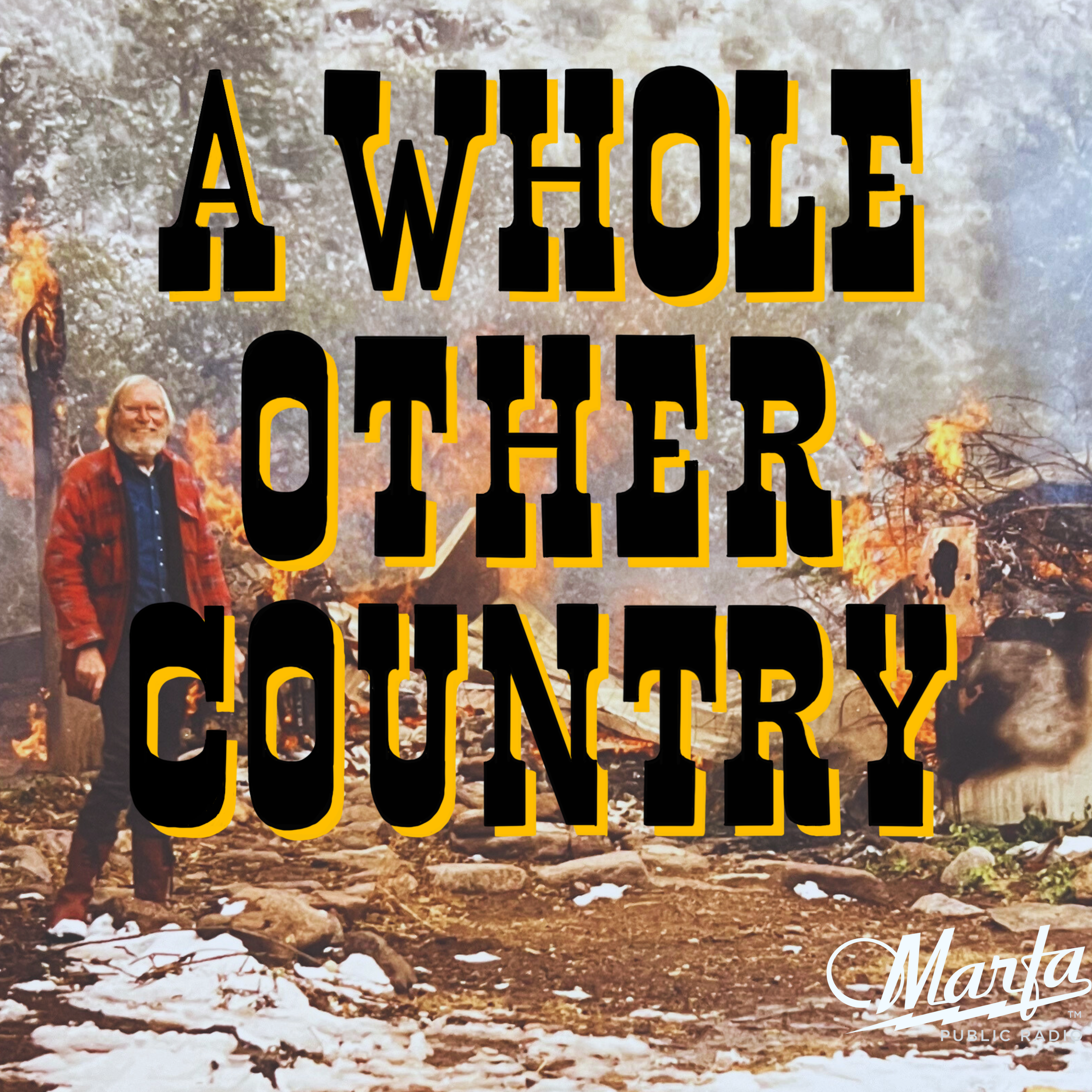
I'm in Joe Rowe's house, standing at his kitchen table, looking at a photo of the Republic of Texas Embassy. In this photo, it's deep winter and snow blankets the ground, glittering almost like it's knitted over the earth. The stark white trailer and rickety lean to are surrounded by trees with skeletal branches.
- [00:31]
Interviewer/Visitor
Why is it burning?
- [00:33]
Zoe Kurland
I should mention in this photo, the embassy is on fire. Joe slides over another photo. In this one, the snow is melted and the embassy is suddenly no more. A browned pile of ember and scrap metal, walls collapsed in like scorched playing cards. A wiry man with a white beard stands in front of it. He's grinning, he. His cheeks flushed in the cold.
- [00:58]
Interviewer/Visitor
Is that you?
- [01:00]
Joe Rowe
Fire department practice.
- [01:02]
Zoe Kurland
Fire Department practice.
- [01:04]
Interviewer/Visitor
What happened?
- [01:05]
Joe Rowe
We had fire department practice, all right.
- [01:12]
Zoe Kurland
Joe told me that once the standoff was over, Rick's overdue land payments caught up with him and the lean to embassy went to taxing authorities who sold it at auction to the Nature Conservancy. The Nature Conservancy had no use for it, so the DMR volunteer firefighters, including Joe, burned it down and buried the whole thing.
- [01:32]
Joe Rowe
He dug a hole and buried it. Now, why would he want to come back to that?
- [01:39]
Zoe Kurland
After the ceasefire agreement was signed, after the ROT surrendered and laid down their weapons, Rick McLaren, Evelyn McLaren and the three other followers who were holed up at the embassy were arrested as onlookers. Remember it, Rick was pretty jovial as he was taken away by the authorities, smiling from the backseat of the police car like a politician. For Rick, the arrest meant that he was a prisoner of war, held captive by the US Government. It meant that the Republic was real. Here he is, another POW in this.
- [02:15]
Jonik Petoske
State of emergency war that we're in.
- [02:17]
Zoe Kurland
Richard McLaren.
- [02:18]
Daniel Miller
Can you hear me, my friend?
- [02:19]
Chris Kirby
Yes, sure. Can you?
- [02:20]
Zoe Kurland
While he was in jail awaiting trial, Rick kept writing letters to Robert Halpern at the Big Bend Sentinel about the illegal annexation of Texas, which Robert sometimes printed. Rick did phone interviews on talk shows with other true believers. God bless you, Richard.
- [02:37]
Daniel Miller
It's good to hear your voice and thank you for coming on the Jeff Davis Show. Sir, how are your spirits?
- [02:42]
Joe Rowe
Pretty good. I've been pushing so much paperwork very hard.
- [02:46]
Zoe Kurland
It's time to get these hearings we've.
- [02:47]
Joe Rowe
Been denied out on the table.
- [02:49]
Zoe Kurland
Start bringing all these sacred cows and.
- [02:51]
Joe Rowe
This governmental fraud on all levels out on the table. We're going to have to clean government out, even whether or not we take.
- [02:57]
Zoe Kurland
But Rick did not end up cleaning out the government. He was tried by the federal government on charges of fraud and by the state on charges of aggravated kidnapping. Rick was convicted by both the state and the federal government on the charges against him. He was sentenced to 99 years in prison. He's still in a state prison in Amarillo, serving out the remainder of his time. He's 72. And by the way, I did send Rick letters and multiple interview requests. He declined each time. But as recently as 2018, he told a reporter that he still believes he's the leader of the nation of Texas. And when I went to do some fact checking at the Jeff Davis County Clerk's office recently, Rick, they told me that Rick still sends them mail all the time. Filings. The paper war continues. I'm Zoe Kerland, and this is a whole other country.
- [04:01]
Mark Hernandez
I'd rather be in there with them.
- [04:03]
Zoe Kurland
You'd rather be in jail?
- [04:04]
Mark Hernandez
Yes, because they're innocent, too.
- [04:07]
Interviewer/Visitor
It's not fair.
- [04:08]
Zoe Kurland
This is Mark Hernandez, the young, quote, revolutionary you heard earlier in the series. He was tried along with five other members of the Republic in that federal fraud case. He was the only one acquitted.
- [04:21]
Mark Hernandez
Long story short is I was found innocent. And then right when I got out, I said, you know what? I want the media to find out and everybody to find out what really did happen. So I thought I went forward, trying to see about getting a movie deal.
- [04:33]
Zoe Kurland
The movie hasn't taken off yet, but Mark is still hopeful. The first time we talked on the phone, he saw my California area code and asked if I could hook him up with anyone in Hollywood.
- [04:45]
Mark Hernandez
You know, who would be perfect for Richard McLaren. There's two people that I think would be perfect. One would be Woody Harrelson. Would be perfect to play him. Or there's Matthew McConaughey, either one of those. And they're both Oscar winners. And you know how Richard will always have his hair like a professor? Out, real long and extended out, and he looked like a wild professor. I picture those guys letting their hair grow and have it long like that, you know, or whatever they do in the movies.
- [05:17]
Zoe Kurland
While Mark left the fight for Texas independence long ago, he says he still believes in what they stood for.
- [05:24]
Mark Hernandez
All right, maybe I'll end it by saying this. Long live the Republic of Texas. Now, I'll be sure to invite you to the premiere of my movie if I ever get that going again.
- [05:35]
Daniel Miller
That narrative harmed a lot of innocent people who just held a firm belief that Texas would be better off as an independent nation.
- [05:44]
Zoe Kurland
Daniel Miller, who joined the rot back in 1996, he told me that after the standoff, the statewide Republic of Texas movement fractured. No one really had the same idea about what Texas independence should look like, when or who should lead the fight. By 2002, there were about a dozen different groups calling themselves the Republic of Texas. And eventually the group dissolved while that movement flamed out.
- [06:12]
Daniel Miller
The idea that seed, that kernel, that spark, it never went away.
- [06:18]
Zoe Kurland
Daniel is now the president of an organization called the Texas Nationalist movement, formed in 2005. He and his pals dropped the annexation thread, the idea that Texas is currently an occupied sovereign nation. Instead, they're modeling their campaign on movements like Brexit. According to Daniel, the Texas nationalist movement has 633,000 followers. They believe in the strength of Texas as an economic and cultural force and want to separate from the U.S. while independence hasn't yet been on the ballot, it. It has been polling better over the past few years.
- [06:55]
Daniel Miller
I always love it when people say that, Tex, it can't or won't happen. And I just tell them, open your eyes, it's happening right now. You know, Tex, it is the process of Texas withdrawing. And I think we are accelerating. I mean, we are moving rapidly that direction.
- [07:12]
Zoe Kurland
I mentioned to Daniel that I'd moved from California, and he really wanted me to know you don't have to be a born and raised Texan to believe in the cause.
- [07:21]
Daniel Miller
Well, yeah, okay, look, that's no big deal. Our organizational development director and his wife are both California refugees.
- [07:33]
Zoe Kurland
Whatever the future holds for Texas independence, I've mostly been thinking about the beacon of independence a few miles out from me. The dmr, the wild west world of individualists that Rick walked into and the chaos he left in his wake. It's not like after Rick, the DMR became an entirely different, entirely peaceful place. Property owners still soldiered on in the fight to eliminate fees and rules. The fight Rick had largely started. There are still contentious arguments at property owners association meetings. And occasionally up in the mountains, something very dramatic happens with a loaded gun.
- [08:15]
Jonik Petoske
It was kind of like a convergence of myths. Rick McLaren's story is the convergence of myths. In a mythic place where you can reinvent yourself and you can be the leader of your version of Texas.
- [08:28]
Zoe Kurland
Journalist Jonik Petoske.
- [08:29]
Jonik Petoske
You could have done that at the Davis Mountains resort and gotten away with it if you hadn't gone down to the courthouse and filed liens. If you hadn't taken your neighbor hostage and shot him he could still be doing this today and claiming this, and people all be going by, oh, yeah, that's that crazy guy Rick, who thinks that's the embassy of Texas. And people wouldn't think twice about it. Cause there's a lot of people out in our neck of the woods that are like that.
- [08:56]
Todd Jagger
You know, there's a reason Texas motto is it's like a whole other country. I don't know if they use that anymore.
- [09:01]
Zoe Kurland
Todd Jagger of the Internet, that used.
- [09:04]
Todd Jagger
To be the tourism motto. And if Texas is like a whole other country, the Trans Pecos is absolute like a whole other country. And yeah, it's. I mean, we're independent. And that manifests in a lot of different ways, including negative ways like this.
- [09:22]
Zoe Kurland
Todd told me that when he started his company, it felt kind of pioneer, jacking together the wires, doing the work that no big company would do. He was a frontiersman, and it was exciting. But in the wake of the standoff, things felt different.
- [09:38]
Todd Jagger
I think those of us who were in on the Internet early on, we thought that this was going to bring the world together. That it's turned out that it's driven us apart in many ways.
- [09:51]
Zoe Kurland
Todd's more cynical now, more cautious.
- [09:54]
Todd Jagger
The standoff, that's done. But the questions that arise about how people utilize and disseminate information that can affect people, that's. We're dealing with that more today than ever.
- [10:12]
Donna Watkins
A lot of people did everything but stand on their head to keep from saying where they were from. And I'm thinking, well, that's dumb, but that's just the way they reacted to it.
- [10:25]
Zoe Kurland
Donna Watkins told me that after the standoff, the DMR's reputation as a weirdo zone blew up. People didn't want to admit that they were from the resort.
- [10:35]
Donna Watkins
And I have to admit, I never could figure out why they were ashamed of it. It's not any different than crazy people in New York City. So, I mean, you know, they're all over.
- [10:47]
Zoe Kurland
And that wasn't all. Before the standoff, the DMR had been relatively unknown. That's part of why the land was cheap, why people were able to live differently, build their own houses and be sort of off the grid. But after the national news stories that.
- [11:04]
Donna Watkins
Changed, people found us. See, we were not known. Nobody knew it existed. We had a lot of strange folks that would come out, looky, lose stuff. We had three years of that crap. Some people I would help and some people I wouldn't. Because at that time, I kept a rifle by the front, front door.
- [11:27]
Zoe Kurland
But Donna stayed put until it was quiet up on the volcano again.
- [11:31]
Donna Watkins
A lot of people were kind of afraid of the resort, which I think is hilarious because they thought crazy people lived out here. I just die laughing to this day. They think it and that we're all crazy and we shoot people. Let's see. Well, I've thought about it a few times.
- [12:00]
Chris Kirby
They're all gone. Even the people that just kind of dabbled in it are gone.
- [12:08]
Zoe Kurland
This is Chris Kirby again, the one who bought the property across the road from the ROT headquarters and took me on the Kawasaki tour of the ruins. He told me that most of Rick's old allies in the DMR have moved away or died.
- [12:22]
Chris Kirby
It's history, and it's been history for 24 years or something like that.
- [12:29]
Zoe Kurland
Chris said that these days, most people don't even know about the standoff.
- [12:34]
Interviewer/Visitor
What is DMR living like now?
- [12:37]
Chris Kirby
Well, it's. I like it. It's quiet. You're the only car that's come up this road all day. I've been outside all day and I haven't seen another car. When it snows, and I'll drive my Kawasaki mule up there and I'll come back down and I'll go up there a month later, and those are the only tracks that are still there in my tracks. So it's like you're in your own little national park here.
- [13:04]
Zoe Kurland
Almost. From the road, it's true. The DMR looks almost uninhabited. All of the houses are hidden except for Joe Rowe's adobe home. A single tooth in the mountain mouth.
- [13:19]
Joe Rowe
Mike took a picture of that back there.
- [13:23]
Zoe Kurland
When I was standing in Joe Rowe's kitchen looking at photos with him, I noticed the quiet hiss of his oxygen tank, the translucent white tube coiling at his feet like a sleeping snake. I don't know if this question was rude or not, but I asked it.
- [13:39]
Interviewer/Visitor
How long have you had the doxygen tube?
- [13:43]
Joe Rowe
Full time? First 40 years.
- [13:47]
Interviewer/Visitor
How's it going?
- [13:48]
Joe Rowe
I guess better than a casket.
- [13:51]
Zoe Kurland
Better than a casket. When Joe was shot back in 1997, a bullet went through a wall in his house and out the other side. That wall is still standing, hole included. Joe told me he never patched it up.
- [14:05]
Joe Rowe
I just hung a picture on both sides of it.
- [14:07]
Mark Hernandez
Really?
- [14:09]
Chris Kirby
Okay.
- [14:11]
Interviewer/Visitor
That works. And then you don't have to look at it. That's funny. What's hanging there?
- [14:17]
Joe Rowe
I don't know. Let me go see.
- [14:18]
Interviewer/Visitor
Yeah, let's go see.
- [14:22]
Joe Rowe
Hey, Billy.
- [14:23]
Interviewer/Visitor
You're stepping on you, too.
- [14:24]
Joe Rowe
Oh, hi.
- [14:26]
Zoe Kurland
At this point, Joe's wife, Phyllis Arp, wakes up, she's wearing a Lebowski 2024 T shirt. Oh, you guys are looking at.
- [14:34]
Interviewer/Visitor
We're looking at a bullet hole.
- [14:37]
Joe Rowe
Here's where it come out.
- [14:38]
Mark Hernandez
See?
- [14:41]
Interviewer/Visitor
Oh, wow.
- [14:42]
Joe Rowe
Come in the other side. Come out this side.
- [14:45]
Interviewer/Visitor
What have you got hanging over it? Is that lightning?
- [14:48]
Joe Rowe
Yes, it is. That's what you do. You just redecorate it. Quote, scene, the crime.
- [14:56]
Zoe Kurland
The scene of the crime. Two pictures hang on either side of the wall. A wagon on one side and lightning striking a field on the other. They conceal the bullet hole. Still sharp and splintered.
- [15:09]
Joe Rowe
Yeah.
- [15:09]
Interviewer/Visitor
I mean, do you ever feel weird living in a house that you got shot in?
- [15:20]
Joe Rowe
Well, it's the only house I ever lived in that I was shot in. It never bothered me. Life goes on.
- [15:27]
Zoe Kurland
But it wasn't just Joe who dealt with the rot that day. In 1997, his former wife Ma was also held hostage. And Joe told me that for her, it wasn't just a same old life goes on situation. Massachusetts left the DMR and the marriage shortly after the standoff.
- [15:46]
Joe Rowe
My ex wife, it did have some long lasting effects on her. She felt like she'd been violated. You know, her domicile had been breached. You know what I mean?
- [15:59]
Zoe Kurland
Ma felt like she'd been violated. Jo told me she was traumatized by the experience.
- [16:05]
Interviewer/Visitor
When did she decide that she didn't want to live here anymore?
- [16:12]
Joe Rowe
2001.
- [16:14]
Chris Kirby
Yeah.
- [16:16]
Interviewer/Visitor
Was that hard for you.
- [16:19]
Joe Rowe
Her leaving financially?
- [16:25]
Interviewer/Visitor
It's interesting to react differently to an event like that.
- [16:29]
Joe Rowe
Wasn't what I had in mind. Wasn't what we had planned, but that was her decision.
- [16:38]
Zoe Kurland
When I first got in touch with Joe, I thought he might not want to talk to me about the rot, that it might be getting old for him to rehash it. He's been telling his story for years. He's talked to people for their books, for their documentaries, even for a hokey TV special. He told me they don't ever get it quite right.
- [16:59]
Daniel Miller
A radical militia group takes hostages in Texas.
- [17:03]
Chris Kirby
Capture them, hold them at gunpoint.
- [17:07]
Zoe Kurland
In the TV special, Joe's life got a kind of bizarro Hicksville treatment. His beautiful two story adobe, the one he built himself, became a lone white trailer. His dog looks unkempt and mangy.
- [17:20]
Joe Rowe
And his wife, this old half kept woman, spoke to my wife. She might be Ma's wife and all that. She's an angry little woman.
- [17:30]
Zoe Kurland
Let's just say the special did not do Ma justice. Massachusetts and Joe and their house were Molded into an image floating in the collective imagination of what this story should be. A standoff in rural West Texas. An isolationist community up a mountain. Real Texans once again overshadowed by the fiction of the sellable Wild West.
- [17:57]
Joe Rowe
What do you think, kiddo? We through?
- [18:00]
Interviewer/Visitor
Think we're through.
- [18:02]
Joe Rowe
Hope you got what you come for.
- [18:04]
Zoe Kurland
I think so.
- [18:07]
Interviewer/Visitor
Did I get what I came for?
- [18:10]
Zoe Kurland
When I started reporting this story, I wanted to know how it could help me understand the way these ideas about the west impact people's real lives. How these reenactments of a bygone frontier change how we live in the actual west today. And in a way, I feel like I saw that the DMR was a place built on the appeal of a Wild west fantasy, down to the infrastructure itself, the names of the roads. When Rick moved there, he saw the values his neighbors held, values shaped by the story of self reliance. And then he capitalized on them, twisting them to wreak havoc on the neighborhood and beyond. When I zoom out, I can see echoes of what Rick did in the cowboy cosplay I see today. Developers looking out at untouched, seemingly endless land and sensing financial opportunity, dreaming of expansion. Visitors coming to this collection of small towns and treating them like backdrops for their adventures, forgetting people actually live here. Recently, I went to watch a Jeff Bezos rocket launch in the West Texas desert. In the press coverage, he's wearing a cowboy hat. But if I'm honest, those big ideas about individualism, playing cowboy, what it all means, after all the time I've spent in the dmr, I have to say, they've started to feel a little less important. For me. The story of Rick and the story of the DMR itself, it's all a lot less abstract now, less of a myth. It's been made real by the people who lived it.
- [19:55]
Margie Ercola
The standoff was enough to keep people away because they were afraid. And when that started, you should have seen the people that live here go flying out of here because they were so. They were afraid.
- [20:09]
Zoe Kurland
Margie Ercola, the DMR resident you heard from way back in episode one, whose horse came up to my car when I went to visit her. We talked about the standoff and how it changed the neighborhood. But the parts of our conversation that stuck with me were what she said about how it really feels to live out here.
- [20:28]
Margie Ercola
I mean, there were so few houses when I came here. It was just beautiful. I mean, I could ride for miles and miles and not see a house or a driveway or anything. And it was just, you know, natural. And just beautiful.
- [20:50]
Zoe Kurland
She told me. Things get hard, too.
- [20:53]
Margie Ercola
It can get lonely. I can feel sorry for myself a little bit. Only when I'm hurting physically do I feel like, oh, poor me. But then I look out at this place or walk around the house, and I'm okay.
- [21:11]
Zoe Kurland
What Margie is describing is, in many ways, something I find myself seeking. Moments of solace and calm. A world that feels simpler, more open, less crowded, less complicated.
- [21:26]
Margie Ercola
I mean, I. I can't sing, but I used to sing. When I wrote, I was so happy.
- [21:32]
Interviewer/Visitor
What did you used to sing?
- [21:36]
Margie Ercola
Old cowboy songs. And I never knew all the words. I just sing the same phrase over and over again.
- [21:44]
Interviewer/Visitor
What was the phrase?
- [21:45]
Margie Ercola
Oh, I can't. I can't do it.
- [21:49]
Zoe Kurland
Old cowboy songs. That's the kind of stuff I remember from the movies I watched as a kid. The warm hum of voices. Horseback. Land, forever and ever. Sky, even more so. Staggering. Technicolor sunsets.
- [22:06]
Interviewer/Visitor
You could even just say the words.
- [22:12]
Margie Ercola
See those tumbleweeds above. Blow in and Lord, it makes me want to cry. It reminds me of my sweetheart. It's a Texas lullaby. I made that up.
- [22:37]
Zoe Kurland
After the DMR was created, the Old Friend Ranch fragmented into tiny parcels owned by newcomers, non ranchers, and people who didn't all have conservation in mind. The Nature Conservancy fought to protect the environment surrounding it. They converted the land behind it into a preserve. This sort of locked the DMR into isolation, making it one of the last communities of its kind in the Davis Mountains. The people who live there got in on something unique, something that likely won't happen again for a very long time.
- [23:16]
Chris Kirby
And I can take you up top if you want, and show you why we live here.
- [23:22]
Interviewer/Visitor
I love that.
- [23:24]
Zoe Kurland
At the end of Chris Kirby's Kawasaki tour of the embassy, as we were puttering back up his driveway, Chris offered to take me to see his favorite view of the dmr. I couldn't possibly pass that up. The mule took a sharp left and we started going up. The road is totally unpaved. Rocks rolled underfoot as we ascended the mountain. The Kawasaki felt like an ant climbing up a very big log.
- [23:52]
Chris Kirby
I flipped it over one time.
- [23:54]
Interviewer/Visitor
How did that happen?
- [23:55]
Chris Kirby
Oh, I got high centered on a sotol that was bigger than it looked, and it just kind of tipped over to the side.
- [24:03]
Interviewer/Visitor
You would tell me if that was gonna happen to us, right?
- [24:05]
Chris Kirby
That's not gonna happen to us. Unless you want the adventure of.
- [24:10]
Interviewer/Visitor
Nope, that's not that kind of adventure.
- [24:14]
Zoe Kurland
We get to the spot without flipping over. Chris cuts the power.
- [24:18]
Chris Kirby
Okay, so here is the top corner of our property.
- [24:23]
Zoe Kurland
We look out onto the land down at Chris's house and the empty lot where the embassy stood.
- [24:30]
Interviewer/Visitor
When you said that this is the reason, what about this view specifically?
- [24:33]
Chris Kirby
Well, the bluffs, the trees. You don't see any city lights or anything like that. And how quiet it is. And you know, this time of day is the best. Or in the morning because you got the shadows kind of bleaches out at noon. You know, you don't have the shadows, but the bluffs in the trees or what I'm attracted to. It's extremely rugged, but you know, it's extremely beautiful too.
- [25:09]
Zoe Kurland
Only a few houses dotted the landscape. We didn't see any cars, any people. It was just us in this big place that looked wild, undeveloped, unfenced. The houses shrinking into the mountains like rings in a too big box. Yeah, this is beautiful.
- [25:31]
Chris Kirby
We'll go up here and turn around. Okie dokie. Well, I'm glad you came came out.
- [25:46]
Daniel Miller
You weren't too bored or.
- [25:49]
Zoe Kurland
No, not at all.
- [25:50]
Interviewer/Visitor
This was such a pleasure. Thank you so much, sir.
- [25:53]
Zoe Kurland
No problem.
- [25:53]
Interviewer/Visitor
Chatting with me for several hours and taking me on the best ride around the dmr.
- [25:58]
Chris Kirby
I was all nervous.
- [26:00]
Interviewer/Visitor
You were great. You were fantastic. Really, I mean you.
- [26:12]
Zoe Kurland
I left Chris in the DMR as the sun was setting. I made my way down the mountain, down the highway, past the cattle, past the fences, the wrought iron gates to the real ranches and real cowboys. Then back to my house, small, under the purple sk. This episode of A Whole Other country was reported, written and produced by me, Zoe Kurland. Liza Yeager edited and also co wrote the show. Original music by Andy Stack. Editorial support from Lindsay Hauck. Artwork by Carolyn McCartney and Lindsay Hauck. Thanks to all of the people who I interviewed for this show and big thanks to the many people who helped me out on this reporting journey, who wanted to stay anonymous, people who dug maps and magazines out of their parents garages, who answered my emails and calls, who connected me to people who may not otherwise have given me a call back. Thanks to Elise Pepel, former executive director of Marfa Public Radio, who greenlit this project. If you want to learn more about the standoff, you can read about it in the Republic of Texas Secessionist Standoff by Donna Marie Miller. Standoff in Texas by Mike Cox and Rachel Munroe has also covered it for the New Yorker. A Whole Other country is a production of Marfa Public Radio, a nonprofit public radio station in the middle of the West Texas desert. If you'd like to donate to support the station's work, head to marfapublicradio.org donate.