← Achieve Your Goals with Hal Elrod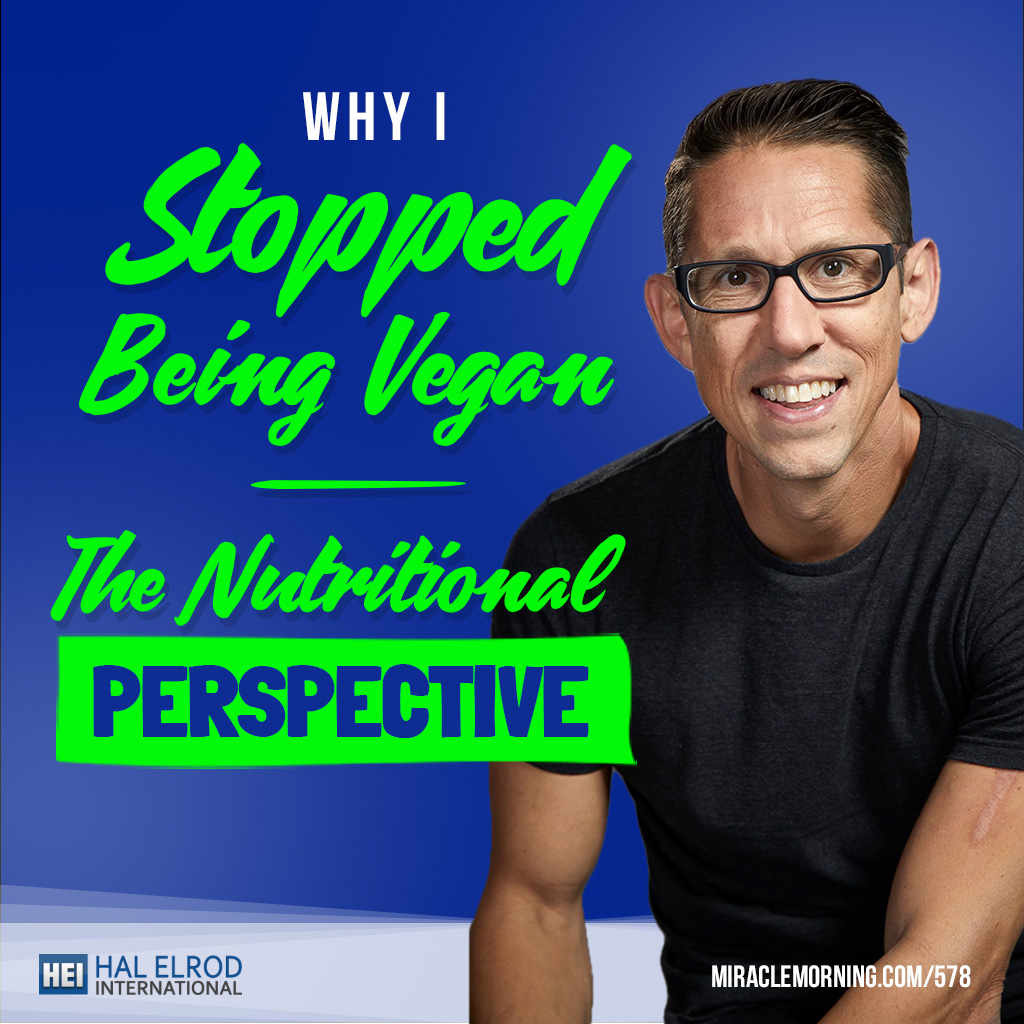
Achieve Your Goals with Hal Elrod
578: Why I Stopped Being Vegan - The Nutritional Perspective
00:23:36
For over a decade, I ate a "mostly" organic vegan diet and believed that I was fueling my body with the most nutritious food available. I say mostly because I didn't believe in inconveniencing people to accommodate my dietary preferences, so I was...
Loading summary
Transcript3 lines
- [00:02]
A
Hello and welcome to the achieve your goals podcast, the show that empowers you to wake up to your full potential and achieve your biggest goals and dreams. I am your host, Hal Elrod and I invite you to join us each week as we share actionable strategies to take your life to the next level, as well as interview world class experts and entrepreneurs who have achieved extraordinary goals themselves. And we ask them to give you a peek behind the curtain and teach you exactly what you need to do to do the same. Ready? Here we go. Hello, my friend. Welcome back to the podcast. Today I want to share something deeply personal and perhaps a little controversial with you, depending on where you stand on this topic. And it's why I stopped being vegan after roughly 16 years of identifying as vegan and eating accordingly. And if you're vegan, by the way, if you are a vegan today, like, keep listening, this is not going to be me trying to change your mind or anything like that. I just want to share with you my journey, my story, and most importantly, what. What I learned about the limitations of a vegan diet. Now, I became vegan originally in 1999. At the end of 99 in December, I went to UPW unleash the power within with Tony Robbins. And he sold me. I mean, he didn't sell me, but he sold me on the concept of, hey, fruits and vegetables, you should eat a vegan diet. And I was all in. And in the beginning, at first I felt amazing. I had more energy, I felt lighter, and I had a real sense of purpose, knowing I was aligning my diet with my values and. But after I was diagnosed with cancer, I started questioning everything I thought I knew about nutrition and I started digging in deeper. Not to mention I was running tests. I had never run blood tests the way I don't think ever I had had all of my markers tested until I had cancer. And one thing that coming up was vitamin B12 and the deficiency. So when I dug in, I realized, wait a minute, this vital nutrient is missing from a vegan diet. Vitamin B12 is missing from a vegan diet. It only comes naturally from animal sources. And it occurred to me, if a vegan diet is what nature or God, depending on your perspective, intended for human beings, why would it be missing a vital nutrient like B12, that one little tiny nutrient? And that fact completely shifted my paradigm and like, got me questioning everything. Now, what I'm going to share today, this isn't just my story. I want to use this episode to share what I learned about the limitations of a vegan diet. Like I said earlier, the role of essential nutrients like B12 and other nutrients and even what our human history reveals about eating meat. And again, my goal isn't to convince anyone to change their diet, but to encourage open mindedness and curiosity. And like I said, I still eat a majority vegan organic plant based diet, but I eat meat every single day. And I'm going to tell you why I do that. Before we dive in, I have a question for you. Have you ever wished you could wake up every day with more energy, clarity and focus? What if you had a personal guide to help you stick to your Miracle Morning routine and transform your life one morning at a time? I think you know where I'm going with this. Now you do. Introducing the Miracle Morning App and specifically the Premium Plus Subscription. It's designed to help you master your mornings and elevate your life. This app is like having a dedicated coach to guide you through your Miracle Morning journey. With features like hundreds of guided meditations, customizable affirmations, visualization prompts and space for journaling plus live events with yours truly, the app makes practicing the savior simple, effective and fun. And with the Premium plus subscription, not only do you get all the features, the live events, you also get to share all of that with any one person in your life at no additional charge. So it's the ultimate accountability partner to stay consistent, track your progress and achieve your goals. Whether that's improving your health, relationships, finances or mindset, there are unique journeys in each area of your life in the app and you can join tens of thousands of users who are already transforming their lives with the Miracle Morning App. Premium Plus Subscription. Now it is your turn because as you know, how you start your day impacts and can even determine the quality of your life. So download the Miracle Morning App today and you can try the Premium plus subscription for seven days with no risk and take your Miracle Mornings to the next level. All right, let's talk about this. I'm going to start with the nutrient that really shook my faith in a vegan diet. Vitamin B12. I mentioned this in the opening. Now this vitamin is crucial for so many functions in our body. Red blood cell formation, brain health, and even DNA synthesis. You may notice if you do buy a vitamin B12 supplement or an energy supplement. Almost every supplement designed to increase your energy has vitamin B12 in it, usually in high doses. But here's the kicker. B12 is only naturally found in animal products, meat, fish, eggs, dairy. That's it. Now sure, vegans can take Supplements or rely on fortified foods. But here's what made me pause. If a diet that excludes animal products was truly natural for humans, wouldn't B12 be readily available from plant sources? To me, it felt like a sign from nature or God, depending on your perspective. That was mine. Like that maybe humans aren't designed to live without animal products. So I started taking supplements, but they didn't seem to be enough. My blood tests were showing that I was still deficient, which explained my constant fatigue and brain fog. And so as I was questioning whether a vegan diet was truly sustainable for my health, I realized there I googled, like, what other nutrients are absent or harder to get in a vegan diet? And here are a few of them. Number one, iron. Now, plant based iron is what's known as non heme iron. You can get it from lentils or spinach. But here's the problem. Non heme iron is harder for the body to absorb compared to heme iron which is found in meat. So all iron sources are not created equal. Second nutrient is protein and amino acids. And of course, as a vegan, I used to always argue with my friends that were meat eaters, like, oh, you need more protein. I'm like, I can get plenty of protein. I get protein from the nuts I eat and broccoli's got a lot of protein. Now, while plant proteins are great, they are often incomplete, meaning they don't contain all nine essential amino acids. And again, pause for me. I paused and I considered, well, wait a minute. If plant protein isn't complete, if it doesn't contain all nine essential amino acids, then how can that be the diet that nature or God intended for human beings? If whatever diet was intended for humans, I thought it would have everything that you need. You'd have all your vitamins, all your amino acids, all nutrients would be contained in a plant based diet. Third nutritional challenge with a plant based diet is vitamin K2 and creatine. Now these are nutrients that are largely absent in plant based diets, but play crucial roles in bone health, energy production and brain function. So these gaps made me realize how much effort and supplementation it takes to thrive on a vegan diet. And even then, the results aren't guaranteed. So for me, it was unsustainable. And it was this realization, like, I try to live my life, everything that I do, I try to do in alignment with nature what God intended. And to this day, I try not to eat anything that is synthetic or manufactured. And now I'm sure I'm not 100% on that. I'm probably 90% or 95. I don't know. Right. But like even the supplements that I take. Give an example. The supplements that I take, the majority of supplements. If you're taking vitamin C in supplement form, you may know what it comes from. It's ascorbic acid. Ascorbic acid is a man made synthetic form of vitamin C. It is not found in nature as ascorbic acid. So I don't buy from supplement companies that use ascorbic acid for vitamin C. As soon as I see ascorbic acid, I go, oh, I don't trust the supplement company. They're not using nature to deliver the vitamins and minerals that are on their labels. They are synthesizing those vitamins and minerals in a laboratory. Therefore they. That is not what nature intended. That is not what God intended. From my perspective. I'm not trying to preach, I'm just telling you where I'm coming from. And so you might wonder, well, where do you get your vitamin C from then? For me it's acerola cherries, camu camu berries, oranges. Right. But they're acerola cherries and camu camu berries. I believe those are two of the highest concentrations of vitamin C. So I get my vitamin C right now. The supplement I take is from Mother Nature Organics. You can go to mothernatureorganics.com or find them on Amazon and they're not a sponsor of mine, but this is where I get my vitamin C and it's their camu camu berry product. I think it's something like 1000 milligrams of vitamin C in a couple of capsules. Don't quote me on that, I'm just going off memory. But the point is it's from nature. They take camu camu berries, then they dehydrate them, they then they simply grind them into a powder and they put them in a capsule. They don't synthesize them in a lab to create an artificial form of vitamin C. So it's looking at nature and where the sources of these nutrients that our body needs, where did they come from? Goal achievers and members of the Miracle Morning community. I just wanted to remind you or invite you to check out the Miracle Morning routine app in the App Store and the Google Play Store. It is free to download and comes with a robust assortment of features including templates to create your affirmations, a built in journal, customizable timers for your savers, the Sabers 101 guided track where you complete your miracle morning in 13 minutes by simply hitting play a miracle evening guided track to help you go to bed at night and a lot more. And then you always have the option to upgrade to the premium version, our most popular version of the app, which you can try for a seven day free trial. And it gives you access to over 500 affirmations, a library of nearly 200 guided savers tracks so that you can click, play and complete your savers in different areas of your life. You want to improve your mental health, you want to improve a relationship, you want to make more money. There are specific savers tracks, guided or designed, I should say, for each of those outcomes that you want to achieve. So you can again literally click play and complete your miracle morning. Plus over 200 journaling prompts and a lot more. And the app now has over 2,900 reviews averaging 4.9 out of 5 stars. You can download the app now in the App Store or Google Play for Android users. Either way, I hope the app enhances your mornings and your life and One of the most compelling things I learned during this journey was about humanity's history with eating meat. So as I researched, I came across fascinating insights about how our ancestors ate and evolved. Now I've heard the argument, well, we've evolved beyond our ancestors so we don't need what they need. But listen, humans have been omnivores for millions of years, meaning they consumed both plants and and animals. Early humans hunted and scavenged for meat and this shift to a higher protein, nutrient dense diet like likely played a significant role in our brain development. In fact, anthropologists even credit the inclusion of meat in our diets for the rapid growth of the human brain over evolutionary time. So meat isn't just protein, it is a package of essential nutrients like B12, like heme, iron, iron in the heme form, zinc and omega 3s. So for early humans, these nutrients were critical for survival, especially during harsh winters when plant foods were scarce. Again, think about that in the winter when all of the plants are scarce, are frozen, aren't growing, what did nature or God intend for for humans to eat? And again, this is just the questions I was asking myself. Again, it was asking if eating meat was so integral to human survival and evolution, why are we now so quick to dismiss it as unnatural or unnecessary? And that's potentially because we have supplements. So you can say it's okay, you can be vegan because you can just take supplements now. By the way, let me pause. I mentioned this is A controversial topic because like my sister is, you know, she is vegan and she does it because she does not want to hurt animals, period. I respect that 100%. I believe everyone should live their life according to what they feel is right for them, as long as it's not harmful to anyone else. Right. But again, it's that questioning of, well, what is natural for our body. And I will say this in terms of the ethical aspect. Modern factory farming is horrific. It's horrific. So you have to think about the act of consuming animal products itself is deeply ingrained in what it means to be human and our evolution. Right. Just because we can supplement it with other fortified foods and artificial vitamins, minerals, doesn't mean we should. Right. But I think it's an important thing to consider is getting ethically sourced meat. So whether that means grass fed beef. Personally, my wife and I buy a cow at a time and we usually split it with our in laws. So we know the farmers or the farmer, we know her, we've been to her farm, we've met her cows, we've seen how she takes care of them. And it's not factory farming. Right. It's the most humane way of farming and that's who we buy our meat from. So we buy a cow from her and then she gets all the different cuts and we freeze it and then when that's gone, we get another cow. So we know where our meat is coming from. Now I don't know that everyone, we live in Texas and so that might be a luxury for us, but I do believe that the ethics of part of why I became vegan still stand. For me, I'm not okay with modern factory farming. So it's still important for me to live in alignment with those values. So what led to my decision to transition and it wasn't instantaneous, right? I start learning this, learning these different nutrients that were missing. But it was hard to shift my identity. So after years of being vegan, though, I decided to listen to my body and I started adding small amounts of animal products back into my diet. Eggs were first, by the way. That was like the first one, then it was fish and eventually some meat. Now almost immediately I noticed a difference. My energy came back, my brain fog lifted, I felt stronger. And that is why recently I started eating steak and eggs for breakfast and I replaced my morning smoothie with steak and eggs, as I said earlier. And I spread the smoothie throughout the day. And this wasn't an easy decision. I actually wrestled with guilt and felt like it was Betraying my values initially. But I've come to believe that it's okay to change our minds and evolve. And health is not one size fits all. For some people, veganism may work beautifully. For others like me, it's a blend of eating a largely vegan diet throughout the day. So I used to be vegan by day, paleo by night. I had an organic smoothie for breakfast, a big organic salad with nuts and seeds for lunch, and then meat for dinner. And now, as I mentioned, it's steak and eggs for breakfast. It is a vegan smoothie spread throughout the day, it is a vegan salad at lunch, and it is meat and vegetables in the evening. So I'd say I'm 50. 50, right? 50% of vegan diet. 50%. A diet that includes animal products. And one thing I wanted to include is I do not drink milk. I still to this day, again, I look at what nature intended, and I do not believe nature intended for human beings to drink the milk of another animal. I can't get there. Again, it's just, to me, what does nature intend? What does common sense tell me? I once heard a comedian say, man, I bet the first guy that drank cow's milk did a lot of other weird stuff before that. That, right? You know, because you think about it like somebody was like, why don't we drink the milk from that cow? And it's like, I'm pretty sure nature would tell me that we drink milk from our human mother. And when we're weaned off of drinking milk from our human mother, that would tell me that that's probably time to move on and not drink milk anymore, as opposed to go steal it from another animal. Anyway, that's just my thoughts. That's my personal feelings, beliefs, perspective, take it for what it's worth. But I do not drink milk. By the way, I have an almond milk maker. It's called Almond Cow, if you want to go check that out. Almondcow.com Probably, I don't know, but it's like a little, kind of like a blender device, but it's made specifically where you fill it up with the right amount of water. Then you put in your almonds and you fill those up in this little container, this little basket, and then if you want to add anything, like sea salt, a little maple syrup, which I do, and some organic vanilla extract, you add all your little ingredients, you hit a button, and it makes perfect homemade almond milk. So that is what I do. If I want some form of milk for a recipe or for cereal or whatever. I don't do it as often anymore. I used to do that all the time, make almond milk on the regular. Now I just don't use it very much anymore. As far as cheese goes, I rarely have cheese. But I'm not opposed. Like, I'm also not this all or nothing mentality for anything. Like, even when I was vegan, I don't think I ate much meat. But I'm sure occasionally, like, oh, that was it. I remember now the only time I'd ate meat is if I went to someone's house and they were serving meat. Now, if I could eat a vegan diet around, not eat the meat, that was fine. But if my mom made a roast or something and she'd usually cater to me. But here's the point. For me, it doesn't have to be all or nothing. I just value the experience of eating something that my mother or someone else made with love and giving them that satisfaction of, hey, I'm going to eat the thing you made me and I'm going to enjoy it and I'm going to appreciate it and I'm going to experience the love that you put into making this food, right? So that was my take. Even when I was vegan, I'd eat stuff that my mom made that wasn't vegan, right? So, but it was, I mean, it was a few times a year I would veer off the vegan path, right? All right, so let me wrap up with some lessons learned, right? Here are some takeaways from my personal experience. Again, this is not me telling you what to do. Like my sister, I don't try to change her mind. She's vegan and she doesn't want to hurt animals. And I'm all for that, right? I will say, this part of going back to what does nature intend, I look at. Well, in nature, animals kill other animals to eat their body, right? Or to eat their flesh and to sustain their lives, right? Like, so I look at, in nature, animals eat animals. So that is how, whether it is God or nature, that's how it was intended. I'm not saying all animals, there are some herbivores that don't eat any meat, right? But in general, like, that is a big part of nature. Like, you think about it, nature isn't vegan, right? Nature isn't vegan. You look at if you saw an animal that was eating another animal, you're like, how could you do that? Why aren't you vegan? There's plenty of plants and berries around why didn't you eat those? So again, just looking at nature, nature isn't vegan. But number one, listen to your body. Your body is constantly sending you signals. So go get tested. If something feels off, like don't ignore it, go get tested, get some blood tests, get a full body panel, get an executive physical, check your iron levels, check your vitamin B12 levels, check all of your nutrients and listen to your body. And this actually really could be a separate point. But don't let ideology override your health. I realized that clinging to the labels of veganism, which for me was like a badge of honor for 16 years, right? But it wasn't worth compromising my wellbeing, me being deficient in these nutrients that were available in meat, right? That was more important than clinging to the label and the identity of being vegan. Another thing is balance is key. Like I said, today I focus on eating sustainably sourced animal products and continue to incorporate plenty of plant based foods into my diet. It is not about extremes, it is about balance. And the last thing I'll say is respect others choices. I have a deep respect for those who choose to be vegan. Like my sister. This is my personal journey and I am not here to judge or convince anyone otherwise. So if you are vegan and thriving, that is amazing and more power to you. Keep going. But if you've been struggling with your any sort of physical feedback, I encourage you to explore what your body might be telling you. So try running some tests or consulting with a nutritionist and you might be surprised at what you learn. All right. Thank you for listening and for being open to hearing my story. Open minded. I would love to hear your thoughts. Reply to the Email if you're on my email list that received or that sent you this podcast, have you experienced challenges with your diet? What's worked for you? Reach out to me on social media or email. I'd love to connect. And as always, if you enjoy this episode or if it upset you, I'm sorry, please share it with someone who might find it valuable. And don't forget to subscribe to the podcast for more conversations about health, growth and living your best life. Thank you for tuning in. I love you so much and I will see you next time.
- [23:06]
B
Thanks for listening. To learn more about the Achieve youe Goals podcast and to get access today's show notes, transcript and exclusive content from hal Elrod, visit Halelrod.com podcast thanks again for joining us. Be sure to tune in next week for another episode of the Achieve your Goals podcast.
- [23:22]
A
Cast.