← Achieve Your Goals with Hal Elrod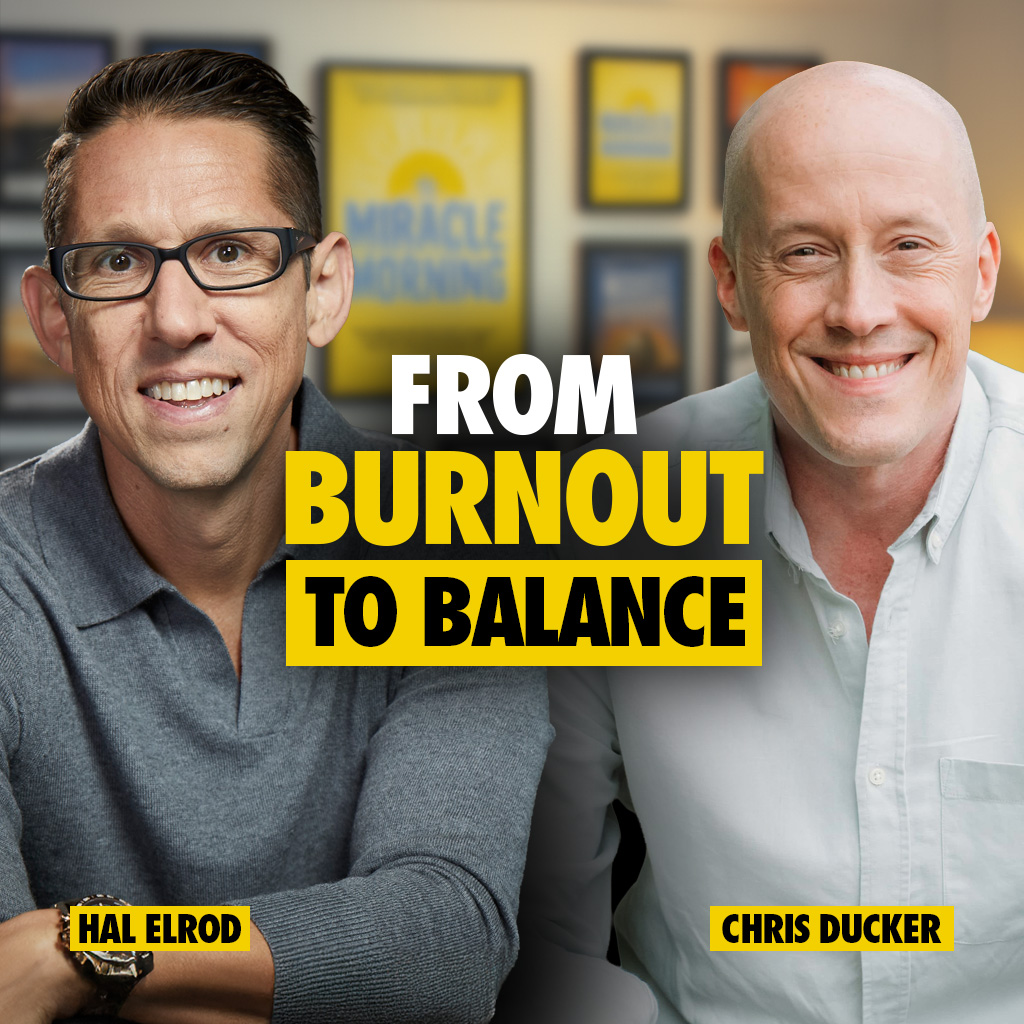
Achieve Your Goals with Hal Elrod
602: How to Go From Burnout to Balance with Chris Ducker
00:37:24
If you’ve ever felt burned out, stretched too thin, or guilty for even thinking about taking time off—you’re not alone. I’ve been there too. That’s why today’s conversation with my good friend Chris Ducker hit so hard. Chris is a wildly...
Loading summary
Transcript59 lines
- [00:02]
A
Hello and welcome to the Achieve your Goals podcast, the show that empowers you to wake up to your full potential and achieve your biggest goals and dreams. I am your host, Hal Elrod and I invite you to join us each week as we share actionable strategies to take your life to the next level, as well as interview world class experts and entrepreneurs who have achieved extraordinary goals themselves. And we ask them to give you a peek behind the curtain and teach you exactly what you need to do to do the same. Ready? Here we go. Foreign welcome to the Achieve youe Goals podcast. I am your host, Hal Elrod and today we're talking with my good friend of 10 plus years, Mr. Chris Ducker. He's the author of the new book the Long Haul Leader. Although he'll tell you in a minute why. I told him he should have called the book something else, but the subtitle 10 Strategies to Work smarter, live better and achieve lasting success. I told him that he should have called the book what we're calling the podcast episode today from Burnout to Balance. Because this book, I feel like is what I need in my life right now. If you're feeling overwhelmed, overworked, stretched thin, this book will help you prioritize your life and take action. I've already changed my behavior just in the last week since I started reading this book to align my priorities with what really matters most so that I don't head toward the path of burnout, which I've been there before. Maybe you have too. Today Chris is going to give you not just talk about the book and what you can read in the book. He's going to give you the meat today. He's going to teach you the life operating system, four key areas of your life to go from burnout to balance. He's going to teach you the Start, Stop, Stay exercise that you can walk through today and we're going to discuss it and I'll tell you how I applied it immediately so you can apply it to your life to go from burnout to balance. So again, if you're feeling overwhelmed, overworked, stretched thin, today's episode will really be be transformative for you, my good friend, author of the Long haul leader, or what I would have called burnout to balance. Mr. Chris Tucker. Chris Ducker. It is good to see you, man.
- [02:13]
B
It's good to be seen.
- [02:14]
A
It's been like a week, right? I mean I was with you a week ago and you reminded me. I didn't even know you're like Hal. We've been friends for 10 years, which is wild.
- [02:22]
B
Yeah, Actually, I think it's closer to 11, but in terms of, like, speaking.
- [02:26]
A
And all that, we can say over a decade. So. All right, before we unpack our bromance public, you wrote this new book, the Long Haul Leader. I'm holding it up right now.
- [02:34]
B
Yes.
- [02:34]
A
And I text you, I said, hey, Chris. I didn't even realize. I didn't fully understand what it was about from the title. And as I started reading it, within the first chapter or the introduction, I text you, I said, chris, this is exactly the book I need in my life right now.
- [02:47]
B
Yes, you did.
- [02:48]
A
And I said, it's called the Long Haul Leader. I said, it feels to me like going from burned out or from burnout to balance.
- [02:56]
B
Yeah.
- [02:57]
A
I think it's going to resonate with 90% of the population. If you feel burned out, if you feel like your capacity is being stretched to the max, not just at work, but, like, you know, for me, it's between work and then trying to be an amazing father and feeling dad guilt, feeling guilty at work. I want to ask you this. What would you say to somebody who feels burned out like I do, yet simultaneously they feel guilty about taking time off of work?
- [03:23]
B
I would say that you do not have to break in order to justify taking a break. That's what I would say.
- [03:31]
A
You don't have to break in order to justify taking a break. And that's a lot of times people don't take a break until they break. Right? Until it's too late. Like, for me, I got cancer because I broke. It was like, oh, you're not going to take a break, Hal. We'll break you. And you're now forced to take a break. And I think your book's going to save people from that. I know in the book you talk about you were burned out, you were overworked, you're an extremely successful business person, an entrepreneur, an author, et cetera. Why did you write this book? What was the journey for you that led you to realize this was a problem that many of us are facing. Burned out, overworked, unfulfilled, not balanced. And how can we change that?
- [04:11]
B
Well, here's the thing. Like 2021, we had an amazing year for our business. We made an absolute ton of money. We are ultimately, @upreneur.com we are an education business. Right. So we had always had a certain amount of digital offerings online for people to be able to download and access and all that kind of stuff. But a lot of what we were doing prior to the pandemic was in person. Large events, masterminds, master classes, workshop days, all that kind of stuff. And obviously because of the pandemic, we needed to pivot. We needed to pivot online. And that opened up a massive global market to us. And we had hundreds and hundreds and hundreds of people signing up for our programs that never would have signed up for them if we were still doing them in person in the uk, in the US and Canada and Australia and other places around the world. And so in 2021, we were crushing it, man. I mean, like, as a business, we were having an amazing year. I, however, was a little bit of a broken up mess. It wasn't as if I wasn't enjoying what I was doing. I was. But I know now, looking back on it retrospectively, that I was doing too much of it all at once in too many different ways, for too many different reasons, in too many different directions. And that's where the burnout came from. And it was a really bad burnout. Like, I was diagnosed with acute anxiety and depression. I was put on an SSRI or an antidepressant for a year of which I told absolutely nobody other than my wife about, because I was shameful of the fact that I was on this antidepressant medication. And the really big one was that I was diagnosed with phase three adrenal failure. Now, your adrenal glands sit on top of your kidneys and they're the things that create cortisol. Cortisol is your stress hormone. And so normal, quote, unquote, normal adrenals will kind of kick off with a really nice high cortisol level in the morning. And then slowly but surely over the course of the day, that cortisol level drops. And that's when your body starts creating melatonin, which helps you kind of wind down and go to sleep at night. I, at phase three, was completely flatlined on my cortisol. I was not creating any cortisol in any way, shape or form at any point during the day or night. And so what that basically meant was that I was in a total state of fatigue, both physically and mentally. Like, I was having problems with like, memory recall and we're all getting old and everything. Like, I get this, like, we all, we all forget things every now and then. But, like, by 11:00 o'clock in the morning, I was pretty much no good to anybody for anything, let alone a room full of people that were paying me quite royally to be able to learn how to build their businesses from me, right? And so that led a massive. Much like your cancer situation led you on a journey of self discovery and understanding the importance of nutrition and meditation and prayer and health and all this kind of stuff. And it's not that I didn't know all of that was important, and it wasn't that I was eating particularly bad diet or getting really horrible sleep or anything like that, but I just wasn't doing enough of all those things in order to be at my best. Best across the board. And the fact of the matter is, is that your business requires for you as an entrepreneur, your business requires for you to be at your best in order to serve the people. And if you're not an entrepreneur and you're just building a career and you're working for a great company and everything, that's cool too. But for you to really thrive in the position that you have within the company that you're serving as an employee, you also need to be at your best every day. And I certainly was not at my best. And when I started talking to my other friends, I realized actually there was a whole bunch of us that were not at our best for one reason or another. And that prompted the book to be written.
- [08:11]
A
Yeah. And whether you're an entrepreneur, an employee, or a human being. Right.
- [08:16]
B
Theory.
- [08:16]
A
Right.
- [08:17]
B
Yeah.
- [08:17]
A
Like, for me, it's like if I'm not at my best for my family, if I'm exhausted in the evening or throughout the day when I'm with my kids, it's like I can't show up as the father that I want to be, nor the entrepreneur, nor the husband. You name it.
- [08:30]
B
Absolutely. Yeah.
- [08:31]
A
I felt good when I read this in the beginning of the book. When I think about, man, I'm burned out, I'm overworked, I'm overwhelmed. When that's my narrative, that's my story that I'm telling myself, it doesn't feel good. I feel threatened. Right. Like I'm, oh, my gosh. Or like I'm making a mistake. Maybe it's. I'm feeling like I'm shaming myself. And what I like that you said it was you framed that burnout is a warning sign. Right. So you said it's not a badge of honor, nor is it the end of the world. It's literally like, hey, it's a warning sign. Now it's time to make changes. What I love is I'm. As I'm reading the book, I think that's when I text you, I'm like, oh, this is exactly what I need is you're helping me be self aware that I'm headed on a path of burnout and that I need to make changes now before it's too late. Which again, when cancer got me, before it was almost too late. And so you developed what you call the Life OS framework. Yeah, I'd like to start there. What is the Life OS framework? Why is it essential for people to implement.
- [09:27]
B
Yeah. So the Life OS stands for Life operating system. And the reason why I picked this particular terminology was because if you think about it, your laptop has an os, your phone has an os, your computer has an OS or an operating system. Yeah. Why don't you have one for yourself? Right. And so at first, funnily enough, there was only three main parts to this Life OS framework. There's four in the book, but at first there was only three. And those three were work, ultimately yourself and relationships. Now they morphed slightly and we ended up calling them impactful Work, Love and Relationships, and personal mastery. Right. But as I started to get deeper into the writing of the book and particularly the research of the book and finding out, like, who's doing it right, like who's really living life right across all aspects of their life, their career, their relationships, their goals, their personal goals, their health, all that kind of stuff. And actually, hobbies came up way more often than I anticipated. It came well out of left field. And then I started to think about some of the things that I'd done personally in the last five, six years of recovering from this burnout. And I realized actually some of my hobbies had become super central to everything that I do day to day, like getting out into nature. I become a wildlife photographer, particularly with birds, watercolors, bonsai, you know, I sit and I have about 40 bonsai tree on my trees on my property now. So, like, all these things that allow me to be able to completely switch off from day to day stresses and be extremely present in just doing what I want to do, what I call having a good time not being dictated by somebody else. You should do this. It's great. You should watch that movie. It's amazing. Read this book, It'll change your life. No, I want to clip away at little miniature trees. I want to paint, I want to go out with a massive 600 millimeter camera lens and take photos of blackbirds, leave me alone kind of thing. Right? So once I realized all this, we put that into the framework of long haul leader, Life Os. And every single person that has seen this has said to me, this is it, this is that icky guy moment where you say, this is the combination of these three or four really important things in our lives that a lot of the time we do take for granted and we shouldn't take for granted, particularly like our relationships and our health. For, for example, put that into a diagram that's simple enough for anybody to pick up and follow, and all of a sudden the pennies start to drop.
- [12:10]
A
If you struggle to fall asleep or stay asleep, I have a supplement that I take that I've taken for about three years now, virtually every single night. I highly recommend it. It's called Nightcaps by Cured Nutrition. It is a CBN and CBD oil supplement. And CBN supports your body's natural sleep rhythms throughout the night for deep restorative sleep that leaves you feeling refreshed and ready to rise in the morning. Highly recommended. I book in my days with Cured Nutrition. I take their flow gummies in the morning. I take nightcaps at night. And you can get 20% off of both of those products. As a listener of the Achieve your goals podcast, head over to curednutrition.com/hal. That's curednutrition.com/forward/hal and use the discount code HAL for 20% off your entire order. And if you do a subscription, which I do, a monthly subscription for both of those products, you get an additional 20% off that stacks on top of the 20% as a listener, so you can save a bunch of money and it'll help you fall asleep and stay asleep again. Cured Nutrition Nightcaps in the evening. And I start my day with flow gummies every single morning. And I hope these products will help you and enhance your life as they have for mine. Enjoy the rest of the episode. I love that. And I love that you added hobbies, because that one actually, that was the one that I go, I don't even think about my hobbies, right? Like, oh, because I don't really have any or not, you know, but it's like, I love playing basketball and I can trace back, oh yeah, when I was playing basketball, which I had a wrist injury last year and so I stopped and I like, forgot about it. And I go, oh, wait a minute, my wrist is healed now. Why don't I like that lit me up and I would go every day or a few days a week. And anyway, so no, I love that you added the hobbies. P. I think my wife and you know, my wife gardens and she talks about that when she's on our land and she's in the garden. It is her church. We go to church on Sunday. But, like, that is her spiritual connection. She's like, I just pray. I'm just totally present to the moment, to nature. All of the worries of the world slip away. And because she's out there every single day, twice a day, right? It's like almost bookending, where in the morning she's watering the garden and she's at peace and she's connected and she's present and then in the evening. And I could learn something from her because I don't know that I'm as tuned in with my hobbies. But as you know, I told you before we started, I'm on page 63 of the book after reading it a few days ago, and I'm just excited. What I love, too, is that your life os, it's four components. It's not 10. And what I think about is, I always think about the wheel of life, right, where you're measuring like 10 areas of your life. And I've used that. It's a great tool, but it's really overwhelming. It's like, okay, so I've got to set it goals in 10 areas of my life. And I love the simplicity of like, no, no, these are the four big areas. Your work, your personal mastery, your relationships, and then your hobbies. The joy, the things you're doing every day. Not because you have to, like you said, not because somebody else told you to, but because these bring you joy. I love it. I love life Os.
- [15:18]
B
It's so funny. You bring up the wheel of life. I remember, gosh, probably six or seven years ago now, I did that exercise with some coaching clients of mine and I thought it was pretty simple. We printed a copy out for everyone.
- [15:35]
A
Yeah.
- [15:35]
B
And you know, business, career, finances, health, family, romance, you know, all this kind of stuff. And I thought to myself, it's pretty simple. Like, you should be able to mark up where you're at, and then we're going to see where the deficiencies are and where you're strong and all this kind of stuff, people in the room are like, I don't get it. Like, there's too much going on here. Like, so the fact that you've got called it that out quite specifically, and the fact that there are only four aspects of the life os, I think that kind of like validates to me that it was a good idea to go with 4, not 10, not 5, not 12 or anything like that. But what I really like about this, if you look at it properly, just as a very simple diagram that it is. I love the fact that when we overlap these four main parts of this framework, little nuggets are almost kind of presented to you where you understand that through personal mastery and hobbies, where that overlaps, like time comes into play. Like, how are we spending our time both on ourself and on the things that we enjoy doing? Like, so are we continuing to learn so we can continue to lead people and serve people and be useful to people, but at the same time, are we taking away time to be able to go and walk in a forest for an hour, two, three times a week? Because we know that's also good for us. And, you know, likewise, where love and relationships overlap with, say, something like impactful work that creates freedom. And that freedom is all about showing how the meaningful work that we do enables personal freedom and strengthens those relationships as well. So when you start kind of looking at this a little deeper, you realize, yeah, there's a little bit more to it than just four main subjects here. But it's so simple to understand and so easy to consume and take on board that with a little bit of luck, God willing, people will be able to go ahead and start making some positive changes, you know?
- [17:27]
A
All right, let me ask you a question. How many apps are you using for your personal development? Maybe a meditation app like Calmer Headspace, an affirmation app like I Am, or Think Up, a book summary app like Blinkist, a journaling app like 5 Minute Journal, a visualization app like Envision, an exercise app like 7 Minute Workout, and maybe even a habit tracking app to keep it all together. That is a lot to manage and a lot to pay for. What if you could replace all of them with just one app? Yes, it is called the Miracle Morning app and it is essentially seven apps in one. Hundreds of guided meditations and breathwork tracks, A full library of affirmations, plus tools to create your own visualization prompts for 10 key areas of your life. Guided workouts from 2 to 10 minutes long, book and audiobook summaries of top personal and professional development books, and a journaling tool with guided prompts. The wheel of life or a blank page to write freely. It simplifies your morning, saves you money and helps you start every day with clarity, purpose and energy. And it's one of the only apps in this space with a 4.9 out of 5 star rating. Try it free for 7 days. Just search Miracle Morning in your App Store or go to miracle morning app.com to get started. All right, back to the show the awareness brings accountability again for me. Now I'm already going, okay, where am I going to start integrating hobbies into my life?
- [18:52]
B
Yeah.
- [18:53]
A
In fact, and then based on the relationship piece, my wife and I just this morning decided that every Wednesday we're going to take our kids to school together, which we did this morning. And then we're going to go out to coffee and just reconnect like a one on one morning date. So, yeah, your book is already like, it's shifting my behavior, which is what actually matters.
- [19:11]
B
I love that.
- [19:12]
A
So you make a powerful distinction in the book between hustle and habits. And I think we're coming off of the hustle culture. I think that for, you know, it's probably still some folks push the hustle culture, but I think that a lot of us are waking up to, oh, that is what leads to burnout. Like, if you buy into the myth of like, oh, just hustle, hustle, hustle, you eventually do get burned out. So again, you make this distinction between hustle and habits. And so how does someone in your book to be called a long haul leader? How does a long haul leader balance ambition with sustainability?
- [19:42]
B
Yeah, I mean, it's clear that hustle culture has wormed its way into pretty much everybody's lives in some way, shape or form. Whether we're kind of scrolling through social and we're kind of punched in the face by somebody with, you got to work harder, hustle harder, put in more hours, it's clear that we've got there and actually hustle in and amongst itself. And what that means, work hard, go after something that you believe in, that in and amongst itself is not a bad word. It's just when it starts to overtake and everything and it becomes your lifestyle, then that's where the problem is. Hustle is a season, it's not a lifestyle. It's got a very, very kind of finite and clear beginning and end. It's a three month project at work. It's a two week planning session before a six week RV trip over the country. Like, there's a finite beginning and end to that hustle season. Once it's done though, you've got to be able to pull back and recalibrate and recharge and reset a little bit. So our plan here is to understand that or the goal really is to understand that it's not about hustling harder, it's about lasting longer. It's about getting to the point where we build a career, a business, a life, a legacy, whatever label you want to put on it that doesn't break you over time and where you very clearly accept and bring on board the fact that it might hustle, might help you get to a certain point, but it will ultimately come to the point where you have to draw a line in the sand. And it's habits at that point that help you last and that habits like making sure that you take time for self care. Because self care is not selfish. It's a strategy and it's one that everybody can jump on board. It's things like getting a really good night's solid sleep. It's about fueling your body with the right food. I love your analogy where you say something to the effect of, and please correct me if I'm paraphrasing horribly wrongly, but you say things like, if it doesn't walk on the ground, grow out of the ground, or swim on the sea, I'm not putting it in my body or something to that effect. Right? Like, yeah, there are certain things that we know are the right things that we should do, but society and everything from complacency comes into play and we, we just don't do these things. Like, we know we need seven, eight hours of sleep every night. We know that. But we consistently stay up watching late Netflix too late or waking up too early or whatever the case may be. Right. So I do feel that ultimately our habits can make or break us. I know you're a big habit lover. I am as well. I haven't always been. And you know, from when we did first become buddies, I said to you, what's this miracle morning malarkey that you keep talking about this, this nonsense of getting up at four in the morning or whatever it was, and reading books and talking to yourself in the dark and all this kind of stuff. Like, I didn't get it at the time, now I get it now. I get the power of those habits, those savers that you always talk about.
- [22:44]
A
Yeah, I love that, man.
- [22:45]
B
It took me 10 years to admit it, brother, but we're there finally.
- [22:51]
A
Unless you're slow learners, Chris is nothing to be ashamed of, buddy. If somebody feels like they are overwhelmed, like being pulled in so many directions, how can they, number one, identify what really matters and how can they execute it? How can they follow through with it? I guess it's almost like a time management question, right? Like I've got my calendar in the background and it's like I feel like I've over committed, right? So if somebody feels over committed, like, is it chipping away one day At a time. Is it starting by looking at the life OS in these four quadrants and going, what do I really want? In fact, I will say that early on in the book you asked three questions. What do you really want? What are you willing to give up to get it? And what are your non negotiables? And those questions alone, I emailed our chief growth officer and I was like, hey, if I'm being honest with myself and you about this, I sent him this, really this email and I just said, I'm reading this book Long haul leader and I said, I just answered these three questions in my journal. Here are my answers. These are not in alignment with some of this one particular initiative that we're taking on. I'm like, if I'm honest, I don't really want to do it. I feel like I'm supposed to do it and I've committed to do it to you, but I feel anyway. So if somebody is like overcommitted, overwhelmed, like how do they actually prioritize what matters most?
- [24:12]
B
Yeah, I mean, you've got to ask yourself some pretty important questions, right? One of the exercises I talk about in the book is my stop, stay, start order.
- [24:20]
A
I just got to that. Yeah, yeah.
- [24:22]
B
Have you done it yet? Have you?
- [24:23]
A
No, I literally this morning I read it, I dog eared it and I will be doing it.
- [24:27]
B
Yes, but so yeah, let's run through it real quick. So it's a very simple exercise and I think one of the reasons why people don't do these types of exercises is because they come across as too simple. And I think, oh, it's pointless, I don't need to do that. What a pointless exercise that would be. But I can tell you right now, we do this as a company twice a year. We do this one exercise twice a year. I personally do this exercise not only from a business perspective, but from just a personal perspective. I probably do it quarterly. There's no like reminder on my calendar. But something will prompt me mentally where I'll be like, oh, I haven't done that for a while. Let me just check in real quick. And I've been doing this now for at least three or four years, right? So this is not pie in the sky stuff that I put just in the book just for the fun of it. So it's very simple. You get a piece of paper, you draw two lines down it and you create three columns and you write stop in the first column, stay in the middle column and then start, stop, say start. And in the first column you're going to write down all the things that you're currently doing that aren't working, that just aren't working for you. They're not working at work or a business, they're not working in your personal life, whatever it might be, relationships. It doesn't matter if you're consistently doing something or attempting to do something, and it's just not working out for you, you gotta stop doing that. Because the very definition of insanity is doing the same thing over and over and over again and expecting something different to happen, right? So that goes into that stop column. The second column, which is stay is all the stuff that you are doing that is working for you. You're relatively happy with it, right? So at work, for example, if you're running your own business and you're running Facebook ads, and those Facebook ads are bringing in a certain amount of leads which are converting to a certain amount of revenue every year or every month or every quarter or whenever you're looking at it, you're going to keep those Facebook ads running. In life, if waking up and doing the savers first thing in the morning from the miracle morning is working for you, they are going to stay in your life as well, right? But here's the thing. I want to challenge you and everybody else when it comes to this stay column a little bit, and that is that don't accept the fact that things are working well and that's the reason why they're staying. Look at what you can do to make a little micro move, as I call it, every now and then on some of these things in this second column where you just make 1% difference, one little tweak that might make all the difference. Because if you collect all of those little micro moves up, you've got a 9%, 10%, 15, 18% compound interest effect building here with all these different little things that you can do are actually going to make your life a lot more awesome. And we all want to live an awesome life. Plain simple. So that's the second column.
- [27:19]
A
And before you go on to the third column, Chris, I just, I want to comment on this. One frame or context that I would add here is this is a chance to also acknowledge yourself, right? I think that so much with when we're into self improvement or just the way we beat ourselves up, it's like, okay, I need to stop doing this because it's not good for my life. So I don't feel great about it or about myself because I'm doing it. I need to start, start doing this And I haven't done it forever and I know I should do it. And I. What if I fail? Right. Like, so it can be, like, really, like, challenging. But the stay is like, hey, what are you doing? Well, what should you acknowledge yourself for? You're doing that miracle. Right. I think that it's important, right. That we're not always just looking at self improvement, but self acknowledgment for the things we're doing. Well, I just wanted to add that context to the Stay column.
- [28:09]
B
Yeah. So, so true and understanding that, like, if you are, for example, if you are engaging in a hobby or a pastime and you're really enjoying it and like you say, you with your basketball, you got back to shooting hoops. Like, don't you dare feel guilty.
- [28:24]
A
Yeah.
- [28:24]
B
About the time that you spend shooting hoops. Don't you dare spend time. It's 30 minutes a few times each week. Yes, you could be in the garden with your wife. Yes, you could be working on your business and reading a book to your kids or whatever it is. But don't feel guilty about taking time out to work on you and enjoy things on your own. Like, want to point that out very, very quickly as it popped into my head. Yeah. So the third one, this is the cool one, man. This is the exciting one, the Start column. Right. So we've got stop, we've got stay, and now we've got start. So what can we start doing? Let's just have a very quick snapshot of what's just happened. We've created all this extra time by stopping all this stuff that doesn't work anymore. How many times do you hear somebody say, oh, there's never enough hours in the day? Oh, I wish I had more time. You know, there's not. I don't have enough time to do that. I don't have enough time to do this, to do that. And so you've created all this time by stopping a whole bunch of stuff that doesn't work for you anymore. Love that You've actually validated yourself in the Stay column by saying all this stuff that's working, going to stay. But here's the good thing. I don't have to reinvent the wheel. It's working great. I'm just going to keep going, baby. But in that third column, the start column, this is where you get to have fun. This is where you say to yourself, what have I been procrastinating on for a bit? What have I been pushing off for a while? Have I been thinking about writing a book for the last 12 years that I would say, I'll get to it one day. I'll get to it one day. But you never get to it. Like, start writing that book, right? Maybe you said to yourself, I'd love to be able to get to the point where I go away with each of my individual children for a long weekend once a year, start doing that. That's never going to turn out badly. So the start column allows you the freedom and I guess the permission slip to go ahead and stop procrastinating on things that you know, that you would enjoy, that you really want to try, that you really want to do, and it gives you the permission to go ahead and do it.
- [30:24]
A
I love the word permission because it's so interesting that reading a book like this, it's like, some of the things I read, and I'm like, oh, yeah, I should do that. Or even I know I should do that, or why haven't I done that? But when you read a book like this, like the long haul leader, it's giving me permission. Oh, do this exercise.
- [30:39]
B
Oh.
- [30:40]
A
Identify these four areas of your life, the life os and look at, where are you off track? And what do you want to add into your world? Like, it's amazing that just reading the book and doing the exercises like you said, that just really resonated with me. It's like, it's permission. Like, hey, stop living the life, like, on autopilot, right? And actually take time to identify, evaluate, reassess the life you're living and the life you want to be living. Like, those three questions, the fact that those three questions were in the book, that gave me permission to answer them, which then gave me permission to email my chief growth officer and be like, hey, this path that we were going down, we've got to stop it. We've got to make a radical change. And luckily, he's a good friend who loves me and we look out for each other. So he's like, all right, man, if. If you feel that way, then we gotta figure something else out.
- [31:31]
B
It's so cool because that message come through from you. And then I had a text message from another one of our mutual friends who said to me, I'm only in the introduction of the book, and I feel like you're punching me in the face. Which I thought was a great analogy, being able to say, I'm waking you up a little bit, right? Like, and I got these two messages from two friends I really respect, two super smart people. And I thought, you know what? Maybe I'm onto something with this thing. Like they're only at the beginning of the book and they feel like it's great. Either that or they need to stop reading immediately and give me a five star review on Amazon right now. One or the other. But here's the thing. There are certain parts in the book where you know that when you create a piece of work and there's certain parts of that work that you do, whether it be a keynote that you're presenting or presentation you're doing a work or a white paper you're writing, you get kind of like really jazzed about certain bits. They kind of like pop out at you. And there's one particular section of one particular chapter which I believe is chapter five off the top of my head, which is called upgrade your batteries. It's around about page 100 or so in the book. Something like that. And we talk about how long haul leaders, which is kind of what we're calling ourselves here.
- [32:41]
A
Yeah.
- [32:41]
B
They learn how to protect their energy in the right way. Now, I've been quoted a gazillion times from my first book, virtual Freedom, where I talk about the fact that time is our most valuable commodity. I am going to retract that statement, your honor, at this point in the proceedings. And I'm going to say, actually, I don't think that's true anymore. I think time's really important. Yeah. And we should try and buy as much of it and get as much of it and borrow as much of it as we possibly can. But I think energy is actually our most valuable commodity right now, regardless of what path we are on in life. Without energy, you're not going to show up in the best version of you. And so I love the idea of going out for walks on a daily basis without my phone, without a podcast playing in my ears and listening to birdsong and the rustling of the trees that when I come back, I have never felt worse off by going out for a walk in nature. I don't think anybody on the planet ever has. And if that's what fuels me, and I do it every day after lunch, if that's what fuels me to upgrade my batteries a little bit for the afternoon session of work, then you can bet your bottom dollar I'm going to do it every single day. It might not be your bag, but it's certainly my bag.
- [34:00]
A
Right.
- [34:00]
B
Maybe it's taking a nap. If that's the case, if that's what you need to do, upgrade your batteries that way. But there's certain Parts where I've just kind of not really quite animated about this because not only is it a message I'm feeling obviously very strongly about and very passionate about right now, but I know that when people take on board certain sections of this book and it's going to be different sections for different people, right? As we say here in England, different horses for different courses. But like, I know that when people take on board those sections of the books that really cool to them and they make the changes in their life because of what they've just read, I know they're going to be thankful for it for sure. Yeah.
- [34:38]
A
No, man, I am thankful for it. And if you're watching or listening right now, again, the book is the long haul leader 10 strategies to work Smarter, Live Better and Achieve Lasting Success. And if you don't identify as a leader, if that doesn't resonate as well, I don't know if I'm a leader. I'm retitling the book From Burnout to Balance. I told Chris before the podcast started that I go, I'm retitling the book today from Burnout to Balance. So, Chris, I'm assuming people can get the book wherever books are sold.
- [35:06]
B
Yes, they absolutely can.
- [35:08]
A
And what is the best way to tap into more Chris Ducker wisdom? Where can people find you?
- [35:13]
B
Well, I'm on social media, obviously, all over as hrisducker. I spend most time on Instagram personally myself. They can go ahead and visit@chrisducker.com as well for other bits and pieces. And I'm up to. But I will say when you pick up the book and you read it regardless of when, like, how's it page 63 right now. And here we are talking about it. He's giving me feedback about it right now. I want to know the first aha moment for you. What was it? Whether it's page 63, page 12 or page 280, like, I want to know what that first aha moment was for you. Please reach out to me on Instagram at Chris Ducker, send me a direct message. I will absolutely reply to you personally. And I would just love to be able to know what it was that, that kind of first catalyst moment for you was when you picked it up and started reading it.
- [36:06]
A
Awesome, man. Well, yeah, mine, like your other friend was in the introduction. It was like, oh, the path that I'm on is heading toward burnout. I need to make some changes. Thank God Chris gave me a copy of his book at the Author Mastermind when I saw him last week and then that's when you got the text message, man. So I'm assuming that a lot of people are going to have their aha moment in the introduction, which will lead to them being very excited to keep reading the book Long Haul Leader. Well, Chris, I love you brother. It is so great to see you, man. I'm grateful. We've been friends for 10 years and looking forward to many decades to come.
- [36:36]
B
Right back at you, brother. Take good care.
- [36:37]
A
All right, Take care. Goal achievers and members of the Miracle Morning community, I love you so much. Get the book Long Haul Leader. It will help you move from burnout to balance and maybe even bliss if you get all the way through the book. So love you so much and I will talk to you next week. Thanks for listening. To learn more about the Achieve your Goals podcast and to get access today's show notes, transcript and exclusive content from hal Elrod, visit Halelrod.com podcast thanks again for joining us. Be sure to tune in next week for another episode of the Achieve your Goals podcast.