← Achieve Your Goals with Hal Elrod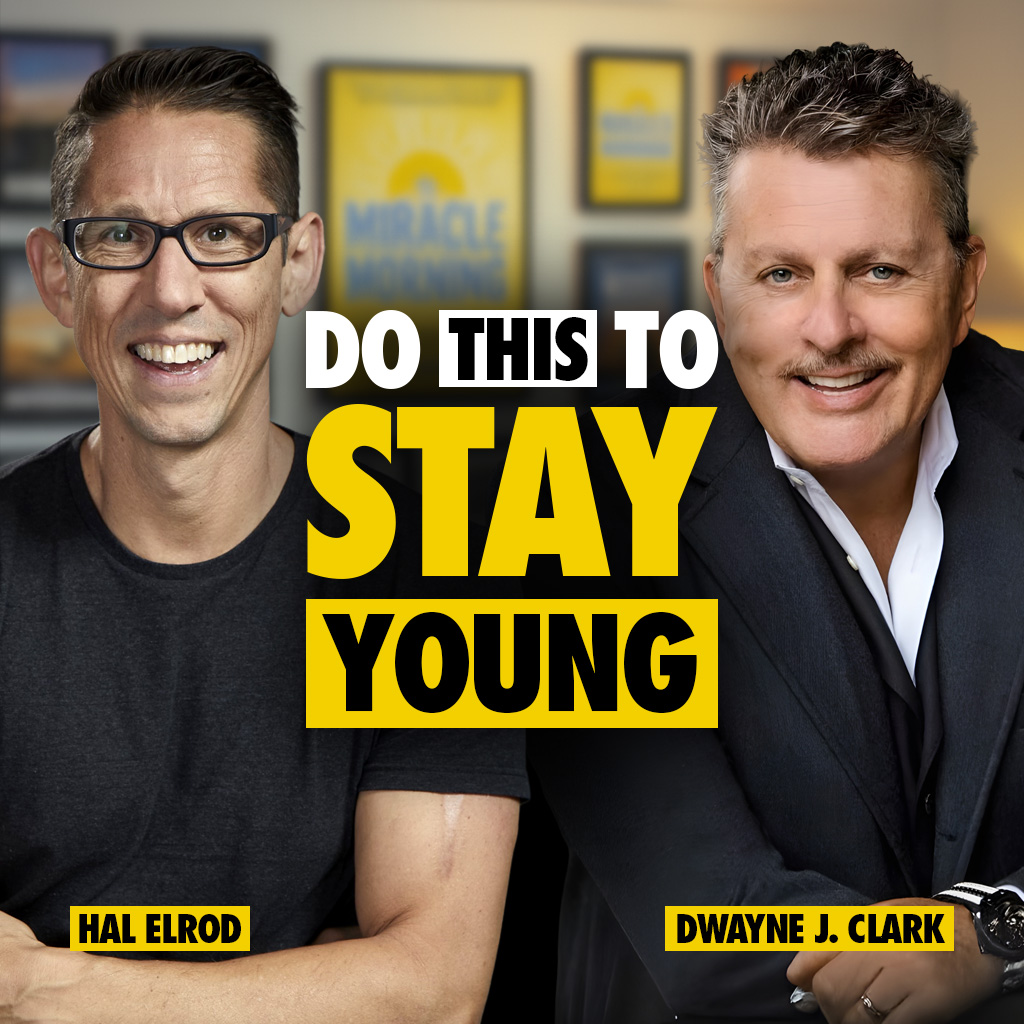
Achieve Your Goals with Hal Elrod
611: How to Live Longer, Healthier & Happier After 50 with Dwayne J. Clark
00:44:26
Loading summary
Transcript62 lines
- [00:02]
A
Hello and welcome to the Achieve your goals podcast. The show that empowers you to wake up to your full potential and achieve your biggest goals and dreams. I am your host, Hal Elrod and I invite you to join us each week as we share actionable strategies to take your life to the next level, as well as interview world class experts and entrepreneurs who have achieved extraordinary goals themselves. And we ask them to give you a peek behind the curtain and teach you exactly what you need to do to do the same. Ready? Here we go. Hello, friends. Welcome back to the achieve your goals podcast. Today's guest is someone you will not want to miss. This is a special conversation. It's someone I deeply admire, the perfect person to co author my new book with me, the miracle Morning after 50, Mr. Dwayne J. Clark. Dwayne is the founder and CEO of Aegis Living. But more important for you in this episode, he's a longevity expert who has spent the last 40 years studying the daily habits, mindsets and longevity secrets of more than 80,000 people, many living well into their 80s, 90s and beyond. In fact, listen to this. Dwayne is on a mission to personally interview 100 centenarians, that's people who've lived past 100, to uncover what's really working when it comes to living a long, meaningful life. In fact, as of last week, he's completed his 45th interview and the lessons he's learning are nothing short of remarkable. So in this conversation, we're diving into what it really takes to thrive and after 50 to how to keep your energy high, your mind sharp, your relationship strong and your purpose alive. All while the miracle morning practices are utilized to make every day your best day yet. This is one of those conversations that I could genuinely change how you see the second half of your life and whether you are over 50 and this is for you, or you're under 50 and you're thinking about your parents, or you're just thinking about the years ahead. Let's get into it. It's my great pleasure to introduce you to the one and only Mr. Dwayne J. Clark. Dwayne, it is so good, as I was just telling you, it's so good to see you, brother.
- [02:08]
B
Good to see you, man. Excited about this?
- [02:11]
A
Yeah. We were just talking about how it's been almost what, four years ish, that we've been writing this book and there were times where we hit some hurdles and we weren't sure if this thing was going to ever get finished.
- [02:22]
B
It's a good day to celebrate the birth of this new book.
- [02:25]
A
It is. And for those that don't know what I'm talking about, I'm going to show it on the screen here. For those of you watching on YouTube, this is the miracle morning after 50, a proven path to joy, vitality and purpose for aging adults. The book is available today for pre order at Miracle Morning After50.com you get a bunch of bonuses. A live event with Dwayne and I, four bonus chapters. The miracle mind, the miracle body, the miracle soul. So I want to get that out of the way just in case you don't listen to the whole episode. Go pre order this copy and if you are over 50, it's for you. But if you're under 50, Dwayne, I think you'd agree this is the best gift I think that somebody could give to a parent, a grandparent, a mentor. What do you think?
- [03:02]
B
Well, I think age doesn't matter. I mean, it's life advice, right? It's about how you want to age well and have good health span. So I mean, if you're 28 and you got a 58 year old parent, you probably want to read it.
- [03:12]
A
Yeah, I would agree. So before we dive into the book and the content and helping people over 50 thrive for the rest of their life, I want people to understand why you do what you do. You know, you've built, for those that don't know, you built one of the most well respected senior living companies in the world, Aegis Living. But what originally pulled at your heart and inspired you to decide that your life was dedicated to helping people age with dignity, with joy, with purpose and so on.
- [03:38]
B
It's a great question and I've pondered that many, many times over the course of my career. In my life, I was raised by a single mom and my grandmother came to live with me when I was very, very young, probably four or five years old. And so when my mom worked, my grandmother took care of me and we shared many, many moments. When I hit about 12, came home from school, my grandmother was laying on the floor and she tripped over the family dog and broke her hip. And she'd been laying there for a couple hours. So really unfortunate situation, took her to the hospital and they said, well, you're going to have to go into a nursing home. And my grandmother was such an iconic woman, spoke three languages, operated a business in the 1930s, had 13 children. I mean, I just thought she was the bomb, you know. And so she went into this nursing home and people didn't treat her with the most dignity. I was so confused by that. I'm like, why do people just walk in a room? Why do people just undress her in front of other people? Why do people treat her like she's a homeless person? Right. It had such a visceral impact on me. And I remember one time asking, don't you know who my grandmother is? She's a really accomplished woman. You know, I was like, 13 years old. She goes, oh, yeah. You know, it's kind of blew it off. And I think that that moment. She lived in a nursing home for about two years before she died. I think those moments really created an impact in me and affected me both in a positive and a negative way. I remember one time walking down the hallways because I spent a lot at. My mom would go there every day, first thing in the morning, before work, after work, at night, and often she took me. I remember going down the hallway one time. There was this gentleman, and he was kind of moaning, and he couldn't talk, and he was kind of reaching out. I just walked in his room, and he wanted a pillow and some stuff, and. And I started looking around his room, and he was this decorated World War I Air Force pilot. When the airplanes first came up, and he had these medals and everything else, and I just sat there, and his verbal skills were not great. But we talked for a while, and I just thought, oh, my God, you know, here's this guy that's a hero. You know, the guy, of course you'd see in movies. And here he is at the end of his life, and he's not being treated very well. And I came in, like, three days later to go visit him because we had a little bond and he'd passed away, and I was so sad and, you know, just impacted. Like, God, here's this guy that served his country, did so much for us, you know, was a hero, protected America, and he had an ending like that. So I think all those things had a really impact where I wanted to create an environment where. Where dignity was of the highest order. Right. And no matter what your physical condition is, your mental condition is where dignity was of the highest order. And I think that's one of the things that in aging, we have to look at how do we preserve dignity as the highest order? And that's why we do what we do.
- [06:24]
A
That's a beautiful story, and it makes a lot of sense why you do what you do. I resonate as like, oh, you go through these defining moments in your life, and you see things that in the world that could be better either in your own life or in this case, it was in your grandmother's life and in that gentleman's life. And you dedicate your life to making those things better.
- [06:41]
B
Yeah. So true.
- [06:42]
A
How. How old are you, by the way? There's just to give perspective for those listening.
- [06:45]
B
I will turn 67 in three weeks.
- [06:47]
A
Okay. All right. In three weeks coming up.
- [06:50]
B
Yeah, 22nd of November. A little over three weeks.
- [06:53]
A
I love that. Amazing. So I want to shift gears, and I want to talk about aging. Right. Because that's essentially there's essence, if you will. That's the underlying theme of this book is like, okay, after 50, how do you make the second half of your life the best of your life? And I think a lot of people see aging as a slow decline. You know, it's mentally or physically or emotionally. But the miracle morning after 50, it really reframes that entirely. So what do you say to someone who feels like their best years are behind them?
- [07:18]
B
Well, I'm going to answer that in a couple ways. As you can tell, I'm a baseball fanatic. You look behind me and see my sports memorabilia. And Satchel Paige used to say, age is a case of mind over matter. If you don't mind, it don't matter. He also said, how old would you be if you didn't know how old you were? Right. And so I think the mental aspect of aging is so critically important. And so from a scientific standpoint, what happens with aging is we tend to. It's not linear. It doesn't go like this. Right. It goes off cliffs. It's more like stairs. Right. And if you listen to, like, Dr. Peter Ortia and others in the longevity space, you know, they'll say, like, at 75, your capacity is at 50%. And the reality is that doesn't need to happen. And that's why this book is so important, because I think oftentimes we take the path that we think we should take for aging, and it's everything, Hal. It's like how you get your hair cut. Should I wear chinos the rest of my life from 50 to 85 and my boat shoes and drive this kind of car and so on. So we fall into a pattern of what we think aging should be. I would say throw all that out the window. If you want to dye your hair blue at 85, knock yourself out. Right. And so this book is critically important because it allows you to contradict the things that typically happen with aging. I mean, I'm sure we'll get into that. But there's so much science behind things like even meditation. How meditation is is so much better for you than high blood pressure medicine. It's like 50% more effective than high blood pressure medicine. So there's so much that we can do to age in a beautiful way. So I'm so excited about sharing this stuff with our listeners.
- [09:02]
A
Are you like me in that you want to optimize your energy and your focus? Well, if that is you like I do, then I highly recommend that you check out Cured Nutrition Flow gummies. I'm telling you, I said this last week. I think I'm like addicted to these things. I take them every morning. In fact, yesterday I took them twice. Took him in the morning first thing. And then I took them before my workout as well. Four functional ingredients that will help you increase your focus and energy. It's lion's mane that improves mental clarity, focus and memory. Ginkgo biloba enhances cognitive speed and memory and boost blood flow to the brain. Green coffee increases alertness, reaction time and enhanced mood with 48 grams of caffeine. Very minimal caffeine, just enough to give you that edge. And then Huperzia serrata supports neurotransmitter function, memory and learning. And they're all in these delicious apple gummies. I take two gummies in the morning to get into my flow state and I highly recommend that you do the same. Head over to curednutrition.com forward/hal that is curednutrition.com HAL and use the code HAL at checkout for 20% off your entire order. And if you do a bundle or you do a subscription, it stacks on top of that so you get an additional 20% off. Check out the Flow gummies and their other products as well@curednutrition.com Hal and enjoy the rest of today's episode. There's two things that I really want to get into today, and it is you just touched on it, which is really the science that's in this book. In fact, it's an area where you and I actually pushed back because you're far more science minded. I'm far more, you know, experiential, analytical. Not that we're not both of the things, but you really went deep into the science on brain health, on cellular health. Right. Those types of things. I also want to talk about the savers and how we really customize those for seniors and how important they are. You just mentioned meditation is twice as effective as blood pressure medication. Is that what you said?
- [11:05]
B
50% more effective.
- [11:06]
A
Yeah, 50% more effective. Got it. Before we do that. Well, actually, I realized that we didn't share the full on story and I want to ask it from your perspective, why did we decide to write this book? I'll share my quick perspective, which is I recall you reaching out. We actually got introduced by a mutual friend, Isaac Stegman, and you said, hal, I care for people over 50 for seniors. And the miracle morning has impacted me. I read your original book. I'm in my 60s and people over 50 really need this book. They need purpose. They need a roadmap to age well. So that was my recollection. How would you recall? Why did you reach out to me and want to write this book?
- [11:43]
B
I think it's very similar. How I think the fact that there's no roadmap for aging. Right. And I think that's one of the things this book does, is give you a roadmap. You get so much information on the Internet and so much of it is bad information, so much as fake information. Right. And so you don't know who to trust or what to trust. And I think Savers provides a blueprint for us to look at and say, here's the things I can do. And they're not, they're not wacky things. I mean, and they're not things that.
- [12:10]
A
Are going to hurt you.
- [12:11]
B
It's not like, take this pill for 10 days and you'll reverse your aging by 20 years. I mean, it's like grounding is such a natural thing to do. Right. Go out. And my kids used to say, hey, dad, you're a tree hugger. There's good science behind hugging a tree. We are all part of nature. And when we ground with that energy in nature, it has a positive effect on our immune system. Right. So I think you and I align on so many things and it's, you know, we should be honest with our listeners and say there are things we disagree on too, which I think is really critically important to get a good product out. You know, you kind of look and say, all right, I don't think it's this way. I think it's this way. But we came to an agreement on what's most important for our listeners. So.
- [12:50]
A
Yeah, yeah, no, well said. And I am absolutely a tree hugger. Literally. That's an example of where I don't need the science of what happens when I spend time in nature to know that when I spend time in nature, mentally, emotionally, physically and spiritually, I feel better. I feel at my best Right. So it's like that for me is like I don't need the scientific peer reviewed journal study that tells me that I feel better when I step out onto the grass and get some fresh air and sunshine.
- [13:18]
B
Well, in Japan, the physicians actually write a prescription to go walk in nature. If you go in with high blood pressure, they'll say, okay, you need to go walk for one hour in nature three times a week. Right. I mean, wouldn't that be miraculous if our doctors in America did that? You know, and by the way, they have the highest mortality age of any place on the planet. So they're doing something right. Right.
- [13:39]
A
Yeah, it's hard, I guess. You can't patent nature, you can't trademark it, you can't profit off it. That's the problem in America's healthcare system. So you've studied more than 80,000 seniors across four decades. What are some of the biggest lessons that you've learned from those who stay sharp, who stay strong, who stay happy well into their 80s and 90s?
- [13:59]
B
It's a good question. You know, I have a production company as well. We've done 13 documentaries and my latest one is called 100 of 100 and I'm interviewing 100100 year olds. They can be 98, because by the time we get done with production, there'll be 100, hopefully. There you go. God willing. But I just did my 45th last week. First of all, it's a profound experience just to have the honor to sit down with these people. My oldest has been 104. I mean, I talked with this one guy and I said, where are you going after this? He goes, oh, I'm going to go hit some balls. He was 101, he was a lifelong golfer. And he says, I'm going to go hit some balls, right? And no cane. And I go, well, are you going to use a cart? He goes, and he almost got angry. He goes, I've never used a cart in my life. He goes, I don't walk the entire course anymore, so I just go to the driving range. So there's a lot of similarities and it's not the kind of things that you and I think of. Right. We're so gym focused in this country. You have to go to the gym, you have to do this, you have to run a six minute mile, you have to lift this much weight. If you look at the countries that live the longest, I have a home in Italy. If you go to Italy, my place is in the center of Rome. If you try to find a Gym within one mile. With the exception of a hotel that has a couple weights, there's no gym within one mile. You go to New York City and find a gym within one mile, you'll find 40. Right. And so Europeans live an average of five years longer than we do. So the prescription for aging is pretty simple. Move your body and it's not like you have to do these kooky exercise or buy this. Just go out and walk, you know, walk, be in nature, go to the parks. If you look at what kills us, let's start there. Yeah. There's five diseases that Americans die of, right? Cancer, heart attack, stroke, diabetes and dementia. Alzheimer's. Right. What do all five of those things have in common? They're inflammatory based diseases, right. So in 1900, the average American ate about 12 to 14 pounds of sugar. Today we eat about 160 pounds of sugar. It's in everything we eat. And it's been added as an addictive attitude to get us to crave certain things and eat more of it. Right. It's, it's been weaponized against us. So when I go to Europe and it's a funny thing, and I'm, I'm very diligent about this. For 13 years, every day I write down my vitals. So I take my blood sugar, I take my blood pressure, I take my weight, I look at my sleep, I look at my exercise, all those things. Every day I write out. So Every day for 13 years I have my stats, I have a blood draw the week before I leave for Europe and I have a blood draw two weeks after I come back from Europe. My doctor said, I think this blood is coming from a different person. When you get back from Europe, really it is that dramatic. My blood sugar, because I'm right on the, my family suffers from diabetes. I'm right on the pre diabetic line, about a 5, 6, a 1C. My blood sugar's average is about 107. Before I go, you're supposed to be under 100. When I come back, it's like 95. In four weeks it drops 12 points. My blood pressure drops about 15 points. Then everybody says, well, it's walking. So for three years I did a study and I said I'm going to walk less in Europe than I do in the US I did came back, blood pressure still went down. So what's the conclusion? The conclusion is it's the food additives that everything from the way the grains are made to people are like my wife's gluten intolerant. She'll eat bread and pizza all day long in Europe. Can't do it here. Right. You get people that get indigestion from the foods they eat there. Go to Europe. They don't get indigestion. I know I'm going off on a tangent here, but it's so dramatic about what. What our food system does for us.
- [17:39]
A
Yeah. And so what, what would the solution be? Right. So if you're like, well, that sounds great, I don't have a home in Italy, if you're listening. Right. I can't get over there as often as I'd like. So what do you do if you live in America?
- [17:50]
B
Well, I think now, because we're a global economy, you can order things from Italy that are much better for you or wherever. Japan or Asian countries that are much better for you and order them from those purveyors where they're not made with the American idea of getting you addicted to food sources. So if you can afford to do that, have the resources, that's the best thing you can do. Other than that. It's all about prevention. Right. What's killing us, you know, in our aging is inflammation. So anything you can do to reduce inflammation. So, I mean, right after this podcast, I have a red light bed in my gym. I'm going to go sit for 20 minutes in the red light bed. Right. That's a great killer of inflammation. I was at a banquet last night. We support University of Washington football team, and one of my kids just tore his labrum and he's still playing. And I go, well, how are you dealing with this? He goes, I do red light three times a week or three times a day. Excuse me. Three times a day we do my physical. The trainer puts red light on my shoulder. And so it takes down that inflammation. You know, you don't want to be on Tylenol and Advil all day long. This is bad for your kidneys, your liver, everything else. Red light is a big thing.
- [19:00]
A
Turmeric's another one. Right Over Tylenol, I would take turmeric.
- [19:03]
B
Yeah, exactly. And a big thing I've started doing in the last year is sauna. Infrared, sauna. And so good for your heart health, gives flexibility to your vascular system. You don't have to go in there for an hour. I mean, infrared different than a regular sauna, which is controlled by heat. Infrared, you can do 110 to 125, 130, so you're not burning up in the thing. So I go in for 20 minutes, 120 degrees and you know, you feel great, takes the inflammation down. So as you and I share, I'm a big a cold plunger. So I go in a cold plunge for four to five minutes three times a week. So getting inflammation down in your body, super important. One of the things that people don't understand, if you really look at how do we die, what really happens physiologically to our body at the age of 30, we actually use more cells than we can produce. Remember when you were like 25 and you're like, man, I could go out drinking all night and get up, get two hours sleep and go to work the next day and I feel great, right? Well, you feel great because your body has a reservoir of cells that replenish those that you just burn up. Right. Once you hit 30, it doesn't do that. Your bodies are consuming more than it can produce. So we actually start dying as a morbid thought at the age of 30. So anything you can do to protect that cell production and get rid of the zombie cells that are giving us bad diseases like cancer and diabetes is helpful.
- [20:27]
A
Yeah, yeah. And for me, a big thing that comes up is it's not what I put in my body, it's. It's what I refuse to put in my body. Right. Meaning yes, I eat, you know, I try to eat grass fed meat and eggs, you know, pasture raised eggs, cage free eggs, pasture raised chicken, organic vegetables. That's great. But it's more important if you eat all the healthy stuff and you eat a ton of sugar, which before I got cancer, I ate a ton of sugar, I drank alcohol. Right. I did all of these things where because I ate so healthy, my identity was, I'm healthy. So it's okay if I take Adderall to help me focus and it's okay if I drink alcohol to help me wind down and aspirin to help with the headache that I got from the Adderall and the beer, you know, Right. Because I eat so healthy. But it's like when I had cancer, I went, oh, it's not just about putting good stuff in my body. It's about refusing to put these inflammation causing chemicals, synthetics products, sugar, processed food, so on and so forth. Thoughts on about, you know, what not to put in your body?
- [21:27]
B
Well, you nailed it. I mean, sugars is cancer, fertilizer. Right. My wife is a big Halloween person. I have an addiction to chocolate. And so she puts out a bowl, you know, like this big full of my favorite chocolates and, and it's right by our stairway so when I go by a stairway, my hand automatically goes in the bowl, and I'm like, oh, my God. And I've done that for the last three weeks. And I got to get off this. I got to get off this, right? That's a big thing. You know, you bring up a really good point. In my previous book, which was called 30 Summers More, I wrote about a syndrome called the mirror syndrome. And I think it's really important. And what the mirror syndrome is, is where you look in the mirror and you go, God, I look good, I feel good. I got big muscles. You know, my chest is popping, my biceps are great. But you don't really understand what's going on inside of you, right?
- [22:11]
A
Yeah.
- [22:12]
B
And so one of my best friends is in my book. I talked to him last night, was the. I mean, he was a guy that. He's exactly the same age as I am about 10 years ago. He's 56, 57 years old. I mean, this guy looks like he should be on the COVID of GQ. Just super handsome. Six, 395 pounds, just, you know, like 5% body fat. And he was in a basketball game and running up and down the court. Coach pulled him out, had a massive heart attack on the bench. And luckily there was an AD there and brought him back to life. And he had a terminal bypass. He didn't understand. I mean, this guy's a workout maniac. Works out six days a week, sometimes two a days. He didn't realize what was going on inside of him. He was beautiful on the outside. The mirror syndrome was working. Right? But he didn't realize, you know, he had some genetic issues that was filling his arteries up with plaque and eventually have open heart surgery and so on. And, you know, he's fine now, but I just encourage people to, you gotta look inside, right? And there's so many things you can do. I mean, just a simple plaque scan that cost $150 takes three minutes, put you in, see how much calcium's in your veins. You know, then if that doesn't work, go to the cath lab. You know, they stick something in your vascular system, in your heart, and see if you know where the plaque is and if it's a concern and so on. And so there's so much preventive things you can do today. And the problem is we stick our head in the hole and we don't want to think about dying or aging or getting sick or having a heart attack, and so we avoid it. Me, I get my blood taken every 30 days. I've had it done twice this month. And I go through longevity testing. I go through cancer testing. There's a great test now called Gallery G A L L E R I that I'm sure you know about it, that tests for, I think, over 100.
- [23:57]
A
Cancers taking it, I think this year. Yeah, yeah.
- [24:00]
B
There's two scans now that are out that are full body scans. One's called Prenova, the other one's called Ursa, and they'll test for cancers and deformities and tumors and so on. But we're getting to this place how? With AI and testing that if you want to live a long time, you better take advantage of these things. They're not super expensive. I mean, the gallery test is $99.
- [24:22]
A
All right, let me ask you a question. How many apps are you using for your personal development? Maybe a meditation app like Calmer Headspace, an affirmation app like I Am, or Think Up, a book summary app like Blinkist, a journaling app like 5 Minute Journal, a visualization app like Envision, an exercise app like 7 Minute Workout, and maybe even a habit tracking app to keep it all together. That is a lot to manage and a lot to pay for. What if you could replace all of them with just one app? Yes, it is called the Miracle Morning app, and it is essentially seven apps in one. Hundreds of guided meditations and Breathwork tracks, a full library of affirmations, plus tools to create your own visualization prompts for 10 key areas of your life. Guided workouts from 2 to 10 minutes long, book and audiobook summaries of top personal and professional development books, and a journaling tool with guided prompts. The wheel of life or a blank page to write freely. It simplifies your morning, saves you money, and helps you start every day with clarity, purpose, and energy. And it's one of the only apps in this space with a 4.9 out of 5 star rating. Try it free for 7 days. Just search Miracle Morning in your app store or go to miracle morning app.com to get started. All right, back to the show. And you don't want to wait till it's too late to your point. Preventative. It's like you got to use your Miracle Morning to take a little time to clarify. What do you want your future to be like? How do you define living well, aging well, and then work backwards and go. What do you need to start eliminating right now that is toxic in your diet, in your environment? And what do you need to start adding? Adding in terms of you know, exercise, diet, the things in the book that we talk about, grounding, sun, gazing, and so on and so forth. Not to mention the savers. Silence, affirmations, visualization, exercise, reading and scribing. I'd actually love to hear Dwayne of those savers. That's one thing we went to great lengths in this book is to really customize, and we've. I've never had a miracle morning book with this long of a section on. In fact, there's a chapter for each of the savers and how to apply them. If you're over 50, I'm curious what your savers look like. You mentioned meditation, reducing our risk of heart attack by 50%. What other savers for you are important, and I'm curious if you have any tips or tricks or ways that you apply them.
- [26:44]
B
Yeah, I have a real hard time with the silence one. Right. You know, just before I got on this podcast, I'm looking out my window. My wife's an incredible landscaper, and I'm. I was just looking. I'm like, hey, this nature is beautiful. The leaves are turning. I have to really be intentional about my silence right now. I meditate every day. Sometimes I do guided meditation. I love one called Boho. Beautiful. But a lot of times I've done. I've been trained in transcendental meditation and teaching transcendental meditation, so I do both. I love describe. I read two hours every morning as soon as I wake up. I think one of the things that as you age, that's really important is to get circulation in your body. You know, you and I may differ a little bit. I think exercise scares people. It's a word that has a weird connotation, right? So I tend to use the word movement more than exercise. And so your body was meant to move. I was talking to one of my hundred year olds in this interview, and we were talking about movement. She goes, well, I didn't have a remote to get up and change the TV. I had to get up, walk 10ft and change to one of my three channels that I had. I didn't have an iPhone to look up a restaurant. So I walked a quarter mile to my neighbor's house and say, hey, where have you eaten recently? That's great, right? I didn't have a dryer in my house, so I had to pick up, you know, wet basket of laundry and go out and hang it on the line. And I pushed a lawnmower that wasn't electric. Right. I washed my own car. You think about the things that our grandparents did that. Just technology. I mean, I can sit here with my iPhone, I can order a pizza, turn down the curtains, turn on music, call my friends, get a review on a book, and not lift my butt off the couch, right? And so technology has really caused a lack of movement. So movement has to be much more conscious, right? So, I mean, that's why I think, you know, I wear an aura ring. That's why I think that step counting is important. You can kind of go crazy with it. That's important. Meditation is greatly important, but. And I journal all the time and scribe all the time. One of the big things for me, it kind of goes along the gratitude lines, is really visualizing. And so I have. And my wife and I have separate bathrooms off our master. I have a board that's 7ft high and about 3ft wide right across from my toilet. So every time I go to the bathroom, I'm looking at everything I want to manifest, right? And in my foundations, I teach this class on manifesting. The things that have happened to me through manifesting are unfreaking, believable. I could tell you two or three.
- [29:21]
A
Stories that give me at least one, if not two or three.
- [29:24]
B
Here's a good story. So I grew up catholic. I always wanted to meet pope francis because I thought he was a great man, right? So I put a picture of pope francis up, and I write on it, I will meet you on the poster. It's on my manifesting board, right? So we go to italy. I'm getting my hair cut by a friend of mine who I've known for 10 years. And he's like, what do you want to do? I go, I really want to meet the pope. He goes, oh, I can make that happen. Now, this is my hairdresser, right? And I'm like, yeah, right. You're gonna. He goes, well, I cut newt gingrich's wife's hair and newt gingrich's hair and flu says the u. S. Ambassador of the vatican, I'll just ask her if you can meet the pope.
- [30:02]
A
Wow.
- [30:03]
B
And I'm like, okay, whatever. This is one of those things. Like, okay, you know, I'm trying to be nice and not be rude and, you know. And so my wife and I are in miami, and my phone rings, and the guy goes, Mr. Clark? I go, yes. And he goes, this is sir john mccaffrey from the vatican. I understand you want to meet the holy father. And I thought it was one of my buddies trying to punk me. Yeah, yeah, yeah. And I'm like, oh God, who is this? Come on, you know this isn't the Vatican. He goes, no sir, this is Sir John McCaffrey from the Vatican. And I'm like. And you know, he goes on and on and on. And finally, you know, he goes, sir, this is the Vatican calling. And so I go, oh, okay. He goes, well, I understand you want to meet the Holy Father. And so I'm like, yes. And he goes, well, I can make that happen. So anyway, to make a long story short, we not only meet the Pope, but we became involved in his private foundation that where our big thing is trying to cure the problem that we have all over this world of sex slavery in children. So we'd become big donors and trying to end that and fund the Vatican cause, which was one of Pope Francis's big things. So that all stemmed from me putting this picture up and saying, I'm going to meet you.
- [31:13]
A
Yeah, it is wild. My brain, I don't know about yours, I would imagine it's similar, but it balances between very logical and wanting to see, you know, evidence and proof that things are going to work and knowing what the plan and the path is. And then this other woo woo, if you will. Spiritual like, I've had so many experiences in my life similar to that, where you go, the odds of this or that happening, you know, it's like one in a million. And yet I intended it and it came true, you know.
- [31:40]
B
Yeah.
- [31:40]
A
The Miracle Morning for schools is one example. In 2016 I wrote my 10 year vision for the Miracle morning. And one of the vision was that the miracle morning is practiced in schools across America and it was just a random 2020 occurrence where Brianna Greenspan, one of my co authors in the Miracle Morning, co author, the book series, she was hosting the Miracle Morning clubhouse room and a teacher spoke up and said, the miracle morning has changed my life. And, and I just shared it in our school district. And then Brianne and her connected and long story short, now the miracle Morning is in hundreds of schools across America.
- [32:10]
B
Wow.
- [32:11]
A
And it's just, it's a manifesting thing, right? Where I did not make a plan. I did not. Right. The left brain's like, well, in order to make this a reality, I've got to make a detailed step by step plan. I did zero plan. I just wrote what I really intended to happen. And then, you know, there's so many experiences like that where what are your are your thoughts on manifesting in terms of how do if someone's skeptical and goes, you can't Manifest things that doesn't just randomly happen. That's coincidence, that's luck. What are your thoughts on it as someone who has manifested, you know, an extraordinary life?
- [32:42]
B
Well, I get a lot of my wisdom from my elderly residents. You know, I call them my oracles. They're just so profoundly wise. Right. And they've been around too long to make things up. They don't need to impress you. Right. And I look at the tendencies they have, and one of the tendencies they have is how they choose to interpret life. And I think this is a critically important issue for living a long age, living a, well, life, right? And the trauma that they've been through. I'll give you one short story. A family came home as this Japanese family came home. She was staying overnight with a friend in Hawaii, and her family said, you have to go home right away. There's been a devastating thing. Well, it was Pearl harbor, right? And she went home, and within a week, she said, they came to my house. We got one suitcase. They put us in a truck. And we saw the neighbors run to our house and take our furniture, our tv, our dolls, our, you know, everything out of our house. People just, like, invaded them. When the Japanese family were put in internment caps, and I'm like, oh, that must have been awful. She goes, no, it wasn't that bad. We. We were with our people. We had our own games, we had our own doctors, we had our own teachers. We grew our own food. The amount of perseverance and intellect it took for them to say, this traumatic thing happened to me, well, it wasn't that bad, right? And I think I see this amongst people that live to 100. Another guy who was. Flew a bomber in World War II, and he almost got shot down three times. And I said, well, what was the worst part? He goes, the worst part was when I got back to base, they told me it took two weeks to get my plane back in the air. And I was pissed. I wanted to get back right up, right? So the perseverance they have and how they interpret trauma and, you know, bad things that happen to their life with a positive attitude, right? With an attitude. And I had this one person that said, everything that's happened bad to me in life. There was something on the other side of that that was good. Even losing family members, even having diseases, losing money, losing businesses, losing, you know, loved ones. There was something on the other side of that that I choose to hang on to that was good, right? So our mental perspective of how we shape the things that come at Us. That's a big thing for me that, you know. And if you're in business, you know, like you, or like I, like your listeners, there's going to be something bad happen to you three times a week, right?
- [35:13]
A
Sure.
- [35:14]
B
And you can either go, oh, me, I'm a victim. Why does this keep happening to me? Or you can go, hey, there's some lesson I'm going to learn in this, or something good that's going to happen out of this. And your, your choice of which road you go down is going to impact your health and your longevity in your health span in a big, big way. That's the major thing that I would tell people. Choose to think positively about your life, because this thing up here, this brain, this is just a computer that tells your body what to do. If you say, I'm sick, I'm tired, I'm, you know, your body's like, okay, that's what you want me to do, Right? You're programming this to do what you want it to do. And the opposite, you know, is true, is you're like, hey, I'm happy, I'm joyful, I'm in gratitude. I'm, you know, I'm healthy. And, you know, one of the things I do is I, I try to put stickers on the, my mirror the night before I go to bed to tell me, you know, some things that I want to be. I'm going to be full of energy tomorrow. I'm going to have this goal accomplished. You know, they wake up in the morning, I'm like, yeah, I'm going to do that. Right. And so, you know, this morning I said, hey, I want to rock the podcast this morning. Right. So you have to realize this thing that rest above your shoulders is a programming center. Be careful about what you program into it because that too will manifest in a negative way if you put garbage into it.
- [36:38]
A
I want to do a mic drop right now. Except that I've got at least one more question I want to ask you. But what you just shared, that's the essence of probably my next book. That's the essence of it is it's like you are going to have challenges. That's what life is about. But if you can interpret it, it's all about your interpretation. If you can interpret it in a way that creates peace, inner peace and calm and optimism and hope and learning and growth and contribution, right? Then there's a very wise man. I can't remember his name, but the quote was, every experience in life is an asset. If you choose to see it that way.
- [37:11]
B
Yeah.
- [37:11]
A
Period. Right. And life's as good or as bad as you choose to see it. Viktor Frankl and Man's Search for Meaning was an example of that. He was a, you know, in a concentration camp watching people die and going, oh, the last of my freedoms is to choose to be happy and at peace in the midst of the most difficult experience I could ever imagine.
- [37:28]
B
Yeah.
- [37:29]
A
And so no matter what you're going through as you're listening and some advanced readers of the book, by the way, Dwayne, that is one of the big things I've heard him say is this just like this shifted my mindset. I feel so excited about the rest of my life, you know, and I'm 60, I'm 70, I'm 80. And I might have thought my best years were behind me now. This book helped me see the miracle morning. After 50, my best years are ahead.
- [37:50]
B
Absolutely. I, you know, I write a monthly column for Forbes magazine. And my, my next column, this next month's called Peace at Night. It's a concept that I've been kind of dealing with because, you know, I've always been a very ambitious CEO, wanted to gain things and material things and, you know, business goals and all that. And really the goal is to have peace at night. I mean, I need some, a fair amount of action and drama in my life between 8 and 6, but between 6 at night and 8 in the morning, I need peace at night. Right. And if we can teach this next generation to have that and not go too far the other way and have peace all day, I mean, that's, it's not really possible in a humankind, but to have peace at night where like, hey, I don't have to worry about my phone ringing. I don't have to be on my emails till 11 o' clock at night. I'm going to have peace at night. Right. That should be a worldly goal for all of us because we need that for our body to be replenished. We need it for sleep, we need it for health, we need it for our partner. Right. And so peace at night is a big goal of mine.
- [38:52]
A
I love that for two reasons. One is, I've always said that a miracle morning starts the night before. Right? It starts with the, you know, going to bed at peace so you can get a good night's sleep. Going to bed with an intention, which you talked about. You put those notes on your mirror like, hey, tomorrow morning I'm going to show up with love and energy and contribution. We create our own reality in that way. So I love it. Peace at Night in that. And that should be maybe our next book. We co author Peace at Night. But I will say this, the other reason I love it is we address this in one of the bonuses that folks get when they pre order the book, which is the miracle evening after 50. It's one of the four bonus chapters. And it's just because the book was, we felt it was the perfect length without these four chapters. And it was hard to pull these out. But you and I made that decision that, hey, let's make them bonus chapters so people still get the content. But the book's not an extra, you know, 50 pages long. So if you pre order at miracle morning after50.com, you do get what Duane just talked about, how to create peace at night through that miracle evening after 50 ritual. I got one more question for you. At least one. I always say one, but I, I'll take the over under. I might go a little more. But when you and I were writing this book, one of the big themes was helping people to see that the second half of life can actually be the most meaningful was the rest of your life. How do you make it the best of your life? So from your perspective, what does it mean to make these years the rest? You know, whether you're 80 with, you know, 20 or so years left, or you're 50 and you're halfway point, give or take, what does it mean to make the rest of your life the best of your life?
- [40:19]
B
Well, I think the first part of your life, you're really posturing who you're going to be in the world. You know, when you're 20, 30, 40, whatever, you're getting married, you're having children, you're trying to raise children, you're trying to keep up with the Joneses, you're trying to get ahead in business and so on. I really think when you hit 50 is that time where you've developed enough wisdom that you're not an enemy to yourself. And so often before we're 50, we're an enemy to ourself, enemy to our health, enemy to our marriage, enemy to our relationships with our children. And my hope for people is once you hit 50, you're not going to be an enemy to yourself. And there's a concept in there that really is like, you're gentler with yourself, you're kinder to yourself, that makes you a better, high quality human.
- [41:07]
A
Yeah, no, well said. And I think that for everyone, first of all, the most important thing is that people realize that it doesn't matter what age you are or what stage of life you're in. This is about what you talked about earlier, which is it's about your perspective. It's about your interpretation. So we could talk all day. Duane, you are a wealth of knowledge. Of course, the miracle morning after 50 captured. What are we at? 230 pages, roughly 230 pages of Dwayne's wisdom combined with my own. And if you are over 50, this book is for you to thrive in the second half of life. And if you're under 50, this is maybe the best gift you can give to someone that you love. And if you pre order today, go to Miracle Morning After50.com and you will get five bonuses, four bonus chapters. Again, the Miracle Mind, the Miracle Body, the Miracle Soul, and the miracle evening after 50. And you'll get a ticket to a live online event that Duane and I are hosting in December. Uh, just go to miracle morning after 50.com or if you already pre ordered the book on Amazon, you can go to miracle morning after50.com and just copy and paste your order number from your email receipt from Amazon and you will also get the bonuses. So it is such a blessing to be able to share Dwayne with y'.
- [42:22]
B
All.
- [42:22]
A
I've been getting to know him for the last four years and he is, as I mentioned, we just scratched the surface today. He is so much. Not just wisdom, but love, heart, care. Again, he does what he does not cause he needs the money. I can, I can promise you that. But it's because he really cares and wants to make an impact and help people age with dignity, with purpose, with love, with joy. I'm so grateful that we got to write this book together. I hope it blesses your life and the life of those you love. And until next time, I love you so much. I hope this book, the miracle one after 50, is a blessing for you. And I will talk to you next week. Oh, we had a little bit of a technical difficulty and we lost Dwayne there. But we got what I think that we intended to share with y'. All. That was Duane J. Clark, my co author on the miracle morning after 50. And I hope this conversation reminded you that your best years truly can be ahead of you if you decide that they are. And you start making some simple but meaningful changes to your mindset, to your habits, as Dwayne said, to your interpretation of your life. And if you want to create a life filled with energy and gratitude, and purpose, no matter your age. Grab a copy of the miracle morning after 50. It's available where books are sold and if you go to miracle morning after50.com you can pre order it and get your bonuses 5 preorder bonuses right now. And it's also available again wherever you want to get books, Amazon, you name it. Thanks for listening. And remember, you don't need a different life to feel happy and fulfilled. You just need to wake up every day with intention and live your miracle morning. Thanks for listening. To learn more about the Achieve your Goals podcast and to get access today's show notes, transcript and exclusive content from Hal Elrod, visit Hal Elrod.com podcast thanks again for joining us. Be sure to tune in next week for another episode of the Achieve your Goals podcast.
- [44:16]
B
SA.