← Achieve Your Goals with Hal Elrod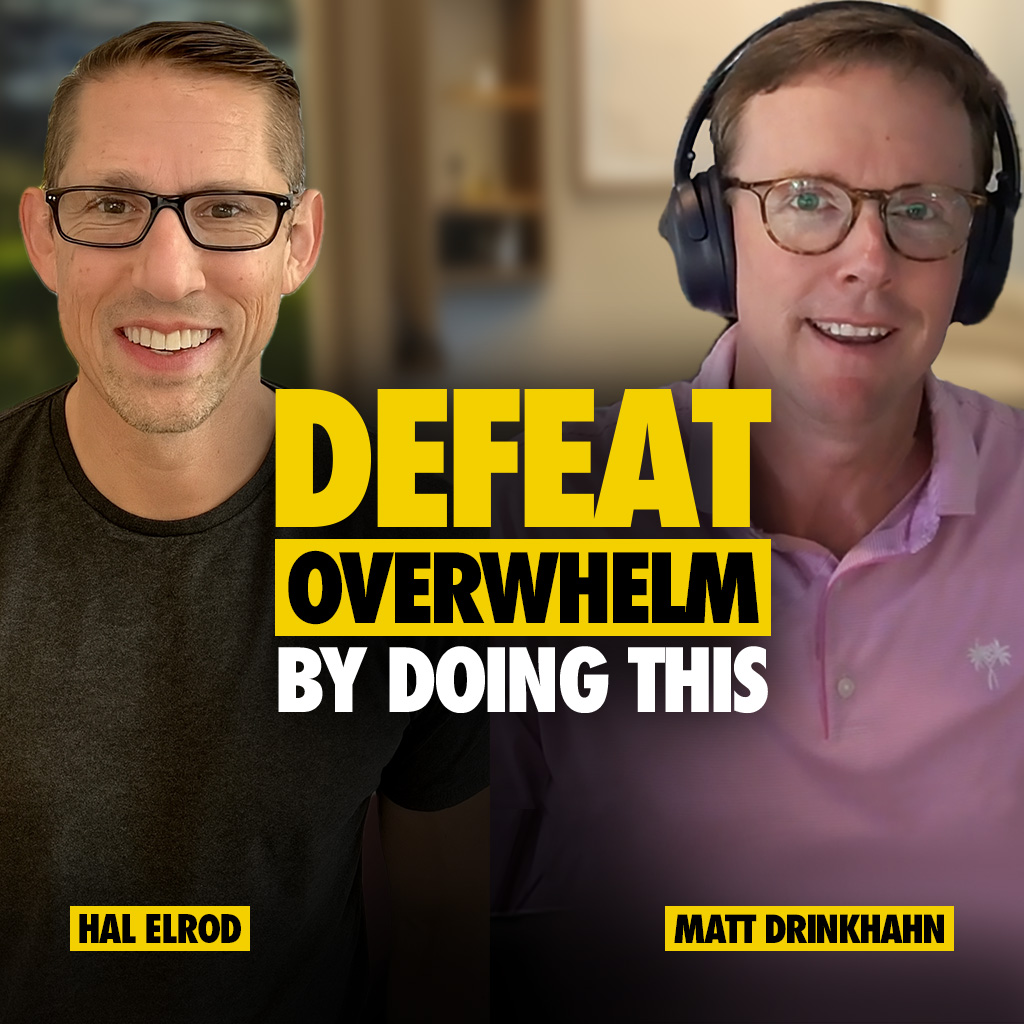
Achieve Your Goals with Hal Elrod
614: The Life-Changing Impact of Eternal Optimism with Matt Drinkhahn
00:36:24
Loading summary
Transcript98 lines
- [00:02]
A
Hello and welcome to the achieve your goals podcast, the show that empowers you to wake up to your full potential and achieve your biggest goals and dreams. I am your host, Hal Elrod and I invite you to join us each week as we share actionable strategies to take your life to the next level, as well as interview world class experts and entrepreneurs who have achieved extraordinary goals themselves. And we ask them to give you a peek behind the curtain and teach you exactly what you need to do to do the same. Ready? Here we go.
- [00:32]
B
Foreign.
- [00:37]
A
Welcome to the achieve your goals podcast. This is your host, Hal Elrod, and today I'm talking to my friend Matt Drinkon and we are talking about what do you do when everything is overwhelming, when life knocks you down? And this is based on the principles that he teaches in his book the eternal Optimist. In fact, I'll probably call this episode the power of eternal optimism because I do really believe this is a superpower. And what I love about Matt and the way that he thinks and even just the premise of his book, which when his book came out, by the way, I bought a copy not only because I love Matt, but because I love what this book is about. And the tagline really clinches it for me. So the book is the eternal optimist and the tagline is it's never too late. And that's what I love about the premise of this book is even if you've been a pessimist your whole life or you've been negative, or maybe you were an optimist in the past, but then life knocked you down and you became pessimistic. I think a lot of us, we become jaded when life just beats us up. You're like, I can't, like, screw it. I used to be happy. I used to be positive and optimistic. But you know what? Screw it. I'm done. Life isn't fair. This isn't supposed to be this way. And so I love Matt because I love this message of you're never too late. You're going to hear today when he talks about he was an angry person in his mid-40s and he yelled a lot and he had young kids and he realized that this was an area that he needed to transform and that just because he was an angry person for the first 45 years of his life, it was never too late to change. And so he now says he's very proud and grateful that he has a five year yell free household. And as the father of three young daughters, he is married, he's 48 years old, four years young, as he would tell you. And again, he's the host of the Eternal Optimist podcast, Author of the Eternal Optimist. It's never too late. He is now an executive business coach to high performing entrepreneurs that are seeking business growth and inner peace. And he is just one of my favorite people. He is a real sweetheart, a good human being. And I think you're going to really enjoy hearing Matt's story. And then he's going to break down three of the most powerful lessons that he learned during the hardest time in his life that enabled him to become the eternal Optimist that will empower you to tap into your power of eternal optimism. Enjoy this episode.
- [03:02]
B
Let's go.
- [03:04]
A
Drink on. You ready, buddy?
- [03:06]
B
Game on, baby.
- [03:07]
A
Dude. We just set our intention with a powerful prayer. That feels really good. I just like you as a person, so I've been looking forward to this because you're just like, I love hanging out with you when we get time together. So this is fun.
- [03:18]
B
It's good time. The tiny things. I just want to compliment you on this because you just set the intention before a podcast. And if every person out there who heard me say, set your intention before you do this meeting, Set your intention for the day. Set your intention as you transition from your workday to when you're going to.
- [03:35]
A
Be with your family.
- [03:36]
B
If everyone just heard that and didn't just gloss over it, if they actually applied it to their lives, I wonder what kind of transformation that would make in the world. How. Because that literally is transformational, Matt.
- [03:46]
A
So I don't know that about you. Is that something that's a huge part of how you show up? You set your intention before anything that.
- [03:51]
B
You do every day. Every day. Every day.
- [03:54]
A
Yeah. Tell me this isn't some cosmic God something. I don't. What I just did. I don't know if I've ever done that before. I don't know that I've ever started a podcast by setting an intention with the guy. And I always think I should, but I never have. I've. I don't think I've ever done it, man.
- [04:11]
B
Yeah, well, I find make magic in the mundane. And if we can turn what is just a routine podcast, a routine day, routine something and just set an intention that just makes it X amount better. More intentional. Yeah, yeah.
- [04:24]
A
I'm just saying it's just wild that, like you are someone that does that and without telling me or me knowing that somehow you, like, got into my brain and my soul and had Me do that. And then I'll just, I'll share what the intention was for everybody. Just like the general was. I said, hey, God, may this be the most powerful podcast that any two human beings on the planet have ever done in terms of the impact that it makes for every person listening. So, like, that's. We just. That's a tall order. We got a lot of work over the next 30 minutes.
- [04:54]
B
Okay, mod baby, let's bring it. Let's bring the thunder.
- [04:56]
A
Hey, let's start here. So I've read your book the Eternal Optimist. I have gifted your book the Eternal Optimist. Maybe only one person, but I've definitely gifted it to at least one, which is Eric Stranghorn. Or didn't you guys connect at some point after that?
- [05:08]
B
And we're dear friends right now as a result of that connection, so thank you. Yeah, yeah, we connected yesterday, as a matter of fact.
- [05:13]
A
Did you really? I love Eric and he. When I just saw your book title and I bought your book, because I'm like, I'm an eternal optimist. I'm like. But Eric is like a next level eternal optimist. So here's where I want to start. I almost want to start with like the opposite of optimism. I want to go to like the most negative, the hardest thing you've ever endured or overcome in your life. What is that?
- [05:36]
B
Okay, well, so many places that any of us could start from. I'm going to start with one place and I'm going to give some context to your listeners so they can hear the whole story and kind of draw their own conclusions from it. Hal. And as I set the stage for it, there are multiple layers of challenge here. So let me set the stage. First, let's take us back in time to Labor Day of 2015. Okay. That's about 10 years ago.
- [06:00]
A
10 years.
- [06:00]
B
I'm 38. I've been married for a year and a half. I have a four month old daughter, my first. And we're still in that phase where we're kind of like the honeymoon phase of Happy Baby, but we're also not sleeping very much. Yeah. So it's good, it's bad, it's everything. It's amazing. And I'm gathered on labor day with about 20 close friends and family. We are at a public place that has a zipline. Okay, Zipline. Now, I'm not a professional zipline inspector, but I've looked at this thing. It's. I've been down at 30 or 40 times. My kids have been Down a couple dozen times.
- [06:32]
A
Okay.
- [06:32]
B
And my kids just go down it in front of me. And now it's my turn. So I'm up in the zip line, which just imagine this. It's about 17ft above the ground. And it's, it's ground, it's not concrete, it's not forest in Costa Rica, it's in South Carolina. It's about 17ft above the ground. I go down the zip line and about a second and a half in. And I'm going at a pretty fast pace by now. Yeah. The harness breaks and I'm £230. I'm six foot six. I fall to the ground. Not as skillfully as Tom Cruise in any Mission Impossible movie, I might add. I fall straight to the ground onto my back. I fall and land straight on my butt bone to my back. Instantly I hear pops and crunches. And it's like you've seen the Roadrunner and the Wile E. Coyote cartoons. When the anvil gets dropped on your head, that happens. Like literally. I saw stars just like in the cartoons.
- [07:27]
A
Oh, wow.
- [07:28]
B
I come to maybe like 10 seconds later, roughly. And I'm starting to be helped up by. Everyone is surrounding me. Everyone. The whole group outing stops. They all come and surround me. And it's, it's kind of a beautiful moment, but I couldn't see any of that because I was in immense pain. Now my body is adrenalizing and kind of going into shock a little bit here and that's masking the pain, but it's still a little bit painful. I won't know how painful it is for another couple of days, but I'm sore and I'm in a little bit of pain. So let's just fast forward the story and the entire challenging period of time here. Hal is nine months from Labor Day until June. And by the way, at the end of the story, you could see today I'm healthy again 10 years later. But in this nine month period, some amazingly difficult things happened. So let me just break it to you down. The first layer of challenge is the physical body. So the physical body at 6 foot 6, I've already had some sports injuries in my past. My health went from a gradual to a very steady to all of a sudden off a cliff decline. And at the end of that nine month period, I was disabled. I was in a wheelchair. I hadn't left the house in some time. I could not go upstairs anymore. I couldn't cook anymore. I couldn't stand for more than 25 seconds. And at any Given moment outside of my control, I could be reduced to the fetal position in uncontrollable, like, agonizing, cry like a baby pain. Just make it stop. The antidote to this in the physical body at least, is the doctor said that you can take a prescription of something called OxyContin, which I had a friend get addicted to that and pass away. So I don't want anything to do with that.
- [09:07]
A
You refuse to do the.
- [09:08]
B
Okay, I refuse that. And. And, for what I do for a living as an executive coach, I earn a living off of being able to think very clearly at a high level, sequentially, and help people build systems in their businesses. And I cannot think clearly. I cannot do that. And the drugs take away that capability. So no drugs for Matt. So the physical body is completely degraded over this time to the point that I'm not able to go upstairs. I'm living downstairs in my office, laying flat on the ground. My feet are up on my couch as I'm laying flat on the ground. That's the physical body. The second layer of challenge is in my marriage now. We had. Our daughter was four months old, and we were at ages that it made sense if we're going to have more children to keep trying to have kids now. I didn't have any problem trying. I kind of like trying to have kids. But after, thank God, we were able to get pregnant In January of 2016, that was the last time I was able to be intimate with my wife for a long period of time. That fact, I was not able to at that time be intimate with Julie. I was not able to pick up my kids. I was not able to swing a golf club. So many things that I did for us in our marriage. I made the meals every day. No more, because I can't stand up. I'm the one that all the outside house things couldn't do any of that. Couldn't cut the grass, couldn't do anything outside anymore, couldn't drive anymore. Right. So the marriage in itself, all the responsibilities, I took care of. No, now Julie has to do all of them. She has to. There's no other option because I am not physically able to do them. That's the second layer challenge. The third one, my business. I was a highly paid corporate executive for some time, and I decided in 2014 that I wanted to become an executive coach and go entrepreneur again. How so? I'm a year and a half into the business and I'm straight commission now with no insurance. We're off my wife's Insurance, which I'm about to find out, is going to go up because of my condition. And I have a brand new business. It has not reached critical mass yet. And I'm not able to stay on a zoom or on a virtual call. I'm definitely not able to go face to face and sell myself anymore at this time. But I've got to stay on a virtual call to build a pitch. It's not easy to do that at this time. So business is challenged. And then the fourth thing is my identity. My identity has always been at this point, up to the age of 38, I had based it on external things. For better or for worse, I was taller than everybody in every room ever. For the most part. That was a strong part of identity. I was athletic, I could dunk a basketball. Still at that time. At that time, I was hitting 300 yard drives. At that time, I prided myself on being athletic. And in one incident over the course of that next nine months, I'm no longer taller than anybody because I'm in a wheelchair and I no longer able to run, jump, hop, skip, golf, basketball, racquetball, any of the things that I built my identity around. So I was in for a major identity shift. Those are some of the challenges. And there's just the day to day small stuff that's taken away from you that you take for granted. That was the difficult period. Okay, I want to take the time to share all that with you because I felt that with all the excruciating pain, with all these things that were challenging, I felt like all this positive talk that I've been saying my whole life, it was really being put to the test. Am I for real? My identity was in shambles. So am I really this optimistic, positive person that can overcome anything? That was a real challenge. So I do want to say that on the front end of this, here's a bonus. I didn't expect to say this.
- [12:42]
A
Okay.
- [12:43]
B
In July of 2015, literally a month and a half before the incident happened, I began practicing the miracle morning.
- [12:53]
A
I didn't know you were going here.
- [12:54]
B
My friend Matt King's wife, Jamie King, gave me the miracle morning on July 15. I started practicing it on July 22, 2015. So I was already in a month and a half. I was down 27 pounds. I was fit and exercising. Everything was great going into the accident. So. And by the way, I still practice the miracle morning to this day. And I've got your new book when it comes out in December, already on pre order for me and Some friends. So I'm all in for the miracle morning. So amazing.
- [13:21]
A
I'll take that. Man, I was not expecting that either.
- [13:24]
B
Well, let me share this with you.
- [13:25]
A
Keep going.
- [13:26]
B
That was it. That was the hard stuff. What I really feel compelled to share with your audience today because I know that everyone out here, no matter where they are, if they're younger, older, male, female, everyone here has overcome some challenge or is currently living in some challenge. And that they suffer in silence or that they. They're unsure how to get past it. And I would like to share with you how, in your audience, my formula that I've been journaling and reflecting on this for years, some of the lessons that came from this experience that I feel your audience can. Can work with, because this is the achieve your goal.
- [14:02]
A
I was going to ask you what you learned from this.
- [14:03]
B
Yeah, well, on the achieve your goals podcast, you don't stop having goals.
- [14:09]
A
Sure.
- [14:09]
B
When stuff gets hard.
- [14:11]
A
Yeah.
- [14:11]
B
Or at least sometimes your goals get put to the back burner because you get so focused on the hard stuff. And my message here is that it doesn't have to be that two things can be true at the same time. You can be going through the most difficult turmoil point in your life and have high level goals that you can achieve. So how do you do both of those? Here are three things that come up in Matt's brain. Yeah. Please jot this down. Dear audience, I'm going to share with you things that may sound new to you, they may sound recycled to you. No matter how they sound, this is the formula or the antidote that I have found to beat the most overwhelming villain or challenge in your life and still achieve your goals at the same time. So, yeah, I'll just pause for one second because I believe that the whole two things can be true at one point concept. That's true in this. A strong offense, you can turn your defense into the offense. And I feel that while you're trying to recover, you can also hit the springboard and expand so you can thrive and survive at the same time. And here's how. Number one. Number one to me. And this is the newest one of these three that I learned. It's the most powerful one. It was the missing piece for me. Number one is curiosity. Curiosity. So somewhere along the way, I have learned that whatever is challenging me in the moment, to be extremely curious for it. So the questions that I've heard on your show and that I've heard through coaching, there's a number of them that could hit your brain, but for me, the tripwire in any moment of adversity, any moment of challenge is, what is this moment here to teach me? Or as I've heard from our mutual friend Berghoff say a couple times, what's the gift in the moment? Or I've also heard, what lesson can I take from this? So to me, number one is, what is this moment here to teach me? That happens in every moment. Now, I've said this so many times, it's on autopilot pilot, that when the challenge hits, what is this here to teach me? Right, so number one is curiosity.
- [16:06]
A
Yep.
- [16:07]
B
Number two. Number two, I'd say, is gratitude. Gratitude. Why? Why? Well, I say, what is good about this? It stems from 8 billion people on the planet. Think about my lineage. I have a grandma that made it out of third grade in object poverty in the southern part of the United States. My mom. Same thing. Sometimes they didn't have a roof over their head. They didn't have food. They had hand me down clothes forever. Grew up with, I'll just say, some poor influences in the family. I'll leave it at that. She's a real survivor. So I look at this opportunity in the moment, whether it's a zipline accident and physical health or when my dad passed away when I was 28, or any of these challenges. Yeah, it's really freaking hard in the moment. And I'm still really grateful to be here. All right, that's the whole human experience. It's going to be sometimes high, sometimes low. I'm grateful for all of it. You can't have the highs delta lows.
- [17:05]
A
All right, let me ask you a question. How many apps are you using for your personal development? Maybe a meditation app like Calmer Headspace, an affirmation app like I am, or Think Up a book summary app like Blinkist, a journaling app like 5 Minute Journal, a visualization app like Envision, an exercise app like 7 Minute Workout, and maybe even a habit tracking app to keep it all together. That is a lot to manage and a lot to pay for. What if you could replace all of them with just one app? Yes. It is called the Miracle morning app and it is essentially seven apps in one. Hundreds of guided meditations and breathwork tracks, A full library of affirmations, plus tools to create your own visualization prompts for 10 key areas of your life. Guided workouts from 2 to 10 minutes long, book and audiobook summaries of top personal and professional development books, and a journaling tool with guided prompts. The Wheel of life or A blank page to write freely. It simplifies your morning, saves you money, and helps you start every day with clarity, purpose and energy. And it's one of the only apps in this space with a 4.9 out of 5 star rating. Try it free for 7 days. Just search Miracle Morning in your app store or go to miracle morningapp.com to get started. All right, back to the show. Let me ask you if someone is going through pain or when you were going through pain and maybe you didn't have this insight to ask yourself this at the time of the zipline accident. I don't know. But when you're laying on your office floor and you can't pick up your four month old daughter and you can't do all the things that you love and you're not sure if you're ever going to be able to do these things again, when you ask yourself what? What is good about this? So two things. Did you ask yourself that question at that time and if so, what was the answer?
- [18:53]
B
I did not ask myself this question at the moment of pain and challenge. This particular question was born on one week before the spinal surgery. So backpack for a sec. There were every possible thing that I knew to try that I've heard of from people to try. We tried, okay. We tried all the acupuncture and the hypnosis and the psychedelics and the cortisone shots, the physical therapy and all kinds of stretching and PT and everything imaginable leading up to you have to go under the knife. So I had the spinal surgery a week before. My wife and I are having a consult with the doctor and the surgeon, Dr. Alfred Ryan III from Duke University. And he said there is a chance that you may not walk again.
- [19:39]
A
Wow.
- [19:40]
B
When he said that, some epiphany happened after maybe two minutes. First, I caught myself in an uncontrollable cry with my wife right there because that was earth shattering news to me at the time. Right. And then something amazing happened. The idea of like this whole serenity prayer that people have been saying to me never really meant that much to me until this moment.
- [20:09]
A
Yeah.
- [20:09]
B
Right. To be able to accept the things that are out of your control.
- [20:13]
A
Yep.
- [20:14]
B
And it's like we're in this moment. We say a prayer together. And no matter what happens, how I'm still going to give it my best shot. Yeah. I'm not going to fade away and be a victim forever. Even if I am disabled, even if this and that happened, I didn't want to take my mind there And I was prepared to go there because deep down in the core, I'm going to give it my best shot for my kids. Yeah, right. So that's it. So when did this happen? I started to think this way. What's good about this? How can I use this to my advantage in this moment, within the time of having that consult in the week to the surgery? That's when a whole lot of deep down the rabbit hole of studying and researching and trying to figure out this whole serenity prayer and acceptance and how I can live with this and still be my best. I did a whole lot of Google searching, reflecting that week. Yeah, right.
- [21:02]
A
And for anyone that doesn't know the serenity prayer, I'm looking over my computer because it is on the wall. And I'm gonna. I'll recite it very quickly. God, grant me the serenity to accept the things I cannot change, the courage to change the things I can, and the wisdom to know the difference. And I mean, you're speaking my language. This has been the number one lesson that I've taught for the last 26 years, since my car accident, is that resistance is the source of all of our emotional pain. It is to the degree that we resist reality and wish the unchangeable things were different, that causes our pain. We really dig our heels in and go, this isn't fair. I don't deserve this. Why did this happen to me? We're creating pain. And the moment you do the opposite of resist, which is accept the things you can't change, you go, oh, I'm free. I'm completely free. And when I was told I would be in a wheelchair the rest of my life similar to you, I decided I'll be the happiest, most grateful person anyone's ever seen in a wheelchair, because I will not let my unchangeable circumstances dictate my choosable mindset and attitude. And, you know, so, man, we're. I love hearing you talk about this.
- [22:04]
B
Amen.
- [22:05]
A
Number three, man. What was the third lesson?
- [22:07]
B
Number three. And this is kind of my own twist. And this is one of the tenets of my coaching practice. This is one of the tenants of my life. Number three is the quote. Expand your timeline. Just expand your timeline, right? Because anything right now can seem insurmountable in the moment. Anything can overwhelm you. Anything in this exact moment can be so painful and challenging that it feels like you cannot overcome it. I'm not trying to say what is good about this right now. In the moment my dad passed away. Right. That's not realistic. And that just sounds kind of phony. And that's not what I'm saying at all. What I am saying is that with practice and discipline, when you expand your timeline on any of the challenges you're currently facing, you will overcome them. Why? Because you have proven successfully in your history, whoever you are listening right now, over and over again, that you will succeed because you have so many times.
- [22:58]
A
Yeah. You have 100 track record of overcoming every challenge you've ever faced. Right.
- [23:02]
B
Because you're still here.
- [23:03]
A
Yes.
- [23:04]
B
And if you're listening to the achieve your goals podcast, you have achieved something. You are some kind of high performer. Give yourself a little bit of credit. Yes. So expand your timeline. The way I think about it in coaching is I think about it. I'm going to go from this to that. And because I always want to plug the front row dads.
- [23:21]
A
Yeah, let's go. I love front row dads.
- [23:24]
B
I would say I am going to take this challenge in my life right now. I'm going to move it from the front row to the rear view. It's just a matter of time.
- [23:34]
A
I love it.
- [23:35]
B
And I am really good at research. I'm really good at using chat, GPT and grok. Nowadays, I can figure out a strategy and execute a strategy. I know where my strengths are. I can research. I can figure out how to implement a new habit and routine. So if it's solvable, then I can solve it. I was talking to Phil Bolinger yesterday. We were talking about Tony Robbins, TED Talk. Al Gore was up there and he's saying, I didn't win the presidency because I didn't have the resources. And Tony's like, no, you just weren't resourceful enough. And expand your timeline, my friends, and you can find the resources to make it happen. Just expand your timeline on any situation.
- [24:10]
A
And would another way of saying that or another philosophy is, this too shall pass, right? Is that kind of one and the same, right? Like expand your timeline? Because this, no matter how painful it is in the moment, this too shall pass. And I think about someone that ends their life. I was suicidal for six months from after three years of chemo and sleeplessness and on and on and on from December 20, well, for the first six months of 2020, roughly. And thank God in my life because now I'm so grateful and I'm so blessed and I'm more connected to God and spirit than I ever have been before. And I'm. My relationship with my kids is phenomenal. And man in that moment, though, I just wanted the pain to end. I just wanted the pain to end. And if someone. If you're listening right now and whether you're experiencing mental and emotional pain like I was, or physical pain like Matt was, right, know that it's temporary. It's always temporary. This, too, shall pass. Expand your timeline. Matt, I'm so glad that you brought that up because it is so important for anyone that's going through it, because we're going through it. It feels like it's like this is my life now, and we don't see beyond the pain that we're experiencing.
- [25:17]
B
Yeah. Yeah. But if you go back in time, like, every one of us faced something that was so overwhelming and challenging and painful. Just go back in that time and what courage did you muster? What strength did you muster? Just rely on your track record if you can go back and do that, friends, because we've all done it. We've all overcome something major. This may feel like the most major challenging thing, but here's a dose of inspiration, optimism for you. Go back and look at all the hardest shit you ever had to overcome in your life. And every single one of those things, there was born some greatness, some great idea, some strength, some resilience, grit. Somehow you leveled up through each and every one of those. And this is no exception. And this might be the big one which springboards you into the biggest successful period of your life. And when I started to realize this, how we took off, we took off. And since then, you know, business has exploded and I've been more present in marriage and parenting and just. Yeah, things have been amazing. But it started with the rebound or the comeback from this most challenging circumstance?
- [26:16]
A
Well, I want to ask you, when you were in that season of life, how did you approach goal setting when all those things were testing you at the same time, when you were feeling so overwhelmed, when you were feeling like you didn't know if you were going to walk again, how were you approaching goal setting?
- [26:29]
B
Okay, so this is not a perfect formula. I did not do this to the tee perfectly every day, and I still did it. Somehow, some way, for me, and we've never talked about this off camera before, for me, I leaned heavily on my miracle morning. I needed some stability, some consistency. And even though I was in immense pain, I knew that this habit, when applied towards my recovery, I felt that, what's the worst that could happen if I just follow this successful habit routine that I've already developed? It's already given me great results in the first for 45 days or so. What if I just keep leaning on this? And I did, and I did it every day during the recovery. I still do it to this day, 10 years later. And what has happened since then? I'll tell you what's happened. Those of you who are watching over here on YouTube or everybody watching, take a look at this. I wrote my marriage affirmation after I read the miracle equation, I might add, in a miracle morning for couples. I wrote my marriage affirmation. I still read it every single day.
- [27:33]
A
And it is handwritten, ladies and gentlemen. Amazing.
- [27:36]
B
I've got my miracle equation formula over here when Covid was happening, and I was wondering, is my business even going to survive in this time? Well, you know what challenges offer a chance to test out preparation, to sharpen my quickness, to lend a helping hand to others and extend it. So these affirmations that I still say every single day, I locked in that habit. So now it's unconsciously competent. This is how I think on autopilot now. So you ask, how do you still maintain a focus on goals and overcome the most vilifying, challenging, overwhelming thing in your life? It takes hard work and practice, and I wasn't perfect at it, and I still was able to stick to the routine. So even if the routine is only one of the savers or 15 minutes a day, stick to some type of routine that when you apply it over and over again, like the slight edge, it'll give you that edge and getting back to it. So the goals. Was I able to make as many calls and reach outs? No, I simply had to be better at them. When I did it, I did less, and I was better at the things that I did when I was less. So that was a little bit different paradigm there.
- [28:44]
A
But, yes, earlier you just, you have to do the best with what you have. That's the number one rule of life. If I had to boil it down off the top of my head, the number one rule in life is do the best you can with the resources you have.
- [28:58]
B
That's it. Yeah.
- [28:59]
A
That's all you can do. Right. And most people are like, oh, it's because I don't have the resources that I can't do the best I can. And. And because I have these limitations and you don't understand of what it was like when I was growing up and my challenge. Right. Like, I mean, Matt, you're a living example of. Yeah, like, challenges hit you and you can end up better on the other side. And I really believe that the Greater the adversity, the greater the opportunity to learn, grow, evolve, develop yourself and then become better on the other side of the adversity. And again, you are living proof of that. Your book, the Eternal Optimist. I know you as an eternal optimist and I think people are getting to know you as that. There it is. It's a short book too. That's one thing I love about it is I'm actually my next book, I'm leaning toward modeling. Make it so you can get it, get in, get out, read the book and finish it and recommend it to a friend. What inspired you to write that book? Was it the story that you just shared? Was it your life accumulate like what was it? Was it who you are and how you being an eternal optimist? So there's two questions I have actually.
- [29:56]
B
Yeah.
- [29:56]
A
What inspired you to write the book? And how do you define an eternal optimist?
- [30:00]
B
So eternal optimist, someone who sees the good in any situation that they can use to learn for themselves and to help the world. So for me I'll see the positive in any situation. Even if it's incredibly ghastly and horrible and challenging, it may be emotionally damaging and just hard. And at the same time there's something in there that on the other side of it can be used to teach, to inspire, to learn no matter what the situation might be. So I want to learn from it, even if it's tough. So eternally learning, eternally seeing that there could be something good. And by the way, this kind of goes into my Christian philosophy as well. Being Christian that in eternal optimism, I believe that eternally I'm going to live this life and keep spreading this energy forever. So eternal optimist, that's what it is. Now the book itself, how it's from a different place. There was a time when I joined this organization of front row dads. In 2019 and Q1 I had a problem. I was a yeller. I had a little bit of a temper and I would yell at my daughters and I didn't like this, I didn't like that part of me. I didn't know how to stop. I could build habits and routines. I didn't know how to stop this one. So I joined the front row dads. We stopped after a couple years. I now I think we're like at five years plus that we've had a yell free home.
- [31:13]
A
Wow.
- [31:13]
B
I wanted to do something to honor the idea that no matter how you age, anyone can change. It's never too late to Go back, right. And change.
- [31:25]
A
It's never too late, right?
- [31:26]
B
That's right. It's never too late. So I wanted to give a story for anyone out there, especially, you know, men in my age group at this time. I was in my middle 40s. I was somewhat successful in business and career, but there was something that was missing or challenging me and I just wanted to share with people that, yeah, you're not alone out there. If you feel that like out of your six spokes of your wheel, if you're crushing it in four or five of them and one of them is not there yet, yeah, you can change that one too. And my story in the book is one of overcoming mom and dad issues. It's one of overcoming like perfectionist issues, which, by the way is probably one of the biggest things I coach to is people that are able to accept that they have actually achieved a lot and they're always kind of critical of themselves and they have. I want more itis, right. So it's meant to be an antidote to some of those things and let you know that you really are enough. It is never too late to make that shift. So anyone who picks up the book gets a copy of it. You'll see that it's a true story. I changed the names to Protect the Innocent, but it's a true life story about someone who was able to overcome some of those things just by perseverance and just hanging in there.
- [32:35]
A
Now there's so much that I love. One is and I did not know that. And you may have shared it before and I forgot, but I don't recall the you being a yeller and losing your temper and then that now you have a five year yell free home like that. To me, whether someone deals with anger or anything, that just is. That's the subtitle of your book. It's never too late. You in your mid-40s were like, oh, I have this problem. And someone's problem could be an addiction. It could be. Right? You were addicted to yelling, right? It could be anything. And it's like it's never too late to change. And that's what I love about your book is here's how you do it, right? Like, here's how you do it. And this is. I love the way you defined the eternal optimist, right. As someone that sees the good in everything, because I would identify as that. Which is why I loved. You know, I picked up the book as soon as I saw it. You came out with it. Plus, you're my buddy. But I was like, oh, this is awesome. Because I really do believe that the eternal optimist is something that is accessible for everyone, no matter even if you're in a pessimist your entire life. And so, yeah, that's where I love that book. I love the title and the subtitle because it's like, this is a superpower, being an eternal optimist. And it's never too late to change who you are and become the best version of yourself. Matt, what is the best place? I mean, people can buy the book on Amazon or is it on audiobook also?
- [33:49]
B
It's not on audiobook yet.
- [33:50]
A
Okay, get in the studio.
- [33:52]
B
Yeah, we're going to hit our second anniversary here shortly and we're going to put it on audiobook. But for now, yeah, go to Amazon and get it there for sure.
- [33:59]
A
Awesome. If somebody wants to follow you and learn from you, because one thing we didn't get into is your humor. You're fricking hilarious. That's actually why I fell in love with you the first time we hung out.
- [34:07]
B
Awesome. Okay, well, check this out. So I actually hit a milestone last week.
- [34:12]
A
Okay.
- [34:13]
B
It has been six months since I have been on Facebook or Instagram. I deleted all social media from my phone this year. So if you do want to reach out to me, then probably the best way. First, check out my podcast, the Eternal Optimist, where I had Hal on there. So check out Hal's episode. It's a great one. Brianna Greenspan's a great episode, too. So check out my podcast. But I still keep a LinkedIn account open, so if someone ever messages me there, I get an email. So if you message me on LinkedIn, I'll get an email. And just because you mentioned Hal's podcast, I'll connect with you.
- [34:45]
A
I love it.
- [34:46]
B
I'm not offering free coaching to everyone, by the way, if anyone reaches out, but I will connect with you and listen to your story. And I'd love to hear from anyone.
- [34:52]
A
And that is Matt Drinkon. D R I N K H A H N. For anybody that wants to know that spelling.
- [34:59]
B
Yes.
- [35:00]
A
Matt. I love you, brother. I'm so grateful that we got to do this today.
- [35:02]
B
Yeah, thanks a lot, brother. This has been amazing, and I hope that we hit the intention that we set to make this impactful for someone's life. So anyone out there that has that, please leave Hal a rating and review and message me. Love to hear that. So, yeah, this has been awesome.
- [35:15]
A
I love it.
- [35:16]
B
It's been awesome.
- [35:16]
A
I love it. All right. Well, goal achievers, you know I love you so much. Thank you for tuning in. Check out Matt's book, the Eternal Optimist. It's never too late. And whatever you're going through in your life right now, tap into the strength, the power of Matt's story that when he was literally on the floor, not knowing if he would ever walk again, he tapped into curiosity, he tapped into gratitude. And even though in the moment it felt unbeatable, he expanded his timeline to realize, hey, eventually everything is temporary. Eventually you can overcome anything. And that is true for the challenges you're facing in your life as well. I love you so much and I will talk to you next week.
- [35:54]
B
Thanks for listening. To learn more about the Achieve your Goals podcast and to get access to today's show notes, transcript and exclusive content from hal Elrod, visit Halelrod.com podcast thanks again for joining us. Be sure to tune in next week for another episode of the Achieve your Goals podcast.