Loading summary
Transcript1,546 lines
- [00:01]
David Rosenthal
Happy 10 years.
- [00:02]
Ben Gilbert
Happy 10 year anniversary, Ben.
- [00:03]
David Rosenthal
It's crazy. It's been 10 years.
- [00:05]
Ben Gilbert
I know. Here we are. Brought you down here to Silicon Valley to record our 10 year anniversary holiday special here. I wanted a special place.
- [00:13]
Yeah.
- [00:14]
David Rosenthal
What are we doing? You keep, like, teeing up, like, oh, just come down. Oh, we'll just record it here. And like, clearly we're not at your house.
- [00:21]
Ben Gilbert
I was actually thinking we should try and find the Silicon Valley house. The Ehrlich Bachmann Aviato.
- [00:27]
This. Aviato.
- [00:28]
Aviato. Aviato. Now, the reason I brought you down here is I booked us a very special place to record. It's actually right over here.
- [00:40]
David Rosenthal
It's a house. Is this the Google house? It's the house where they had their first office in the garage.
- [00:47]
Ben Gilbert
This is Google's first office right here. They gave it to us for the day.
- [00:51]
David Rosenthal
Like, we can do our holiday special in it.
- [00:53]
Ben Gilbert
Come on in.
- [01:03]
Michael Lewis
Who got the truth?
- [01:06]
Ben Gilbert
Is it you? Is it you? Is it you?
- [01:08]
Michael Lewis
Who got the truth now?
- [01:11]
Ben Gilbert
Is it you? Is it you? Is it you?
- [01:13]
Michael Lewis
Sit me down. Say it straight.
- [01:16]
Ben Gilbert
Another story on the way.
- [01:18]
Michael Lewis
Who got the truth?
- [01:20]
Ben Gilbert
Welcome to the fall 2025 season finale of Acquired, the podcast about great companies and the stories and playbooks behind them. I'm Ben Gilbert.
- [01:29]
David Rosenthal
I'm David Rosenthal.
- [01:31]
Ben Gilbert
And we are your hosts. Well, listeners, today we're going to do something very different than our holiday specials of years past. We've received a bunch of requests over the years to do an Acquired episode on Acquired itself and to unpack why acquired worked when 99% of podcasts do not. But it's always felt a little bit strange to me. And we've always shied away from analyzing our own company.
- [01:55]
David Rosenthal
Yep. But then this year we turned 10 years old and thought, well, maybe it's time for something, at least a sort of pause and reflection to shout out the Coca Cola episode on our journey to this point and why Acquired has worked.
- [02:10]
Ben Gilbert
And so we thought, well, if we're going to do something, we should bring.
- [02:14]
David Rosenthal
Someone in to do it with us. And we'd want someone who is great.
- [02:17]
Ben Gilbert
At dissecting the mechanics behind teams or companies, someone who distills complexity into simplicity, someone who himself knows how to tell a great story.
- [02:28]
David Rosenthal
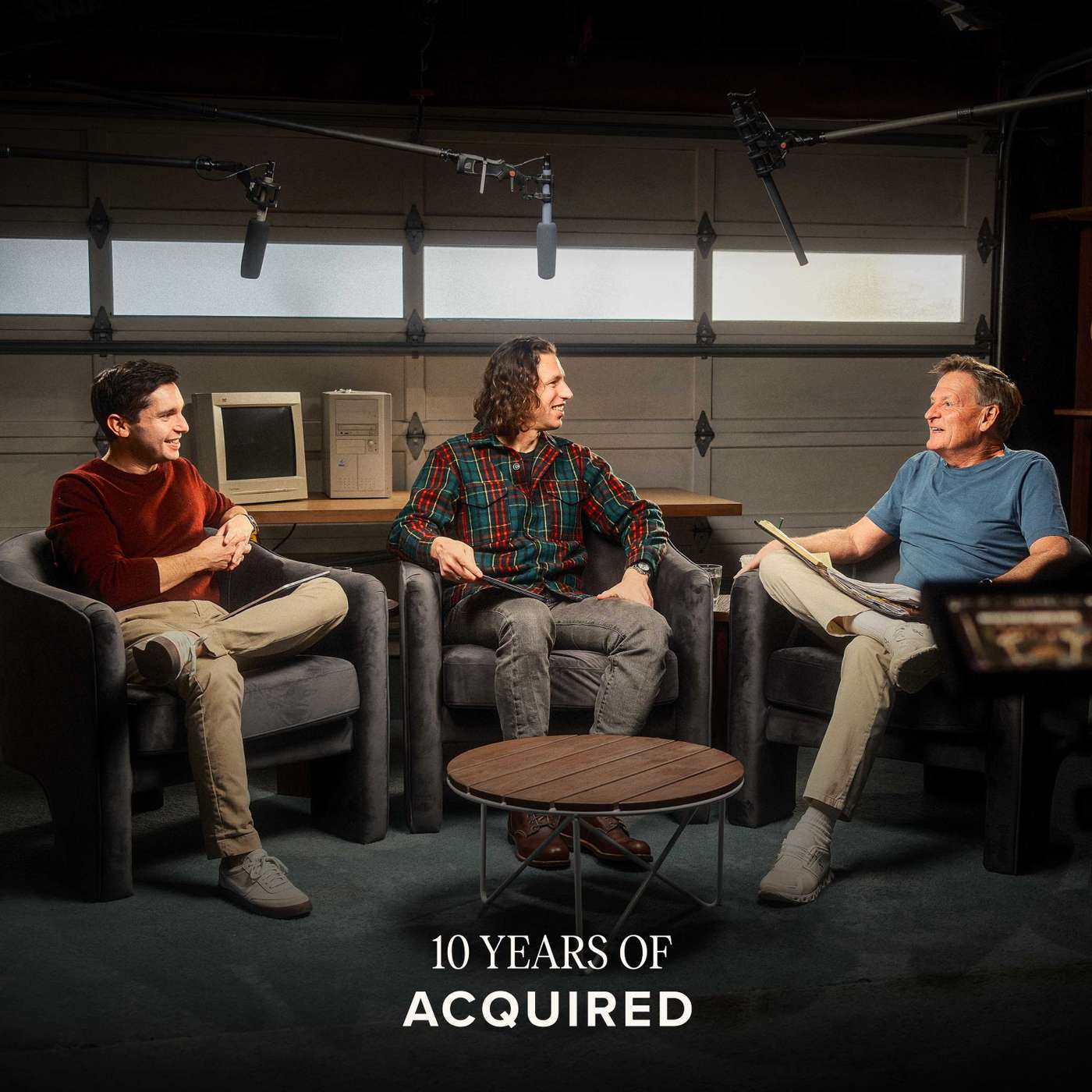
And there was really only one. Michael Lewis, author of Moneyball, Liar's Poker, the Blind side, the Undoing Project, going infinite on and on and on. And of course, host of his own podcast, against the Rules. And Ben, you and I have looked up to Michael forever. So this was really Special.
- [02:46]
Ben Gilbert
Yes. And then of course, there's the venue. We thought it'd be a fitting way to cap off the year of our three part Google series to record in the literal garage where that nearly $4 trillion company got started.
- [02:59]
David Rosenthal
Yes, indeed. Well, listeners, if you want to know every time an episode drops, vote on future episode topics and get corrections on past episodes, check out our email list at Acquired FM email.
- [03:09]
Ben Gilbert
And that email list just got a whole lot better with our first overhaul in five years. So you'll now get episode summaries, our big takeaways, and exclusive photos from our research process. That's Acquired FM email. Chat about this episode with us and the whole acquired community in Slack. Acquired FM Slack. And if you want more Acquired, check out our interview show, ACQ2. Our last episode was with Andrew Ross Sorkin, founder of the New York Times dealbook, host of CNBC's Squawk Box, and author of 1929. That's acq2 in any podcast player. And before we dive in, we want to briefly thank our presenting partner, JP Morgan Payments.
- [03:50]
David Rosenthal
Yes, just like how we say every company has a story, every company's story is powered by payments. And JP Morgan Payments is a part of so many of their journeys from seed to IPO and beyond.
- [04:00]
Ben Gilbert
So with that, the show is not investment advice. David and I may have investments in the companies we discuss. And this show is for informational and entertainment purposes only.
- [04:08]
David Rosenthal
With that, onto our conversation with Michael Lewis. Well, Michael, thank you for joining us.
- [04:14]
Michael Lewis
Total pleasure.
- [04:15]
Ben Gilbert
We have a little something, since this is our 10 year anniversary that we're celebrating that we need to do before we start.
- [04:21]
Michael Lewis
Okay.
- [04:22]
Ben Gilbert
So you went to Princeton. I went to Princeton, yep. My senior thesis would become impactful for acquired. I was a French literature major. I wrote my thesis on the history of Dom Perignon and the marketing history of Germany.
- [04:38]
David Rosenthal
Very serious college students.
- [04:39]
Ben Gilbert
Two very serious college data. A little different than yours.
- [04:42]
Michael Lewis
They let you do that?
- [04:43]
Ben Gilbert
They somehow I conned the French department into letting me do this and what, probably 12, 13 years later we made our LVMH episode and it was a big moment for a choir. Moet and Chandon has just released the 2015 vintage Dom Perignon. 2015 is the year we started.
- [05:05]
Michael Lewis
So I thought you were going to say that the effect that the Princeton thesis had on acquired. I didn't think it was as specific as that, but I feel that when I'm listening to your episodes, I'm listening to someone who's worked for up to a thesis. It is thesis like immersion in A subject.
- [05:23]
Ben Gilbert
Well, I can tell you our episodes are much better than my actual thesis was.
- [05:27]
David Rosenthal
But that is exactly how it feels.
- [05:29]
Ben Gilbert
But that is the process we go through.
- [05:30]
Michael Lewis
Yeah.
- [05:30]
David Rosenthal
And the finals the night before, there's a lot of, like, academic feelings that happen as we get close to recording day.
- [05:37]
Michael Lewis
So it's your show and I don't want to take it over, but I wanted to start by saying that I didn't discover it until this year. In July, I was at Google Camp, which is kind of a good way to discover Acquired.
- [05:53]
Ben Gilbert
And we should talk about where we are now too.
- [05:55]
Michael Lewis
And we are sitting in the Google garage. Where.
- [05:59]
David Rosenthal
Yes.
- [05:59]
Michael Lewis
I mean, I don't know exactly. I'm not sure exactly what happened in the Google garage. So this was the.
- [06:04]
David Rosenthal
It's a nice idea. Like literally, Susan Wojcicki lived here. She had, I think this was her house.
- [06:10]
Ben Gilbert
She had just bought the house and.
- [06:11]
David Rosenthal
Was looking to sublet part of it, like just make some extra money on other people using the house.
- [06:17]
Ben Gilbert
And posted a bulletin notice on the Stanford campus that there was space available here.
- [06:23]
David Rosenthal
And so Larry and Sergey's first desks when they got kicked out of Stanford, Stanford's offices were right there.
- [06:29]
Ben Gilbert
Right here.
- [06:30]
All right.
- [06:31]
David Rosenthal
I actually think this actual door desk sawhorse is the one that they were using because Google pulled it out of storage for us.
- [06:38]
Michael Lewis
So I'm at this camp with a lot of kind of well known people and a prominent CEO.
- [06:44]
David Rosenthal
Thank you.
- [06:45]
Michael Lewis
Says to me, you ought to listen. Have you listened to Acquired? And I didn't know what he was talking about. And I went and listened. I can't remember what I listened to first. I think it might have been the Morris Chang episode, but I had about eight different reactions to it, all positive. And I thought, this is. It's kind of amazing, which you all are doing. So then from July until now, I've listened to maybe, maybe 10 of the episodes, which is a lot of hours of listening to it. The first thing struck me, could not believe you were getting away with a four hour podcast. And I couldn't believe that even after four hours I was still looking for even more. That you created the environment with the podcast that I tried to create with the book. You grab the listener like I try to grab a reader and get them to the state of mind where they'll let you take them anywhere and teach them about stuff that they don't even know they want to learn about. I think if we're going to, we're doing this as the 10th anniversary sort of celebration.
- [07:43]
David Rosenthal
Please yeah, I'm honored.
- [07:45]
Michael Lewis
And I feel like. Kind of like I'm a little out of my depth here because I'm just a new listener and I haven't listened to all of it, and I'm hardly the world's authority on your podcast, and I didn't prepare at all except to listen to it. Except I did one thing, and that was I went back and listened to your very first podcast.
- [08:02]
Ben Gilbert
Oh, wow. Oh, wow.
- [08:04]
Michael Lewis
Just to compare.
- [08:06]
Ben Gilbert
Be kind, please.
- [08:07]
Michael Lewis
It is shocking how different it is from where you started, from where you have. You probably haven't ended up, but where you are now. So I'm gonna start by this 10 year journey. I think I can see some things you've learned.
- [08:22]
Ben Gilbert
Ooh.
- [08:23]
Michael Lewis
But I wanna know what you think you've learned. Give me. Let's do the 10 lessons from the 10 year journey.
- [08:29]
David Rosenthal
Do you have yours, like, crystallized? Cause I don't wanna taint you.
- [08:31]
Michael Lewis
No, no, I do have. It's actually one big thing.
- [08:36]
David Rosenthal
And.
- [08:38]
Michael Lewis
If you say it, I'll acknowledge that you sunk my battleship. And I have nothing to add. But I'm curious what you think. There's no way that first thing you did was ever going to become a hit.
- [08:52]
Ben Gilbert
Well, I'm curious if you think I've always believed something that's always been there from the beginning is the magic between me and Ben.
- [09:00]
Michael Lewis
That's interesting to me. You all meet at, like, a Passover Seder. Yes. And you end up being colleagues at a VC firm. Yep. I'll come back to that. I want to talk a little bit about you as investors, but we'll come back to that. And how that's different from being a podcaster. But at what point do you decide that. Oh, there's a kind of odd chemistry here.
- [09:20]
David Rosenthal
We really just wanted to spend more time together. It was one of these things where you're both straight.
- [09:25]
Ben Gilbert
Yeah.
- [09:26]
Yes. Okay.
- [09:26]
David Rosenthal
This is.
- [09:27]
Michael Lewis
Yeah. Both married. It's not a romantic relationship.
- [09:29]
Ben Gilbert
No. We like to say that we each have two spouses. We have our actual romantic spouses that we have families with, and then we have each other.
- [09:36]
David Rosenthal
But, like, David and I shared a bank account before my wife and I shared a bank account.
- [09:39]
Michael Lewis
So are either of your spouses threatened by the relationship? No.
- [09:46]
David Rosenthal
Just from a sheer time perspective.
- [09:47]
Michael Lewis
Yeah. Yeah, a little bit.
- [09:49]
Ben Gilbert
My spouse loves it because she doesn't actually want to spend that much time with me. She likes to. Like, I used to. All the stuff we do on a choir, I used to just talk at her and she wasn't interested.
- [09:59]
David Rosenthal
That Is true. My wife loves it, and she loves.
- [10:01]
Ben Gilbert
It because I get to talk to.
- [10:03]
David Rosenthal
Although she gets the rough draft, my wife won't listen to episodes because she's like, I've already heard four versions of the episode, and unfortunately, I heard four worse versions. And because I endure that and give you feedback, the listener actually gets the better version.
- [10:15]
Michael Lewis
Right. So you meet and there's a chemistry. Yeah. Explain that chemistry. What is it that you. When you. What is it that makes you excited to see each other?
- [10:25]
David Rosenthal
David knew all the Apple rumors in real time, just like I did. You had read all the latest Stratecheri posts.
- [10:32]
Ben Gilbert
We bonded over Ben Thompson originally, and.
- [10:35]
David Rosenthal
I think you can tell me if this is mutual, but I looked up to you because you were doing a thing that was mysterious to me, which was venture capital. I was a software engineer, and I got hired to work at a venture firm to do some incubation work, but I didn't know anything about the real job of venture capital. And here's David, someone who's just a few years older than me, doing that thing, but kind of in my peer age group. And I could lean over and be like, what are they talking about?
- [11:04]
Ben Gilbert
I kind of felt like a fraud in a lot of ways as a. I repressed this deep down, but if I'm honest with myself, I think I felt like a fraud as a VC because I'd never. I went to Princeton. I was a French literature major. I worked on Wall Street. I worked briefly at the Wall Street Journal, and then I became a venture capitalist. I had no qualification to.
- [11:22]
Michael Lewis
Have you ever coded or you ever done anything?
- [11:25]
Ben Gilbert
I mean, I took some CS classes in college, but, like, I'd never built anything. And so I was like, ben who? Ben. Ben who built all these things? Like, you built this for that website. You built so many products. You had products that millions of people use. And I was like, I'm just masquerading here.
- [11:41]
Michael Lewis
So you can. They'd been new stuff. It was exciting for you to know about.
- [11:46]
Ben Gilbert
Yes.
- [11:46]
Michael Lewis
Did you feel that David knew stuff?
- [11:48]
David Rosenthal
Absolutely.
- [11:49]
Michael Lewis
What kind of stuff?
- [11:51]
David Rosenthal
Business.
- [11:52]
Michael Lewis
Really? It wasn't generator. It was.
- [11:54]
David Rosenthal
No, no, no. I only found out years into doing acquired. He was a French lit major.
- [11:59]
Michael Lewis
But that's important, that French, that background.
- [12:02]
Ben Gilbert
It ended up becoming this kind of.
- [12:03]
Michael Lewis
Broad curiosity about things other than business and technology. I hear it in your program. I hear it in your podcast. So what I'm thinking of in my head is Kahneman and Tversky. I wrote a book called the Undoing Projects. And you could see. You could see two people. And then it got me thinking about collaboration. And I've had exciting collaborations with people. And the feeling I get is this person is bringing out a better version of me. Which is why I asked if your spouses were threatened because Kahneman, Tversky's spouse. Spouses were. Threatened's too strong a word. But they were very aware that the relationship that was the most important in their lives was with. Not with their spouse, but with.
- [12:46]
Ben Gilbert
I got the sense from the Undoing project that Kahneman and Tversky's relationship was very intense. I don't know that I would describe our relationship as virtuous.
- [12:56]
Michael Lewis
It was. Yes, it was.
- [12:58]
David Rosenthal
And competitive.
- [13:00]
Michael Lewis
Was not competitive. On Danny Kahneman felt. Was always felt at risk of being dismissed. Thought the lesser partner. There was a status difference between the two of them. Right. Going into it, everyone in the world thought Amos was the smartest person they'd ever met. You two didn't have that. Ever have any of that?
- [13:20]
Ben Gilbert
Not for me.
- [13:21]
Michael Lewis
But you said you felt like a fraud.
- [13:23]
David Rosenthal
I think I felt lesser. There were a lot of things when we started doing Acquired where we were doing this business analysis podcast, but I didn't know finance like it was, which.
- [13:32]
Ben Gilbert
Is you've become more, you know, the keeper of the analysis on Acquired, and I'm more the keeper of the story.
- [13:39]
David Rosenthal
It's different, though, than a difference in status. I don't feel that you or I have ever felt we had a difference in status. And the number of, like, fights we've had or real tension we've had is like two, three, ever in 10 years. I mean, it's weirdly. Let's come back to those non.
- [13:55]
Michael Lewis
And let's get to the lessons. What have you learned?
- [13:58]
Ben Gilbert
We started thinking about what have we learned from the companies we've covered that we've then applied to Acquired.
- [14:04]
Michael Lewis
All right.
- [14:04]
David Rosenthal
In particular, Acquired has clearly worked.
- [14:08]
Ben Gilbert
Why?
- [14:09]
David Rosenthal
And does that why have something to do with the fact that we study the world's best companies? Like, is there some osmosis that happens from the subject matter bleeding into the property itself? And so that's our frame.
- [14:23]
Michael Lewis
Okay, let's go with that frame.
- [14:25]
David Rosenthal
Yes.
- [14:26]
Ben Gilbert
So the one I was going to start with is the NFL. The product is scarce. 162 baseball games a year. It's called America's Pastime. You pass a lot of time with it, but with the NFL because the product is scarce, and then they have very smartly cultivated that and engineered it to be more scarce, more of an event driven sport that's made all the difference. And to me, as I look at what we do is insane for the podcasting industry. It's completely insane. We release. For the last three years, we've released 12 episodes. The next year we're gonna do eight. Eight episodes for the whole year.
- [15:06]
Michael Lewis
Now, as a hobbyist podcaster, what I get told is you have to be on all the time, and I can't do it, and so I'm not gonna do it.
- [15:13]
Ben Gilbert
Podcasting is like your second or third thing that you do.
- [15:16]
David Rosenthal
Right? Correct.
- [15:17]
Ben Gilbert
And you make more episodes, I think, per year than we do.
- [15:19]
Michael Lewis
That's correct. But they're just, you know, except for the scripted ones, which I do throw myself into, it really is. I do no preparation and it is a conversation, and I don't do very much of those. The scripted ones I do put time into, but it's a different sort of thing than what you're doing. It tends to be a very narrow little story that I'm telling you. Didn't start out, though.
- [15:40]
Ben Gilbert
We used to make 26 episodes a year.
- [15:44]
David Rosenthal
They were 40 minutes long to an hour 20.
- [15:46]
Michael Lewis
And so how do you go from that to realizing and did you really learn it from the NFL or did you just do it? And then it was.
- [15:52]
Ben Gilbert
We were starting to do it and then we covered the NFL and we were like, aha, this is what we're doing.
- [15:56]
David Rosenthal
Most of these things are actually, I think, are confirmation bias. We get some inkling that, like, we should continue to go in this direction. Like my. In calling out Hermes. It's because I think quality and scarcity have become an important part of acquired. And in some ways we, like, learned that from Hermes, but we covered Hermes last year. I think we found our way to that probably 4ish years ago, maybe five years ago, where we used to feel like we were bad at podcasting because we couldn't make very many and because we didn't have a whole production team and we didn't have professional ad salespeople and we didn't have.
- [16:31]
Ben Gilbert
We weren't full time for a long time.
- [16:33]
Yeah.
- [16:33]
David Rosenthal
And at some point we kind of looked at each other and we're like, maybe if we just admit that we are heavily constrained and then try to just lean into that constraint in the way that Hermes leans into. Every single Birkin bag must be handmade by one artisan. And we're going to build a business model around that and it turns out to be a great business. We sort of thought every episode is going to be entirely handcrafted. By us, all the research, all the recording. We work with this amazing audio engineer, Steven, who does the like literal waveform editing. But you know, we go in and in a transcript, highlight a thousand cuts per episode like it's this Made With Love product. And it turned out we could actually build a big platform and a good business out of something heavily constrained.
- [17:20]
Michael Lewis
That's not where you start.
- [17:21]
Ben Gilbert
No, no, no, no.
- [17:22]
David Rosenthal
How do we not.
- [17:23]
Michael Lewis
So let's just. People who don't know. Where you start is you're two guys who've met each other and got a crush on each other. You love being with each other and you get this idea that, oh, it would be really cool to do a podcast on corporate acquisitions that worked.
- [17:40]
David Rosenthal
Yeah.
- [17:41]
Ben Gilbert
Bad idea.
- [17:42]
Michael Lewis
Well, it is an idea. I would find you could easily have started the opposite. The corporate acquisitions that didn't. And you'd. You had much more material, which is.
- [17:50]
David Rosenthal
What most press at the time was. It was. Let's talk about how crappy this acquisition was.
- [17:54]
Michael Lewis
So it's interesting to me that your first step right from the start is positive. It's like what worked. Not what didn't work. It's what worked.
- [18:04]
David Rosenthal
That's. Cause we were VCs and I was trying to build companies. I mean, the goal was create things that have enough value to get bought or go public. And when people buy things, it's because they're working. So let's try to reverse engineer what works. Yeah.
- [18:17]
Ben Gilbert
Understand why things worked.
- [18:18]
Michael Lewis
Right. So that's a different starting spot from almost all journalism. Yeah. In fact, if most journalists started there, they'd be accused of hagiography of that. But because of where you're coming from and because you're thinking of this in very practical terms, like, why did this work? You do get away with it. It's just that first episode. You're almost like different people. But I'm going to hold back on what I think you learned because I want to see if you get to it. So what's the third episode that you have learned a lesson?
- [18:52]
David Rosenthal
I think Berkshire, we learned so many things from. We did this three part.
- [18:56]
Ben Gilbert
I didn't even think about it.
- [18:57]
David Rosenthal
On Berkshire.
- [18:58]
Ben Gilbert
Yeah, that's a good one.
- [18:58]
Michael Lewis
God, I have not listened to it. And I am a big investor in Berkshire Hathaway.
- [19:03]
Ben Gilbert
Good for you.
- [19:03]
Good for you. Since when?
- [19:05]
Michael Lewis
I bought it right in the middle of the financial crisis because I thought. I mean, I had done a take. I mean, it's not. It's a little. Putting it a little strongly. But oddly, I had written a Takedown of Warren Buffett on the COVID of the New Republic magazine called the temptation of St. Warren. You can probably dig it off of the way back.
- [19:25]
Ben Gilbert
What was the thesis?
- [19:26]
Michael Lewis
The thesis was that he may have started out being who he says he is, but that he's become this very different thing in the marketplace. His money's not like other people's money.
- [19:36]
Ben Gilbert
That's true.
- [19:36]
Michael Lewis
And you don't have a couple of things. Warren Buffett has, and his money is valued differently. But secondly, he was willing to do deals that at the time bothered the hell out of me. And what had happened was like the.
- [19:49]
Ben Gilbert
Goldman deal, or it was a Solomon.
- [19:50]
Michael Lewis
Brothers deal that bothered the hell out of me. He kept a CEO in place who I thought should not have been.
- [19:55]
Ben Gilbert
Were you there?
- [19:56]
Michael Lewis
I was there, yeah.
- [19:56]
Ben Gilbert
You lived through it?
- [19:57]
Michael Lewis
No, I was through it.
- [19:58]
Ben Gilbert
This is like part of our Virtue series.
- [20:00]
Michael Lewis
It turned me briefly, only briefly, actually cynical about Warren Buffett. And then I came out of it and fell in love with him all over again. But I had written this thing and pissed him off entirely. I mean, like, it would clearly upset him. And then kind of started watching him for longer and I thought, you know, I just liked him. Just liked him. You couldn't help but like him. So I started to soften. And when we get to the financial crisis, I thought, well, his money's going to be so valuable here that what is needed is credit. And I think it might, if he stays alive long enough, it might happen again soon.
- [20:33]
David Rosenthal
So you invested in Berkshire before the legendary deals coming out of the financial crisis?
- [20:39]
Michael Lewis
Yeah. And so I bought a chunk of the A shares and I've just sat on them and let me tell you. Can I tell you a Warren Buffett story? I mean, this is a little talking a little bit out of school, but I've never met him. I know he was really irritated with me. And then I actually look back at that. It's the only time I've ever looked back at a piece I wrote. And I thought I overdid that. I went right back to the New Republic and wrote another 5,000 word thing about Warren Buffett in which I basically apologized for the first piece. I bought these shares in 2008 when I was working on Going Infinite. I was working on the Sam Bankman Fried book, and I was talking to a publicist completely unrelated to Warren Buffett. And she said, you know, I also represent Warren. And she said, and I told Warren that I'd been talking to you, and he said he has a question for you. And I said, what? He says, is he the Michael Lewis who bought shares back in the financial. I swear to God. So this tells you something about Warren Buffett. More about Warren Buffett than me. And he said he bought it, like, the book value to that thing, that ratio. He bought it as cheap as it's ever been. And he says, but he.
- [21:49]
Ben Gilbert
You made the best trade.
- [21:50]
Michael Lewis
And then he says. Then he says, so he's the Michael Lewis who sold some Berkshire Hathaway two years ago and four years ago. And he was like, why do you sell? So he's tracking. I'm not a huge.
- [22:06]
Ben Gilbert
I can't imagine you, like, you're not like, Vanguard here.
- [22:09]
Michael Lewis
No, no, no. And I said, well, actually, I actually just gave him the charity is what I'd done. I'm giving the money away.
- [22:15]
Ben Gilbert
That's unbelievable.
- [22:15]
Michael Lewis
And when he heard she said, he'll be relieved to hear that kind of thing. It's like, so can you imagine. Can you imagine that Warren Buffett is taking the time to watch who is coming in and out of the A shares and. And thinking about it? I mean, I just thought he has. That. He and Munger had that whole thing about don't put your money in an index fund. Put your money in a big bundle of stocks. Put it in a few stocks and watch those stocks like a hawk. It's like they watch that thing in a way that, like, in history, has anybody ever done anything.
- [22:45]
Ben Gilbert
I mean, all these people are the maniacs. You don't build something like this if you're not maniac.
- [22:49]
Michael Lewis
That's exactly right. So anyway, sorry, I digressed here, but what did you learn from your Berkshire. There are three episodes of Berkshire Hathaway.
- [22:56]
David Rosenthal
Well, as it applies to acquired, we got really obsessed with the circle of competence, that it's okay to have a giant too hard pile. There's a bunch of things that, like, I'm not intelligently saying no to.
- [23:08]
Ben Gilbert
We used to say this all the time. We'd be like, too hard pile.
- [23:11]
David Rosenthal
Every phone call we'd have would be.
- [23:12]
Michael Lewis
What is the pile expression using?
- [23:14]
Ben Gilbert
So Warren and Charlie had this thing. There was the, like, the yes pile, the no pile, and then the too hard pile.
- [23:22]
Michael Lewis
The too hard pile. I see. Okay.
- [23:24]
David Rosenthal
And it's okay.
- [23:25]
Ben Gilbert
The too hard means all the time.
- [23:27]
Michael Lewis
The technology was a too hard pile.
- [23:28]
Ben Gilbert
Yeah. It was just all, yeah, there might be something in here, but, like, I'm just too hard.
- [23:33]
David Rosenthal
It's basically admitting that, like, our opportunity cost is so high. Like, the things that we say yes to are so awesome. That it's okay to say too hard to just a giant amount of things.
- [23:43]
Michael Lewis
Yep.
- [23:44]
David Rosenthal
And that was really freeing once we started. Just like, I mean, truly on most of the.
- [23:49]
Michael Lewis
So what's an example of something that you. I'm surprised you say this.
- [23:52]
Ben Gilbert
What's too hard for me? One of the reasons, besides just wanting to meet you because you've been an inspiration to us forever, that I wanted to meet you a few months ago was Hollywood. We've had lots of opportunities to work with Hollywood. It keeps being to this point. You have thus always, invariably ended up in the too hard pile.
- [24:13]
Michael Lewis
Are you talking about doing episodes in Hollywood?
- [24:16]
Ben Gilbert
No, no, no.
- [24:17]
Michael Lewis
Or to become a movie star.
- [24:18]
David Rosenthal
Creating TV shows. Creating a movie.
- [24:19]
Michael Lewis
Creating a TV show.
- [24:21]
David Rosenthal
Adapting these stories into films. They all sound good until we start digging in, and then we're like the time it would take us to think through all the implications of this.
- [24:32]
Ben Gilbert
We should just make another episode. The answer almost always is we should just make another episode.
- [24:37]
Michael Lewis
That's a really intelligent place to land. Because what they will do is woo you with their enthusiasm and then take you down a rabbit hole where you will spend years of your life and have nothing to show for.
- [24:50]
Ben Gilbert
Well, this is one of the reasons I want to talk to him. Like, Michael's a very smart guy. You've been very successful.
- [24:53]
Michael Lewis
I've gone down the rabbit hole. Yeah, but you love knowing that didn't have a whole lot else better to do at the time. It's like, between books, it's a palate cleanser. You don't have a between books period.
- [25:04]
Ben Gilbert
You know, we need to.
- [25:06]
Michael Lewis
Yeah, I don't have that. I don't have a. I don't have the machine. You have. You've got an assembly line going, and.
- [25:11]
David Rosenthal
It'S a compounding asset. I mean, this is the craziest, craziest thing about podcasting. And, like, a giant amount of why this has worked for us is we do a lot of work that looks a lot like the research and the writing of a book. But when we make our book and we release it to the world, people click, subscribe. And so when we release the next book, get the next book, those same people go, listen. Like, it's almost guaranteed.
- [25:33]
Ben Gilbert
Because we're always growing our base podcasting.
- [25:35]
David Rosenthal
Being an author, there's loose compounding elements to it, but there's not a, like, literal.
- [25:41]
Michael Lewis
Nearly what I thought when I got into the business of writing books. I thought there was gonna. I thought about this a little bit, and so you're right.
- [25:48]
Ben Gilbert
But you've probably done it better than.
- [25:49]
David Rosenthal
You're one of the few people who probably does have a brand.
- [25:52]
Michael Lewis
I'm going to move around America to the various arenas of ambition. Wall Street, Silicon Valley, Washington, movie business, sports, various things. And I'll naturally attract the audience that is interested in that arena and then I'll drag them along to the others. And it hasn't really happened that way even for you? Not really. Not really. The books have a kind of market, and it's a big market, biggish market, but it doesn't. I see no evidence that I'm dragging people along with me. I feel like each book feels like another startup and that I've got to go out and make it happen, almost as if I've not written one.
- [26:32]
Ben Gilbert
Now, that's Moneyball. Audience is not necessarily fifth risk.
- [26:36]
Michael Lewis
Exactly. And the audiences end up just being different. So it's just the way it is. But that's not true with you.
- [26:43]
David Rosenthal
That's not true.
- [26:45]
Michael Lewis
So every time, if you were to take time off to go do something in Hollywood, you'd be abandoning this glorious network.
- [26:53]
David Rosenthal
The opportunity cost is so high of spending a month not making an acquired episode. Because when we publish an episode of acquired, the base does come with us. Not all of it, but like, you know, we make epic systems about healthcare. And all the people who listen to LVMH are now learning how Doctor's Office, it works.
- [27:10]
Right?
- [27:11]
So podcasts are unique in that it does have that true subscriber base. But unlike anything else where you click subscribe, there's not an algorithmic platform that disintermediates you. I mean, you think YouTube or Twitter or any of these. When someone clicks, follow or subscribe, it's like signal in the algorithm, but it's not guaranteed. But you subscribe in Apple Podcasts or Spotify, and those people are actually subscribed and they're gonna get the next episode right.
- [27:38]
Michael Lewis
And they learn to trust you. They learn to trust you that if you're interested, they'll be interested. That in fact what they're buying into is not the subject, but your interest in the subject.
- [27:46]
David Rosenthal
Yes. And I am terrified of betraying that trust. Like anytime we make an episode, I think of it as a churn opportunity. If we put this in the feed, if we don't live up to the expectations that our listeners have, we will burn them and they will use us forever.
- [28:01]
Ben Gilbert
In the why Does Acquired Work framework, there's a strong element of terror of why it works. We're constantly terrified every time we make an episode.
- [28:10]
David Rosenthal
Every minute is a churn. Opportunity.
- [28:13]
Ben Gilbert
Are we letting people down?
- [28:15]
All right, listeners, now is a great time to thank our presenting partner, JP Morgan Payments. And we want to tell you about something pretty cool that we just did with them last week, which was a big live show in Las Vegas together.
- [28:27]
David Rosenthal
Acquired residency in Las Vegas, baby.
- [28:31]
Ben Gilbert
No, no, no, no. But what we did do is we.
- [28:34]
David Rosenthal
Took the stage at the beautiful venetian theater at AWS re invent. We did four really just incredible interviews with the CEOs of Netflix, Perplexity, AWS and JP Morgan payments. And I will say, Ben, it was extra special in retrospect. We were talking with Greg Peters, the co CEO of Netflix and asking him how Netflix is reshaping Hollywood just a few hours before they announced the Warner Brothers acquisition.
- [28:59]
Ben Gilbert
He has a pretty good poker face.
- [29:00]
David Rosenthal
Given that we were, you know, in Vegas and all that.
- [29:02]
Yeah, that he does.
- [29:04]
Ben Gilbert
Also very funny to interview Matt Garman from AWS at his own event. And I will say one of the most interesting conversations was with Max New Kirchen, the global co head of JP Morgan Payments. We dug into this question that I've always wondered about. How did the leading global bank also come to own this technology business that does $18 billion a year in annual revenue on its own, separate from the rest of J.P. morgan?
- [29:29]
David Rosenthal
Yeah, it's wild. If J.P. morgan payments were a standalone company, it would very likely be in the Fortune 500, but it's also part of J.P. morgan.
- [29:37]
Ben Gilbert
Max also told us about JPM Coin, developed by Connexus by J.P. morgan and how it's helped the bank and even Jamie evolve their thinking on how blockchain technology is transforming financial infrastructure.
- [29:49]
Overall, it was a great week.
- [29:51]
David Rosenthal
We hung out at JP Morgan's booth on the show floor and got to see their developer portal being demoed live in action to customers too.
- [29:57]
Ben Gilbert
Yep. So if you want to learn more about these innovations in payments and how JP Morgan can help power your business, head over to JPMorgan.com acquired.
- [30:06]
Michael Lewis
Are you more terrified than you were two years ago?
- [30:08]
David Rosenthal
Yes.
- [30:09]
Michael Lewis
So you're growing.
- [30:10]
Ben Gilbert
The terror is growing. The terror is growing.
- [30:11]
Michael Lewis
At some point, it's not going to be a good thing. It's good to be a little on edge.
- [30:16]
Ben Gilbert
Yes. Yeah.
- [30:16]
Michael Lewis
But you don't want to get yourself in a situation where you feel like you do the same thing over and over again. Because eventually it will get old. We'll come back. This is. We're going to get to the bull and the bear case at the end, but it's this is so back to your. The lesson that you gleaned from Munger and Buffet. It's okay to have a too hard pile. And you said, and the too hard pile is like doing things in Hollywood. But when I asked the question, did you ever run across this? Have you run across this? Have you ever had a subject where you thought this is just too hard to do?
- [30:44]
David Rosenthal
Yeah.
- [30:45]
Ben Gilbert
Oh, yeah.
- [30:45]
Michael Lewis
What would be an example of that?
- [30:47]
David Rosenthal
We got pretty far down the line on doing an episode on the Fed.
- [30:50]
Ben Gilbert
Yeah.
- [30:51]
David Rosenthal
And walked away from it.
- [30:52]
Michael Lewis
Yep. So you walked away from it.
- [30:55]
David Rosenthal
Yeah. We might come back, but it's been quite fun.
- [30:57]
Michael Lewis
It'll be a moment to come back to.
- [30:58]
Ben Gilbert
Yeah, yeah, yeah, yeah. I'm glad we didn't.
- [31:01]
Michael Lewis
This would be better to do. Although it's going to violate your rule about doing newsy things.
- [31:05]
Ben Gilbert
We always try and find things. Must be timelessness is like a must must. Everything we do must be timeless. The company we're covering, nothing's timeless.
- [31:16]
Michael Lewis
So what do you mean by that?
- [31:17]
Ben Gilbert
It must be that, like, if you listen to this, an episode that we make five years after we made it, it's 80% as relevant. It will still be an important institution in the world.
- [31:28]
Michael Lewis
Right.
- [31:29]
David Rosenthal
But like a CNBC article is worth 2% of its original value within a month.
- [31:36]
Michael Lewis
Right?
- [31:36]
Ben Gilbert
Yeah.
- [31:36]
David Rosenthal
And we want to be worth 80% of our original value five years from now on any given piece of content.
- [31:41]
Michael Lewis
So does that mean you're picking institutions that you think will survive?
- [31:45]
David Rosenthal
Yes, yes.
- [31:46]
Ben Gilbert
But. Okay, so that's like baseline bedrock.
- [31:49]
Michael Lewis
So much of your stuff is tech and finance, where there's so much churn.
- [31:52]
Ben Gilbert
Well, yes.
- [31:53]
David Rosenthal
This didn't used to be true. You look at Anything pre tour 2020, 2021, we had not yet discovered this.
- [31:59]
Ben Gilbert
Principle, but our real bangers are timeless and timely. Doing Google this year was timeless and timely.
- [32:06]
Michael Lewis
Right. Having that, however you do it, you're getting to something that I try to get to when I'm picking subjects, but you're doing it in a slightly different way. What I like when my socks start to go up and down about a subject is when I'm really interested in it and nobody else is, that there isn't that there aren't people. It's not hot. And I found with, I think it's true of basically all my books, maybe a couple exceptions, but a lot of the books that if I'm at a dinner party and someone asks me, what are you working on? And after about 60 seconds, I can see their eyes glaze over like why is he interested in that? You know, it's just not registering with them in any way. And I've learned just to not even talk about it because it kills my interest to watch kill their interest. But I know why I'm interested and why it's important. And I'm not relying on the world telling me it's important. That's a really good sign.
- [33:06]
David Rosenthal
This is a difference between what you do and what we do. Because I feel like when I think through all your books, they're almost always a story of obscurity, that once it becomes a Michael Lewis book, then it becomes a well known phenomenon. Moneyball. Like you are discovering these things that kind of nobody's talking about. Whereas when we do something like Trader Joe's, someone says, what are you working on? And we're like, trader Joe's. They're like, I love Trader Joe's.
- [33:32]
Ben Gilbert
Yeah, yeah, yeah, yeah, yeah.
- [33:33]
Michael Lewis
So that is a difference. Your subjects are not obscure, right? They're the most famous corporations, right?
- [33:39]
Ben Gilbert
People love it, but they don't really understand there's a secret hiding plain sight. A secret in hiding in plain sight. Like people didn't understand Trader Joe's or people didn't understand Google. We thought when we.
- [33:49]
Michael Lewis
Right.
- [33:49]
David Rosenthal
There's three things that make a great acquired episode. One, there's a compelling hero protagonist that takes a hero's journey where we're going from obscurity to ubiquity. How it starts as this thing that nobody cares about. And then it becomes the most important thing in the world. Two, is there's a secret hiding in plain sight, like Costco. I think when the ordinary consumer sees Costco, they're like, oh, I love Costco. But when someone who's listened to the acquired episode on Costco, thinks about Costco, they see like all the gears turning of the machine. Like we there, there has to be some way that we can expose something. And then our third criteria is it has to be important in the world. And I think that's something we picked up later. I mean, we used to do these like little $10 million acquisitions. And now when we're going to go spend two months of our life researching and making that like the acquired episode, it has to be something worthy of the acquired stage.
- [34:40]
Michael Lewis
When did that happen? So I'm a little unclear again, getting back to this first episode you did and where you are now and the difference between them, what sort of compelled you or propelled you into the current form of acquired. The decision to make it a business and the decision to Actually live off of what you earned from your podcast. So it had to work commercially. So then you started to make these adjustments. Is that how it works?
- [35:06]
Ben Gilbert
Yes and no. You're on the right track. I like the Berkshire. I thought you were gonna say partnership as a lesson from it. So we did a series on Sequoia Capital. The venture firm.
- [35:19]
Michael Lewis
Yep.
- [35:20]
Ben Gilbert
I went full time on acquired in 20, 25 years in. Ben didn't go full time until January 24th, right?
- [35:27]
David Rosenthal
Correct.
- [35:27]
Ben Gilbert
End of 23, beginning of 24 when I went.
- [35:30]
Michael Lewis
You remained equal partners.
- [35:31]
Ben Gilbert
Yes.
- [35:32]
David Rosenthal
Oh, it wasn't a business when we started. It was just like. I mean, we didn't make money till.
- [35:35]
Michael Lewis
Our third year, but those three years while you're full time and you were part time, it was an equal.
- [35:39]
David Rosenthal
Equal, yes. David never once raised the issue, I'm depending on this for my livelihood and it's my only thing, so I should own more or get a greater share. That never once came up.
- [35:50]
Michael Lewis
That's great.
- [35:51]
Ben Gilbert
It never crossed my mind.
- [35:53]
Michael Lewis
There we go. That's an important point.
- [35:56]
Ben Gilbert
I guess I'm glossing over it. Cause it wouldn't even. It didn't even cross my mind. Now it's always been acquired, has always been the two of us equal. It would be profane for it to be anything.
- [36:07]
David Rosenthal
It would actually break it if we ever started trying to figure out little carve outs or pieces of the pie for. Well, I did this, therefore I should get it's true collaboration.
- [36:16]
Michael Lewis
You don't recognize there's no boundary where you start and you start.
- [36:20]
Ben Gilbert
This is where I'm going with the story.
- [36:21]
David Rosenthal
It's funny you bring up Sequoia because it's actually benchmarky in that way.
- [36:24]
Ben Gilbert
Well, it's the quote. It's Leonie's quote.
- [36:26]
Michael Lewis
Okay.
- [36:27]
Ben Gilbert
So end of 22, FTX happens, interest rates go up, Podcast advertising market falls off a cliff, our revenue drops 40%. So we went from. This wasn't a business. I went full time. We made it a business. It worked amazingly well.
- [36:47]
Michael Lewis
From 20 to 22.
- [36:48]
Ben Gilbert
From 20 to 21 into 22.
- [36:50]
Right.
- [36:51]
And then our revenue dropped 40% overnight. And that was the moment when we changed everything. And. Oh yeah.
- [37:00]
Michael Lewis
So how many episodes are you making in 2021?
- [37:03]
Ben Gilbert
A lot.
- [37:03]
Michael Lewis
Oh, I see. Okay. And is it. But it's not. No longer just corporate acquisitions.
- [37:08]
David Rosenthal
We started broadening with the Tesla episode in like 2019, maybe 18.
- [37:12]
Michael Lewis
And why did you broaden?
- [37:14]
David Rosenthal
It was David's idea. And he said, I have this thesis that the audience doesn't listen to Us because they want to hear if a tech acquisition worked or not. They want to hear the story and strategy of the most important technology companies.
- [37:26]
Michael Lewis
There you go. So you would get all this feedback. You kind of foul hooked your audience.
- [37:31]
Ben Gilbert
Yes.
- [37:31]
Michael Lewis
They were listening.
- [37:32]
David Rosenthal
What's a foul hook?
- [37:33]
Michael Lewis
When you go fishing and the fish. You catch the fish by the belly rather than the mouth, the hook gets. The hook gets. Gets in some weird way, you didn't actually catch the fish in an honest way.
- [37:44]
Ben Gilbert
Yes. But yeah, we would get all these emails every time we meet people and they talk about the show. I love the story. You guys are just gifted storytellers. That's what we hear over and over and over again. And eventually we're like, well, we should believe that.
- [37:59]
Michael Lewis
So at that moment, I'm going to interject what I noticed because that in that first episode, you were so unsure of yourselves. There is. You were so choked, both of you. And you have a background in theater. You were a kid.
- [38:16]
Ben Gilbert
We both do. Yeah.
- [38:18]
Michael Lewis
So you did not come across as people who'd been on stage. It was kind of an affectless performance. There was a flatness to it. You were afraid to, whether you knew it or not, exhibit a lot of emotion. You didn't realize that one of your secret sauces is emotion. It's the way you respond to each other when you're presenting material, is teaching the audience, is helping the audience understand how they should feel about it. That you're giving them sometimes very dry facts like, I don't know, their revenues doubled every year for 100 years straight. And the audience may not know. Summing up every acquired episode, that that's an incredible thing.
- [39:01]
David Rosenthal
Right.
- [39:01]
Michael Lewis
And the way you respond. Even sophisticated listeners are helped. Oh, pay attention now. That's an important thing. I should get excited about that.
- [39:13]
Ben Gilbert
We used to share our research such that we were doing research in the early days. I think we only had a single Google Doc that we weren't doing.
- [39:21]
David Rosenthal
We were just dumping everything into the same shared document.
- [39:22]
Ben Gilbert
We were on the. So by the time we would actually go to record the episode, there's no surprise. Yeah, there's no surprise.
- [39:28]
David Rosenthal
There's no disagreement.
- [39:28]
Michael Lewis
We can't pretend to be surprised or you would be pretending to be surprised.
- [39:32]
David Rosenthal
Neither of us are good actors.
- [39:33]
Ben Gilbert
I don't. When did we.
- [39:35]
David Rosenthal
We did a little cold intro.
- [39:36]
Michael Lewis
This is really important. So you added an improvisational component.
- [39:40]
David Rosenthal
Yes.
- [39:40]
Michael Lewis
There's another way of putting that. You're added risk. You're taking risks when you don't know what's gonna happen.
- [39:46]
David Rosenthal
When you come on 100% agree, every episode now going into recording day feels like a high wire act because we haven't fully scripted it out. I'm like, I think this is gonna come together. But we had to add this thing called a production meeting about six months ago. One week before recording, we are required to get together and share. Agree on an episode's structure, but not share any details. Because we got so into this improvisation thing that some of our episodes would sort of end. And you're like, that had no flow to it like you guys had. Well, and sometimes it doesn't work. Different ideas.
- [40:18]
Michael Lewis
You're not taking risk if it doesn't work sometimes. Right. But it's the difference between. I mean, do you know how your heart sinks when someone gets up at a podium with a script, with a speech and they're gonna read their speech? The audience is waiting for you to get through this thing because they know nothing's going to happen. Like, whatever's on that page, that's what's gonna happen.
- [40:38]
David Rosenthal
Pre announcing the score to the Super Bowl.
- [40:40]
Michael Lewis
It's exactly right. And that if you get up and you just start talking, the audience also knows, oh, my God, this could be a disaster. They don't know where it's going. Just having just some of that has a huge effect on the way the audience responds to the performance. And so that is not in the beginning.
- [41:00]
Ben Gilbert
Do you remember when we started doing that?
- [41:03]
David Rosenthal
Well, I think in the first 10 episodes, first five episodes, we got feedback saying, you guys need to disagree more. But I don't think we quite realized that we should reveal surprises for each other until five years ago, four years ago.
- [41:16]
Ben Gilbert
But at some point we made it an unwritten rule of, like, we have separate documents, we prepare separately.
- [41:23]
David Rosenthal
We try to do, like, separate research calls.
- [41:25]
Michael Lewis
That was five years ago, you say. So the basic. So we start with the corporate acquisitions in 2015 and you two knowing everything that you're gonna say when you get on, basically. And it's short and it's 40 minutes.
- [41:37]
Ben Gilbert
Yeah.
- [41:39]
David Rosenthal
And we're not confident. What you're doing too, is like, I'm supposed to be doing financial analysis. As someone who's never been taught how to read a financial. And so you're also hearing a little bit of like, imposter syndrome. I can't get over enthusiastic because I'm afraid David's going to catch me and be like, you don't know what you're talking about.
- [41:54]
Michael Lewis
Okay. Plus, so there's an uncertainty about your own abilities. All right, so first thing that happens is you move off the corporate acquisitions.
- [42:05]
David Rosenthal
We went from acquisitions to IPOs, which was unbelievable timing in 2017. 18, when Uber, Pinterest, Slack, they've been the eight IPOs in a row of tech companies that everyone had been following. And then it went really, for two years and kind of culminated at the end of 2020 with DoorDash and Airbnb, which we recorded and released one day apart because we wanted to. We would never do that today on IPO day.
- [42:31]
Michael Lewis
So once again, you're constraining yourself unnecessarily.
- [42:34]
Ben Gilbert
Yeah, exactly.
- [42:35]
Michael Lewis
Eventually, you get to. We're just going to do stories, big success stories, basically.
- [42:39]
David Rosenthal
So it was acquisitions, IPOs, then it was broad histories and strategies of tech companies, and then broad histories and strategies of companies, period.
- [42:49]
Michael Lewis
And people.
- [42:50]
David Rosenthal
And people with Taylor Swift and all.
- [42:52]
Ben Gilbert
People, we frame them as companies.
- [42:54]
Michael Lewis
In a funny way, you're still constraining yourself. You feel like you need this frame, and you actually. You're not really living in a frame anymore.
- [43:01]
David Rosenthal
Yeah, but constraints are good. Like format, force yourself.
- [43:04]
Michael Lewis
Sure, but you should. But at some point, you're gonna wake up and say, you know, we should be doing more biographies, geography. We should be doing more people. And if that person is not, you know, is not naturally a huge corporation, you may still. I have a feeling there's more. There's an evolution to come that you're not just. You haven't reached, like, the end point of this. So at what point do you start to feel confident, like, we know what we're doing?
- [43:32]
Ben Gilbert
Well, when the crash, you know, crash. When the reset happened in 2022, 2023.
- [43:38]
David Rosenthal
So pretty recently, crypto bubble tech stocks plummet, podcast advertising, advertising budgets kind of dry up. End of 2022, Ben and I looked.
- [43:47]
Ben Gilbert
At each other, and it was like. It wasn't even, like, really a conversation. We just knew what we had to do.
- [43:52]
David Rosenthal
We watched a lot of other people go for easy, secure money.
- [43:58]
Ben Gilbert
Now try and keep the music playing right. And we were just like, party's over. We need to get to work. We need to focus on only what is enduring and make great, great, great work and stop doing everything else. Like, up until that point, we used to do these things called specials. We would just do not totally random, but essentially random interviews and undifferentiated topics. And we said, we need to start making stuff that is only n of 1. Only we can do will only be great. We need to stop doing everything else.
- [44:33]
David Rosenthal
And we did it on the commercial side, too. We said, let's Go cut deals with our favorite partners, get rid of most of our sponsors and try to just figure out when we come out the other side of this, that we have the best companies to work with commercially as well as the most durable stories and brands associated with us. Because of the editorial side of the.
- [44:52]
Michael Lewis
House, the J.P. morgan's of the world. Did they join before you proved that this new way of doing it?
- [44:58]
Ben Gilbert
No, we did a year. 2023 was the first year.
- [45:01]
Michael Lewis
And what were those episodes?
- [45:03]
Ben Gilbert
That was LVMH, that was the NFL, that was Porsche Deep Dive. That was the beginning of what we were really.
- [45:10]
Michael Lewis
These long term episodes.
- [45:12]
Ben Gilbert
Yeah, yeah. And I think that's when we started to build the confidence of like, oh, we can do something that.
- [45:18]
Michael Lewis
Isn't it interesting that you grabbed this kind of commercial attention only after you went really long?
- [45:24]
Ben Gilbert
Yes. And so then JP Morgan came in in the January 24th. So we had did the year of kind of building this out.
- [45:32]
David Rosenthal
You're right. It was only after we had sort of leaned into acquired as a brand about durability, about compounding over decades and you know, centuries. And I don't think I appreciated that as a person in the early days of acquired. And it certainly wasn't what the show was about.
- [45:49]
Michael Lewis
Yeah. Anyway, so I got us a little off track. Your lesson number three was Berkshire Hathaway. And don't be afraid to have a too hard pile. Pick another.
- [45:59]
Ben Gilbert
Okay, so then I'm doing 10 of these. My frame for all this story was Sequoia. So this story is very different than Sequoia. But we interviewed Douglione who was one of the, I guess two stewards ago of Sequoia. And he told us that after the dot com crash for the Sequoia fund, that was the dot com bubble fund, every other venture firm out there after the bubble popped were taking Mulligan funds. They went to their LPs and they said, there's nothing we can do on this one. We're going to be more disciplined next time. We said, absolutely not. We will never lose money for our investors, ever. We will do everything we can possibly do to make this fund in the black. And he said, I think the best line anyone's ever said on acquired, he said, we looked at each other and you could burn cigarettes on our arms and we wouldn't flinch. And they spent the next five years, they didn't raise another fund. They just went to work with the.
- [46:57]
David Rosenthal
Portfolio and they stopped taking fees for a while.
- [47:00]
Ben Gilbert
They stopped taking fees? Yeah. And got it back and it Ended up being a positive returning fund.
- [47:06]
Michael Lewis
This is how you get a reputation.
- [47:08]
Ben Gilbert
Exactly. And that was that moment for us.
- [47:10]
Michael Lewis
And easy to lose one, too. And so, I mean, they were really sensitive to reputation.
- [47:18]
David Rosenthal
We'd studied enough businesses by that point where we saw what led to durability. And I think we already were awake to the idea that all that matters is the late years of compounding. Like, in any given year, you look at a Mag 7 company and their profits from the last year are greater than the first 20 years combined or whatever. And I think realizing that being around and being respected on the other side of this economic chasm is the key to everything. Who cares about making money this year? It's about 5, 10, 20 years from now. And we have to have the brand that people want to be a part of then.
- [47:58]
Michael Lewis
Right. But you don't know that you are a Mag7 podcast.
- [48:05]
Ben Gilbert
It's kind of ridiculous to compare.
- [48:08]
Michael Lewis
When you make this decision, you don't know that there's going to be great riches 10 years out or five years out or three years out.
- [48:14]
David Rosenthal
Yeah.
- [48:15]
Ben Gilbert
But really, like, I think we were just. We both so believed. It was like the burn cigarettes on our arm. Like, I think we just both so believed that that was the right thing to do.
- [48:23]
David Rosenthal
Something has happened.
- [48:24]
Michael Lewis
Quality. Yeah. So something had happened before that, and you had figured out how to do this. You'd figured out how to study a business in a way that was really interesting. The first episode's not that interesting. Yeah. There's just not that much I didn't know, hadn't thought of. Whatever.
- [48:40]
Ben Gilbert
I don't know much about Pixar, but tell a story.
- [48:42]
Michael Lewis
And it's 30 minutes or whatever it is now in that first episode, I think there are more ads than there are you two speaking.
- [48:50]
David Rosenthal
And now we pride ourselves on having the lowest.
- [48:52]
Michael Lewis
Yes, I know, I know, I know. So let's pause here before we get to number four. How do you study a business? Like, what have you learned about how to study a business that's different from when you started out? Explain to the audience what you do to prepare, what you do to learn about a business.
- [49:08]
David Rosenthal
Great.
- [49:11]
He'll read everything ever about them.
- [49:13]
Michael Lewis
So. Yep, you do what I do. Yeah, yeah. Whatever's out there. Right, right. So you do what's AI? That's just the AI part of it.
- [49:20]
David Rosenthal
Who started with canonical? Who's done great canonical work in the past? And then what ideas do you have from reading the previous canonical work? And, you know, you then say, like, I wonder if I can find this old YouTube video. And then those YouTube videos mention something else. And the spiderweb always starts with the pre existing canonical novel.
- [49:38]
Michael Lewis
At what point do you pick up the phone and start calling people who maybe have information that isn't on the.
- [49:44]
David Rosenthal
World Wide Web zero ever until about 2023. And now that is the most important.
- [49:49]
Ben Gilbert
Way that we can get around 50% for me, at least about 50% of the way through the like start to get your arms around, then start calling.
- [49:56]
Michael Lewis
Right. You don't call uninformed, you call knowing as much as there is to know. And then you start picking the brains of people who might know more and have not said.
- [50:04]
Ben Gilbert
There's like the obvious people to talk to. Like you know, for Google we talked to Sundar Demis or like, you know, like obvious. Then there's like the less, slightly less obvious.
- [50:14]
Michael Lewis
You just say that so casually. Who gets to pick up the phone?
- [50:17]
Ben Gilbert
Well, as part of the compounding effect.
- [50:19]
Michael Lewis
Talk to the CEO of Google about Google. I mean nobody.
- [50:23]
David Rosenthal
We're in a scale economy.
- [50:25]
Ben Gilbert
We're in a compounding business.
- [50:26]
Michael Lewis
Right. So the fact that you. When do you first realize that you can pick up the phone?
- [50:32]
Ben Gilbert
That's a good question.
- [50:33]
Michael Lewis
And call Tim. You know, you're on this first name basis with all these people. When does that start?
- [50:40]
Ben Gilbert
I think it was our Microsoft series when we talked to Steve, to Bomber Steve. Here we go. Steve Cast Acquired guest Past Acquired Guest.
- [50:48]
Michael Lewis
Steve, name dropping in your world is so different from the name dropping in like Hollywood. None of your names mean anything in Hollywood, but they mean everything here.
- [50:58]
David Rosenthal
And the arenas are so funny because these people aren't, most of them aren't famous and they're 1,000 to 10,000 times wealthier than these Hollywood stars. These different yard sizes.
- [51:09]
Ben Gilbert
Well, what's funny with Microsoft had some access because Ben used to work at Microsoft before, which got us zero access. Well, no, no, but you knew some people. Here's in my mind what sort of happened with this as I'm trying to think about how to answer Michael's question. Because we had started in Seattle and you still live in Seattle and you'd worked at Microsoft when we started our Microsoft journey, we knew some people.
- [51:31]
David Rosenthal
Yeah, that's true.
- [51:32]
Ben Gilbert
We were like, well, let's see if we can talk to Steve. And so then we talked to Steve and we got his perspective on things and it completely changed how we Cold email, I think it was.
- [51:44]
Michael Lewis
Is that the first time you do that?
- [51:46]
Ben Gilbert
First time we reached that high?
- [51:47]
Michael Lewis
Okay, yeah.
- [51:48]
David Rosenthal
And you know what? This is where reputation Matters. Steve didn't get back to us for a day, and then we heard back, and he said, I don't listen to podcasts. I haven't listened to your podcasts. I talked to some people, but I talked to some people that I trust, and they say you're great, so let's hop on a call. And we wouldn't have gotten the response back if.
- [52:05]
Ben Gilbert
And he gave us probably three hours, four hours in research for.
- [52:09]
Michael Lewis
He did. Yeah. And you learned a lot.
- [52:12]
Ben Gilbert
Yeah. Before we even interviewed him. That was later, but just in research.
- [52:16]
Michael Lewis
I see.
- [52:17]
Ben Gilbert
And we learned a lot.
- [52:18]
Michael Lewis
Did you all have a moment where you thought, oh, my God, let's keep doing that? That worked.
- [52:21]
Ben Gilbert
Yes. Well, yeah. So then we were like, that works great.
- [52:23]
David Rosenthal
It kind of worked with Jensen, too. So originally, when we had the idea in 2021 to do Nvidia, we thought we were like an interview show. Then we thought the interviews would be better than our core storytelling episodes because we hadn't discovered that the Ben and David storytelling is our N of 1 product. It is the thing that we uniquely can do that no one else can do. And we thought getting these big gets would be the key to success, which is funny, because usually they underperform our standard format. And so in 2021, we emailed Nvidia through the warmest connection we could find and said, can we interview Jets?
- [52:55]
Ben Gilbert
We're planning to cover the company. Can we interview Jensen?
- [52:57]
David Rosenthal
And they said, they gave us a nice party lineback. He's very busy. And then in 2022, we did our Nvidia part one. We did our standard research process, and I think we did our part two.
- [53:07]
Ben Gilbert
We did part two, and then we.
- [53:08]
David Rosenthal
Got a note from Nvidia saying, jensen has listened and wants to know who your inside sources are, because it's the most correct telling of Nvidia's story ever. And we were like, oh, this was all just public information. And if you're good at spidering the Internet and just, like, digesting it and thinking about why he would have said something at this point in time to this audience in these various random university talks and stuff, you can kind of piece together the story. And so that's like.
- [53:34]
Michael Lewis
But you're still flying by radar a bit.
- [53:36]
Ben Gilbert
Yeah. Oh, we were totally flying by radar.
- [53:38]
Michael Lewis
Yeah. Yeah.
- [53:39]
David Rosenthal
But that landed us. They were like, that started the relationship. And eventually then they're like, all right.
- [53:43]
Ben Gilbert
He wants to meet you, and then.
- [53:44]
David Rosenthal
Do you want to do an interview and follow up on your episodes?
- [53:47]
Michael Lewis
But you did an interview episode with him. But it doesn't do as well as your own Nvidia episode.
- [53:52]
David Rosenthal
That one may have been like at some particular peak of Nvidia buzziness. So it was probably our then largest episode.
- [53:59]
Ben Gilbert
Well, here's what happens with interviews.
- [54:00]
David Rosenthal
Makes it small.
- [54:02]
Ben Gilbert
They spike faster.
- [54:04]
Michael Lewis
Yeah. And then they go.
- [54:05]
David Rosenthal
And those listeners don't retain the way that.
- [54:08]
Ben Gilbert
Whereas if you look at our Costco episode, which is now two and a half years old, or LVMH or Mez Rolex, like, they just, they just keep going. I mean, I'm sure your books are like this. Like, they just, they just keep going.
- [54:22]
Michael Lewis
Yeah, every time I bring out a new book, it has the same effect on the old books that a new podcast has on old podcasts. Yeah, it sells all the backlist. So, yes. All right. So I was asking you how you studied a business. You told me you read everything there is. And you must find. When you go and read everything there is, you're very polite and you're very generous about citing your sources and all that, but you must find.
- [54:48]
Ben Gilbert
My wife is an academic. My wife has a PhD. She was trained as an academic and she was like, you guys gotta cite your sources. Like, what are you doing?
- [54:55]
Michael Lewis
Well, yeah, but it's also. Are you ever surprised by the weakness of the source material?
- [55:03]
Ben Gilbert
Yeah.
- [55:04]
Yes. In fact, literally today we are no longer surprised.
- [55:07]
David Rosenthal
But we got an email from a company that we recently covered saying you said a factually incorrect story in the episode and we know the book that you got it from because it was factually incorrect in that book. We told the author that it was factually incorrect and it went out and anyway. And now you're repeating the incorrect story. And we have now an errata section where we publish to our email list.
- [55:28]
Michael Lewis
And I bet you're mainly correcting other people's errors that you just repeated.
- [55:32]
Ben Gilbert
Sometimes there are.
- [55:33]
David Rosenthal
Sometimes there. Ares. Yeah, sometimes we make a financial calculation error or something like that.
- [55:37]
Michael Lewis
Right. So we read all source material and then we start to make phone calls in 2023. And now the phone calls have become extremely important and you're making extremely. Yeah, 25 of them.
- [55:47]
David Rosenthal
Google was 40. Probably 40 across the years.
- [55:50]
Michael Lewis
And do you find that when you're reaching out by phone to all these people that they always want to talk to you or. No, no, sometimes it makes.
- [55:57]
David Rosenthal
Yeah, but usually when you approach it with a spirit of.
- [56:01]
Michael Lewis
I'm just trying to understand its own background.
- [56:03]
David Rosenthal
Yes. We are going to tell a narrative here. Our biggest question to you is what is most misunderstood and what incorrect Stories are out there where we can set the record straight. And you get lots of great information after that.
- [56:16]
Michael Lewis
It's a very good way to go about it. Yeah, I do the same thing when I'm researching something. I don't know what the story is for a longest time. And I'm holding everything very loosely. And almost all the relationships I have with people I'm interviewing is, hey, this is all on background. I just want to try to understand this. Can I hop on a call with you? And they're usually pretty open to it. And like, I just want to be educated kind of thing. And it's a great way to say, like, what's the stupid thing people say? Because everybody has an opinion, but it's not a trick.
- [56:45]
David Rosenthal
Like, this isn't. Here's one cool trick to get people to talk to you. I think you mean it earnestly. And we mean it earnestly of like, I wanna make something that's good. Everybody has different beliefs about the truth, but I wanna make the story that most correctly approximates the average truth that exists from all these different truthy sources.
- [57:05]
Michael Lewis
Yeah, yeah, yeah. I don't think of it quite that way, but I do think it's like, I wanna give something that's good and pure and true and is like. Is like the thing that will. Once it's said, there's nothing else to say. It's like, done.
- [57:17]
Ben Gilbert
Yeah.
- [57:18]
I gotta imagine for your subjects. And I think a big part of us too is, like, there's the truthy aspect, which is very, very important. But there's also the, like, this is gonna be great. Like, this is gonna be really fun. This is gonna be entertaining to read. And people are going to consume it. That's, I think, a huge motivation for our sources.
- [57:35]
Michael Lewis
Have you. So when you were working on one of these episodes, are you aware of how much fun you're having learning? And do you ever. Have you ever shut something down just because, oh, this isn't that much fun? The Fed, maybe that's kind of why.
- [57:48]
David Rosenthal
We killed the Fed. We've definitely killed other episodes.
- [57:50]
Michael Lewis
If you can find fun in the Fed, man, you are doing.
- [57:54]
Ben Gilbert
You can find fun in the world you were doing.
- [57:56]
Michael Lewis
Yeah, we can generate all that enthusiasm for each other's insights about the Fed.
- [58:00]
David Rosenthal
We killed Bell Labs cause we couldn't find a through line. There were so many different stories and so many different characters.
- [58:06]
Ben Gilbert
I know we might come back to it.
- [58:07]
Michael Lewis
Bell Labs. That's one that. If I saw it, I said, yes.
- [58:10]
Ben Gilbert
I want to listen to that. It feels Like a Michael Lewis book.
- [58:14]
David Rosenthal
You could kind of do it as the history of the transistor. But then you miss all these other things like radar and.
- [58:21]
Ben Gilbert
Yeah. There's so much stuff that came out about.
- [58:23]
Michael Lewis
Did you do Xerox parc?
- [58:25]
Ben Gilbert
No, no, no. But that's a good.
- [58:27]
Michael Lewis
It's another one, right?
- [58:28]
Ben Gilbert
Yeah.
- [58:28]
Michael Lewis
I guess Google still has this spirit where they're doing lots of stuff that maybe you can't identify instantly.
- [58:35]
Ben Gilbert
Quantum computing.
- [58:36]
Michael Lewis
Yeah. The payoff that's right around the corner. This kind of like let's just fiddle around, see what we find stuff. I mean corporate America, I think just generally does less of that than it used to do a long time ago.
- [58:47]
Ben Gilbert
But the big tech.
- [58:48]
Michael Lewis
Am I wrong?
- [58:49]
David Rosenthal
No. I'm trying to think. That's an interesting. So I'm stealing this idea from our friend Hamilton Helmer. But he brought up this idea in conversation with us that there is a positive benefit to monopolies because they create the cash flows that fund these sorts of boondoggle. Basic research and a lot of the most important technologies that move society forward. You need some waste come out of these.
- [59:18]
Michael Lewis
You need fat. Yes.
- [59:20]
David Rosenthal
And like, boy, does Google have that. I mean you just. Their last quarter was their first hundred billion dollar quarter ever. Astonishing.
- [59:27]
Michael Lewis
I know.
- [59:28]
David Rosenthal
And that's how they fund the next generation, right, Brian?
- [59:32]
Ben Gilbert
Waymo. And yeah.
- [59:33]
Michael Lewis
So actually you just bring up your friend Hamilton Helmer, who I'd never heard of until I listened to your podcast and you do that thing at the Seven Powers.
- [59:40]
Ben Gilbert
Seven Powers, Yeah.
- [59:41]
Michael Lewis
Let's just briefly since we're here, how you study a business that has been a useful analytical framework for you. Whatever these Seven Powers are. And I'll never remember any of them.
- [59:51]
David Rosenthal
That's why we say them every episode.
- [59:52]
Michael Lewis
Network effects and all that stuff. Yeah, yeah. What is it about Hamilton? Like where did you find him and why isn't you making him so famous?
- [60:02]
David Rosenthal
There's a lot of good frameworks out there for analyzing business strategy. And this one just clicked. I just read it and I was like, that is actually the complete list.
- [60:10]
Michael Lewis
When did you read it?
- [60:12]
David Rosenthal
You found the book?
- [60:13]
Ben Gilbert
I think it was 2020. I read that list.
- [60:16]
Michael Lewis
I read the list and it was all gobbledygook to me. I mean the words did not mean things. But if you didn't know what they mean.
- [60:24]
David Rosenthal
If I asked you in plain English, can you brainstorm all the ways in which a industry leading company gets away with being more profitable than their competitor and gets to keep being more profitable?
- [60:38]
Ben Gilbert
That's the list.
- [60:38]
David Rosenthal
You would Come up with, you might find a whole lot. What creates the moat? Yes.
- [60:41]
Ben Gilbert
Yeah.
- [60:42]
Michael Lewis
Right. So why did you decide you even needed that framework? We.
- [60:49]
David Rosenthal
Oh, it has always with the durability. If you're trying to study why is a business durable? The cause is the power.
- [60:57]
Ben Gilbert
We'd always been searching for a way to land the plane on the episodes. Like, we tell this story and we finish the story, but that's unsatisfying. What's the takeaway?
- [61:06]
Michael Lewis
Yeah.
- [61:07]
Ben Gilbert
And so we had all various permutations of analysis at the end.
- [61:11]
Michael Lewis
Buy or sell or hold, Right?
- [61:12]
Ben Gilbert
Yeah. We create bull and bear and grading and blah, blah, blah. Once we shifted to like, hey, we're studying these great companies, these durable businesses. Power felt like a really good part of that. So what. Why? For me, a critical, critical part of process. It goes back to writing a senior thesis at Princeton. Everything needs to pass through multiple cycles of source material. Through my brain, through my fingers, onto a keyboard, and recycle back through about three times. And so I don't use AI note taking. I do write physical notes in hard copy books. Like, if I'm not doing that, I feel like it's not gonna work. Yeah.
- [61:56]
David Rosenthal
His image.
- [61:57]
Ben Gilbert
What do you do?
- [61:58]
Michael Lewis
So I have exactly the same issue. I discovered I wanted to be a writer writing my senior thesis, and no ambition to do it before then. And then all of a sudden, I thought, oh, my God, I love this. And what I love was just that was the constant recycling of the thought. And. And so what I do the process. I don't want to get too far away from your podcast, but. So here I'm sitting with my notepad.
- [62:20]
Ben Gilbert
Yeah.
- [62:20]
Michael Lewis
Yeah. So this is a filter. Like, if I'm talking to you, it takes effort to put it down on the page. I don't record anything that I filtered it. It's interesting enough to me that it belongs on the page. Then I go home and I write the notes up quickly. And that's another filter. If what's on the page interests me enough to put it in a Word document, then I've got. It's filtered again. And I keep those notes while I'm working on a book. And the file will be 500 pages long, by the way, maybe longer by the time. And it's just stuff. And then I start thinking about, how do you frame this story? What is this story? But that's months, usually down the road. And there are times when I get into something and I am months into it, and I realize, oops, there's nothing here with Sam. Bankman fried. I was a year into it, and I did not know what I was going to do with it until it blew up. And then I thought, oh, my God, I had the story when it blew up.
- [63:19]
David Rosenthal
You had been sitting there for a year watching.
- [63:21]
Ben Gilbert
Do you think you would have not published the book if it hadn't?
- [63:24]
Michael Lewis
Oh, no. Wow.
- [63:25]
Ben Gilbert
You would have killed the book.
- [63:26]
Michael Lewis
Well, I might have found a way to do it. I might have found a way to do it, but I hadn't found a way to do it. And it was always the same conversation with my editor. It was, I just don't know where this is going. I don't know what the end is when I don't know what the end is. I don't know what the beginning is. And it's that simple. And it wasn't that, oh, I smelled fraud or anything like that. It was just. It didn't have shape to it. It was just. It was picaresque experience after picaresque experience. It was like Don Quixote, but the first chapter over and over and over and over. And so there was material there, which is why I kept coming back. It was fun. There were endless scenes. There were, you know, but it was just like, I don't know.
- [64:05]
Ben Gilbert
Yeah, but scenes don't make a. Scenes don't make a play.
- [64:08]
Michael Lewis
They're necessary. They're necessary, but insufficient.
- [64:10]
Ben Gilbert
Yeah, so.
- [64:11]
Michael Lewis
But the bigger point, I hate to. I don't want to be talking about me. We'd be talking about you. But this pro you are doing. I smell this from your work. You're doing something that rhymes with what I do. You are gathering before you make judgments. You're open to learning things. You're trying to be the world's best student. You want people to want to teach you. And then if people want to teach you, they will teach you. And then you could take what you learn and you could present it in the best way you can present it.
- [64:44]
David Rosenthal
I basically take a note in two scenarios. One is, oh, I just figured out how that works. And that is so cool. Like when I learned how a mechanical watch.
- [64:55]
Ben Gilbert
Yeah, you're the master of the, like, this is such a cool thing.
- [64:58]
David Rosenthal
It was like you got excited. This is in some ways irrelevant to the business success of Rolex, but it will make my year to explain on air how a mechanical watch works and how an escapement is a thing. And my excitement around that, those greatest.
- [65:16]
Ben Gilbert
Moments or the Costco ballet or like.
- [65:19]
Michael Lewis
Yeah, yeah.
- [65:20]
David Rosenthal
So there's the. I just figured out how something worked and Then there's the I just made a connection. And it's like, I'll be on a run. I'll be listening to an audiobook. It'll be the third audiobook that I've listened to about a certain subject. And I'll hear something and think, oh, that's why. And I'll stop and I'll write my little Apple Note this timestamp in this book. Just realized why I can't think of an example right now. This happened. And then later I go and I look it up in the Kindle book and I figure out how I want to explain the connection that I just learned on air. But it has to come from the I have to remember and bottle up my excitement of learning it in that moment to share that enthusiasm with the listener.
- [66:01]
Michael Lewis
Yeah, Yep, that's all very familiar to me.
- [66:05]
Ben Gilbert
All right, listeners, now is a great time to tell you about a great friend of the show, Work os. And since we recorded this episode in the garage where Google started, we thought this would be a fitting moment to talk about when a startup exits their proverbial garage phase and starts to become a real business.
- [66:22]
Yeah, garages were a little more popular.
- [66:25]
David Rosenthal
Back in the day with HP or Apple, or in the 90s with Google and Amazon all founded in garages. Today though, it's more likely an SF apartment or a coffee shop or a hacker house. But you know, the key question remains. What do you do after you find product market fit and when you start scaling?
- [66:42]
Ben Gilbert
One big answer is moving up market and finding your first enterprise customers. And the best way to do that is workos. Workos makes it easy to add all the things that enterprises require, single sign on skim permissions, audit logs, all with simple drop in APIs. It lets you scale revenue bigger and faster earlier in the life of your company, or if you already have some of this functionality, to just simplify your code base.
- [67:09]
David Rosenthal
As we've been saying all season, this is even more important in the AI era. AI products need deep access to sensitive data to be impactful. So these security features are just the price of admission for enterprises.
- [67:21]
Ben Gilbert
You really don't want to be late to this. We talked on our Google series about even with how successful they are today, by initially ignoring the enterprise, Google left the door open to competitors for a while. Google Docs and their original G suite were so good. I mean amazing productivity apps on the web. But they lacked enterprise features for years, leaving the door open for Microsoft to catch up and respond with Office 365.
- [67:45]
David Rosenthal
Yeah, it's funny. We were talking with Work OS founder Michael Greenwich about this and he was making an impassioned pitch to us that Google should have won the entire web based productivity market given they were first and they had better technology.
- [67:57]
Ben Gilbert
Get your enterprise story right early on. OpenAI, Anthropic, Cursor, Perplexity, Sierra, Replit, Vercel, hundreds of other AI startups too. They all rely on WorkOS as their enterprise ready auth solution and you should too.
- [68:11]
David Rosenthal
So if you're ready to get started with just a few lines of code for SAML, SCIM, RBAC, SSO authorization authentication and everything else to please IT admins and their checklists, check out WorkOS. It's the modern software platform to make all this happen. That's workos.com and just tell them that Ben and David sent you so give.
- [68:30]
Michael Lewis
Me a fourth example of a lesson learned from an episode.
- [68:33]
David Rosenthal
This we learned I feel like I learned from Ben Thompson, which is Tell.
- [68:37]
Michael Lewis
The audience who Ben Thompson is.
- [68:38]
David Rosenthal
Ben Thompson is the author of Stratecheri, proprietor of Structure, founder of strikeri.
- [68:43]
Ben Gilbert
We did an episode on him with.
- [68:46]
David Rosenthal
Him a few years ago, but his writing is sort of the thing that we bonded over when we met. He's a great strategy technology writer. A the Internet niches are way bigger than you think they are. So if you think you're writing about a niche topic, the Internet being a global community of 4ish billion people means that any little niche there might be six people in your geography that care about it in your local town, but there's millions of people online and the Internet is your way to reach them. So no matter how niche you are, it's actually way, way bigger. And the corollary to that is in the media business, in podcasting, you can grow your audience and thus your revenue.
- [69:28]
Ben Gilbert
And thus your importance in the world.
- [69:30]
David Rosenthal
All outputs can scale completely independently of your inputs. David and I effectively do the same thing that we did not 10 years ago, but two years ago to make an episode. But the audience has grown so much that every output from the business is dramatically different, even though all the inputs are the same. And so we really took to heart the niche of smart people who care about how these businesses work and why the world is arranged in this way is large and we don't have to scale our operation to reach them, we just have to keep making the highest quality stuff and giving people reason to share it.
- [70:07]
Michael Lewis
What is your operation? We're in here with a large group of large men. This is a bigger operation, but this isn't your normal operation. What is your operation?
- [70:19]
David Rosenthal
I have a basement studio. It's an office that we happen to have some lights and a camera in.
- [70:23]
Ben Gilbert
I built a studio in my backyard.
- [70:25]
Michael Lewis
So that's the YouTube shed. You mentioned that you send your stuff to an editor without naming the editor.
- [70:30]
David Rosenthal
His name's Steven.
- [70:31]
Ben Gilbert
Steven. Is Steven never what we do?
- [70:34]
David Rosenthal
He does. I'm not sure he'd want us to share on air.
- [70:36]
Michael Lewis
So Steven. So the mysterious Steven.
- [70:38]
David Rosenthal
He's an independent contractor. We're his only client.
- [70:40]
Michael Lewis
And he works only for you.
- [70:41]
David Rosenthal
And he's the best.
- [70:42]
Ben Gilbert
He's the best.
- [70:43]
Michael Lewis
So he's clearly his.
- [70:45]
Ben Gilbert
Stephen is maniacal about creating the best.
- [70:51]
David Rosenthal
Audio product and video when we do it.
- [70:54]
Michael Lewis
But we.
- [70:55]
Ben Gilbert
Yeah, no, we. That's no assistance. No, we do everything.
- [70:58]
Michael Lewis
You don't sell. You don't have ad sales.
- [71:00]
Ben Gilbert
We do all the stuff.
- [71:00]
David Rosenthal
We love doing the.
- [71:02]
Ben Gilbert
We love doing the business.
- [71:03]
Michael Lewis
You're doing it, right.
- [71:04]
Ben Gilbert
We love. We love doing the business equally as much as we love making the show.
- [71:07]
David Rosenthal
And I love the alignment. The business and the content are equally important. And they're. They're, like, married.
- [71:13]
Ben Gilbert
Yeah. It's funny. You're preparing for this. Like, we're always tempted, like, to just talk about the business because we love the business as much as the show, but we never talk about the business.
- [71:20]
Michael Lewis
So let's just stop here for a moment, because I want to talk about this first before we move on from Steven. So Stephen is in this rare position, basically being the only person who helps you create this thing.
- [71:27]
David Rosenthal
Yeah.
- [71:28]
Michael Lewis
How different is the.
- [71:31]
Ben Gilbert
We hired a wonderful production crew because we wanted to have great video for today.
- [71:34]
Michael Lewis
Right. So how different is what you give, what comes out of Steven from what you give him?
- [71:42]
David Rosenthal
8, 9 hours of raw audio with dozens of retakes, sometimes hundreds of retakes.
- [71:50]
Ben Gilbert
We produce each other as we go.
- [71:52]
Michael Lewis
Hundreds of retakes.
- [71:53]
Ben Gilbert
Yeah.
- [71:53]
Yeah.
- [71:53]
David Rosenthal
David will say a paragraph and I'll be like, wait, wait.
- [71:56]
Michael Lewis
I wanna do that in an acquired tone. Wow, that's amazing. Hundreds of retakes.
- [72:02]
Ben Gilbert
You do hundred. That's incredible.
- [72:04]
Michael Lewis
I would have guessed, like, if you just asked me five hundreds.
- [72:07]
Ben Gilbert
You sound like a millennial.
- [72:09]
Michael Lewis
Yeah, I just wanna be appropriately amazed.
- [72:12]
David Rosenthal
The number of hundreds. You can't do hundreds of retakes, literallys, that we cut.
- [72:16]
Ben Gilbert
We need to cut literally all the time.
- [72:17]
Michael Lewis
Literally. I see.
- [72:19]
David Rosenthal
Totally. The retakes, though, are a different thing. The retakes are.
- [72:22]
Ben Gilbert
We didn't say that clearly enough. We didn't land the point.
- [72:25]
David Rosenthal
I made a point where I wasn't paying enough attention to what David was saying because I was looking over at my notes, and then I make the same point, and he's like, oh, I think you missed it. I just said that. Can you just say the last thing as a.
- [72:37]
Ben Gilbert
Just give me an A and then we'll move on.
- [72:39]
David Rosenthal
Or I explain something in twice the amount of time. And David's getting bored. And he's like, that was a real monologue. I think we got to keep the story moving. And I'm like, I agree. When I wrote it in my notes, I was really excited about it. But now that we're in the moment, I can feel that it's slowing down the energy. So let me take two minutes, let me retype some stuff, and let me figure out if there's a condensed way to say that so that it can flow seamlessly in the energy of the story.
- [73:06]
Michael Lewis
Right.
- [73:06]
David Rosenthal
But that is all in the eight, nine hours.
- [73:10]
Michael Lewis
So he's cutting it in half.
- [73:12]
David Rosenthal
Yeah.
- [73:12]
Michael Lewis
And when it comes back to you from him.
- [73:15]
Ben Gilbert
So he turns 8, 9 hours of that into an intelligible, into like 5ish. I think it's probably appropriate to call it, like, Release Candidate one to use like a software analogy.
- [73:26]
Michael Lewis
All right.
- [73:26]
David Rosenthal
And then we make 5 to 800 additional cuts to cut another hour off of it. And that stuff.
- [73:34]
Michael Lewis
Are you doing it on the page or are you doing it by the page?
- [73:36]
Ben Gilbert
We use a tool called Descript, which we sort of use it. Not.
- [73:42]
Michael Lewis
You're not listening to it. You're reading.
- [73:43]
David Rosenthal
We are listening to it and we are watching.
- [73:45]
Ben Gilbert
Yeah, watching that.
- [73:46]
Michael Lewis
And how long does that take?
- [73:47]
David Rosenthal
Days.
- [73:48]
Three days.
- [73:48]
Michael Lewis
Three days to edit. Yeah.
- [73:50]
Ben Gilbert
Because we usually do two cycles of that.
- [73:52]
Michael Lewis
And then do you send it back to him after you've done that? Yeah.
- [73:54]
Ben Gilbert
And then we do it again.
- [73:55]
Michael Lewis
And you do it again.
- [73:56]
David Rosenthal
I listen at 1x. And you have to feel where you get bored or feel where you're just like, I don't care. Like, you have to get so sick of the material where you're just, like, cutting the bone.
- [74:05]
Ben Gilbert
You're the hero of this. I can't bring myself to do it. I listen on 2 1/2 x.
- [74:09]
David Rosenthal
Just.
- [74:11]
Ben Gilbert
You're the hero for doing it.
- [74:12]
Michael Lewis
You don't actually listen to it at normal speed.
- [74:15]
Ben Gilbert
Ah, it's so like Ben really jumps on the grenade for this.
- [74:20]
Michael Lewis
Almost always you can cut the beginning of almost everything.
- [74:25]
Ben Gilbert
There's almost throat clearing, like this big wind draft.
- [74:28]
Michael Lewis
Always. Yeah, yeah. Wind up always. You don't need it. You just go right to it.
- [74:30]
Ben Gilbert
Yeah.
- [74:30]
David Rosenthal
Yeah.
- [74:31]
Michael Lewis
And then once I start to feel it get taught, I just love it. I love it. I like making the hardest thing is getting the stuff out in the first place. And then once it's out on the page, then you can start. Ah. Each time it gets better. I find there's no despair associated with it.
- [74:46]
David Rosenthal
And there's stuff in the original draft that is a remnant of the point you thought you were gonna make. And by the time you get to the end, you're like, that's actually not the important thing here. I no longer need that whole setup.
- [74:58]
Ben Gilbert
Or that.
- [74:59]
Michael Lewis
Or it's in there in all kinds of other ways.
- [75:01]
David Rosenthal
Yes.
- [75:01]
Michael Lewis
Yeah. But it's important that you had the idea. But it's buried in the story some which way.
- [75:07]
David Rosenthal
David will often highlight something and go en. Okay to cut. Belaboring.
- [75:12]
Michael Lewis
So the minute you're there, you know it's gotta be cut. Yeah, yeah. Mostly. Right.
- [75:17]
David Rosenthal
Yeah.
- [75:17]
Ben Gilbert
Our default is always cut.
- [75:18]
David Rosenthal
Always cut.
- [75:19]
Michael Lewis
Yeah. And so you get five hours down to whatever it is. Three and a half.
- [75:22]
David Rosenthal
Four.
- [75:23]
Ben Gilbert
Three and a half is the sweet spot.
- [75:25]
Michael Lewis
And how do you're done?
- [75:27]
David Rosenthal
We run out of time.
- [75:28]
Ben Gilbert
Yeah.
- [75:29]
Michael Lewis
So deadline. It isn't like you're deadline.
- [75:31]
Ben Gilbert
We operate on deadline.
- [75:31]
Michael Lewis
You're never really done.
- [75:32]
David Rosenthal
I would love one more edit.
- [75:33]
Ben Gilbert
We'd always. There's always more. Yeah, yeah, yeah. We have both the gift and the curse of deadline and next episode coming. Whereas like you have an infinite timeline, right?
- [75:43]
Michael Lewis
No, no, no. I mean I owe a book on June 1 that will come out September 29, that I will start writing on January 5 and I will write it in five chunks and each chunk will be delivered at the end of the month and I won't be able to go back.
- [75:58]
Ben Gilbert
Okay, wait, wait, wait. What happens if you get to June and you're like, no, I'm not.
- [76:01]
Michael Lewis
Can't. Can't.
- [76:02]
Ben Gilbert
Okay, so it's a hard deadline. It's a drop dead.
- [76:04]
Michael Lewis
Yeah. But I always find, even once I establish that deadline, which is a reasonable deadline, because I've done all. Spent a year doing the work, I have the material. By the way, it's very polite of you to ask me questions about myself.
- [76:17]
David Rosenthal
It's like this great.
- [76:19]
Michael Lewis
No, but that it's somehow if you take your deadlines seriously, that's the key. You take the deadlines deadly seriously and you just refuse to violate them. Then you're serious when you establish them and your mind just finishes when it needs to finish. And I'm always like a couple of days ahead of it.
- [76:41]
Ben Gilbert
Yeah.
- [76:41]
Michael Lewis
So I would talk a little bit about the business side because this is something that I certainly don't know anything about in your lives. But you turn this into a very lucrative franchise and you go out and unlike most podcasts, you're not subcontracting the sale of ads to some other company and you're not just promiscuous in who you have as advertisers. So you have two or three, four, whatever it is, major advertisers you can for every season and some stability there. When you go walk me through. Pretend Michael Lewis Inc. Is your target, that you want me to be the anchor tenant in your building and you're coming in to tell me why I should do this. Give me a sense of it with that listener.
- [77:30]
David Rosenthal
I'll let David give you the sales pitch. The philosophy of the whole thing comes from we want to create a durable business on our side and a great listener experience on the listener side. And I always feel as a listener so disrespected when there is this content of the podcast that is diamond quality and then they are running record Scratch McDonald's ads in the middle.
- [77:52]
Ben Gilbert
Usually not read by the host, usually with some jingle playing underneath.
- [77:56]
Michael Lewis
It bothers the hell out of me too and I haven't been able to do anything about it. I agree. And it's the biggest complaint I get about my podcast. It's like I gotta listen to these ads.
- [78:09]
David Rosenthal
The very first ad we ever sold, we said what sponsor could we get that would make people perceive acquired to be a higher quality brand? So we could like have our cake and eat it too. We'll get ready.
- [78:20]
Michael Lewis
I had a thought about this on mine and no one ever took me up on it really. Just find the things I actually use and it will be fun to talk about them. I want to tell the whole world about Ex Officio Underpants and I can't get Exofficio to return my coffee. I mean that kind of thing foolish.
- [78:39]
Ben Gilbert
I just sleep with the.
- [78:40]
David Rosenthal
Wait.
- [78:40]
Ben Gilbert
So literally you're telling me that Michael Lewis calls.
- [78:45]
Michael Lewis
I did not. I just gave them. I gave my podcast a list of things that I really love. Just love.
- [78:50]
Ben Gilbert
Oh, you gotta call them.
- [78:52]
David Rosenthal
That's the problem.
- [78:53]
Michael Lewis
Well, that probably is the problem. Or my podcast company does not actually sell the ads. Another company sells the ads. And so it's just I thought that was the way to make it seamless is actually what's integral to my life will be the things that we're talking about.
- [79:08]
David Rosenthal
So that is a structural blocker to creating the best experience Right. And everything has a trade off. The trade off for us is we spend an enormous amount of time engaging with our sponsors. We write a custom read for every single sponsor, every single episode. We try to write it as if we're almost like talking about what we think is interesting about the business. We're doing this like mini 2 minute analysis and you know, there's some horse trading there of we have to make these points.
- [79:34]
Ben Gilbert
Okay.
- [79:34]
David Rosenthal
But like for the most part. And the best sponsor relationships are the ones where they say like, yeah, your listeners are going to respond the best.
- [79:42]
Michael Lewis
To what you have to say.
- [79:44]
David Rosenthal
Yeah.
- [79:44]
Ben Gilbert
So if you're Michael Lewis Inc. We want you to be a sponsor. I would say we're not coming to pitch you. We're deciding a year in advance now too. When we're now two years in advance. Like what do we want our slate of partners to look like? So we start Michael Lewis Inc. We think is going to be super strategic for us in 2027, 2028. We start planning like okay, how are we going to make this happen? How are we going to make sure that you, Michael Lewis Inc. Is as good as we think it could be? How are we going to make sure that we're going to work really well together? That you're going to see massive ROI from us?
- [80:19]
Michael Lewis
@ any point do you sit there worrying that you're compromising the shows because of the relationship you're about to have with an advertiser?
- [80:27]
David Rosenthal
No. There's been companies that don't feel Switzerland enough that come to us that want to sponsor and we just like the idea of not picking a venture capital firm to say we think this is the best venture capital firm. It's like too much of a picking.
- [80:44]
Michael Lewis
Team. What do you think? I've never heard anybody say that they don't feel Switzerland enough. Is this a cliche in the VC.
- [80:51]
David Rosenthal
Business? No, I think I.
- [80:51]
Ben Gilbert
Just. That's a lovely.
- [80:53]
Michael Lewis
Line. So you're looking for.
- [80:54]
David Rosenthal
Switzerland.
- [80:55]
Michael Lewis
Yes. And what do you mean by.
- [80:56]
David Rosenthal
That? Companies that we think are great where we don't have to take a side in like a big contentious current thing.
- [81:04]
Ben Gilbert
Conversation. Yeah. Or the industry dynamics are.
- [81:07]
Michael Lewis
Too. Coca.
- [81:07]
David Rosenthal
Cola. We don't really deal with.
- [81:09]
Michael Lewis
Contentious. Number one. Okay, here we.
- [81:11]
Ben Gilbert
Go. B2B companies with high, very high LTV.
- [81:15]
Michael Lewis
Products. So not ex officio.
- [81:17]
Ben Gilbert
Underwear. Basically we want companies that, that are doing a significant number of multimillion dollar annual deals with customers because we want to feel like we can deliver a couple incremental of those for you so you can directly attributable to us. Yeah. And then like it's just a no.
- [81:33]
David Rosenthal
Brainer. Many of our sponsors have been ROI positive on signing one large customer who heard about them on acquired. That is.
- [81:41]
Ben Gilbert
Awesome. And often it's not even just heard about unacquired, it's events are a big part of this. So we do events with almost all of our sponsors. So there's the funnel of like heard about and acquired. That helps. But then like we're doing an event together with them. We're sitting next to their best.
- [81:56]
Michael Lewis
Prospects. So I'm thinking about hiring you. What kind of event will you do for.
- [82:00]
David Rosenthal
Me? We're happy to join for a customer dinner. We're happy to speak at your big annual customer.
- [82:06]
Ben Gilbert
Conference. We're happy to give them this pitch. We're happy to go to a sporting event with you, with your top clients. We're happy to at that sporting.
- [82:14]
David Rosenthal
Event where you do like, like Fireside.
- [82:16]
Ben Gilbert
Chat. Some little Fireside Chat, sure, yeah.
- [82:18]
David Rosenthal
Yeah. Interview your.
- [82:19]
Ben Gilbert
CEO. Interview a legend from the.
- [82:21]
Michael Lewis
Sport. How many hours of your time am I gonna.
- [82:23]
Ben Gilbert
Get? A couple days. Couple days. We're there. And while we're there with you.
- [82:27]
David Rosenthal
It'S like we're there with.
- [82:28]
Ben Gilbert
You. How can you maximize using.
- [82:29]
Michael Lewis
Us? You promised to be my friend. Yeah, of course you'll be my friend too, in the.
- [82:33]
Ben Gilbert
Bargain. We're great friends with a whole bunch of. Okay, wait, so then it gets even better. So we. Let me tell you more, tell me.
- [82:40]
Michael Lewis
More. I'm getting interested. I'm on the edge of my.
- [82:42]
David Rosenthal
Seat. The reason this whole thing works is the people who listen to acquired are the most valuable audience in the world. And so if you want to market your B2B software or financial product.
- [82:53]
Ben Gilbert
Or whatever to them, founders are executive decision makers. Right. But really I'm going to take a step back. I think the whole business side and a lot of the content too. But the whole business side of acquired starts with we were venture capitalists, we're not media people. So we have just always taken an approach. You're aspiring to be a great partner to them. You know, you're going to help recruit employees, you're going to help with whatever. And so we just like, great. That's how we approach our.
- [83:19]
Michael Lewis
Partners. Right. Why do you think maybe you've just answered the question. Why do you think no other podcast has approached their business? And the way you approach your.
- [83:26]
Ben Gilbert
Business, I think we just came at it from like.
- [83:28]
Michael Lewis
This. You think everybody else comes at a kind of media space and the media space was kind of bad.
- [83:33]
David Rosenthal
Business. Okay, here's a. Take the media business model of splitting the commercial activity from the editorial is a societal benefit that we all benefit from from publications like the New York.
- [83:48]
Michael Lewis
Times.
- [83:48]
Ben Gilbert
Yep. It was started for.
- [83:50]
David Rosenthal
Journalism. It is really good for journalism that exists. The rest of the what we.
- [83:53]
Ben Gilbert
Are doing is not.
- [83:54]
David Rosenthal
Journalism. Seems to have adopted it, and everyone doesn't need.
- [83:57]
Michael Lewis
To.
- [83:57]
David Rosenthal
Right. If we're the host of Acquired, it's kind of great if you're going and learning about your sponsor's business and working with them and trying to build partnerships with them. It was almost like we had the luxury of getting to rethink what our operational model looks.
- [84:13]
Ben Gilbert
Like. So then the thing that brought it full circle a couple years ago is we added an investment fund. So not our public company sponsors, but almost all of our private company sponsors. We invested them, so it came full.
- [84:23]
Michael Lewis
Circle. You created an investment fund? You. You're the ones who are making the.
- [84:28]
Ben Gilbert
Investments?
- [84:29]
Michael Lewis
Yes. Is it how you do.
- [84:30]
David Rosenthal
It? It's quite full.
- [84:31]
Ben Gilbert
Circle.
- [84:31]
David Rosenthal
Yeah. We're only a year in, but we've invested in five of our sponsors, and several of them are more valuable than when we've.
- [84:38]
Ben Gilbert
Invested. Yeah. We asked ourselves, we're like, how do we do this? The focus is the show. If for a venture capital firm with a podcast, it doesn't work. We need to be a podcast for the venture capital firm. The way we make this work is we just invest in our sponsors. We put all this work into finding the best partners for our sponsors in every category that we think are great. Why wouldn't we just invest in them? We don't do any incremental.
- [84:58]
Michael Lewis
Work. Are you investing all of your.
- [84:59]
David Rosenthal
Sponsors? No, but a lot of the time we'll just get a call that, hey, we're raising it up round. We want to talk about it in the next ad read. And we say, oh, that's cool. Can we invest a couple million dollars? And they're like, the round's like 300 million. So no one on the cap.
- [85:12]
Ben Gilbert
Table is going to.
- [85:13]
David Rosenthal
Care. And we love that you're more aligned with us now, so we'll make.
- [85:16]
Michael Lewis
Room. So you're only really accepting as sponsors companies that you would like to invest.
- [85:21]
Ben Gilbert
In. That's essentially the frame we put on the whole.
- [85:24]
David Rosenthal
Thing. It's not a perfect.
- [85:25]
Michael Lewis
Mobile. JP Morgan is not an.
- [85:26]
Ben Gilbert
Example. Right, right. We think we like having a couple public companies. JP Morgan, Shopify.
- [85:31]
Michael Lewis
ServiceNow. And how deep is this market? How many acquireds could be created on the back of this business.
- [85:38]
David Rosenthal
Model? Oh, I think a lot the question that I'm always wondering is why aren't there more acquireds out.
- [85:43]
Michael Lewis
There? I'm asking that question now. Like.
- [85:45]
David Rosenthal
Why? Here's the ingredients. Two hosts that independently go do research and through storytelling like narrative storytelling and analysis create a conversational audiobook. Could be about businesses, could be about sports teams, could be about Hollywood movies, political parties, could be about any.
- [86:03]
Ben Gilbert
How any arena of ambition as you.
- [86:05]
David Rosenthal
Would say there should be unacquired in all these other verticals. In fact the business vertical could.
- [86:12]
Michael Lewis
10 more 10 more money in business. In tech and.
- [86:16]
Ben Gilbert
Finance. I think there's a bit of a cold start. If you were to propose going and creating an acquired for sports, you would. The sort of risk I guess we took, we didn't think about it as risk at the time because it was just a hobby. Was. You're looking at years of no or little monetization because it's going to take a long time to build up the audience versus oh, I could go join a network. I could make a show on the ringer. I could do whatever.
- [86:44]
David Rosenthal
Acquired. Was path dependent on us having day jobs for.
- [86:48]
Michael Lewis
Sure. Right. And day jobs in the industry that you're going to cover.
- [86:52]
Ben Gilbert
Right?
- [86:52]
Michael Lewis
Yeah.
- [86:53]
David Rosenthal
Right. We built half the relationships and all the know how and all the shorthand from being in the industry.
- [86:59]
Michael Lewis
Before. So I asked you how many acquireds could be created in just your space? What percentage of the advertising revenues do you think you're hoovering up in.
- [87:11]
David Rosenthal
The way you're hoovering them up in like business.
- [87:14]
Michael Lewis
Sponsors? B2B the B2B like the things you pick the kind of people you will accept as your sponsors. How many.
- [87:21]
Ben Gilbert
Times? Fortunately there are a lot more people who want to sponsor acquired.
- [87:26]
Michael Lewis
Than. That's what I mean. Like how many more are.
- [87:28]
David Rosenthal
There? A.
- [87:29]
Lot. We're probably 3 or 4x over subscribed on on like people who really could convert on becoming sponsors. If we said sure, we'll take.
- [87:38]
Michael Lewis
You. How come you don't spawn an extra acquired or.
- [87:41]
Ben Gilbert
Two? How come I think.
- [87:43]
Michael Lewis
That why don't you create the next use Then we're not.
- [87:48]
Ben Gilbert
Acquired. Then we're not us do less then we become.
- [87:52]
David Rosenthal
CEOs.
- [87:53]
Right. We do not want to build a.
- [87:54]
Ben Gilbert
Company.
- [87:54]
Michael Lewis
Yeah. So now you've decided no. It's funny. There's a line that that you don't have bosses. You have incentives, but you don't have.
- [88:05]
David Rosenthal
Bosses. And we're not other people's.
- [88:07]
Michael Lewis
Bosses. That's like my life too. I have a lot of incentives. I have no bosses. When you're in any kind of creative thing. There is this benefit to not just following the financial incentives and not trying to kind of like milk every last penny out of it and to creating scarcity not just for the sake of the scarcity, but for the sake of the quality. And only do it if it's great. If you only do it. It's a long term strategy. I mean it's not that I think all my books are great. I don't write them though, unless I think they're gonna be great. Yeah, I just.
- [88:41]
David Rosenthal
Don'T. Well, why would you allocate? Let's say you have a portfolio of however many more years you think you're gonna write 20, 30. Why would you allocate I don't.
- [88:50]
Michael Lewis
Know how long A year, a year and a.
- [88:51]
David Rosenthal
Half. Why would you blow a slot on a bad.
- [88:54]
Ben Gilbert
Book? That's a gaping.
- [88:55]
Michael Lewis
Hole. I give you some people might. A publisher offers me gazillion dollars to write a book about X and how much I know the book's going to suck because it's not actually a good idea for a book and it's not going to be fun to do because all the fun is and it may be.
- [89:08]
David Rosenthal
Great. Is there any chance any of those dollars make your life better at this.
- [89:13]
Michael Lewis
Point? Zero. So this is the thing people miss. What is Lane Kiffin going to get out of an extra couple of million dollars going to LSU for mole miss? The average athlete is taking a few million dollars more to move his wife and kids from one family, one city that loves him and that he loves to some strange place where everybody's going to be unhappy. People do this all the.
- [89:32]
David Rosenthal
Time. All dollars do not have equivalent.
- [89:35]
Michael Lewis
Value.
- [89:35]
David Rosenthal
No. The marginal dollars have way smaller value than the early.
- [89:39]
Michael Lewis
Dollars. Sometimes they end up having kind of negative value and you become a person who. That's what you're about. It's like you're saying I'm going to be the person who just follows the financial incentives rather than I'm going to control the. I'm going to let these incentives do. They could be useful. They get you out of bed in the morning for a while. But you have to kind of control them. So I love that you're not milking the.
- [90:00]
Ben Gilbert
Market. I think there's two different things that we're talking about here. One is milking the market, yes or no. The other one is do you want to build an enterprise or do you want to stay a boutique? So to your question for us, why don't we create more of choirs? We don't want to manage other people.
- [90:16]
David Rosenthal
Shows. Podcast hosts, people often tell us like, oh, you're building this business. You guys are sort of foolish because there's all this key man risk. Like, you're building this great business, but if either of you leave, unfortunately, what's the enterprise value? Your business has low enterprise value. And we're like, but if we sold this business, then we would just go start acquired. We're already doing the.
- [90:36]
Ben Gilbert
Thing. Yeah, the dream is what we're.
- [90:39]
Michael Lewis
Doing. All right, so I took us off on a sidetracked. We've only gotten through four. I wanna hear the.
- [90:44]
David Rosenthal
Fifth. We've gotten like five or.
- [90:45]
Ben Gilbert
Six. We've got a bunch of.
- [90:46]
Michael Lewis
Them. I wanna hear a number. What's the fifth lesson you've learned? Okay, yeah, go for.
- [90:49]
David Rosenthal
It. Founder control was a huge.
- [90:51]
Michael Lewis
One. Is this from.
- [90:52]
David Rosenthal
Google? I think we learned Meta again. This is one of these things that we, like, learned early but then got reinforced through episodes. Meta, Rolex, Trader Joe's, ikea. Yeah, like, stay private. Be family.
- [91:05]
Ben Gilbert
Owned. You don't even have to take. I have Meta's public company, but founder control. I mean, Google.
- [91:10]
David Rosenthal
Too. Google's founder controlled the important things in the world probably should be big publicly traded corporations, but there's these amazing, wonderful things you can create by being boutique and maintaining.
- [91:21]
Michael Lewis
Control. I think there's an argument to be made that in any industry where they're both private and public companies, the private companies end up being much better run. And I mean, mostly bad things happen when companies go public and certainly less pleasant. So public or private, your point.
- [91:35]
Ben Gilbert
Is founder control, but there's also just like a personal choice element. Last year we had an existential crisis is way too dramatic. But I think something that was on our minds was like, are we being wussies? We're not doing Hollywood. We're not adding more shows. We're not building an.
- [91:54]
Michael Lewis
Enterprise. What triggered this? Are we being.
- [91:55]
David Rosenthal
Wussies? We were currently researching Bell Labs, and I think I felt like we were chasing this.
- [92:03]
Ben Gilbert
Esotericness. So we sought some advice and we went to one of the best investors ever, who we've gotten to know, who's a fan of the show, somebody everybody would know. And we asked him to dinner and we just sort of like, hey, we've got this. We could do all these things. We're not like Hollywood.
- [92:22]
David Rosenthal
Etc. And we sort of expected his.
- [92:24]
Ben Gilbert
Comment to be like, dream bigger. Like, you know, go for it. Like, you know, you guys are being wussies. And he sort of sat there and he thought a minute and he said, I have seen so many founders become trapped in prisons of their own making in their own companies, and they're successful prisons. Yeah, yeah. You guys have avoided that fate. Don't go down that.
- [92:47]
Michael Lewis
Road. But what is. I'm missing actually the connection. Oh, why if you. Why if you were less wussy.
- [92:54]
Ben Gilbert
Ish, would you have created hire people, take on project, start a section. Oh, I saw Hollywood movies. Yeah. Business.
- [93:03]
Michael Lewis
Wussies. I thought you were saying you were avoiding like the.
- [93:06]
Ben Gilbert
Composition. Oh yeah, that's a whole separate wussies. But no, no. We asked ourselves, are we being business.
- [93:10]
Michael Lewis
Wussies? I.
- [93:11]
David Rosenthal
See. But they sort of go hand in hand. Like cheap growth is covering the current thing. It will. I've been toying with this idea of stored potential energy that great businesses have a stored potential energy that you can't see in the current.
- [93:26]
Michael Lewis
Financials. Great people have that too. Great people have that too. They have these reserves that you just come out when they need.
- [93:34]
David Rosenthal
Them. And they're not presented in the.
- [93:37]
Michael Lewis
Objects. Yes. They aren't sparkling there in front of your eyes in any.
- [93:40]
David Rosenthal
Way. And I think we're trying to store up as much potential energy and acquire it as we can rather than any time. There's a way to make it show up on the financial statements, sort of like letting out the pressure and being like, yup, second.
- [93:57]
Ben Gilbert
Show.
- [93:57]
David Rosenthal
Yup. More ads. Yup. Dynamic ads from an ad network. You can say yes to all these things and you can sugar high the current profits or you can try to figure out how to store up as much potential energy as you.
- [94:10]
Michael Lewis
Can.
- [94:10]
David Rosenthal
Right. And I think once you kind of hit the point in life where money won't make you any happier, then there's actually not a point to letting any of that potential energy out. It just creates goodwill for everyone, most principally, selfishly, yourself, to keep it.
- [94:28]
Michael Lewis
Bottled. Right. So how do we get on that? I don't know how we got.
- [94:34]
Ben Gilbert
On that from founder.
- [94:35]
Michael Lewis
Control. So that was number five. Number.
- [94:38]
Ben Gilbert
Six. Okay, I've got one from. This is a non obvious.
- [94:44]
David Rosenthal
One. Also, can I just say, like sometimes we do some stuff like this. We are not like saints, we're capitalists. Like we're running a capitalist.
- [94:52]
Ben Gilbert
Enterprise. Sometimes we hire a production crew, sometimes.
- [94:56]
David Rosenthal
We. Last year we added a fourth ad slot. We always had three. Last year we looked at ourselves and we said, there's four hour podcast episodes. We're currently at like 2%, 3% ad load. Everyone else 15%. God forbid we go to four and a half percent of time. So like, like we indulge.
- [95:13]
Ben Gilbert
Occasionally. All right, listeners, this is a great time to thank our friends at Sentry. That's S E N T R.
- [95:21]
David Rosenthal
Y, like someone standing guard, which is exactly what they do for developers. Sentry helps teams debug everything from errors to latency issues and fix them before users get.
- [95:32]
Ben Gilbert
Mad. And since this episode, we are reflecting on 10 years of acquired. It's fitting to look at Sentry's journey, which actually looks a lot like our story. They started in 2008 as a tiny open source project, not even a company. And the goal was to solve one simple alert me when something is broken. It wasn't born out of a big budget or a funding round. No big strategy off site, just a developer seeing something broken in the world and fixing.
- [95:58]
David Rosenthal
It. And from there, they just listened to what developers needed. More language, support, insight into what happened before an error, who was affected, which release broke, and where the bug lived. Sentry delivered all these and slowly started compounding and making the product better every week for 17ish years. And that's why more than 150,000 organizations trust them.
- [96:19]
Ben Gilbert
Today. And the range of those companies is incredible. Disney Duolingo Friends of the Show. Over at Vercel and Anthropic, there's Cloudflare, GitHub, Atlassian, also a ton of indie developers who are shipping features at 2 in the morning. Sentry has just become a key part of how modern software gets.
- [96:37]
David Rosenthal
Built. The product has grown the way the best companies do, expanding organically into other tools that give developers granular context, like tracing, profiling and session replays. And now Sentry is taking the next step. With AI, their agent seer, can pinpoint root causes with nearly 95% accuracy by using everything that Sentry already knows, including errors, logs, traces and code. It even suggests fixes. And because Seer has that full context, it can review a pull request and spot bugs before they ever ship. This is not noisy code review. This is like real error.
- [97:12]
Ben Gilbert
Prediction. So as Acquired celebrates our own decade of learning and improvement, it is fitting to partner with a company that has been on a learning and improvement journey right along with the rest of the software industry over that same.
- [97:23]
David Rosenthal
Time. Yes. So thanks to Sentry for helping make sure that everyone's favorite apps work the way they should. You can check them out at Sentry IO Acquired, that's S E N T R Y IO Acquired. And just tell them that Ben and David sent.
- [97:36]
Ben Gilbert
You. Okay, so sometimes we make episodes that either we think are going to Be great or we're just really interested in them and they like in the numbers wise, they don't perform. They don't. The great thing about podcasting is like it's always within like a 20, 30% range. So it's not like, like it's a total.
- [97:56]
Michael Lewis
Flop. So give me an example of the podcast, the extreme version of the one you all were most excited about that didn't resonate with your audience in the same.
- [98:05]
Ben Gilbert
Way. Okay, well, so the lesson here is going to be, yeah, Nintendo. We thought Nintendo was going to be a big, such a great. It's an incredible history, incredible story, incredible company N of one company, durable, over 100 years plus has been through so many iterations. People love it. You know, 20% underperformed our benchmark at the time. We were like, oh.
- [98:31]
David Rosenthal
Man. And then we did a part two to really dig.
- [98:33]
Ben Gilbert
Ourselves.
- [98:33]
David Rosenthal
Really? Like, yeah, just, you know, what people don't love is part.
- [98:36]
Ben Gilbert
Twos. Yeah, they really don't love part twos when they don't love part.
- [98:40]
Michael Lewis
One. Let me tell that joke again. It's so funny that you like any better the second.
- [98:43]
Ben Gilbert
Time. Exactly, exactly.
- [98:45]
David Rosenthal
Exactly. It is a necessary subset. You never tune into something called part two without part one. And so the dumbest thing you can do if you're focused on growth is have an underperforming part one followed by a part.
- [98:57]
Michael Lewis
Two.
- [98:58]
Ben Gilbert
Right? Yeah, yeah.
- [98:59]
Michael Lewis
Yeah. But we did it and you liked.
- [99:02]
Ben Gilbert
It. We had a great.
- [99:04]
David Rosenthal
Time. Nintendo, it's like one of the most interesting.
- [99:05]
Ben Gilbert
Companies. It started as a yakuza company. Like it's.
- [99:10]
Michael Lewis
Crazy. How did it start playing.
- [99:13]
Ben Gilbert
Cards? It was playing cards. So gambling was illegal in Japan after the Meiji Restoration. And so they made Hanafuda cards, which are cards in Japan. And the Yakuza was the main.
- [99:23]
David Rosenthal
Customer. And then they got into toys and then they way later found their way into the.
- [99:26]
Michael Lewis
Toy. The Japanese mafia was the main.
- [99:28]
Ben Gilbert
Customer.
- [99:28]
Michael Lewis
Yes. That's.
- [99:29]
Ben Gilbert
Funny. Yeah. This is amazing, amazing story. And that they have this philosophy called lateral thinking with withered technology, which is if you look at Nintendo systems even going way, way, way back, it's not bleeding edge technology. It's like, how can we, a couple generations back technology, how can we take withered technology and think outside the box with it? So like the Wii is the best example of this. The Game Boy was the original example of this. The Game Boy is basically a calculator. But like, you know, it didn't have a color screen, it had two buttons. Like, you know. But it was this incredible.
- [100:01]
David Rosenthal
Success. You can See the.
- [100:02]
Michael Lewis
Passion. I feel like I'm about to get you into part.
- [100:04]
Ben Gilbert
Three. Yeah, exactly. Gonna do part three. Okay, okay.
- [100:07]
David Rosenthal
Okay.
- [100:08]
Ben Gilbert
But. But here's the last listen. Another episode that was totally like this. Indian Premier League Cricket.
- [100:12]
Michael Lewis
Underperformed. Love that.
- [100:13]
Ben Gilbert
Show. Incredible.
- [100:14]
David Rosenthal
Story.
- [100:15]
Ben Gilbert
Thanks. Incredible.
- [100:16]
David Rosenthal
Story. You either really loved it or didn't listen at.
- [100:17]
All.
- [100:18]
Ben Gilbert
Yeah. This is the.
- [100:18]
Michael Lewis
Lesson. It's the first of your shows I listened to. That was.
- [100:21]
Ben Gilbert
Myplan. You are making the.
- [100:24]
David Rosenthal
Point. This is why we did ipl. It's all worth it if we just.
- [100:27]
Michael Lewis
Got. Michael, I'm a partial owner of the Rajasthan.
- [100:29]
Ben Gilbert
Royals. You are.
- [100:30]
David Rosenthal
Not. I have a Royals.
- [100:32]
Ben Gilbert
Jersey. You and Minaj is the majority.
- [100:34]
David Rosenthal
Owner. Have you read the.
- [100:35]
Michael Lewis
Book? He's a majority owner. So it's a very tiny slice. But as I haven't been over, I still can't explain the game, but the.
- [100:41]
Ben Gilbert
League. Okay. How did you become a minority.
- [100:44]
Michael Lewis
Owner? Two friends. I leave their names out of it, but you know who they both.
- [100:50]
David Rosenthal
Were.
- [100:50]
Michael Lewis
Okay. Call and said, there's this guy who's got this cricket team. He wants to make it the money ball.
- [100:56]
Ben Gilbert
Of. They're the Oakland days of the.
- [101:00]
Michael Lewis
Ipl and he'd be open to having you invest. And they were both good filters. Like, if they were interested, it was already smart. And I also thought it was small enough that if it went wrong, it would be an amazing story. And even if it goes right. Even if it goes.
- [101:19]
Ben Gilbert
Right. Have you met Lalit.
- [101:21]
Michael Lewis
Modi? No, no, no. I haven't met anybody but Manoj. And.
- [101:26]
Ben Gilbert
It'S. Oh, boy, oh, boy, oh.
- [101:27]
Michael Lewis
Boy. No, I know there's a.
- [101:28]
Ben Gilbert
Whole. Have we got a subject for.
- [101:30]
Michael Lewis
You. I. I don't want to redo your podcast. It's just like, there may be some way down. So that was the other thing. I was thinking, like, a number of. This could work out a number of ways. So anyway, that was the first one I listened to. And you. It's an unbelievable.
- [101:44]
Ben Gilbert
Story. Oh, it's.
- [101:45]
Michael Lewis
Unbelievable. Everybody in the world should listen to this thing. And it underperformed. And yet it.
- [101:50]
Ben Gilbert
Underperformed. Okay, but here's the lesson. Both Nintendo and ipl, we. They were the first listening experiences for some incredibly influential people who have changed the direction.
- [102:03]
David Rosenthal
Actually. Here, let's acquire. I think we can share the whole.
- [102:04]
Ben Gilbert
Story. Nintendo was specifically listened to by one person on the meta executive team who found it, thought it was amazing, sent it to the entire meta executive team, and then they all.
- [102:14]
David Rosenthal
Listened. We built a relationship with them. And then when JP Morgan called.
- [102:19]
Ben Gilbert
Us and said We've got Chase.
- [102:21]
David Rosenthal
Center. Yeah. And they were like, well, what would you do? And we asked this person like, hey, do you think Mark would want to do.
- [102:27]
Ben Gilbert
It? And he said, I don't know, but I'm going to ask him right.
- [102:30]
Now.
- [102:30]
David Rosenthal
Right. And so without the Nintendo.
- [102:32]
Ben Gilbert
Episode. Without the Nintendo episode, Mark Zuckerberg doesn't.
- [102:34]
David Rosenthal
Join. No 6,000.
- [102:35]
Ben Gilbert
Person. And we have some similar stories with IPL. The point is that doing episodes that we, one or both of us is just like insanely passionate.
- [102:48]
Michael Lewis
About. Where'd you learn this.
- [102:49]
Ben Gilbert
From? From doing these episodes and like.
- [102:51]
David Rosenthal
Underperforming. But no, we learned it from lvmh. I pitched that like three times and you were like, no.
- [102:57]
Ben Gilbert
No. But LVMH was a banger. It performed.
- [102:58]
David Rosenthal
Great. Which is why we learned the lesson that if one of us feels passionate about something, go.
- [103:02]
Ben Gilbert
Forward. Oh, no, no. But I'm making a different point, which is that if one of us feels passionate about something, even if the episode is a relative dud, it's still worth doing. Because that passion somebody latches onto that is exactly.
- [103:13]
Michael Lewis
Right. If you don't feel anything, there's a chance nobody's gonna feel. But if you feel a lot, someone's gonna.
- [103:18]
Ben Gilbert
Feel. Someone's gonna feel.
- [103:19]
Michael Lewis
Something. That's right. Yeah, that's right. So go. So trust that.
- [103:22]
David Rosenthal
Feeling. Yeah, yeah. It's about the magnitude of the way a small number of people feel about episodes, often more than the.
- [103:31]
Michael Lewis
Spread. I think that's.
- [103:32]
Ben Gilbert
Right.
- [103:32]
Michael Lewis
Yeah.
- [103:33]
Ben Gilbert
Yeah. Now sometimes we're passionate about something and it becomes a banger. That's the ideal. Rentech Renaissance Technologies. That was amazing. That was.
- [103:42]
Michael Lewis
Incredible. That's one of the episodes I've listened to. I loved it.
- [103:44]
Ben Gilbert
Too. So.
- [103:45]
Michael Lewis
Great. It's one of the two great mysteries on Wall street. How they do what they do. And who is.
- [103:51]
David Rosenthal
Satoshi.
- [103:53]
Ben Gilbert
Yes. Those are the.
- [103:54]
Michael Lewis
Two. Those are the.
- [103:54]
David Rosenthal
Two. I kind of like the take that they invented machine learning a decade or two before and kept it secret. That resembles LLMs. And that they were able to find signal that existed only in really weak ways in a predictable alpha generating.
- [104:12]
Michael Lewis
But that nobody else found it too, so that it all went away because they hid it at the same time that they found it. Yes. That's mind blowing if true, that that could still be going on with. I mean, you can see why it worked through the 90s. Yeah, yeah, yeah. It's really hard with like Jane street and Citadel and all these other places looking for every bit of signal in the marketplace. It is an amazing story and that is of the books I didn't write that I wished I'd.
- [104:39]
Ben Gilbert
Written. Did you consider doing.
- [104:40]
Michael Lewis
That? So Jim Simon's son had a kid in my oldest child's class in high school, and I tried. I said, look, I can't do it unless you want me to do it. There's no point. And he said, like, dad. Just like, no, no, no. This whole business of kind of doing it by radar, completely from the outside, you know, you're gonna get so many things wrong, and it's like. And embarrass yourself that you need to be so inside so that you don't. So that the person you're writing about doesn't read and say, like, that's just completely wrong. And I could have done that book. But why? You know, that didn't appeal to me. What appealed to me was he was at the end of his career. I didn't need all the secrets, but I needed some of the secrets and I would need him. And. But that's on my. Oh, that's too bad. That one got.
- [105:33]
Ben Gilbert
Away. Yeah. If a butterfly had flapped its wings differently and he collaborated, it would have been fabulous.
- [105:39]
Michael Lewis
Book. It would have been a fabulous book. All right, number.
- [105:43]
David Rosenthal
Seven. It's a different twist on the NFL, but we definitely learned it from the NFL. Create.
- [105:49]
Spectacle. All.
- [105:51]
Ben Gilbert
Right. A live event.
- [105:52]
David Rosenthal
Strategy. Yeah. There's twofold. One, we now have stopped thinking about Acquired as a habit. For people. Most podcasts, your dream is to create a habit, and ours, we've thrown that out the window and said, you.
- [106:04]
Michael Lewis
Don'T do enough of them. Right.
- [106:05]
David Rosenthal
Right. So we need to create events. It needs to be the current thing. When we release an episode for whatever your group of friends or acquaintances is, it has to be the water cooled.
- [106:14]
Ben Gilbert
Conversation. That has to be Monday Night.
- [106:16]
David Rosenthal
Football. And then once a year we have to have a Super.
- [106:19]
Michael Lewis
Bowl.
- [106:19]
David Rosenthal
Yeah. And doing the Chase center show and then the Radio City show. Very small amount of people in the audience.
- [106:28]
Ben Gilbert
6006. So.
- [106:30]
David Rosenthal
It'S. Yeah, great. It's the world's largest indoor theater. It's 6,000 people in this incredible venue in New York City relative to the number of people.
- [106:36]
Ben Gilbert
Who. Even if it were 200 episodes, even if it was, it would still.
- [106:38]
David Rosenthal
Be. It's 0.4% of the audience. It's very.
- [106:43]
Ben Gilbert
Small. It's a tiny.
- [106:43]
David Rosenthal
Percentage. But the amount of heat and light created from the idea that you did that show is more impactful to building the franchise of Acquired than any given episode. Maybe even then, a whole season of.
- [106:59]
Michael Lewis
Episodes. What's the first spectacle you.
- [107:01]
Ben Gilbert
Created? Well, Chase center was the first spectacle. How long ago was that? We had been.
- [107:06]
David Rosenthal
Stepping. That was 18.
- [107:07]
Ben Gilbert
Months. So you just started September 24th?
- [107:09]
David Rosenthal
Yeah. This is.
- [107:09]
Ben Gilbert
A. We had been. We did a show in Climate Pledge arena in Seattle, but it was one.
- [107:15]
David Rosenthal
Section. But actually, by the way, we would say we did an arena show.
- [107:19]
Ben Gilbert
Even though it was only credibility.
- [107:20]
David Rosenthal
To. We talked about it on air as the Acquired arena show, and that had.
- [107:25]
Ben Gilbert
Some. We were able to say to JP Morgan, to Chase center, to the warriors, like, we have done this.
- [107:30]
Michael Lewis
Before. I'm asked a couple of rude questions. Your Radio City Music hall event was with Jamie Dimon, 6,000.
- [107:38]
David Rosenthal
People. And Meredith Copet Levian, New York Times CEO, and Barry.
- [107:42]
Michael Lewis
Diller. Okay, so the three. How many people are there for them and how many people are there for.
- [107:46]
David Rosenthal
You? We didn't announce the.
- [107:47]
Ben Gilbert
Guests. Oh, so they were. They were all there for.
- [107:50]
Michael Lewis
Acquired. Oh, they're so.
- [107:51]
David Rosenthal
Close. Mostly because I wanted to give.
- [107:52]
Ben Gilbert
This answer when people asked. We knew Michael, at the end of the year was gonna ask this question, so.
- [107:58]
Michael Lewis
I. So it was a surprise. So all I knew was it was gonna be acquired with the guest. Was it sold out before you announced the.
- [108:05]
David Rosenthal
Guest? We didn't announce the.
- [108:07]
Michael Lewis
Guest. So the guest is a.
- [108:08]
Ben Gilbert
Surprise?
- [108:09]
David Rosenthal
Yeah. Yeah. Oh, it hurt in my soul. When we did Chase center afterwards, reflecting on it, there was this little thing of like, did all those people show up because it said Mark Zuckerberg on the.
- [108:18]
Michael Lewis
Poster?
- [108:18]
Ben Gilbert
Yeah. Well, now you know, so now we.
- [108:20]
Michael Lewis
Know. So are you. So this is your form of spectacle? Is these big public shows. Any other forms of spectacle on the.
- [108:26]
Ben Gilbert
Horizon? Well, we are doing the actual super bowl, so this is coming. We basically manifested.
- [108:31]
Michael Lewis
This. Are you the halftime.
- [108:33]
Ben Gilbert
Show? I wish. Us and Bad Buddy, we're gonna be on.
- [108:37]
Michael Lewis
Set. I would love the reaction of the NFL fan.
- [108:39]
Ben Gilbert
Base.
- [108:40]
Michael Lewis
Yes. We were told that it's not gonna be.
- [108:41]
Ben Gilbert
Music. Ben and David are coming.
- [108:43]
Michael Lewis
Out. It's gonna be in a corner. Acquired episode. Yes. Yes. With Peyton and Eli Manning, the.
- [108:48]
David Rosenthal
Editor. That would be so good. Manning cast. That's like the only way I watch Monday Night Football. Now we're doing the Innovation Summit. So the NFL is.
- [108:56]
Ben Gilbert
Launching. Launching a Innovation Summit the Friday before the super bowl because the Super Bowl's here in San Francisco this year. So they're launching an Innovation Summit Friday before the super bowl with all the big partners in the NFL with Roger Goodell. It'll be in the city in San Francisco, and we're gonna emcee.
- [109:12]
Michael Lewis
It. Okay, so do you know who your guests are gonna.
- [109:15]
Ben Gilbert
Be? We do. They haven't been announced yet, but it'll be. It'll be on par with our.
- [109:20]
Michael Lewis
Past. Where are you doing.
- [109:21]
Ben Gilbert
This? Venue SFMome. Oh.
- [109:25]
Michael Lewis
Yeah.
- [109:25]
Ben Gilbert
Okay. It's not. It's not gonna be open to the public. It'll be. It'll be streamed. So it'll be a different style of event than it'll be vip. It's for the NFL partners. Right. But, yeah, it's going to be.
- [109:39]
Michael Lewis
Incredible. All right, let's go to. I think we're on number.
- [109:43]
Ben Gilbert
Nine. All right. So we made Costco in the back half of 2023, but it was one or two episodes after we made Nike. Nike, I think, ended up being a fine episode, but I tried way too hard, like, way too much pressure on myself. I won't speak for you on the Nike episode. And it came out.
- [110:06]
David Rosenthal
Flat. We read nine books between us to.
- [110:09]
Ben Gilbert
Prepare. I think it was 11. So it was just too much for all sorts of reasons. And so we were burnt out. We were not happy. We decided to do Costco. I said, I gotta take a different approach here. I gotta play loose on this one. I can't play tight, to use the sports analogy. And I said, let's find the one book, the right book helped that there was only really one book. Read that book. Sol Price's autobiography. Read that. Use that as the main source. You got maybe one of the best primary source interviews ever. The CFO of Costco gave you a one on one.
- [110:46]
David Rosenthal
Presentation. Come over to the office and I'll sit you down and give you the entire whiteboard and PowerPoint on how the Costco business model works. And we spent the whole afternoon together. And it.
- [110:55]
Ben Gilbert
Was. And between those two things, the book and that time that you spent with Richard, that was the. And we didn't need to do more than.
- [111:02]
Michael Lewis
That. When you went into it, did you know.
- [111:03]
David Rosenthal
Anything?
- [111:04]
Michael Lewis
Yes. What did you.
- [111:06]
Ben Gilbert
Know? When we went into starting work on Costco, we do.
- [111:09]
David Rosenthal
Nothing. Correct. But I knew a lot going into that Richard meeting. I wanted to be able to hear the things he was saying that were different than common wisdom. There's a lot of think pieces out there about Costco. The Wall Street Journal loves to write about it. Investors love to write about the stock. So you can kind of.
- [111:27]
Ben Gilbert
Research. What's Charlie Munger's favorite company? There's lots of stuff out.
- [111:30]
David Rosenthal
There. And I wanted to hear. This was actually one of the last pieces of research because I wanted to be really.
- [111:36]
Michael Lewis
Prepped. What did you know you were talking about when you're working on an episode, you're going for a run and you make some connection or some insight occurs to you and you stop and you write it down. Give me a few of the ones about.
- [111:51]
David Rosenthal
Costco. Low SKU count drives.
- [111:53]
Michael Lewis
Everything. Oh, all.
- [111:56]
Ben Gilbert
Right. That's the like the number of.
- [111:58]
Michael Lewis
Things they have on.
- [111:59]
David Rosenthal
Everything. Do you want the Charlie Munger.
- [112:00]
Michael Lewis
Talk? This is the number of things they have on the shelf. So unlike Walmart, they have billions of.
- [112:06]
Ben Gilbert
Things. Walmart has 100 to.
- [112:08]
Michael Lewis
200,000. You get what you get, you don't pitch a fit, whatever's.
- [112:10]
David Rosenthal
There. Is there 4,000.
- [112:11]
Ben Gilbert
Things? Walmart is 100 to.
- [112:13]
Michael Lewis
200,000.
- [112:14]
David Rosenthal
Yeah. And here's like all the knock on effects of that. If you only sell 4,000 things, it doesn't take a lot of volume before very quickly you are a meaningful seller to every single one of those products, those vendors. Suddenly you become really important to that vendor, your merchandisers, since you only.
- [112:34]
Michael Lewis
Have 4,000, so your incentives start to.
- [112:37]
David Rosenthal
Align. Yes. The merchandisers have a very small portfolio. You're not dealing if you're a.
- [112:42]
Ben Gilbert
Walmart buyer, you're dealing with.
- [112:44]
David Rosenthal
Right. Hundreds of, you're dealing with seven. And you would know the absolute crap out of their product line. If you sell chocolate, you monitor the price in cocoa commodities markets. And if it takes someone who's managing a very small portfolio to stay that attuned to each one of the things. Small SKU count means that any given thing on the shelf flies off the shelf pretty.
- [113:06]
Michael Lewis
Quick. So there's not. Yeah, so the turnover is faster. So there's more.
- [113:09]
Ben Gilbert
Float. They're getting paid. In some cases they're getting multiple turns of cash flow before they pay the first.
- [113:14]
David Rosenthal
Time. On average it takes them 27 days to sell through their entire inventory, which means that's on net 30 terms, three days of grace where the inventory is actually financed by the vendors and then.
- [113:29]
Ben Gilbert
Some. I think on average it's 27. So some SKUs are selling in two days that they're turning, they're turning it 10 times a.
- [113:36]
David Rosenthal
Month. There's no working capital in this business other than building more.
- [113:39]
Michael Lewis
Costcos. Right. Low SKU count for Costco is like low episode volume for.
- [113:45]
David Rosenthal
You. 100%.
- [113:48]
Michael Lewis
Yes.
- [113:49]
David Rosenthal
Right. And low number of partners. So we can put like all.
- [113:52]
Michael Lewis
Of our, these kind of constraints, you know, it's not normal, it's not really natural for a business to sell less of things, sell fewer things when you could sell more things. And everybody you're actually doing that. And when you walk into it is the odd experience when you walk into Costco is the absence of.
- [114:05]
Ben Gilbert
Choice.
- [114:05]
Michael Lewis
Yeah. And in fact, consumers kind of like not having too much.
- [114:10]
David Rosenthal
Choice. This is the.
- [114:11]
Michael Lewis
Traditional. There's all this research showing that if you sell 30 different kinds of jams in the supermarket, you will sell less jam than if you sell three kinds of jam. Because the people just be paralyzed by the.
- [114:21]
David Rosenthal
Choice.
- [114:22]
Michael Lewis
Yes. And you feel at Costco, someone has made all these decisions for me and they're good.
- [114:27]
David Rosenthal
Decisions. Yes. It's.
- [114:29]
Michael Lewis
Curated.
- [114:29]
David Rosenthal
Yeah. You can't just run this strategy willy nilly. If you're only gonna sell very few things, you're only gonna make very few episodes. It puts a lot of onus on making exceptional choices on the things that you do choose to carry. So it's like a very high leveraged.
- [114:43]
Michael Lewis
Strategy. But you didn't know any about any of this when you went into the.
- [114:46]
Ben Gilbert
Episode? No, we were just. The only reason we did the episode was it was Charlie Munger's favorite.
- [114:51]
Michael Lewis
Company. All right, give me another lesson. How are we doing at this.
- [114:55]
Ben Gilbert
Time? Is this the.
- [114:56]
David Rosenthal
Last. This is acquired.
- [114:57]
Michael Lewis
Michael. Okay, I know, I.
- [114:59]
Ben Gilbert
Know. You said you didn't have any plans.
- [115:01]
David Rosenthal
Tonight. We were sitting down with Morris Chang and he was talking about tsmc and he told us that one of the ways that they aired was trying to exit the integrated circuit market or diversify from that market and go into solar Memories. Memories. And there was one other thing, too, and none of those were as good of a business. And the key insight was you're already in the best business. Integrated circuits are the future and will be for a long time. And you're already the best at them. So stop trying to do other things and just do that really well. Probably to a fault and with a bias. We believe that about acquired. Every time we look at anything.
- [115:43]
Michael Lewis
Else, we're doing the thing we should be.
- [115:45]
David Rosenthal
Doing. We're already doing.
- [115:46]
Michael Lewis
This. Don't go do something that we're less good at or it's going to be less fun or.
- [115:49]
Ben Gilbert
Right. We should always just make another.
- [115:50]
Michael Lewis
Video. However, you have decided to become venture capitalist again. So here's a question. I'm curious. What's the difference between what you do and what a normal Silicon Valley venture capitalist does before they put money in a company? Do you think, you.
- [116:04]
Ben Gilbert
Know. Well, I think there's a. There's just a. I think there's a top level misconception about what the venture capital industry.
- [116:11]
Michael Lewis
Is. All.
- [116:12]
Ben Gilbert
Right. I think a lot of people think it is A analytical industry, you're learning all about the company. You're doing diligence. It's not that you're not, you are doing that. But that's the commodity. It's an access.
- [116:25]
David Rosenthal
Business. Especially at the growth stage early stage, there's more picking.
- [116:29]
Ben Gilbert
Involved. But that picking is like a super art. Early stage picking is not understanding a company. It's a whole different.
- [116:41]
David Rosenthal
Thing. The entire bet that we've made in this chapter of our venture capital careers is a bet that getting into the best companies is just an access thing. The growth stage, private companies, you can tell what the good ones are. Most people can't get in. If you can, you.
- [116:57]
Ben Gilbert
Should. All right. You know, I mean, we do the work in choosing our sponsors and then you're like, okay, great, that box checked. Our sponsors are not non obvious companies that all growth stage investors don't want to get.
- [117:10]
Michael Lewis
Into. But the kind of work that you do to do a podcast episode about a company, does it bear any resemblance to the kind of work a VC does about a company before they invest in.
- [117:23]
David Rosenthal
It? I don't think so. I wrote a lot of investment memos in my early stage career. They're all about how big could this thing be if it goes right? But you're almost always investing. At least I was at the napkin stage. And so you're mostly making stuff up. You're dreaming what this market could look like when it materializes, but you don't know. You're really just making a founder bet and then you're trying to support it with all this structural information that is very imprecise. You're acting like you know the third or fourth decimal place, when in reality you barely know the first.
- [117:59]
Michael Lewis
One. You answer my question was, are these two things similar? And you're saying basically not so.
- [118:04]
David Rosenthal
Much. They're.
- [118:04]
Michael Lewis
Not. So that means that being a venture capitalist in no way really prepared you to create these podcast episodes because they're very different.
- [118:13]
Ben Gilbert
Things. Well, I think it prepared us to create the business that we created for.
- [118:16]
Michael Lewis
Sure. But what have you learned? I'll put a question another way. What have you learned about telling a.
- [118:21]
Ben Gilbert
Story? No, no, I think like you didn't know how to do reading your books and you know, being a liberal arts major at.
- [118:29]
David Rosenthal
Princeton. For me, studying the businesses that we studied for acquired helps me make acquired far more than any investment memo I ever wrote. In fact, I remember in one of my last few years of being a venture capitalist, one of my partners asked me how I learned so much so quickly about different industry Dynamics. And I was like, it's not because I'm talking all these early stage companies, none of which know what the future looks like. It's studying these mature businesses and understanding what markets can look like at maturity. Acquired helped me be an investor much better than the other way.
- [119:04]
Michael Lewis
Around. Gotcha. What can you do now as storytellers that you couldn't do 10 years.
- [119:08]
Ben Gilbert
Ago? I think we think about narrative structure and acts and what a story is when we're reading books. Sometimes a lot of books, especially corporate history books, are, this happened and then this happened, and then this happened and then this happened. That's fine for cataloging history. It's not a story. That is not a story. And at a certain point we realize, like, you can't do and this.
- [119:33]
Michael Lewis
Happened. Right. It's the why of.
- [119:35]
Ben Gilbert
It. It's the story.
- [119:37]
Michael Lewis
Flow. The queen died and then the king died is not a story. The queen died and then the king died of heartbreak.
- [119:42]
Ben Gilbert
Is.
- [119:42]
Michael Lewis
Yeah. If someone just told you, told me 10 years ago that two guys without any previous really literary podcasting, any kind of experience, were going to create this four hour conversation about an individual company and people are going to be mesmerized by it. People are going to listen to the whole thing and want even more. I said, that doesn't sound like very.
- [120:06]
Ben Gilbert
Promising. Definitely.
- [120:07]
Michael Lewis
Not. I wouldn't put money into that.
- [120:08]
Ben Gilbert
Yeah. If you're an early stage beast.
- [120:10]
Michael Lewis
It'S like, why it works is a really good question. Because it's not obvious. It's counter to much of what's going on in the culture, like tension spans supposedly getting shorter, blah, blah, blah. But it does work. It clearly works. It works as a business, but also works as just a creative thing. And the why of it is like, you must think about this all the time. The why of.
- [120:32]
David Rosenthal
It. Yeah. There's a bunch of different answers to this. One giant tailwind for us is a year after we started the podcast AirPods came out and it became societally acceptable to just listen to stuff while you're moving about the world, while you're talking to your mother. Yes. So our brains all got two input channels. Like, we used to only focus on one thing at a time. Everyone now focuses on two things at a time. You can't do the same thing. Like, you can't read and listen at the same time, but you can drive and listen. You can run and listen, you can do the dishes and listen. And so we have this massive tailwind of people have like a large number of minutes throughout the day where they're doing stuff that they can also listen.
- [121:14]
Michael Lewis
Right?
- [121:15]
David Rosenthal
Yeah. Which that's true for all.
- [121:17]
Ben Gilbert
Podcasts. But, like, there are a couple things that are true for all podcasts. One is AirPods. Basically all the platform stuff that happened over the last 10 years. And we started at the right time to advance. So AirPods. Spotify. Spotify didn't enter podcasts until 2018 and now is, I think over half of the market brought hundreds of millions of people into.
- [121:38]
David Rosenthal
Podcasting. Apple podcasts not becoming. YouTube was actually great for us that it's a place to. When you get a listener, you really get a listener. And it's like this durable, incredibly valuable place to accumulate listeners. Spotify is too, but YouTube in its own way.
- [121:53]
Michael Lewis
Too. But there are zillions of podcasts and not many are doing what you're.
- [121:56]
Ben Gilbert
Doing. And they all have the.
- [121:59]
David Rosenthal
Requested. Corporate America becomes ever more.
- [122:02]
Michael Lewis
Important. Yeah, that's huge. That's completely right. It's like what is going on in the economy is mysterious to.
- [122:09]
Ben Gilbert
People. The.
- [122:10]
Michael Lewis
Financial. These companies. A lot of your episodes have been about these companies, about Tesla and Nvidia and Microsoft and Google, and people don't really get them explained to them. So that's a big part of.
- [122:23]
David Rosenthal
It. If I had pitched you on acquired in 2015, there's no way I would have said Acquired helps you understand why the world is arranged the way it is. But now I think that is absolutely the promise that we come through.
- [122:35]
Ben Gilbert
On.
- [122:36]
Right. I think the biggest reason Acquired Works is kind of how you started off. The conversation is just. It's our partnership. Like, if just one of us were making Acquired, it would be a shadow of itself. Like, the magic exists between us and there's so many. There's a million times over the last 10 years where like, if we hadn't just been, you know, that burn cigarettes on our arms, aligned that like, it wasn't even a conversation. But like, had our partnership been slightly different, like, it would have fractured. That's why we're still.
- [123:08]
Michael Lewis
Here. So I want you to. I want to conclude this conversation because we don't want to go three hours, but I want to do it by doing the seven powers and apply it. I want you to.
- [123:19]
Ben Gilbert
Apply. It's one of our most requested seven powers for.
- [123:22]
Michael Lewis
Acquired. Apply it to.
- [123:23]
David Rosenthal
Acquire.
- [123:24]
Michael Lewis
Great. And then I can learn what these seven powers.
- [123:26]
David Rosenthal
Are. All right. So we are definitely a scale economies business. The fact that there's a large number of listeners to amortize all the inputs across makes it so that we can do an unreasonable Amount of things for each episode. I mean, if you were gonna try to compete with acquired today, you couldn't do all the stuff that we.
- [123:48]
Michael Lewis
Do. But you don't start with a.
- [123:49]
Ben Gilbert
Million listeners or the access or.
- [123:51]
David Rosenthal
The. And you could do it for one or two or three episodes, but if it didn't grow quickly, at some point you'd be like, it's not even about the money. It's about like, why am I doing all this work when no one is listening to it? And it would feel like. So there was this path dependent thing of we always had the right product for the current amount of value that it created in the world, which you can use a listener base as a proxy for. And now because the listener base is large, we can afford to do things other people can't. Which is sort of the definition of scale.
- [124:20]
Ben Gilbert
Of. Put this even much more simply. Let's say we on another podcast made the exact same episode. We've got a million and a half subscribers. They have zero. Our episode is a lot more valuable even if we said the exact same words in the exact same.
- [124:34]
David Rosenthal
Way. Yep.
- [124:36]
Ben Gilbert
Yep. Okay. Scale economies.
- [124:37]
David Rosenthal
Yes. Counter positioning.
- [124:39]
Ben Gilbert
Everywhere. Counter positioning.
- [124:40]
Michael Lewis
Everywhere. Explain counter positioning. Okay, we're gonna do a little meta thing and also explain these.
- [124:43]
Ben Gilbert
Powers. Okay, Explain these.
- [124:44]
Michael Lewis
Powers.
- [124:44]
Ben Gilbert
Okay. Counter positioning is when you do something that your competitors just cannot respond.
- [124:51]
Michael Lewis
To. Give me an example outside of the podcasting.
- [124:54]
Ben Gilbert
World. Yeah. So what's a great example of.
- [124:56]
David Rosenthal
This? Southwest Airlines launches. They only use 737s. Everyone else who already has fleets of other planes can't do all the streamlined operations that Southwest is going to do because they have all these other sunk costs in this diversified.
- [125:11]
Ben Gilbert
Fleet. We're counting position that we're not volume driven. Most podcasts sell their ads on a CPM basis and they are incentivized to make as many episodes as.
- [125:22]
Possible.
- [125:22]
Right. With as many ad slots as possible. Our business is entirely structurally.
- [125:26]
Michael Lewis
Different.
- [125:26]
David Rosenthal
Yes. We also, to your benefit, don't have shareholders. So we can do all these non economic things because the thing we're solving for, the quotient is actually like our.
- [125:36]
Michael Lewis
Lives. Right. Why you need four episodes as opposed to six or eight or one. Yep. It'd be cool if it ends up being just one.
- [125:44]
David Rosenthal
Episode. To see this is David's.
- [125:45]
Ben Gilbert
Dream. No, no, no, no, no, no. That's my nightmare is that we actually. We can't end up. If we end up at one episode a year or one episode a season, it's time to hang it.
- [125:54]
David Rosenthal
Up. Time to hang it up.
- [125:55]
Ben Gilbert
Here'S. A.
- [125:56]
David Rosenthal
Rule. We don't work with agencies. If an agency reaches out and says we want to place ads on your podcast, we write them a very nice note. If we're able to get to the email and say, oh, we don't work with agencies, but thank you so much for your interest. Can you imagine working at a podcast network where there's a revenue opportunity and you're saying, sorry, we just don't. You're a middleman in a transaction and so therefore we won't take your.
- [126:17]
Michael Lewis
Dollars. Right?
- [126:18]
Ben Gilbert
Yeah. Counter positioning.
- [126:20]
Michael Lewis
Yeah. All of those counter positioning is in the number of shows you.
- [126:23]
Ben Gilbert
Do. So the kind of show, that's how it expresses itself. But because our business is structurally different than most others, others can't do what we're doing. Network economies. Not really. But there's some water cooler effect of people talk about acquired episodes, especially within.
- [126:39]
Michael Lewis
Companies.
- [126:39]
Ben Gilbert
Right. So we release an episode, it becomes a topic of discussion. That's not really an important power. This is a weak power. But it exists too. It's small.
- [126:48]
David Rosenthal
Extent. If you like acquired more people. Liking acquired is valuable because you get to talk about it with more.
- [126:52]
Michael Lewis
People.
- [126:53]
Ben Gilbert
Right. No switching costs. Switching costs is a power, but super easy to explain. Switching costs.
- [126:59]
David Rosenthal
Salesforce.
- [127:00]
Ben Gilbert
Yes. You get anything else CRM on Salesforce and to switch to another CRM is just a huge amount of cost associated with.
- [127:09]
David Rosenthal
That. Even though let's say on a day to day basis it's the same price or cheaper. It's just such a pain and an economic tax to do a new implementation of.
- [127:20]
Michael Lewis
Something.
- [127:21]
David Rosenthal
Right.
- [127:21]
Yep. There's none of that people.
- [127:23]
Ben Gilbert
Can. Another podcast is one click.
- [127:25]
David Rosenthal
Away. Listeners can.
- [127:26]
Michael Lewis
Switch. There's no cost to switching out of acquired into whatever might come.
- [127:30]
David Rosenthal
Along.
- [127:30]
Ben Gilbert
No. No.
- [127:31]
Michael Lewis
Cost. Or replace.
- [127:32]
Ben Gilbert
Acquired. Yep. Don't have.
- [127:33]
David Rosenthal
That. Can I just also say this is so weird and uncomfortable for me because like while I think we've created this like beautiful gem and I love thinking about it and talking about it with you, it is terrifying to talk about it with everyone and also feels so self aggrandizing to like we are just a little thing. What a great painting I have.
- [127:55]
Michael Lewis
Made. No, no, no. This is good. But it's very useful to think about this in this way. You've got a framework. Let's think about you and your.
- [128:01]
Ben Gilbert
Framework. What's the next power.
- [128:03]
David Rosenthal
Branding.
- [128:04]
Ben Gilbert
Yes. Again, thought exercise. Same product released by a different podcast. Not called acquired people, just.
- [128:10]
Michael Lewis
Acquired.
- [128:11]
David Rosenthal
Right?
- [128:11]
Michael Lewis
Yep. And that's just.
- [128:13]
Ben Gilbert
Growing. Yeah. Yep. Cornered.
- [128:17]
David Rosenthal
Resource. The business owns.
- [128:19]
Michael Lewis
Us. Explain Cornered.
- [128:20]
Ben Gilbert
Resource. Give me an example, Ben Gilbert and David.
- [128:23]
David Rosenthal
Rosenthal. Intellectual.
- [128:24]
Michael Lewis
Property.
- [128:24]
Ben Gilbert
Okay.
- [128:25]
David Rosenthal
Patents. Disney owns the likeness of Mickey Mouse. You don't get to build a business that benefits from the economic value driven by Mickey.
- [128:34]
Michael Lewis
Mouse. Right now, we're.
- [128:35]
Ben Gilbert
Assuming. Hard to value. Ben Gilbert and David.
- [128:37]
Michael Lewis
Rosenberg. We're assuming that you're a cornered resource, that the reasons that people are tuning in is that it's your lovely voices and the way you enthuse over this stuff. It could be that you've just actually found a thing that everybody wants and that if two other people came in, they'd do it even.
- [128:53]
David Rosenthal
Better. And there are people who create. It's early, they're small, but things that resemble acquired a lot. The Step Change podcast by our friend Ben Idolson is one of them where, like, it's doing really well for a podcast that has three episodes because there's magic in the format, even if it's not.
- [129:08]
Michael Lewis
Us. Yep. That is, if there is a corner resource, it's you or your editor.
- [129:12]
Ben Gilbert
Or. Yeah. Or whose name you won't Rue du.
- [129:15]
Michael Lewis
Punch. So suggesting that.
- [129:16]
Ben Gilbert
Perhaps. Yeah, yeah.
- [129:17]
Michael Lewis
Yeah.
- [129:17]
Ben Gilbert
Yes. It could be a corner.
- [129:19]
Michael Lewis
Resource.
- [129:19]
Ben Gilbert
Okay. And then the last one is.
- [129:21]
David Rosenthal
Process power, which almost always businesses don't.
- [129:24]
Ben Gilbert
Have. We have in.
- [129:26]
David Rosenthal
Spades. We totally.
- [129:27]
Ben Gilbert
Have. It's the same thing you.
- [129:28]
David Rosenthal
Have. Because we kind of fail to articulate how an episode comes together. We tried on this conversation. I don't think we could recreate it, and we didn't. I can't really explain to you exactly mechanically how an episode comes together.
- [129:40]
Michael Lewis
Except I can understand the iterations. But you vomit out eight hours, your editor decides what's the best five. It comes back to you, and you cut and.
- [129:50]
David Rosenthal
Cut. Who I show up with on recording.
- [129:52]
Michael Lewis
Day. Oh, I see. So we should maybe do this a little bit.
- [129:55]
David Rosenthal
Here.
- [129:56]
Michael Lewis
Process. Can I.
- [129:57]
David Rosenthal
Guess?
- [129:57]
Michael Lewis
Sure. Because I actually don't know what. You show up with the recording. You both, I assume, you each take a kind of part of the story, like either the history or current analysis of the business, and you're responsible for that, and you go learn about it. But there's got to be some improvisation here so that you don't tell each other exactly what you've.
- [130:18]
Ben Gilbert
Learned. More or less. I'm responsible for the story with. We carve out one or multiple chunks that Ben will take, and then Ben is responsible for the.
- [130:26]
Michael Lewis
Analysis. Right. And then you probably have some lines you want to say that you know you want to say, but you want to say them naturally, so you kind of have them stored in the back of your head. And you wait for the moment where you can drop it, where it sounds casual, like. But if that doesn't happen, you set it up like Ben's point. Like, SKU is everything in Costco. That kind of insight, you can reduce it to something you want to get across in a line or two. What's hard about improv is disposing of all the things you imagine that were gonna happen in the conversation before they happen. And nobody does it perfectly. And so there's this tension between the script and what's happening organically between the two of.
- [131:10]
Ben Gilbert
You. The truth is, it's.
- [131:12]
Michael Lewis
Both. It's.
- [131:12]
Ben Gilbert
Both. So I write a script. I write 10 to 20,000.
- [131:16]
Michael Lewis
Words. You.
- [131:16]
Ben Gilbert
Do? In sentence form, word for.
- [131:18]
Michael Lewis
Word. Do you read it?
- [131:20]
Ben Gilbert
No. Well, I read it. It doesn't come out of my mouth. It comes out as a natural.
- [131:24]
Michael Lewis
Conversation. So you write it, but then you put it to one.
- [131:27]
Ben Gilbert
Side. I have three screens in front of.
- [131:28]
David Rosenthal
You. You're kind of reading.
- [131:29]
It. I'm kind of reading.
- [131:30]
Ben Gilbert
It. Yeah.
- [131:30]
Michael Lewis
Yeah. Are.
- [131:31]
Ben Gilbert
You? But Ben interjects and it doesn't come out exactly as I wrote.
- [131:34]
Michael Lewis
It. It doesn't sound like a.
- [131:35]
Ben Gilbert
Script. That's good. But part of my process is I need to write a script to know what you.
- [131:40]
Michael Lewis
Think. Yeah, yeah, it makes complete.
- [131:42]
Ben Gilbert
Sense. But also to have it as a crutch there when we're performing of.
- [131:46]
David Rosenthal
Like, we can't keep all this in our.
- [131:48]
Michael Lewis
Heads. But the real crutch you have is you can go, you can do it for nine hours and it's only gonna be four, so that you can make any. You know, you don't have to be perfect. You can screw it up every which.
- [131:57]
David Rosenthal
Way. And you have a real time feedback agent where I'm like, this is dragging. I don't care about any of this free history. Like, cut, cut, cut.
- [132:05]
Ben Gilbert
Cut. Yeah, yeah.
- [132:06]
Michael Lewis
Yeah. And then. But yet all we hear, the audience hears is, that's amazing. Oh, that's so interesting. It's incredible. I never thought of it that.
- [132:15]
Ben Gilbert
Way.
- [132:15]
Michael Lewis
Way. You're the best. I love you. So we don't see any of the other.
- [132:20]
Ben Gilbert
Stuff? No, no, no. It's in.
- [132:22]
Michael Lewis
There. It's in there somewhere. Okay. All right, so take me further into the process. So you have a script and you don't. Ben, you don't have a.
- [132:30]
David Rosenthal
Script. I have a giant text edit document with just a whole bunch of mechanical points I want to get across. I have some story points in there that I know I want to interject in David's story, but I Know, the things that I'm going to bring to the episode that I really care deeply about are explaining how something works. So I have written out bullet point by bullet point by bullet point and.
- [132:54]
Ben Gilbert
Then. And we've usually identified where that's going to enter in.
- [132:59]
David Rosenthal
Right?
- [132:59]
Michael Lewis
Yeah. But this thing works because it doesn't sound like you're reading anything. It sounds.
- [133:04]
Ben Gilbert
Like. But the reality is it's a.
- [133:05]
Michael Lewis
Hybrid. Okay. The reality is that it's a.
- [133:07]
David Rosenthal
Hybrid and there's all sorts of stuff in there that we are sort of looking at about six hours into recording and we're like, that's not gonna make it in. And that's okay. That turned out it was not at a salient.
- [133:18]
Michael Lewis
Point.
- [133:18]
Ben Gilbert
Right. But the point of process power there is like, we can describe all this. You could probably. I'm sure you have described in painstaking detail how I do a book, how you do. But that doesn't mean anybody else can write a Michael Lewis.
- [133:30]
Michael Lewis
Book. The process. But your point is you have the process power, but the point of.
- [133:35]
Ben Gilbert
Process, you can tell them it's.
- [133:37]
Michael Lewis
Uncopulguable. Oh, I see. Yeah, that's interesting. You have a process that can't be replicated. Even if.
- [133:42]
Ben Gilbert
You. Even if we explain in excruciating detail exactly what it is, what pops.
- [133:46]
Michael Lewis
To my mind is that the magic, the pixie dust in a process is trust. That it's like something that you get when you trust a process, hear it, trust the process. Darrell goes to Sam Hinkey. But the ownership of the Philist 76ers, they didn't trust the process. They wanted the process. They wanted to replicate what they had been doing in Houston, but they didn't trust.
- [134:13]
Ben Gilbert
It. Where does trust show up for.
- [134:15]
Michael Lewis
You? I was just about to say that I think I trust my process and it's self trust, but that's a form of trust. And I know if I just told it to someone and they went and tried to do it, they'd be thinking it'd make them. They'd wig out. I gotta record the things. I gotta do this. And so that in fact. In fact, doing it my way would be a kind of weird handicap for.
- [134:36]
Ben Gilbert
Them. That's the process. If you were to copy paste the process, it wouldn't have the same results. And it might in fact be.
- [134:44]
Michael Lewis
A handicap, but there's something emotional going on there, the difficulty in replicating.
- [134:50]
David Rosenthal
It. I also think it's because when you describe your process, it is lossy compression. The way compression works in computing is you're taking a large amount of data and you're compressing it down into a smaller amount of data, a different file format. And if it's lossy, it means that you can never fully recreate the original.
- [135:10]
Ben Gilbert
Work. This is the MP3 codec or a.
- [135:13]
David Rosenthal
JPEG. A JPEG doesn't actually contain all the RGB values from the original photo, but like a human kind of can't tell most of the time. And so it's.
- [135:22]
Michael Lewis
Fine.
- [135:23]
David Rosenthal
Right. Explaining a process is a lossy compression of the actual.
- [135:27]
Process. That's.
- [135:27]
Ben Gilbert
True.
- [135:28]
Michael Lewis
True. That's true. You're actually not giving him everything.
- [135:30]
David Rosenthal
And you're not doing it intentionally. No, it's just impossible. Language is a lossy compression of.
- [135:34]
Michael Lewis
Thought. Yeah, true. That's an interesting observation. Language is a lossy compression of thought. Trying to think if the reverse is also true for some.
- [135:41]
David Rosenthal
People. And uncompressing information. It's so funny when you and I are communicating, I had a thought. I compressed it into a very narrow bandwidth thing of speech. I told it to you. You uncompressed it into your brain. It might actually mean a pretty different thing to you than it means to.
- [135:55]
Michael Lewis
Me. That insight is at the bottom of my creative process. I assume when I write a book that what goes into people is something different that came out of me, that they are going to take it and reassemble it in a different way. And so I have to construct it in a way that there's a hole for the reader to go in and just do what they need to do with it. Like that. The more I just let the story tell itself, the less I tried to, like, influence the way he thought about the story, the more the story landed. And then, of course, when you do that, you're giving people lots of options in how they see the story, how they understand the story. It's the risk you take, but it's what makes it alive. And it's why you get this huge range of response to a given story. But you've got to actually just accept that when you're saying something, the other person gets to understand it however they want to understand it. And if you don't do that, what you get is something that's dead the next day. It's like, yeah, yeah, you made your point, but I didn't hear it. I don't want.
- [137:02]
Ben Gilbert
It. This is always one of our key goals with every episode is like, no matter what you think about the company, you're going to enjoy this episode and you're going to learn something from it. And then you may come away thinking, like, it's about understanding this company is terrible. You may come away thinking this company is.
- [137:20]
Michael Lewis
Righteous.
- [137:21]
David Rosenthal
Yep. But, like, sometimes we don't nail it.
- [137:23]
Ben Gilbert
Sometimes. Yeah. So we don't always nail. But that's the.
- [137:25]
Michael Lewis
Goal. Yeah, yeah. I think it's the creatively fun goal because that's the challenge. Rather than just imposing your editorial view on the world, present it in as elegant way as possible and let the reader make what they make of it. Once you realize that's the thing to do, it's so much more fun than trying to muscle people around. It's. All of a sudden you're dancing with a reader instead of, like, hurling them all over the dance.
- [137:50]
David Rosenthal
Floor. It also requires you to learn something new while you're making the creative work. Like, if you come in with a point of view and you come in, let's say we try to. I was so afraid when we were making Trader Joe's that we were gonna remake the Costco episode. And I was like, this episode's gonna suck because we're not gonna have the original.
- [138:08]
Ben Gilbert
Enthusiastic. Just like Costco, but not as good. Yeah.
- [138:10]
David Rosenthal
Yeah. Or it's Costco, but it's. But it's for.
- [138:12]
Ben Gilbert
Furniture. And we're like, oh, this is totally.
- [138:13]
David Rosenthal
Different. You have to have new insights that delight you as you're researching it so that you can make something great. And I think the reasons acquired will eventually fail, I don't think, come from platform disruption. Like, oh, TikTok's going to make it so people want short form instead of acquired. Maybe. But the more likely reason that we eventually fail is we stop being delighted by new things we discover. So we have nothing new to deliver to.
- [138:42]
Michael Lewis
Listeners. Right. I agree with that. If you were to ask me how you were going to feel, that's exactly the kind of thing I would say you just run out of. You'd run out of gas or run out of material that made your socks go up and.
- [138:53]
Ben Gilbert
Down. Okay, listeners, now is a great time to thank one of our very favorite partners, Shopify and David. We recorded this episode with Michael the week after Thanksgiving. And while you and I were nice and festive and coming off of some relaxing time with family, the Shopify team had been cranking because Black Friday and Cyber Monday is, of course, the biggest sales weekend of the year for merchants around the.
- [139:17]
Michael Lewis
World.
- [139:18]
David Rosenthal
Yeah. At the very same time as we were recording, Toby was sharing the final stats. So Shopify merchants did $14.6 billion in sales over the weekend, which was up 27% from last year. Over 15,000 entrepreneurs made their first sales and 81 million unique shoppers bought from Shopify.
- [139:42]
Ben Gilbert
Merchants. That is absolutely nuts. That four day sales volume number, that's almost twice as much as Shopify's entire annual volume when they went public in 2015. Of course, as we chronicled on our acquired episode on Shopify back a.
- [139:57]
David Rosenthal
Few years ago, just.
- [139:58]
Wild. And part of that growth was that for the first time this year, a few merchants were able to sell on Black Friday directly inside ChatGPT thanks to Shopify's partnership with OpenAI. So, like no links or redirects, consumers could ask ChatGPT about Black Friday deals for products they're interested in. And Shopify loaded actual checkout flows directly within their ChatGPT.
- [140:21]
Ben Gilbert
Conversations. This is super cool. Glossier away. Nike Strength, Mejuri, Spanx and Skims. We're all live on ChatGPT on Black Friday with.
- [140:32]
David Rosenthal
Shopify. This is just one example of why Shopify is so awesome and one of our very favorite companies. In the acquired universe. Shopify lets anyone sell in seconds. Online, in store, on mobile, on social, on marketplaces, and now with AI agents. And it's not just startups. It's General Motors, it's Estee Lauder, it's Mattel, and on and on and.
- [140:52]
Ben Gilbert
On. So whether you are just starting out or you're operating at global scale, Shopify helps you sell anywhere your customers are. So get started@shopify.com shopify acquired and just tell him that Ben and David sent.
- [141:03]
Michael Lewis
You. All right, how are we going to end this? This is your.
- [141:05]
David Rosenthal
Show. Carve.
- [141:06]
Ben Gilbert
Outs. Carve outs? Yeah, we got to do so. Okay, I got carve.
- [141:10]
Michael Lewis
Outs. What does this even.
- [141:11]
Ben Gilbert
Mean? Okay, so you'll appreciate this. It was my wife's idea. Back towards the beginning of the show, she used to listen to Slate's, I think it was the culture.
- [141:22]
Michael Lewis
Gabfest.
- [141:23]
Ben Gilbert
Yes. And they do cocktail chat at the end of episodes. It's just like, hey, something unrelated. And she was like, you guys should do that. That's.
- [141:33]
Michael Lewis
Fun. Well, I understand the idea of it. Why is it called a carve.
- [141:36]
Ben Gilbert
Out? Well, okay, so then we were like, this was in a phase of acquired where we wanted to brand everything.
- [141:41]
Michael Lewis
Around. Okay, there we.
- [141:42]
Ben Gilbert
Go. And so we thought, okay, what can we call this? We're not going to call it cocktail chatter. We came up with the idea of a carve out. Like in an M and a transaction. A carve out is like this piece of the purchase price goes to this set of shareholders for Special reason. They're employees or.
- [141:56]
Michael Lewis
Whatever.
- [141:57]
David Rosenthal
Okay. So these are the things we're carving out as things that delight us that have nothing to do with the rest of the.
- [142:01]
Michael Lewis
Episode. But the name is just residual. It's just a residue of your former.
- [142:07]
Ben Gilbert
Incarnation. Yeah, we used to brand. We used to have a thing called the LP show because of. We had all these little.
- [142:13]
David Rosenthal
Branded. Playbook is sort of a remnant of the older.
- [142:15]
Ben Gilbert
Version. Okay. Yeah.
- [142:16]
Michael Lewis
Yeah. So what are we gonna do? What are carve.
- [142:17]
David Rosenthal
Out? What are the specific things? We have some categories that we're gonna throw.
- [142:20]
Michael Lewis
Out.
- [142:20]
David Rosenthal
Out. And then you got to tell us, and we'll tell you things this year that we loved in this category. Typically pieces of media or products or something like.
- [142:27]
Michael Lewis
That. All.
- [142:28]
Ben Gilbert
Right. We usually start with books. That's kind of funny having you.
- [142:33]
David Rosenthal
Here. I mean, so many of your books have been our carve outs over the.
- [142:36]
Michael Lewis
Years.
- [142:37]
David Rosenthal
Really?
- [142:37]
Absolutely.
- [142:38]
Ben Gilbert
Yeah.
- [142:38]
Michael Lewis
Yeah. So it's books that. Books that I've read in the last year.
- [142:42]
Ben Gilbert
Yeah. Books this year that.
- [142:43]
Michael Lewis
Yeah. So I gotta confess, I've had a very weak reading year because I've been really deep in two projects where I've been working. And when I'm working, often all I'm reading is for work. But I can think of a couple. One at the beginning of the year, one I just put down. First one I read because my son was in high school at the time, had read it, and he was enthusiasing about this 800 page novel. And I thought that just didn't happen very often. And it's been out a long time. It's called the Name of the Wind by Patrick Rothfuss, and it's a fantasy trilogy. He never got to the third book, and I don't know what's happened to him. He's like, blocked, but I've not.
- [143:22]
Ben Gilbert
Found. It's like George Martin.
- [143:24]
Michael Lewis
Situation. I'm hoping he's an acquired listener and I would tell him I can come help get you unblocked. I know how to unblock writers. I have a secret power here. And so do you have a.
- [143:33]
Ben Gilbert
Secret life as a fiction.
- [143:34]
Michael Lewis
Ghostwriter? No, do.
- [143:36]
Ben Gilbert
Not. That would.
- [143:36]
Michael Lewis
Be. But I do have a secret life as a coach to writers and other writers. And this thing was. It was so compelling. I couldn't believe how good it was. And I couldn't believe how good it was that he hasn't. He's just gotten stalled. But the Name of the Wind, Patrick Rothfuss, right at the beginning of the year. Very beginning of the year, at the End of the thing. I just finished. It's not like it's a great book, but I think it's so short and it's something that is speaking to our moment in our. It's basically how I govern.
- [144:04]
David Rosenthal
Ourselves.
- [144:06]
Michael Lewis
It's. I always mispronounce his name. It's Vannevar.
- [144:09]
Ben Gilbert
Bush. Oh yeah, yeah.
- [144:10]
Michael Lewis
Yeah. Who essentially created the American Science Project. And it's a little. It's a basic. I think he started it as a memo to fdr. Then FDR died and it ended up being a memo to Terry Truman about what America could do if the government in the right way got behind science. He was saying, look what we did with the Manhattan Project. We can do with biology, we do with the other hard science he was describing. Not a top down approach. Not like the government is going to just decide we're going to fund it and let the scientists figure out what they need to work on. That was the big insight. So those are two books. How about you? What books do.
- [144:47]
David Rosenthal
You. Similar to you. It's been a research heavy.
- [144:51]
Ben Gilbert
Year. Yeah, we have young kids, so fun. Books.
- [144:53]
David Rosenthal
Are. One great book I read for research was Last Man Standing to prep for the Jamie Dimon.
- [144:59]
Ben Gilbert
Interview. That was really.
- [144:59]
Michael Lewis
Good.
- [145:00]
David Rosenthal
Good. Total page turner. Made it. It was a great opponent. Yeah. It's about the ascendancy of his. And then two is. I just love reading Morgan Housel and his new book the Art of Spending Money is really fun. I mean it's where I get most of my latent ideas of hey dummy, money's not going to make you any.
- [145:20]
Michael Lewis
Happier. He's a great.
- [145:21]
Ben Gilbert
Explainer. Oh, great.
- [145:22]
David Rosenthal
Explainer. So.
- [145:23]
Ben Gilbert
Good. My two are. First one is a reach back to December of last year with the Mars episode Emperors of Chocolate by Joel Glenn Brenner. You ever read that? So.
- [145:35]
Michael Lewis
Good. I once I had a chocolate related story and I flipped through it and I didn't ever have time to read the whole thing. But yes, I know the.
- [145:42]
Ben Gilbert
Book. So it's the dual history of Hershey and Mars together. It's I believe the only big book she ever wrote and it's just a masterpiece. It's so good. The other one, Morris Chang's autobiography that we got to read. It is currently only in Chinese, but we got to read an English version of it to prep. It's so. I mean, why did you do.
- [146:06]
Michael Lewis
That? Who translated for.
- [146:07]
David Rosenthal
You? This woman, Karina Bao did a translation for.
- [146:11]
Michael Lewis
Us. Just for.
- [146:12]
Ben Gilbert
You. Yeah, she was working on it as just a pet project anyway and accelerated it for us. Okay. Books, podcasts, number.
- [146:20]
Michael Lewis
Two. Well, this is a layup. Your podcast is the big addition to my.
- [146:26]
David Rosenthal
Rotation. Well, thank.
- [146:27]
Michael Lewis
You. It started in July and I've listened to, I don't know, 10 of them or.
- [146:31]
Ben Gilbert
Something. Well, thank you. What is in your rotation besides acquired? I'm against the rules, of.
- [146:38]
Michael Lewis
Course. I don't listen to my own thing. I listen to Malcolm Gladwell's revisionist history. I listen to the smartless.
- [146:46]
Ben Gilbert
Guys. Cause I like.
- [146:47]
David Rosenthal
Them. Your interview on that was great.
- [146:49]
Michael Lewis
Too. It was fun to do it. What else will I listen to? The Daily. Some. Every now and then I'll dip into a right wing thing just to hear it. Just, you know.
- [147:01]
Ben Gilbert
That. Any of your.
- [147:03]
Michael Lewis
Recommendations. No, not really. And then kind of, you know, random stuff. Like every now and then, Bill Simmons will have something I want to hear. I love Bill Simmons. I just don't have time. Like, he's prolific. You have eaten my podcast, Alex. You've eaten a lot of my.
- [147:22]
David Rosenthal
Podcast. Apologies to.
- [147:23]
Michael Lewis
Bill. No, no. And I can tell you where I was, like treadmill in Denmark when I listened to the Indian cricket.
- [147:28]
David Rosenthal
Thing. Isn't that the most fun thing about.
- [147:29]
Ben Gilbert
This? You remember a.
- [147:30]
Michael Lewis
Place. You do remember a place. They're very place specific. And. No, the acquired podcast is the new thing. All right, how about you.
- [147:40]
David Rosenthal
All? I listened to an episode of Invest like the Best about a year ago, which was a really, really long interview with Graham.
- [147:48]
Ben Gilbert
Duncan. Oh, yeah, that was really good. That was really good. That was originally. Didn't Patrick do that as like, a private podcast? And then. Yeah.
- [147:54]
David Rosenthal
Yeah. And then he did a shorter version. I didn't listen to the shorter version. I only listened to the, like, super long one. But one of my biggest takeaways from that is about having the correct grip. That you don't want to have too tight of a grip on your work, but you don't want to have too loose of a grip. You need to play with an appropriate grip for whatever the task is that you're trying to do. And you'll. If you're gripping too tight, you know you're gonna pull it or it's gonna feel too mechanical, too unnatural. And if it's too loose, like you're not minding the shop enough, you know, you're gonna get your head back in the game. And.
- [148:28]
Michael Lewis
There'S. Yeah, there's a. I've been amazed, my career at just how useful sports analogies are to writing, I'm sure to everything. But these physical memories translate pretty neatly to how the mind, what the mind is doing too. Like, when I write a book, I'm on a pitcher's mound. It takes me back to pitching in high school, and I know, and I'm thinking of the reader as the hitter. Getting meaning across to a reader is tricky in a way that fooling a hitter is tricky. And it's just I can feel that connection. And so these physical analogies are really useful, even if they're sometimes a.
- [149:05]
Ben Gilbert
Stretch. Speaking of sports, mine is the Glue Guys podcast, which I think we both went on this year, which actually was the origin of us.
- [149:13]
David Rosenthal
Meeting. Those guys are.
- [149:15]
Michael Lewis
Great. They are.
- [149:16]
Ben Gilbert
Great. I think we told them on the episode. I tell them, you guys got some magic here. You got to keep doing.
- [149:23]
Michael Lewis
This. You keep telling everybody that they run their podcast business in the wrong way, and you're right, and you depress everybody else. You figured out how to do it. Nobody else.
- [149:34]
Ben Gilbert
Has. Well, I thought they've got magic. They are taking it seriously and keeping doing it. But I think it's a really, really. They have the really rare dynamic of just the three of them together, regardless if they have a guest. Don't have a guest. They're equally.
- [149:51]
Michael Lewis
Good. They're very different personalities. To me, that.
- [149:53]
David Rosenthal
Helps. Can I just. I'm so, like. Something inside me feels so crunchy. I don't think we've figured out a better way to do it. Like, I don't think we figured out the way to do it, and everybody else should just snapped our way. It's like we have an enormous amount of privilege that we can run a business in this way. And most people have constraints that prevent them from doing this. It's not that we're right and everybody else is wrong. It's that we have, like, set up a particular system that works for.
- [150:20]
Michael Lewis
Us. But it is like, you're right and I'm wrong. That really is a way of running a business. We could have done with against the rules. And I'm gonna go think about it. But anyway, so what's our next.
- [150:32]
Ben Gilbert
Car? Next category is.
- [150:35]
Michael Lewis
Videos.
- [150:36]
Ben Gilbert
Movies. Videos, movies, TV.
- [150:38]
Michael Lewis
Shows. So I just saw a movie two days ago. Two nights ago. We went to the theater. Whole family went to the.
- [150:43]
Ben Gilbert
Theater.
- [150:44]
Michael Lewis
Wow. And Jay Kelly, it's new Noah Baumbach, new movie, and it's George Clooney. I guess you'd say he's playing George Clooney with a midlife crisis, that it's. He's playing a famous actor who's trying to sort out the meaning of his life. It's just magical. It's a beautiful movie. And a really ambitious movie and that I've been thinking about it kind of since I saw it. Like what exactly it was getting across and getting across. I think being famous like a movie star is. Puts you at a certain distance to the world around you. And that distance has a price. And it was sort of taking the measure of that price. And which makes that more general is that I think everybody has to make some decisions about the distance that they keep the world at. And this is a way of having that conversation and entertaining what that distance should.
- [151:45]
David Rosenthal
Be. Gotta see it. I have so many, but there's.
- [151:48]
Ben Gilbert
One that's like, you're a TV.
- [151:50]
David Rosenthal
Guy. I love movies and I love television. The like, I have no video games to recommend, but I have lots of these. The one that's just head and shoulders above everything else and is the greatest performance art I've ever seen in my entire life is the Rehearsal Season.
- [152:02]
Michael Lewis
Two. All.
- [152:03]
David Rosenthal
Right. Nathan Fielder and Eric Natar Nikola, who we actually got to work with Eric and a 24 films shot, the sort of concert film part of our Radio City show. And collaborating with Eric was.
- [152:18]
Ben Gilbert
Unbelievable. But he's so.
- [152:20]
David Rosenthal
Great. Before any of that, I saw The Rehearsal Season 2 and My Jaw is just on the floor with the.
- [152:26]
Ben Gilbert
Level. You were talking about this for.
- [152:27]
David Rosenthal
Months. Ambition. Nathan's a complete psycho. And it's the highest commitment to the bed I've ever seen in any form of media. I mean, I don't want to spoil anything, but have you seen.
- [152:39]
Michael Lewis
It? I have not seen it. I will now go see.
- [152:41]
David Rosenthal
It. It is. I was.
- [152:44]
Michael Lewis
Shaking.
- [152:45]
David Rosenthal
Okay. All.
- [152:47]
Ben Gilbert
Right. I'm a lighter video guy. I'm a YouTube guy, mostly. My YouTube for the year is one I've recommended before a past collab. Doug Demiro is still, like, killing it. I just like, I think Doug is probably my favorite YouTuber. Like, he's.
- [153:01]
Michael Lewis
Just. What does he.
- [153:02]
Ben Gilbert
Do? He's the biggest car reviewer. Like, I'm not really that into cars, but.
- [153:07]
Michael Lewis
He. Well, the car guy first. They got everybody interested in cars who weren't interested in.
- [153:12]
Ben Gilbert
Cars. Yeah, yeah, yeah. And Doug is like, he does these delightful reviews of like, I just love. I love, you know, watching like mid range SUV reviews that I'm never gonna buy. I just love.
- [153:21]
David Rosenthal
Them. So listeners will like this. David falls asleep to this.
- [153:23]
Ben Gilbert
End. Yeah, yeah.
- [153:24]
David Rosenthal
Yeah. Like, you watch Doug in other things too. But like, Doug is.
- [153:27]
Ben Gilbert
Your. Yeah, yeah. Like, he'll release a new review and I'll like, watch over like five.
- [153:32]
Michael Lewis
Minutes. Is this what you watch before you go to.
- [153:33]
Ben Gilbert
Bed?
- [153:33]
Michael Lewis
Totally. So how does it affect your.
- [153:35]
Ben Gilbert
Dreams? That's a good.
- [153:37]
Michael Lewis
Question. Do you dream. Do you, like, have lightning McQueen dreams? What do you have? What do you kind of.
- [153:41]
David Rosenthal
Dream? No, no.
- [153:42]
Ben Gilbert
No. The. The beauty of Doug, his. His key insight was, you know, all the other car youtubers are making. Making videos for car enthusiasts, right? He makes videos for, like, people who need to buy a family.
- [153:56]
Michael Lewis
Suv.
- [153:56]
Ben Gilbert
Gotcha. Like, so. I mean, he also reviews supercars, like, et cetera, et cetera, but, like, most of his.
- [154:01]
Michael Lewis
Content. Seriously, I thought you would spend half your dreams on in automobiles. No, no, no, no, it's.
- [154:06]
David Rosenthal
Not. I want to list like a bunch. I'm not going to give commentary on them just because a lot of people are watching stuff over the holidays. And here's a bunch of things I've loved in the last year. Tires. The TV show. So funny. F1. The movie I thought was very.
- [154:18]
Ben Gilbert
Entertaining. I got to watch.
- [154:19]
David Rosenthal
It. Beautiful production.
- [154:20]
Ben Gilbert
Quality. My favorite tribute, Expensify paid $40 million for the rumored. Rumored $40 million for the sponsorship of the fake team in the.
- [154:28]
David Rosenthal
Movie. That's.
- [154:29]
Ben Gilbert
Right. That's so.
- [154:29]
David Rosenthal
Great. Andor some of the best thing, if not the best thing in the modern Star wars franchise available on Disney. The show Fallout. So good. And season two is about to come back. I think that's Jonah Nolan and Lisa Joy again, artists. Like I was saying about Nathan Fielder, severance was amazing. Silo has a new season coming out that I can't.
- [154:52]
Ben Gilbert
Wait. The books are really good. Yes, I like the.
- [154:55]
David Rosenthal
Books. Yeah, those are my TV.
- [154:57]
Recommendations.
- [154:58]
Ben Gilbert
Nice. Next category, which might just be me, is video.
- [155:01]
David Rosenthal
Games. Just.
- [155:02]
Ben Gilbert
You? Just me. Yeah. So. So one of the greatest moments in my parenting journey thus far. My older daughter is 4 is I got her into video games. We play video games together now every night. And it's just like, it's the best. This is what I have been waiting for. But I need to give a shout out again to Sea of Stars, which is an indie throwback rpg, which I bought just for me on my Steam deck. And we were on vacation in Santa Barbara and she was like, dad, what are you doing? And that was it. I wasn't trying. It was like she came up to me as I'm playing this indie RPG and she started playing it. I never would have guessed that this was my daughter's entry into video games. And then two Kirby and the Forgotten Land on the Switch is perfect. We can play it together. It's co op. It's great for me. It's great for.
- [155:52]
David Rosenthal
Her. It's.
- [155:53]
Michael Lewis
Awesome. So your daughter's at an age where she'll do anything you want to.
- [155:56]
Ben Gilbert
Do.
- [155:57]
Michael Lewis
No. Because she wants to be with you. No, no, no, no, no, no.
- [155:59]
Ben Gilbert
No. You don't know my daughter. She is extremely.
- [156:03]
David Rosenthal
Independent. It's anomalous and awesome that she.
- [156:06]
Ben Gilbert
Has. This is a rare.
- [156:06]
Michael Lewis
Occurrence. All.
- [156:07]
Ben Gilbert
Right. She runs the house.
- [156:09]
Michael Lewis
Like.
- [156:09]
Ben Gilbert
Yeah. No, no. So this is like so much joy for.
- [156:12]
Michael Lewis
Me. Great.
- [156:13]
David Rosenthal
Products. What are some products that you have come to own in the last year that you have just thought are awesome or improved in quality of.
- [156:20]
Michael Lewis
Life? I found a new pen. I got it.
- [156:21]
Ben Gilbert
Here. Let's.
- [156:22]
Michael Lewis
See. And it's just like I needed a pen that had just the right sort of fine point and that it. That it's kind of generous with ink but it doesn't explode on an airplane and doesn't smear. I imagine it doesn't smear it. I'm looking at it now. The arsteca rollerball pen. 0.7 fine. And I just ordered a whole case of them because it's finally got a.
- [156:45]
David Rosenthal
Pen. I just love listeners. If you want to write like Michael Lewis, we have the.
- [156:48]
Ben Gilbert
Answer. This is an example of that.
- [156:50]
Michael Lewis
Company is going to sell someone's.
- [156:52]
Ben Gilbert
Process.
- [156:52]
Michael Lewis
So. So that pen is a.
- [156:55]
Ben Gilbert
Thing. What else? Other products this.
- [156:57]
David Rosenthal
Year. The Fujifilm X100VI. I previously specifically did not carve it out and carved out a different camera. I've started carrying the Fujifilm and now love it. It's amazing. I've got a two year old and it's just so nice to have more than just smartphone pictures of family. It's.
- [157:12]
Michael Lewis
Awesome. Nice. I'm just looking at what I have on like.
- [157:16]
Ben Gilbert
Camera. So hopefully exofficio.
- [157:18]
Michael Lewis
That's. No, no. But we're not going to talk about. That wasn't this year. That wasn't this.
- [157:22]
Ben Gilbert
Year. We're only talking about this.
- [157:23]
Michael Lewis
Year. Not until they sponsor me. But anyway, that wasn't this year. But this year actually on my feet. These are things, these socks. I ran out of white socks in London. I went over to. Is it.
- [157:35]
Ben Gilbert
Uniqlo? Yeah, yeah, yeah.
- [157:36]
Michael Lewis
Yeah. And they didn't have any. I was just looking for athletic socks. Right. And they have these other things instead that have turned out to be so much better than the athletic socks. And they come in different colors. So you can. You can like a light gray. You can wear them as dress socks. You can wear them as athletic socks. And they like. Whenever I. I don't know about you. Whenever I find something I love. What's about to happen is it's about to be.
- [157:58]
David Rosenthal
Discontinued. So you need to buy all of.
- [157:59]
Ben Gilbert
Them. You need to buy all of them.
- [158:00]
Michael Lewis
Yes. Right. So I didn't get quite all of them because I was flying. I got them in London. I was gonna have to fly back with them. But I bought basically what was in the store at the moment and these.
- [158:10]
Ben Gilbert
Shoes. So those.
- [158:12]
Michael Lewis
Ons. These are.
- [158:13]
David Rosenthal
Ons.
- [158:13]
Michael Lewis
Nice. Oddly, I spent a couple days with Roger Federer this summer and I just discovered them. So we had the on conversation and made me kind of like acceptable to him. But it was. But I think these ons. I was a HOKA.
- [158:29]
Ben Gilbert
Guy. Also.
- [158:30]
Michael Lewis
Great. Also great. Nike basically blew it. Right. They let these. They got rid of their stores. They thought it's all going to be online and on and hoko roll in. And I'm a little torn, but not that torn. I've kind of. These ons are just like they're. And I don't know what it is. It's. It's especially the white ones I get. I'm getting criticized for it because I started wearing them instead of even dress shoes. And like on. I went on the Colbert with. With these and like I got eight calls saying you can't do that.
- [159:01]
Ben Gilbert
Again.
- [159:02]
Michael Lewis
Really? Yeah. Like it.
- [159:03]
Ben Gilbert
Looks. I keep them wearing ons all the.
- [159:04]
Michael Lewis
Time. Yeah. They just don't look good on TV or.
- [159:06]
David Rosenthal
Whatever. Whatever.
- [159:07]
Michael Lewis
So. But I've been over wearing both the Uniqlo socks and the. But that's a sign of.
- [159:12]
David Rosenthal
Enthusiasm. That's.
- [159:13]
Right. There you.
- [159:13]
Go. And isn't the Federer on deal like one of the best endorsement deals by an athlete ever measured by how.
- [159:20]
Michael Lewis
How much money he gets.
- [159:21]
David Rosenthal
Paid? Didn't he do like an equity deal early.
- [159:23]
Ben Gilbert
Marathon? I think that might be.
- [159:25]
Michael Lewis
Right. He only aligns with companies whose products he really.
- [159:28]
David Rosenthal
Likes.
- [159:28]
Ben Gilbert
Rolex.
- [159:29]
David Rosenthal
Yep. It's an.
- [159:30]
Michael Lewis
Amazing. It's amazing how easy it is.
- [159:32]
David Rosenthal
Right. Also he's Roger.
- [159:33]
Ben Gilbert
Federer. He's also Roger Federer. Similar. But I bought a Ramoa suitcase this year and I love it. It's just a suitcase, but like I love it. I got. I can tell you Ramoa LVMH bought this. It's a suitcase. German suitcase company. They make the like aluminum.
- [159:52]
Michael Lewis
Shell.
- [159:52]
David Rosenthal
Yeah. You gotta tap in your step every time you show.
- [159:54]
Ben Gilbert
Up.
- [159:55]
David Rosenthal
Yeah.
- [159:55]
Ben Gilbert
Well. And I got.
- [159:56]
Michael Lewis
The. It's exciting to find new.
- [159:57]
Ben Gilbert
Luggage.
- [159:59]
Michael Lewis
Totally. I mean I don't know why it is so exciting, but it's hard to find new.
- [160:02]
Ben Gilbert
Luggage. Well, my whole life I've just.
- [160:03]
David Rosenthal
Three middle aged men sitting around talking.
- [160:05]
Ben Gilbert
About luggage on a.
- [160:05]
Michael Lewis
Podcast. You know where you find the new bag, you know, your life is gonna be.
- [160:11]
Ben Gilbert
Different. I've always been a minimal packing, like, backpack only, like, just maximum.
- [160:15]
Michael Lewis
Efficiency. You assume you're gonna be washing your clothes wherever you.
- [160:18]
Ben Gilbert
Go. Yeah, yeah. But this is the first time I've just been like, you know what? I'm just gonna get a nice piece of luggage and, like, it's not the most efficient way to. But, like, I just like it. It makes me happy. It's great parenting.
- [160:31]
Michael Lewis
Parenting.
- [160:32]
Ben Gilbert
Yeah. Let's go to parenting. Feel free to decline on this for the young parents. Yeah, yeah, yeah. Two and four and four and 18.
- [160:40]
David Rosenthal
Months.
- [160:41]
Yeah. So the first is discovering guided access on the iPad. It's an accessibility setting where you can make it. So none of the buttons do anything, and it doesn't respond to taps. So on an airplane, they can't mess with Ms.
- [160:53]
Ben Gilbert
Rachel. Then he's gonna be like, f you, dad. Make it.
- [160:57]
Michael Lewis
Work. So these are products for.
- [160:59]
David Rosenthal
Parenting. These are products if you are a parent of kids age. The last one is the movie Toy Story. It's the first movie we introduced him to. It was my favorite movie growing up, and it's been really.
- [161:10]
Ben Gilbert
Fun. He took to.
- [161:11]
David Rosenthal
It. He took to it. He loves Mr. Potato Head. He calls it tapo head. And so he always runs into the room and says, tapohead tv. And that means I want to watch Toy.
- [161:19]
Ben Gilbert
Story. So as I alluded to, my older daughter is a independent woman, shall we say? We bought this when she was younger, and she completely rejected it. The slumber pod. Do you have one of.
- [161:32]
David Rosenthal
These? Oh, yeah.
- [161:32]
Ben Gilbert
Yeah. So this is a blackout.
- [161:34]
David Rosenthal
Tent. We have two of these that.
- [161:35]
Ben Gilbert
You put my mom's over a portable crib. So when you're traveling, you basically just put your baby in, like, a sensory.
- [161:43]
David Rosenthal
Deprivation. Oh, you set up the noise machine right next to it too. You really.
- [161:46]
Ben Gilbert
Iced. And for most kids, I remember reading, hearing about this from people, that it's a miracle. I tried it with our older daughter, and she was absolute nuclear. No way is this gonna work. And so I shied away from it. And then we went on a trip recently, and I brought it back for my younger daughter because I was like, all right, well, we'll give it a shot and work like a.
- [162:07]
Michael Lewis
Charm. Can I just interrupt here for a.
- [162:09]
Ben Gilbert
Moment?
- [162:09]
Michael Lewis
Yeah. Is it a kind of end zone dance you're doing of your business model that you're just at the end of this offer free endorsements of consumer products without actually nobody pay you for.
- [162:19]
Ben Gilbert
It? No, no.
- [162:19]
Michael Lewis
No. You do this with A flick of the wrist. Because we don't even need the advertising revenues.
- [162:25]
Ben Gilbert
No. We just.
- [162:26]
Started. Cause it was.
- [162:26]
David Rosenthal
Fun. These are things we.
- [162:27]
Michael Lewis
Like. It's good. It's.
- [162:29]
Ben Gilbert
Good.
- [162:29]
Michael Lewis
Yeah. Yeah, it's.
- [162:30]
Ben Gilbert
Good. And then my last one. This is fun. Cause it's a tie in with our Radio City show. Brought the whole family to New York for Radio City Bluey. We got to do a Bluey episode someday. Is this incredible phenomenon. I don't know if it's crossed to your.
- [162:46]
Michael Lewis
Readers. No. What is.
- [162:47]
Ben Gilbert
It? Bluey is. It's the greatest kids show ever made, bar.
- [162:52]
Michael Lewis
None. That's a big.
- [162:55]
Ben Gilbert
Claim. It's this guy in Australia, in Brisbane, and he made it. He was, I think an animator for Peppa Pig and then made this play. And it's.
- [163:03]
David Rosenthal
Like. But the claim isn't that.
- [163:04]
Ben Gilbert
Great. I love Bluey. Like, it's just.
- [163:06]
David Rosenthal
So. Disney agrees with.
- [163:07]
Ben Gilbert
David. Yeah. Disney has been trying to buy Bluey for years for ever escalating amounts of.
- [163:14]
David Rosenthal
Money. And they just did a deal which I think is the first of its kind to use Bluey IP in the Disney universe without owning.
- [163:22]
Ben Gilbert
It. I think. News just came out today that Bluey is coming to Animal Kingdom in Disney World in 2026. It's basically like it's the Pixar who owns Bluey. Think of it as Pixar of this.
- [163:33]
Michael Lewis
Generation. Is Bluey owned by his.
- [163:34]
Ben Gilbert
Creator? Yeah. Yeah. Who is this creator? This is.
- [163:36]
Michael Lewis
Guy. It's like the.
- [163:37]
Ben Gilbert
Muppets. Yeah. Yeah, it is. It's like Jim Henson and the Muppets. So. So in New York, in New York City, you can buy tickets. You get like a 45 minute window. You can take your family, you can take your kids to Bluey's house. A recreation of Bluey's house inside a building in Union Square. That's like, great. If you've got kids into Bluey, go to New York. Take them to Bluey at the.
- [163:58]
Michael Lewis
Camp. My kids would find that a little strange.
- [164:00]
David Rosenthal
Okay. It's true. We keep saying.
- [164:02]
Ben Gilbert
Kids. Kids of, you know. Yeah.
- [164:06]
Michael Lewis
But. Yeah.
- [164:06]
David Rosenthal
Right. All.
- [164:07]
Ben Gilbert
Right. That's all we got for carve.
- [164:09]
David Rosenthal
Outs. That's all we got too.
- [164:11]
Ben Gilbert
Michael. Anything else? Thank you so.
- [164:13]
Michael Lewis
Much. This is so much.
- [164:13]
Ben Gilbert
Fun. What a joy. Thank you for giving us your.
- [164:16]
Michael Lewis
Evening. This is the longest I've spoken to anyone in the last four.
- [164:20]
David Rosenthal
Years. Thank you for doing.
- [164:23]
This. Thank.
- [164:23]
Michael Lewis
You. My pleasure. Anytime. See you at your 20th.
- [164:27]
Ben Gilbert
Great. We'll see you in 10.
- [164:28]
Years. All right, listeners, thank you so much for listening and being on this journey with us. David, Very fun way to try to unpack. Why acquired worked there with.
- [164:38]
Michael. If you had told us 10.
- [164:43]
David Rosenthal
Years ago when we made the Pixar episode that we'd be sitting down with Michael Lewis to analyze ourselves and trade.
- [164:51]
Ben Gilbert
Notes. Oh, how my creative process works.
- [164:55]
David Rosenthal
Unbelievable. Unbelievable. Thank you Michael for doing this with.
- [164:58]
Ben Gilbert
Us. So good. We have another thank you to Shep Films. This is the crew that made this one look so good. You'll notice that this was not.
- [165:08]
David Rosenthal
Just David and I setting up a.
- [165:09]
Ben Gilbert
Few cameras like we've done with Steve Ballmer or Morris Chang. This was actually produced and so we have a giant thank you to the Shep Films S H E P Films company. They do amazing work. They've made like full two hour movies with Pedro Pascal and make sci fi movies and they do stuff like this and so we're just delighted to have worked with them. Thank you to our partners this season. JP Morgan Payments trusted reliable payments infrastructure for your business, no matter the scale. That's JPMorgan.com acquired to Sentry the best way to monitor for issues in your software and fix them before users get mad. That's Sentry IO acquired to workos the best way to make your app enterprise ready starting with single sign on in just a few lines of code. Shopify the best way to sell, whether online, offline, AI anywhere, whether you are a large enterprise or just a founder with a big idea. That's shopify.com acquired listeners. If you like this episode, go check out our episodes on tsmc, Hermes, Costco, the NFL Berkshire or any other episode that we talked about there with Michael. After this episode, check out ACQ2. We had Andrew Ross Sorkin on and it was awesome. Speaking of trading notes on the creative process, very different job that he does but you know, rhymes with acquired in some ways. So you can search acq2 in any podcast player. Come talk about this with us in the Slack or if you don't want the Slack but you do want email. We just did a huge, huge.
- [166:43]
David Rosenthal
Overhaul to our email.
- [166:44]
Ben Gilbert
System. It's no longer just going to notify you in an episode comes out. There's all sorts of goodies in that notification email, like our takeaways from the episode, some behind the scenes photos, corrections from past episodes. It's the place to be so you can join that at Acquired FM.
- [167:01]
David Rosenthal
Email. It really is beautiful and we might have some more upgrades to all.
- [167:07]
Ben Gilbert
The. That's.
- [167:07]
David Rosenthal
Right. What do you call it like the Chrome around Acquired. Yes, coming in 2026 so stay.
- [167:12]
Ben Gilbert
Tuned. That's a great way to put it. Well, with that, listeners, we'll see you next.
- [167:16]
David Rosenthal
Time. We'll see you next.
- [167:17]
Michael Lewis
Time. Who got the.
- [167:19]
Ben Gilbert
Truth? Is it you? Is it you? Is it.
- [167:22]
Michael Lewis
You? Who got the truth now.