← Acquiring Minds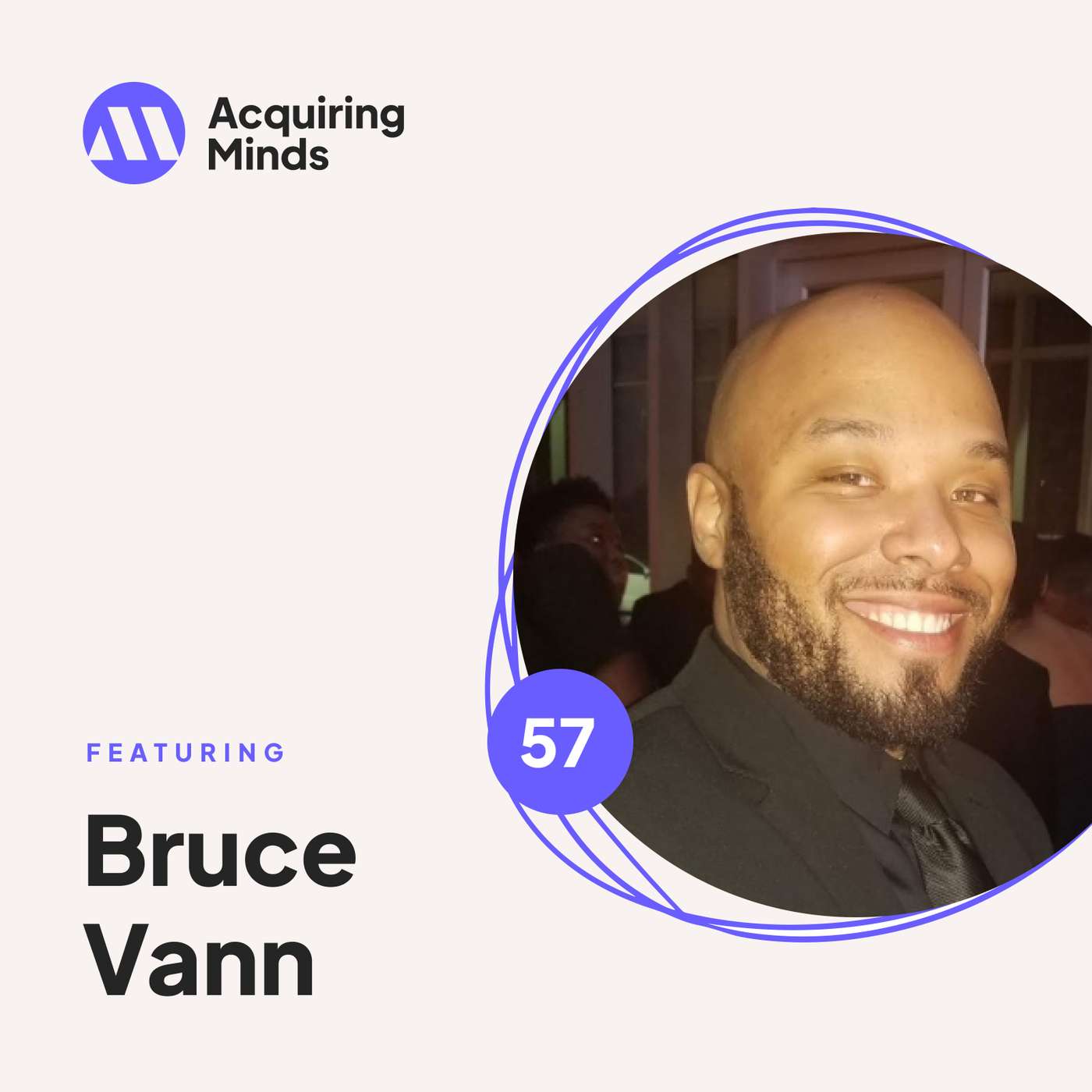
Acquiring Minds
Overcoming a Career Rut by Buying a Business
00:53:30
Frustrated after losing 3 jobs, Bruce Vann used savings to acquire a 25-employee, 7-figure curtain manufacturer for 2x.
Loading summary
Transcript115 lines
- [00:11]
A
Welcome to Acquiring Minds, a podcast about buying businesses. My name is Will Smith. Acquiring an existing business is an awesome opportunity for many entrepreneurs and on this podcast I talk to the people who do it. Bruce Van is my guest today.
- [00:27]
B
Bruce.
- [00:28]
A
Bruce decided to buy a business after a rough few years in his professional life and acquisition entrepreneurship ended up being his path out. We talk about Bruce's search using Biz Buy Sell, why he started, then stopped doing proprietary outreach, how he was able to get a great price on the business he acquired, and what his transition was like going from unemployed to the owner of a business with 25 employees. I, I think Bruce nailed his acquisition. See if you agree. Here is Bruce Vann of Luxout Stage Curtains. Bruce Van, thank you for joining me today on Acquiring Minds.
- [01:04]
B
Thank you for having me.
- [01:05]
A
Will you acquired Luxout Stage Curtains, a manufacturer of stage curtains. So this isn't residential curtains over windows in your home, but the really tall, heavy fabric ones that are open and close during performances at theaters and churches and schools, wherever you find stages. So one of those really niche businesses that you probably weren't even aware of before you saw the business for sale. At least I wasn't until I reached out to you. So you bought it two years ago? Two years ago this coming February. And I know from our pre call that things are going well. So this is a really cool story and let's get right into it. Start us off with a quick background on you, Bruce. So take us up, give us all your relevant background taking us right up to that decision to go out and buy business.
- [01:49]
B
Sure, sure. So I went to business school, but prior to business school I got a degree in economics and worked for GEICO in a product management role. I liked that role, but I wasn't going to make much money there. It's just kind of the nature of the business structure or the business model of geico. It's always about being the low cost provider. So I wanted to go find something else. Even though I love my experiences, went to business school at Darden, loved it. It was one of the, probably the best two years of my life and I got a lot of exposure to a bunch of things and that was where I learned that just like you can go and buy a house with a note, you can go and buy a business with a note. The thought started and sort of ended there. I went to go work for an oil and gas company and it was a, the role that I was in was, was good. It was sort of like a CFO role of a small division, but the culture of the company didn't really work for me. I just held my breath, saved my money, invested it over time. They had a nice 401k match and that capital became useful later on when it was came time to buy my business for the way that I structured my purchase. But I left there at exactly three years to the day and then didn't really know what I was going to do. Kind of floundered around, tried to start a few businesses from scratch. None of them picked off. I mean, I took off and so I ended up working a couple of odd jobs until I started to beat the bushes of my network. After losing my third job, which I'd never lost a job in my life prior to this season of my life. But for whatever reason, those four years, I lost three jobs in four years. I started to beat the bushes of my network and somebody said, hey Bruce, you ever thought about doing a search fund? I was like, huh? Yeah. Well, I only had one case my entire time at Darden on a search fund, looked into it, had a good feeling about it, had actually even had a dream about it, which, and that gave me even more, sort of made me feel even better about going forward with this path. And then for the next 15 or so months, I just beat the bushes of I just sort of dove right in to searching for something to buy. And fortunately I bought a really, really good small business and I didn't even have to use any outside capital to do it. That was the part that really surprised me.
- [04:18]
A
There's a lot here, so I'm going to pick apart some of your story here. So first of all, Darden is UVA University of Virginia's business school. This is important to me because I'm a Virginia guy, like from Hampton, Virginia. You went to undergrad in Richmond, Virginia at vcu. Also know many, many of my friends growing up went to vcu. Then you went to UVA for business school. And you are in Richmond now. So the business that you found is in Richmond, Virginia, Correct?
- [04:43]
B
Correct. It's like maybe it's walking distance from the grocery store I went to when I was a student. It's funny how close, but yeah.
- [04:50]
A
And in fact your search had, you had looked at buying businesses all over the place so that you, you, you fortunately, I mean, I assume you wanted to stay near home. Found one near home, but you were totally open to going anywhere and yet you find this one at the convenience store just down the block from where you were as a student. Now, losing the three jobs over those four years so you had been a successful guy. You'd never lost a job before that. But you just hit this rough patch in your. In your professional life, and I. I imagine that that got you down. So just talk to me a little bit about your headspace during that time.
- [05:37]
B
Absolutely. I mean, I think it was really just a bad. I'll talk about my headspace and the. How I got into that rut in my career. So, yeah, post business school, I don't think that you really understand this when you're in business school, but when you come out, it's like when you're in business school, immediately when you come out, you can basically do anything in the business world. But once you pick that thing that you're going to do, you're kind of pigeonholed to that thing. And so I got pigeonholed into just doing accounting work. And I can understand accounting, but I'm not a great fit for accounting. I don't really care about controls. I'm not a corporate policeman. All those things that make a good auditor, accountant, controller. I was more like a. Not to diminish one type of person versus another, but it was more like. It was a bad fit for me. It was like a putting an eagle among ducks. Right? Everybody, it can all fly together and whatnot, but as soon as it's time to go into the water, the eagle tries to go into the water, it's going to be. It's going to look crazy. And then if the. The eagle tries to go fly too high, then the ducks are going to look at the eagle like they're crazy. So it was a bad fit for me, and I kept getting. These were the only jobs I could find. But in my second, when I lost my second job, that one really hit me home. And I really was actually suicidal at one point because I thought, man, I did all this stuff the right way, went to the right school. Especially as a black man in this country, you don't want any strikes against you because you really basically have to be perfect in order to get anywhere close to what you're warranted to get. So it was rough, but fortunately, by the grace of God, I pulled through definitely with the support of my family. But it was a very, very rough and low patch for me. Yeah.
- [07:24]
A
And so do you think that the decision to buy a business and essentially be an entrepreneur, be your own boss, that must have. I mean, was that something that you saw for yourself before this rough patch, or do you think that you saw it as a path out of the rough patch? Or a combination of both of those or what?
- [07:43]
B
Yeah, good question. It was both. I mean, actually, in my Darden essays, I said I wanted to be an entrepreneur. I just didn't think it was gonna be possible. And at that time, I only knew about starting something from scratch and changing the world, like making the next Facebook or something goofy like that. So it was always in my heart to do that. I just didn't know how I was going to get back there. Matter of fact, actually, when I was in high school, instead of going to get a job, what I did was I sold candy and drinks in high school and made a little profit every day, enough so that I didn't have to go and work and I could feed my fast food habits and clothes and stuff like that. So once I had a taste of it back then, it was just a matter of figuring out how to get back to it in my adult life. And it took a while, but I got here.
- [08:32]
A
So this person that told you about search funds or said, have you considered a search fund while you were out there kind of figuring out what was next? This was just a colleague.
- [08:39]
B
If you're somebody in your network, this was someone in. He wasn't even really in my network. So I beat the bushes of the Darden network and I talked to a gentleman who knew the CEO of Buzz Franchise Brands, and he said, hey, why don't you reach out to Kevin? That was. His name is Kevin. And while I'm in Kevin's office, we're just talking because I was looking for work that was in Tidewater and there wasn't, there's. There aren't many like highfalutin, high finance jobs basically out there. And the thing that he, that's when he, at the end of the conversation, he said that, he said, I might be able to put you in contact with somebody. And that sort of just began the whole thing for me from there.
- [09:21]
A
And so this person mentioned search fund to you. You remember that from your Darden days. A case study at Darden. But what you proceed to do is not the traditional search fund where you raise money with the whole, that whole structure and model. You just were going to buy a business for yourself. You had saved up. You're really good with money. You'd saved up all this money over, over the course of these years. And so you had enough money to make a down payment or the, the 10 to 20% and bring on the SBA loan as the, as the other piece. So, so tell, so tell me more about the search. Are you you had said to me in our pre call that you looked at businesses all over the country. Were you just, were you looking for a particular type of business if you weren't geographically constrained? Obviously we're all financially constrained. You had that constraint. But what other constraints did you have?
- [10:14]
B
I didn't care about the industry. I didn't really care that much about where it was. I just cared that I could find something, one that I knew I could scale and wrap my head around. I wanted something that I could not. I felt like I couldn't mess up with my highfalutin MBA ideas because we all have them and think that we know what we're talking about. And then the market gives you a sense of a slap in the face and says, no, this is what I really want. And then I wanted something that I could get at an acceptable multiple. Right. I didn't want to overpay, I think. So for those three things, they were very important to me in my search and I think they, they, they suited me pretty well when it came time to have the end result.
- [11:00]
A
And so did you, were you just looking at biz by sell or did you reach out to brokers around the country or what, what were the actual mechanics of your search?
- [11:07]
B
Yeah, good question. So I mean I kept a, I, I didn't have a, a CRM system like as like some searchers have today. And I, I, I applaud those who, who do that. I wasn't that sophisticated. All I did was put things into a spreadsheet. Matter of fact, it wasn't even a word. I mean a Microsoft spreadsheet. I had Google sheets of things just because I was that cheap.
- [11:32]
A
Not even Excel man using Google sheets.
- [11:37]
B
But I put everything in the spreadsheet. So I would wake up every morning, my now wife, she was my girlfriend back then, she said, oh my gosh, you don't have a job, but you are like working out, working everybody I know with the way that you're, you're searching. But I would wake up every morning, check the listings, inquire about things, anything.
- [11:55]
A
That looked, check the listings. Meaning, Meaning biz by sell or stuff in your inbox. Brokers had sent you stuff in your inbox or what?
- [12:02]
B
Brokers sent me things in the, in my inbox. But I mean, I feel like if you want a really good deal, you, you have to search it out and beat everybody else to it. And that's just the nature of things. Like fortune favors the bold. And one thing that I have is that I can be bold. Enough to like really knock on doors everywhere and beat everybody else to the chase. So that's basically what I did. I looked like through Biz Buy Sell and anything that looked interesting, I would introduce myself and I would stay up with brokers because, you know, you have some brokers that are very responsive and you have other brokers that are not responsive at all. And it's just a matter of knocking on that door. There's a sign in here. I won't show it and pull it down, but I have it in my office that says persistence. And it's a Calvin Coolidge quote. Because if there's one thing I absolutely believe in is being persistent. And this role is actually very. Or doing search. If you are a persistent person, doesn't really matter how smart you are per se. You have to have a certain level of it. But beyond that, you just have to be extremely persistent in executing and keeping your deal flow up. So that's my story and I stuck to it. I don't know how many businesses I looked at, but my guess is it was in the hundreds at least per month, probably in the thousands. Most of them, it's just like dating, you'd swipe left on. But every so often you find something that's a good maybe and you pursue that thing until you get all the information that you have and then you make an offer. And that's basically what I did.
- [13:40]
A
Not to put too fine a point on it, but using Biz Buy Sell primarily for your deal flow. And the reason I'm interested in that is just because you hear people say, you gotta get off Biz Buy Sell, you gotta do proprietary search. And then you hear others, of course, say the proprietary search is a huge amount of effort without a lot of response. And we're all on Biz Buy Sell anyway. I mean, it's a very alluring website with. I mean, I'm constantly checking it anyway, but anyway. So I'm always interested to hear from successful searchers who use Biz Buy Sell pretty much exclusively and did in fact buy a business from the site.
- [14:15]
B
Well, let me add a caveat to that. I started out with the proprietary search, but what I found with the proprietary search was deals are much harder to come by. And then most sellers, they just think their baby is far more valuable than it actually is. In my experience, they may want 8 times EBITDA for a business that is shrinking. And that was one of my experiences and was like, I can't offer you that cause there's no way I can make Any money on this deal. I probably can't even get a bank to accept the terms of financing this at this multiple. Like, you gotta have some give here. So what I found was that sellers who have a broker, they at least have some of this that come down to earth for their valuations.
- [15:01]
A
Totally. Yeah.
- [15:03]
B
They have a best.
- [15:04]
A
Their broker has done the hard work of showing them what the realistic valuation of their business is.
- [15:09]
B
Yeah. And they're also motivated to sell. You said what?
- [15:12]
A
Well, yeah, I said, you hope that their broker has done that, done that work.
- [15:17]
B
He or she's done their job if.
- [15:19]
A
They'Ve done their job.
- [15:20]
B
Right.
- [15:21]
A
But also it's just the whole dynamic of like when somebody has put out there that their thing is for sale, you as the potential buyer have a little bit more leverage than if you're going around to all these business owners who aren't thinking about selling and they're just like, well, sure, make me an offer. Like, you automatically have less leverage and you have to make them an enticing offer, presumably if they haven't been thinking about selling.
- [15:44]
B
So cool.
- [15:46]
A
All right, so you now remind me you actually went down the path on a few businesses that you really wanted and it didn't work out. Give me quick details on one or two of those stories.
- [15:59]
B
Yeah, sure. One was. One was a concrete company. I found it, it had an acceptable asking multiple from my perspective. Try to put an offer on it. The broker just ghosted me and then came back months later and was like, oh, yeah, we raised the price and we went after somebody else who could do blah, blah, blah for the financing. I don't remember exactly what all he said. That one stung really, really, really bad pretty early. And the another one that stands out in my thinking was a landscaping company. There was a landscaping company that I wanted to purchase that I didn't want to pay more than 1.1.275 for the business. Based on the math that I could see, that was the high end of what I wanted to pay for the business. I think they were trying to sell it for 1.5 or something like that. And the guy, the seller, called me a nuisance because I was trying to ask him a question about the ad back. So I was like, hey, I need your help here to explain to me what these add backs are so that I can substantiate this valuation that you're asking me to pay. And he said, you're a nuisance. You're probably going to drive my people away and all these other things. I was like, okay, well, fine, I'll back away from this deal. Apparently this is not a good fit for me and there has to be that chemistry between the buyer and the seller.
- [17:25]
A
And how dare you ask about some questionable add backs.
- [17:29]
B
Exactly. Which is the same question that the bank is going to ask for the. Yeah, but anyway, a year later that broker contacted me and said, oh yeah, Bruce, you know that business is for sale now for 850. And I was like, man, I dodged a bullet with that one. So the guy actually sold the business for or was selling it, putting it back on sale for 850 instead of the 1.5. And I was fighting him for 2.1.275.
- [17:59]
A
Yeah.
- [17:59]
B
So it's just, it is what it is.
- [18:03]
A
So through all of this, Bruce, you talked about persistence and we talked about how you had, you were on a coming out of this rut in your career. Were you feeling discouraged in the search? Your girlfriend tells you that she's so impressed with how hard you're working even though you're not actually gainfully employed.
- [18:20]
B
Right.
- [18:21]
A
You and I both know, of course, that you're working toward a great outcome. But it might be hard for somebody who doesn't understand search to see that or understand that. And you just hear, I hear from my guests and from the ecosystem so often that search is extremely lonely, extremely demoralizing, filled with rejection. You know, it's basically, it's a lot like sales, like a sales effort. So how's your headspace during this search? During this very frustrating search on the heels of a very frustrating professional.
- [18:54]
B
Three years. Yeah, I think my headspace got better. I mean the headspace was the worst. After the second job loss. I thought the third one, I was like, okay, these people are idiots and I just don't fit in anybody else's company. That's what I kind of just walked away from with, with the understanding of. And so I knew, like, I knew there was something out there for me. I just didn't know what. I didn't know where it was. And like, plus also like I told you, I had a dream. For whatever reason, when I first started to consider search fund, doing a search fund, I had a dream one night that I was pulling my car into a parking space and whatever business I had bought in this parking space was in the middle of, of the hood somewhere. And, and, and it just so happened that the business that I bought is kind of in the middle of the hood of Richmond. So, so I felt like I was on the right path once I kind of got up there. I was like, okay, this is where I need to be. And then after that, it's just a matter of sort of like I told you in the pre call, it's like doing this is just like taking a full court shot. And it's just a numbers game. You put up as many shots as you can in a certain amount of time, and eventually something goes in if you do it the right way. Now you want it to be a shot that you actually want to make because you don't want to overpay for a business, obviously, but. But that's. That's really kind of how it is. So, I mean, I think my headspace when I started the search was much better. I still had like a lot of the bitterness from all the crap that happened to me, but I was just like, okay, well, that happened to me. And I kind of have to move past that and go forward to. To getting my own business.
- [20:35]
A
How long had you been searching when you found Lux out? And then once you found Lux out, how long did it then take to close on the business?
- [20:42]
B
Yeah, so I started my search in November of 2018. Was it November? It was. No, I'm sorry. I really started it in January of 2019, like I said, found Lux out in July of 2019 and didn't close on Lux out until February of 2020.
- [21:08]
A
Okay, so all six months of. Yeah, six months of searching and kind of just searching without really anything going anywhere very serious. Then at month six or seven, you find Lux out and then another six or seven months before close.
- [21:23]
B
Yeah, because it took a long time to negotiate. It took like, I had my signed LOI around, I want to say, Thanksgiving of 2019, and then that's that. And then I presented that to the bank. And then it took a long time for them to get all their ducks in the row so that we could close on the business.
- [21:50]
A
So can you tell us about Lux Out? Tell us a little bit more than I said in the intro about what it does, and then tell me about the size of the business and any of the numbers that you can share on its revenue and your offer for it, et cetera?
- [22:04]
B
Sure, sure, sure. So Lux out has been around since the 40s in some form. It started out as a company called Tuckahoe Drapery Cleaners, used to clean curtains, but now is in the business of manufacturing stage curtains for theaters. And our industry is very. What's attractive about our industry is that it's kind of geographically segmented. The nearest competitor to the north is In Pittsburgh, the nearest competitor to the south. There are actually a couple of competitors in the, in North Carolina and one in South Carolina, one in Georgia that I can think of, there's several in Florida. But we kind of mainly have a pretty good foothold on the mid Atlantic because there's only so much space in this business. And if you don't know what you're doing when you're making stage curtains and when you're bidding them, you can very quickly drive yourself out of business. I actually saw somebody do exactly that even in my short tenure here. So the bulk of the business is the stage curtain business. We do it for new construction and we do it for the, for replacements. We have some things that are, that are key differentiators from us, from everybody else. For one, we have an online quote tool for, for our stage curtains. So any person can go up there and if they know the dimensions and the specs of exactly what they want, they can do that. My salespeople use the online quote tool and then they quote it for the customer. We are to my knowledge, the only company in our industry that has something that transparent. The other thing that we have that kind of differentiates us is that we make our curtains in a certain way that makes them safer and they look better. The folds still, the pleats stay in the curtain from top to bottom. In a way that's a little bit better than everything else that I've seen that's out there. So that's sort of the key differentiator there. Then there's another part of the business where we make shades, window shades. We have a high end line of window shades called Luxelle Shades and we have a separate website for, for that. Let's see, what else should I say about the business we are for in terms of revenues? Revenues are in the seven figures. I plan to grow it substantially. But hey, the pandemic came and definitely changed some of those plans. But still now we're back in the place where it seems like we're on the path to growth again as a company. Just from what we've seen with our orders. The I wanted a business that was hard to mess up. It was very important to me. And one thing I also like about this business is that it has a long sales cycle. Right? Like so a school district may, or a construction company may decide to purchase their stage curtains two years in advance and then so the order's placed for that, that amount of time. That's the long end. The high end of it is that long. But it May be shorter, especially for a school district. And then we may make them and then it will take a certain amount of time for us to make them and bill them and collect on the cash and everything like that. So even with the disruption of the pandemic, we still were all right. And we had our best year in 2020 as a company even though our orders were down substantially. And I don't think that's unique to us as opposed to anyone else. And then in 2021 we came out all right, we crawled forward and now in 2022 it looks like we're, looks like we're going to be in a really good spot for growth as a company. As far as what I paid for the company, I, I gave you the number of what I was talking about for the, for the landscaping company. So you, you could tell that I was looking for companies in the, that were less than 2 million in purchase price. That was just because of what I could afford at the time based off of my savings. But I got this company. The cool thing about it, I got this company at an awesome multiple. When it was all said and done it was at a 2, 2 times EBITDA for a company that had been growing pretty substantially. And I think part of the reason I was able to get that, actually the main part of the reason I was able to get that is because I looked in places that other people didn't look right. I think for larger targets, everybody's looking at larger targets. One and then to the broker had reported cash flow but didn't really understand that the cash flow that he reported was wasn't even ebitda. It was the net income and it was the net income after the previous seller and his wife paid themselves a salary. So that's how I was able to get it at such an aggressive and because of my digging and my persistence I was able to find oh this is like a great deal. And I can't believe anybody else, everybody, anyone else passed over this deal based on the terms that I was able to get it for.
- [27:14]
A
So the broker under priced the business essentially.
- [27:18]
B
Yeah, yeah, by a lot. And what that did for me was it made it so that the moment I purchased the company my net worth went up substantially which was great. Especially you're kind of like your equity.
- [27:35]
A
You meet had immediate equity because in theory you could flip the business and turn a profit. So yeah you now so that maybe the broker didn't. Didn't do the best job of evaluating the business, valuating, valuing the business. The guy the owner, from what I understand from our pre call, was it was a businessman. So I assume he had some sophistication and he, he, you would have thought that he might have caught the fact that he was selling a good thing for too cheap. What do you think about that?
- [28:07]
B
Yeah, I think to this day I still scratch my head about that. I think he was just more at a place where he wanted something in his lifestyle as opposed to worrying about what he sold the business for. He wanted to make sure he left it. He wanted to make sure he left his baby and his staff with someone who was really going to care for it. And I think that's one thing. The other thing is when my business is very, it's not very capex heavy but it's very labor intensive. And because it's very labor intensive and there's such this long sales cycle and this long cycle to collecting cash, there's a large portion of the balance sheet that is dedicated just to working capital. So when he offered the price, I think when he did the initial offering price, he was thinking this is the price of the business without the working capital. If he kept the receivables and the cash and all these other things. And what I did was I said, well, I need all the receivables and this amount of cash because I don't have that much money and I need you to leave that much in here with the business and I'll go a little bit over asking price on these, on these terms. And he accepted it.
- [29:21]
A
Ah, so you got a big chunk of working capital without it affecting the purchase price too much. Nice. And you talk about growth and wanting to grow the business, but you also mentioned like, you know, there's only so many, this market is only so big, there's only so many curtain stages that need curtains. So when you talk about growth, are you thinking acquisition of, you know, the Pittsburgh company or the north or South Carolina company, or are you just talking about organic growth? Are there a lot of stages going up in the mid Atlantic?
- [29:54]
B
Yeah, it's not that there's a bunch of stages going up but I mean you think about it though, think about it this way. A school district goes and they build a school. That school is probably going to be around, let's say 75 years. In that 75 year time, their curtains are going to last them maybe 15 years a pop. So that's five times where they have to replace their curtains per school. And if you multiply that times all the schools in a given area, there's quite a bit of opportunity for the replacement market, even if they're not building a bunch of new schools. So that's one thing. But in terms of the way that we grow, we have a culture at Lux out of being significantly more aggressive at pursuing the business. I'm not saying we're pests or anything like that, but we will. Companies, yeah, we're persistent. Most of the companies will wait for the business to come to them. We don't wait. We did go after every. The customer chats us does anything. We are going after after that lead and going to chase it down to really make sure that we can do everything right by the customer and turn as many of those leads into sales as possible. So that's work. That's what they did before. I don't. And I think the challenge that a lot of others in our industry have is that there are a little bit more because. Because they've been around for a while, it becomes easier to be more complacent. Complacent with the business model, but just.
- [31:36]
A
Take orders rather than pursue new ones.
- [31:39]
B
Exactly. And we don't. We just don't have a culture to do that. So there's an element of organic growth that goes into just doing that. That has been proven before and it very much aligns to how the focus of how I did business when I was a product manager analyst at Geico. It's the thing that differentiated Geico from other insurance companies growing organically in an old industry like that. The other thing is, if I'm able to acquire something that already exists, more than happy to do that. I mean, I would love to have those conversations with anybody in the industry and I would have to, of course, make sure that it's under acceptable terms for both them and for myself. But, yeah, that's how we plan to grow. And we'll see. We'll see exactly what happens. Everybody has a plan. Then you get punched in the face. That's what Mike Tyson said. But. Well.
- [32:39]
A
You'Ve been in the business for two years now. Two years next month.
- [32:42]
B
Yeah. So.
- [32:44]
A
How has it been compared to, you know, what you hoped and expected before you actually bought the business and got in the seat? Matter of fact, I found you because you posted this great essay on Search Funder shortly after you bought the business, talking about, you know, what that transition was like? It was really great. But that was very shortly after you'd gotten in the seat. We're now, you know, a year and a half or almost two years later. So talk to me about how things are compared to what your expectations had been.
- [33:14]
B
Yeah, it's. It's the. I will put. I would say these two years have been the best of times and the worst of times simultaneously. They've been the best of times because the money I made my first year, I was more. It made up for all the crap that happened in the other years of my life where I just wasn't making. It was. Blew my mind. And. And that was. That was great. And to be able to be preserved for the business to be not just preserved, but preserved and thriving during that time, that. That was really, really way more than what I thought it was going to be. And I think that's part of the reason why when you purchase an existing business, you want something that is growing and doesn't require a ton of capex in order to continue to grow. I think that's one thing that a lot of searchers you should probably give some attention to because I really lucked out when it came to that. And it's been the worst of times just because, I mean, the orders fell substantially, like I said, during that year, even while we were doing very well. And I won't say the exact percentage, but it was a lot and it was enough to be felt. I would say that second quarter of 2020, we like it. Nothing was happening. It was sort of like we were just a ship without a paddle at certain points. And then it kind of came back. And then it came back full force. And then the other thing that I would say is, like, there's a lot of opportunity in certain markets that we. Previously we had sort of dipped our toes in, and now we're diving right in, too. And I won't go into what those markets are, lest the competitor hear me and do exactly what I'm doing. But we think we found the secret sauce to two entirely new markets. Yeah, two entirely new markets and to growing the business substantially. I wouldn't be surprised if we. I don't know what this year is going to hold, especially with the. With the Omicron variant, but it would not surprise me at all if we grew 25 to 50% this year, which is really good growth, especially in the old boring industry like my own.
- [35:34]
A
The size of the business in terms of employees, what does your staff look like? How many folks?
- [35:38]
B
Yeah, about 25 folks.
- [35:40]
A
25?
- [35:41]
B
Yeah.
- [35:42]
A
Oh, that's. And so the manufacturing is done by your staff or it's outsourced?
- [35:48]
B
Yeah, it's done by us. Yeah, we make it right here in Richmond. We have four sewers, two shade makers in Richmond. We have two salespeople, two customer service people, two installers. And then we have staff in Texas and North Carolina also. So we try to cover. We try to dominate the south as much as possible.
- [36:22]
A
And why is this not something that an industry that's been outsourced to China?
- [36:27]
B
Oh, yes, because it's next to impossible to do. That's a good question. And that was one of the questions I had when I was looking at the business. It's the lead time of. So every stage is different. So in order to do our business, you have to have someone that not only pursued the lead, but actually went out to this. Usually, I mean, you can have, you can train a drama teacher to measure, you can walk them through how to measure a curtain. I mean, measure a stage. But usually you want a professional out there who says, oh, no, we need this kind of fabric. We need this. This is the structure, this is how it's laid out. This, that, the other, blah, blah, blah. And then they can send the specs to the workroom. Now, if the workroom that made it were in China, that would be a nightmare scenario. Unless they could get everything perfectly done right. Like everything that's in that person's head is right on the paper. And there isn't much need for back and forth communication, for clarity, for things that can go wrong, all these other things. And if it came, like from East Asia, they could make it. But if they did something wrong, like, say, for example, they made the curtains three inches too long, well, then that has to go all the way back to China and then come back and then hope that it works again. And so because we're closer to our customers and every stage is different. That's why I have a business. Yeah, it's pretty hard for. It'd be difficult for like an Amazon to come in and do my business or anybody else that you can think of just because of the nature of. Because of that nature of it.
- [38:07]
A
It's so sort of custom and there's so much back and forth and there's so much room for error.
- [38:11]
B
Yep.
- [38:12]
A
So give us a sense. Just roughly. I know a lot of variation. How much does your typical school auditorium stage curtain run?
- [38:22]
B
Yeah, it varies. It depends on the size of the stage. I mean, for an elementary school, you're probably looking, most elementary schools to replace their curtains is probably going to be four grand. It's my guess to put the track up and do all that other stuff, it's going to be significantly more expensive. Because putting track, which is what the curtains hang on, is a little bit harder. And it's certainly harder to do the rigging, which is done at new construction. But as the school gets bigger, middle schools will be, we'll say 7,500 to 8,000, something like that. And then high schools are probably going to be usually, excuse me, high schools are probably going to be somewhere in the neighborhood of 10 to 10 to 17,000, depending on the size of the high school and the number of curtains and things like that. And then larger auditoriums, they can become very huge. You can spend. We just did a job in Richmond, actually, we just did a job at the Main street station in Richmond, which is where the governor elect is going to have his. I guess his swearing or his party or something like that. He's having some event there in a few days once he gets sworn in. The guy who did all this upset in the politics of the country and everybody was looking at Virginia, but he. He's doing it there. And that was a. I won't say the price of that job, but that was significantly more expensive than the most expensive high school we've ever done. So it just varies like that.
- [40:05]
A
So when we see that guy giving his speech on TV and in the background is a pulled curtain or maybe a closed curtain, we'll know where it came from.
- [40:13]
B
You will know exactly where it came from. Yep, that came from us.
- [40:20]
A
A couple more questions for you, Bruce.
- [40:21]
B
Sure.
- [40:24]
A
When I talked to you the other day, you were working from home, as many of us are, but you actually made a point of saying that you really try to create some distance between yourself and the business, because you've just got the approach, as we all should, of working on the business rather than in the business. Talk to me about how you approach that and also weave in just like your first six months in the business. Because while many acquisition entrepreneurs want to buy a business and eventually be working on it rather than in it, they find themselves, at least during the transition period, working very in the business. Did you have to do that and just talk me through all of that?
- [41:01]
B
Yeah. Short answer to your last question is I definitely had to do that. I actually went out on and did some installs of stage curtains myself because during the labor shortage, we couldn't get guys to come to work to save our life. We couldn't even get people to accept job offers. I would come in above other offers and they still would go and pick somewhere else. It was rough, so I had to get out.
- [41:26]
A
Has that passed? Is that over? Is the labor shortage over for you?
- [41:29]
B
Yeah, well, that part is the worst of it is done. We have a good team, actually have a couple of good team of installers now, and we're in a much better place. But that was, that was probably the roughest part of 2021. And I'll say this and then I'll answer your other. Your question about working in the business versus on it more broadly. But just to give you some perspective, we had in a given month, we need to do a certain amount of business. We had a dry first three months of 2021, and then the fourth month in April, that month came and it was like everything fell out of the sky because now all these like school districts, they knew what they were going to do, whether they were going to let kids back in and things like that. And so everybody's focus wasn't on Covid. And the one thing I like about our business is regardless of whether, regardless of whether you get stage curtains now or next year, you're still going to need them at some point, so the demand doesn't really go away and evaporate. So we had just the heavens fell from an orders perspective that month, but at that same time we just didn't have anybody to install them. So it was a very tough spot. But I make sure not to do that on a regular basis, like at least one day a week. I need just time to just sit by myself and in quietness and think, maybe I'll go play a video game or something, whatever it is, to kind of think about the problem, do something else, come back to it and try to have some sort of solution for it. I was able to do that a lot more the first year. And now, fortunately, I mean, now that I'm not necessarily installing as much as I was before, I'm able to do that again and take a step back. But it's critically important. At some point you're going to have to go in and do that. One thing I would suggest to a new CEO, and I'm still having to do this with my people and getting some pushback from them is every job, especially every critical job. And you won't really know which jobs are really critical, but every job you should have some sort of desk documentation of. This is how you do the job in case the person decides to up and leave or they get Covid and you're out for a very long period of time and the work still needs to go go on like you need that for the sake of your business continuity. So I Think that's.
- [44:00]
A
Were their processes written down by the previous owner, or have you had to write those from scratch?
- [44:04]
B
Oh, we had to write those from scratch. I was actually. He's a very controlled man, but I was very surprised that he didn't have that before. But I think that could be just because of my experience as a CEO. Covid has shaped my experience as a CEO, so I think, yeah, in. In term, in very real terms of something that he never had to think about when he was in my seat. So I don't know. But yeah. Did I answer your questions? Want to make sure I did? Yeah. Okay.
- [44:35]
A
Bruce, had you ever managed people before in your previous jobs? Had you been a manager?
- [44:40]
B
Yes, yes, I did. I. I had, but they were always like, the folks that I kind of managed and oversaw were all accountants. Never had to manage a sales team before, never had to manage an operations team before. And that all is different, but it's not prohibitively different. I feel like Darden prepared me pretty well for it in general.
- [45:08]
A
I assume you also had never managed as many as 25 people before when you managed a team of accountants. It was probably just a small handful.
- [45:15]
B
Yeah. Yeah. The biggest team.
- [45:16]
A
So how was that when you rolled in day one, looking at 25 faces, looking back at you?
- [45:21]
B
It was challenging. I think it was challenging because everybody was on edge. I wasn't, because I was just, like, really calm in my life experiences that maybe just like, say, okay, well, whatever happens, I'll roll with the bunches. But people were really on edge. Multiple folks crying, people blowing up at each other. I mean, just in the first week, it was. I wasn't. I didn't. Wasn't prepared for emotionally what that was going to be like. I think when you start out in a business as a new owner and CEO, especially a small business, it's more like a family. And you have to be very prepared. You just have to be prepared because people bring all their childhood issues to their family, and they bring their family issues to work. And so you're. You're just going to sort through a lot of that. And he said this, and she said that. Can you believe that? You just kind of have.
- [46:24]
A
And so did you have to get in there and kind of solve those problems, or did you just kind of let them dissipate on their own and kind of let. Let the, you know, let. Let things calm down kind of on their own as people adjusted to the new reality?
- [46:38]
B
Both for some.
- [46:40]
A
Some felt it. Felt it.
- [46:42]
B
Some of them warranted me me solving them. Other Ones, I. I said, this is. This does not affect the bottom line of my company. This is. You all need to figure this out as adults. So it's, It's. You just kind of use your judgment there. But there was never a one size fits all solution for that.
- [47:02]
A
Two more questions for you, Bruce, both personal. So just to highlight something that you said earlier about the money aspect.
- [47:12]
B
So.
- [47:15]
A
You said basically, like, you were just kind of amazed that you bought this business. And in the first year, you, You. You not only paid yourself a salary, but the business also generated, let's say, six figures in cash flow. And so you go from a guy, an unemployed guy, to a guy who not only not only has a healthy salary, I assume is managing 25 people, but is also now the owner. It's not yours, fully yours for another 10 years, assuming you have the typical SBA loan, but essentially the owner of a business generating six figures a year in profit. Do I have all that right? And if I do, would you just reiterate how cool that is?
- [47:54]
B
Yeah, it's hella cool, man. I think I'm living a dream of previous seasons of my life. And that's one of the things I always told myself when I would go home and complain to my wife is like, oh, babe, I gotta come over here and babysit and all this other stuff. And then I'd get the reminder, this is exactly what you asked for in another season of your life. So. But it's great so far, man. I wouldn't trade it for the world.
- [48:21]
A
And do you feel like acquisition, entrepreneurship, that kind of was the path that was waiting for you when you were going through those frustrated years of getting laid off or fired or whatever?
- [48:29]
B
Yeah, Yeah, I think I should have done this along. Well, I mean, I think I did it at the right time for my journey, because, I mean, if I had done it prior to when I did it, I probably would have been a more arrogant. But, yeah, I didn't understand how realistically doable it was. And to me, it was always like the whole thought of a search fund. Okay, that's what the. That's what the. The kids at HBS and Stanford do. That's not what. Yeah, I mean, Darden's a good school. It's a very. It's a good, very good school. But it's like, oh, yeah, I wouldn't do that. Especially not especially coming from Darden. I probably was probably. I don't know for certain, but I probably was one of the least wealthy folks among my classmates. So it really I wouldn't have thought that I was going to even be able to do something like that, but it all worked out pretty beautifully. And the returns you get, I mean, I know a lot of people kind of are scared of the SBA notes and everything like that, but the returns, if you do this thing the right way, you may legit get a 4 or 500% return and have to pay 6% on the capital. And that difference, you keep. So it's it. So if you find something that's relatively stable, just go for I. To me, I think it's worth it to just go for it. So great.
- [49:58]
A
Last question. Bruce, in your. In your post that I referred to earlier on Search Funder, you made a point of saying that here you are in Richmond, Virginia.
- [50:06]
B
Yeah.
- [50:06]
A
Which during the Civil War was the capital of the Confederacy.
- [50:10]
B
Yeah.
- [50:10]
A
You're an African American man, and you just made a very personal and very historical point about all that. Can you kind of reiterate that for the audience?
- [50:20]
B
Sure, absolutely. I would love to. So I'm from Hampton, Virginia. Hampton, Virginia, is where Point Comfort is. It's where the first black folks came to this continent in 1619. There's a family called the Tucker family. So that's the place I was born. The place that I have my business is in the capital of the Confederacy. These people made an entire country to keep people like me from doing what I'm doing right now. And I just feel elated, elated, elated, elated that I'm able to do that and realize the dream, because I feel like that's just what was missing before. I mean, there are some folks that are good allies, and there are other folks who want to try to disrupt and destroy people like me. And regardless of whatever the case, if my family has their own wealth basis, we don't have to really worry about that. So hopefully, if it works out, when myself and my wife have children, we won't have to. They won't have to necessarily go work for someone else. They can if they want to, but they won't have to go and beg somebody not to fire them three times when they know they're qualified to do work. So I'm really excited about that.
- [51:33]
A
That's awesome. That's really powerful. And is there any thing in your search that, as an African American man, you felt made your search different than it would have been for somebody like me and that maybe somebody else in the audience who's black or person of color listening to this should know?
- [51:51]
B
Yeah, absolutely. I mean, I think and I sort of talked about it earlier. I think the guy with the lawn care, I mean, with the landscaping company, when he called me a nuisance, I think he just wasn't used to black people asking him questions that he didn't want to answer and he had some sort of hostility toward that. And you're going to run into that in this world. It's just if you're. Whether. If you're anything other than a white male, you're certainly going to run into it. And if you're a white male, you're probably to some extent going to run into it, but you're just going to be more keenfully aware of it. Keenly aware of it. I mean, you made up a word, but be more keenly aware of it if you're anything other than that. But you just take it and with strides keep it going and don't let it make it. Hopefully it makes you better and not bitter when it's all said and done. So if anybody wants to lament about their woes of going through that experience, I'm more than happy to be an earth to encourage somebody through that rough patch.
- [52:52]
A
Well, perfect segue. How can people reach you, Bruce? What's the best way to get a hold of you?
- [52:57]
B
Best way to reach me is B Van. So, Bruce Van B V A N N at L U x o u t.com and yeah, love to hear from other searchers.
- [53:09]
A
This has been really a fun interview. Bruce, thanks a lot.
- [53:12]
B
All right, thank you. Will you have a good one.
- [53:13]
A
You too.
- [53:14]
B
Bye.
- [53:14]
A
Bye.