Loading summary
Transcript32 lines
- [00:00]
A
Hey everyone, this is AdTechDot and this is a commercial message. Here at Marketecture, we know what you need more of in your life. Adtech Podcasts. So I'm thrilled to tell you about the MediaOcean podcast network. Three different shows currently live and a bunch more launching soon. There's Femme Forward, a show about women in leadership, Add it up, which is Basically ad tech101, and fraprap with G Dog, which defies all descriptors. Check them out@medaocean.com podcastnetwork that's mediaocean.com podcastnetwork available on Apple Podcasts, Spotify and YouTube. And thank you MediaOcean for supporting Marketexture.
- [00:43]
B
This episode is brought to you by Accenture. When your advertising operations fall out of sync, everything else follows. Spotify and Accenture are working together to reinvent the rhythm of ad sales using automation, analytics and smarter workflows to simplify campaign delivery and and access better data across the business. The result? Less time spent on operations, more time connecting brands with the moments and fandoms that matter most. Learn more@accenture.com Spotify welcome to the AdTech
- [01:14]
A
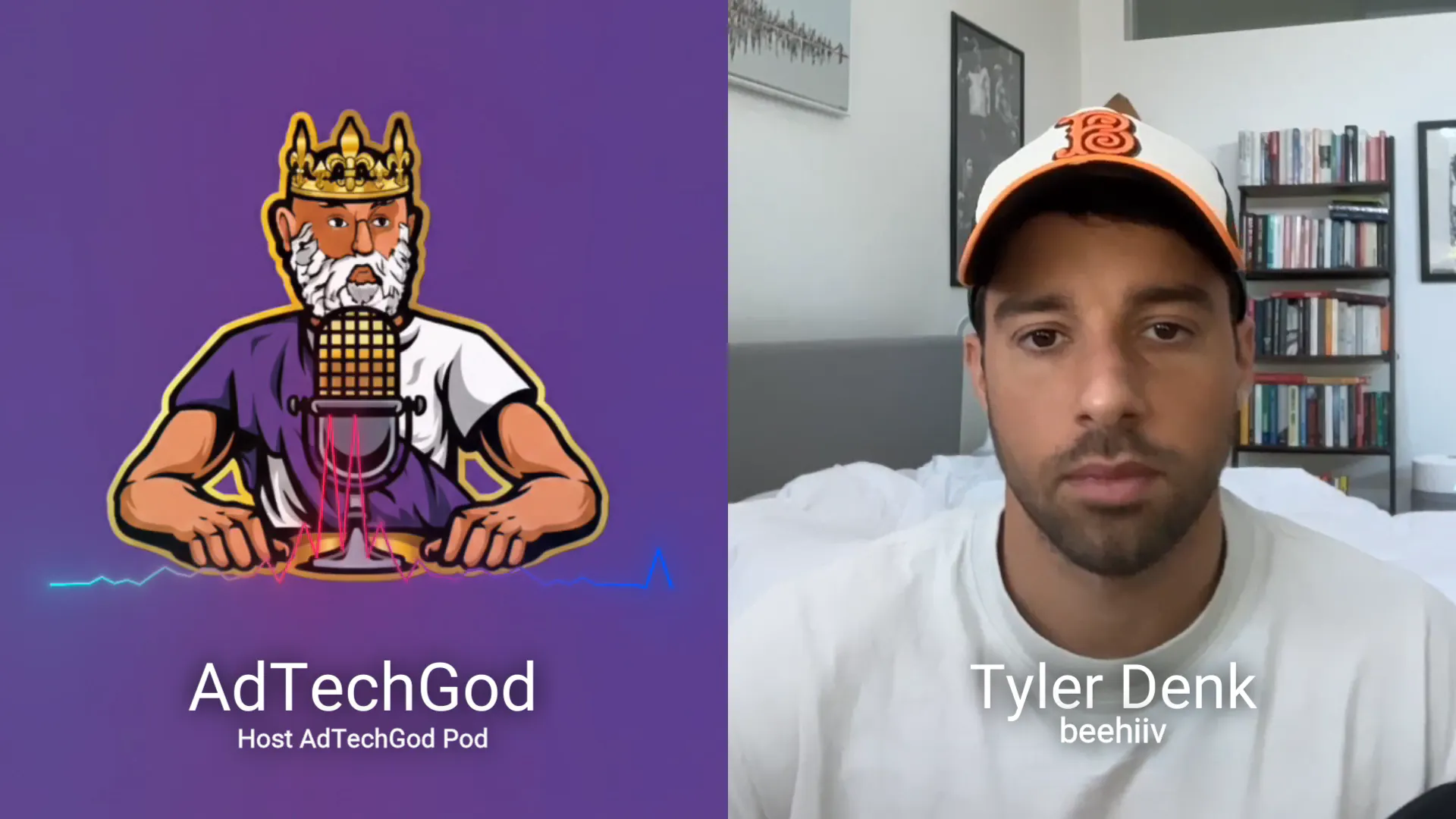
Godpod, your window into the world of advertising technology and the people behind it. I'm your host, Ad Tech God. Welcome to another episode of the AdTech Godpod, where we speak to the founders of our industry. Normally I speak with AdTech veterans, people who work in the space. Today I actually have the co founder of Beehive, Tyler Dank. Before Launcher Beehive, Tyler was a part of the early team at Morning Brew where he saw firsthand how newsletters could grow into a meaningful media business. And so he's doing that today with over 170,000 publications and reaching over 400 million people. So his reach is massive. If you're not familiar with Tyler Beehive, check it out. You will enjoy this interview, that's for sure. Tyler, thank you again for joining me on the POD today.
- [02:02]
C
Yeah, thanks for having me.
- [02:04]
A
So I would consider myself a super user. I've been using Beehive for a couple of years. Everything from segments to surveys to our main website, everything is there. I personally really like the product. But before we kind of dig into some of the new products and features you've released, can you just take some of the audience back to, you know, your background, why you started Beehive and I guess what got you to where you're at today?
- [02:27]
C
Yeah, for sure. To take a few steps back, I joined Morning Brew, as you mentioned in the intro back in 2017, as the second employee. My job there was to run product engineering and growth. So I worked with the content team and the writers. We built our own content management system, so that's what they used to create the newsletter. I worked with the ad sales team and the partnerships team to build this proprietary ad management platform which managed all of the inventory of upcoming ad placements within the newsletter. It reported metrics back to the advertisers, it inserted the ads directly into the newsletter. So that was a well oiled machine. I built the website, I ran the growth, I ran the marketing campaigns, built the dashboards. All in all kind of built like what I would consider the internal infrastructure of Morning Brew. And that led us to, when I joined, we had a hundred thousand readers, scaled it to 4 million readers up through the acquisition in 2020 from Business Insider. And on that journey obviously learned so much, working next to the content creators and writers and building tech for them and then sitting next to, on my other side, the sales team and building the tech for them to be able to monetize the different newsletter assets. And through that, the beautiful thing about newsletters is you can reply to an email and get directly in contact with the person who wrote it. We would receive thousands of replies every day, and about a few hundred per day were actually people asking us, how did you build the newsletter? How does the design look that way? How are you scaling it so quickly? How did you build the referral program? What data are you looking at? And those emails would get forwarded to me from our intern team. And it became very obvious to me that what we had built was actually super valuable. And that whether they were writers at different businesses, whether they were hobbyists who wanted to launch a newsletter, there was this massive gap in the market for building best in class newsletters that could scale and monetize to the effect that Morning Brew had. And Morning Brew became kind of this beacon in this newsletter and media ecosystem of everyone wanted to build a newsletter that was Morning Brew for X, Morning Brew for Crypto, Morning Brew for AI, Morning Brew for Sports, Morning Brew for Politics. And that was really the impetus for Beehive. We built this tech internally. My users were the 30 employees at the company, but the input from everyone externally who wanted what we had built is what gave me the vision of there's clearly market demand here. And what we had built was great. So we fast forward me and my two co founders, both of them were also early software engineers at Morning Brew. We launched what initially was Morning Brew in a box, which is Beehive it was the best and still is the best place to launch and scale and monetize your newsletter. We go head to head with enterprise ESPs like Campaign Monitor and Sail through, which is what we use that morning brew in terms of, you know, how to create content, how to do automations, all of the data, all of the workflows. Like, we can do that with the best of them on the enterprise side, but at consumer prices. So we've kind of democratized access to those types of capabilities. And where we started off with newsletters, we have since gotten into. We've launched a website builder so you can host your website similar to like a Squarespace or wix. We launch digital products. So now that you are a subject matter expert writing about XYZ topic, you can create guides and templates and coaching sessions directly on the platform and we don't take a cut of revenue. We launched podcast hosting a few months ago and so you can host, distribute and monetize your podcast directly on the Beehive platform. And then just a few weeks ago, we launched Community, so you can actually build your own native custom branded community to go deeper with your audience. And so while newsletter is still at the heart of everything we do, we have evolved into this content creator operating system of sorts.
- [06:28]
A
Yeah, because I was, I was going to ask you prior to you getting into all the new product releases that you have, like, the newsletter business is kind of like a legacy business overall. Right. Like, it's been around for a long time, but it didn't really change. Nobody really innovated and nobody specifically helped you grow. It was all about import or capture your user's audience or your user's email. It was limited data on them. There was no real flow to capture that information, their name, their title, et cetera. It wasn't that customizable. You drop it in email, you send an email blast and you kind of cross your fingers and hope that somebody likes it and forwards it. But now what we notice is that we get a ton of referrals from competitors like other marketing newsletters, even people that are kind of adjacent to us, that maybe are not focused on ad tech, but are in media or in social. And it's really kind of creating this flywheel of growth where everybody's helping each other lists get bigger, which then makes it easier to monetize and to promote what we're doing.
- [07:25]
C
Yeah, I mean, I think it's important to call out like the ecosystem that we initially entered was not too long ago, people would host their website on WordPress and then to create a newsletter, they would copy and paste their content into mailchimp or campaign monitor or whatever the ESP is. And the ESP really had one job. It was whether you craft like the drag and drop template or you drop in HTML, you create some email, you choose the list, you hit send and that was it, right? Like you're, there was no way to monetize that content through that esp. Like they were simply a mechanism to get an email out of your head and into the inbox of your audience and nothing else. And what we did at Morning Brews, we built all of these tools to help us grow faster. So we did co registration, we partnered with other newsletters like we had all of these strategies to grow faster. We built a referral program which helped turn our existing audience into a growth lever to accelerate growth even more. We had sponsorships, we had paid subscriptions. All of these like tangential things around the actual sending of a newsletter that helps you grow faster and monetize is what we built in house at Morning Brew. And those were like custom add ons that I had built. And that's really what it takes to scale a newsletter and get the full value extraction out of it. And so I think that's really where the innovation came when we launched in 2021 is we're not just another mailchimp. We are everything around sending the email that you need to be successful built natively into the platform.
- [08:55]
A
You know, I think one of the biggest things that that was a miss before you guys came out with it was, was like you said, you would copy the content over from your blog, put it in your newsletter, you send it out and you'd probably have links that link them back to your website. But with the website builder, what I generally like and what we've been doing is the content that we're generating lives on forever on a single page. And it's actually helping SEO and it's helping us take a presence, right? We write so much content at Architecture along from our, you know, five or six newsletters that we, we manage maybe more that like we're, we're dominating the search engine. When you look up anything advertising, media marketing related and we don't have to copy and paste, we're writing the newsletter. It's the right formats, the right length, we're SEOing the title, the URL, everything is pretty much automated with you guys, with some minor edits that we put in ourselves and then we are all over the web. And this is not two steps it's now one step, write a good newsletter and click publish. And I think that alone for a startup for us has made it so much easier to just write, publish and then move on and write again and publish and not have to worry about managing a website anymore. The website's just part of the package and it's been really nice.
- [10:03]
C
And that is one of our big, our big value add is, is exactly what you just said there it is. How can we do all of like the hard things around scaling a newsletter so our users can focus exclusively on what they're best at, which is creating content. It's not SEO optimizing the posts, making sure it's like a EOG optimized for these different LLMs, which is all we've spent the past three week weeks doing everything under the sun to make sure every piece of content that is hosted on beehive is AEO geo optimized for these different LLMs. We want to put our engineering resources into making all of that behind the scenes, done best in practice, like best possible. And then our users can just focus on creating content.
- [10:45]
A
Right? Speaking of SEO LLMs, we, we did the MCP integration recently that you guys have and we use that to redesign one of our newsletters and published it and made minor edits in your new kind of drag and drop designer. And it was super easy. What we're realizing is you don't have to be a newsletter expert to be able to bring a newsletter to life. Like the team, all of us have never written newsletters yet we're all creating them left and right and having very limited assistance with the exception of really our account manager when we need to dig in and ask them some deeper questions. But for the most part it's self sufficient.
- [11:21]
C
Yeah, the MCP is not even built just to expose like functionality in the platform. It's built on top of like our entire corpus of like tens of thousands of blog posts that we've written, best practices, our knowledge base, our YouTube tutorials. So it really captures not just how to use the platform, but playbooks of how to extract the most value and build the best workflows and make sure that your newsletter is actually successful. And we just launched this copilot last week as well, which you can think of is an MCP but built directly into the platform. We just want to expand the surface area of our users being able to get this support and the functionality that they need to succeed. And yet we're doing that via both the MCP and copilot.
- [12:05]
A
You announced The Copilot just a few days ago. Obviously it takes actions inside the platform that you have. Do you think from like the creator aspect or perspective, the creator business side of things, do you expect more AI to manage their workflow and their presence online? How do you see, like, Copilot and the launch of an AI solution as something to help your creators build better? I guess, yeah.
- [12:32]
C
I mean, we're seeing that now. There's an email I got the other day that. That from a user who was like, why am I doing X, Y and Z still like, manually as a human when, like, there should be an agent just doing that on my behalf? I think that's like, there's a cohort of the market and I think it will be a growing cohort of the market that really just wants to focus on creating content. They want to oversee that the list is growing. They want to oversee that there's engagement happening. They want to oversee their monetization, but they want to outsource a lot of the manual labor to some sort of agent or AI that can do a lot of that for them. So I think that is a growing cohort of people. And we specifically don't have like an AI, like writing tools, per se. Like we. And, and I'm not super opinionated one way or another there. I think if you're creating content or you have an AI that's trained on data, that's creating content as long as it's providing value, and that value could be informative or entertainment to the end user or reader. Like, I think that's up to them to decide whether they care if it's AI generated or not. But there is a. A fine line of like, we aren't positioning our AI as this will replace the user and this will replace the creativity and content creation. Rather, it is what is all of the admin things that take a ton of time to scale a successful newsletter or podcast or community. And how can we abstract a lot of those admin tasks for an AI agent to do?
- [13:54]
B
When you need to build up your team to handle the growing chaos at work, Use Indeed sponsored jobs. It gives your job post the boost it needs to be seen and helps reach people with the right skills, certifications and more. Spend less time searching and more time actually interviewing candidates who check all your boxes. Listeners of this show will get a $75 sponsored job credit@ Indeed.com podcast. That's Indeed.com podcast. Terms and conditions apply. Need a hiring hero? This is a job for Indeed Sponsored jobs.
- [14:24]
A
You you mentioned earlier in the pod, you've got the newsletter, which is your core website. Podcasts, communities, advertising, you've got a ton. Like, you've basically taken four or five different companies and consolidated into one. What's the purpose of doing that outside of kind of the efficiencies you and I talk to? Are you finding that, as you mentioned, an operating system for creators is the way to go and to just utilize everything and just create everything in one spot for them to manage, but what's like the overall goal with doing so?
- [14:57]
C
Yeah, I think there's a lot of value in consolidation for a few reasons. One is, I think the most successful content creators today aren't just YouTubers, they're not just podcasters, they're not just newsletter operators, but they usually go across multiple different channels. So they have all of those things and they're selling digital products and they also have a community. And historically not dissimilar to when I describe the ecosystem, about what the industry looked like before Beehive for like email, when you were copying and pasting from WordPress into Mailchimp and you had like five or six different platforms just to scale a newsletter, I think to be a publisher or content creator today you have your podcast hosting platform, you have a newsletter platform, you have a website platform, you have a separate community platform, you might have a membership platform that runs like the subscriptions through all of it. And as an independent content creator, that is a ton of admin work and operational complexity to do all of those. As a publisher, maybe you're. You don't have the deepest bench of tech talent to be able to build all of these integrations and then operationally, like now you have all of these data silos where you know your newsletter data lives in one platform. But are those the same people that are buying and booking, like attending IRL events and booking and. And coaching sessions and buying products and listening to your podcast, like, it's hard to actually tie them all together and get an actual unified view over who is your audience and who's engaging and who's not, and by pulling them all into a single platform, we can make that really easy. And as people launch more subscription products, having a single subscription product that allows you to pay for a paid newsletter and get access to a paid podcast and join this community, like, you can sync that all up in like two or three clicks within the Beehive platform. So I do think there's a lot of value for a lot of different reasons for building this kind of operating system where you don't have to juggle four or five different platforms.
- [16:50]
A
You know, I think one of the bigger values that I think you used to beat the drum on this quite a bit on social was, you know, own your audience. So, like, as a creator, you're dependent on these social networks, right? The Instagrams of the world, the meta of the world, TikToks of the world. And if anything happens to your account, you lose your audience. Like, you literally have no idea who they are. And one of the things that I experienced was I actually got kicked off of LinkedIn and had to restart basically from scratch. And what saved me was the fact that I still had access to, at the time, maybe 10 or 11,000 people that had followed me that were subscribed to my newsletter. So I was able to re engage them and say, hey guys, I got kicked off. Can you follow my new account? And I realized at that point that the value on LinkedIn or TikTok or Instagram is something. But if I'm able to get their email, I can actually communicate to them and have them follow me on other social platforms. I can have them engage with our conferences or our parties or our happy hours. And I realized that the email was actually significantly more powerful than the social aspect because I actually knew who they were, their email address, the companies they worked at, sometimes even their title. And it just created this, like, flywheel of, oh, I can regrow my accounts by just everything looping back into my Beehive account because I can recommunicate and reengage whenever I needed to. So that's where I saw the value
- [18:11]
C
totally the own your audience and own your distribution. I think it sounds good until you've had it happen to you, which it sounds like it had for you with LinkedIn.
- [18:19]
A
Oh, yeah.
- [18:20]
C
And once that, once that hits, you realize how vulnerable you are. Building a follower graph on YouTube or Instagram or LinkedIn and even ignoring like, that's the worst case scenario, which is that you are actually kicked off or banned from an account or your account gets shut down. What I think is more common is you have a hundred thousand followers on Instagram and anytime you post, only a tiny fraction of them ever see your content. And those are people who went out of their way to specifically follow you because they want your content. But the way that these algorithmic feeds surface content varies day to day, week to week, and it's very unreliable. Whereas newsletters are the. A complete opposite of that. You send a newsletter. I send my newsletter every Tuesday. So earlier today to 130,000 people and 130,000 people received it in their inbox. And not having gatekeepers and algorithmic feeds to get in between me and my audience, I think is going to become
- [19:18]
A
more and more important moving forward. You have a massive following on social. Do you guys plan on doing anything social related with the newsletter? I know it works as like an operating system for creators. Do you plan on tighter integrations with Instagram or with LinkedIn? Do you see something happening on the horizon or is it more of a catch, like a user catcher, audience catcher for people on social?
- [19:42]
C
Yeah, we don't have plans internally to build our own social network. I know one of our competitors in Substack is very actively trying to build their own social platform. And like that's not the direction we're taking the product. We believe in building the tools and infrastructure to power these different content businesses and not building an algorithmic feed and being the aggregator. That being said, obviously I think it's. And I've grown tremendously, like my newsletter has grown tremendously from posting frequently on X and Instagram and LinkedIn and so there's obviously value in the social platforms. I don't think that most content creators should depend entirely on the social platforms to build a business on knowing how, how unreliable the algorithm is and, and the how you could be susceptible to getting your account shut down. But we're always looking to partner and build tighter integrations with all the social platforms. We think we can serve them tons of great content from the users and the content created on our platform. We believe it's great top of funnel for our users to discover new audience and convert them into a newsletter subscriber. So yeah, we're, we're always actively talking to all of the platforms.
- [20:50]
A
Awesome. Last question for you because this is an ad tech podcast, so you guys are bringing kind of the programmatic advertising to your newsletters. So basically you're matching up advertisers with the right type of newsletter audiences. Can you just explain a little bit how that works and maybe what you learned from other mistakes that may have happened across the open web and what you're bringing to your newsletter users?
- [21:13]
C
Yeah, so the Beehive Ad Network is actually one of our biggest bets as a company. The thinking there was I saw firsthand at Morning Brew that we had a team of 25 brand partners who were talking to companies and agencies to sell advertisements and sponsors to our newsletters. Then I looked at the growth of the newsletter ecosystem and Substack came out very opinionated that the only Way to monetize content on the Internet should be subscriptions. And I think that was complete opposite to what I had experienced that Morning Brew, let alone Axios, the Hustle, the Scam, and all of these newsletter first media companies that were making tens of millions of dollars all through advertisements. But when I looked at the individual content creators who were maybe best in class writing about sports or politics, like they want to spend more time writing about sports and politics, they don't want to do brand deals. So now they're stuck kind of in between a rock and a hard place of not being able to actually monetize their content. And so the Beehive Ad Network really came from that core, core thesis. And I think it's also important to view it from the other angle, which is the advertiser angle. So if you're an advertiser who wants to target a certain demographic, let's say that you go to Morning Brew and sponsor them for $60,000. If it works well, now you can go back to Morning Brew or you need to find 30 other newsletters that look like Morning Brew that you have to reach out one by one to sponsor their newsletters, trust their own data, and go back and forth with their teams on creative and copy and schedule. So the BI Ad Network really solves all of that. As an advertiser, you can come to us and say that you want women in their 30s who are interested in wellness, and we can say that we have, you know, 50 million people who fit that criteria or 7,000 newsletters that reach that type of audience, and we can diversify your ad spend across the entire network. Inversely, our publishers and content creators are getting paid CPC cpm, depending on the different types of campaigns to run these premium sponsors in their newsletter. It's totally on autopilot. You can think of it kind of like what YouTube did for video. We are trying to do and are doing for newsletters. And it's just a really healthy ecosystem of advertisers like Nike, Netflix, Roku, HubSpot that are investing in these very niche audiences that are highly engaged in the inbox. And inversely, publishers and creators are getting paid. So it's been a huge bet of ours. It's a big focus moving forward. And as we launched podcast a few months ago, you can see a world in the not too distant future where advertisers come to us so they can sponsor both newsletters and podcasts across our entire ecosystem and we can start to consolidate that.
- [23:52]
A
Awesome. How does it work for so Roku comes to you. Is there like a requirement on the publisher side or does this help fulfill some of the needs even for the smaller, like really highly specialized publishers? Because I think that's the hard part, right? Like when you have scale and you have twenty, thirty, fifty, a hundred thousand subscribers, it's easier to convince an advertiser to spend with you. But if you're small and still growing, but still highly specialized and niche, it's kind of hard to find advertisers and generate any sort of revenue. So are you, are you bundling everything together based off of the the data you have on the back end to say Bob's newsletter with only 3,000 subscribers is all about marketing and we think this is relevant for the advertiser or are they excluded?
- [24:34]
C
No, that's actually where I think we shine is the long tail. And in that example of Bob with 3,000 subscribers, like he probably doesn't have the sway at that size to get in front of Roku, but he can get a Roku ad that's paying a four dollar CPC a dollar six cpm directly on our platform. So he's now monetizing so Bob can then invest those earnings back into growth and grow faster on the platform and continue to scale and invest in his content. So that's actually where I think we see a bit of a divergence in the sense that those newsletters who have 70 500,000 subscribers plus can have these direct relationships with advertisers and the Beehive Ad network fills more remnant ad inventory or unsold slots or additional like secondary units in addition to their primary sponsor. But where we are really strong are the very niche small to medium sized newsletters that don't have those direct relationships and we are bringing, bringing monetization opportunities to them for really the first time.
- [25:34]
A
Awesome Tyler, thanks for joining me. Anything, anything you want to say to the listeners before we we sign out and say goodbye?
- [25:40]
C
My company always makes fun of me because I'm always promoting it. But my, my personal newsletter that I mentioned earlier, Big Desk Energy goes out every Tuesday. If anything I said about building in the creator economy or building startups or entrepreneurship is of interest. I covered the full behind the scenes of scaling this company. So my thoughts, my philosophies, the features, et cetera and that goes out once a week on Tuesdays. So highly recommend you subscribe.
- [26:05]
A
Awesome. Thank you Tyler. Thanks for joining me. Cool.
- [26:07]
C
Thank you.
- [26:09]
A
Thanks for tuning in to another episode of the AdTech Godpod, a podcast for the people about the people stay connected with me for more insights, trends and interviews in the realm of ad tech. Don't miss out on the latest updates, so follow me on X Instagram and connect with me on LinkedIn. Don't forget forget ATG Slack community has insights, networking opportunities and jobs. Keep the conversation going and stay at the forefront of ad tech innovation.