← Against the Rules with Michael Lewis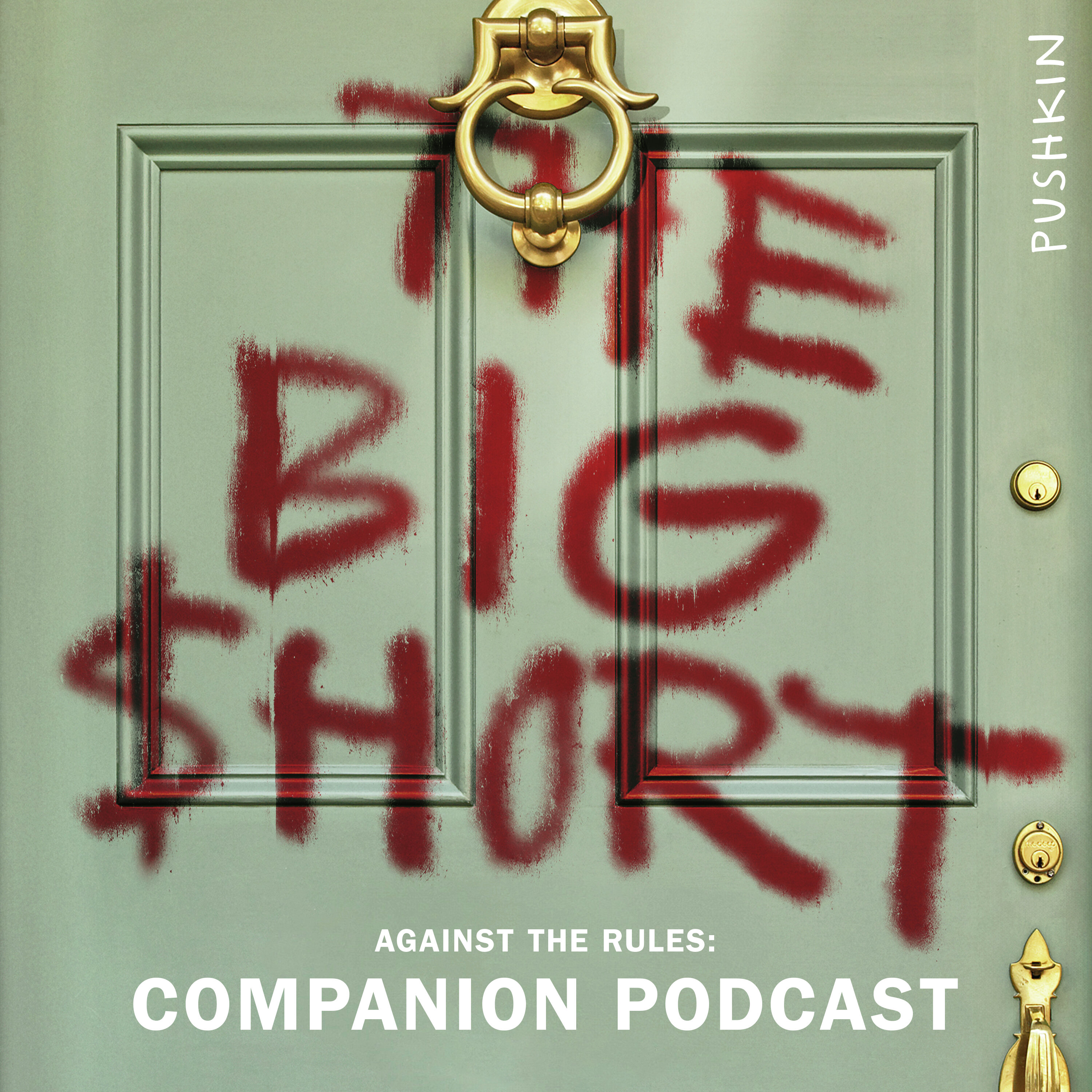
Loading summary
Transcript76 lines
- [00:06]
A
Pushkin. Most of 2006 and early 2007, Dr. Michael Berry had experienced as a private nightmare. In an email, he wrote, the partners closest to me tend to ultimately hate me. This business kills a part of life that is pretty essential. The thing is, I haven't identified what it kills, but it is something vital that is dead inside of me. I can feel it.
- [00:40]
B
I'm Lydia Jean Kott, a producer here on against the Rules. And what we just heard is an excerpt from the Big Short, a book that Michael Lewis wrote in 2010. He's now releasing it for the first time as an audiobook narrated by him.
- [00:55]
A
Yep. And I'm here, too. So, lj, I'm going to tell you what I want you to do. You are an innocent outsider with no particular interest in the global financial crisis. It is like one of these huge events in American history. And it's really useful to me to hear what you're curious about and also for me to explain to you why the people who we're interviewing are. The people we're interviewing, why they matter now.
- [01:23]
B
So I haven't thought about the 2008 financial crisis since it happened, which is when I was in high school. And I'm gonna be honest, I actually didn't even really think about it that much when it happened.
- [01:35]
A
Why would you.
- [01:35]
B
I was thinking about high school. Why did you want to revisit it? Why, why look back at it now?
- [01:43]
A
It has never lost its relevance. There's been this slow motion train wreck that comes right from that. The essence of its importance was. Was the feeling of unfairness it generated by how it was dealt with. You had these elites on Wall street doing things they shouldn't have been doing, getting paid a fortune to do them. And when it all goes wrong and everybody suffers, there's no apparent cost. They get to go about doing their business, they get bailed out by the government. Everybody has to live by the harsh rules of capitalism except the capitalists themselves. The feeling that the world is rigged, the anger generated by the event has been the dominant mood in our political life. So I have thought for some time that there'll come a moment where it's worth looking back on and saying, like, why was this important? What were the consequences of this event?
- [02:32]
B
Right. And here we are. Now's the moment. And you did it by talking to a bunch of people, right, who you thought could answer questions that you had that kind of came to you as you were rereading the book.
- [02:43]
A
Correct.
- [02:44]
B
The first person was Adam McKay, who is the director of the big short movie. How would you characterize your relationship to that movie?
- [02:55]
A
The same as my relationship to the movies of all my books, is that I had no effect whatsoever on how they made the movie, but they pretended to listen to me. They pretended to care what I thought while they were making the movie. So I developed personal relationships with some of the actors and with the director. To make a movie from a book, you need to break the thing and remake it. And the author is, I think, uniquely unsuited to do that. And the movie was different from the book. So I wanted to start with McKay because, you know, I'm awed by him. He's a huge talent. He grappled with the same material, and I wanted to just kind of talk about how he grappled with it. You know, we had never had that conversation with when the movie was made.
- [03:35]
B
Well, Adam McKay, when he took on the movie, right. Like before that, he had only done straight up comedies, Stepbrothers, Talladega Nights. Were you anxious about entrusting your book to this guy who up until then had only done comedies?
- [03:51]
A
Anxious doesn't describe what I felt. What I felt was incredulity. I thought, there's no way they're going to turn this book into a movie.
- [04:00]
B
Right?
- [04:01]
A
And so I was amazed that it happened in the first place. I thought, no way they're gonna be able to pull this off. And the fact that he pulled this off is incredible, the way he did. Now I remember thinking, the only way it works is if it's funny. Like you ask a comedian to be funny, they can be funny. That's their job. When they're supposed to be funny, they're funny. I find that so hard.
- [04:21]
B
Same. I feel like I can only be funny by accident.
- [04:24]
A
That's exactly right. I'm the same way. I can be funny by accident. Very well put. And, you know, I hate to say it when I'm writing, I laugh at my own stuff. Laughter is, like, really important to the stuff. If it's not fun, I lose interest. I don't think, oh, I'm writing a comedy. I think, oh, there's lots of funny bits in here. It's more like a tragedy, the story with lots of funny bits in the middle of it. But when Kate took it on, I thought, if someone's gonna do it, it has to be wildly entertaining, Otherwise nobody will come to the subject matter. So I thought, if anybody can do it, sure. The guy who did Talladega Nights and Anchorman is the guy.
- [05:01]
B
This is the big Short companion pod. After the break, Michael Lewis conversation with Adam McKay about how he transformed a wonky book about the 2008 financial crisis into an Oscar winning this is an iHeart podcast.
- [05:26]
A
In today's super competitive business environment, the edge goes to those who push harder, move faster and level up every tool in their arsenal. T Mobile knows all about that. They're now the best network according to the Experts@ookla Speedtest. And they're using that network to launch Super Mobile. The first and only business plan to combine intelligent performance, built in security and seamless satellite coverage. That's your business. Supercharged. Learn more@supermobile.com Seamless coverage with compatible devices in most outdoor areas in the US where you can see the sky. Best business plan based on a combination of advanced network performance coverage layers and security features. Best network based on analysis by OOKLA of speed test intelligence data 1H 2025 so I'm going to ask you a lot of stupid questions. The questions I and the questions, some of them I know kind of know the answer to, but mostly don't. And before we get to the big short, I want you to tell me about the how you made your first movie, how you became a movie person, a movie director, what it was and how it happened.
- [06:43]
C
So I was head writer at Saturday Night Live and you know, the big advantage I had was I had come out of that Chicago long form scenic improv scene and basically all we did every single night of the week was, was improvise sketches. So I was very comfortable in that space. And so they made me head writer. I was head writer for three years, but I've always loved movies. So after three years I was like, you know what, it's time to move on. I wanted to do my own stuff. And I was frustrated. I mean, Ceterate Live is kind of like the New York Times. I mean, it's a very established institution that has a certain way that it operates. And honestly, if you asked Lorne Michaels, I think he would tell you he was sick of me arguing with him. So I was about to leave in, you know, friendly terms. And I had a manager, Jimmy Miller, who said, if you're going to leave, you might as well make a totally unreasonable demand. So I went back and I said, all right, I want to make short films. I want you to give me a budget. I want you to let me name my co credit. I don't want to ever have to go to production meetings or any of that stuff. And I still want to write sketches as I See fit. So I was like, and, oh, and I want to raise. And. And I was expecting the response to come back, you know, get lost. And he said yes. And it was really all credit to Lauren. The experience I had shooting those short films was really when I knew, like, oh, I'm a writer director. They were all on 16 millimeter, like real film. And they were. It was just an incredible experience. So Farrell and I, Will Ferrell and I had written a script which we couldn't get made over at Paramount, but it was about a car salesman from Anaheim who was the greatest car salesman but fell into a slump. So we'd had so much fun doing that that we decided to write another script. And we wrote the Anchorman script. And the idea was always that I would direct it. And once again, to Lauren's credit, he loved it. He was behind it. He was like, McKay can direct. Ferrell is a star. And every single studio and financier in town passed on it. And I'll never forget, we were back in my little apartment in New York City and I was with Feral. And it, you know, nothing was going the way we thought it would go. And the only project that anyone wanted to make was this goofy script about him as a full adult being an elf. And we were just sitting in my apartment and we're like, we better make this good. I was hired to do the rewrite and we hammered on it and all the studios that had passed on Anchorman came back and like there was like a little bidding war and that was it. I got to make Anchorman.
- [11:13]
A
This is the beginning of your long form career as a film director. Yeah. Is Anchorman. I remember you telling me that Anchorman you always had a kind of political objective, a cultural. And there was cultural commentary there that maybe the audience didn't fully take on because they were too entertained.
- [11:30]
C
Yeah, I mean, that's the background. I came out of Chicago, Second City, Del Close. Del Close, who's the famous long form improv teacher, used to always say, if you aim for art and you miss, you end up with comedy. If you aim for comedy and you miss, you end up with crap. So everything we did, even Anchorman, as silly as it is, if you look at the way we begin it with the shot choices, I mean, we were really trying to play it high stakes. Same thing with Talladega Night. Stepbrothers, always as ridiculous as they were. We were trying to play it at the highest stakes. And then Will and I would always have a little secret that we were like Anchorman is actually about the collapse of mainstream news media. Talladega Nights is about this backwards pride of the W. Bush supporters. Stepbrothers was about how consumerism turns grown men into children. And so every movie, we had this little secret we never tell anyone. Anyone. So the Big Short. Yeah, I mean, it was really like. Someone recommended the book. Oh, they have good taste. I picked it up. Oh, let me read this. Could not put it down. And I was like, oh, my God, this story is incredible. I mean, people forget. But at the time that book came out, that was like the book of that era, because we were in the full throes of what people now call the neoliberal economic model. That's where essentially, corruption became, quote, smart. And it was this weird period which has now come to blossom, where not only our institutions, but our culture itself, the way we operate as a society became something that was about get what you can get. You know, Michael, you're familiar with the Last man out theory, which was the scariest thing I discovered when I was doing the Big short. And that theory is, get everything you can. Get your bonuses, make as much money as you can, screw everything and just don't be the last man left. Make sure you're out before the collapse. And I really think if you look at the neoliberal economic age, that one theory explains so much. So, yeah, I loved your book. You also have a really good sense of humor, so you made me laugh several times. And then I loved in the book how you would call stuff out and stop and say, if you're confused right now. So was I when I heard this. And that was really the bell that went off that was putting.
- [15:18]
A
Putting Margot Robbie in a bathtub to explain credit default swaps.
- [15:22]
B
Yeah.
- [15:23]
C
Yeah.
- [15:24]
A
So the banks started filling these bonds with riskier and riskier mortgages. Thank you. That way they can keep that profit machine churning. Right.
- [15:35]
C
By the way, these risky mortgages are called subprime. So whenever you hear subprime, think.
- [15:43]
B
Our friend Michael Burry found out that.
- [15:46]
A
These mortgage bonds that were supposedly 65% AAA were actually just mostly full of shit. So now he's going to short the.
- [15:55]
C
Bonds, which means to bet against.
- [15:59]
B
Got it.
- [16:01]
C
Good.
- [16:01]
A
You never adapted a book before, had you? No.
- [16:06]
C
My wife is a theater director, and she had adapted a lot of stuff. It's kind of her specialty. But most importantly, I knew that there are no hard rules. And I also knew from talking to people that they were very confused by the financial language. And I said, we have to time this exactly right. Right at the moment where your average audience is like, what are they talking about? We have to stop. And I knew we had picked the right moment when my sound guy came to me and said, hey, Adam, I just got to let you know, this is really confusing. And I was like, yes, we're in good shape.
- [17:04]
A
When we come back, I ask Adam McKay how he got so many big stars to sign up for the big short. I'm back with writer and director Adam McKay. For you, what were the challenges of, like, taking the book and turning it into a script, or did it just kind of come naturally?
- [17:32]
C
Well, you know, there was already a script written.
- [17:35]
A
Charles Randolph.
- [17:36]
C
Charles Randolph had written a script. And I was like, oh, there's some really good stuff in here, but I know exactly what to do. And that rewrite, I think it was turned around pretty quickly. And then Paramount had the script, and they had no interest because they're like the guy who did Stepbrothers with Wall Street. And we realized we had to get big stars. So just on our own, we went out to Christian Bale, Ryan Gosling, Brad Pitt, and it was one of those freaky moments where they all said yes. And Adam Goodman was running Paramount. And to his credit, he was like, okay. I mean, they didn't give us a huge amount of money, but they gave us, you know, the green light, and that was it.
- [18:37]
A
Do you know why your actors said yes? Do you know why Christian Bale and Ryan Gosling and Brad Pitt all said, I want to do this?
- [18:44]
C
I'm going to say this, and it sounds very immodest, but that was a good script. Like, that was. I mean, these actors get, you know, 100 scripts a year. Maybe they read like 30 or 40. That was a good script. And then in every case, I met with them before they said yes. So I was able to say, like, I know you know me from xyz, but here's how I see this. This will be different. I right away knew that I wanted Barry Ackroyd to be the dp, because we had a lot of scenes in offices, and we needed to make the mundane of a phone call have urgency. And no one adds life to scenes. When, like, Barry Ackroyd, give me an.
- [19:48]
A
Example of how he creates drama from a phone call. That's just different.
- [19:53]
C
So what he does is his background is as a documentary filmmaker. So he started with long lens in the corner of the room, don't look at me, and crazy stuff going on. And through the years of doing that, he learned how to look for the right light, how to find the artistic shot. And by the time I met him, he was at full peak ability. And the only thing I told him was, occasionally I'm going to want to do traditional dolly big Hollywood shots. I want it to be a blend. And he was totally cool with it. And it was some of the most exciting filmmaking I have ever seen. Because it's a constant process of discovery. He kind of treats it like, I don't know what's gonna happen, happen. This is a documentary. So you can see him constantly zooming in, finding something. Oh, I like this hang out. Meanwhile, I'm behind the monitor going, oh, Barry, that is incredible.
- [21:22]
A
But you know what? You know what that sounds like? It sounds like a visual, a rhyme with how you approach the words. You were so open, you're holding your script so loosely and you're letting things happen sometimes that aren't in the script always so that you don't know what's going to happen. That if you. That if. If everybody was sort of like roped to the words on the page.
- [21:46]
C
I actually think, see what you think of this, Michael. I think this hyper capitalist is end result culture we're now in eradicates discovery. So if you're going to sell a book or you're going to write an article, you have to tell them the conclusion. And I'm old enough to remember the early 80s, the late 70s, people would go into movies and have no idea what, where it was going to end up. There would be investigative pieces where the writer would start with A and end up with like W. And the more and more financialized America has become, the less and less you see that. I think our lower budget helped us a lot with the big short. You know, the executives could have missed on it. And once we got those big stars, they had cover for the boardroom. Like, if the boardroom asked them, why did you give $35 million to the guy who did stepbrothers? They could just say, we had Brad Pitt, Christian Bale, Ryan Gosling, Steve Carell, and on and on.
- [23:17]
A
I am at my best, and the best things happen when I have a very loose notion and I don't know what's going to happen. I love that. That feeling of like being on a ride and you're not quite sure where it's going. So the actors gave you cover. How did you decide who was going to play who? Let's take one. How did you pick Christian Bale to play Michael Burry?
- [23:40]
C
He's just one of the ten greatest film Actors ever. And I would just say, if you're gonna, like, create that list of people that are chameleons, people that are really artists. I started doing all this stuff in 1990, which is crazy. And so I've met a lot of actors. We had a lot of hosts. And at Saturday Night Live, I was doing those short films. I got to work with feature actors. And I just started noticing that there is a giant gulf between personality actors who kind of operate off their charisma with some real skills, and then these like. I mean, for lack of a better term, but like real artists. And Bale just, wow. Seeing his process was incredible.
- [24:52]
A
I. I was watching it and I was thinking, oh, my God, he's. That's Michael Berry on the screen.
- [24:59]
C
I've always been more comfortable alone. I believe maybe it's because of my glass eye.
- [25:17]
A
I lost the eye in a childhood illness.
- [25:24]
B
Separates me from people.
- [25:30]
A
I could not have told Christian Bale how to do it. That meant Christian Bale figured stuff out that I had, that I had not articulated. So this bothered me because I thought, I'm an observant chap. I should have observed whatever it was that he would have needed to play Michael Burry. So we're on the junket, and I'm on stage four or five times with Christian Bale and you sometimes talking about the movie in the book and the story and backstage, I have a lot of time to chit chat with him. And I kept badgering him, like, how the hell did you do that? Because all I knew was what Michael Burry had told me. Michael Burry said. I called him. I said, what's going on with the movie? He goes. He said, Christian Bale visited me. He's the weirdest guy I've ever met. I said, if Michael Burry is calling you weird. And I said, well, what was weird about it? He said. He said he just wanted to come for a day. He came in the morning, sat across from me until the evening, did not get up to go to the bathroom, and just watched me the whole day and asked me some questions. And then at the end of it, he said, could I just. Could I have that T shirt and those shorts? Cause I'm gonna use those. I'm gonna wear those when I play you.
- [26:39]
C
Wow.
- [26:41]
A
So I went to Kristen Bale. I said, like, what the hell happened in those 12 hours? Like, what did you figure out? Because there was something about his body language. I couldn't figure out why he had got him. Cause Michael Berry, in his presence, you feel this discomfort. And Christian Bale had replicated that. And he says to me, I don't want to talk about it. I really pestered him. And finally he says, okay. He says, it wasn't that complicated. If you watched him, you could see it's a breathing. He breathes in the wrong places of sentences.
- [27:10]
C
Yes.
- [27:11]
A
And he says, as long. And if you do that, you get all herky jerky. And I had not noticed that. The genius in saying that was just breathtaking to me. And he said to me, I told McKay, just remind me to breathe in the wrong places and everything else will come. Does that ring a bell?
- [27:30]
C
Oh, yeah. Oh, yeah. He told me exactly that. What I noticed about him bury is he's a lovely guy. I noticed this contrast of extremely sensitive, big heart, and then armor. We never got into the way he was raised. We didn't need to. But I could identify with the idea of growing up as a 1970s latchkey kid with kind of the tumult of childhood, the chaos, seeking a safe place.
- [28:19]
A
So we're going to take a quick break now. When we return, Adam McKay and I talk about the event behind both the book and the movie, the financial crisis of 2008. When I think of the difference between the movie and the book that, you know, aside from Margot Robbie being in a bathtub rather than a footnote in my book talking to the reader, I think there's a tonal difference. It's to your credit. It's to your moral credit. The movie's angrier than the book.
- [28:59]
C
Oh, yeah. Yeah.
- [29:00]
A
And it may be partly because some time had passed and we could see what had happened. Yeah.
- [29:05]
C
It was part.
- [29:06]
A
I think it's partly temperamental. I think you have an ability to get angrier than I do.
- [29:11]
C
Well, you know, that is a great point because I always joked with Ferrell that when we did those broad comedies, I used to call Anchorman, Talladega Knights and Stepbrothers, the mediocre white man trilogy, because they're all about white guys who think they're better than they are, think they're more powerful, unearned confidence. And really looking back on it, when you go big short vice, don't look up.
- [29:49]
A
Yep.
- [29:50]
C
I would call it the collapse trilogy. Yep. I mean, I think now even mainstream people can admit, like, the west is collapsing, like the climate is collapsing, you know, and Big Short was the first with that in the sense that I was really angry with Obama for not prosecuting, not doing the right thing as far as the allocation of all the money, taking Care of the homeowners. And that was kind of my peak betrayal moment, because I had really. This is embarrassing, but I had really believed in Obama. It just never occurred to me that someone could be so cynical in that vulnerable moment. It never occurred to me that someone could step into that seat and just go, same old, same old confrontation, adverse. And that betrayal was really deep.
- [31:05]
A
You got radicalized by the financial crisis.
- [31:10]
C
Yes. I mean, the only thing I'll say is I've always been left. I grew up, you know, this. You know, we were on food stamps, welfare. I was poor. So I always grew up as the guy who's like, look, this system worked. That LBJ Great Society was really working in the 70s and the early 80s before Reagan and then Bill Clinton dismantled it. But I definitely. The anger you're talking about.
- [31:46]
A
Yeah, no, it's well earned. It's well earned. It's a funny thing. I don't feel I have the right to be angry. You are really, a little bit. I mean, it's just that I was raised with the opposite of you. I was raised with incredible privilege. Not only did I. Did we not have food stamps? I couldn't have told you what a food stamp was. I would thought it's like something you put on a letter, you know, it's. Or collected and it's sold for profit.
- [32:11]
C
I mean, to your credit, pretty much every book you've written has been suspicious of the power structure.
- [32:21]
A
The jargon comes from a different place. It comes from New Orleans. It comes from being an outsider to the mainstream culture. And I think that's where it starts also, but also comes from a place of. I do have the fairness gene. Like, I get really upset. Injustice, unfairness really upsets me.
- [32:40]
C
Yeah.
- [32:40]
A
And so that's the other thing. We only have a few minutes left. And there was something I wanted to say because first off, it was very clearly the least likely book of mine to be turned into a movie. So it was, to me, an amazing triumph. It happened at all. It was like the dog walking on its hind legs thing. Like, the wonder is that it does it well, is that it does it at all. But that it was that good and it was so difficult to make. The degree of difficulty was incredible. And so it was in some ways the movie that I felt least responsible for. So it was touching and curious to me that when the movie came out, you insisted on dragging me along for the ride. And so that I. Not only was I doing the junkets with you, but I was in the second row of the Oscars I'd been to the Oscars before, but I'd been by the time I got to the Oscars for the Blind side and Moneyball, I was very much a spectator. Like, I was just there to watch everybody get nominated and maybe win. In this case, I sit down in my seat in the second row and one of the Oscars attendants come over and says, if the movie wins Best picture and it had a real shot, says, Adam McKay insists that you come on stage and receive the Oscar with us. And I was so. I was really touched by that. Like, like I teared up. Like, it was just like it was wholly unnecessary on your part. I really have thought from the minute I started, had interactions with the movie business that everybody in the movie business would really prefer the author to be dead, because he does he. Cause he causes nothing but trouble, like there's no upside and you wanted me alive. I was just really pleased with that and grateful.
- [34:24]
C
I've said to you over and over again through the years, the energy of reading that book is directly in the movie. I just think maybe part of the power of your stories, you know, it's the fact that you do come from a, whatever you want to call it, privileged, you know, somewhat wealthy background. And New Orleans, which is an outsider city, I mean, you look historically like a lot of revolutionaries were wealthy. And there's a credibility to that voice that really can't be challenged because no one can say to you, oh, Michael Lewis, you just want to get rich. Here's my privilege, here's my name. There's a real power to it. And I think your point about I believe in fairness stands stronger because you come from where you come from in your movies.
- [35:35]
A
You make these useful and jarring cuts from one thing to the next. I'm going to make a useful and jarring cut to the end of this conversation. Thanks for doing this.
- [35:43]
C
What a pleasure, man.
- [35:51]
A
The pleasure is always mine. I always leave any conversation with Adam McKay feeling like I want to go write something again. Anyway, coming up next week, we're going to meet some of the real life characters. The short sellers, traders and investment bankers who appeared in both the movie and the book. The ones who saw the financial crisis looming long before anyone else did. Thanks for listening to this episode of the Big Short Companion podcast. See you.
- [36:29]
B
Against the rules. The Big Short Companion is hosted by Michael Lewis. It's produced by me, Ludie Jean Kot and Kathryn Girardot. Our editor is Julia Barton. Our theme was composed by Nick Bertell, and our engineer is Hans Dael. Shih. Special thanks to Nicole Opton Bosch, Jasmine Faustino, Pamela Lawrence and the rest of the Pushkin Audiobooks team. Against the Rules is the production of Pushkin Industries. To find more Pushkin Podcasts, listen on the iHeartRadio app, Apple Podcasts or wherever you listen to podcasts. And if you'd like to listen ad free and learn about other exclusive offerings, don't forget to sign up for a Pushkin subscription at Pushkin FM plus or on our Apple show page and you can get the Big Short now at Pushkin FM audiobooks or wherever audiobooks are sold. This is an iHeart podcast.