Podcast
Agency Blueprint
Hosted by Robert Patin · EN
The Agency Blueprint Podcast is for Agency Owners looking to explore strategies for scaling a truly profitably agency, reducing stress and getting your personal life back. Hosted by Robert Patin International Best Selling Author, Business Coach and Contract CFO for Creative Agencies.
42episodes
Episodes
Newest firstAll episodes
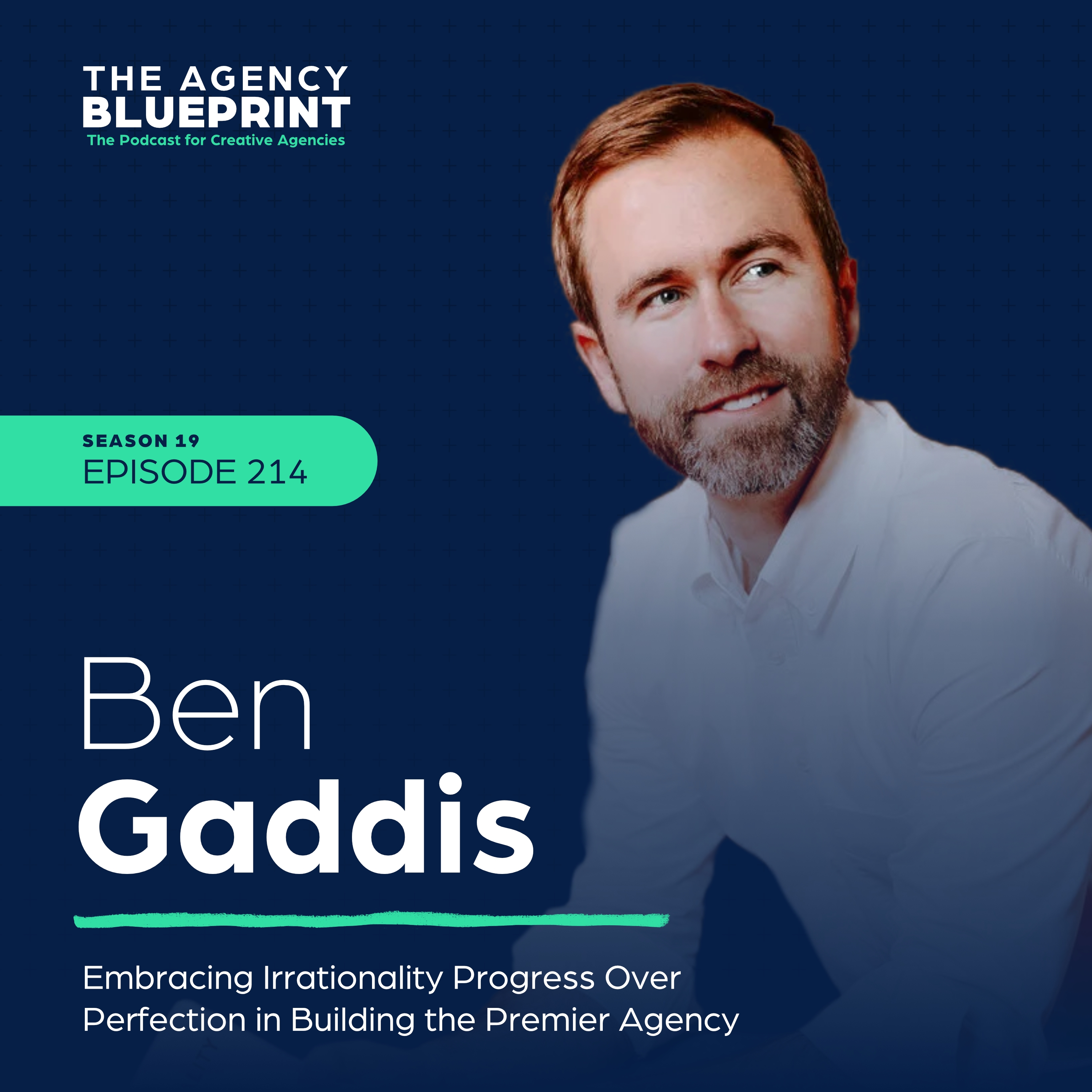
Season 19 | Ep 214 | Embracing Irrationality: Progress Over Perfection in Building the Premier Agency with Ben Gaddis
Jan 900:38:30Tap to summarizeWhat if the real path to agency growth isn’t working harder, but thinking more irrationally? And what if your biggest breakthroughs are hiding inside the constraints you’ve been trying to avoid? In this episode of The Agency Blueprint, I’m joined by Ben Gaddis to explore why agency growth depends less on heroic effort and more on systematic, scalable thinking. Ben is the former CEO of T3, co-founder of SuperStep Capital, and co-author of Embracing Irrationality. He took his agency from a boutique creative shop to a $50M powerhouse before merging with a $350M firm and eventually transacting with Blackstone. Listen in to learn how small one-degree shifts in pricing, productization, positioning, and delivery can alter an agency’s trajectory without the instability of a massive overhaul. You will also learn about team dynamics, creative culture, psychological safety, and the importance of creating space for unconventional thinkers inside your agency. Key Questions: [05:22] Are you empowering your most innovative team members, or accidentally pushing them toward starting their own competing firm? [07:29] What are your thoughts on the risk factors and opportunities of letting something go live without fully thinking through every single potential nuance of it? [13:37] Can you define what a premier agency is and why most firms today lack the traits of a premier agency? [25:43] What outcome is your creativity aiming to deliver, and have you defined it well enough for a client to trust it? [32:03] If you treated an innovative project differently from day one, how would that reshape your team’s engagement and the quality of the work? What You’ll Discover: [01:39] Ben explains why large organizations struggle to innovate and how this applies to agencies of all sizes. [03:42] The “one-degree decisions” concept — how small shifts can accumulate into massive business transformation over time. [06:05] Why rejecting innovative team members causes them to leave and potentially become stronger competitors, and how to prevent this. [08:05] How to clearly define what tiny piece of your delivery model is changing so teams don’t feel overwhelmed or threatened. [11:47] How leaders can frame meetings to encourage big ideas by stepping back and allowing others to think freely without constraints. [13:48] The traits of a premier agency: point of view, methodology, and the ability to attract top talent and elite clients. [14:57] Why agencies resist specialization and how fear of losing opportunities often leads to a watered-down, generic market presence. [17:19] How most agencies present the same pitch, and clients can instantly tell when a firm lacks true differentiation. [19:58] How small teams can win massive enterprise clients if they have unmatched expertise in a narrow domain. [22:56] The power of clarity and repeatability – why clients prefer agencies with proven systems rather than teams who “figure it out” as they go. [24:54] Debunking the myth of creativity as personal art and reframing it as a service tool. [28:17] Why bold innovation projects often lead to significantly higher long-term revenue, even when they initially look risky on paper. [32:30] How agencies can define outcomes in ways that command attention, even from the most disengaged person in the pitch room. [35:11] Ben on how a 5% innovation investment became a powerful marketing engine that attracted attention, created standout case studies, and accelerated inbound demand. Connect with Ben: WebsitesLinkedInBook: Embracing Irrationality
Transcribe →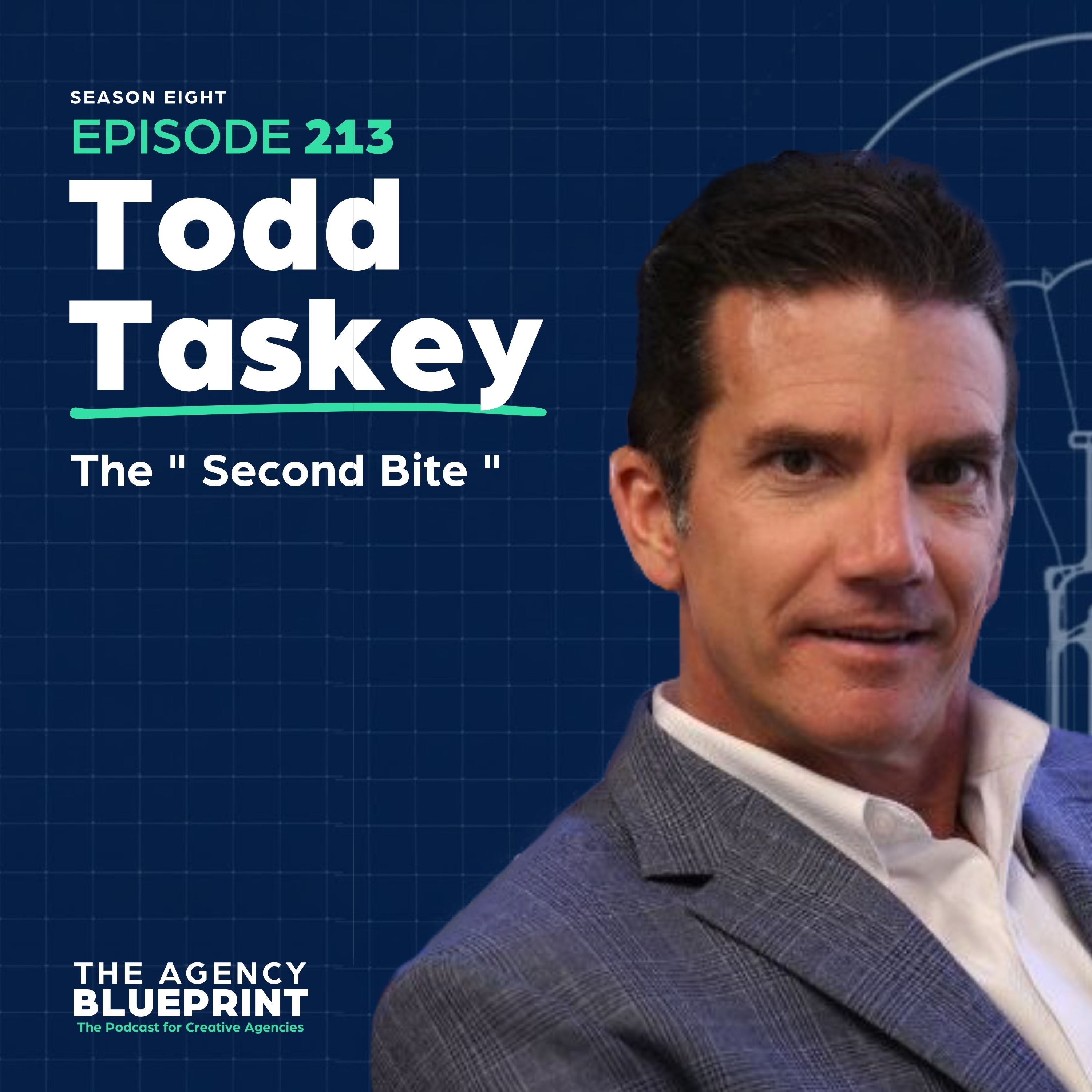
Season 18 | Ep 213 | The “Second Bite" with Todd Taskey
Dec 1900:33:27Tap to summarizeHow can you maximize the value of your business through mergers, acquisitions, and the “second bite” opportunity? Most agency owners today are seeking an opportunity to cash out some equity while continuing to play an active role in scaling their business.In this episode of The Agency Blueprint podcast, I’m joined by Todd Taskey to discuss how deals are structured, why private equity loves specialized agencies, and how “the second bite” often ends up being larger than the first payday. Todd is a seasoned M&A advisor and investment banker who has spent over two decades guiding agency founders through lucrative exits and growth-focused partnerships.Listen in to learn how smaller agencies can attract the right buyers with specialization, strong client retention, and scalable sales systems. You will also learn how AI is reshaping agency margins and valuations, eliminating low-level tasks, and allowing agencies to scale profitably.Key Questions:[01:12] What exactly is the second bite, and how can agency owners benefit from it beyond their first sale?[03:45] What types of deals are most common for agencies today—strategic, private equity, or conglomerate roll-ups?[08:25] Which types of agencies are most attractive to private equity firms right now, and which ones are struggling?[15:16] How is AI changing agency valuations? Is it just hype, or does it create lasting value?[23:07] What areas should agency owners strengthen in the next 2–3 years to maximize valuation?What You’ll Discover: [01:30] Todd explains the concept of the second bite, where selling equity today can lead to a bigger payday in the future.[04:15] The difference between selling to large holding companies versus partnering with private equity-backed strategic buyers.[06:59] Why many agency founders end up enjoying their businesses more after a partial sale.[08:50] The verticals private equity firms are most eager to acquire, and why niche specialization wins.[11:38] How agencies are using vertical focus to create irresistible acquisition stories.[15:40] How AI is reshaping agency operations, cutting costs, and boosting margins without replacing strategic thinking.[19:46] How agency owners should weigh the choice between pursuing higher margins or lowering prices to gain market share.[23:34] The three pillars of maximizing agency value: strong sales, high retention, and healthy margins.[26:13] Todd warns against assuming you can hire a CEO and exit cleanly—buyers see that as a red flag.Connect with Todd:LinkedInPodcast: Second Bite
Transcribe →
Season 14 | Ep 165 | Planning for 2025
Dec 20, 202400:23:47Tap to summarizeHow are you defining success for 2025? Are you setting clear, measurable goals that are ambitious yet realistic? The right planning involves aligning your team with a vision and mission and breaking goals into manageable quarterly milestones. In this episode of The Agency Blueprint, we share a comprehensive guide to strategically planning your creative agency's success in 2025. We discuss the importance of team alignment, transparency, and performing a SWOT analysis to address challenges as they arise when creating a plan. Listen in to learn how to be clear and consistent with leadership objectives and avoid the “shiny object syndrome.” You will also learn the value of seeking external advice and mentorship while balancing external inputs with personal intuition. Key Questions: [00:50] How do you set realistic yet ambitious goals, align your team around a unified vision and mission, and anticipate challenges before they arise? [01:23] Do you understand where your objective is in the longer term? [06:15] How transparent are you with your leadership team about your agency's goals? [18:14] Do you have the right advisors to help you reach your goals? [21:24] How much are you investing in your personal and professional growth and development? What You’ll Discover: [01:23] How long-term personal and business objectives can guide your agency’s success, plus how to define clear and measurable goals. [03:04] Set realistic growth targets based on past performance and assess the gap between where you are now and where you want to be. [04:12] Perform a SWOT analysis to identify each quarter's risks, opportunities, and roadblocks for better prioritization and focus. [06:15] Why transparency with your leadership team is critical when setting goals and making strategic decisions. [08:05] The significance of weekly KPI monitoring and project plans to keep progress on track and avoid missing key objectives. [12:33] The challenges of "shiny object syndrome" and the importance of staying focused on set goals. [14:45] The importance of overcoming limiting beliefs and focusing on personal goal-setting rather than adopting others' goals. [18:14] The value of having an advisor or coach to offer insights and help you navigate your blind spots. [20:50] Why you should focus on solving problems and not just setting goals. [21:24] The importance of investing in your personal and professional development to become who’s needed to reach your goals.
Transcribe →
Season 14 | Ep 164 | Building High-Performing Global Teams with Phillip Rivers
Dec 13, 202400:22:12Tap to summarizeHave you considered expanding your team globally? Leveraging the full potential of your remote workforce can transform your business from a small-scale operation to a multi-million-dollar success. How do you overcome the cultural and communication barriers to build a high-performing global team? In this episode of The Agency Blueprint, I’m joined by Philip Rivers to discuss how to hire and manage overseas talent effectively. Philip is an email marketing expert and founder of a $200M revenue-generating agency. His journey began designing niche t-shirts and grew to a thriving agency with over 50 employees leveraging global talent for outstanding results. Don’t miss this episode to learn more about strategies for building cohesive remote teams and creating meaningful physical connections with them. Key Questions: [01:04] What is the distinction and the relationship between local and global talent, and how can you leverage each? [06:38] How did you look at where to find the right talent with good cultural crossover for the right type of skillset that allowed you to expand your team globally? [09:29] What would you say to someone who needs help in hiring the right global talent? [14:33] How do you consider the compensation component of a fair wage within that individual’s country? [16:18] How can physical team-building activities and annual gatherings improve team cohesion and performance among remote and offshore team members? [18:55] What would someone who’s never hired nearshore or offshore talent consider when hiring? What You’ll Discover: [01:39] Philip’s shift from hiring only local talent to embracing global talent driven by financial and operational considerations. [04:22] His experience hiring client-facing overseas talent and how it works in specific industries. [06:53] The process for finding and hiring the right talent with the right hiring strategies in regions like Latin America. [09:42] The importance of businesses fully preparing for remote workers with SOPs to clear communication expectations. [11:49] How to effectively integrate global talent into the company culture without making them feel undervalued. [13:33] The potential risks and opportunity costs that come from not investing in overseas talent’s success. [15:22] How different cost-of-living levels impact compensation and how fair wages in various countries can still provide a good quality of life. [17:09] How regular team-building efforts and cultivating a united company culture can impact team members' longevity and effectiveness. [19:10] Things to consider when hiring overseas talent, like planning the first 30 days and evaluating soft skills. Connect with Philip: WebsiteLinkedInTwitter
Transcribe →
Season 14 | Ep 163 | Account Based Marketing
Dec 6, 202400:13:44Tap to summarizeAre you looking to target mid-market to enterprise-level clients? If so, the Account-Based Marketing (ABM) strategy might be a good fit. Unlike traditional broad outreach strategies, ABM focuses on precision, personalization, and relationship-building. In this episode of The Agency Blueprint, I discuss the effectiveness of the ABM strategy when working with high-value clients and why it’s more impactful today. I also explain the importance of understanding your ideal client persona, building detailed outreach strategies, and consistently engaging with these clients through multi-channel efforts. Don’t miss this episode to learn how to balance email automation and personalization during client outreach. Key Questions: [00:50] How can you effectively target and engage high-value accounts for your agency? [06:34] Are you prepared to build a long-term relationship with larger organizations with longer sales cycles? What You’ll Discover: [01:44] Why the ABM strategy is more impactful today as larger clients now favor project-based work with boutique agencies. [03:58] Identify your target client persona—understand the industry, organization size, and key decision-makers for effective outreach. [04:24] How to build a client list based on your available time and compile detailed research on your target client before outreach. [06:34] How larger organizations plan their budget and why you should prepare for long-term relationship-building. [09:19] The value of a multi-channel approach – build name recognition by engaging with prospects before initiating direct outreach. [10:12] How to use email templates to streamline your outreach without sacrificing personalization. [11:30] Consistency is key—implementing this strategy requires ongoing effort and consistent follow-up to yield results over time.
Transcribe →
Season 14 | Ep 162 | Focusing Your Attention
Nov 22, 202400:21:42Tap to summarizeAre you fixated on the idea that working more is the key to success? What if we told you that the key to success is not the hours you put in but about focusing your attention? You achieve better results by dedicating just 8 to 12 hours a week to a singular goal, refining processes, and creating intentional focus. In this episode of The Agency Blueprint, we discuss how focused attention leads to real progress rather than putting in more hours. We explore where the hustle culture propaganda stems from and how it only leads to burnout and decreased productivity. Don’t miss this episode to learn how to create a simpler approach to work that focuses on what truly matters in your life and business. Key Questions: [00:33] Did you know you can achieve more impactful results by dedicating 8 to 12 hours a week to a specific goal, refining systems, and improving processes? [06:46] Do you feel like you’re on a hamster wheel, hustling without making real progress in your business? [16:50] Are you focusing on the right problem within your business? What You’ll Discover: [01:31] Understand that hustling leads to burnout, preventing you from long-term success and enjoyment in life. [03:14] How the hustle culture in America was shaped by corporate interests leading to societal stress and inefficiency. [05:28] How agency owners who hustle often find themselves trapped in a cycle of working long hours with little progress. [07:18] How to create boundaries between your work and life and focus on key services in your agency. [12:55] How to plan and prioritize short-term goals for better results than setting long-term, vague goals. [14:19] The importance of patience and focus in achieving meaningful progress in your business goals. [16:50] Why solving the key problem can lead to solving multiple issues within a business. Book Recommendation: Do Nothing by Celeste Headlee
Transcribe →
Season 14 | Ep 161 | Organic Search in the Modern World with Greg Brooks
Nov 15, 202400:29:30Tap to summarizeHow are you prepared to evolve your SEO and organic search as a marketing channel in this age of AI? AI is transforming organic search marketing, so it’s important for businesses to provide high-value content to meet the personalized needs of today’s customers. In this episode of The Agency Blueprint, Greg Brooks joins me to explore SEO and organic search marketing and how AI is transforming organic search marketing. Greg is an author and partner at SearchTides, a hub for all things search and SEO, and in the AI era of searching online. His role is pivotal in shaping the future of effective SEO, leveraging large language models, or LLMs, and navigating an AI-driven era of the internet. Greg has successfully collaborated with industry giants such as Home Depot, Zillow, Western Union, and FanDuel. Listen in to learn how to align your SEO and social media strategies based on customer journey length and domain authority strength. You will also learn whether your SEO works best for your business and when to explore other marketing channels. Key Questions: [01:22] Is organic search still a viable marketing channel in the era of AI and fragmented online search behaviors? [04:32] What’s your advice to businesses to stay updated with AI advancements and SEO changes? [13:39] Who is organic content for and not for, and is organic search meant for everybody? [15:49] How can businesses adjust their SEO strategy to account for user intent and funnel stages, ensuring they reach the right audience at the right time? [27:35] What’s your advice to businesses still trying to determine whether SEO and organic search are a viable channel for them? What You’ll Discover: [02:00] How Google positions itself as a leader in AI-driven search, unlike GPT models, which are often blocked from web traffic. [04:45] How to study user behavior and the buyer’s journey to tailor content across multiple channels and touchpoints. [08:06] The future of AI-generated content and why human expertise is more important than ever. [12:31] The importance of content structure and scrollability to ensure content is easily digestible and tailored to modern user behavior. [13:29] How people are taking combined ways of searching online even as businesses continue to focus on easily trackable marketing strategies.
Transcribe →
Season 14 | Ep 160 | Data Decision Making – Marketing (Part Two)
Nov 8, 202400:16:56Tap to summarizeHow do you leverage data in your agency to create effective marketing strategies? When appropriately leveraged, data in marketing can help you optimize audience targeting, campaign performance, and overall marketing outcomes. In this episode of The Agency Blueprint, I discuss how to base marketing decisions on data instead of making assumptions or shifting tactics too quickly. I also explain the importance of having a disciplined, long-term approach focused on continuous testing and small incremental improvements in various marketing funnel stages to double results over time. Listen in to learn the importance of understanding your audience, running A/B tests, and tracking attribution across channels to refine strategies and achieve measurable success. Key Questions: [01:13] Are you harnessing data within your agency to create effective marketing strategies? [08:30] How do you go about thinking through your existing marketing strategy that allows you to make improvements? [09:32] How well do you understand your audience? Are you collecting the data necessary to segment and target them effectively? What You’ll Discover: [01:32] How marketers often jump from one tactic to another without giving marketing strategies enough time to prove effective. [02:36] How to leverage data to test and verify your marketing efforts instead of making assumptions. [03:56] The importance of perseverance in marketing and monitoring progress before giving up too early. [06:25] The power of making small, incremental improvements in various stages of marketing to double results. [08:30] How to think through your existing strategy and make improvements in each marketing stage. [09:32] How to deeply understand your audience and use data to articulate their problems better than them for more effective marketing. [12:38] The importance of A/B testing even when initial assumptions about messaging may seem obvious.
Transcribe →
Season 14 | Ep 159 | Data Decision Making – Operations (Part One)
Nov 1, 202400:19:23Tap to summarizeHow are you harnessing the power of data to drive operational decisions in your creative agency? Leveraging data helps track agency performance and predict future outcomes, ensuring sustained growth. In this episode of The Agency Blueprint, we discuss how agencies can use data to streamline processes, enhance client satisfaction, and boost their bottom line. We also explain how to avoid data overload and enhance effective decision-making by focusing on fewer meaningful KPIs. Don’t miss this episode to learn more about asking the right questions, data transparency, and proper data management. Key Questions: [00:33] Are you leveraging data to make informed decisions, improve efficiency and effectiveness, enhance client satisfaction, and boost your bottom line? [09:27] Do you have someone in your corner guiding you with data management as a creative agency owner? [16:41] Are you focusing on too many data points, making it difficult to prioritize improvements? What You’ll Discover: [01:37] How data from past performance helps predict future outcomes, allowing for minor adjustments to optimize business trajectory. [02:57] The importance of clean, clear, and well-organized data for making informed growth decisions. [03:35] How to focus on key cornerstones like revenue growth and client lifetime value when reviewing data. [07:29] Ask the right questions about your agency and use data to support the answers for better decision-making. [09:19] Have data management to allow for sustainable business as a creative not naturally inclined toward data. [10:52] The importance of data transparency with your team to ensure everyone contributes to decision-making. [13:56] The power of measuring and monitoring data in your business for continual improvement. [16:50] How to avoid data overload by focusing on a few meaningful KPIs to drive performance improvement.
Transcribe →
Season 14 | Ep 158 | Delegation for Reluctant Delegators with Ashlee Berghoff
Oct 25, 202400:28:09Tap to summarizeWhat’s holding you back from delegating more in your agency? Trust issues and fear of handing over control are some challenges you might face when trying to delegate. But are you aware that effectively delegating gives you time to focus on growth and sustainability? In this episode of The Agency Blueprint, I’m joined by Ashley Berghoff to explore how effective operations can transform visionary businesses. Ashlee is an MBA and systems strategist with the mind of an architect and the heart of an entrepreneur. Her company works with visionary founders and agency owners stuck 'in' the business. They specialize in building and running powerful performance engines, and they have COOs and operations managers on their team. Don’t miss this episode to learn about effective delegation and how personal boundaries can enhance visionaries' productivity. Key Questions: [01:37] In your experience, what are most agency owners' biggest obstacles when trying to delegate? [05:21] Is hiring a virtual assistant when stuck in business operations good advice? If not, why is it bad advice? [11:16] How can agency owners identify which tasks they should delegate based on their strengths and preferences? [23:17] What are your views on setting personal constraints or policies that help agency owners manage recurring issues more efficiently, and would you recommend them? What You’ll Discover: [01:43] The challenges of trust and fear that agency owners face when trying to delegate. [05:33] Why jumping straight into hiring a VA is not the best move and how to delegate effectively for business success. [08:43] The documenting processes by recording videos approach and how it helps build a more efficient system when delegating. [11:34] The importance of thinking holistically about your business’s operational engines rather than simply delegating tasks in isolation. [15:35] How to transition from task-based to outcome-based delegation by empowering team members. [19:28] How integrators and visionaries can work on ideas effectively without misalignment. [21:13] The importance of having both systems creators and doers within a team to ensure smooth, repetitive task execution. [24:13] How setting personal constraints and firm boundaries can help remove the emotional strain of decision-making. [26:14] Ashlee’s playbook – a step-by-step guide for business owners to transition from operational management to strategic leadership. Connect with Ashlee: WebsiteLinkedIn
Transcribe →