← Ahead of the Curve with Coco Mocoe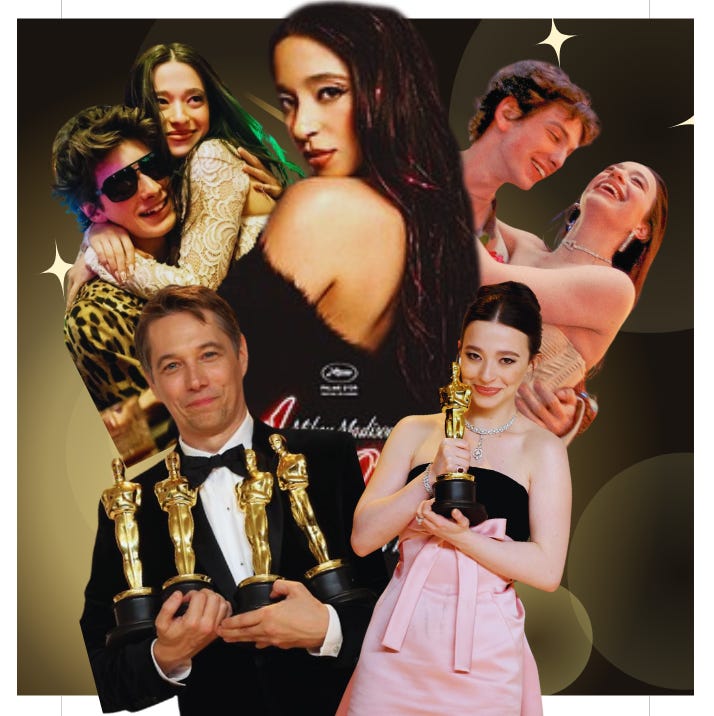
Loading summary
Transcript1 lines
- [00:00]
Kokomo
Did you know that Sean Baker, the director of Honora, won more awards at the 2025 Oscars on one night than legendary directors like Christopher Nolan, Steven Spielberg and Quentin Tarantino have won in their entire careers? He won five Oscars for Honora, whereas those three directors have won between two to three awards each. Sean Baker, a relatively unknown director to the masses, was only known by film buffs for his fringe but beloved movies like Tangerine, which was shot on iPhones, and the Florida Project. Prior to Sunday, March 2, 2025, Sean Baker's name became a breakout search on Google March 2nd and 3rd of this year, the same night that the Oscars premiered, Mikey Madison, the breakout lead of Honora, also became a household name that same night. Prior to the Oscars, Honora was almost entirely snubbed in the awards circuit, losing out to gore horror film. The substance Conclave was also thought to sweep the Oscars this year after a strong awards season run, and it was the type of film that the Academy loves to vote for, a somewhat historically adjacent movie with strong religious or cultural undercurrents moving the plot forward. But instead it was upset by a movie about a stripper in Brooklyn who fell in love with a client who came into the club. So how did that happen? Now I have to say. Coconuts, I called it. Once again, I was on fire this awards season. I predicted six out of the seven main Grammy categories the morning before the Grammys aired, and despite Anora being snubbed throughout the almost entirety of the awards season, I confidently posted a video to Tick Tock and Reels the morning of the Oscars, practicing my dance to the movie's theme song for when the film came out on top. In today's episode of the Brilliant Branding of Insert name here, we are going to be talking about the brilliant branding of Anora. I plan to make an episode about this regardless of how the Oscars did. But in the last few days, more information has come out about their really interesting and unconventional marketing spend of what was a relatively small indie film. Or maybe that's what they want us to think the movie is, because as I always say, America loves an underdog. And no matter what genre you're in, what type of creator or brand you are, if you can position yourself as the underdog, you always win. That is really what they did brilliantly with Anora. So in today's episode of Ahead of the Curve with Kokomoko, we will talk about some fun facts about the making of my favorite film of the year. I went to see it three times in theaters because I can't just like something moderately. I have to dive in and become obsessed with it. And then we are going to talk about some of the budgeting behind the Anora film that is trending online. And then in the second half of the episode exclusively for Paying Coconuts on my best selling sub stack, which by the way, thank you for 10,000 subscribers. We are going to talk about my thoughts on the specific branding, why it was so brilliant. My theory of this whole episode is that they created a popular movie by refusing to be popular and we will talk about how you can do something similar whether you're an artist, creator or brand owner. So all of that will be on the extended episode@cocomoco substack.com thank you so much for tuning in week after week and helping the show grow to new heights. As you're listening to this, on Monday I'm going to be on a flight to Hawaii to just celebrate how really great these last few months have been. And so much as that is because of you guys, the numbers on Substack keep going up and up and I don't really know why or how, but I am just so grateful the paying subscribers make it possible for me to continue this show without running any ads that you might hear on every other podcast every five minutes. I think that is part of the growth. So thank you. Part of the growth is also reviews on Apple and Spotify. Let me know what you guys think of this new the brilliant branding of series that I'm doing. You can let me know in the reviews. You can let me know what other artists, brands or creators you want me to do an episode on. Next week I plan to do an episode on Road Beauty. It's really crazy if you think about it, how Hailey Bieber was the victim of what I believe was an astroturfing campaign in around 2022-2023. Actually, if you go back, one of my first episodes on this podcast back then was actually about that Hailey Bieber and I in the episode I'm kind of talking through this immense hate that she's getting, but if I remember correctly, I didn't really understand why or where it came from. And in hindsight, what we know about Blake Lively now. I do wonder if there were some nefarious actors behind the scenes in regards to the hate that Hailey Bieber got. Despite the immense hate that she did end up getting. It's really cool to see that two years later she has one of the top selling beauty brands of 2024, which is really insane. Good for her. I think her marketing is brilliant. I think she does something specific with her marketing that I've never talked about before. So I'm gonna go into it in next week episode of Ahead of the Curve and if I have the time, I might actually film that episode while I'm in Hawaii. So if you watch the video version, I'll be in Hawaii. So if you love these brilliant branding episodes, let me know and raise your hand in the reviews or the comments on Substack to let me know who else you would like to see covered. Now, diving into Anora, I want to start by talking about some fun facts about the making of the movie. If you're watching this episode, I assume you're somewhat familiar with the film, but a quick TLDR for anyone who isn't. It follows a stripper who meets a Russian oligarch son. They are both in their early twenties and quite impulsive. They get married in Vegas drunkenly one night. Honora, or Annie as they call her, she seems to think that it's true love and he seems to just kind of do it for the plot and because he is a spoiled kid who loves instant gratification. They then deal with the fallout of his angry Russian parents heading to the States to force Annie to annul the marriage because of the shame that would come from the public in Russia finding out this high profile family son married a stripper. I never really figured out in the movie what his dad did, so if anyone pieced that together, please let me know. Like he wasn't like a political official. I don't think. I don't know if anyone knows what job his dad had, please let me know. Now here are some fun facts about the actual filming and behind the scenes of the movie. The movie came about after Sean Baker, a relatively unknown director at the time, saw Mikey Madison as a side character in Once Upon a Time and Screaming. According to an interview with Fandango, in Quentin Tarantino's film Once Upon a Time in Hollywood, she played a Manson follower who only showed up in the last few minutes of the film. In it, she gets killed via flamethrower. Sean Baker said that she even stole the scene from Brad Pitt. Sean Baker and his wife and co producer Samantha Kwan decided to cast Mikey Madison as the lead in their upcoming project Honora. After watching her in Scream, they called her rep to set up a coffee date. As soon as they left the movie theater, he pitched her the long shot movie Anora over this coffee date that was really only a loose idea at the time. I love this anecdote because you never really know who is watching your side. Video that only got 10,000 views on TikTok could be the one that leads to an email in your inbox that changes your life. Some really great friends that I've met or even clients that I've worked with in this industry found me because of a TikTok video that didn't even reach 100,000 views. Another fact is that Mikey Madison learned Russian and Yura Borisov learned English. Mikey Madison told Q with Tom Power that learning Russian felt important to her character. The broken languages that they speak to each other is part of the plot points and really felt organic. I think the broken English and broken Russian made the film and dialogue feel more organic than if they truly knew none of each other's languages and was just reciting off the script or someone was reading it to them and then they were just repeating, you know, what they heard phonetically. I do think that the commitment to learning another language is the type of thing that the Academy eats up. So don't be surprised if you see a bunch of actors next year for their Oscar run talking about how they learned new languages for their respective movies as they campaign for nominations. Maybe we'll even see them throw some dialogue into Wicked. That's a different language and they'll be like, see like Ariana learned a new language for this and I added here in the notes like this is me with my 365 day streak on Duolingo learning the Irish language in which I wrote B Care, which is it was hard. The home invasion scene in the middle of the film that had a runtime of 28 minutes, took seven to eight days to shoot. Mikey Madison told EW that she didn't have a stunt double and didn't want to have a stunt double. She wanted to do her own stunts. She said it was important for her playing the character to actually go through the motions and know what it felt like. Her character gets tied up and gagged, breaks lamps and statues, punches and kicks the Russian henchmen and more. I was most fascinated with how they were able to film this constantly moving fight scene without capturing the crew in the many wall length mirrors around this modern but soulless house. I also wonder if it took over a week to film because they broke so much furniture and like decorations during the fights that I wonder if they needed to clean up and then replace them each day. I'm sure they had replicas ready to go, but as I Was watching it a third time in theaters, I was like, I wonder how many times they filmed this fight scene and how many times they had to replace the props that, like, they were breaking as they're fighting. Another fact is that Mikey Madison learned the specific Brighton beach accent for the film. Mikey's character, Honora, is from Brighton beach in Brooklyn, which is a heavily Russian area, and they have a really specific New York accent. Not only did she work with an accent coach, but she spent weeks living there before they began filming to socialize with locals and perfect the way that they spoke. Again, this is another type of thing that the academy really eats up. They really want you to, like, be so committed. And then the fifth fact, which I think is my favorite, is this is the fifth film of the up and coming production company Neon to win the Palme d'or at Cannes Film Festival. Neon is a smaller production company compared to the likes of a Netflix, and they are eclipsing Netflix and A24 in terms of awards and buzz. The last five Neon films to win the Palme D Or at Cannes Film Festival, which is, like, the biggest award that you can win there have been Parasite, Titanium, Triangle of Sadness, which I love. Triangle of Sadness, Anatomy of a Fall, and now Anora. So at the Cannes Film Festival, the last five major awards, their version of, like, the Oscars have gone to Neon in a row. The only year that they didn't win was 2021 or 2020 because they literally just didn't have an awards ceremony because of COVID I personally would give anything to work with Neon one day as a creator, so one can dream. Now, this leads me to the marketing budget of Neon and what they spent on Anora. It made waves online when it came out that this relatively indie film, Nora, spent three times its production budget on marketing. This kind of makes me excited because it reminds me of the importance of marketing and what we do. I always fear that marketing isn't very important, and it really is not in the grand scheme of things. Like, society needs doctors and accountants more and, like, engineers more than marketers. Like, I always laugh that, you know, if the Internet goes out and civilization ends and we're in, like, a bartering system, like, I'll be the first one kicked out of the tribe because all I know is, like, random, like, Bravo, fun facts, and, like, I have nothing to contribute except maybe I can be the storyteller. I don't know. But, yeah, marketing is actually very important if you think it the way money gets spent on different things. So marketing is meant to be invisible. There's a reason that there's no marketing category at the Oscars or the Emmys or the Grammys, and it's because the best marketing doesn't leave a fingerprint at the crime scene. Best marketing appears that it didn't happen at all. And all of the hype was organic. Tom Quinn, the CEO of Neon, talked about the marketing campaign behind Anora in a Variety interview that came out this week. He stated that they never pander to the campaign, AKA the Academy voters. Instead, they focused on the film filmmaker and audience, in that order. Variety notes that this Oscar win for Best Picture for the relatively small production company Neon beats out juggernauts like Disney and Netflix who have never won the coveted award, let alone twice. For comparison, the Marvel's Avenger Endgame movie had a marketing budget of 200 million. The marketing budget for Wicked this year was 150 million. And that is only one part of the movie. There's a second part coming out. So we can estimate that the Wicked's total marketing spends by the end of 2025 will be $300 million or more. And the Barbie marketing budget was 150 million as well. Variety reports that one competing film, they don't say which, but that it spent up to $60 million on their marketing budget for awards season alone. Now, they don't say what movie it is, but I personally assume it might be Emilia Perez. Tom Quinn even mentions that people often Compare neon to a 24, which as I began scripting this episode, I thought it was going to be more of a neon versus a 24 type, you know, back and forth. But Tom Quinn actually says that Netflix is their biggest competitor in terms of who buys out the movies that they auction for oftentimes. So. So I do Wonder if the $60 million spend was maybe for Amelia Perez. Quinn stated to Variety that they spent $18 million on this movie for the marketing. Now it's of course a lot of money, but it does not even hold a candle to bigger media companies around who spend three to eight times what they did. Quinn states that the overall film budget was 6 million, meaning the marketing alone was three times the actual cost of the movie. David Theon, the producer of Anat of a Fall, which was the movie that Neon was nominated for last year for Best Picture at the Oscars. Well, he's the producer and he told Variety that Quinn is scrappy when it comes to marketing. It's really cool to hear about a CEO that's like really hands on with the marketing strategy, but it was Quinn who had the idea to highlight the dog in the film as an integral part of their marketing campaign. And of course that was a smart decision because the film would then go on to be nominated for Best Picture at the Oscars. The article also mentions the relatively low box office sales for Anora despite it winning Best picture. It grossed 16 million domestically and 41 million internationally. But Quinn isn't letting that phase him. He said the box office isn't the only revenue source and marker of success for a film. The movie is currently number one on streaming for Amazon prime and Apple. The movie will most likely continue to be a sleeper hit, especially after the record breaking awards and Sean Baker and Mikey Madison's name being breakout searches on Google. Famously, Fight Club with Brad Pitt was considered a bomb at the box office when it came out. It saw a major drop in second weekend sales, which is never a good sign for a movie. Fight Club was also so poorly received at its premiere that critics left the movie theater midway through, even with the actors like Brad Pitt sitting in the theater with them. But now Fight Club is considered a cult classic despite despite it not doing as well at the box office and it is now the most reviewed movie of all time on Letterbox. I believe the second most reviewed movie of all time on Letterbox is Parasite, which is a Neon film, which is the second Neon film to win an Oscar for Best Picture. So it's really interesting that everyone says a 24, a 24, a 24, but there's also this indie neon that's, you know, it's creeping up from the side as well. And Anora almost didn't happen in 2023. Neon almost sold to a billionaire industrialist, Stephen Rales, but it fell through in the 11th hour. Some thought that this meant Neon, like many other film startups, would shutter its doors and close for good. Which hopefully that doesn't happen because as I talk about later in this episode, I just really feel like we need good movies in movie theaters again. As you guys know, the movie theater is my happiest place on earth. I think my bio on Instagram or Tick Tock is like probably in a movie theater right now. I go to the movies all the time. It's my happy place. It's why I launched my show Middle Row, because I just love the feeling of going to a movie. It's like you're escaping your real life for a couple hours. You get to eat your favorite candy popcorn and you leave a different person. You leave, you know, having experienced something you would have never in your normal life. So, God, I just hope that it'd be so dystopian if one day all we're left with is like Marvel movies and like Disney remakes. I mean, I do, I'm excited for the Snow White movie, but like, franchises are just taking over. It's annoying. However, Neon preserved and kept going despite this major setback. They focused on the art and not the profit or popularity. When you focus only on profit or popularity, you often fall short at making a genuinely good product. You only become an extreme version of whatever is popular at the time. And as I always say, the opposite of trendy is timeless. While there's nothing wrong with being popular or profitable, I do think that those things must happen organically. They must happen not because you were aiming for it necessarily, but because you focused on making the best possible product that you could. Chasing trends and popularity is a short term strategy that is often sniffed out by audiences quite quickly. And if I ask you to go back into your brain and think about the times that your videos have really done well and you've seen growth, usually it's when you're. It's really when you're doing something that you didn't even anticipate was gonna go viral, you're like, why did that video take off? It's never when you're like, okay, I saw this video go viral. I'm gonna recreate it word for word, bar for bar. So I really think this movie is an example of that. They weren't really chasing the same box office profits that maybe a Marvel movie or a Disney movie would. They were just trying to make a really good film. And as a result, they were awarded by the Academy. Anora really followed the cocoism formula of the nicher. You go the quicker you grow. And you can do it too. As a creator, I will talk in detail about Anora's $18 million marketing campaign. Where exactly they spent that money. I'm going to compare it to other movie marketing campaigns and why theirs was a little unconventional. And then I'm going to really wrap it up in a pretty bow for you guys about how you can apply these strategies to your own growth, whether you're a creator with a hundred followers, 100,000 or a million. So you can listen to the second half of this episode exclusively@kokomoco substack.com for $9 a month. Thank you again so much for 10,000 subscribers. Those of you that are paying coconuts, you guys get access to every Friday trend report and you can binge the full length episodes of this podcast. So if you become a paying member today, you get to go back and listen to six months worth of weekly content that's, you know, the full length deep dive. So if you like to hear about marketing and you have some time to kill or you're going to be in traffic or working on your laptop and you like to listen to this ad free podcast, you can do so over there. I always save the best bits and knowledge for the paying coconuts, so be sure to tune in and just if not though, thank you so much for making it this far. I really appreciate every single one of you who tune in week after week, and I really hope that this brings you wisdom or comfort because being a creator and just putting yourself out there, whether you're doing it for your art or for your brand or because you want to be a content creator, it's really scary. It's really a vulnerable thing. You're going to fail more than you're going to succeed. It's part of being a creator is shameless. It's embarrassing. You're, you know, you put out videos that people don't watch, but you just have to keep going regardless. So I really hope that my podcast can be a comfort to those of you guys and a reminder that that's normal and that the most successful people just keep chipping away. So paying coconuts, I will see you.