← Ahead of the Curve with Coco Mocoe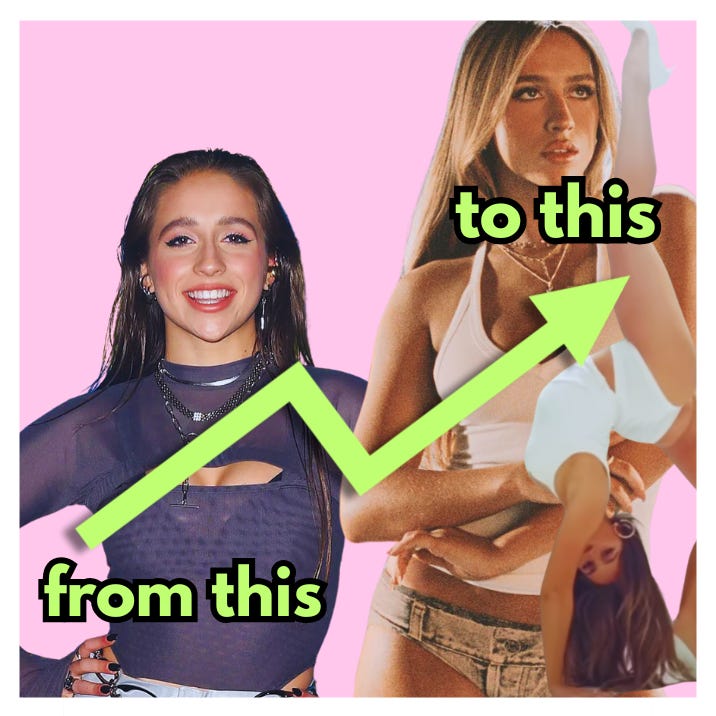
Loading summary
Transcript1 lines
- [00:00]
Coco Moco
Did you know that Tate McRae's newest album, so Close to what, is set to debut at number two or number one on the Billboard 200 as I'm recording this podcast, which would make it her highest charting project to date. This is despite the fact that just three years ago she was best known as the girl who went viral on YouTube for her bedroom choreography videos and covers, and for being friends with stars like Olivia Rodrigo, even appearing as a side character in one of her music videos. While Tate McRae's music has always been a slow burn, so I don't want to diminish that at all, but it seems Tate is at the precipice of a cultural moment right now, one that will break her out of being a niche Gen Z celebrity and potentially into the throes of household name fame, the way Sabrina Carpenter and Chapel Roan and Doji experienced last year and early this year. But what exactly is that shift that happens and how can you help use these tools to elevate yourself as a creator, artist or brand? What has Tate McCrae done differently from not only her past self but also 99% of other artists in the industry that she finally seems to be having her breakout moment? We are going to be breaking down her brilliant branding in the first episode of this new format of my show since I posted a two minute TikTok about the top topic that has far outperformed my expectations tenfold and the coconut seem to want more, so I'm going to give them more. So let me know in the comments on Substack or the reviews on Apple and Spotify what other artists, creators or brands you would like me to do a full breakdown of for the next addition to the brilliant branding of Insert name here, plus any theories that you might have about said artist, creator or brand. I am thinking of doing Road Beauty next week, so let me know if you're interested in there's one specific thing they do that I've never talked about on my channel that they do with branding that's really, really fascinating, so let me know if you would be interested in that. Before I get into specifically Tate McCrae, I want to start by telling you what my definition of household name fame is, because I do know that it can be subjective. I think of household name fame as meaning that everyone in a singular household knows who someone is the grandma, the dad, the teen, the aunt, and the youngest kid. You can find huge heights of fame as an artist or a creator or a brand, but never break into household name territory. If you only stay within one generation. A good example of this phenomenon would be Sabrina Carpenter last year before opening for Taylor Swift and becoming an almost caricature extreme version of herself with Short and Sweet, she was previously a Gen Z darling. She was known to high schoolers and middle schoolers who may have seen her on Disney Channel, and she made appearances on podcasts like the Zach Sang show that really tapped into that younger audience demo. But a parent or a grandparent might not have known who Sabrina Carpenter was in late 2023 like they did by late 2024. And that's especially before she found her own branding and instead was kind of leaning into this more grun that I believe was popular because of the rise of stars like Billie eilish. Will Tate McCray have a similar moment or will she fail to break out of the Gen Z bubble? In the free portion of this podcast, I will break down the key elements of Tate McRae's branding success, particularly through the lens of her so close to what album rollout. I will discuss how her pivot from relatable singer songwriter to polished pop star was both risky and brilliant. But I will only scratch the surface. If you want access to the full breakdown, including an analysis of how Tate McCrae was able to really build a world around her through her social media presence and her collaborations. To position her as an A list star, then you'll need to subscribe to my best selling substack@kokomoco.substack.com so that further deep dive will be the second half of this episode. But as far as the beginning, we are going to dive in part one become an extreme version of yourself Tate McCrae didn't just wake up one day and decide to be a full fledged pop star. If you followed her career from the youe Broke Me first era, you'll notice a study evolution not just in her sound, but in her entire public Persona. In the early days, McRae was best known for her vulnerable, emotional songwriting. It would have made sense for what was popular at the time, which was breathy bedroom pop like Billie Eilish. While these early YouTube covers helped Tate McRae land a record deal and have her first breakout song to a Gen Z audience with youh Broke Me First. I would argue that this side of Tate McRae was not one that would make her stand out from the pack. It felt like a young artist who aligned with the trends at the time. But if you want to really stand out, you must figure out what you bring to the table that no one else is doing The Internet is like a potluck. You don't want to bring something, a dish that someone else has mastered. You have to figure out what is something unique that you can bring that will leave people wanting more. One of the biggest mistakes that I see artists and creators make, including myself at times, is falling victim to whatever is popular at the time. As I always say, my favorite little cocoism, as my talent managers call it, the opposite of trendy, is timeless. When I preach the Hollywood hair theory or the Halloween costume theory in branding, I will often see creators or artists grasping at straws to become an extreme version of whatever they think is popular at the time. While I hate the word authenticity when used by marketing gurus, since none of them really explain what it even means or how to get there other than be yourself, what the hell does that mean? I'm sorry. It's like one of my pet peeves. What the does it mean to be yourself? Like, how are you not? Anyways, the one way I think of authenticity, and I said this in my TikTok that's going viral that inspired this episode, is authenticity is doing something you would be doing whether a camera is filming you or not. For me, it would be inauthentic if I became a chef online because, you know, Emily Marico is trending or Nara Smith is trending because I'll be honest with you, this is embarrassing. I don't really cook and I don't really have a desire to learn. It's just not something I do. And I know that, like, if we ever go into the apocalypse, like, I'm gonna be the first one kicked out of the tribe because I have nothing to barter with. I'm like, hey, like, I could tell you how algorithms work, but there's no such thing as a WI fi connection now that the world is ending and I'll get stoned in the town square for not bringing anything of value. But we'll cross that bridge when we get there. I'm not a chef. If I started posting cooking videos because I wanted to ride the wave of Emily Marico or Nara Smith or Ballerina Farms, my audience would clock immediately that I'm being inauthentic, and it would turn them off. But Tate McCrae and her label, they could have chased what was trendy in 2024 in the creation of her so close to what album. They could have made her a pinup girl like Sabrina Carpenter, or they could have had her lean into drag inspired outfits and performances like Chapel Roan, but none of those things would have made sense for her. She could have become the most extreme version of those two trends, but it would have put audiences off to her because they would sense that it isn't who she is. Instead, she began making music that she could dance to. We see that with her first breakthrough single in 2023, Greedy. She has a dance background like no other pop girl before her currently or after her. The music video for her new song Revolving Door, which is the first single off so close to it, actually might not be the first single. Sorry, it's the one that came out closest to the album coming out. But in the music video it has her start with her in a scorpion. Okay, so one of her legs is behind her head. I know in cheer they would call it a scorpion. I don't know if they call that in the dance world. And then on one leg she falls backwards into a backbend. I cannot think of any pop artists currently or within the last 20, 30, 50 years that could do that. Maybe Normani. Maybe Normani or FKA Twigs. I digress. But it's something that makes her unique and now she is leaning into it. Not only with her athleticism and dancing did Tate McCrae find an extreme but authentic version of herself with visual branding, she's leaning into the sport aesthetic more than ever, and it's something that no other pop girl is doing right now. Her brother Tucker McRae, is a ice hockey player for Dartmouth. She even dated. And one of her exes is a ice hockey player professional. She grew up around the sport and also the competitive dance world. She wore ice hockey shin guards in her Think later album cover from 2023, and her music video Fun Greedy took place in an ice hockey rink. She sung at a National Hockey League game and fully embraced the sports references with her first single from her new album, Being Sports Car. At her album release party in LA earlier this month, she wore a jersey with a bedazzled bra underneath for her performance. Not only with the sporty aesthetic, but she also leans into this kind of winter ice queen, Calgary, Canada aesthetic that complements it as well. If a Sabrina Carpenter or Taylor Swift all of a sudden started wearing jerseys and hockey shin guards on their album covers, it would make no sense. Just like how it would make no sense if Tate McRae all of a sudden started doing a pinup style. The sports branding, specifically the ice hockey branding, makes sense for this Canadian pop star with close family ties to the ice hockey world. She found something that makes her and her story unique from all other pop stars. And she turned it up a thousand notches with the release of so Close to what and finally it is paying off. I'm really interested to see what she does for the SNL performance, which will be out by the time this episode is out, but not before I'm recording it. Her song Revolving Door is trending, so maybe she'll perform Revolving Door and it'd be cool if it was like her going through a revolving door, literally. Or it could be like treadmills, like the OK Go music video from the early days of YouTube, which she kind of has like references of intentionally or not with her Run for the Hills music video. So I hope she continues to lean into something athletic and movement that no one else can pull off for her specific SNL performance. We will see it comes out tomorrow. Part two of her branding the brilliant branding of Tate McCrae is finally leaning into mystery One of the smartest things that McCrae did leading up to the so Close to what? Album release was strategically pulling back from social media. This is a very risky decision to make, but it is necessary if you want to be seen as a list Instead of flooding TikTok with endless clips and forcing trends like many artists do. Not always because it's their own creative decision, but labels make them. Instead, for this rollout, she kept things really selective. She still posted to TikTok, but only in a way that built intrigue. Gone were the overly personalized just woke up style videos. Instead her posts became more stylized and more curated, giving just enough to keep fans engaged and excited for upcoming performances or appearances, but not in a way that felt like she was overexposing herself. The only times we really saw her online in the lead up to her 2025 album was when she was appearing in interviews. Now this is what I call the third party effect in marketing. People are much more likely to be open to you, whether you're a creator or brand or an artist, and learning about you if it's not coming directly from your account. A sad comparison here, but I think it's a good way to explain it because it's really relevant right now would be the rise of the problematic TikTok live streamer Astrovino. She started breaking into millions of views when a secondary account called Ash Updates popped up on TikTok and they would start posting the most outrageous clips from Astravino's live streams. Prior to this, Astrovina was a pretty smaller creator. She got some attention because she was known as her self proclaimed inmate hopper, but she wasn't like a huge Alex Earl I personally would have never sought out to watch a tick tock live streamer on my own. It's just not my thing. But I learned a lot about her and her wrongdoings and her chaotic live streams from a third party account that had no ties to her. I was intrigued because it kind of felt like reverse psychology. In fact, I'm pretty sure the Ash Updates account was actually someone who didn't like her and kind of wanted to expose her. And they have exposed her. But that account popping up elevated her status tenfold. For Tate McCrae, instead of posting a million TikToks of a day in my life or the dreaded listening to my new song in my car format that had TikTok artist in a chokehold from like 2021 to 2023, Tate McCrae pulled back completely. A lot of her videos on her TikTok are from music video sets, interviews with people like Alex Cooper, or clips of her on stage to perform to a huge crowd. This creates an air of mystery and elevates her star power since she becomes less accessible. Mystery is especially important with music since since people need to be able to see themselves in your music, I talk about pulling back in the rubber band effect in marketing in the previous episode of Ahead of the Curve, which was about Addison Rae from last week and it's on this podcast. If you want to learn more about creating mystery. Tate McCrae still took over the for you page of millions by appearing in podcast shows like Los Culturistas, the Jimmy Fallon show, and now the upcoming SNL performance. She often appears alongside her close friend Jake Shane, who is an influencer who he posts multiple times a day and so having someone more accessible like him kind of doing the legwork of virality helps her still remain top of mind for fans without coming off like she is desperate or too accessible. If you yourself want to create an air of mystery for you or your brands and you're Internet savvy enough, you can create a secondary account where you post updates about what you are doing. It sounds corny, but I know that it has helped some artists catapult themselves and I know some influencers do it. I don't, but I know some do it. I know of one artist who doesn't want to be named, but catapulted herself to mainstream fam about two years ago by creating an anonymous Twitter account to hate on her own music and then that would boost SEO searches for her because people would go listen to the songs, but since her music was actually good, it was kind of genius. Because then she created a loyal fandom of users who are ready to go back to Twitter after listening to her and then defend her against these hate accounts that were actually her in disguise. The third party approach is major in breaking out of the small bubble of your niche audience. It does often happen organically, but if you need to, if you need to jumpstart a little bit, you can create secondary accounts to get some extra momentum to your work. But if it's meant to look like a fan account, that's kind of walking a fine line and you don't want to get caught like Normani did a few years back. But with Dave McRae, this approach, intentionally or not, created an aura of exclusivity around her. When an artist feels just out of reach, it makes their work feel more valuable. Suddenly, McCrae wasn't just another Gen Z musician or content creator desperate for the attention of so many. Instead, she became a star. And I wrote about this phenomenon, known as the Curiosity Cue in my substack on the Friday Trend Report. But becoming mysterious is a risky move, but it kind of acts in the same way that you know how if you're walking down the street and you see a really long line for something, or there's like a bar or a club that's really hard to get into and there's this long line down the street, you're like, oh, I want to go, I want to get in. But like, even if you go inside, it's not even that interesting. Like I talked about the club in Berlin that's coined the most exclusive club in the world. I think it's called Bergen. But like, people post clips from inside and it's not even that popping. But the reason it's so interesting is because it's so hard to get in. Like the bouncers just turn away so many people and that creates a level of value for the work that like not everyone had access to it or they weren't desperate for everyone to be able to see it. And so I think that's part of the mystery as well with a music artist is like pulling back and not having to be as accessible or doing all the same tick tock trends that everyone else is doing. And if you look at the meaning of star, why do we call people in the public eye stars? A star is literally something that is in the universe that is so out of reach from us, but we can still see it's out of our normal orbit of every other planet, planet in, I think it's the Milky Way, which one is the one that we are in with our Sun. Anyways, this is so embarrassing because I also took astronomy in college. Anyways, but a star is something that doesn't exist within the Sun's little universe, and it instead has its own gravitational pull that is much further than our own. So Tate McCrae isn't chasing the trends of other stars, gravitational pull or our own sun and Milky Way. Instead, she's now existing in her own world, thus giving herself her own gravitational pull. I hope I explained that well. It sounded much better when I was typing it out at a coffee shop, but okay, Coconut. So you've made it this far. And in the second half of the episode we will be talking about the different strategies from her Think later album in 2023 to what she changed for her so close to what strategy for 2025. What the difference was there, why both of them worked, but why? I think they're introducing her to new audiences in new ways. And then we will talk about her world building. Something that all creators, artists and brands must learn to do if they want to ensure that they are not a flash in the pan. No matter how small of a creator you are, you really want to try and world build. And I'll explain what that is. So only paying members of my best selling sub stack will be able to listen to the second half of the podcast. You can unlock the rest of the episode exclusively@cocomoco.substock.com but regardless, thank you guys so much for making it this far. I really appreciate you for being here and paying Coconuts. I'll see you on.