← Ahead of the Curve with Coco Mocoe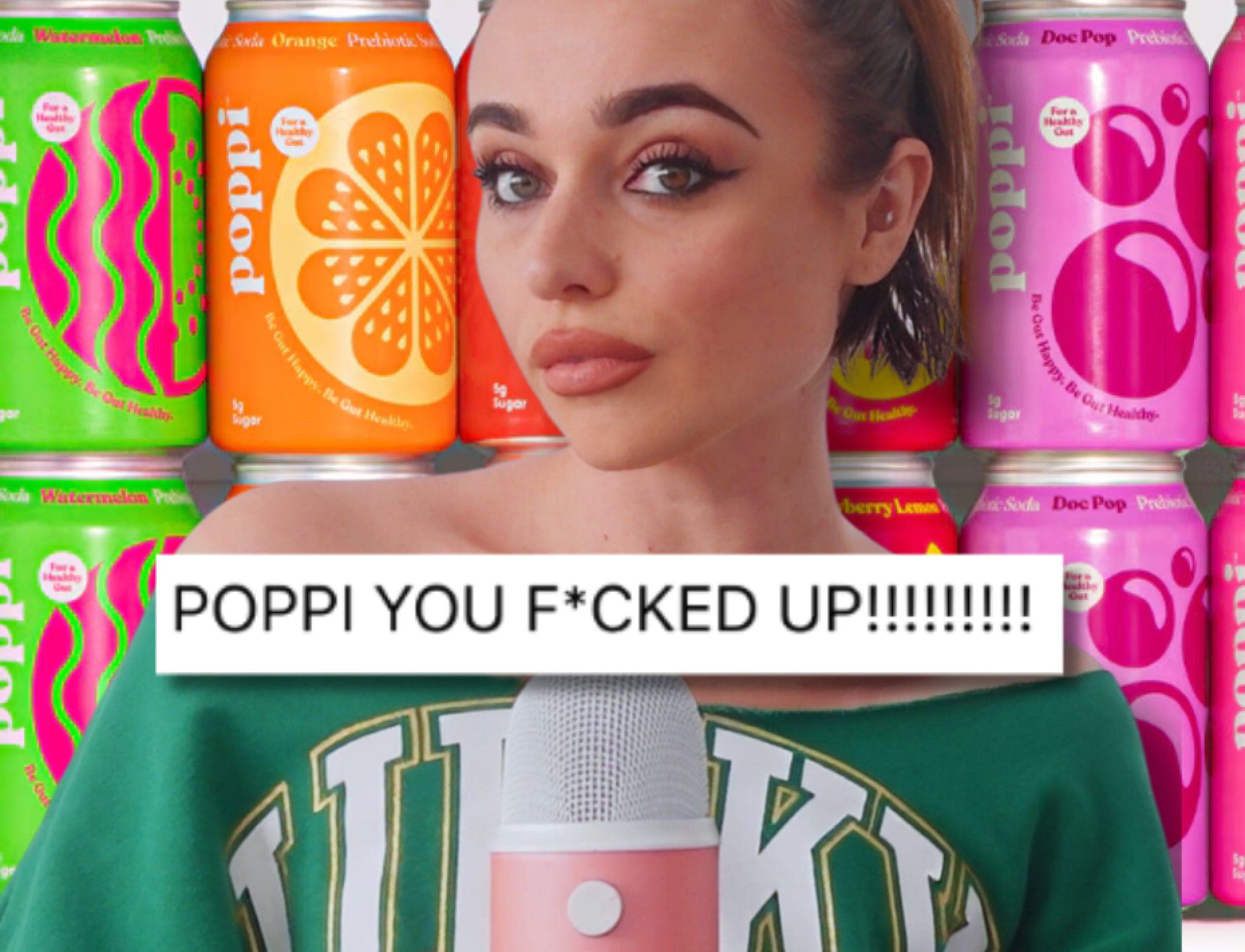
Ahead of the Curve with Coco Mocoe
The Internet Hates Female-Founded Brands: Poppi Vs. Olipop
00:26:59
Loading summary
Transcript1 lines
- [00:00]
A
The legacy of super bowl commercials is that the Internet must find one to be mad at every single year, as it is a rite of American passage. Most of the times the anger is justified, like when Kendall Jenner solved police brutality by handing an officer a Pepsi. Other times it is unfounded, like when Tubi was in hot water last year for a commercial that brilliantly made it look like the game had come back on. And then the channel starts flipping around. People online began blaming any spike in domestic violence that night on Tubi. There's a lot to unpack there. Domestic violence has unfortunately existed before that Tubi commercial and will unfortunately exist long after it's forgotten about this year, I thought outrage would maybe be at how boring the commercials were. Or maybe another good contender is the fact that Kanye west was allowed to air a commercial where he was promoting a web website where the one sole product was a white T shirt with a swastika on it. But no, surprisingly, they weren't mad at that. The bulk of the conversation around super bowl anger was because Drumroll please. Poppy sent temporary vending machines to influencers. Wait, am I reading the script right? Huh? Yeah, that's actually what they were mad about, not the swastika shirts. We're going to break this down now. I do want to preface this by saying that part of the anger wasn't about the actual vending machine, but at the group of influencers chosen for the vending machines. And I totally agree with that. It only takes one TikTok search to see that there really wasn't a ton of diversity with who they chose. And I do agree that is creators that like, have to work 10 times harder and get 10 times less pain recognition are POC creators 1000%. And I myself have used my platform to advocate for inclusion in the influencer space. And I know it's never enough, but I do do my best. In fact, I did an episode about the lack of diversity on Tarte brand trips in 2022 on this very podcast. So that is a sentiment I wholeheartedly agree with 100%. If you are a white creator who gets invited on a brand trip, one thing that you can do to advocate for inclusion is ask for a roster of who else is going before you sign on because you want to make sure that it is inclusive. You might not get that roster or they might even rescind your invite. But if you feel that you have the leverage and you're okay with potentially losing your spot, then you should ask, even be willing to give up your spot. If it means someone else has the opportunity to go. So I did want to include that before I get into the other aspects of this episode of Ahead of the Curve with Kokomoco. Thank you so much for watching my other show. Middle Row with Kokomoco is on this YouTube channel as well. And the first episode back with the new set of episodes with Adela from Pop Star Academy is performing so well. I'm so excited and happy to finally see things taking off. It takes so so long as a creator to invent your own ip, but like I never wanted to do it with a production company. I put all of my money into the show and it's so cool to see new people finding it and it getting views and future guests include Remy Bond and Hannah Lux Davis Hannah Lux Davis is a music video director who directed Thank U Next with ariana Grande and 10 other music videos for her. She's done Charli XCX music videos, Doja Cat music videos, Tate McCrae music videos, Renee Rapp music videos. The list goes on. She's major. We talked about all of those pop stars and more in the episode and some cool behind the scenes story about filming those that she shared. But back to Ahead of the Curve. What I love about this topically topic specifically is that there is no right or wrong answer. I do think inclusion is the right answer 100%, but this episode will be more about the parts that are a gray area of Vending Machine Gate Was it distasteful for Poppy to send out vending machines? Was it the budget that was out of pocket? If so, why aren't people up in arms about other super bowl campaigns? The first portion of this podcast will be about the claims against Poppy. What exactly was their super bowl campaign? Why are people mad? And some other similar branded activations. To contrast, was some of the anger rumor mill or was it truth? And then in the second portion of the podcast, exclusively for paying members of my bestselling substack@cocomoco substack.com I will go into a comparative analysis and what happens next? Will Poppy have to shutter its doors close? Is there any other brand that they can learn from? And maybe this is just people moving on from influencers. Who knows? Comments are only available on substack. The episode specifically will be linked in the show notes in case you want to leave your thoughts or if you have some other perspective that you would like to add. There is no right or wrong answer here. I love that I'm not in an echo chamber and have people of all different perspectives in my audience who always keep discussions respectful. So those discussions will be over on Substack. Thank you for making my substack a bestseller. And thank you for those of you rating the show on Spotify and Apple because of the coconuts. Continued support every single week I'm able to grow this show and keep it completely ad free. I've never run an ad on this show in the two years that I have it, and I don't want to say never, but I do intend to keep it that way as long as my substack continues to grow because I personally hate that podcasts now have a million ad reads. I want every minute of this show to bring you value and unique insights. If you've ever gotten a fresh or unique perspective from my show, let me know in the ratings. Thank you so much. Diving on in so what was Poppy Super Bowl Activation? Poppy ran its first super bowl commercial last year in 2024. It had their distinct hot pink and colorful branding, but most notably the commercial had no influencers or celebrities. And with that, their commercial got little to no buzz. It wasn't that interesting. But this year Poppy was potentially the most talked about super bowl activation of 2025. Even more talked about than huge commercials that had huge a list celebrities. So what exactly changed in a year? Well, to start, Alex Earle became an investor in Poppy, according to a TikTok on her account from May of 2024. Since then they've leaned into influencer activations even more than before. The founder of the brand, Allison Lensworth and her husband Stefan. They're a couple, but Alison is really the face of the Poppy brand. In fact, she's the one who made a video responding to the alleg of overpriced vending machines, which I'll get into later. Their super bowl commercial last year was pretty boring, didn't get that much buzz. But this year they had Alex, Earl and Jake, Shane and not one but two super bowl commercials. One for cable and one for Tubi. The commercials were kind of boring and not really anything to write home about, but interestingly enough, what really got people talking is the fact that they sent out vending machines to influencers ahead of the super bowl game. I would argue that Poppy has gotten more social media mentions and viewerships than any other brand that ran multi million dollar campaigns during the 2025 Super Bowl. In fact, the Dunkin Donuts super bowl commercial currently has 2 million views on YouTube. But a TikTok talking about poppy vending machines, not even the commercials has 1.9 million views. So it's crazy to think about. As soon as the vending machines were sent out, people began making videos about how out of touch these campaigns were. And again, they weren't wrong. The whole point of this episode is that I agree with the fact that it was out of touch and that it was not inclusive. But if we are going to hold Poppy to that standard, I think we should hold other brands to that standard as well. A brand that I want you coconuts to keep in the back of your mind as we go through the Poppy controversy is Dunkin Donut. From what I could find, Ben affleck was paid $10 million for a 32nd Super bowl commercial with Dunkin Donuts in 2024. That's not a number I pulled out of my ass. Like Olipop saying that Poppy paid $25,000 per vending machine. Which it's kind of funny because Olipop follows me on social media. Maybe not anymore, I don't know. They probably don't listen to this podcast anyways. But the 10 million dollar price for Ben Affleck was according to multiple news outlets like Us Weekly, TMZ and Yahoo. And that was just for his 32nd ad last year. While I don't assume the price was doubled on time alone, I do wonder if he was able to negotiate more than 10 million this year because the commercial was 60 seconds and not 30 seconds. And on that point of inclusion, which again I agree with. So we're going to be mad at Poppy for inclusion, understand? Look at the Dunkin Donuts commercial. It had about a 90% all white cast if not more. I will include screenshots on the video version of the pod, but you can see almost all white faces besides Druski. So if we're going to be mad about inclusion, why are we only mad at Poppy? And no one is making think pieces about Duncan's inclusion. I don't mean to dunk on Duncan here. They are just a really good contrast for us to think about for the rest of the episode. Now back to Poppy. The controversy around Poppy really kicked off when a creator made a video critiquing Poppy in a TikTok titled Poppy, you fucked up in all caps on this video. Poppy's biggest competitor, Olipop commented that the vending machines cost $25,000 each. First off, how would they know that? And second off, why did people take them as an authority on another brand's activation? Olipop has a huge incentive to bring down Poppy. In my opinion, it is Their biggest competitor, and most notably Olipop is founded by two men. If a female founded brand started being catty and spreading unfounded rumors in a competitor's TikTok comments, people would call them bitches and jealous and catty. But when it's a male founded brand, they are called hilarious. And coming with receipt, Daymond John from Shark Tank made a fascinating video about the topic. He mentioned that it is entirely possible that the overt attacks and potential astroturfing against Poppy could be com coming from a competitor. Or what fascinated me is that it could be coming from a bigger brand trying to acquire Poppy. Now what is astroturfing? This is something we talked about in a few of my Blake Lively episodes. But if you look at the root word of Astroturf, it is grass that they use on like football fields and stuff that looks like real grass from far away. But if you get really close up, it's not real grass. It's fake grass. So that way they don't have to like water it and all that stuff. But it looks real from far away, but it looks fake from close up. And part of Astroturfing is that there's power in numbers. If they only had one little plastic piece of fake grass, it would look silly. But they have thousands of little plastic pieces of fake grass across an entire football field that makes it look real. So when you have astroturfing in this context, what happens is essentially, and this is my understanding of it, okay, I'm not an expert because I've never done an Astroturf campaign. I never would. I think it's one of the dark arts of social media. But what they do is say you really, really hate Santa Claus and you have a million dollars and you want Santa Claus to have his reputation just absolutely ravaged. This is making me think of that one tick tock. That's like, how does Santa Claus know where I live? Don't come to my town. Anyways, that's some brain rot for today. But okay, you hate Santa Claus, okay? And you decide that you're going to put a million dollars towards astroturfing Santa Claus and making it seem like the Internet hates him, to tank his confidence, to tank his brand deals, et cetera. What happens is, let's say you find a video that is organic, right? So there's someone else out there in the world that hates Santa Claus just as much as you do, and they make a TikTok and it gets 200 views, okay? Astroturfing is you go in and through the Dark arts through the dark PR companies that can run these campaigns. You will send them that link and for a price, they will boost that video of this random person who hates Santa Claus in the feed. It will go super viral. They'll get a bunch of bot accounts to comment on the video so it seems real. And what ends up happening is other influencers who do think pieces on holidays. Okay, this is all hypothetical. They are gonna see that. Oh my God, this nobody creator just made a video about how much they hate Santa Claus and it got 3 million views. That's probably $3,000 in the TikTok Creator Fund. @ least that's what mine is like. Usually a thousand dollars per million views and they're gonna go, oh my God, I don't really hate Santa Claus. But if this is what's trending right now, okay, so then if I make three videos today about how much I hate Santa Claus and those videos are getting pushed in the feed, I can make money too. I can grow in followers. Even though they're all empty accounts, they're not a real following. And that is what astroturfing is. So they will find organic videos and they will push them in the feed so it looks like that conversation is going viral because then it encourages other creators that lack integrity to make similar videos. And then it seems like this organic hate train on Santa Claus. Okay, so Draymond Daymond John, sorry, freaking dyslexia. Adds letters that aren't there. So Damon John, what he was saying is it could be a competitor that's astroturfing. I don't think he's Astroturf. But what it could also be is a hypothetical bigger brand that wants to acquire Poppy. So I did some research and their competitor Olipop, according to CNBC is valued at 1.8 billion billion. And Olipop is smaller in following compared to Poppy. So let's say hypothetically Poppy is valued now at $2 billion. Okay, so what happens is, let's say Coca Cola or Pepsi hypothetically want to acquire Poppy because they're such a social media front facing brand. What they can do if it's all a legend, it's all dark arts, I don't know that this is happening. But they can go in and pay for or they just see some organic controversy about poppies start to spark. They can then astroturf those conversations like the Tick Tock video, that's like Poppy up. It's just so dumb. And then those videos go viral. Other creators that are low on budget that need some Money are like, okay, hating on Poppy is popular right now. Let me jump on the bandwagon. They go popular too, because they're getting Astroturf. Their videos are being pushed as well. And then let's say the brand that wants to acquire Poppy, a Coca Cola, a Pepsi, whatever, they can then go into negotiations and they'll say, hey, Poppy, you know, three weeks ago you came into the boardroom and you pitched us for $2 billion. Well, look at all this negative press you're getting right now. I think that bumps you down to only $700 million. So it really fucks with the mind of the brand. This up and coming brand that's now getting all this negative press that could potentially not even be completely organic. It's another company that has an incentive to either bring a competitor down or bring their valuation down if they're in talks to be acquired. So that was Damon John, a really great video. If you guys watch it. He also talks about how it's a female owned brand. And again, I don't mean to be an advocate for women all the time. Like, I didn't mean for my podcast to be this. I'm just an advocate for what I believe is equality in this space, in the creator space, in the celebrity space. And I think oftentimes once you see the disparities with female creators and female celebrities and the way they're treated, you can't unsee it. So we don't know if it's a hundred percent true that potentially, you know, Poppy is being astroturfed, but it is food for thought. There was a comment on my TikTok video that I made about the topic earlier this morning, and Amber Lane, a creator, she commented that super bowl commercials are a tradition that people look forward to, to be shocked, entertained by Dunkin Donuts played to that audience. But Poppy isolated their audience. And I do think that that's a great point. A lot of people made the point that Poppy is, you know, a brand for the working class, for the little guy. And that's kind of how they made their, their whole image. And so them really, like doing this vending machine thing is out of touch. I get kind of. But is Dunkin Donuts not for the working class? Like, I'm working class and I go to Dunkin Donuts all the time. So why. I didn't realize Dunkin Donuts was like, so highbrow and like brushing shoulders with like Hermes and like, what do you mean that Poppy is. But like, Duncan isn't. Right. So again, but I do get the point that she says that Duncan shocks and entertains the way a Super bowl commercial should, whereas Poppy didn't do that. And I also think part of the critique around Poppy versus Duncan is literally social media activation. And this is why I tell clients again, like, going viral is not always the goal. Sometimes going viral is gonna bite you in the ass. So like Poppy is a very social media facing brand and them doing a Super bowl activation where they of course had commercials, but then they also sent influencers vending machines that they had to post about on Tick Tock. Guess what? Tick Tock has comments. People can immediately sway the conversation in comments, whereas no one. While Ben Affleck's super bowl commercial was airing, it's not like in millions of people's homes across America as they're watching the Super Bowl, a little like frame came on screen and it was some girl in her bedroom in, you know, Wyoming being like, did you know that actually Ben affleck was paid 10 million doll for this? Like do, do everyone needs to be mad. No one could do that on a Super bowl commercial. There's no comment section. But people can do that to Poppy in these smaller creators videos about the vending machine. So I do think that like the immediate feedback of social media is also where these brands get in trouble. Also, Poppy is seen as a smaller and more accessible brand compared to Dunkin. So the people feel anger when they don't have immediate access to the brand, but they don't expect that with a Dunkin Donuts super bowl commercial. And then I also think part of the anger towards Poppy is more an anger towards influencers. Influencing is one of the only industries that is female dominated and any female dominated industry is likely one that is underpaid. But influencers do get pretty good money. A lot of the language around the Poppy vending machines was that these influencers didn't deserve it. How do we determine what someone deserves? A great example to compare to is Celsius. Celsius is an energy drink. And okay, again like people saying Poppy is so unhealthy and the prebiotic stuff, I get that. But if you look at Celsius. Celsius, I love Celsius, by the way. But like they're an energy drink and like they themselves have been in trouble for health concerns. Like all energy drinks have, no one's mad at them for that. Like no one's making think pieces about them. At least that I can see. So Celsius, the energy drink regularly works with influencers like David Dobrik. And Jake Paul, they send them lots of products and they have extravagant activations like a celebrity pickleball game for David Dobrik. And again, it was brilliant. It went viral, like great. For Celsius, like round of applause. They did their job. But I personally never saw a think piece that said Celsius, you fucked up the way people said Poppy, you fucked up. No one said that David Dobrik didn't deserve a celebrity pickleball tournament and demand that he donate all of the pickleball supplies and drinks to schools in the area. It is only when it happens to female creators. And I must add that from my own experience, even though female creators do dominate the influencer space in terms of like impressions and virality, I personally have had situations where I found out that a male creator with one third of my following who had made a career off of copying me and other creators was offered more money than me for an identical brand deal. The only differing factor that was that he was a man. The brand could not provide any other reason as to why they offered him so much more and they didn't think that I would find out. So as a result, I turned down this life changing money to make a point. And hopefully that brand thinks twice about offering female creators way less money than male creators. Even though female creators have a bigger audience, bigger reach, and maybe those male creators, you know, copied them. So just because it's female dominated doesn't mean females have equal pay. In fact, people were ragging on some of the influencers who got the vending machines, who I would argue are not even close to being millionaires. Some of those influencers that got the vending machines. But no one ragged on David Dobrik or Jake Paul for their Celsius partnerships and no one ragged on Ben affleck for making $10 million for a 30 second commercial. So if we are going to hold people accountable for being out of touch, that is okay, I agree, let's hold them accountable. But do it to everyone and don't cherry pick the female owned brands for the sake of rage bait. I really am. I think 2025 is the year of me kind of growing frustrated at and wanting to distance myself from the pop culture commentary space or just the influencer commentary space because mind you, 99% are amazing people and do amazing work and do amazing videos and so many of them are able to find entertainment value from being positive. And I think that's so hard and underrated as a creator. But more and more I feel that the space that I'm in is becoming more so. Like, I think some creators that do commentary are just vultures. Like, I think that they fly around the sky of the Internet and they wait for someone to make a mistake or make a misstep or not even make a mistake, but then they pounce. And their money, their monetization, comes from hating on someone who is successful, someone who made a mistake or whatever it might be in a way that you don't see that with. Like, they are not putting their personal lives out there. They're not being vulnerable. We don't know anything about them yet. They go after other people's personal lives and. And it's like vultures. Like, they're like the, you know, the tea spill type content. That one. They're not adding any value. Their podcasts are just them, like, recapping the drama that someone already figured out on Tick Tock two weeks before that. And I also think, like, my warning to you guys as well, my audience is like, be careful consuming pop culture content because I think it's becoming the alt right pipeline, the way UFC and like MMA fighting was for men like five, 10 years ago. I think that the fact that like a Candace Owens is the most popular pop culture content commentary channel right now is so concerning. And I don't know that I want to be a part of that anymore. And that's why I've been distancing myself and not making as many commentary videos, even though I have thoughts. And I always say, like, for my videos, I only want to add to the conversation if I have something to say that no one else has said. Am I critical of creators and celebrities sometimes? Hell yeah, I am. Sometimes I've regretted it, sometimes I don't. But I do think that I want to distance myself. And I'm so glad. I'm so lucky for Middle row, where I'm getting to just sit down with the artists themselves and let them tell their stories instead of me hypothesizing or theorizing or when I'm not going viral like other critters jumping on a hate bandwagon. So that was kind of my sermon of the day. If we're gonna hold Poppy accountable, hold other brands accountable, hold Duncan accountable, but it's not going to happen. Now I'm going to get into the second half of this episode that will be exclusively on CocoMoco substack.com and I will link out this particular episode in the show Notes, in case you're listening on Spotify or YouTube and you don't know how to navigate substack because it is confusing and that is where people can leave comments because I'm going to turn the comments off elsewhere. So thank you so much. Coconuts. Whether you're paying or not, if you made it this far, I appreciate you. And let me know your thoughts in the reviews. If my podcast has ever given you a unique insight or perspective, or you just appreciate that I don't run ads on this podcast, please let me know in the reviews and it will help other marketing people like us find our community. So paying coconuts though, I'll see you on the other side.