← AI + a16z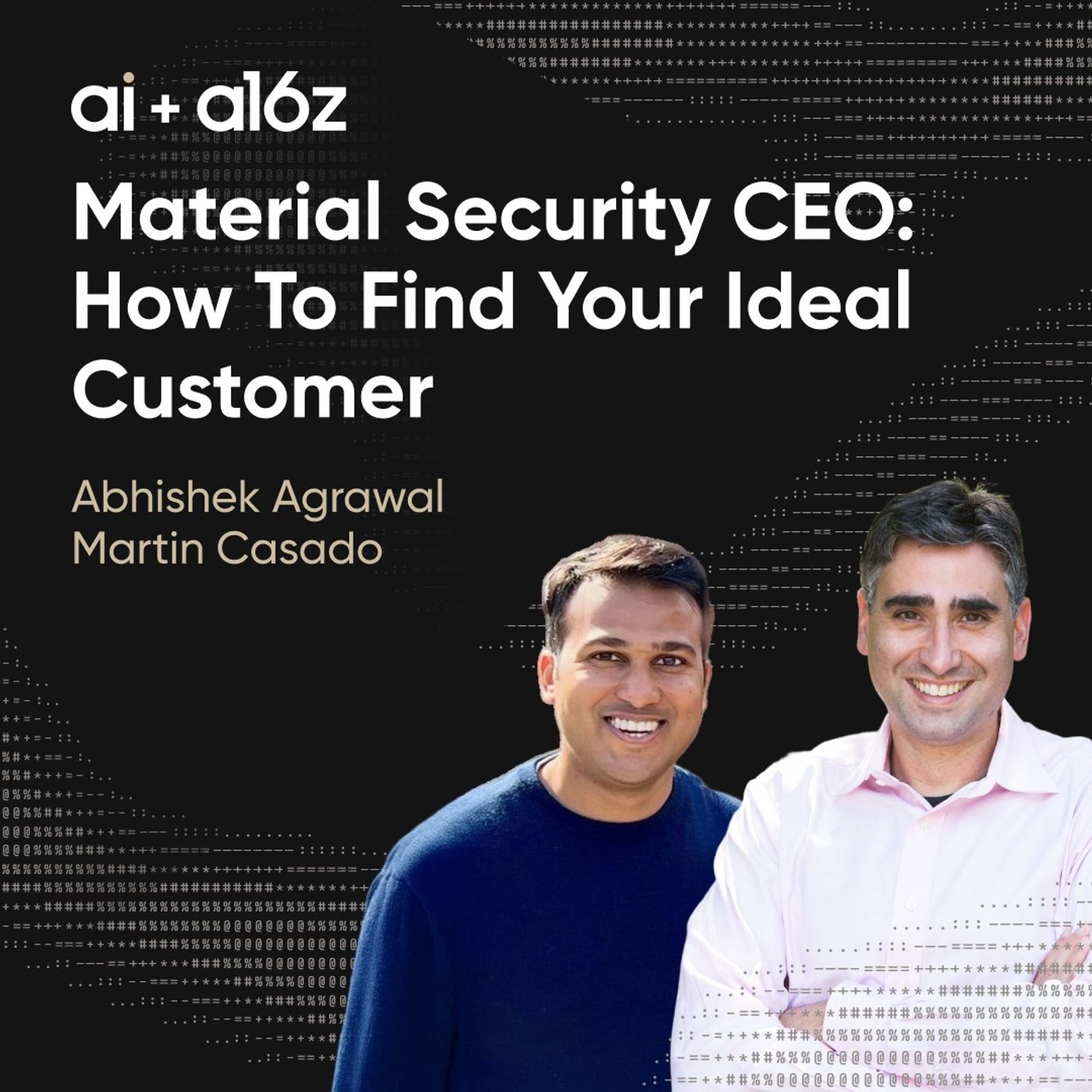
AI + a16z
Material Security CEO: How To Find Your Ideal Customer
00:34:26
What if the hardest part of building a company isn’t the product, but knowing exactly who it’s for? In this episode, a16z General Partner Martin Casado sits down with Abhishek Agrawal, Cofounder and CEO of Material Security, to discuss how an ideal customer profile is discovered, how to manage any kind of customer, and how frothy markets can distort real signal.
Loading summary
Transcript127 lines
- [00:00]
Abhishek Agrawal
Over time, when we secured our first few customers, they had that need, they got it. They had the discretionary budget at the time. As things tightened, as we had to go past those kind of early visionaries and start moving more through the adoption cycle, what we learned is that you kind of have to meet the market where it is before you can take it where you want it to go. And I think that is the lesson for founders that are trying to do category creation because it's really hard to convince a market to move to the position you see it going to without bridging their path to get there. Right. Like you have to provide some of the things that they need to do today so that you can take them on that path. And I think for us, right out the gate, we had a pretty different thing. And it could supplement stuff that customers already had. But as soon as they had to be very diligent in what to choose, they had to solve a problem they have right now. Not just an aspirational problem.
- [00:56]
Podcast Host / Narrator
What if the hardest part of building a company isn't the product, but knowing exactly who it's for? In this episode, A16Z general partner Martin Casado sits down with Abhishek Agrawal, co founder and CEO of Material Security, to discuss how an ideal customer profile is discovered, how to manage any type of customer, and how frothy markets can distort real signal. Let's get into it.
- [01:19]
Martin Casado
Abhishek.
- [01:20]
Abhishek Agrawal
Martin, thanks for having me.
- [01:21]
Martin Casado
It's great to have you here. So, CEO, Founder of Material Security maybe just to start. So we're going to be talking about finding your icp, maybe a little bit about going through like, you know, an economic, I would say investment bubble and then crash, you know, soul searching as a founder and then kind of everything in between. So maybe a quick overview on Material Security, what it does and then we'll dig into it.
- [01:44]
Abhishek Agrawal
Material is a cybersecurity company. It's in the growth stage and basically what we do is we help companies secure their cloud office suite. So whether that's Google Workspace or Office 365. And we got our start in email security. These days we do things like account security and file data security as well.
- [02:00]
Martin Casado
How long have we been working together now? Think about it.
- [02:03]
Abhishek Agrawal
Six, seven years.
- [02:04]
Martin Casado
Seven years.
- [02:05]
Abhishek Agrawal
I think we've met each other seven years officially, maybe six years.
- [02:08]
Martin Casado
Yeah, it was pre Covid and it was kind of during a bit of a boom time. Yes, it was interesting actually to kick a lot of this off and so like, I think that You've been one of the more thoughtful founders that I work with when it comes to like, really refining who the ICP is, going through that journey, you know, identifying it and then adjusting business to it. So we're going to talk through that. I think this is actually very useful for a lot of people to learn. But early on, Material Security was like one of the darling companies and you had all of these great logos and you kind of had all this great deal velocity. And we have these board meetings, like, wow, it's just amazing you had these customers. So maybe like an initial question is, did that kind of throw you off the scent a bit? You're like this kind of like wealth of riches.
- [02:46]
Abhishek Agrawal
And yeah, I think, you know, it's one of those things where I'm certainly not complaining. That was a great time and it was a great time to start a company in many ways. But I think to this conversation, yeah, absolutely. In retrospect, one of the hardest things about that time was that the market was so frothy that basically you had a cool new idea. It was solving a real problem that was ubiquitous. And you kind of didn't hear. No. Usually people had a lot of discretionary budget. They had a lot of budget to experiment with. And so in the early days, you know, we were kind of in that syrup era and not trying to take anything away from our early, like, accomplishments. But it was certainly harder to tell. Kind of like where there's like a real strong need versus where this is just an interesting take. And especially you think about a market like security where you're never done with security. Like, you can always justify more security. I like to make this analogy of like in your home. Yeah. It's not like a front door lock is enough. Then you can have a camera system that you can have a fence. You can always do more. So, yeah, in retrospect, it was kind of easy at that time to justify another layer.
- [03:47]
Martin Casado
Just to put a little bit of a point on it, just because I think we forget, like, how good times were then. Do you remember what your net revenue retention was in like 2018?
- [03:57]
Abhishek Agrawal
I actually remember something even funnier. I remember me sharing it with you and you're like, are you sure you know what rent revenue retention is the wrong number. So you sure you know how to calculate it?
- [04:06]
Martin Casado
But it's even crazier than that. So, okay, so the net revenue retention was crazy. I don't remember what it was. It was something crazy. Okay. But even crazier, it wasn't usage based. Right. It was seat based. Right. If you have any idea. So you have just imagine 180% net revenue retention. That's seat based. And this is literally just because these companies were growing so fast.
- [04:24]
Abhishek Agrawal
They were growing so fast. It felt like AR was just falling from the sky at the time.
- [04:28]
Martin Casado
And how would you characterize like the kind of classic, you know, customer during that time?
- [04:36]
Abhishek Agrawal
So a lot of our very early customers were kind of, you know, all three founders were from Dropbox. So we kind of had the Bay Area like tech kind of network. And a lot of the very, very early ones were just like literally folks that like the Dropbox security team knew and other companies. But then also you know, like things like EBCs through you guys and that's. But in terms of characterizing, I would say like back then probably like these kind of hyper growth tech startups, you know, like the doordashes, Lyft, Gusto, Stripe, like these kinds of companies and then occasionally one offs these kind of large, larger companies, more like traditional enterprise.
- [05:12]
Martin Casado
Yeah, yeah.
- [05:13]
Abhishek Agrawal
So but it was a mix.
- [05:14]
Martin Casado
It was, I remember looking at this, it's like there's not a lot of commonality. It's all great.
- [05:18]
Abhishek Agrawal
And we thought, you know, again, in retrospect it's kind of funny to talk about, but it's like we were like, well yeah, of course, like the same problem that we solve exists at this company and at this company who doesn't have email?
- [05:29]
Martin Casado
Everybody has email.
- [05:30]
Abhishek Agrawal
So therefore who doesn't have sensitive data in their email? And not only that, but we even thought this extended to personal accounts. If you remember.
- [05:38]
Martin Casado
I was patient zero.
- [05:39]
Abhishek Agrawal
Yeah, you were patient zero. So we're like, well, the whole company comes out of John Podesta's personal Gmail account getting hacked. And these cloud email systems are basically the same APIs on whether it's corporate email or personal email. So we're like, why even start stop at all businesses go to personal individuals as well.
- [05:55]
Martin Casado
So now in retrospect, and we're going to go through this journey, but in retrospect, having gone through the journey of really figuring out who the core ICP is, do you think that this was a hindrance having gone through the, you know, everybody's buying and it's really easy.
- [06:09]
Abhishek Agrawal
Or yeah, you know, I've thought about that a lot because on the one hand like what we were just talking about, in a way, yes, it's a hindrance because you're kind of hearing yes everywhere. So it's like kind of not forcing you to have the discipline of really figuring out what. On the other hand, it gives you a lot of at bats. A lot of people are saying yes. And then it gives you the opportunity to figure out what your ICP really is. Because I think that's one of the topics that I've learned is like you can't really derive your ICP in a vacuum. You have to do it through the field experience. So like you have to actually go through a bunch of sales cycles, understand where you were able to sell, where you weren't able to sell where you were, you were able to retain customers where you weren't. And that teaches you your icp. So. But that whole cycle can't get started if you never make any sales to begin with. So in a way, I'll also feel silly if I'm like, well, no, it was really bad because it kind of unlocked our ability to go test the market.
- [06:59]
Martin Casado
And what caused you to feel like you needed to get a lot more clear about the icp? Like maybe walk through. I mean, listen, we went through Covid. We went through, I mean a lot of the customer base that was providing 180% NRR. They, you know, they went through troubles so forth and so kind of just maybe talk a little bit through like how that forced you to think about.
- [07:25]
Abhishek Agrawal
Yeah, I would say they were kind of like the earliest signs actually were not even around business metrics or anything like that. They were just like our own team sentiment. You know, you could see like engineering and product starting to have like less clarity about okay, are we building X or are we building Y?
- [07:40]
Martin Casado
And again, almost like internal. Internal kind of schizophrenia.
- [07:44]
Abhishek Agrawal
Yeah.
- [07:45]
Martin Casado
And again like enterprise.
- [07:46]
Abhishek Agrawal
And then Martin's individual 95, 95, 98% of the stack was the same. So we told ourselves it doesn't matter and we don't have to make this choice. But the thing is, the earliest signs were there that there are going to be divergent requirements. And I think it's just one of those things. No matter how much diligence you do to ensure that an SMB or mid market company has the same kind of vague requirements as a large enterprise, you will discover the long tail where it's not the same one. We were kind of feeling that pressure. I think two is.
- [08:18]
Martin Casado
Can I just ask you, so if the good times continued, do you think you'd have had to have dealt with this anyways?
- [08:26]
Abhishek Agrawal
I think eventually, yes, but it's just.
- [08:29]
Martin Casado
Too hard to see.
- [08:29]
Abhishek Agrawal
It's just too hard because I think.
- [08:30]
Martin Casado
An individual all the way to the enterprise.
- [08:32]
Abhishek Agrawal
Yeah, well, I think the real reason I feel that we would have to deal with this anyways what I was about to say, the next thing is you start not really having a clear answer of who you are and who you're for. I think that starts influencing downstream things like, well, where do we market, which events do we participate, where do we not participate? And like for all those questions you kind of as a founder I remember thinking like, well we're saying yes to a lot of things. We're not really so clear on where we're saying no. So those were like the earliest signs. Like basically investment decisions felt hard because there was no like so literally like.
- [09:04]
Martin Casado
You mean like so it's not just leadership, it's not just even like marketing messaging, it's actual like deployment, deployment of dollars.
- [09:12]
Abhishek Agrawal
Like where do you spend, like where do, which activities do you engage in, which do you not activate? Simple thing like should you have a self serve trial on your website? Well, if you're selling to like really large enterprises, maybe it doesn't matter. But if you're selling to very small companies like you obviously need to. So things like that I think were the earliest signs. I think to your question though, what really started making it really clear is yeah, as the good times were kind of ending, this, you know, seed based NRR was going away and we really had to start having a lot more discipline about where we want to build pipeline, what type of pipeline are we going to be able to close and get, you know, continue the growth. That's where this really came into focus.
- [09:49]
Martin Casado
So maybe talk. So we, you know, you had this kind of abundance of riches and then this. Okay, we actually have to do a very focused effort. So we need to, you know, we need to know what the ICP is maybe talking about through how you went through that process.
- [10:04]
Abhishek Agrawal
Yeah, yeah. So I think you know, the key sort of like glaring alarm that was like, okay, we got to start like thinking about this was as we started seeing some of those good times end, I think we didn't realize like how much of our growth was dependent on that. And so when as that was starting to wane and we had to compensate for it with like much more new business, that's when these investments decisions really became sort of like top of mind. Okay, well if we have to kind of get this back on track, if we have to build a lot of pipeline, get a lot of new logos.
- [10:36]
Martin Casado
Do you think it's too simple? So I don't mean to cut you off, but do you think it's too Simplistic to say that, like, you're forced to do this when you, in, in, in Material's case, when you went from basically inbound to outbound, do you think that generalizes for other, like, other founders listening? Like, if you're always outbound, you kind of have to figure this out. But like, for those that are enjoying some inbound motion but then are forced to outbound, do you think that's kind of the time where this is going to be forced on the founder?
- [11:00]
Abhishek Agrawal
I think certainly the first step of like when you're getting past like that founder selling kind of like just your network and you're actually like organizing a sales team and, you know, getting them to go attack pipeline on the inbound, outbound side. I think that's interesting. Like, I, the reason I'm hesitating is that I feel like regardless of whether you're doing inbound or outbound, you still kind of have to define who you are. But I think it's more about just overall pipeline goals. As you start trying to sustain that same growth, I think that's where it starts really putting pressure on. And then also in our case, it started just trying to think about which channels and things like that do you participate in. And that again, it starts putting these questions in stark, you know, stark relief.
- [11:41]
Martin Casado
You know, you know, the CFO or the finance function really have to think about like the operating plan and unit economics and like to. To what extent are you trying to reconcile that when you think about ICP versus providing some guidance from a leadership perspective, from an investment perspective, and to be very clear, which is the ICP will dictate your acv. Yes, it'll dictate, you know, the reps that you hire dictate how. That you comp them. So how much of that is like leading versus trailing? When you think about going through this.
- [12:16]
Abhishek Agrawal
I think it's more trilling. So in our case at least, I think in our case at least, my biggest learning is like not having an. The way that shows up in your business is actually a lack of efficiency and maybe to tie it all the way back to what we've been talking about with good times versus the bad times, when it started becoming important to be efficient. That's what really put pressure on us trying to find an icp. I think before that, when it was growth at all costs, it kind of didn't matter as much. But if you're going to go efficiently acquire customers, I think you need to have a good sense of what your ICP is because Efficiency shows up in things like how do you market and how do you invest those dollars, how do you build out your post sales team and can they drive retention and expansion? And those things become inefficient when you don't have an ICP because you're unintentionally spreading yourself thin and kind of investing resources in a non deliberate way.
- [13:07]
Martin Casado
So how do you go about finding an icp? Do you just sit in a room and think really hard like you go through daily? Is there a systematic way to do this?
- [13:16]
Abhishek Agrawal
Yeah, I think that what, what happened in our experience was that I don't think you just sit in a room. I think that actually, in my opinion, founders have an instinct that is actually very counterintuitive to finding an icp because their instinct is to want to go.
- [13:31]
Martin Casado
Everybody wants everything. Yeah. Every meeting is not about qualifications, about selling.
- [13:35]
Abhishek Agrawal
You ask my sales team. I'm shit at discovery. Why? Because I just want to pitch.
- [13:39]
Martin Casado
Everything's selling.
- [13:40]
Abhishek Agrawal
Yeah, but I think that, but it's actually more insidious than that. Not only that, but I think founders are problem solvers. So where they're losing, where they're not doing well, that's what they want to go fix.
- [13:50]
Martin Casado
But actually this is such an important.
- [13:52]
Abhishek Agrawal
Point, but actually an ICP is about doubling down on where things are working right. And so I don't think it's just sitting in a room and thinking about it. I think it's actually starting to. It's almost like a historical look back. Okay, when we look at all the customers we've closed, or when we look at the kind of customers we serve, which are our favorite customers, you know, either from the product fit or from a perspective of unit economics, you know, where we can serve them efficiently. Where was the sales cycle the easiest? Where do they just get it? It's a look back. And I think the really tricky thing with that is that in startups your product is also always changing. So when you say I'm looking at the last 12 months of data to figure out my ICP is, it's like the first objection you hear is, but, yeah, but 12 months ago our product was X, Y and Z, and now it's this, so can't use that data. But I think you kind of have to be like, look at that very honestly and start the other thing. I remember this clear clearly. There was this moment where I was like in a room with our sales team and we're doing a pipeline review and you talk about like opportunity X and like the room would lift up, people lean in.
- [14:56]
Martin Casado
And you're almost reading the body language.
- [14:57]
Abhishek Agrawal
Talking about opportunity Y. And people are like, almost like, mentally writing it off. That's your freaking i50p, right? Like, it's telling you right there because it's saying to you, what are the opportunities that the reps kind of intuitively understand are going to be better served for them versus the ones that aren't.
- [15:12]
Martin Casado
You know, Ben Horowitz said something to me when I was in your seat as a founder and he was on my board, and he said, always look for the people that are piped into the nervous system of product market fit. And I think he's exactly right. Which is there is, like, almost kinesthetic sense that some people have on what's working and what's not. And not everybody has it, but the sales team clearly should.
- [15:35]
Abhishek Agrawal
The sales team should, yeah. And I think that, you know, it's sort of like their instinct is, well, I just have to hit this quota. So am I going to try to fill my pipe with things that I have high confidence in closing or low confidence in closing? And I think what is sort of nice about that is that it's like a very logical, unemotional way to think about the problem, like, I have to hit. And whereas, like, I think actually, founders, we're often in this trap of there's, you know, certain markets you might be emotionally attached to, there's existing customers that you feel like you don't want to walk away from. So you're kind of. It's trickier for a founder, in my opinion, to derive this on their own. I think they have to do it through the data and through their team.
- [16:14]
Martin Casado
You know, it's surprising to me in this conversation is you haven't mentioned competition at all. Like, not as a way, like the thing that caused you to think about icp, nor how you've gotten it. So how do you view competition? Is this something that's sort of irrelevant, or does it help inform it, or do you react to it?
- [16:31]
Abhishek Agrawal
It's a really good point. I think competition is actually very related because ultimately, what you're really saying when you say an ICP is you're saying, who are the set of customers, buyers? What criteria do they have where they prefer you over alternatives? And I think that the root of it is, well, what is it about your product that makes you more appealing to these customers or prospects than other alternatives? So competition is actually very related to it, but it's almost like the market is sort of segmenting itself into different positions and.
- [17:04]
Martin Casado
And you just need to realize that it's almost like this tectonic plate.
- [17:07]
Abhishek Agrawal
Yeah.
- [17:07]
Martin Casado
And you seem to know which continent you're on type thing as opposed to like you respond to some other company or have to position yourself relative to them. Is that a fair way to.
- [17:16]
Abhishek Agrawal
Exactly. But I think this is a really interesting point which is like there the two things kind of go hand in hand, like your positioning versus your icp. What comes first is I think another thing that like, at least for me was confusing at the beginning. Are we trying to declare who we are and then that's almost like self fulfilling or are we seeing kind of where we do well and then backing into a positioning? I think that honestly it's a little bit of both. Like you. One of one of my favorite things, like an ICP starts as like an aspiration or a hypothesis, but then it ends with a data regression because you know, you have a hypothesis of who you want to be, who you want to be for who you want to serve and then you kind of see if that actually plays out in the market. And often you're very surprised, I think with who actually prefers your product and for what reasons.
- [17:59]
Martin Casado
So I want to talk about two things. You can decide which one to start with. So one of them is actually just describing how the customer base has evolved. The second one, maybe just to tee it up for you or maybe you want to talk about it first is material security. This is a little inside baseball, but it's one of the few companies I've ever known that went from this category creation really differentiated thing first. And then it kind of backed into something that's kind of more common and now has both. And so just thought it'd be kind of interesting to talk about that journey because I think there are a lot of folks that are trying to do category creation is realizing it's hard and may have the same set of trade offs. And so maybe we'll start with like kind of how the ICP's evolved. But then I would really like to dig into going from like actually being super differentiated to deciding to being less.
- [18:46]
Abhishek Agrawal
Yeah, yeah, definitely. I think in terms of how it's evolved, I wouldn't say that we had an ICP and then changed it. I think it's been more about. We didn't have an ICP defined and then we've been.
- [18:54]
Martin Casado
You just picked it out of the.
- [18:56]
Abhishek Agrawal
But I think, you know, early days, like our customer base was literally like, you know, it was like complete me, complete mix. Like I Remember getting on sales calls and bragging about the fact that our smallest customer was 200 people and our largest customer was 200,000 people. And I thought that was like a great thing because I was like, look at this big range we can serve. And so early days, it like literally was not a choice that we decided to make. I think the only way that you would even hear the words segmenting or anything in our company at the time was just in terms of, like, how we'd organize the sales team. I think, you know, going forward a bit, what we have kind of realized is that our product. And this actually segues well into your second question as well. But it's really great for companies that are looking to do several use cases in kind of one area versus have a siloed solution. And that correlates somewhat to size of company, but not always. What we've learned over time is actually correlates to the size of the security team, because if you have a very large security team, you actually have more appetite for maybe point solutions, or you have organizational silos in the company itself and that dictates their buying behavior. Whereas if you're a smaller security team, whether it's at a small company or at a big company, you're actually looking for one tool that does more. And that's who we speak to better. And that's something that has been, you know, learned through blood, sweat and tears over the years. But I think that's very much. And what's been interesting to me is that it's not as simplistic as just a company size or an industry. It's actually related to these kind of more subtle second order.
- [20:27]
Martin Casado
How do you get the sales team to actually qualify something that kind of nuanced?
- [20:32]
Abhishek Agrawal
I think what you. What we've started.
- [20:34]
Martin Casado
I mean, at the end of the day, what I've learned is founders can sell anything. Yeah, exactly, right. What you don't want them to do, you want like somehow to them to figure out who to sell to and then somehow articulate the qualification criterion to the sales. And so, I mean, like, given this is actually fairly comp.
- [20:50]
Abhishek Agrawal
It is complicated. And I think that, you know, I remember that one of the things again, that was hinting to us that we really needed to declare an ICP and actually get the company aligned around it is that we were running into this thing, like, literally reps were like, I'm about to talk to customer X. Do I use slide like deck A, deck B or deck C? And you know, again, I think founders are Versatile enough to your point that they can adapt. Some of your earliest sales team might also be able to do it if they're like, you know, very. But as you're trying to scale, that's not going to work.
- [21:20]
Martin Casado
You know, another interesting thing I've noticed about salespeople is even if they can, they don't want to.
- [21:24]
Abhishek Agrawal
Right.
- [21:24]
Martin Casado
Because they understand what velocity is. And so you kind of have, you know, there's almost like this cliche or this kind of canard where we're like, oh, salespeople can't enable this. And that I've learned that's actually wrong. Like they're very sophisticated, they're good at what they do. They just understand what's needed for a high velocity sale.
- [21:39]
Abhishek Agrawal
I think that's a great point. It's kind of like a coach in some sport which is like encouraging you to be like, no, don't try to have seven different shots, just have this one. Try and do it really well.
- [21:47]
Martin Casado
Yeah.
- [21:48]
Abhishek Agrawal
And it's because. Yeah, to your point, they recognize that there's some benefit and especially if they're.
- [21:52]
Martin Casado
Building out a team and the whole thing.
- [21:53]
Abhishek Agrawal
Yeah, that's right. Yeah. You know, to your point around starting with something super differentiated and then over time and then let me just.
- [22:00]
Martin Casado
Yeah, very. Be very particular on this specific one. So you're talking about the category creation. So when we first started talking, you had this pretty amazing thing which is. Was putting access controls on your inbox. Right. So if my email got compromised with account takeover, they couldn't access my bank statements. When you told me that, it blew my mind because like my entire professional and personal life and academic life was in my one Gmail that I'd had for whatever it was 15 years. Right. So that's amazing. But that's not a thing.
- [22:27]
Abhishek Agrawal
Yeah, it's not a thing.
- [22:28]
Martin Casado
So you had this.
- [22:29]
Abhishek Agrawal
There's no OKR on some security team.
- [22:31]
Martin Casado
That's.
- [22:31]
Abhishek Agrawal
Oh yeah, add this control. Yeah. I mean, as you remember, like the company, this was all in the backdrop of the 2016 US election cycle. There'd been some very high profile email account takeovers. The Sony Pictures breach was very famous for this with the North Koreans. But basically. Yeah. The idea was we literally were thinking about email security from the perspective of the content actually inside the mailbox. And to your point around, it wasn't a thing. I remember talking to some folks in security. I was like, we're email security. And they'd be like, oh, so you must block like phishing emails. And I was like, well, no, we actually secure content inside email. And they're like, well, that's not email security. I'm like, well, it's security for email. I don't know what you want me to call it, what else?
- [23:11]
Martin Casado
Right, it's email security.
- [23:12]
Abhishek Agrawal
But I think, you know, as far as. Yeah, so that's where we started over time, when we secured our first few customers, they had that need, they got it, they had the discretionary budget at the time. As things tightened as like we had to go past those kind of early visionaries and start moving more through the adoption cycle, what we learned is that you kind of have to meet the market where it is before you can take it where you want it to go. And I think that is the lesson for founders that are trying to do category creation. Because it's really hard to convince a market to move to the position you see it going to without sort of bridging their path to get there. Right. Like, you have to provide some of the things that they need to do today so that you can take them on that path. You know, I think, for example, like Gong, you know, to take an example from outside of security, like the revenue intelligence category is not how they started. They started with call recording because call recording is what you need to do. And they had to, they had to like win call recording so that they could have the right to show you that call recording was actually just one piece of, you know, this broader thing called like revenue intelligence or whatever. And I think for us, right out the gate we had a pretty different thing and it could supplement stuff that customers already had. But as soon as they had to be very diligent in what to choose, they had to solve a problem they have right now, not just a kind of aspirational problem.
- [24:34]
Martin Casado
So what percent of deals would you say roughly, just roughly are super differentiated? Only material can do versus something a bunch of people can do is competitive.
- [24:45]
Abhishek Agrawal
I think at this point what happens for us is that all deals that we do start with the kind of things that anybody could do.
- [24:52]
Martin Casado
Just let me get, get it getting in the door, right? Getting in the conversation.
- [24:55]
Abhishek Agrawal
The reason we win is because of stuff that only we can do. And that's. I think that was the key unlock, which is like, if you're kind of on your like.
- [25:02]
Martin Casado
And is that pre first when you're saying this or is that like an expansion thing pre first when.
- [25:11]
Abhishek Agrawal
Yeah, yeah, like when they're selecting a product for the first time. I think what they're coming to us is for the well understood use Case the thing that is actually on their okrs, but then once they're exposed to the platform, they're choosing us because of the differentiation. And I think that was the key learning for us at least, which is like in this kind of market. And again, I think this goes back to that idea of are you in a frothy market or are you in a tight market? If you're in a tight market, you kind of have to solve the problems that your base has today and teach them that the problems they might have in the future are also important.
- [25:41]
Martin Casado
Another topic I wanted to dig into very quickly, and it's just because I've watched this as an observer with you, is you've always been a great leader, but I think that your leadership has become such more incisive now that you've identified your icp. Like everything from roadmap to P and L to sales to go to market. It feels like it's cut across the entire organization, like every aspect of your job. And I've seen you do. I've seen you make the transition. So I thought maybe you could talk a little bit about how finding the ICP really does. Is a tool for leadership.
- [26:13]
Abhishek Agrawal
Yeah, I think, you know, if you're saying yes to everything, you're not leading basically.
- [26:18]
Martin Casado
Like, I think the job, no decisions are being made.
- [26:20]
Abhishek Agrawal
Yeah. The job of a leader is to make investment allocations and decisions at the end of the day. And I think that without this sort of backdrop of who are you serving, what are you for, what's your mission? It becomes really hard to be consistent in your decision making. And it also becomes really hard to scale your decision making because at the end of the day, you don't want to be making all the decisions. You want your team to be making the decisions you would have made. And so really, at the end of the day, all we're talking about when we say pick an ICP is get alignment in your org. And that alignment obviously has many benefits for us. I remember, you know, a conversation with you where you were like, look, when you pick this, it's going to cut across every single aspect of your company. And I don't think I fully internalized that at the time because I was like, what are you talking about? Sales is just going to like work on this instead of this. And it's no, you know, like, literally there is no aspect of your company that that is untouched, but in a good way. Because I think what happens is, okay, well, obviously, if you've identified who you're selling to that dictates your messaging and how you position in the market. If you've identified that, that will dictate your, you know, your product roadmap and what you actually sell, which use cases you pursue, which ones you don't. It'll dictate how you think about competition. It'll dictate how you build your post sales or adoption team. You know, are they a certain type of profile that is serving very large segment or are they a different even like the culture that you build in your team? I'll tell you, one time we had a prospect who ended up choosing us in a pretty competitive deal. And it was one of those deals where it was like neck and I was talking to him like, you know, why'd you pick us? And you know, he went through kind of product reasons and you know, other things. But at the end he was also like, honestly like the vibe of the team, like it just felt like you guys would be better partners. And the thing is, I would love to say yeah, that's just because we're great partners. But I think it's also that we just had a better alignment with this prospect versus there's probably some prospect out there that's not in our ACP that actually we would be the ones that don't seem to be getting it or whatever. So I think it really does cut across every aspect of the company.
- [28:24]
Martin Casado
I mean, in retrospect, do you kind of wish you would have done this exercise sooner or did it happen at the right time? I think, could you have done it sooner? I don't, you know, these questions are kind of unfair because you don't know. And of course, you know, in an ideal world, but like having been on the journey with you, like, yeah, I think it kind of happened when it was forced as opposed to I, I.
- [28:43]
Abhishek Agrawal
Wish we had done it earlier. But to your point, I think timing questions one of, one of the best pieces of advice I got about startups. In startups, you're either late or early to everything because hoping you're on time is kind of like wishing you win the lottery. Like it might happen, but it's probably not going to happen. So like fundraising, recruiting, building out a leadership team, finding an icp, you're either late or early.
- [29:03]
Martin Casado
And that's great, that's great guidance.
- [29:06]
Abhishek Agrawal
Not only that, but there are downsides to being early and downsides to being late in every one of those decisions. So I think, you know, had we tried to over index too early, maybe that could have actually unnecessarily Constrained us. But I do, I mean in retrospect, I do think we could have maybe started that extra a little earlier. I think it was really the forcing function of the market that made us have to really take it seriously. But I think we could have been more proactive about it in retrospect, in hindsight.
- [29:31]
Martin Casado
And going forward, how do you think about investing now relative to you've done this huge journey, there are an existing customer base, you've really refined your icp. How do you think about go forward investments relative to the existing customer base versus the go forward?
- [29:49]
Abhishek Agrawal
Yeah, I think that's one of the hardest questions because when you start and you're trying to serve whoever, I mean.
- [29:55]
Martin Casado
You shut off my account. So at least you've done some work. At least you've done some work.
- [29:59]
Abhishek Agrawal
That's right. That's right. I think, you know, as an engineer, product manager, my analogy for this is kind of like ktlo, like the keep the lights on work in engineering, right. It's, you can't not do it. It's also as you, it's not the thing that like you're necessarily investing in a lot and if it takes up all your engineering cycles, that's not great. But you also can't have it be zero. So I think you kind of have to think about your customers outside of your icp as, you know, things that have to be managed in a similar way with a similar mindset. Like you have to budget for it, you have to allocate something, you have to sort of ring fence it and make sure that it doesn't accidentally take all the resources of the company. But I don't think, is there a.
- [30:37]
Martin Casado
Notion of evolving customers that would otherwise not be part of the ICP and making it part of your icp? Is that a thing like existing customers?
- [30:43]
Abhishek Agrawal
Yeah, I think that we've definitely seen some scenarios of that where almost an.
- [30:48]
Martin Casado
Account by account basis, it is kind.
- [30:50]
Abhishek Agrawal
Of an account by account basis. But like it turns out that some customers kind of go on that journey with you and like, even if their original use case or their original thing was something different, as you evolve, they kind of figure that out. Others honestly may never just have been a fit for your kind of long term thing. And I think that the sort of like task at hand is how to manage that in a way that it doesn't accidentally confuse your team and kind of undo all this alignment that you've fought so hard to get while still, while still being something you can maintain. And I think it's really about transparency with the Org and being very clear where if you are making exceptions to your own investment decisions. Like why? Because I think that's the very dangerous thing. You know, last couple of years there have been times where people are like, well, you said the ICP was X, but you're, we're now doing Y. Like why? You know, and I think you have to be okay using your founder discretion. It's like, yes, like those are our rules, but we're breaking them in this case for this reason, you know, and being just explicit about that.
- [31:44]
Martin Casado
All right, well, this has been an awesome conversation. I appreciate you coming here and talking about it. And then maybe just final question for the founders that are listening to this, that may be thinking about this or about to go through it, is there any kind of high level guidance you'd provide to them on how to think about it?
- [31:59]
Abhishek Agrawal
Yeah, my one kind of advice here is that I think when people talk about an icp, they sometimes sort of think about it in a very narrow way, which is like it's a marketing exercise or it's just so that we can go figure out go to market. It's actually like a step in your company building journey. And I think just reframing it that way makes it seem less like a chore that a founder might think is kind of this like less valuable work and more like a very critical step in figuring out like what company they're going to build and whether it's going to be successful or not. So first of all, reframing it from not just like a go to market exercise, but to a company building exercise. And then second, maybe starting to think about it earlier than you might otherwise be forced to.
- [32:40]
Martin Casado
Yeah, and I'll actually almost make a counterpoint to this. This is just from my observation, which is there's a number of founders who whatever saw a talk or went to business school and they're so obsessed about the ICP that before they have any customers, they've kind of almost refined themselves out of a bunch of highly productive markets. And so like every board meeting you have pre revenue, they're talking about ICPs and qualifications. So I find that also is a failure mode. And actually I think what material did early was great, which you just went out and you sold a bunch of shit and you got a bunch of customers and you learned a bunch and then you kind of got very thoughtful about it. So maybe it was a little bit later than you would have otherwise done it and it was kind of forced on you.
- [33:21]
Abhishek Agrawal
But you can't do it prematurely.
- [33:23]
Martin Casado
I don't think you can do it prematurely.
- [33:24]
Abhishek Agrawal
And in fact, it's probably to our earlier conversation, it's probably better to be late than too early because you might.
- [33:30]
Martin Casado
Absolutely. Right. Yeah. So you heard it here, you heard it here that if you're going to be doing your icp, wait longer than sooner. I think that's actually you just need.
- [33:37]
Abhishek Agrawal
The data from the market and if you don't have that, you just don't.
- [33:40]
Martin Casado
You just don't know until you've actually spent your time with the market.
- [33:42]
Abhishek Agrawal
Yeah, good.
- [33:44]
Martin Casado
Thank you so much for joining us.
- [33:45]
Abhishek Agrawal
Thank you.
- [33:45]
Martin Casado
Great.
- [33:45]
Abhishek Agrawal
This was fun.
- [33:47]
Podcast Host / Narrator
Thanks for listening. If you enjoyed the episode, let us know by leaving a review. We've got more great conversations coming your way. See you next time. As a reminder, the content here is for informational purposes only, should not be taken as legal, business, tax or investment advice, or be used to evaluate any investment or security, and is not directed at any investors or potential investors in any A16Z fund. Please note that A16Z and its affiliates may also maintain investments in the companies discussed in this podcast. For more details, including a link to our investments, please see a16z.com disclosures.