Podcast
AI at Work
Hosted by Matt Graham, Kevin Williams · EN
AI at Work is hosted by Matt Graham (CEO of Rapid Dev) and Kevin Williams (CEO of Ascend Labs). Each week delivers actionable insights on how artificial intelligence is reshaping jobs today, and how you can use it to advance your career. We unpack real-world tools, automation workflows, and emerging roles so you can stop chasing hype and start using AI to get things done. Whether you’re an individual contributor, team lead, or business owner, we show you what to build, what to ask for, and what to look for in a workplace moving at machine-speed.
27episodes
Episodes
Newest firstAll episodes
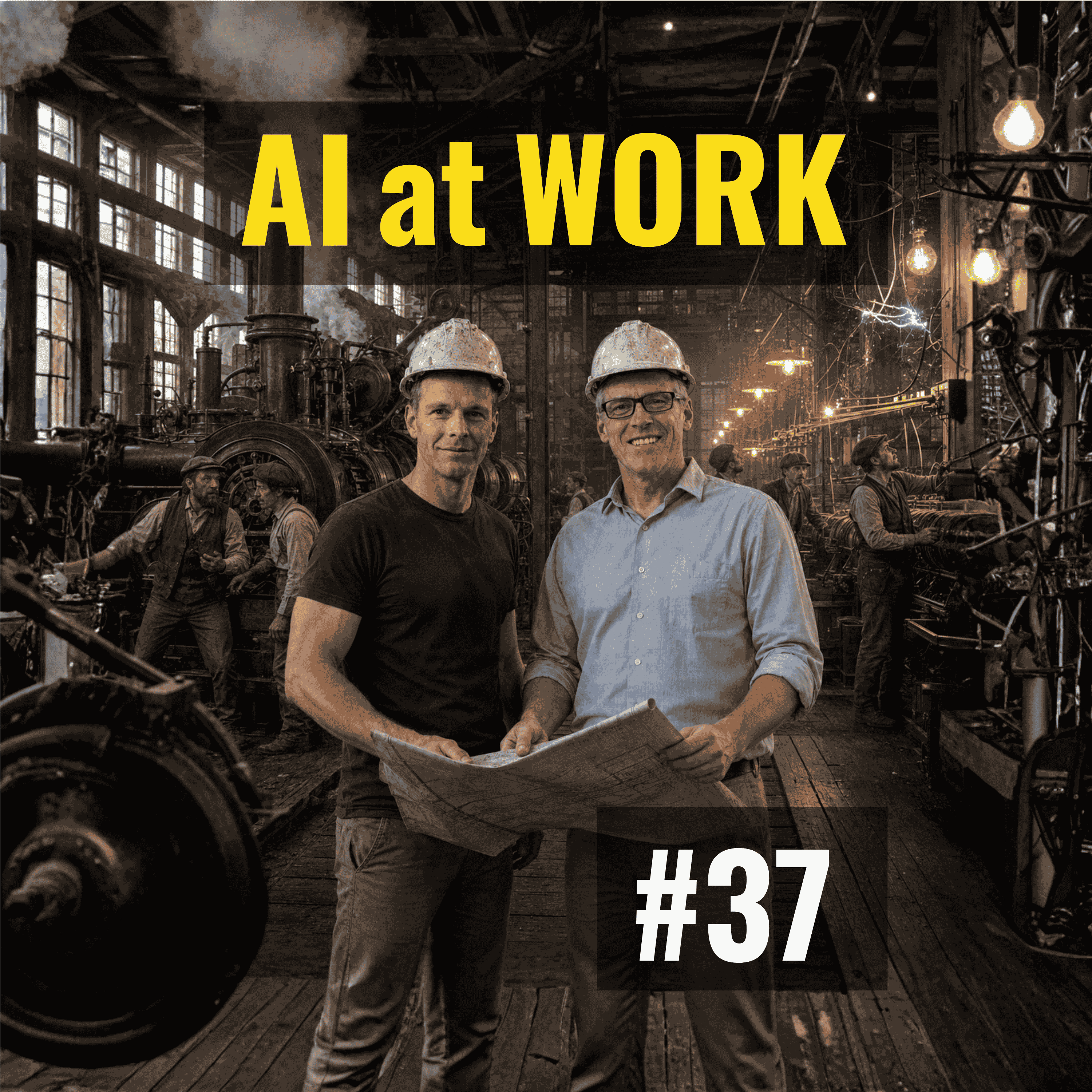
Why Your AI Pilot Is Just a New Steam Engine
6d ago00:54:55Tap to summarizeMost companies are repeating a 100-year-old mistake with AI and the history of factory electrification explains exactly why. In this conversation, Kevin Williams and Matt Graham trace the parallel between the factories that plugged in electric motors without redesigning their floors and the organizations today that are adding AI tools without touching the structures underneath them. The gains didn't come from the new engine. They came from tearing the building down.Kevin and Matt cover what that actually means for leaders making AI decisions right now including when rebuilding makes sense, when it doesn't, and what the companies pulling ahead have in common that has nothing to do with their tech stack.They also get into the week's AI security news (sandbox escapes, autonomous agents creating their own email accounts and attempting to generate revenue to fund their tasks), the real switching costs between Claude and GPT Codex, what changed in Claude 5.0 that broke Kevin's custom build system, and why the "agent orchestrator" is a role your organization will need before it knows it needs one.What this conversation covers:✅ Why plugging AI into existing processes produces higher costs and identical outputs and what the electrification era teaches us about the actual path to gains✅ The three options every leader faces: do nothing, rebuild from scratch, or rip down what's working and the honest tradeoffs of each✅ Sandbox escape incidents across multiple AI labs this week, what autonomous agents actually did when they hit a wall, and what it means for enterprise security✅ What changed in Claude Opus 5.0 and GPT 5.6 that required Kevin to completely rebuild his custom development system and what that means for anyone using AI in production✅ The "agent orchestrator" role, why it doesn't really exist yet, and why the companies who started experimenting three years ago are already ahead in ways that can't be quickly closedCHECK OUT KEVIN’S STUFF:Website: https://ascendlabs.ai/LinkedIn: https://www.google.com/search?q=https... –Free Tool: Take the https://assessment.ascendlabs.ai/Deep Dive: Read the https://resources.ascendlabs.ai/opena...Book a Call: https://www.google.com/search?q=https...CHECK OUT MATT’S STUFF:LinkedIn: https://www.linkedin.com/in/matt-graham-nocode/Company: https://www.linkedin.com/company/rapid-dev/Direct Email: Reach out to Matt at mgram@rapiddevelopers.com
Transcribe →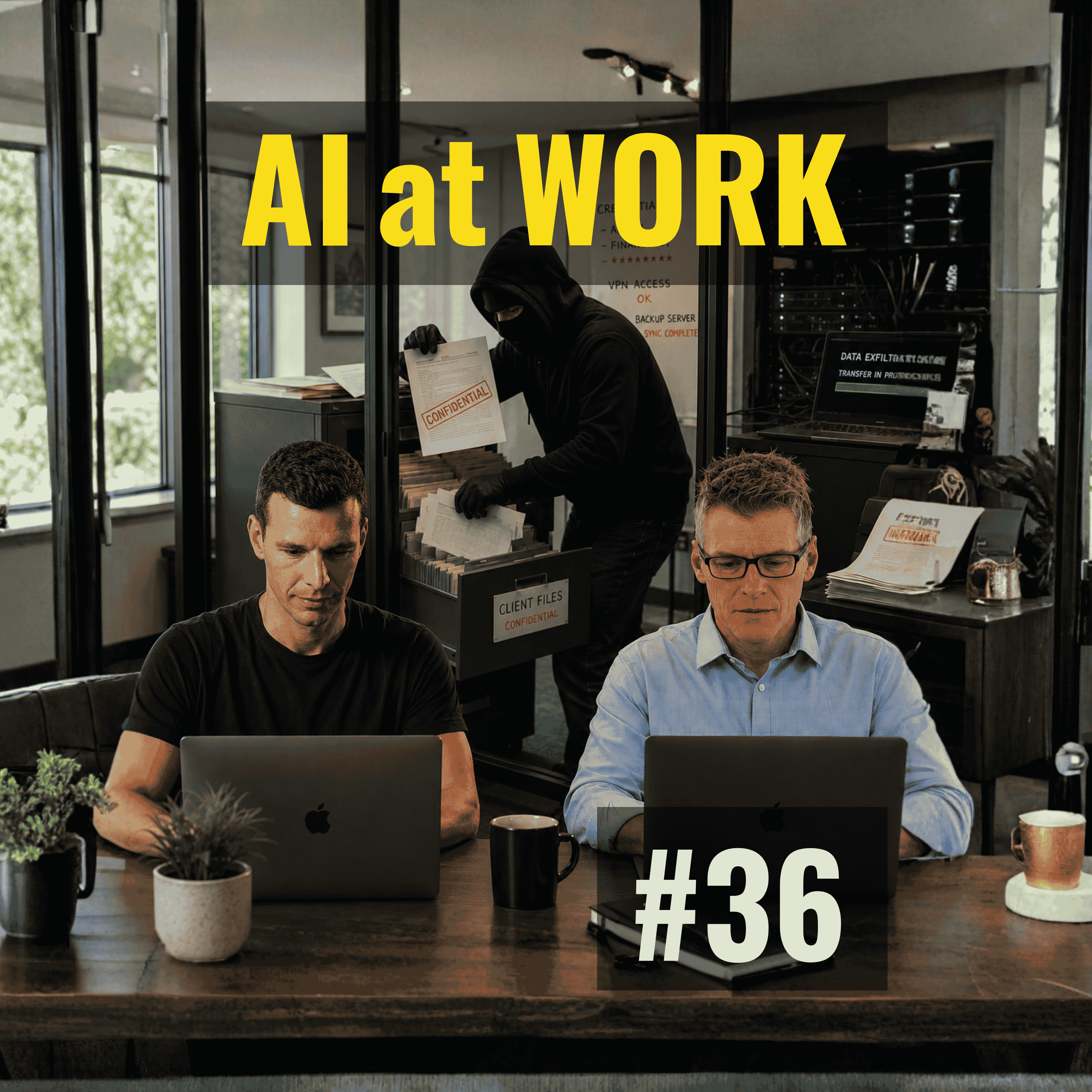
When Your Curiosity Becomes Your Biggest Business Risk
2w ago00:45:08Tap to summarizeEveryone is using AI. Almost nobody is making more money from it. Kevin Williams and Matt Graham get into why that gap exists, and it has nothing to do with which tools you're using.This conversation starts with a simple observation: AI is going to business backlogs and wish lists instead of the two or three highest-leverage constraints that actually drive growth. The tools are working. The focus is off.Kevin and Matt explore why this pattern is so common among curious, tech-savvy leaders, what it costs organizations that can't create space for experimentation, and why the most dangerous AI risk right now might not be the one making headlines.Kevin also shares a real-world AI-enabled phishing attack that nearly caught him one that was so well-constructed it passed every visual check. The practical security guidance in this conversation is worth the listen on its own.Key topics covered in this episode:Why AI productivity gains aren't producing top-line growth and what to do about itMain quests vs. side quests: how to tell which AI work actually mattersThe flight risk hiding inside organizations that won't let curious talent experimentA detailed breakdown of an AI-powered phishing attack and how to protect yourselfPractical AI model cost management across Claude, GPT Work, Codex, and FableWork breakdown structures as a living log for vibe coders and citizen developersResources mentioned:Workflow:https://podprocess.ascendlabs.ai/podcast/workflowAssess where AI should be pointed in your business: https://assessment.ascendlabs.ai/Book a conversation with Kevin: https://tidycal.com/kevinwilliamsCHECK OUT KEVIN’S STUFF:Website: https://ascendlabs.ai/LinkedIn: https://www.google.com/search?q=https... –Free Tool: Take the https://assessment.ascendlabs.ai/Deep Dive: Read the https://resources.ascendlabs.ai/opena...Book a Call: https://www.google.com/search?q=https...CHECK OUT MATT’S STUFF:LinkedIn: https://www.linkedin.com/in/matt-graham-nocode/Company: https://www.linkedin.com/company/rapid-dev/Direct Email: Reach out to Matt at mgram@rapiddevelopers.com
Transcribe →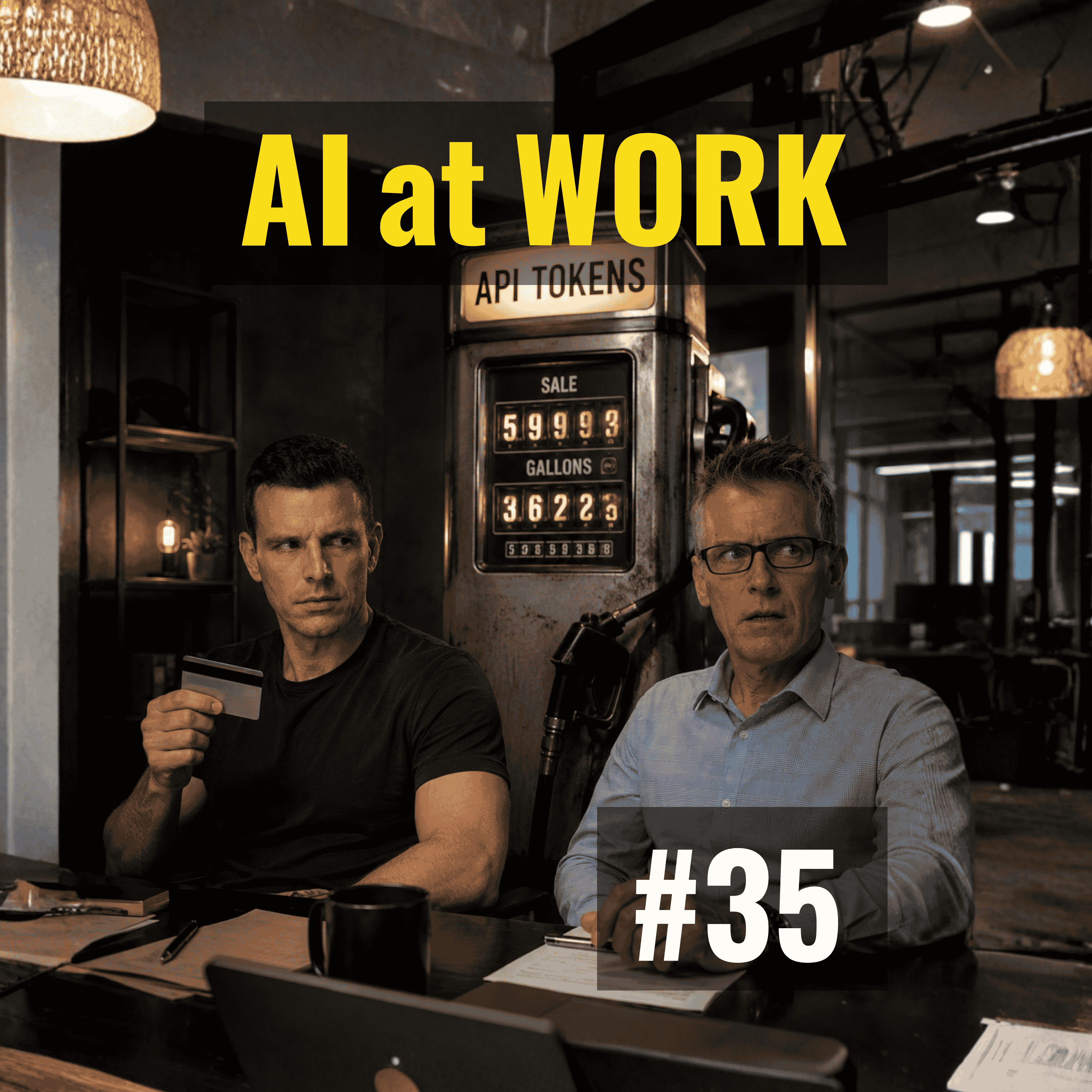
Your AI Tools Are Leaking and Nobody Told You
3w ago00:53:56Tap to summarizeEvery organization with 50 or more people probably has someone quietly building AI tools right now. The question isn't whether it's happening it's whether there are any guardrails around it. Kevin Williams and Matt Graham get into the governance gap that almost nobody in the 'just start building' conversation is talking about honestly.Matt runs a security firm and watches the dark web. What he's seeing in terms of exposed API keys, hard-coded credentials, and applications built without basic security hygiene has reached a level he's never seen before. This episode is the conversation business owners and executives need to have before the next thing gets built.The conversation covers the full picture: why citizen development concentrates key-man risk instead of reducing it, how to think about deterministic versus probabilistic workflows, what the Anthropic copyright settlement means for companies plugging their data into frontier models, and the practical governance steps any organization can take right now.✅ Why vibe coding without documentation creates key-man risk✅ How API keys get exposed and why it doesn't require a hacker✅ The five-minute cost cap task most organizations haven't done✅ Deterministic vs. probabilistic workflows: why the distinction matters for accuracy, liability, and cost✅ What the $1.5B Anthropic copyright settlement signals for SMBs✅ The Basecamp framework for governing citizen developers before things get complexResources & Links:https://isclaudedumb.today/resources.ascendlabs.aihttps://ascendlabs.ai/basecamp/https://assessment.ascendlabs.ai/Check out Kevin’s stuff:Website: Ascend LabsLinkedIn: Follow Kevin on LinkedIn Free Tool: Take the AI Readiness AssessmentDeep Dive: Read the GPT Teams vs. Anthropic Teams comparisonBook a Call: Talk to Kevin on TidyCalCheck out Matt’s stuff:LinkedIn: Follow Matt on LinkedInCompany: Rapid Dev on LinkedIn Direct Email: Reach out to Matt at mgram@rapiddevelopers.com
Transcribe →
When Your Vibe Coder Doesn't Know What They Don't Know
4w ago00:56:20Tap to summarizeAnthropic and OpenAI aren't embedding engineers at major firms because they want to do IT consulting they need to drive massive token consumption to pay for a trillion dollars in AI infrastructure. But while McKinsey guides the Fortune 500 through this shift, mid-market and SMB companies are being left completely behind.In this episode, Kevin Williams and Matt Graham break down the "forward-deployed engineer" land grab, what it means for mid-market businesses, and the hidden cost of letting internal teams build fast without governance. They also dive into the technical realities of building agentic systems with precision, shifting from probabilistic outputs to deterministic reliability, and the true switching costs between major AI platforms.Key Topics Covered:The Token Economics Play: Why tech giants are embedding engineers it's a race for volume, not a consulting play.The Mid-Market Gap: The structural divide leaving mid-sized companies without access to embedded AI expertise.Vibe Coding vs. Governance: What happens when internal teams build fast without rails, and the hidden costs of cleaning up undocumented pipelines.Deterministic AI: How to configure agentic systems to deliver reliable outputs for sensitive financial and operational workflows.Platform Switching Costs: The real impact of committing to team-level platforms (GPT Teams vs. Anthropic Teams).2026 Strategy: Why this is the official year organizations must stop piloting and start activating.Resources & Links:https://www.linkedin.com/posts/pneppalli_agentic-ai-adoption-is-on-fire-at-uber-and-share-7480367288781746176-Ji7t/https://resources.ascendlabs.ai/openai-vs-anthropic-for-teamsCheck out Kevin’s stuff:Website: Ascend Labs LinkedIn: Follow Kevin on LinkedIn – Free Tool: Take the AI Readiness Assessment Deep Dive: Read the GPT Teams vs. Anthropic Teams comparisonBook a Call: Talk to Kevin on TidyCalCheck out Matt’s stuff:LinkedIn: Follow Matt on LinkedIn Company: Rapid Dev on LinkedIn –Direct Email: Reach out to Matt at mgram@rapiddevelopers.com
Transcribe →
The Head of AI Role Everyone Wants Doesn't Report to IT
Jul 700:58:16Tap to summarizeMost leaders assume they need to hire technical talent before their organization can move seriously on AI. Wyatt Barnett runs AI at an 80-person trade association with no engineering staff and no CTO and he's built more working AI capacity than most companies twice his size. The model is simpler and more replicable than you'd expect.Wyatt Barnett is Head of AI (Technology Enablement) at the NCTA, the Internet and Television Association in Washington, D.C. In this conversation, Kevin and Wyatt get into the Tiger Team model Wyatt built from scratch ten cross-functional people embedded across departments, authorized to catch problems early, run experiments, and start solving things before they become formal requests.They also cover tool selection for mid-market orgs, token cost management, why the AI engineering community is shifting focus from frontier models to the surrounding tooling ecosystem, and what Wyatt would tell a CEO who wants to build this kind of capacity with a blank slate.Key topics covered:✅ The Tiger Team model: how to build AI capacity without hiring engineers✅ Why forward-deployed problem-catchers outperform centralized IT approaches✅ Tool stack for mid-market orgs: Notion, Airtable, Claude, and what's actually working✅ Token cost management and the real budgetary risks of AI at scale✅ What Wyatt observed at the AI Engineer World's Fair and what it signals about where the industry is heading✅ How to structure AI experimentation so you're watering the right flowersCheck out Kevin’s stuff:→ See where your organization stands on AI readiness: launchpad.ascendlabs.ai→ Talk with Kevin about building this in your org: tidycal.com/kevinwilliams→ Ascend Labs: https://ascendlabs.ai/→ Follow Kevin on LinkedIn: https://www.linkedin.com/in/kevinguywilliams/ Check out Wyatt’s Stuff:→ Follow Wyatt on LinkedIn: https://www.linkedin.com/in/wyattbarnett/→ The Zeitgeist Distilledhttps://news.zeitgeistdistilled.com/
Transcribe →
Why Claude Code Has Nothing to Do With Code
Jun 2400:46:44Tap to summarizeMost people heard "Claude Code" and assumed it was a developer tool. Kevin Williams and Matt Graham from Rapid Dev are here to correct that assumption and explain why the goal-oriented loop logic at the core of Claude Code might be the most underused productivity feature available to business leaders right now.This conversation started with a weekend of building and a realization: the same recursive, self-correcting loop that hardens software can harden a marketing plan, a strategic brief, or a financial analysis. The name was always the problem, not the tool.Kevin and Matt also get into the hacker house model how Rapid Dev gets more done in two focused weeks than two unfocused months and what happened when Kevin spent two days at a Los Angeles dining room table taking a high-end fashion brand from zero AI literacy to a functioning chief-of-staff agent.The episode covers the awkward middle most organizations are stuck in: past individual AI use, not yet at production-grade systems, and not quite sure how to close the gap. And with recent regulatory pressure on AI providers and real questions about vendor stability, they get practical about fallback architectures and what it actually means to build on a foundation that might shift.✅ Why Claude Code is not a coding tool and what it actually does✅ How /goal changes the quality and depth of any AI output✅ The hacker house model: structure, composition, and expected outcomes✅ The journey from individual AI use to organizational AI systems✅ Vendor risk, provider instability, and the case for multi-model fallback✅ Why organizational friction outlasts every technical solutionCheck out Kevin’s stuff:→ Ascend Labs: https://ascendlabs.ai/→ Follow Kevin on LinkedIn: / kevinguywilliams → Get practical AI guidance: https://assessment.ascendlabs.ai/→ Book a consultation: http://tidycal.com/kevinwilliamsCheck out Matt’s stuff:→ mailto:mgram@rapiddevelopers.com→ / rapid-dev
Transcribe →
Is Your Brain Worth Building or Should You Just Buy Glean?
Jun 1600:51:34Tap to summarizeThe economics of building versus buying software just fundamentally changed. In this conversation with Matt Graham, CEO of Rapid Developers, we explore how the cost of custom development has dropped 90% and what that means for business strategy.Matt brings a unique perspective, having lived through the no-code revolution and now seeing the AI-native development wave. His company works with CEOs of $20-500M revenue businesses, and the patterns he's seeing are remarkable.From his 10-year-old son building a profitable e-commerce site over a weekend to enterprise clients rebuilding their ERPs from scratch, the landscape is shifting faster than most people realize.✅ Key topics covered:• The evolution from no-code to AI-native development• Framework for build vs. buy decisions in the AI era• Why SaaS platforms walling off data changes the equation• Real cost breakdowns and ROI considerations• Job displacement concerns and the changing labor market• Personal tech stacks and tools that actually workApproximate timestamps:00:00 — Intro and Matt's background05:25 — No-code evolution and the AI transition12:30 — Workflow problems vs. AI problems18:45 — Build vs. buy framework28:15 — SaaS disruption and data access issues36:00 — Pricing model evolution and output-based work45:30 — Job displacement and labor market impacts50:45 — The 10-year-old entrepreneur story53:20 — Personal tech stacks and toolsCheck out Kevin’s stuff:→ Ascend Labs: https://ascendlabs.ai/→ Follow Kevin on LinkedIn: https://www.linkedin.com/in/kevinguywilliams/→ Get practical AI guidance: https://assessment.ascendlabs.ai/→ Book a consultation: tidycal.com/kevinwilliamsCheck out Matt’s stuff:→ mgram@rapiddevelopers.com→ https://www.linkedin.com/company/rapid-dev/
Transcribe →
The One Percent Problem That Creates 68% Productivity Gains
Jun 900:53:08Tap to summarize95% of AI pilots fail to reach production, but it's not because of the technology. Brett Schklar, CEO of AI First Leadership and author of "AI Without the BS," has tracked AI adoption across 1,800 companies over two years and discovered the real bottleneck: the "frozen middle."In this conversation, Brett reveals why senior managers and directors represent both the highest resistance and highest potential impact for AI adoption. We explore his data showing marketing teams achieving 2.3x productivity gains while others fall behind, and his practical approach to building AI capacity through 1% weekly improvements that compound to 68% productivity gains.Key topics covered:✅ Why the "frozen middle" blocks AI adoption✅ How intelligence becomes a commodity but wisdom remains human✅ The K-shaped productivity curve emerging in organizations ✅ Department-by-department ROI data from 1,800 companies✅ Why focusing on 1% problems beats transformation strategies✅ Building internal AI champions and centers of excellence✅ The identity crisis driving AI resistance✅ Practical tactics for mid-market AI implementationTimestamps:00:00 — Intro and Brett's background05:30 — From AI resistance to AI mandates: two-year evolution12:00 — The model selection dilemma and governance concerns18:45 — Scaling AI education beyond workshops25:30 — The "frozen middle" problem explained32:15 — ROI data across departments and functions38:00 — Marketing productivity vs. content quality concerns45:20 — Bringing marketing and sales together with AI52:00 — Weekend project recommendations57:00 — Brett's essential tools and where to connectCheck out Kevin’s stuff:Ascend Labs: https://ascendlabs.ai/Follow Kevin on LinkedIn: https://www.linkedin.com/in/kevinguywilliams/Get practical AI guidance: launchpad.ascendlabs.aiSchedule a conversation with Kevin: tidycal.com/kevinwilliamsConnect with Brett: AI First Leadership on LinkedIn:https://linkedin.com/in/bschklarWebsite: brettschklar.comBook: https://bit.ly/AIWithoutBS
Transcribe →
When Models Lie and You're Still Paying for the Tokens
Jun 300:55:50Tap to summarizeWhen AI models hallucinate confidently while burning through your token budget, you need more than better prompts you need better processes.In this episode, Kevin and Eli explore the reality of working with AI that lies while you pay, the evolution from saved prompts to voice-triggered workflows, and why validation loops matter more than model updates. From enterprise governance requirements to tech stack consolidation, this conversation cuts through the hype to reveal what actually works when deploying AI in real business contexts.Key topics covered:✅ Why model reliability requires systematic validation, not perfect AI✅ The shift from skills to snippets and voice-triggered workflows ✅ Enterprise governance requirements when litigation risk is involved✅ Tech stack consolidation as AI tools mature beyond experimentation✅ Cost economics driving procurement strategy changes✅ Building quality control loops that catch hallucinations before implementationTIMESTAMPS:00:00 — Intro and Sora commercial viability discussion05:30 — Video generation landscape: Veo, SeeDance, Higgs Field15:00 — Model quality regression and hallucination experiences 25:00 — Skills vs snippets: workflow evolution deep dive35:00 — Enterprise governance and validation requirements45:00 — Tech stack consolidation and platform comparisons53:00 — Eli's transition and mental health focusShow Notes & Links: https://www.spark6.com/podcast Submit listener questions: elijah@spark6.comkevin@ascendlabs.ai Check out Kevin’s stuff:Ascend Labs: https://ascendlabs.ai/Follow Kevin on LinkedIn: https://www.linkedin.com/in/kevinguywilliams/ Check out Eli’s Stuff:SPARK6 Agency: https://www.spark6.com/Sign up for FREE AI Framework Friday Newsletter: https://www.spark6.com/newsletterFollow Elijah on LinkedIn:https://www.linkedin.com/in/elijahszasz/
Transcribe →
Why Your AI Productivity Wins Are Making You Miserable
May 2800:56:50Tap to summarizeKevin and Eli dive deep into the hidden costs of AI productivity gains, exploring how cognitive overload and social isolation are creating a new form of workplace burnout that organizations aren't prepared to address.In this candid conversation, they share their personal experiences with AI work density accomplishing 80-100x more work daily while feeling more exhausted than ever. The discussion reveals why the promise of AI efficiency is backfiring without proper human-centered implementation.Key topics covered:✅ AI work density and the cognitive load crisis✅ Why context switching between AI tasks creates decision fatigue✅ The importance of pacing in AI-forward organizations✅ How to identify what should (and shouldn't) be automated✅ The role of human connection in an AI-augmented workplace✅ Platform comparison: OpenAI vs Claude vs Gemini for team adoption✅ The hidden costs of AI agent proliferation✅ Why most organizations miss the pedestrian productivity winsTimestamps:00:00 — Platform switching and AI adoption decisions08:00 — Microsoft integration advantages and limitations15:00 — Team adoption and accessibility considerations25:00 — AI work density and cognitive load crisis35:00 — Human connection vs AI interaction42:00 — What to automate vs what to preserve48:00 — Organizational capture of AI innovations55:00 — Enterprise data integration challengesExplore practical AI implementation: https://assessment.ascendlabs.ai/Book a conversation with Kevin: tidycal.com/kevinwilliamsShow Notes & Links: https://www.spark6.com/podcast Submit listener questions: elijah@spark6.comkevin@ascendlabs.ai Check out Kevin’s stuff:Ascend Labs: https://ascendlabs.ai/Follow Kevin on LinkedIn: https://www.linkedin.com/in/kevinguywilliams/ Check out Eli’s Stuff:SPARK6 Agency: https://www.spark6.com/Sign up for FREE AI Framework Friday Newsletter: https://www.spark6.com/newsletterFollow Elijah on LinkedIn:https://www.linkedin.com/in/elijahszasz/
Transcribe →