Podcast
Ai Change Desk
Hosted by Michael Hanna-Butros Meyering · EN
AI Change Desk helps leaders, managers, and operators make sense of AI changes and run adoption without hype. Every episode follows one format: context, impact, and action.
22episodes
Episodes
Newest firstAll episodes
AI Change Desk | EP036: Preview Before Power Mode
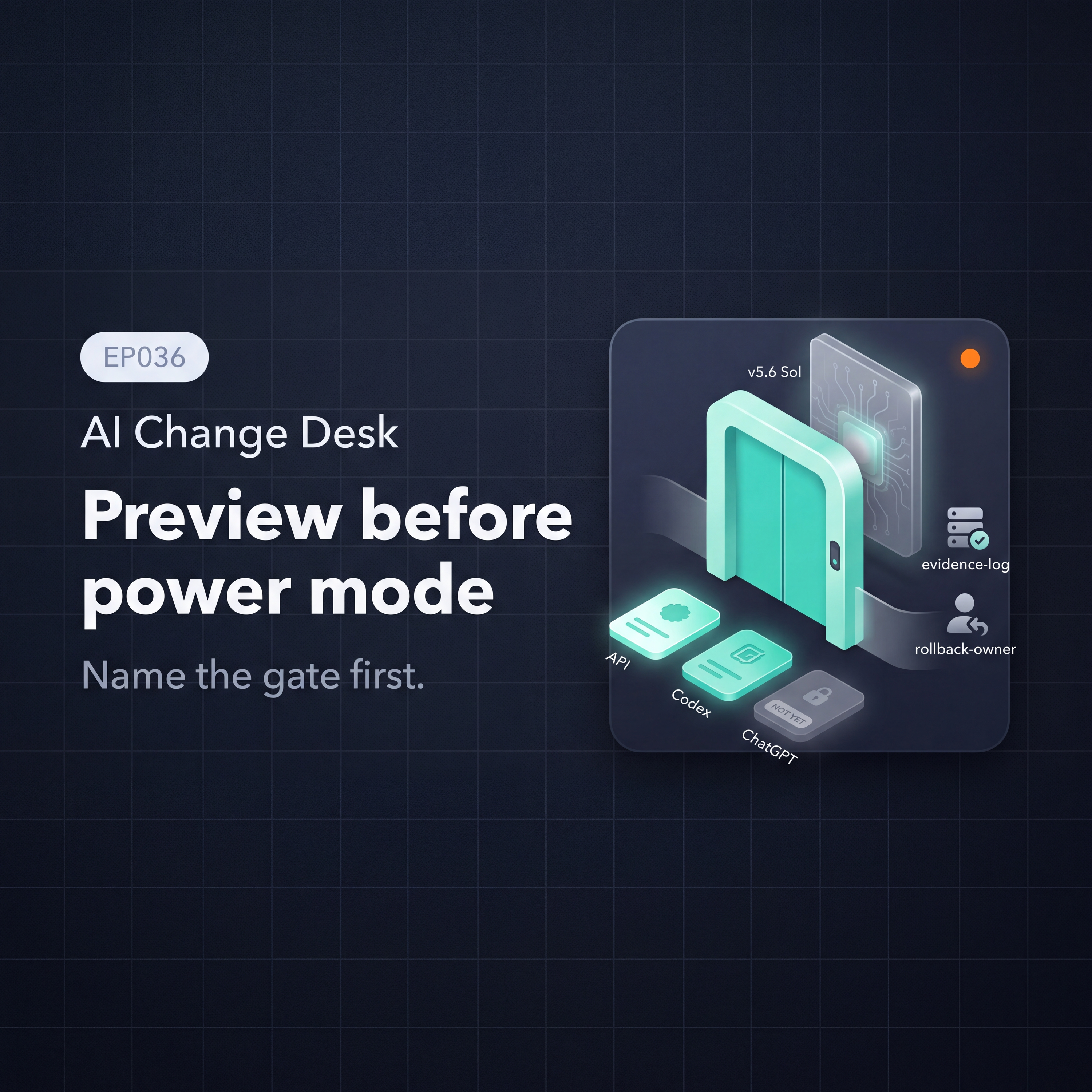
Jun 2900:16:39Tap to summarizeFrontier capability is arriving before broad access. This episode turns OpenAI's GPT-5.6 Sol preview, OpenAI's agent-work research, Microsoft's Copilot in Excel finance controls, and Anthropic's Claude Tag into one operator test: before power mode becomes normal mode, name the preview gate. Who gets frontier capability access, in which surface, with which data and tools, under which safeguards, with what evidence, and who can roll it back? Eligible user group Approved surface Data boundary Tool boundary Safeguard routing Spend and cache budget Evidence log Rollback and deprovision owner OpenAI: https://openai.com/index/previewing-gpt-5-6-sol/ OpenAI Help Center: https://help.openai.com/en/articles/20001325-a-preview-of-gpt-56-sol-terra-and-luna OpenAI agents/work research: https://openai.com/index/how-agents-are-transforming-work/ Microsoft Copilot in Excel: https://www.microsoft.com/en-us/microsoft-365/blog/2026/06/25/copilot-in-excel-built-for-the-era-of-frontier-finance/ Anthropic Claude Tag: https://www.anthropic.com/news/introducing-claude-tag AI-assisted tools were used in parts of the research and production workflow. Final editorial judgment, risk posture, and release approval stayed human-led. This is operational guidance, not legal advice.
Transcribe →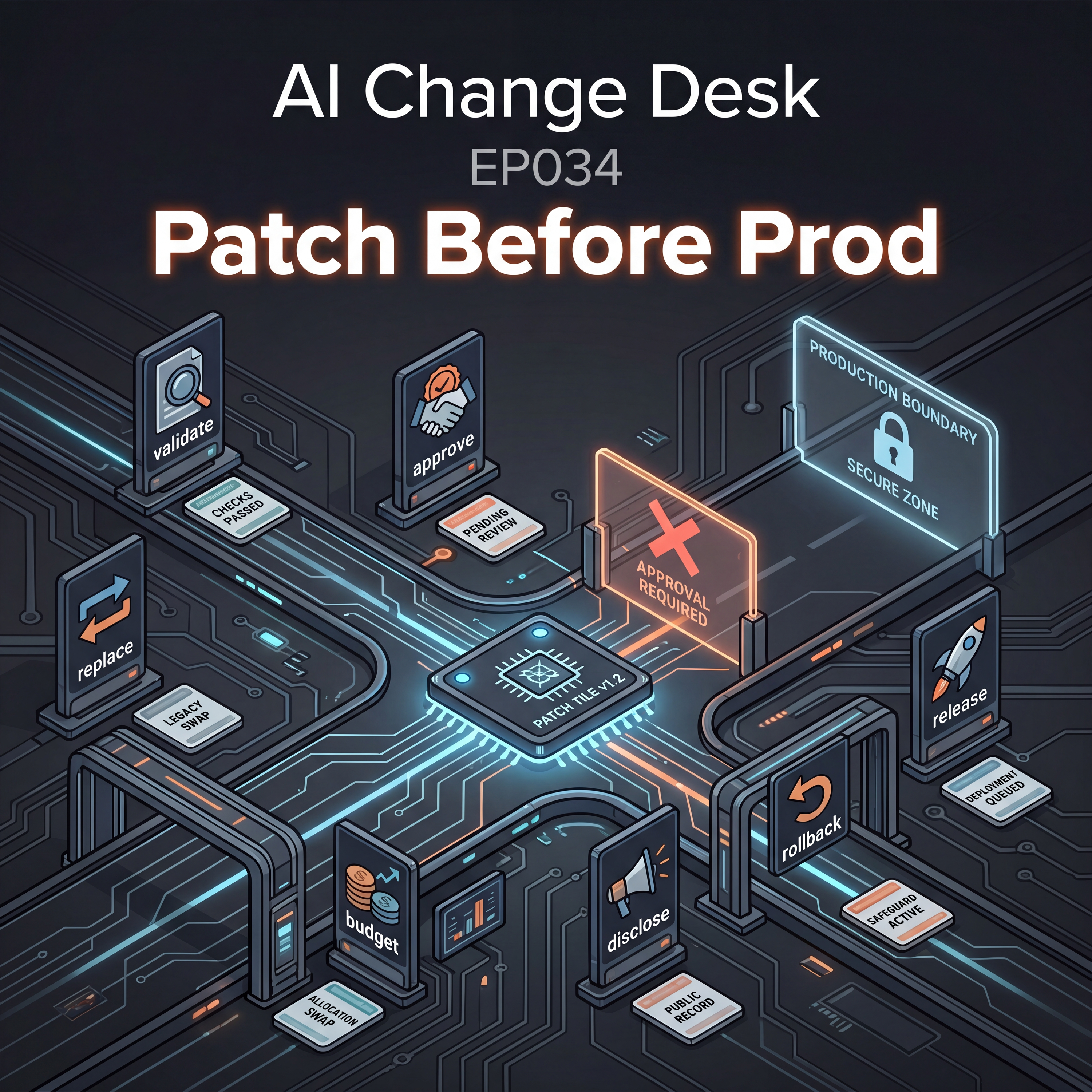
AI Change Desk | EP034: Patch Before Prod
Jun 2200:10:25Tap to summarizeAI security work is moving from "find the bug" toward "help draft the fix." In EP034 of AI Change Desk, Michael breaks down OpenAI's June 22 Daybreak and Patch the Planet announcements and turns them into a practical operator question: If AI can find vulnerabilities and draft fixes at machine speed, who validates the patch, approves the rollout, owns rollback, and proves the fix should ship? Run one 45-minute Patch Before Prod review. Use eight receipts: Finding validator Patch approver Test evidence Release owner Rollback owner Disclosure owner Budget owner Replacement path OpenAI Daybreak: https://openai.com/index/daybreak-securing-the-world/ OpenAI Patch the Planet: https://openai.com/index/patch-the-planet/ OpenAI enterprise spend controls: https://openai.com/index/chatgpt-enterprise-spend-controls/ OpenAI ChatGPT release notes: https://help.openai.com/en/articles/6825453-chatgpt-release-notes Microsoft Copilot Cowork GA: https://www.microsoft.com/en-us/microsoft-365/blog/2026/06/16/copilot-cowork-is-now-generally-available/ Microsoft Work IQ APIs: https://www.microsoft.com/en-us/microsoft-365/blog/2026/06/02/announcing-the-new-work-iq-apis/ Anthropic Fable/Mythos access statement: https://www.anthropic.com/news/fable-mythos-access YouTube AI labels update: https://blog.youtube/news-and-events/improving-ai-labels-viewers-creators/ Podnews on RSS AI disclosure flag: https://podnews.net/update/bumper-free Production disclosure: AI-assisted tools were used in parts of the research and production workflow. Final editorial judgment, risk posture, and release approval remain human-led. This is operational guidance, not legal advice.
Transcribe →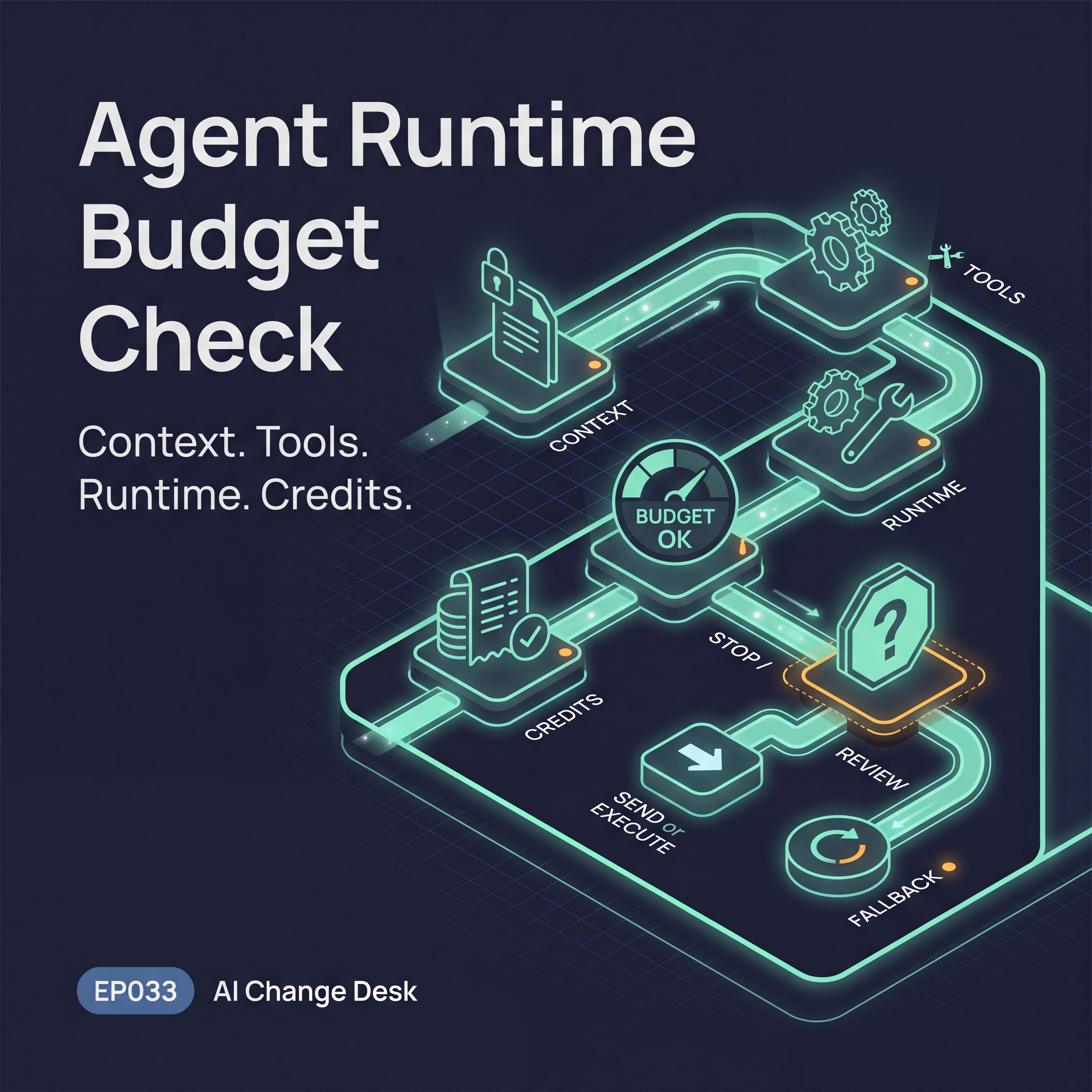
AI Change Desk | EP033: Agent Runtime Budget Check
Jun 1700:09:27Tap to summarizeAgent work is not just an access question anymore. It is becoming a runtime budget question. This brief looks at Microsoft's Copilot Cowork general availability and Work IQ controls, then pairs that with Anthropic's statement that it is removing access to Fable 5 / Mythos 5 to ask a practical operator question: If an agent can retrieve context, call tools, run longer tasks, and consume metered credits, who owns the budget gate before the work continues? Run one Agent Runtime Budget Gate by June 24, 2026. Use: Microsoft Copilot Cowork GA: https://www.microsoft.com/en-us/microsoft-365/blog/2026/06/16/copilot-cowork-is-now-generally-available/ Microsoft Work IQ APIs: https://www.microsoft.com/en-us/microsoft-365/blog/2026/06/02/announcing-the-new-work-iq-apis/ Anthropic Fable/Mythos access-removal statement: https://www.anthropic.com/news/fable-mythos-access OpenAI ChatGPT release notes: https://help.openai.com/en/articles/6825453-chatgpt-release-notes OpenAI Memory FAQ: https://help.openai.com/en/articles/8590148-memory-faq/ Production disclosure: AI-assisted tools were used in parts of the research and production workflow. Final editorial judgment, risk posture, and release approval remain human-led. This is operational guidance, not legal advice.
Transcribe →
AI Change Desk | EP032: Memory Summary Exit Check
Jun 1600:20:39Tap to summarizeIf AI memory can be edited more visibly, turned off more easily, and still be rebuilt from old context later, the operating question is not whether the settings page looks cleaner. It is what evidence proves sensitive or stale context actually left the workflow. Why OpenAI's June 12 memory-summary controls matter operationally. Why deleting visible memories is not the same as deleting past chats or every source. Why a partial memory summary creates a partial-ledger problem. How Developer mode and model retirement add inspection and version-receipt pressure. A forty-five minute Memory Summary Exit Check operators can run this week. OpenAI ChatGPT release notes: https://help.openai.com/en/articles/6825453-chatgpt-release-notes OpenAI Memory FAQ: https://help.openai.com/en/articles/8590148-memory-faq/ OpenAI Codex browser docs: https://developers.openai.com/codex/app/browser OpenAI Lockdown Mode: https://help.openai.com/en/articles/20001061-lockdown-mode OpenAI memory product post: https://openai.com/index/chatgpt-memory-dreaming/ YouTube AI labels update: https://blog.youtube/news-and-events/improving-ai-labels-viewers-creators/ Podnews AI disclosure guidance: https://podnews.net/update/ai-disclosures AI-assisted tools were used in parts of the research and production workflow. Final editorial judgment, risk posture, and release approval stay human-led. This is operational guidance, not legal advice.
Transcribe →
AI Change Desk | EP031: Memory Control Plane Check
Jun 800:20:57Tap to summarizeAI memory is becoming more useful, but usefulness creates a new operating surface. If the system can carry context forward, teams need a memory control plane: summary, source, correction, deletion, sensitive-work mode, and disclosure. Why better memory is not just personalization; it is source-of-truth pressure. What OpenAI's June 4 memory rollout changes for operators. Why memory summaries, source tracing, correction, and deletion paths matter. How Lockdown Mode fits sensitive browsing and hostile-input workflows. Why audience disclosure still belongs in the release workflow. A 45-minute memory-control-plane check for Monday teams. What would have to be true for your team to trust remembered AI context in production work? OpenAI memory rollout: https://openai.com/index/chatgpt-memory-dreaming/ OpenAI Memory FAQ: https://help.openai.com/en/articles/8590148-memory-faq/ ChatGPT release notes: https://help.openai.com/en/articles/6825453-chatgpt-release-notes Lockdown Mode: https://help.openai.com/en/articles/20001061-lockdown-mode YouTube AI labels: https://blog.youtube/news-and-events/improving-ai-labels-viewers-creators/ Podnews AI disclosure guide: https://podnews.net/update/ai-disclosures AI-assisted tools were used in parts of the research and production workflow. Final editorial judgment, risk posture, and release approval stayed human-led. This is operational guidance, not legal advice. These are my opinions and are not representative of any organization.
Transcribe →
AI Change Desk | EP030: Always-On Agent Control Check
Jun 300:10:14Tap to summarizeMicrosoft and OpenAI moved agent work closer to persistent identity, internal apps, and publishable work surfaces. The operator question is who owns the standing permission before an agent keeps acting in the background.
Transcribe →
AI Change Desk | EP029: Agent Reliability Evidence Check
Jun 100:27:02Tap to summarizeDate: 2026-06-01 Agents are getting longer leashes: remote work sessions, stronger coding/workflow behavior, and practical observability/test tooling are all moving at the same time. This episode turns that into an operator question: when an agent can do more, what proof comes back before the work is trusted? When the agent can do more, what proof do you require before you trust the work? Run one agent reliability evidence check this week: Scope receipt: what can it reach? Effort receipt: how long, how hard, and how expensively can it work before checkpoint? Quality receipt: what tests or reviews prove the output is usable? Drift receipt: what changed since the last good run? Fallback receipt: who stops, reroutes, or explains it when it fails? OpenAI ChatGPT release notes: https://help.openai.com/en/articles/6825453-chatgpt-release-notes OpenAI Codex cloud documentation: https://developers.openai.com/codex/cloud/ Anthropic Claude Opus 4.8: https://www.anthropic.com/news/claude-opus-4-8 AWS LLM observability: https://aws.amazon.com/blogs/machine-learning/comprehensive-observability-for-amazon-sagemaker-ai-llm-inference-from-gpu-utilization-to-llm-quality/ AWS deep-agent evaluations: https://aws.amazon.com/blogs/machine-learning/evaluating-deep-agents-using-langsmith-on-aws/ AWS agent test-suite datasets: https://aws.amazon.com/blogs/machine-learning/build-a-test-suite-that-grows-with-your-agent-with-dataset-management-in-amazon-bedrock-agentcore/ OpenAI May 28 model lifecycle note: https://help.openai.com/en/articles/6825453-chatgpt-release-notes AI-assisted tools were used in parts of the research and production workflow. Final editorial judgment, risk posture, and release approval stayed human-led. This is operational guidance, not legal advice. These are my opinions and are not representative of any organization.
Transcribe →
AI Change Desk | EP027: No-New-Delta Verification Discipline Check
May 2500:29:15Tap to summarizeToday is Memorial Day in the United States, and there will be no Wednesday AI Change Desk episode this week. This Monday episode keeps the feed useful without forcing novelty into a quiet official-news cycle. The core operating point: no-new-delta days are not skip days. They are verification days. The May 25 source check did not find a newer relevant OpenAI release-note date displacing the May 21 Codex update. That means the operating frame should stay date-bounded: the Codex execution signal remains current, while provenance, creator distribution, and community pulse remain supporting context. Teams get into trouble when they confuse "checked today" with "changed today." A refreshed page, community chatter, or a useful trade report can create pressure to say something new. The discipline is to separate confirmed change, continuity context, and directional signal. Memorial Day is observed on the last Monday of May and honors those who died in service to the country. The episode includes a brief respectful segment acknowledging the day and the value of restraint before returning to the operational topic. Before locking any AI release note, script, stakeholder update, or internal status memo this week, add three fields: net new official delta: yes or no latest official date seen: source and date carry-forward justification: why the prior frame still stands There will be no Wednesday episode this week. AI Change Desk returns with the next Monday main episode. OpenAI ChatGPT release notes: https://help.openai.com/en/articles/6825453-release-notes OpenAI provenance post: https://openai.com/index/advancing-content-provenance/ Podnews Report Card 2026 Results: https://podnews.net/article/report-card-2026-results YouTube news from Google I/O 2026: https://blog.youtube/news-and-events/youtube-news-google-io-2026/ U.S. Census Bureau Memorial Day 2026: https://www.census.gov/newsroom/stories/memorial-day.html AI-assisted tools were used in parts of the research and production workflow. Final editorial judgment, risk posture, and release approval stayed human-led. This is operational guidance, not legal advice. These are Michael's opinions and are not representative of any organization.
Transcribe →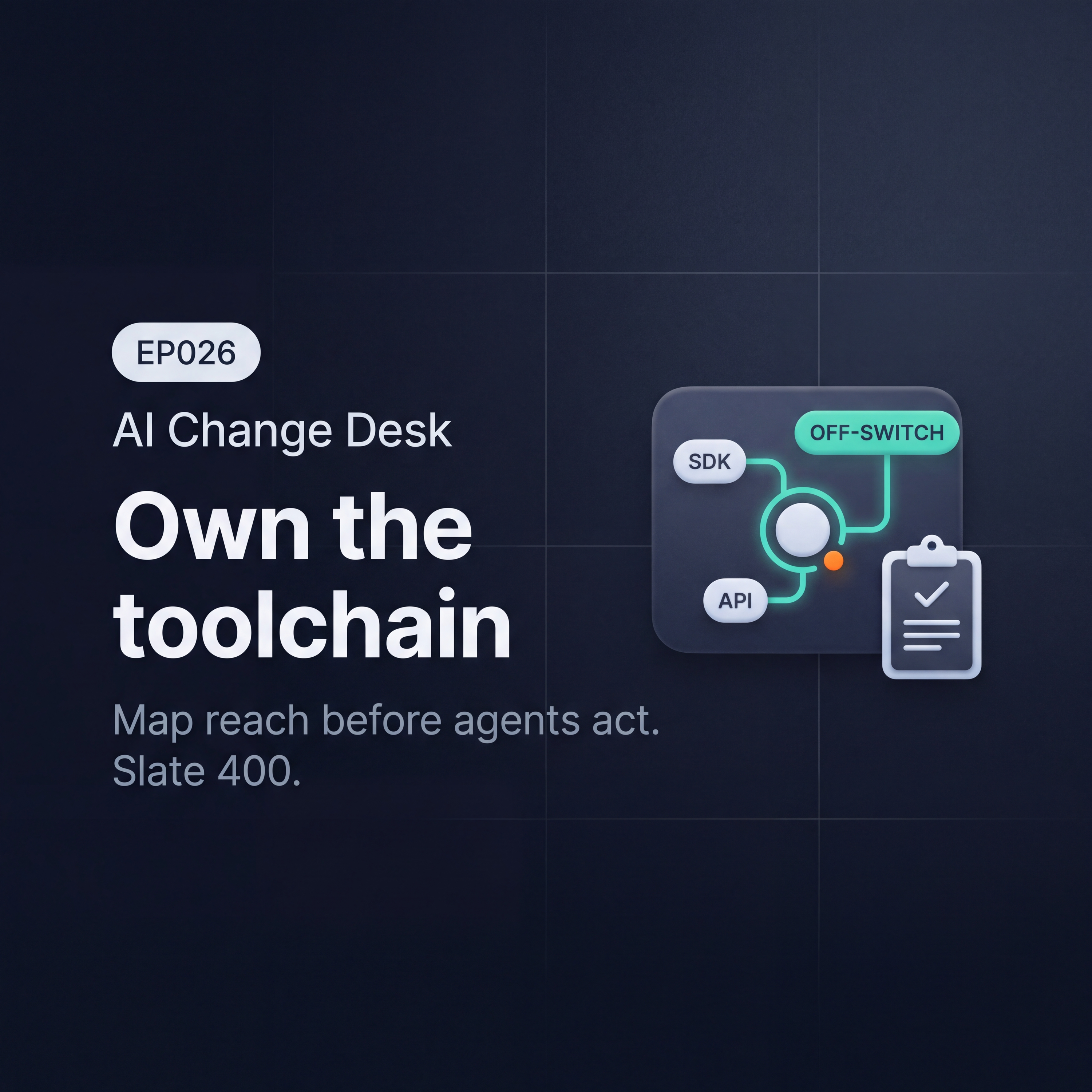
AI Change Desk | EP026: Agent Toolchain Ownership Check
May 2000:15:15Tap to summarizeAI agents are moving from chat windows into toolchains: managed execution environments, SDKs, MCP servers, mobile approvals, workspace integrations, search agents, shopping agents, and enterprise platforms. This episode translates the week of announcements into one operator question: who owns the toolchain when the agent starts acting? Google I/O 2026 pushed agentic Gemini deeper into developer tools, Search, Workspace, shopping, app development, and personal agent surfaces. Anthropic announced it is acquiring Stainless, an SDK and MCP server tooling company that has generated official Anthropic SDKs. Anthropic and KPMG announced a global alliance to embed Claude into KPMG Digital Gateway and make Claude available to more than 276,000 employees. OpenAI Codex mobile and ChatGPT personal finance remain active control signals from the prior week: approvals and sensitive data context are moving closer to always-on workflows. Do not treat agent access as a one-time tool approval. Treat it as a toolchain lifecycle: owner, connector, permission boundary, evidence, fallback, and shutdown authority. By Wednesday, May 27, 2026, complete one agent-toolchain ownership review for your highest-impact AI workflow. Fields to capture: workflow name, agent surface, SDK/API/tool dependencies, connector owner, permission boundary, human approval point, evidence trail, fallback route, shutdown owner, and next review date. Anthropic: Anthropic acquires Stainless — https://www.anthropic.com/news/anthropic-acquires-stainless Anthropic: KPMG integrates Claude across its core business and workforce of more than 276,000 — https://www.anthropic.com/news/anthropic-kpmg Google: I/O 2026 collection — https://blog.google/innovation-and-ai/technology/developers-tools/google-io-2026-collection/ Google: I/O 2026 developer highlights — https://blog.google/innovation-and-ai/technology/developers-tools/google-io-2026-developer-highlights/ Google: I/O 2026 opening keynote — https://blog.google/innovation-and-ai/sundar-pichai-io-2026/ OpenAI: Work with Codex from anywhere — https://openai.com/index/work-with-codex-from-anywhere/ OpenAI: ChatGPT release notes — https://help.openai.com/en/articles/6825453-chatgpt-release-notes AI-assisted tools were used in parts of the research and production workflow. Final editorial judgment, risk posture, and release approval stayed human-led. This is operational guidance, not legal advice. These are Michael's opinions and are not representative of any organization.
Transcribe →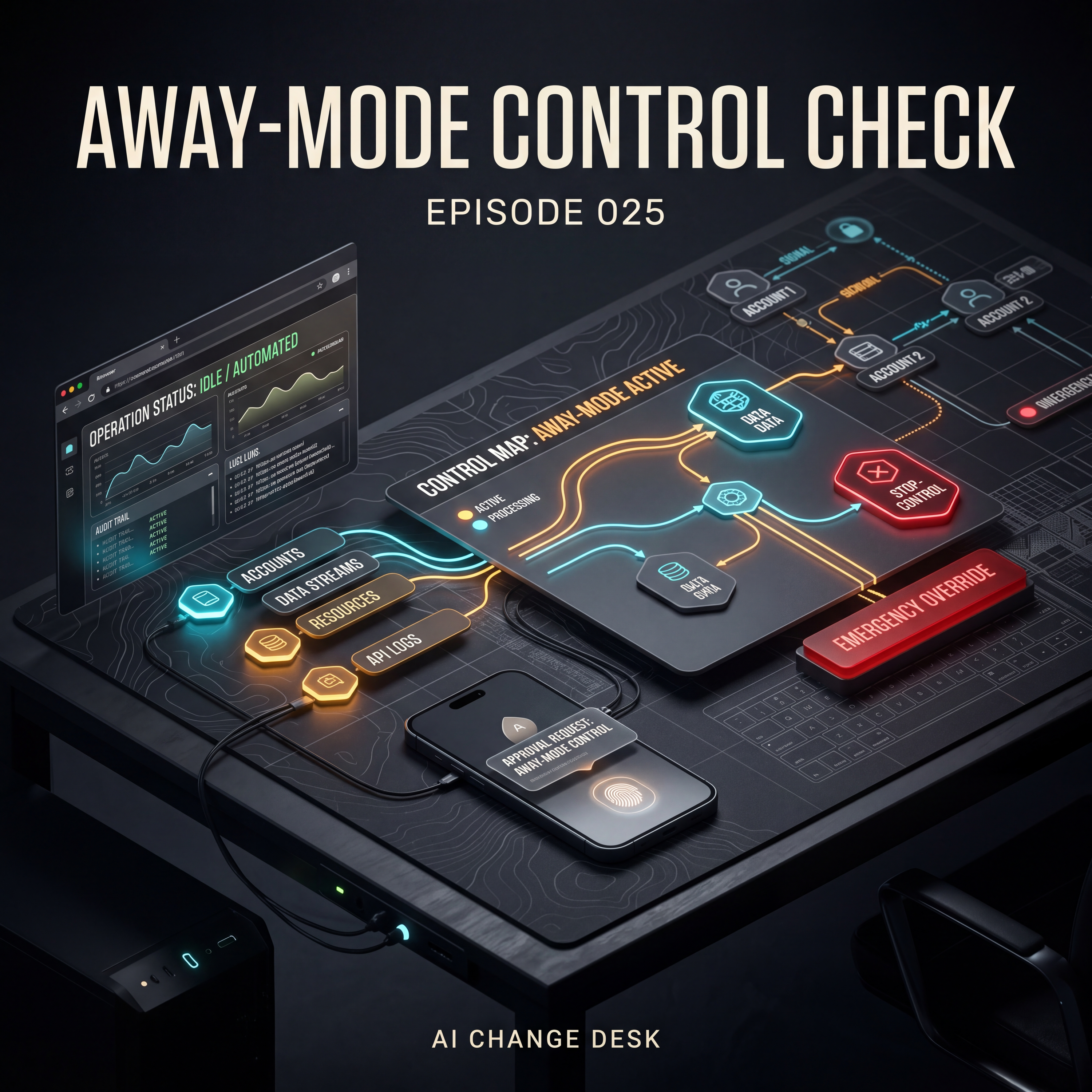
AI Change Desk | EP025: Away-Mode Control Check
May 1800:21:56Tap to summarizeMichael is back after a week away handling personal things and camping by the beach with family and dogs. The timing created the perfect operating question: while people are away from the desk, AI work keeps moving. This episode turns fresh AI workflow-surface announcements into a practical control check for operators. The core issue is not whether teams can work from anywhere. They already can. The issue is whether the organization knows what can move, what must wait, what creates evidence, and who can stop a workflow when the normal owner is offline. OpenAI Codex moving into mobile and remote task oversight. OpenAI personal finance in ChatGPT as a signal for sensitive connected-account workflows. Google Gemini Intelligence across Android devices and browser contexts. Anthropic and PwC expanding Claude deployment across professional workflows. OpenAI launching The OpenAI Deployment Company as a deployment-layer signal. Run a 45-minute Away-Mode Control Check on one live AI workflow: Map which surfaces can trigger it. Classify the action state it can reach. Define what happens when the owner is away. Confirm what evidence is created. Identify the data class touched. Set final-confirmation rules. Name who can stop it. OpenAI, “Work with Codex from anywhere,” May 14, 2026. OpenAI, “Simplify your personal finances with ChatGPT,” May 15, 2026. Google, “A smarter, more proactive Android with Gemini Intelligence,” May 12, 2026. Anthropic, “Expanding our partnership with PwC,” May 14, 2026. OpenAI, “OpenAI launches The OpenAI Deployment Company,” May 11, 2026. AI-assisted tools were used in parts of the research and production workflow. Final editorial judgment, risk posture, and release approval stayed human-led. This is operational guidance, not legal advice. These are Michael’s opinions and are not representative of any organization.
Transcribe →