← AI-Driven Marketer: Master Practical AI Marketing Skills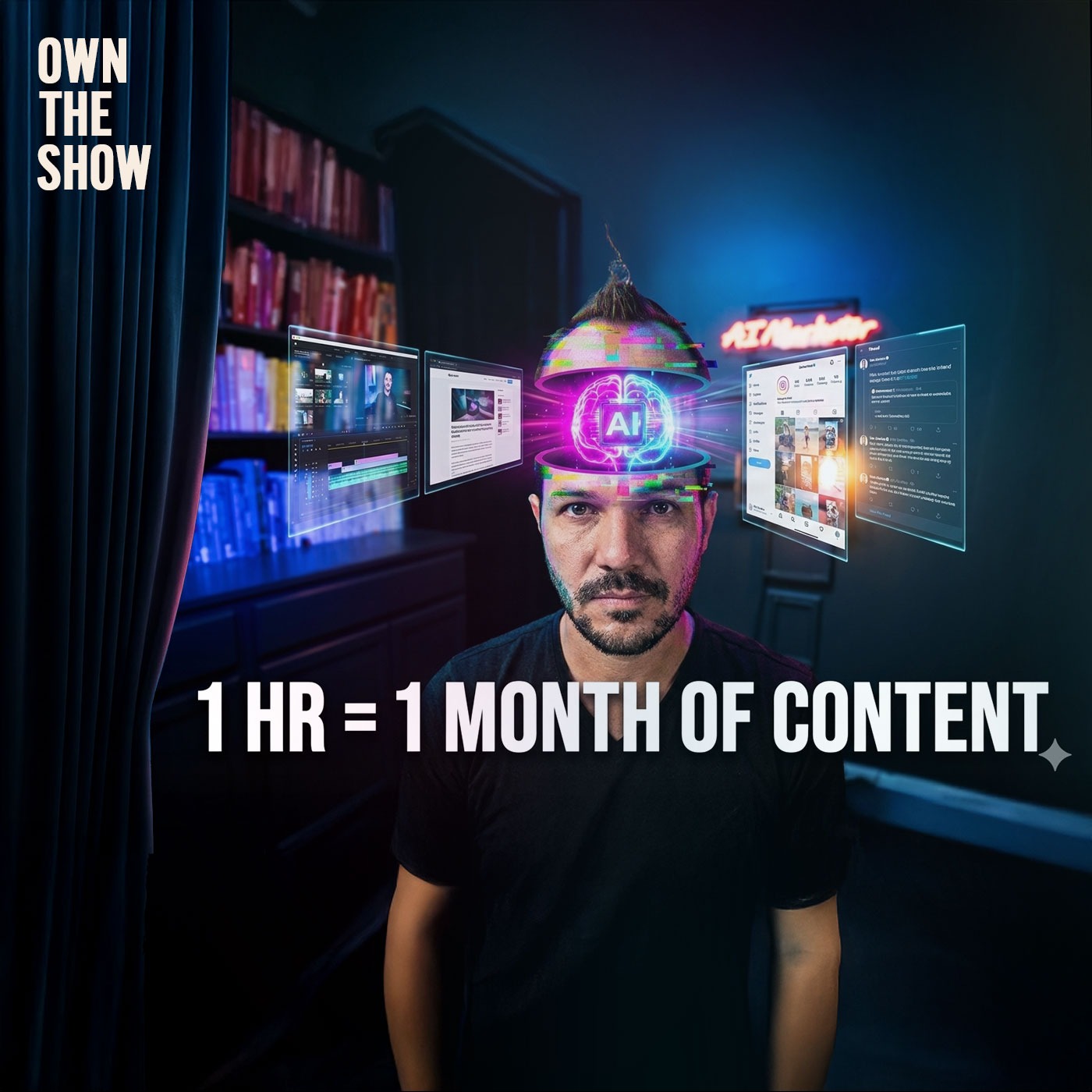
AI-Driven Marketer: Master Practical AI Marketing Skills
1 Recording → 12 Assets: The AI "Waterfall" System
00:32:36
Loading summary
Transcript28 lines
- [00:05]
A
I've been in marketing for almost like 15 to 20 years, depending on what you call marketing. And I could tell you, Ken, that the one tool that ended up ruling them all ended up being podcasting. Sadly for me, it was like the last tool that I figured out of all the different channels, of all the different tools, of all the different strategies and tactics out there. It was like the last one that I came to. And maybe that was, maybe that was, I don't know, God's providence, because maybe I had to know all the ins and outs of all the other ones of Facebook ads and Google Ads and SEO and website optimization and email marketing and automation and text messaging and phone calls and working with the call center and all that kind of stuff just to arrive at what became my favorite medium because it was so freaking powerful. And maybe, maybe that's why it was the last one. Maybe I had to go through the ringer on every single one to realize how good this particular channel is. Because podcasting really is the Swiss army knife of marketing tools out there. It's a channel, but I find that I use it to help compliment everything from my emails to my social to my paid media, to just about anything I want to accomplish. Top of the funnel, middle of the funnel, bottom of the funnel. It does it all. So in this episode of the AI Driven Marketer, we're going to be diving into why podcasts are so freaking important for modern day marketing. Or getting your message out there if you want to become a thought leader. I'm Dan Sanchez and I'm joined by my co host Ken Frery here.
- [01:35]
B
What's up, bro? I'm so excited for today's topic, man.
- [01:39]
A
This is one that I think changed both of our lives. Thanks to our good friend James Carberry over at Sweetfish Media, we've both discovered how cool this medium is. And it's an important part of this series that we're doing for the book Own the show, where we're going from podcast to book. And if you've been following along, you know, we've been working on this series for a couple of weeks now. We've been putting out one of these almost every day. We've, we've taken some breaks for different things like the pot, the breakthrough conference and all that. Different things. But we've been pretty, pretty consistent here with publishing episodes, building out this book, and today we're on episode 10. Yes, this is going to be chapter 10 of the book, talking about why podcasting is the ultimate tool. And there are many different reasons in this episode, we're going to go rapid fire, but probably not too fast through 10 different reasons. Yes, there are that many because again, it's a Swiss army knife. It can do a lot. We could probably easily cover 20 different reasons, but I've whittled it down to the top 10. So, Ken, do you want to kick it off for us for number one?
- [02:37]
B
Yeah, absolutely. And one thing I would love to add is that these top 10 also tend to be the top 10 reasons why people don't want don't do it or they're afraid to do it and how it could actually unlock some powerful stuff. So let me hit us with number one. It's authority and positioning. Okay, so a good show quietly is working in the back end, showing that you have the chops, that you actually know what you're talking about. I mean, long form proves this, right? Anybody could do a one minute clip. It's easy to do a one minute clip and like practice on it. But when you start getting asked questions about it to see if you're an actual authority, it shows when you can talk about it for a long time.
- [03:20]
A
There's something about having a number of different episodes under your belt too. It's kind of like going to Amazon where you see the product reviews and there's like 3,000 reviews. You're like, oh, okay, 3,000 4.5 star on average. You're like, then it's pretty freaking good because so many people have been through it. When you're actually able to produce dozens and dozens, maybe 100 plus episodes on a very niche topic, people don't even have to listen to them all to know that you probably know your crap. It probably shows forth that if you're able to talk about this, even, even if you're not, even if it's just an interview based show and you're having all these interviews, chances are you've learned a lot then going through a hundred different interviews. Like if we just started on a random topic that none of us, that neither of us know nothing about, let's say it's cosmetics, right? I don't know anything about cosmetics other than like my wife.
- [04:11]
B
That's such a manly topic you picked.
- [04:13]
A
But if I started interviewing a bunch of people on cosmetics, you better believe after 100 episodes, I would know a lot, a lot. Probably more than your, your like hardcore makeup user. Maybe not that much, but like, I would know a lot more about cosmetics than most people. Even people who use cosmetics a lot. I just do. That was like the most random Topic I could think of that I don't know anything about. Like, I was going to say jewelry making. I'm like, no, I know something about that.
- [04:41]
B
My dad was a jeweler at one point.
- [04:43]
A
That's all I could.
- [04:43]
B
Yeah, he was okay. Dan, you know when you think about authority, you have this like, use case or a tagline that you think about it. When it comes to AI marketing, walk us through what that mindset is. To just give people an example of what it looks like to have authority.
- [04:59]
A
What it looks like to have authority is to actually define what that niche is about or steer it in a way. I mean, that's the whole goal. It's why we're even talking about this whole book is we don't want to just put ideas out there. We want to lead people's thinking. That's how we define thought leadership. So when you're putting out content into a niche space and getting the word out there, it actually gives you a chance to actually lead their thinking in a topic. So I don't just talk about AI marketing with the AI driven marketer this very podcast. I want to lead the thinking on the topic. That's why I'm so passionate about, like, be AI driven yet human first, because I want to advocate for freaking people. That's what we're all about. I don't want to automate people out of the jobs. And I know it's probably inevitably, inevitably going to happen, but I can at least use my voice and my thoughts and ideas to steer business leaders, companies, marketing leaders into being human first, keeping their people, reskilling them and actually driving that to our more human centric approach rather than just automating everything, every. Everybody out of the equation. I'm like, no, no, no. We need people in the loop. This is why. So that's an example of me trying to steer and using this podcast as a platform to steer the conversation towards something that's actually human centric.
- [06:17]
B
Yeah. And which has led to you getting asked to speak on different podcasts on different stages. You are becoming known as the. The AI driven marketer. Right. Like, that's what people come to you for. So this is why creating a podcast is so important. But let's jump into number two. This is all about idea development and IP creation. We kind of hit on this in the last few episodes, but really people want to want to hear what you actually believe. Right. And they're helping you process through this. And. And sometimes you have a raw idea that you can start fleshing out on podcasting. Or it might be more mature that you're trying to crystallize and synthesize for people. This is where people start to be like, that's exactly what I believe. That's exactly what I want. I mean, since we've been doing this whole series, I've gotten more and more people. It feels like every day now that they're messaging me, they're like, hey, how's, how's the podcast a book going? Can you tell me any new developments? What are you learning? What are you growing in? And I'm sharing my insights. And they're like, oh, man, I never thought that that was possible. You know, like, it's like unlocking their minds for another reason why they should do podcasting and just helping them with their own ideas.
- [07:35]
A
What I love about a podcast is it can be fairly informal. It doesn't have to be so thought out yet. It's a lot less structured than something like a blog post, which is much more formal. And because it's in writing, you have to think really hard and edit it. It could be much more like, shoot from the hip kind of a thing, but yet still be long form. In fact, my, my method usually starts with social LinkedIn. Specifically. If I have a new idea, I'm like, huh, I wonder if anybody's ever tried X. So I posted on LinkedIn. I'm like, hey, I had this cool idea. What if we tried this and did it this way instead of that way? And you know, the algo will either prove that it's a good idea or that it falls flat if it actually kind of picks up and people are like, ooh, like, I like this idea. And they start adding their own 2 cents onto it. I'm like, huh? That's given me an indicator that maybe I should expand on this idea. You know, I just shot a bullet out, it hit and I need to turn this into a cannonball. It's like a Jim Collins thing. I think it's good to great. I don't know. It's one of his books. It might be built to last. One of those books. He talks about the idea of like shooting bullets before shooting cannonballs. You know, test with a small thing before going up to something bigger. And a podcast is like the next level up. It's not going to like full on course or like keynote or book yet, but if you find you shot an idea or maybe even shared something with a client, the client was like, dang, that hit. That worked. I tried it and it was fantastic. Tell me more about it you're like, well, maybe I need to record a whole podcast episode about it. And it's a way to kind of develop that intellectual property, that idea into something fuller. Because it's so much easier just to stand in front of a mic and be like, okay, here's the idea, guys. You can actually flesh it out in a way and in a medium where people are actually going to give it more time and attention to actually consume it. Because on LinkedIn is, is I could post a long form video or an audio clip or something, but the chance that someone's going to actually consume that whole thing on LinkedIn is very low. So you have to put that kind of long form content in a channel where people are actually going to consume it in a podcast. The easiest way to get long form content out, my opinion, I also spend a lot of time in front of the mic. Realize not everybody's comfortable with it, but it's either that or write a blog post or a webinar or something. So either way, you're gonna, you're gonna have to write something long or record something long. And I'm like, the podcast the easiest way to go.
- [09:50]
B
Yeah, well. And one thing I have found is that some people are afraid of like the camera or the mic, but if you just took those two things out of the equation, if I was sitting with you one on one, and I was like, hey, explain your idea, man. You could ramble for 45 minutes or talk about it easily. So that's why I always tell people when they're starting a podcast, I'm like, just act like you were talking to your best friend. Just sit there and just start, just engage it right. Like, just start talking. And they're like, oh, is it that easy?
- [10:17]
A
I'm like, yes, it's that easy.
- [10:19]
B
You'll get.
- [10:19]
A
It's just a mental hurdle time.
- [10:22]
B
The cool part about this, and we've talked about this in the last two chapters, but when you start doing this and podcasting, this is like what you said earlier, Books, keynotes, your flagship framework start to come alive and that's what's really important. So that's what we got so far, is you got authority, you got idea development. Dan, what's the third one?
- [10:42]
A
The third one is the content Flywheel and repurposing. This is why podcasting is keen when it comes to content marketing is because it's at the top of the waterfall, I call it, right? There was something about doing a lot of podcasting that I discovered. I'm like, oh, you Know what? This is what journalists do. You sit down and interview people in order to get the content in order to write the thing. But I'm like, people actually want to listen to the interviews. Actually, there's a lot of podcasters now doing this where they're interviewing multiple people and then working clips into like their little doc mini documentary. It's like 20, 30 minutes. And I'm like, dude, you. They could just publish those whole freaking interviews as podcasts and some people would go listen to them. Yeah, they're slicing and dicing up in these little mini docs. But I'm like, publish the full freaking interview, my man. That's like extra content for you. Or maybe. Or maybe you're hiding something. Sometimes I think that too is. I'm skeptical. And you're only slicing and dicing their words to fit your narrative. Right. But at the end of the day, interviews or solo episodes are like your raw content that you're already capturing good audio on. And you just need one maybe $80 mic in order to do that. And you get the video feed, which you already are used to sitting in front of a video camera for zoom calls. So if you're talking to the microphone and looking into the video camera, you already have what we call the A roll of video. You could just publish that straight to YouTube. Most of these videos, I don't have any B roll. I just literally publish under YouTube as is, because some people like to consum. But at least I get the audio content. I get the video content. And the secret ingredient these days, I get a transcript. Almost every podcasting service out there or recorder includes a transcript now, as it's so cheap. But the transcript is key because with the transcript, you could feed that to AI to repurpose for all the different kinds of content, whether it's video clips or blog post or newsletter or outline for a more tightened up video or LinkedIn post or tweets or whatever you want, AI can make it for you. Based on that transcript, you can repurpose your content into other pieces of content so that every single episode can become an avalanche of 12 different pieces of content every time you publish. And AI is making it easier to automate and get it all out there.
- [12:56]
B
Yeah, and the. The beauty of all this is that we're in this book and in like a few episodes, we're going to talk about the exact flywheel on how to do it. So this is top level right now, but we're actually gonna get into the nitty gritty of that in next Two chapters, so stay tuned with that. One of my favorite reasons for podcasting is number four. It's relationship building and networking. I have used this time and time again for it. Whenever I bring in interviews or guest interviews, a lot of times it's just because I want to get to know the person. I want to learn from them, I want to build a relationship with them. So there's several ways that you could do this, right? Whenever you have guests, imagine inviting your dream guest. I told this to a friend of mine who was interested in starting a podcast. I said, look, dude, eight out of ten people I invite to the podcast say yes to me. Now, I'm mindful that, like, maybe the top A listers, it may be a different story, right? Like, John Maxwell may be a little bit harder to get right off the bat because you're still not known. But once you start getting there, it's easy to do, man. It's so much fun. It also allows, once you start building those networks, when people see that, you know, that individual, right, they're like, oh, you had Dan on your podcast. Yeah, yeah, yeah, that's. That's cool. Maybe I want you on my podcast. And there could be some crossovers there. The other one is collabs, right, where you could just collaborate with individuals and be like, hey, if I'm on your podcast, or if. If you're on my podcast, can I be on your podcast? Dude, I've done that so many times, and it's just opened the door for. For conversations and relationships. The one way that even for those of you who are listening to this and you may not be like, hey, I'm not a creator. I'm not a business owner. I'm just working in an organization. The reason why I would say you should even do this philosophy of, like, networking and podcasting is because now you know so many other businesses that if you ever need another job, now you've connected with people. I got hired at Full Focus because they were looking for some people. I circumvented the process of hiring because I literally just went to LinkedIn. I found everybody who worked at Full Focus, and I, like, said, hey, would you want to be a guest on my podcast? Like, 10 of them, three of them said yes. And it was like, all of a sudden, they all started talking about me because they saw that I'm, like, influential. I have this thing. I'm able to do this thing, and they hired me. And I, like, quickly cut through the whole line of all these other people who are on the list simply because I was networking with people. It's literally my favorite. I could do it in so many different ways. Splice it and dice it. I could talk about it for a long time.
- [15:41]
A
We're going to break up this whole topic of using a podcast strategically to build relationships and getting to the nitty gritty of the how to behind it. Tomorrow's or not Tomorrow, Tomorrow's bot Bros. But Saturday's episode, we're going to be coming out with the full breakdown and how to do it with relationships. And this is really. A lot of people think you just need to publish the best ideas when it comes to being a thought leader, but it's actually not just based on your ideas because you're not. If you want people to actually believe you, you actually have to build almost like a network of people that say, yeah, so and so knows what they're talking about. There's gatekeepers, there's other influencers, there's other legitimate thought leaders in your space. If you get a few of them, if you become friends with a few of them and they kind of like endorse you or promote you or share your stuff, every once in a while it helps. Just grease like I'm going to mess up that metaphor. It's. It just makes it a lot easier to get your ideas out there because you can ride on their credibility, especially in the beginning. That's why I even like starting new shows and new topics and by actually interviewing all the different authors and influencers out there on a particular niche topic. That's why the 30, 30, 30 plan actually starts with that. It starts with of course, the books and then doing the interviews because the relational aspect is so powerful. So. But let's move on to the fifth one, which is audience, audience trust, community and what we're calling the human edge, which is the whole point around this book, right? And the AI. An AI driven world. More and more content is going to be made by AI. And because of that, just like we talked about at the very beginning of this series, people's skepticism is going to be at an all time high when it comes to expert content. Any kind of content that's teaching somebody something beyond the basics. You know, there's probably going to be content that we're like, oh, how do I fix this pipe in my house? And we'll be like, chat. GPT will tell us it'll be fine. But when it comes to making strategic decisions, when it comes to actually navigating hard problems, we'll listen to AI. But there's going to be a level of skepticism, even as we're seeing different ideas out there on social or on the different media channels. And having a podcast with the real human person in front of it is going to help circumvent that, because there's going to be a certain level of trust built with personal brands. And I don't have to go back and under, like, re explain why that is. Go listen to the early episodes of the series. But a podcast does a good job of giving you a platform to tell your stories to, for people to hear your values, how you've actually worked through different problems that they've worked through, and how you came to it. It actually gives enough breathing room for you to actually share that human edge that I will never be able to replicate.
- [18:28]
B
Yeah, people are going to long for connection, and that's what this provides, is a way to connect with you. Which also leads to, excuse me, number six, which is market research. Number six, market research and customer insight. So one of the things that we love doing with podcasting is that you could experiment a lot. You could treat it like a lab and you could do interviews. Right. With people that we've just talked about, but it's all about structuring it for customer research. So you may have seen this in some podcasts where, where they're always asking like the same five questions to each guest. What they're doing is getting research data, figuring out what's actually working, what's not working in that industry. And I, I actually have done it where I do those five questions post podcast, because it was more like me trying to learn the niche in the space. And it's. It didn't fit the. The podcast, but I needed the information from the expert, so it was a great way to do market research. The other thing is that when you're starting to do the market research, you hear the exact words that the market's using for their pain points and their desires. And that's great for copy, that's great for selling, that's great for everything. You want to make sure you're just using their words, because then they're like, this guy feels me, he understands me, he gets me. That's exactly what you want here. And then you'll start to also realize that as you do more market research, that there's going to be reoccurring themes across guests and questions that your participants are asking or people are asking that can help you think about what your offers may be in the future or what your frameworks may be or Your ideas or even your books may be. And that's kind of even how this came about is because you started getting so many questions about it that we needed help with it.
- [20:23]
A
Another thing I love about this, that a lot of people don't really take advantage of, even people with podcasts, is that it's a great thing you can do to interview your actual customers, people that are loving what your service or your product is. And I never really see people do this with a podcast, but I'm like, man, it would be good. I think some people should actually start like if you're a big company and you have like a lot of customers, like using it to do just a whole customer show and just share customer success stories, but in a way that almost gives playbooks and helpful tactics of maybe even unconventional ways of using their service or product. Not just testimonials, but like tactical, you know what I'm saying? Like, I wish, I wish High Level had something like that just had customers and how they're using it and specifically how they're succeeding. Not only is that great, like case study over and over and over again, but it's actually good for the rest of your customers and kind of builds out a whole testimonial line for you and your company. But you could, even if you do it like sparingly, not the whole show, but every once in a while you have a customer onto your show who's working with you as a coach or a consultant and like you just unpacking their story in a way that's still compelling for the audience and not just making you look good. That's some really valuable content, not only for the audience, but also to promote what the heck you do. So I'm like, it's really a good tool for doing market research, getting customer insight, but as well as actually unlocking customer case studies. So let's move on to number seven, which is internal alignment and team benefits. Because we all know internal marketing is a thing. And sometimes if you have a team, whether it's a big one or a small one, trying to get them on board with what you're doing can be difficult. Like what are the ideas behind your, your, your company, your product, your service, how do you get them aligned with it? Having them listen to the podcast, one of the best ways you can do it, especially if you're doing internal episodes all of a sudden. Every podcast episode can be an internal update for the company so that they better understand your approach to the customers problems. And I find that a podcast really easy to do that, even if you're in a distributed team, it saves a meeting. People can listen to it on their own time. They can listen to it at slow or 1.5 or 2x like I do. And all of a sudden you don't have to do the whole meeting because they can actually listen to this sometimes. I think it also is great for creating onboarding assets for new hires, because you're probably already recording some of your core ideas that you're like, every teammate needs to know about this, this thing that we talk about. And then you can link to it in your onboarding. You can use it as sales enablement for your sales team even, and give them certain pieces of episodes for customers at certain stages of the pipeline. You'd be like, hey, these are some common hurdles they run into. Here's some podcasts you can share with them. And again, it doesn't even have to be the podcast. It can be a blog post that came from the podcast or even some other kind of snippet that came from the blog podcast that you've sliced and diced up and is now good in sales enablement, content.
- [23:17]
B
Yeah, I, you know, I'm thinking about several organizations that we worked together with that this would have been really awesome to do. Like, we would have weekly meetings and they were good. But I'm like, I. I'm one of those bad students that if I get bored real quickly and you're talking slow, I'm checking out. But if I could listen to it in 2x and still get the right information, I would have been all about it. I would have most likely listened to that faster than having to sit in a meeting, disrupt my day, do all the stuff. I could have just been like, here we go. You know, I'll listen to this on my, on my drive into work, and it would have been just as effective. But after number seven, the other one is number eight, which is personal growth. So another reason to start a podcast is for personal growth and skill building. Podcasting upgrades you, not just your brand. And this is what I tell people all the time. Like, you're learning, you're growing, you're developing, you're becoming a clearer thinker, you're becoming a better communicator. You are learning so many skills when it comes to podcasting. If you're doing a video podcast, you're learning how to look at a camera and be able to express yourself well, right? You're learning how to talk in a mic, you're learning how to do interviews. These are all Great things that are done with, with podcasting. Now, the other side of it is that if you are also a student of a craft, right, you're learning all the new skills that are needed. I, for example, I learned so much from you already, Dan, when it comes to AI and how to use it in marketing. So I'm constantly growing in that. And as I'm interviewing people about AI, I'm learning and I'm like, oh, did you know about this? And Dan's like, yes, that's. That's something I learned six months ago. I'm like, dang it. I'm like, trying to find a place where I can learn something faster than Dan can about AI. So I can be like, look, look, Dan, let me teach you. That's my, like, milestone right now. But there's so many beautiful things about personal growth and skill, skill building.
- [25:20]
A
It's the reason why podcasting and interviewing is such an important thing when you're still becoming an expert on a topic and picking a niche and narrowing it down. There's something about interviewing a bunch of people that really know what they're talking about after you've read the general lay of the land with all the different books. There's something about the Socratic method of learning where you're asking questions and going back and forth with an expert who really knows their stuff to narrow it in. And honestly, I still do interviews on this show. It's mostly, mostly solo or co hosted with Ken or my bro Trav, but I still interview people because people learn all kinds of incredible things that I can't have the. I don't have the time to dive into this nuance or this thing or they've specialized in this. And so I have them on the show. I'd interview them. I try to suck all the goodness out of them because I'm using it as a tool for myself personally. I'm being selfish and just learning. And I publish it because I'm like, well, like, if I'm getting value out of it, then I, I think some of you would get value out of it too. So it never really stops becoming a tool for that. And even someone like, like Stelzner, who's been doing his show since, gosh, 2010, 2011, something like that, still does an interview based show. And he still learns a lot from all the people that are on his show, like, I can't. Like, that guy's just curious and he's hungry and I'm like, dang, I want to be like that when my show finally has finally reached 10 years old. It's only. It's just crossing into three years old now, which is just getting started. But that never really goes away. You want to continue learning, but moving on to number nine, discoverability and long tail distribution is another reason why podcasting is amazing. Because if you're putting out that many pieces of content across all those different channels, consistently across dozens and dozens, maybe over a hundred different episodes, that that's a lot of different content out there for people to discover you. And this is one thing I learned after being a co host of the B2B Grow show, which had 2,000 episodes, is that more than half of the traffic, like, I'd say even 70 to 80% of that show's traffic. And it was getting a lot of downloads per every single episode. But most of the traffic came from the back catalog. Shows that hadn't been. That were published more than a month ago. Which just goes to show, like, the long tail is very long. And people, even if it's only one and two, listening to different episodes from long ago. It's like every single episode becomes a line, a fishing line out in the water. You might be able to pull someone in to get to listen to you and hear your way of thinking. You never know when that's gonna happen. But if you're putting out all these different lines and it's multiplied now because it's not just a podcast episode, it's a YouTube video, it's three shorts, it's on Instagram, it's on TikTok, it's on LinkedIn, it's a blog post for SEO to index and now search the AI to go and index to pull in potentially and source it. Those are all opportunities. And once you've done a lot of them, it really starts to build up and take on a life of its own.
- [28:08]
B
Yeah, I'm actually always surprised when people come to me and they're like, I started listening to your podcast from the beginning. And I'm like, oh, that's a lot of episodes. And they're like, yep, I'm catching up. I'm like, wow, you don't have to. But they do it like something in them. Once they fall in love with it, they're just like, I gotta go into it and start listening to all of it to get a full understanding. So that's the beauty of once you get found and people like it, they'll start listening to you. And that builds incredible authority and it builds raving fans. Which leads to the final reason you should Create a podcast is that it's a beautiful asset creation and monetization option. So by an asset, we mean that this is yours. You can utilize it. You have a thousand, ten thousand people listening to you. There's influence there now, and you can decide what you want to do with that influence. So if you want to monetize it, there are several different options. You could do it right here. Just a couple options that I'm thinking about. Number one, it could be book deals or self publish, right? When people see that you have a platform, that's huge. Again, I'm picking on Michael Hyatt because he's got, like, numerous bestselling author books, right? But he said him and Joe Miller, he's the chief content officer there at Full Focus, they said something fascinating. He said, most people now, when they get published for a book, they're actually looking for authors who have a platform already, who have an audience that they can sell to so that all the marketing is not just done by the publisher. It's a collaboration. So if you want your book out there more, you actually want a massive audience that people are going to look at and publishers are going to be like, oh, I'll go with this person versus the other person. Yeah. So keep that in mind. It's a beautiful asset to have.
- [30:00]
A
The show becomes an asset in itself. But I actually even use a podcast to create other assets anytime I want to make a new course. Podcast episodes, any. If I want to make a book, which is what we're doing with this very episode. Podcast episodes. Again, it's a Swiss army knife. And because it's my favorite channel, I'm like, what else can I get out of this thing? And I use it to create everything, like, if I want to. Even. Even now, people are using podcasts more and more at live event shoot. I just got invited to be a. I wasn't a speaker. I was a podcast partner. And I went and just recorded a couple interviews. But I. I actually got compensated for going over to that conference, recording a few episodes, doing an episode about it. And I was happy to because they had some awesome content. It was great for the audience, and I loved what they were doing. I wouldn't have done it if I didn't think they had something awesome to show and something to learn from. But that was a whole nother thing, like actually going to an event and using it for a live event and recording there on the spot. So there's so many different ways to use a podcast, and we've only covered 10 of them. But I can't get over the fact that it's become my favorite channel. And even though I've become mostly known for AI with the AI driven marketer, I still find myself talking over and over and over again about podcasting because it's just that powerful of a tool. AI is changing my life in a lot of ways. But podcast man, podcasting is, is, is a love that just never dies.
- [31:27]
B
It's, it's the foundation, man. It's like the thing that we use to be able to do all the other stuff. So this is why we're encouraging it. And we. I've only talked about one monetization option. There's a ton of them. You could create courses you could do sponsorships, membership communities, live event summits. There's so many ways. But our final encouragement to you as you're listening to these 10 is that don't let your fear stop you from clicking record. There are so many of you right now who have the ideas, who have the expertise, and you're waiting and wondering, how should we do this? And you're asking all the common questions of like, what about the gear, what about this, what about the title? Like, that's part of the reason why we're building this book is so that you can start to learn how to craft your ideas, how to do all this stuff, and how to truly use a podcast to leverage your expertise and get it out to the audience. So our encouragement is don't worry about those things. Just start hitting record, record in the light, right? It's going to be messy at first, but it's going to be beautiful. It's going to be wonderful. And a year from now, you won't regret.