← AI-Driven Marketer: Master Practical AI Marketing Skills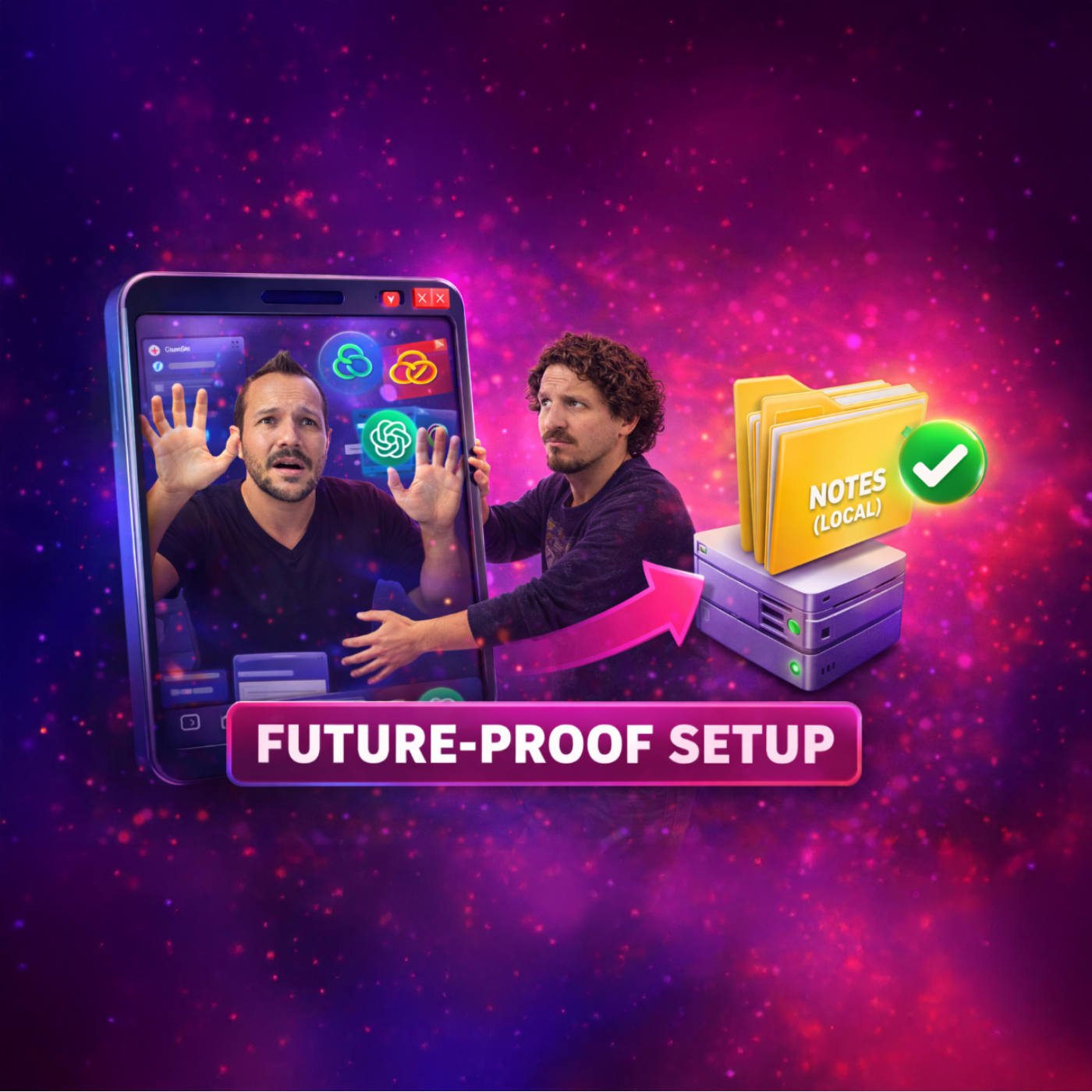
AI-Driven Marketer: Master Practical AI Marketing Skills
Build a Second Brain You Actually Own
00:37:45
Loading summary
Transcript87 lines
- [00:05]
A
The AI landscape is changing and it's not really clear who's winning anymore. So in today's episode, I want to talk about how to future proof your setup, because it's becoming more and more apparent that what you need to win with AI is not even killer prompts anymore. It's actually just context giving it the right information at the right time. But if you're committed to ChatGPT, what happens if Gemini wins? If you're committed to Gemini, what happens if Claude wins? You're like, oh, no, my information spread out across three different systems. What do I do? In this episode, we're going to talk about exactly what the new trend is becoming that I'm now seeing as a thing I'm going to be putting my time and effort into, so that no matter who wins, you're going to be able to keep all your data for yourself. So, welcome back to the AI Driven Marketer. I'm Dan Sanchez and I'm joined by my brother, Travis Sanchez.
- [00:53]
B
Let's jump into it.
- [00:55]
A
And of course, this is the Bot Bro segment where we talk about what's trending with AI and what's really relevant for marketers because there's a lot of AI news and hype out there there, and only a few pieces of it are really relevant for us trying to grow our businesses, our. The companies we work for or who are just trying to get the attention on social media. Whatever it is you're marketing, this is the channel to get the most relevant tips and news that make the most sense for you when it comes to AI. So, Trav, on this first one, I gotta tell you about this new trend taking place, and I can't say that I'm fully in yet. I'm just on the cusp. But it just clicked in my mind recently. I was like, oh, crap, this is it. This is it. This speaks to the problem I'm starting to seen, because, as you know, AI is getting good across the board. Oh, yeah, like chat. I'm still mostly a chat GPT user, but I'm using Gemini a ton and I'm using Claude more and more and I'm like, crap. My context is spread out over three different places. So something happened when we talked about, like, this big craze around Open Claw giving me some serious fomo. I'm like, oh, my gosh. Some people have started figuring out how to, like, you build their own repository or their own, like, collection of context, so it all lives in one place. And then you can just switch out your AI agent as you need. You're like, oh, you want to use ChatGPT with it, great. You want to use Claude with it, great. I say Gemini doesn't work yet, but it probably will soon. So this thing is a combo of two different apps. And let me break it down, it's a combination of this note taking app called Obsidian and not using ChatGPT directly, but using ChatGPT, Codex or Claude code. Yes. I'm not even talking about using code applications. I'm not talking about like developing any websites. No code necessary. Those agents are just actually good at a lot of things beyond code. I know. Mind blown. So this is a little unintuitive at first, but let me walk you through it and tell you, like this setup here. Let me walk you through this setup a little bit. Let's, let's start with Obsidian. Okay. Obsidian is a lot like Notion, right? Notion or Evernote. They're note taking apps. You log in, you put in your note and it stores it and you can organize it, you can link your notes together. Right. I've been using Notion for years and before that I was an Evernote guy. But I don't know about you, but do you ever find like you're just opening up Apple Notes anyway and just like typing stuff in there? Yeah, I use Apple Notes a lot. I'm still using Notion a lot. And I find that my notes are all spread out. But now a lot of my notes are in chat. GPT is I'm having conversations with them like crap. Like, it's spread out all over the place. Place. If only you could live in one place. Now the claim to fame for Obsidian, and this is why people are just going nuts over it, is it's notes before apps, notes before apps. So you can put notes into Obsidian, but what it's really doing is just storing the note locally on your computer as like a markdown file, really simple, plain text file. And it keeps the images and stuff or whatever multimedia it stores it in there. And it's just simply a folder system. You make a folder in Obsidian, it makes a folder on your desktop, you drag some notes into that folder, it creates these little MD markdown files that are super simple on your computer. And for a small fee, like four bucks a month, which is pretty freaking reasonable, you can sync your notes across your iPhone and your computer, or you could just use it for free and have it only on one of those places. So that's Obsidian. Now where that becomes powerful is when one, one extra note is, maybe you don't like Obsidian. In the future. That's the cool part. They specifically engineered Obsidian so that you can ditch Obsidian, plug in a new note taking app interface and all your notes are right there. Because there's no specialty anything. It's your notes before apps, right? So it's future proof. It's all organized in a way that any app can read it and any app can manipulate it. Now that's where AI comes in. Because Obsidian is just a cool interface, an easy way for you to navigate notes. Way better than like Microsoft Word, which is kind of frustrating because it can't interlink between other Microsoft words and doesn't deal with multimedia well. And that's where notion was cool because it can organize a lot of different content, create layers. Word can't do that, but Obsidian can. This is where the AI side comes in because you can bring in something like a Claude code, Mac app, or now Codex, which just came out a week or so ago, and say, hey, I want you to have access to this whole folder. And now it has all the context. Codex and Claude code are like slightly different versions of the originals, but you don't have to just use them for code. That's what people are figuring out and that's what OpenClaw is using. OpenClaw is using these like code agents to either write code or just make decisions and move. The cool thing is, is both of them are really used to navigating because they're used to navigating code repositories because you know, you don't organize all your code in one one file. No, it's organized across multiple files across multiple folders. They're used to having to go through and understand the context of what's going on to achieve the task. You're like, oh, the footer's broken on the website. So it's like, okay, well let check out the couple of files where that could possibly be, understand the context, scan it, look for the problem, pick it apart and make changes. Right. It's used to going into folder systems and organizing things where ChatGPT isn't necessarily trained on that, but Codex is. Claude code is. So when you start hooking up these tools to this Obsidian database, all of a sudden you can have it, you can have conversations with all the context you need. The cool part is, and this is, this is the thing right now I'm using Codex, ChatGPT, Codex. But what if I get, what if like ChatGPT Codex falls behind and I'm like, that's okay. Same repository, bam. Now, now Claude code has Repository, maybe both of them have reposit, like have access to my folder and I can have chat GPT's Codex doing one thing kind of brainstorming with me, and then I'm like, oh, cool, now let's use this to start to write a book. Maybe I have enough notes in there and transcripts in there that I have chatgpt help me organize the ideas and then create a new note because it can take actions, it can make new notes and help you organize your Obsidian database if you need to. It can also. But you can bring in multiple AI agents to have access to the same files. And that's the part that's cool, is because now it doesn't matter who wins. You just put something else on top. You own your data. And I'm like, this is really cool.
- [07:14]
B
Wow.
- [07:15]
A
I think this, this is. I like this feeling of like, I own my data.
- [07:20]
B
Yeah, totally.
- [07:22]
A
So how does that hit you? Does that seem like smart? Am I giving you some fomo? Like, I need to figure this out. It's not technically complicated at all. It's actually very straightforward.
- [07:30]
B
So I don't want to be a wet blanket, but everything you're saying, I'm like, yeah, okay. I don't really. That doesn't pique my interest at all, like, at all. I'm like, I mean, I can. I can understand why you'd want to have a database of your thoughts stored locally, to not have access to anything web wide. I'm like, I get it.
- [07:50]
A
But I see here's the thing is I have. I have a lot of the context spread across three different AI apps now. ChatGPT, Gemini, Claude. I also have a lot of stuff in my Notion folder. I also have a lot of stuff just in Apple Notes, where I'm just taking daily notes and thoughts and just stashing it. Wouldn't it be cool to have an AI agent have access to that when I needed to have access to that?
- [08:14]
B
Yes. And essentially Obsidian will take every. Well, this is, this is. Where is it automated for organization of all that information across all platforms.
- [08:30]
A
It's one of those organic organization pieces where it starts to create like a mind map of how things are interlinked. There is another app like it called Rome, but no one people are using Obsidian now versus Rome.
- [08:43]
B
Let me, let me explain it this way. It would be cool to me if you're like, listen, if you get Obsidian, here's what it's going to do for you. It's going to take the conversations you've had with yourself across any AI plus your Note, app plus Notion, or what was the other one you said? Everclear. No, Evernote, Notion, Evernote, whatever.
- [09:02]
A
Just replacing it with Obsidian.
- [09:04]
B
And it's going to combine it all so that you can have all of this data that you've collected over time, almost creating that personalized Chat GPT feeling that it gives you, because it has a memory of you and it knows you, and that's going to create that database that you're now AI platform can utilize to understand more about you, how you think all that stuff. Is that what you're essentially telling me?
- [09:27]
A
Yes, and it can go a step farther and that you're. I don't know about you, but I'm making stuff with AI all the time. But I don't know why Chat hasn't done this yet. But they don't have a way to organize all your canvases because I'm constantly saying, hey, come up with a canvas for this. Come up with the canvas for this. Gemini is nice because you can. They have canvases and you can be like, oh, export to Google Docs. Now I have a copy of that in a folder somewhere.
- [09:48]
B
Yes, right.
- [09:49]
A
But it's in Google. So Google's kind of building an ecosystem like this. But with this, I can have my own private note library. And every time I have something and you have to do it with Codex, you're like, oh, that's a great thought. Can store that in a note for me. Hey, you know, this folder is getting a little busy. Let's create. Can you organize it for me? Come up with suggestion? Yeah, that looks good. Do it. And then it organizes it for you. It has the ability to take action. And I think over time it will have a greater and greater ability to actually not just work with you and your notes, but actually take actions on your behalf. They can actually go and do things. Yes, It's. It's essentially a lot of people are using this for Open Claw too, because Open Claw, but Open Claw is a little bit more a massive security vulnerability, like we talked in the last show. So I'm trying to figure out how do we bait. How do I start building the systems now so that when something like Open Claw is actually ready and not going to get me hacked, like super fast, like, I already have the infrastructure to do it. I'm trying to think ahead to like, six months from now, Open clause, something is going to be available, like Open Call, that could take a lot of action on my behalf and I can delegate to the executive assistant that can actually do stuff. How do I start creating the infrastructure for it? Now, I know I'm getting into the weeds, but I'm trying to give a preview of what, How I'm thinking, how I'm future proofing this thing.
- [11:09]
B
Well, you heard it here first, Dan.
- [11:15]
A
Moving on, moving on to something more practical. That's. That is Obsidian Codex combo. It's actually, it's not that hard, I promise. Not.
- [11:24]
B
It's not hard. I just, I'm trying to. My brain hasn't like figured out why that should be. Firing some neurons.
- [11:30]
A
We'll come back when I have some more practical examples. I'll start, I'll start showing.
- [11:34]
B
And we wonder which one of us is the more intelligent one. Okay.
- [11:40]
A
And which one of us has more friends? All right.
- [11:44]
B
Great.
- [11:45]
A
Friends.
- [11:48]
B
All right.
- [11:49]
A
Another. A big piece of news came out. This was like this one kind of got lost. There's so much AI news right now, but so much of it's like not just not relevant from our marketers, but this one was. ChatGPT updated its deep Research. It got a big upgrade. If you've been into ChatGPT recently, you notice there's like a Deep Research on the left hand side like, like right above your custom GPTs. There's like actually a whole tab dedicated to Deep Research now. And the upgrade that it got is that you can now it's, it's, it's gotten more levers, more buttons. You can deal with Deep Research. One of the most useful tools in Chat GPT right now is Deep Research. And now you have the ability to force it to visit certain websites when it's doing its research. You could be like, hey, only look at these websites or emphasize these websites. But you can still do general searches on the web or have access to these tools like a Google Drive or different types of tools that you might have access to that you can integrate when you're doing your Deep research. This is really cool because now you can force it to either just scan more credible sources, only specific sources, or even your own resources. I tested it just recent, just a few days ago and I said, hey, go and only search my. I have two websites, AI Driven Marketer and Dances.com, right? I have two websites where I've been posting content for years. Years. And I said, hey, go and look at all my information about what it means to be an AI driven marketer. And based on my own thoughts and ideas that I've posted over time, I want you to outline a book about what it means to be an AI driven marketer. As me. So it goes and takes its 25 minutes to go and read all my stuff. And it's only my stuff because I said only. Visit marketer.com and dances.com It's a WordPress site. It's well organized. So I went and read it and then it put together my book summary and in my book summary had it organized with like chapter one, chapter two, chapter three, the thoughts in each chapter, a whole summary with like evidence of like, oh, Dan often says this, Dan often says that. Oh, here's this framework Dan came up with and it has links and citations to all of it. Wow. And it was freaking good. I'm like, dang. Part of me is like, dang. I need to go take all the transcripts, put it into my Obsidian database that I'm building, have clusters.
- [14:06]
B
Of course you thought that. Of course you did.
- [14:10]
A
I haven't done it yet. It's to come to come. That's why the database becomes an important deal. But if you haven't played with Deep Research, go and do it today. In fact, I will give you a link. I'll drop it in the show notes. I have some amazing prompts that I've. I've been using them like all the last couple of weeks as I'm getting into a new company for audience research. Deep Research is amazing at getting to know your audience better than you do. I've literally gone and sent it on a mission to go, like, understand this audience. Go and search Reddit and Quora and just the places where they chat. I want to know what they're talking about when it comes to X and Y and Z. And it's really good at finding insights. It's the fastest and honestly some of the best user research. But I'll drop a link to that. I have a whole notion doc, maybe soon an Obsidian doc, I don't know, full of prompts and ideas of how to use it. All marketers should be using this, but it just got more powerful because you can specify what websites and what tools it has access to. This is a big one for marketers to use if you're not using it yet.
- [15:06]
B
Wow.
- [15:07]
A
Do you use it yet? Have you done it?
- [15:10]
B
No, but I can already think of multiple use cases of why that will make a big difference in my field. Specific searches, specific information that I'm looking for is for. From a specific group of individuals that I want to learn the most from.
- [15:25]
A
So that, yeah, it's helpful sometimes. Sometimes I'll just send thinking mode on a search day, like go find the answer for me, go search the web and find it. And I know it's, it's more nuanced. It's going to have to think about it. But sometimes you're like, no, I need, I needed to spend 30 minutes thinking and researching this. That's when you want to use deep research. It's like a whole nother level of thinking and analyzing based on what it finds on the web. It's one of the best. It's, it's, it's an agent that's essentially been available for a year now. But it's actually, I call it an agent because it goes, it searches, it thinks, it searches, it thinks. Has to go back and forth before it gives you the report that you ask for. It's amazing. It just got an upgrade. Go check it out. Third in the news is this post from. I don't have his name in front of my notes. Matt Schumer that went viral on X. I almost led with this story, but it's a little bit of a downer. So I'm like, I'm gonna bury this as the lead because I've been talking too much about this one topic. But he's essentially said something big is happening and he wrote an all article about it. He made an interesting comparison to like how people are just going about their normal lives, their normal work right now. But it's a lot like what? Like AI is coming and it's about to disrupt a whole job industry across the board, across countries, across fields. It's a lot. And he made the comparison. It's like, it's a lot like January of 2020, woof. We had no idea what was going on, right? Life was going about as normal. We just entered the new decade and everything's exciting and the February comes and everything's exciting. But we start to hear about this virus and China and we're like, wait, what? And then March comes and bam. Like smashes the whole world, right? He's like, that's what we're in right now. We're in the January of 2020. People are going, but they have no idea what's about those tsunami that's going to come. And he makes all his correlations. I'll link to it in the show notes. It was viral. A lot of people picked it up, a lot of news outlets picked it up. If you've seen it, it's one of those things that's becoming really scary. So today I actually want to talk about why there's actually a lot of hope still. Like we don't have to look at this and be like, we're all screwed. Oh no, I still think there's a lot of hope because I don't know about you, Brad, but the AI news is the, the, the doomer news is starting to get to me a little bit because there's so much of it. Fear sells so many clicks.
- [17:42]
B
Yes, it sure does. I watched a video, which I'm guessing now that this girl made this video from this article, but it had a hopeful like turn to it and it wasn't, it wasn't so much about job loss. She starts the video by saying, listen, all of us have heard of AI. Most of us have dabbled with it to help write a text, help write an email. But that is the low hanging fruit of AI as we've all talked about. And she said the, the thing that is going to separate you from someone using AI is in a productive way and not is code. She goes, the thing that has trans, like, what's the word? That has been remarkable for society in general. Of course we had revolutions in technology, but the thing that has most revolutionized things is software. And now with everything that AI can do with writing code, it takes months of work down to literal hours. So if you can start messing with, and I mean you've talked about it so many times, is actually vibe coding and getting into understanding that AI can do the coding for you is. Is the answer. So she had this uptick of like, if you want to be ahead, get into vibe coding. Vibe coding. Vibe coding. Vibe coding.
- [19:02]
A
It's funny because the article and other people have said like, dude, it's not even vibe coding anymore. You're literally just assigning the task to the agent who vibe codes for you and then checks on itself and then vibe code some more and then checks to make sure it works and then vibe code some more. Like the agent assigns it to a different agent and starts getting it done. And that's what people are doing with openclaw right now. But again, openclaw is a security nightmare. So, you know, use at your own risk. And it's a little bit more technical than you probably want to deal with if you're a marketer. But this whole like, again, if you're fascinated and have a lot of FOMO over the open Claw thing, start following me on this like Obsidian slash Codex or Claude Claude code thing. This is, I swear this is the baby step towards what OpenClaw will be in the future. That's my prediction anyway. Other positive things is that like People are like these solopreneurs of course are automating their whole companies with AI. It's like them and cloud code. They're spending a freaking amazing amounts of money doing this whole stuff. They're getting like bills of like $52,000 they owe for this month's work use of anthropic. And while the costs on AI are dropping quickly, the use of it, like when you start using things like openclaw or Claude code and using agent agent, multi agent things, guess what, the costs go up dramatically. And of course we always want to be using the best model because they make less mistakes, because they can do more, they can think more deeply. But it's like, well yeah, but they cost a lot. Especially when you have them thinking for you and doing stuff for you all night. Imagine sending it to do some stuff for you. Like, oh wow, it did 10 hours of work for me that I don't have to do now. Yeah, but you got a $500 bill for it.
- [20:41]
B
Yikes.
- [20:42]
A
And maybe it's worth it for you. Maybe you're a high leverage individual and 500 is kind of like, yeah, but my time, it costs, would have cost $3,000 for those 10 hours.
- [20:50]
B
I don't know.
- [20:51]
A
Huh. Like right now I'm looking at this and I'm like, yeah, one, businesses are always slow to adopt stuff. Two, this thing's expensive to run. So it's going to be difficult. It's going to be, it's, it's going to go a little slower hopefully. And there's always more work to do. Yeah, it's like we can spin up things fast. But I'm like, yeah, then we'll, we'll spin up, spin them up fast, run a bunch of costs on AI and then change our minds. Before we used to have to be very careful how we spent time. That's why even coming up with the logo, right? Like, oh, let's make a mood board because we don't want to have to design a logo that takes a long time and then have them be like, that's not it.
- [21:27]
B
Uh huh.
- [21:28]
A
Right. And then you have to stair step your way there. But that was a time saving measure because you didn't want to have to come up with 10 mock ups. That's way too time consuming of finished logo. So you create a mood board and start narrowing it down with an audience or with whoever your client is. If you're a designer. Same thing with code. You build an MVP and then you add on top of it. Now, now you could Just go and get there fast and be like, down and then get there fast and then down. It's like you just get to finish product faster. But it's like you're still. You're just wasting AI credit. So I'm like, maybe. Maybe that kind of slows things down. Like the, the cost of electricity is just not going to go down. So it's like, well, until we figure out nuclear fusion, AI is going to be expensive. It's kind of how I'm thinking about it. Wow. AI is getting to a point where anthropic and OpenAI and Microsoft and all those guys are kind of like, dang. Our servers are. Every time we throw up a whole new data center, it's at capacity with really fast. So I'm like, yeah, that, that'll slow things down because AI will just be expensive. It'll drop, the cost will drop, and maybe we'll become more efficient. But then new things will come and we'll be making movies and stuff. But it'll cost a lot to make a movie, a lot less than it did before. But, you know, it's like, maybe it's.
- [22:32]
B
Just not data centers around the moon like Elon suggested.
- [22:36]
A
Yeah, well, love those bold ideas. Maybe we'll see it when we're like 60. You think too small? I don't think it's small. I think he's gonna do it. I just think solar panels around the sun. Let's just bottle. Let's just put the sun in a bottle and then we'll be fine. Hence nuclear fusion. Moving on. Sponsor is again. I talked about this last week, but today's the last day. If you want those free tickets to get to the AI business world, where I'm speaking in April 28th through 30th this year in Anaheim, California, literally right next to Disneyland. I'm going to Disneyland the day afterwards. So if you want to. You want to bump into me at Disneyland or hang out in our line and talk shop, then come join me at AI Business World. You can come. But if you want to win a ticket, there's not a lot of entries, so chances of you winning are actually really high. Today's the last day. If you're listening to it on Friday. I'm choosing tonight, so get your entry in. It really is really simple. You just gotta leave a review on Apple or Spotify. For this show, take a screenshot, upload it to the form@aidrivenmarketer.com contest, you know, take your name and email because I got to be able to message the winner, but chances of winning are high. People like this show has a good amount of audience listening, but I don't know what it is. Podcasts people don't like to click on links and take action sometimes. It's one of the downsides to podcasting versus emails of course. So if you want to win a ticket, you want to come and hang out with me in April at AI Business World and hear a ton of awesome sessions. Leave a review, give it a one star if you need to or two star or five star whatever you feel like it deserves. It doesn't matter. Take a screenshot, upload it on the form@aidrivenmarketer.com contest and we will announce the winner next week. Moving on to everyday AI how are you using AI to enhance your life over the last week?
- [24:31]
B
Bro, this is a simple one, but I had information on cards, okay, that I needed to edit, but I had about 20 cards of information that I just needed to put into a document. I laid them all out, I took a photo, uploaded one photo to chat gbt. I said I need to edit all of this information. Please create a doc where it's all separated by each category. It's totally different. And what would usually take someone I don't know, 30, 45 minutes to copy all of this information or take a picture with your iPhone and then try and copy it and paste it in. AI was just so helpful because I didn't have an electronic copy of this hard copy stuff on paper, which feels so. I mean paper just feels so prehistoric at this point. But anyways, I was just man, the fact that I had AI in my back pocket just to turn it over to an actual electronic document. So helpful.
- [25:31]
A
There's nothing that feels more magical than taking something from analog, taking a photo of it and having AI just take it and make it into digital for you like instantly. It's just like every time you do it you're like yes, I love this about AI.
- [25:43]
B
And it formatted it nice. So it's like yeah, it kept the titles and the.
- [25:48]
A
I'm like okay, smoothed it out. It was. Yeah, yeah, it's amazing. Just a few days ago I needed a simple icon and I found one. But I needed like the icon that I found on the web, but I needed a tweak to it and then I needed it on top of a transparent background and there's nothing like just being able to drag and drop that sucker into chat. GPT be like this but with this and give it to me in black on A transparent background. And then, you know, ChatGPT's image generator is still a little slow, but at least it can do transparent backgrounds. So it was done and it was easy. And then I uploaded it to the website where I needed it and bam. It's like such a smooth. It's just a little thing, but little things like that throw off marketers all the time because oftentimes marketers don't have access to Photoshop. And then if, even if you do, like, building, like making tweaks to an icon is kind of a pain. I know how to do it. Illustrator.
- [26:34]
B
Like Illustrator.
- [26:35]
A
Yeah, still a pain. Still a pain. So much easier just to drop it into chat. Like, hey, can you take this change real quick? Bam. Done.
- [26:41]
B
Right? My second one is where we manage a couple Airbnbs and I was adding some photos to some remodeled rooms, but I didn't want to hire an entire photographer to match the high quality real estate photos we have for our listing. So I did a wide angle photo with my phone, took it into chat. You know, the good photos that were taken by a professional were in the summertime. The trees are green outside. You can see it through the windows. They do like really hdr. So it looks high quality all the way through the image, even when you look outside. So I just told chat, I'm like, hey, I need you to one, brighten up all these photos to make it look like, you know, high contrast, high bright. Make it actually match this photo. But I need the wind. I need everything to be the same except I need you to like open the windows and make it greenery outside. That matches the aesthetics of all these things. And man, did it deliver.
- [27:41]
A
Oh, come on.
- [27:42]
B
It crushed it.
- [27:44]
A
It.
- [27:44]
B
You can't. You can't even tell that the trees in the background are just totally. Yeah. Not real. And you're like, well, is that false advertising?
- [27:51]
A
Summer?
- [27:52]
B
Yeah, literally, it's like, is that false advertising? It's like, no, because we actually had an old photo of the room that had the summertime photos. And I was like, this is basically what it looks like outside, so just replace the windows. And it did it within seconds. In fact, I tried to do it with chat and Gemini. Gemini. I. I don't know what happened to Gemini. Gemini didn't know what the heck I was asking for. It started blending the good photo with the old, like blending the whole photo together.
- [28:19]
A
I don't know.
- [28:20]
B
I have. It was a hallucination beyond. I feel like Chat should be or Gemini went, well, this is expensive. We need to not actually do such a good job.
- [28:30]
A
Maybe this is the thing. The reason why I end up sticking with Chat GPT is that it's much better in. And this is true for its writing, it's true for its code, and it's true for its images and its video. ChatGPT is just much better at dealing with ambiguity and it can figure things through and it can kind of figure out your intent and just kind of run with it. Huh? Everybody else, like, they might be technically more better, but like, they freaking, like, you have to be way more precise versus Chat GPT. You can like, you have, you know, you work with like an intern or something. And some of them are like, they're technically smart, but like, man, you have to specify the exact order to do it in or they are going to go off the rails.
- [29:09]
B
It's like your firstborn child. That was like. But you said it's like, okay, but do you understand the meaning, brother?
- [29:15]
A
Like, can you just intuit what I'm trying to figure out versus there's always those workers. Every once in a while you get like one of those people that are just really good at figuring out what.
- [29:22]
B
Yes, yes.
- [29:23]
A
And then they get it done and they improvise a little bit on the way. But like, you're like, yeah, that's. That's what I would have done. We need that. You ran into a snack, you got overcome and figured out the better thing. Great. That's Chat GPT. Which is why chatgpt, in my opinion is still kind of like the go to is it thinking partner. It just is better at dealing with the abstract better. But again, I'm using all three pretty regularly now. Moving on to the poll of the week. This one's not actually a poll, but I. It was close enough to a poll that I was like, but it was really interesting. People are essentially betting against ChatGPT. There's this website called Polymarket where you can kind of like take bets on all kinds of things, whether it's sports or finance or politics, crypto. And people make bets and they, you know, you make a bet and you win or you don't win, you know, so Poly Market had people are taking bets and you could see the trend over time. You don't have the image in front of you, but again, check the link in the show Note, you can see this Poly Market page where you could see, like, people are betting for AI at like a really high rate. I can't see it exactly, but on the graph it looks like it's around like the 90% rate, people betting for it. Betting for it. But then comes along, well, you know, like December, January of this year, and it tanks to like 3%. As far as, like, people's confidence in ChatGPT, at least according to the bets of where it's going, Anthropic is now at 74%. So high being like 90% to dropping to 3, and Google's at 21%. So Google has also had a big rise. But Anthropic, with Claude, now people are like, this is. They're going to crush it. Which I just thought was interesting. Do I believe that that's the future? No, I still think it's too early to tell. I think Google's probably, probably more likely to be.
- [31:08]
B
The bet, though, is which company has the best AI model by the end of February. Which I'm like, how are they even measuring what best is?
- [31:17]
A
I don't know. But this is the current consensus. The anthropic will have the best.
- [31:22]
B
But what are they?
- [31:24]
A
It's like, I don't know how they're calling it.
- [31:26]
B
Yeah, how are they calling the winner?
- [31:29]
A
It's just like, I don't know, the.
- [31:32]
B
Groundhog coming up to see its shadow. Dude, what?
- [31:35]
A
The whole betting market, I. I've never made a bet ever, so I don't know how it works. But people are betting against a Chat GPT now, and it had a long, consistent record of being the top one, so who knows? But everyone's opinions, it was obvious that Chat GPT was in the lead, and I'm like, not so obvious anymore. There's. There's many, many, many good there. You go forth a lot and we'll see who's. Who's ahead in this year. I still think ChatGPT had the lead in 2025, but in 2026, could be anybody. Could be anybody. All right, viral post that I found this week. And this one's recent just came out, I think this morning or yesterday. But Ethan Moloch is always testing it. And it's funny. One of his video tests, he uses otters a lot. I don't know why, but this one comes from a recent model that just came out from Seed Dance, or See Dance is the video model. And it comes from a company called ByteDance, aka TikTok, and is now the most sophisticated video model right now. It's got audio, it's got music, it's got voices, it's got the whole thing. So he tested it and said, like, hey, create a version of Monica's apartment from the show friends. Except all the friends are otters wearing wigs. The otter with the Rachel wig says, is anything weird? And the one with the Joey wig says, nope, all is normal. I'll link to it in the show notes so you could watch it yourself. But it was actually really good. You're like, wow. It even has the little like laugh track for the sitcom thing going on. The apartment isn't perfect, but if you would just glance at it, you'd be like, oh, it's the friend's apartment. The dress, the wigs, the, the voices were not bad. The, the music and the intro music to the whole thing was actually pretty good. I was like, dang, we're getting close. From the same model. Another one that went viral from the same model. Unfortunately, I prepared this show notes and finished this before I got to this one. There's like a fight clip. I'll put it in the show notes. I will find it. There's like a fighting clip between Tom Cruise and Brad Pitt.
- [33:38]
B
Oh, I can see that one.
- [33:40]
A
This like utopian world where like LA's blowing up. And it looks, you can tell, like the fight scene isn't quite right in the way it's. They're striking the face and the blowback from it. But it's like, it looks pretty freaking good. Like really freaking good. Like almost passable for grade A movie. And it looks just like Tom Cruise. It looks exactly like Brad Pitt. The movements are accurate. Now the fighting is kind of like it's, it's not quite believable. It looks like they're pulling their punches the whole time. But I'll link to it in the show notes. Watch it. It's from Seed Dance and it's like, no, it won't be long now. Of course, the organization that like represents all the Hollywood studios, like sued them like immediately. But you know how it goes. They sue, they panic, they sue, and then they work out a deal with them on the back end. So I imagine we'll see that take place over this year and we'll see where movies are at. Because remember you predicted at the beginning of 2025 that we would see a full length AI movie by the end of the year.
- [34:42]
B
Yes, and I'd say it's not just a full length movie. Like, oh, look at this AI slot movie. Like, my guess is it will be in theaters.
- [34:50]
A
Okay, do. All right. So it didn't happen last year. You think it's going to be by the end of this year in movie theaters? Full length AI movie.
- [34:57]
B
We're in February and if you, and if people are listening to this and they go watch this otter clip. I am, I keep watching it over and over. It's 10 seconds. I keep watching it. I'm just watching it over and over. The camera angles, there's. They have three different shots and I'm like, no way. They have like a pan and it camera kind of, it like jiggles a little bit. Almost like an actual live studio audio. Dude, I am blown away by this clip. I am blown away.
- [35:27]
A
Watch it in the show notes. I will link to it. But again, I read the whole prompt to you. It's not like, it's not like Ethan specified the camera angles or the jib shot or the audience. Laughter. It's literally just Monica's apartment from the show Friends. Except all the friends are otters wearing wigs. And the otter with the Rachel wig says, is anything weird? And the other one, the other one with a Joey wig says, nope, all is normal. That is the prompt. That's it. That's it. The rest of it was just done by Seed Dance.
- [35:53]
B
Literally. Like the otter's body language and the movements and the hair touches. It's all so natural. Nothing that someone couldn't do with cgi. But it's like this was made in.
- [36:05]
A
Probably, probably two minutes. Yeah.
- [36:08]
B
So I'm just like. And this is all that movies are. They're three second clips. 10 to three second clips. And within this one 10 second clip there's three. Anyways, I, I, I'm, I'm, I'm, I, I don't know what to say.
- [36:23]
A
I'm sure by the end of the year, full length movie in theaters.
- [36:26]
B
Yes.
- [36:27]
A
I think we will see full length movies. I'm going to predict that it's not going to be in a theater. But I think there will be full length movies available to watch. Maybe even pay for online. But I don't think it's ready for movie theaters. I think just legally they'll just get sued and the theaters will be.
- [36:42]
B
You might be right.
- [36:43]
A
Yeah.
- [36:43]
B
I think they'll start paying for actors permission for their likeness and the actor doesn't have to do anything if there's.
- [36:49]
A
Going to be deals done with this to make sure people get paid. But I think it's the beginning of the end. It's not a good time to be getting into video unless you're using AI video like this. Wow. Because this, this is the future. But it's really cool because we could be making some really exciting things for ads. I know. I'm going to be running some AI ads soon, just to test it out and see how it goes, but we'll see. Well, cool. That is it for this week. Stay tuned for what's going on and of course, go and get your free ticket to the AI business world. There'll be one winner. Go to AI drivermarketer.com contest and submit your screenshot of your review of this show on either Apple Spotify, doesn't matter, doesn't even have to be a good review, but if you submit it with your name and email, you will be in the drawing. There are not many entries, so chances of winning are high.