← AI-Driven Marketer: Master Practical AI Marketing Skills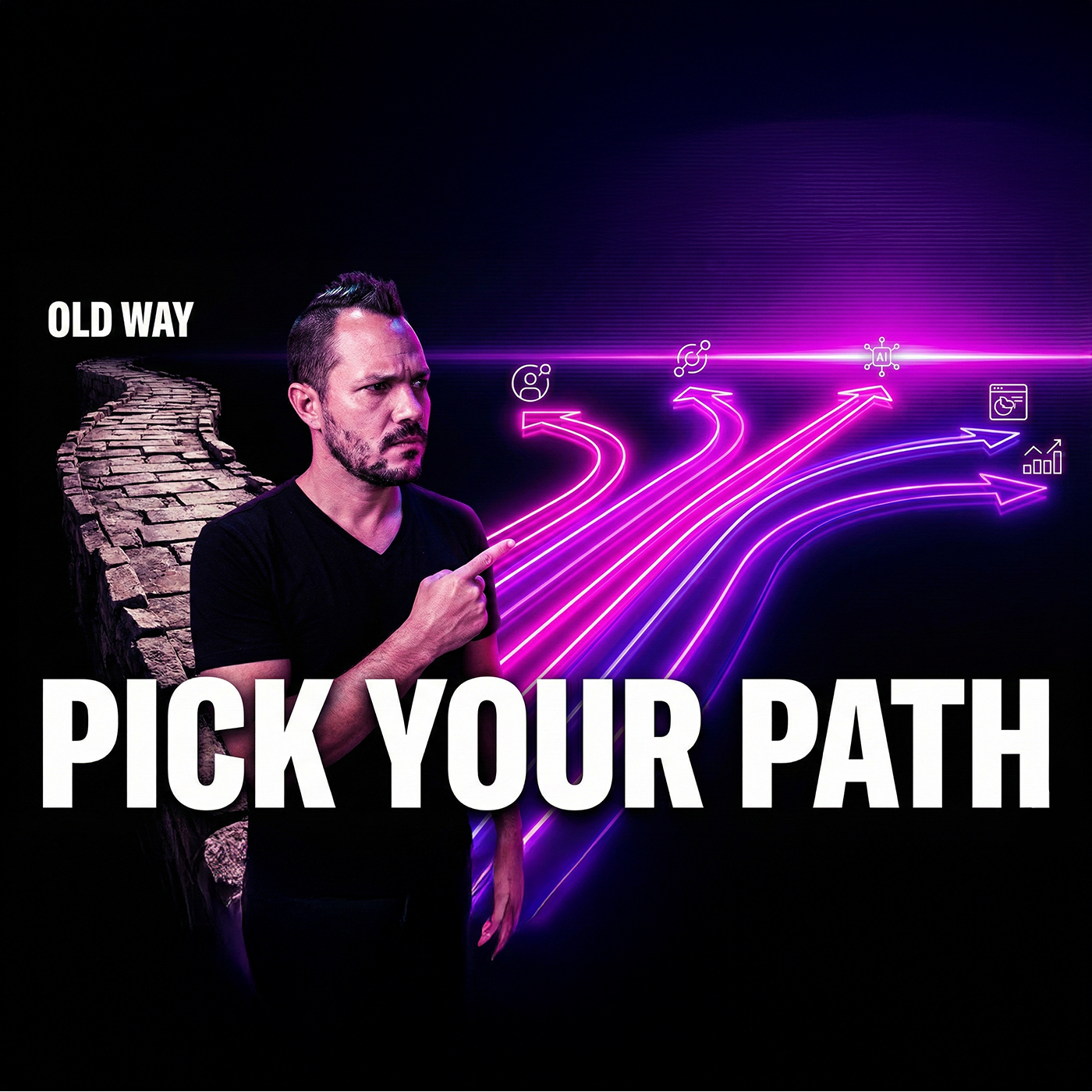
AI-Driven Marketer: Master Practical AI Marketing Skills
Future-Proof Your Job: 6 New Marketing Career Paths
00:56:16
Loading summary
Transcript135 lines
- [00:00]
A
Foreign.
- [00:05]
Welcome back to the AI Driven Marketer. I'm Dan Sanchez, and I'm joined by my brother, Travis Sanchez.
- [00:11]
B
Good morning.
- [00:12]
A
Normally we cover the news and what's going on in AI, but we're all kind of expecting ChatGPT to drop some big updates next week. So I'm like, I'm gonna hold back. There's been updates, there's been things going on, but today I want to bring you a special episode. In fact, I haven't really prepped Travis on much of this. We're just gonna let him react to this whole thing because I think. I think enough time has passed. It's been three years since ChatGPT's dropped that I want to drop a forecast. Okay. For marketers out there. And I've posted this on LinkedIn. I've let my friends grill this. So it's not. It's not completely unsubstantiated. I'm looking at the tea leaves here and trying to figure out what the heck is going to happen over the next couple of years when it comes to marketing roles and marketing jobs. And honestly, like, my prediction is not looking good. So I want to give you guys a fair warning. I want to give you my possibilities. I've been thinking hard. I'm like, okay, what if this is the truth or this is the prediction? What can we start doing about it? What will then take place out there so that we can all have, like, a fair warning? And if you're like, dan, show me the data. I'm like, look, it's a prediction. If I had perfect data, then it wouldn't be a prediction. It would just be reality. You got to remember, like, the research reports, the big stuff, that only measures what's happened, which is why academia is always so far behind when it comes to this stuff. So I'm going to be here on a podcast doing what podcasters do. Come on. That's why you listen to podcasts. That's why you're not listening to some, like, academic journal out there somewhere with peer reviewed, perfect, researched stuff, is because you want somebody who's reading all the stuff, has a deep expertise of the craft of marketing, and is looking around, talking to people, talking to peers, also doing the same thing and coming up with their best, like, educated guess on what the future is going to be. So that's what this episode is. If you want this episode, here it is. If you don't like this episode, then, you know, you can go to the next one and we can dive into the things that are Practically working now. But I think this is something that I want to hear about. I want to hear people not only talk about, you know, the wave that's going to come in. Certainly I'm not the only one talking about that. But in this episode we're going to dive into some practical solutions for that wave, or at least the best that I can figure out now. So let's dive into it. When I look at the future of AI and marketing, I don't see marketing jobs becoming more. I do see them becoming less. Obviously that has implications because like, if what, what if that happens to all white collar work? You're like, dude, nobody knows. I don't have a solution for that one. Okay, Nobody does. And the solutions that I have seen out on the table of Universal Basic Income, like, it's, it's just laughably bad math. So what are we going to do? I do see that AI is coming from marketing jobs. How many of them? I don't know. I do think it could be as high as like 20 or 30%. And I think that would be on the conservative side. But here's my reasoning for it. Here's the evidence that I'm seeing already. It's already happening. It's already happening and it's happening in things analogous. It's happening to your friends. If you just ask around, you could see it happening. It happened to writers first. All our copywriter friends. Like if you have a lot of copywriter friends, then you know because. Because they're already feeling it, because it's already happened to them. It started happening almost as soon as ChatGPT came out. I know two companies personally where I personally know the founders who used to hire and employ copywriters before that have all of zero now. Zero. One had a single copywriter and one had five copywriters. They both let go of the copywriters for other reasons and then they just never replaced them. They never did. They didn't need to. AI was good enough to take it and you'd be like, well, AI can't write as good as humans. It doesn't matter because it's based on the opinion of the person doing the hiring. And if they say chatgpt is good enough or Claude or whatever they're using, then it's good enough. And truth be told, both of these founders are actually pretty good writers themselves. So they get to make good calls and they, they think sending their stuff into Chat GPT to ex expedite, they just become the writers or they hand it off to another person. In the company to do the writing. But AI is doing the writing now. They don't have to outsource it to a writer. And I've talked to many copywriters and they say it's happening the same thing to them. Have you heard about any writers, Trav, that's happening to you?
- [04:53]
B
I haven't heard about any writers that have been let go. I mean, I know how prevalent copywriting and articles are and how much I've used it, but no, I, I, I haven't personally, but I don't doubt that they have been let go.
- [05:08]
A
It's painful in freelance writing too, unless you have a platform or unless I've seen some people, some writers get really smart and shift to AI writing. But essentially, they're just essentially saying, like, I could write more better for you. Let me manage your AI teams as a writer and I will curate them and make sure they don't sound like AI. This is how a lot of writers are doing it in freelance. And of course some writers are thinking good enough and have, they're, they're senior enough, they have enough relationships that people are still reaching out. Like, so I'm not saying writers went away. I'm just saying easily 20, 30% of that industry got hit of copywriters in general. Like, it's just kind of like it became hard to be a freelance copywriter or a full time copywriter looking for jobs. Like how many job posts have you seen for a full time writer? They're out there sometimes. Everybody went up in arms when ChatGPT or OpenAI was hiring a content writer, director or something like that, and they were pairing them like a half million dollars or something crazy like that. Maybe it was a quarter million. And they're like, see, see? And I'm like, that doesn't mean it's not happening across a lot of small businesses or mid sized businesses that employ writers. So, and we all know they've tried to get away with it, but you know, some of their presentations have had really silly mistakes in them. So hence they're hiring a content marketer.
- [06:29]
So it's happening with them. But that's not the only one. It's beginning to happen to developers. They're on the beginning stages. They've been feeling it for maybe eight months now. They're on the beginning stages of feeling the same burn that have happened to writers. And it always starts with the junior level people and then kind of works its way up. The senior level people are pretty safe though, for the most part. And the two companies I'm thinking about for writers. They all, they're all gone.
- [06:56]
But that's also kind of because the CEOs of both those companies are actually pretty good writers. But it's happening to developers because AI can write code and the only place you need to write code is in one application. Right? Most devs just have their code app and they just commit from there. Shoot. They even push it through their stage processes from that place. Usually it's like, yep, push it to GitHub. Okay. Push it to staging. Okay, run it back. Like it's like a whole control panel. They like staying at their keyboard so they don't have to click around, you know, so it's happening to devs. AI is beginning to eat all the bottom jobs of that role because all the bottom development jobs are just AI now. And senior developers find they can go a lot farther, faster. And of course a lot of people are trying to do it all with AI and that's, that's a mistake. And it writes a lot of bad code if you let it go unsupervised for too long. But it's happening. So what's protecting marketers? Gosh, there's a lot of junior level marketers out there and they're more like, let's be honest, most marketers are marketing managers, marketing coordinators, but they're really like glorified project managers who copy and paste marketing materials and have a little bit of a marketing vocabulary. What protects them? Want to take a guess?
- [08:23]
B
I mean, I was thinking of somebody at my current job who hustles, gets work done, has great focus, really is a team player, easy to work with, but doesn't have. She uses AI but doesn't. She's not like really read up on it. So she's constantly asking me to do things for her using AI, but I'm like, what? What would make her desirable? It's the execution. Like she gets stuff done. She moves the needle from X to Y all the time, constantly. She is that administrator who just will take on any task and make sure it happens with excellence. So AI hasn't reached that place of agency yet where you can give multi layer tasks as simple as can you just go work with that person on this project? And there's like, I already know. You'll know the details of questions that will need to be asked. I don't even need to explain it to you because we work so closely. So I'm like, there is a level of agency and.
- [09:28]
I guess individual responsibility. That AI is still not crossing that Threshold. So I'm like, yeah, in terms of marketing, there's just multi layer steps to almost every single thing. And we're not seeing that agency from, from AI happening quite yet.
- [09:45]
A
Right.
- [09:45]
B
But I'm like, even execs.
- [09:48]
A
But what is that agency like? What is that? What do you mean?
- [09:53]
B
Well.
- [09:55]
It'S looking at the data, analyzing where someone is in their marketing plan, in their marketing journey, taking that data and going, okay, here's our plan for the next three months. Here is the 10% of that plan that we need to focus on heavily to make sure. Because I think this is the lowest hanging fruit. Execute that plan, transfer, track the data and see if it's working. But I'm like, AI is not multifaceted enough from that, from you know, being an agent to look across from the data to making the plan, to executing the plan and then recalibrating the data Again, like that's not happening yet.
- [10:30]
A
So most marketers can't do that.
- [10:34]
B
Yeah, but you, but, but also execs. Execs. We. Okay, if you've read the book by Patrick Lencioni, I forget which one it was where he's like, executives should be executives because they execute the most. This was the definition. Right. But we know that there's a lot of executives that don't want to execute the most and they just want to use their authority to hire people that do execute the most.
- [10:59]
A
Right.
- [11:01]
B
So they don't want to hide, they're not going to fire people that are getting the freaking job done because they think AI is going to take those, mark those lead.
- [11:08]
A
They can, they will if they think AI can execute at the same level of quality as the, as the person they've hired. So I think there's two things going on. One, most marketers can't actually assess a company, look at all the data, even know where to look, what questions to ask, to pull out the right things and then begin to go execute the plan. Right, that's, that's one, that's one marketer that I think is actually pretty safe at the moment.
- [11:31]
B
Oh really?
- [11:31]
A
But that's, that's your senior level marketers, your junior level marketers. What keeps them safe, they're the ones usually doing a bunch of the busy work at the bottom. And I think the one thing that keeps them safe.
- [11:42]
B
Can you, okay, can you give us a 30 second pitch on what a junior level marketer is to see if anyone who's listening falls into that category in terms of responsibility is this. People that are just thinking about social Posts may the content in an email have a link to a, an article that then has a link CTA to a donation page or to a product page? Like what, what is a junior level marketer thinking?
- [12:07]
A
Gosh, I see it all the time. I see it all the time. But every marketer thinks they're strategic until you actually like go through the wrong like the ringer a few times and you read all the books and you're like, oh, there's been a better way to deal with this all the time. Everybody thinks they can come up with a content plan. Every college student thinks they can come up with a content plan because it's easy to come up with. Oh, okay, yeah. If I was going to start a social media channel for this company, let's go find out what they like. It's not a bad thing to just start answering frequently asked questions or come up with fun things, especially if you're kind of from that industry. Ish. Right. If they're college students writing for college students, you're like, oh yeah, let's put this in there, let's put this in there. That part's the easy part. It's how do you come up with why they would want to do it, what differentiates it? You start going a few levels deep and it's really hard. Like how do I convince someone to buy this thing that's essentially a commodity that my company sells and differentiate it from the competitor who does the same thing without lowering the price?
- [13:08]
B
Almost like story brand level. What's.
- [13:11]
A
Who's the enemy story brand starting to get to it. But it's so much more than that. It's positioning, the offering, the packaging, it's all the strategic reasons why you would buy from somebody. It's the positioning. It's going to interviewing your customers and asking them very strategic questions so you can get an insight and as to why they're really buying it. Not why they say they're buying it, but why they're really buying it or what tweak they might be able to make if they could really want to buy it. And they're just kind of buying it before because it was convenient. Maybe convenience is the thing. So there's a bunch of different things a strategic level senior marketer does that. A junior junior marketer has no idea. A junior marketer understands the vocabulary of marketing but they don't really know how to think through, through it quite. And I would say AI is actually even better at them than think at thinking through it strategically.
- [13:58]
B
And they wouldn't Even understand as AI's repeating it back to them what they're reading. Like, yeah, they, they wouldn't, they wouldn't, they wouldn't have comprehension on, on the higher level thinking because they just haven't walked long enough.
- [14:11]
A
Like I met with someone, a marketer that was like better, that was much better than me a couple of years ago and I thought I knew a lot. And I'd already even read the, this book on how to develop a Persona, which is a strategic marketing function. I'm like, oh yeah, I've done Personas. And she's like, well, have cool then. Can you run the process for us? I'm like, yeah, do you want to have a brainstorming meeting? She's like, brainstorming meeting? No, you don't want a freaking brainstorming meeting. You go and interview a bunch of customers. That's what I was doing. Now you need to do it. I'm like, oh, okay. Well, what questions are you asking? She's like, it's in the book. Didn't you read the book? I'm like, yeah. She starts schooling me and walking me through the process. I'm like, oh, that's how you develop a Persona. You ask them questions and you take all their answers and you start freaking color coding them to the right types of things that you're looking for. And then eventually you quantify it all on the back and you take all that qualitative data you quantify and the data starts to tell you what the Personas are. And then maybe you come up with a creative name for it afterwards. But it's not a brainstorming meeting on what you think the Personas are. There's a quantity, quality, there's a, like a highly valuable way you can approach it. And then you have to go and do it and then run through how hard it can be to like stick, like get everybody on the phone, ask them the questions. It's all that experiential stuff that makes the difference. Because even if I had remembered the book, there's a big difference between reading the book and remembering it and actually have done the process a few times and landed at something and seen that it works for yourself. She was at a different level of strategy on that particular thing. And that's junior level marketers. They don't know. They haven't done any of that on across multiple fronts, value propositions, positioning, how to write a strategic landing page with great copywriting frameworks in order to capture attention and walk them through the buying stages of writing pages. They can't, they can't do all those things. There's so many different like levels of depth when it comes to marketing strategy. So what do they do? Well, you know, they handle the newsletter and they put out social posts, but it's usually trickling down from somewhere else. And whether it's strategic or not, they're the ones who just kind of coordinate it.
- [16:21]
B
Do you see people that are like social media managers are like entry level.
- [16:27]
A
Marketers most of the time? There's a big. Most social media managers are entry level managers for sure.
- [16:35]
B
You mean marketers.
- [16:36]
A
Now the big diff, huh?
- [16:39]
B
Social media managers are entry level marketers almost always. Okay, you said social media managers are almost always managers, so I just wanted.
- [16:47]
A
To say yeah, they're almost, almost always entry level marketers. The big difference in my opinion, it's funny, as I started my career, my first, one of my first marketing jobs was a social media manager. So I thought I got social media. No, I didn't understand social media for much, much longer. Yeah, social media is actually really hard. There's a whole different. I don't even put them in the same category. I don't even put it as a career next step because it's so far removed. But there's social media manager and then there's being a creator. And they're so far removed that I don't, I don't even put them as a progression. You don't go from social media manager to creator. The only difference between the two is that one knows how to grow an audience. But the amount of things you need to learn in order to go from knowing how to how to put something that looks professional and makes sense on social media to learning how to grow an audience is substantially different.
- [17:43]
B
Yeah, totally. But, but, but just that's the entry level is to becoming a marketer is just understanding the technology and posting something. And that's where I'm saying AI is not quite even. Like I can't get AI. I mean you can get it to post for you, but you still have to come up with the content. You can't just go, hey, chat, run a content plan for me for the next month. Think about the visuals, the physical posts, the videos that need to be created that the copy from based off my website and then go ahead and create that calendar, go ahead and create the media, go ahead and post it for me, comment and like everything that is happening or coming through so that there's conversation and community being built and then send the link to the people that are really interested in the product. That's not ha. That's not happening. And I don't think it's going to be happening for a while to a level that executives are going to go, yeah, that's the kind of stuff that we, that's. This is the quality that we can let go of the social media manager, we can let go of the marketer.
- [18:42]
A
So there's one thing that's missing. And once AI can do this, social media managers are going to have a.
- [18:49]
B
Hard time year of AI.
- [18:52]
A
It's not the zapier of AI necessarily, because you don't need zapier where it's.
- [18:57]
B
Going or zapier, whatever you say.
- [18:59]
A
The thing that's protecting entry level marketers right now is it's what I call cross tab work.
- [19:06]
B
Cross tab work, right.
- [19:08]
Is there a different term for that? Because that's what I've been trying to talk about in terms of agency, of just.
- [19:13]
A
Yeah, I was asking questions to see if you'd connect the dots. I was throwing out. I was throwing out questions. But cross tab work, the ability to take information from one application and move it and do something with it, manipulate it and put it into another, it's copying, pasting, clicking and thinking. Right? That's it. That's most of our jobs. That's pretty much all knowledge work is. That thing is copying, pasting, clicking and typing into your keyboard.
- [19:43]
B
We were saying the same thing, just different terms.
- [19:45]
A
Yeah, AI can do it and it can do it a lot better than it could a year ago. It came out a year ago, in fact, Anthropic launched this like beta, super beta, rough thing where it could go in and open up a virtual browser and go and book hotels for you and stuff. It was rough, it was beta and you had to download this weird application to get it running. And then OpenAI launched their own called Operator in February of this year and it was only available to pro users and none of us had access to it. Right. I remember I didn't even many was, it was still beta. It wasn't even good. So even when I had Pro for a month, I didn't even use it. The Deep Research was so much more fascinating because that was workable, that could do stuff. But then this summer everybody got access to it and they made it like a combination of Deep Research and the Operator. So now it can think and research and then kind of look, it can move around a screen. And then they launched their own browser. ChatGPT did. In fact, Perplexity now has this feature too. In fact, I think Perplexity had it first in their browser. Comment. An AI browser. And you could be like, hey, do the work. And then it takes over your browser for you and starts thinking. And it has access to all your past chats. It has access to whatever you had in the chat right now. So it has, like, information, but it can work across tabs, open up new tabs, and go and execute things for you. That's the current state. It's gotten a lot better in one year. Is it the level that it's dependable and fast? No, it's still slow, it's still clunky, and it still makes mistakes. There's also some huge security vulnerabilities with it and prompt injection stuff. But I imagine at the rate of change we're seeing, sometime in 2026, it's going to start becoming decent.
- [21:28]
B
It's like, I know you like, I know you like Dave Ramsey. So I emptied your Roth IRA account and made sure to put that cash back in your, you know, bank account so you could pay your debt to your mortgage. And I put all of that money.
- [21:42]
A
Exactly. So that level of work for AI, that's the thing keeping marketers safe right now. Because you still can't. As smart as Chat, GPT and Gemini are, like, it can't execute past you putting information. Like, you even have to literally still put it in a document unless you automated a process where it automatically puts it in a doc for you. But that has to be something that you do regularly. So that's. That's happening. People are automating more. It's getting easier to automate processes, but you can really only automate 20% of business processes. And it's like, man, if you ever get to that level, you'll fricking be flying. Because that's a lot.
- [22:20]
B
But how many people are doing that who use AI? 0.01%.
- [22:24]
A
Exactly. Because it's no good. It's not good right now. But once it's good and they make it easier and it's fast and reliable, then it will go up because it's so good at eliminating extra work. Okay, so imagine you don't have to delegate to a junior level employee. Hey, this is the steps for the newsletter. You could just be like, oh, there's no automated process for this. Hey, ChatGPT. Every time I click this button, just run through the process of taking this. Send it to Gemini, you know, put it out, look, double check to make sure the links are correct. And then put it in, double check, send it to Yourself, double check and then send it to me and then I'll give you the final word. And that's the process. Most junior level employees run through some kind of process like that, whether it's social media or project management or some kind of thing, this is what keeps them safe. This is going to start going away next year. This is my forecast. The thing that's happening to writers already happened is still happening. The thing that's happened to developers happening. Now go talk to any of them in the job market or even think about market.
- [23:22]
B
This is going to happen in 2026.
- [23:25]
A
I'm thinking this is going to start happening in 2026 because this is my prediction of where that technology going and how businesses work. Businesses are always looking for the most efficient path and humans are not efficient.
- [23:38]
B
By the end of 2026, cross tab work will become soap work. Prolific.
- [23:44]
A
No, I think it will start becoming good enough right now. AI is a fantastic writing, writing tool, but it didn't start that way at first. It was kind of rough and it could only do short things. Yeah.
- [23:55]
B
And it was making mistakes and hallucinating. Yeah.
- [23:57]
A
Yeah. And it was only reliable enough to kind of give you a Facebook ad copy in the very beginning. That's kind of like the only thing it was good at was coming up with headlines for Facebook ads and like, give it to me preachy. Give it to me funly. You know, it wasn't even that funny, but like it could give it to you in different tones. That was the first wave, but a lot of copywriters were doing that. So it's like boom. So it happens in stages, it happens in degrees. But I think we start filling it next year. Now I will say I've made predictions on the show and we still need to do a what did we predict last year and the year before and what's actually happened? Some of my predictions are a year late because there's things I predicted two years ago that have totally happened this year and didn't happen the year I predicted it would come in. So I could be off. But I'm pretty sure this is an inevitable thing. Again, we're talking prediction land here. We're like looking at where everything's at the signs of where it's happened before and trying to think of when it's going to happen to marketing. And that's what I see.
- [24:52]
B
Here's what goes through my brain and maybe this goes through some of the people that are listening when that cross tab work happens. I'm always thinking, man, how easy Is this thing to use? Do I have to have some level of development? Even if it's not code to create connections? I mean, it's like using Zapier. You have to, oh man. Everyone's like, man, yeah, it integrates. Sure, you can say it integrates, but can you actually get that to integrate? So I'm thinking of, when there is that cross tab work, how user friendly is it? How can the common executive, who has been in the role for 20 years, he's not being fired. Like, is he going to be able to learn this quickly without having that? And I'm guessing by the end of 2026, it's not going to be friendly, it's not going to be something that you know you can learn.
- [25:46]
A
It actually is user friendly already. That's not the hard part. The hard part is coming up with these systems in order to make sure that you clearly delegate. There's that. So there's kind of like a capturing system where it's like you have to actually know what it's capable of in order to clearly delegate and make sure that you delegate what you want done. And then systems for verifying that the work was done. Sure. Because it will go off and just start doing it. I mean, this is a true agent. This is something that can take a objective and then think through the process that it needs to take. You don't even have to dictate the process. It's probably going to be in the beginning. It's going to be way more reliable. If you have a, hey, go and check the sop, the standard operating procedure before you do this. Right. Every time you run this play, run this sop. Here's the step by step test. Those are going to be way better at first. But you already have to do that for junior level employees.
- [26:43]
B
Sure. But then if you don't do that.
- [26:44]
A
Then they're probably A plus junior. They're probably like junior level employees that were already like on the fast track to be managers if they don't need SOPs of some kind.
- [26:53]
B
Let me ask you this. By the end of 2026, do you think AI will be good enough if, let's say a CEO is like, hey, I want to post to Instagram, I want to have a carousel of this thought I had in the shower. Here it is. He gives it, you know, a paragraph worth of sentences. Break this up into a carousel with different quotes on it. You've already, you know, let's just pretend chatgpt or whoever he uses already knows his design desires. Like he's already approved so many. He goes, I trust you. You know what I like. You know what I don't like? Go ahead and post it. Write a caption for it.
- [27:29]
A
You understand our company policies, you understand our culture, you understand how we evaluate. And I in a decision like you, it's gone through all the onboarding an employee would go through.
- [27:39]
B
Yeah. Our brand guide. You know what colors we use. Like I just.
- [27:42]
A
You need it knows stuff.
- [27:44]
B
You think that it'll be one, one voice text away from getting all that done.
- [27:49]
A
Yeah.
- [27:49]
B
At the end of 2026.
- [27:52]
A
It will begin to feel more like that. At 2026. This is obviously this is good. This is a multi year black or.
- [27:58]
B
White answer, yes or no.
- [28:04]
A
I think its completion rate will not be 100% by the end of 2026. Okay. But I think its ability to do it reliably enough for the ba. More basic tasks more versus because you can, you can be like, hey, make me a whole marketing strategy to correct the down slump that we're in. Well, that's, that's a lot of ambiguity in that. It's got to go figure out a lot. That's a lot for it to figure out.
- [28:28]
B
What checks and balances does it need to come back and actually prove the marketing strategy strategic plan for you to like before it starts moving? You know, but let's.
- [28:38]
A
I mean if it's smaller stuff because junior level employees weren't doing that. But what do you currently have junior levels employees, Employees doing what I just said, that work? Yes. It'll be reliable enough not for the CEO but for the marketing director to begin taking over those tasks. Yes. By end of 2026, that's what I'm predicting. It's things like your newsletter which you can't automate. Well, it's going to take a level of autonomy to be able to do it. I know because I've, I've. It's one of the things that I've been like stumped by that I can't automate. Well, is the newsletter. If you want a good newsletter, you can't automate it. You can automate lots of things. It's possible. You can RSS to email, you can automatically send a news blast. But there's, it's just complicated enough and there's enough copy, paste and like multimedia and multiple things in it and things you have to think through. Even when I've taken this very episode and, and drafted a full AI process to turn into the content, there's still like this middle gap of coming up with the content and getting it into the thing and sending go on high level. But I have a person helping me with it right now and she would be a junior level marketer.
- [29:45]
AI will be able to do it. My prediction, by the end of next year.
- [29:48]
B
It's like you almost need chat or you need AI to be able to resonate with content, with written, with spoken. Because what makes a great marketer is hearing something going, man, that was spicy saucy.
- [30:04]
A
But we're not talking about great marketers. We're talking about the ones that aren't very good, which is like, it's at least like 20%.
- [30:11]
B
Yeah. But even not great, marketers can see a post and go, dang, that's engaging.
- [30:15]
A
Yes. But they don't know how to make it.
- [30:17]
B
No, they don't know how to make it. But I'm not even talking about making. We're talking about clipping and posting. Because, you know, right now you, you have AI clip some of these, you know, video posts and it does okay. But even a junior level marketer would be able to clip a better clip based off content they're hearing. Because a lot of people work in that discernment skill because they can't create it, but they can see what is good.
- [30:41]
A
Yeah, the technology for it to actually pick banger clips is already there. But the software engineers who implement this AI in their systems haven't caught up to it yet. Just give Opus Clip like let's say AI, we, we publish, not another AI API for these developers to go and use their AI tools like Opus Clip does. Like they have to outsource their AI to whoever they get it from, whether It's Gemini or ChatGPT or something. Let's say all the frontier models stop where we're at. A year from now, Opus Clip will catch up to the point where their clips will be bangers. Or at least the best possible thing like that a human editor would have been able to take. Right now. Opus Clip will be able to deliver whatever a human editor would have been able to splice out of what you said. And the footage you got, it'll be able to do that. That a really good human editor would have been able to pick up and pull. I believe that we just, they just haven't fully tapped into the better stuff we have right now. It'll be able to edit too. Not just like take it, but find like, oh, if I put this and then take what they said over here and put that on the front and then clip this and put it on the back. That's the banger. Yeah, it could. I'm pretty confident that AI would be able to do that already. We just haven't implemented it into the tool yet. So I think that's already a thing. And it's just this cross browser work is too compute intensive and it takes too long. Sure. Which is why they're building out all these data centers right now. The one thing that will slow this down is if the AI bubble pops soon and like all these data centers become hammered because there's so much demand for AI that they have to throttle back work like this. It'll slow it down, but it's still coming.
- [32:21]
B
I'm, I'm, I'm also thinking about just creators when it comes to video or design. And AI is getting there, but I think 2026 will have. Because I don't know if you've seen the, the clip of Will Smith. When the first AI video of Will Smith eating spaghetti came out, clearly it was Will Smith, but it looked like a Picasso of Will Smith moving around the page.
- [32:41]
A
Yeah, yeah, yeah.
- [32:42]
B
And now they have Will Smith eating spaghetti and you're like, okay, the only thing missing is tightening up the sound. The sound is like 50%, 60%, maybe 70%. The visual is like 85 to 90%, but still not quite there. And I'm thinking in 2026, will AI be able to.
- [33:04]
Replace the producer? Because every AI video is missing one thing. It's missing a producer. I have a friend who's a video editor. He does. He's not, he's not just a good editor because he knows how to edit. He's also a producer. We call him a predator because he can edit and produce. But Predator has a bad connotation. So we're not going to.
- [33:29]
Predator in terms of like, you know, Alien versus Predator kind of thing.
- [33:33]
A
Yeah.
- [33:33]
B
But he does such great work because it goes into sound engineering and clipping right at the right time. He's producing a whole three minute clip. So it's like, oh, will AI become a creative genius and become a good producer?
- [33:45]
A
You know, eventually, but it gets a little bit better every couple of months.
- [33:48]
B
Totally.
- [33:49]
A
It takes.
- [33:50]
B
Is it going to happen in 2026? We know it's going to happen.
- [33:53]
A
I mean, it's already. It will. In 2026, it'll begin affecting video editors jobs.
- [33:59]
B
I think so too, because I'm a.
- [34:02]
A
Marketer who like unwillingly started getting into video. I mean, I was excited to. Actually, I wasn't unwilling. I was excited to learn video. But I Had to learn video because that became the game of marketing. Video became a big part of marketing, so I had to learn it. But like, if I can have, if I, as a marketing director can outsource more my video to AI and not a person, then I just will. I'll just do it myself. I'm also the kind of marketer that likes to get my hands dirty and I learn everything somewhat. But let me talk a little bit about, like, how I think this thing will play out, because a lot of people hear about the news headlines and I think that confuses a lot of how this will actually go because they hear the news will say, oh, Microsoft laid off 2,000 employees, claims AI, blah, blah, blah. And you're like, okay, so like, are we just gonna all lose our jobs to AI? No. Yes and no. Yes, it's going to be because of AI. No, it's not going to be like these mass layoffs and all of a sudden you're like, hey, AI took your job. See ya. This is what happens. Imagine you have a team of 10 marketers. Okay, okay. And we got a mix of them. Some are channel specialists, some are generalists, and we have a director, different levels in there, but we have 10. Okay. And the leader says, like, you need to learn AI. It's now required. You have to incorporate AI. Of course we have 10. So like the Pareto principle says some are going to do it. You know, two of them are going to crush it and they've like 5x the amount of work they can do. A few at the very other end resist. And they're creative and they're romantic about it and they're like, heck no. Techno. I'm, I'm boycotting this and I'm talking to HR and I'm not gonna do this. Whatever they do, you know. And then some people in the middle kind of like, yeah, they learned a thing or two. They're using it to help check their writing and stuff. And some do more, some do less. But the increased output, especially by the, the two that crush it, they're doing 5x the amount of work that they used to. Well, now you have extra capacity. And what do businesses do when they have extra capacity? Well, if they're good businesses, then they just find more stuff for them to do. And luckily, marketing is kind of a black hole. There's always more to do. But then so and so leaves because, you know, they were offended by the AI thing. So they leave, left, and found a new job. Do we replace so and so? No, we don't replace so and so. We have extra capacity. Why would we replace so and so? Right. Then we let other person go because they, they were a bad fit culturally and causing problems. Do we replace that person? No, we don't replace that person. Shoot. The company even grows during this time. We have less people than we did before and we grew, but we had extra capacity. Right now the bad. And that's, that's the good company. That's a good company. And maybe one job becomes completely irrelevant. So they reskilled that person. Put them on a different part of the company or a different part of marketing. You know, those are the people. Those are the companies that care about their people, not letting them go because of AI. Most companies aren't that. And I keep hearing reports because again, I talk enough about AI that people send me these reports. They're like, I just found out about a company in my town that let everybody go or let a bunch of people go. And then, you know, posted record profits for the year because it's December. Right. And a lot of it's because of the efficiencies of AI. Not all of it, but a lot of it. That's most. A lot of companies think that way and they're just like, oh, you're. Humans are just a bottom line endeavor. And they've been lying through their teeth about this whole family thing.
- [37:21]
B
Pizza party.
- [37:25]
A
That's why I'm like, company loyalty. I'm like, yes and no. Because the company's going to be loyal to itself. You need to be loyal to you and your family.
- [37:32]
B
You know what? People aren't loyal to companies. They're loyal to people. And if the people that the person is managing them is a good cover, protects them, coaches them, helps them grow. Dream managers. It's not just a company. It has to be exactly that person. You know what I mean?
- [37:48]
A
Yep. So that's how I see this panning out. It's going to happen. Slowly, it's going to happen. It won't, of course the big companies will make headlines. The bunch of small companies will let people go and they won't make any headlines. But we'll just start to feel it. It'll be really hard to get a job all of a sudden. A lot of you, a lot of your friends, if not you will be unemployed. And that's where we're going. And maybe it begins to happen in 2026. I'm not saying it's going to happen in 26. I'm saying we begin our journey as marketers this in 2026. That's what I'm saying. So there's a lot of people out there and we've. We're 40 minutes in and there's a lot of people out there saying these kinds of things. I'm not the only one saying them. A lot of people are saying this, this is like old news. But here's. Because this is a show just for marketers. Here's where I imagine you can go as a marketer, your six different paths, options. Because I don't know how much marketing as a field is going to shrink. It's like I've seen estimates and anywhere between like a half million to over 1.2 million marketers have careers in marketing. It's also kind of fuzzy because a lot of marketers overlap with other weird things. And it's like how do you define that? Right. So but that's a lot of jobs. To say we lose 20% of them is. There's a lot of jobs lost. That's. This is gonna be rough. So what do we do? Here's where I imagine these are the future roles of marketing that I see. And again I've had a bunch of people pick these apart already. It's probably not finished. I would probably add one, remove another, combine them. I don't know. But I'm gonna share em to you and then we'll see what you think. But here's where I think the future is going. This is where you can aim your career. I think here's. Let's get the obvious one out of the way. There's going to be a technical marketer, someone getting out. Someone has to run all those AI systems on a deeper level. You know, you know, has to create the checks and balances to make sure AI doesn't run away with the company bank. Right. And you're going to work really heavily with it. But you're still going to be on the marketing function that understands a lot of marketing. This is like what we call marketing ops right now or marketing automation. Like that's this, this team's going to do well. Marketing ops. You're. If as long as you become AI driven, if you're in marketing ops, you will be fine because you become a more critical part of this organization because everything's becoming so technology driven.
- [40:07]
So pretty obvious.
- [40:09]
B
Yeah. Obvious. Yeah.
- [40:10]
A
That's going to be a role. There's going to be the technical marketer. The next one is that and I'm putting it in order of like safety. Like safety right here. The next one is what I'm calling the strategic leader. This is not. This is a generalist, but with depth across multiple fields. And they're a leader. Like they're good at working with people and it's assumed that they're also good at working with AI because someone's got to have to be the glue between the people that are left and your AI team. Right. Because people need people. And it's not going to be an AI, it's going to be a human for a long time.
- [40:44]
B
Oh, you just described me.
- [40:49]
A
You are safe. This is a lot of senior leaders. This is where most of you will go. A lot of you will become technical or a lot of you will become strategic leaders. This is why senior leaders have a lot. This is also a really. This might be number one. I don't. I don't know. It's somewhere between the technical marketer and the strategic leader for the number one most safe. Because there's always going to need. In good sized companies, there's always going to at least be one human running all the marketing and the strategic leaders. Maybe not the most technical out there, but the AI will get intuitive enough that you can do a lot. Right. So, but you need one. One. One adult human in the group kind of running the show that really understands marketing to a deep level and is working with AI and the other humans in order to deliver the thing and drive the ship. That's still going to be a thing. So most of you will land in that. I think a lot of people listening to this show also landed in this technical marketer route because I just think that's obviously one of the safest bets. The third one is where I think a lot of marketers are going to go. You're all going to launch off by yourself and go solopreneur, become a marketing coach and consultant, specialize in the thing, or you launch a totally different business endeavor. But you're already a pretty good marketer and AI is making it easier than ever to launch all the other facets of a business that you didn't know about before. Don't know a lot about legal. AI is a great legal consultant. Now, that's just my opinion. Don't sue me if chatgpt gives you bad legal advice.
- [42:14]
B
Legal advice, no. But it steers you in a path that you didn't even know where the path started. So you're like, oh, okay, now I know what to look for.
- [42:21]
A
That's a whole nother career field that's getting disrupted right now is law. That's Another one entry level people getting crushed right now by AI. Even though of course there's hiccups and people are citing things that never existed with AI and blah blah, blah, like, yeah, AI is going to still continue to be used by lawyers. That's not going away. But like you have all these advisors now and you. And then of course if it's agentic and it can do stuff for you, it's like you could practically run a, you can be a consultant and run what was, would have been a boutique agency at the time. You can, you can now so you can take all your really specific domain specific strategic marketing leadership and go and start stuff. I think a lot of marketers are going to take this route. It's kind of where I'm going, honestly, that's where I want to go. And entrepreneurial, sexy, like we all want the entrepreneurs. You want to own your own destiny. It's scary too. So like there's, there's hurdles with it but I think a lot of marketers will exit or they'll get laid off and be like, I'm just gonna go solo. I have, I have enough contacts, I can rustle up some stuff. Boom. The next one I'm really excited about. I'm like, frick, yes, I could do this full time. Part of me is like, I'm just gonna build my own company so I can do this just for myself. But it's what I'm calling the experience director. It was actually the last one I added to this list because I knew it needed to be there. It needed to. That's like where does the creative person go? It's going into this because imagine a day when AI can give you any content you want. If I want to learn about something, I don't have to go to someone's content marketing blog. Even if it's really good chat, GPT can just serve it up for me a la carte. So then when I'm starting my shopping experience, what am I going to do? Am I going to go to the website? The website's kind of probably going to be customized for me in a way that's different. Every website's going to look different. You're not even. It's a hyper personalization to the, to the, to the extreme. So you gotta have to have someone incredibly creative and incredibly strategic and not just to build content, but to put parameters around AI so that when someone walks into the store, someone walks to the digital thing, they're experiencing it just for them.
- [44:22]
B
Yeah, it's like, it's like a Disney.
- [44:24]
A
Imagineer meets like an A. It's like, it's like, it's put that level person in there and you're like engineering what an experience would look like with the music and the video. And is there a movie? And they're in it. You think of like VR in the future, but someone has to coordinate and direct the experience. They have to be the man behind the curtain pulling the things with A.I. you know, behind the scenes. I think that'll be a job. I think someone's gotta be the creative person behind the scene, working with AI to craft experiences.
- [44:53]
B
I mean, it already kind of is with set design. People use it. I mean, think about, think about anthropology. Entrance, Create, Creation. Creation. Do you know anthropology?
- [45:03]
A
Oh, yeah, the store. Yeah.
- [45:05]
B
Nobody did custom, like, artwork themed. Imagine. I mean, amazingness until Anthro showed up and it was like, whoa.
- [45:17]
A
Yeah, but hotels do it, right? Hotels spend 5 to $30,000 just creating a custom smell for their hotel chain. Wow. And the smell has to match. They come in, they match the decor, and they're like, what's the experience? What's the vibe we want to get off here? And how can the smell. Like that's the kind of level stuff. Now we're. Most of this is going to be. A lot of this is going to be digital, so we're not talking necessarily smells, but maybe, I don't know, like, who knows what the future has? There's stuff available now, and I didn't think it was going to be around in my lifetime, but.
- [45:46]
B
Oh, speaking of, I saw a billboard that was like, of an octopus arm and it was like literally splashing and then water was flowing over.
- [45:53]
A
Dude, that's the next level.
- [45:54]
B
It was a digital screen reacting to physical water splashing down onto the ground where it was getting caught in a pool. I was like, there you go. That's what you're talking about.
- [46:02]
A
Like, you've seen Minority Report, right?
- [46:05]
B
Yeah, of course.
- [46:06]
A
And for our younger audience, just go look it up. If you're Gen Z listening to this, you're like, wait, what? Yeah, go look it up. It's Tom Cruise, Minority Report. They have these like, interactive ads that like scan people and then they like, talk to them as they're walking by. Hey, John, wouldn't it be nice? You know, it's. It's actually just doing a first name insert. It could be way more. But imagine if you're a direct, like, if every ad is an experience, people can like easily like click away to and then get immersed in to an Experience.
- [46:32]
B
Have you seen the social media video? This guy walking on the street and this guy's leaning against the building and he goes, hey, bro, you want to buy some of this chocolate? And the guy's like, no, I don't want to buy chocolate. And he walks around him and these kids go, oh my gosh, you're so old. What an unk you totally fell for. And the guy's like, what are you talking about? He go, that was AI. And he turns around. It was like a hologram. Like he's like kind of going through a, you know, midlife crisis. Like, oh my gosh, I'm getting old. And then some other guy walks by him and walks through the kids who are also a hologram. And his brain is just like.
- [47:08]
Oh, dude, I should have sent it to you.
- [47:09]
A
It's amazing. Send it to me. I know, I know for a lot right now this kind of sounds like science fiction to some of you, but some of us are already starting to think that way. That's why I know it's going to be a thing because I'm even crafting like, okay, if someone takes this assessment, what is the email sequence going to look like? And I'm building the email sequence with AI. So I'm literally engineering a prompt per email, right? And I'm going to have to run through it a few times to make sure it's kind of within the parameters if I throw weird crap at it. But I don't know what the emails are going to say. I don't, because it's literally going to be customize based on a whole bunch of questions now, not just three, but like, like I've done before, but like a whole bunch of things. I'm going to let AI have some more autonomy with writing these emails that are coming after this assessment now. I'm giving it a prompt to be like, hey, this is what we need to hit in this email. Here's an exam, general example. You're going to customize it with this. But I'm starting to craft an experience. I'm not just crafting a normal email. I am engineering an experience at a small level because it's just email, but it's going to be bigger. It's going to be with video, it's going to be with music. Music off like suno hits now, man. It's like I don't have to generate like 24 tracks to find one track that hits. It's generally hitting first try now. And it might not be the exact feel I want, but it's not making mistakes hardly anymore. Which means I'm like, okay, it's gonna be. We're all gonna be listening to our custom soundtracks and be like, hey, chat GPT play music. And I don't even have to specify it. Already knows. Like, oh, he's. He's had a down day. Let's get something that's like hits that but then kind of brings him back up. Like, you don't just freaking know it. Just play music. Or it'll ask you, dan, would you like some music right now? Yeah. Like, I know it sounds like sci fi, but we're moving fast. This is going to be a reality. Okay, so we talk about the experience director. That's number four. Let's move on to number five. This is probably one of the most strategic ones of all of them, is probably going to be the most neglected one of all. But I swear this is going to be a thing because I can't do this. It's what I'm calling. It's. I don't know what to call this, but it's the relational marketer. It's the one who has strategic relationships. And I'm not talking about sales. Okay. I'm not talking about relationships with clients. So it might be some of those. This might overlap a little bit of sales. We're talking about relationships with vendors, gatekeepers, news outlets, influencers. All those people have you like. And I've met marketers who do this already, but they're few and far between. But, man, I'm like, I want them on my team because they're freaking good at relating with people and building rapport and getting people to like them and then getting introduced into the company and finding weird partnerships, synergies, cross promotions. They're like wheeling and dealing with all the major players. I'm like, dude, this is like one of the best marketing functions of all times. Hardly anybody does it. But I know it's a skill out there. And I know when AI starts to become more prominent, this human connection thing, I'm like, oh, but it'll never be able to do that the way a human can. This is just different. And I think that'll be a very strategic play that very few will actually discover. But 10 years from now, they'll be like, dude, there's going to be like five companies that crushed it, and it's going to be because they have a strategic relationships person.
- [50:25]
It's going to be a thing. I can already think, do you know anybody who plays that game?
- [50:29]
B
The people that play that game are CEOs. Typically right now, they are the top, top, top person. Everyone wants to be friends with the top. I don't care if it's a CEO, a pastor, the guy who has the money, the guy who has the authority, the guy who has the power. Everyone wants to have a relationship with that. It's like we're all drawn to have a king in our life, those people. So if that can transition out of the CEOs, you know, world, then yeah, it's hard to think that it can.
- [50:55]
A
But there's another role and there's. There's a few places where you find this role more often in an organization already. And again, they're all. They usually fall under one or two camps. They work on the sales side. Those people often because of their skill set, they're like, they're just like, build relationships or clients, I'll give you money. But they have the skill set. And it's honestly, it's really valuable, especially for enterprise level deals. But like, there's something to be said for taking that same skill set and just applying it to the marketing side too. Sure. So they're either on the sales side. The other place I find these people in an organization right now is in pr. Your public relations people. You have some strategic public relations people and they're really good at relationships. Wow. And they're using that to build relationships with influencers. Because influencers, like, get sent a ton of pitches all the time, but it's the ones who build relationships and maintain those relationships. You can just fire off a text to somebody, right? And it's like, when you hire them, you don't hire them. You hire them in all their relationships because they can step into a new company and be like, hey, influencer, have this new thing. You should check it out. And influencer, be like, done, send it. Why? Because of the relationship. And all of a sudden you're swimming in earned media, which is the best kind of media of all.
- [52:14]
So I think that'll become a strategic thing. So that's number five. I said there were six. The sixth one is sad, but it's inevitable. A lot of marketers will exit marketing. I promise. We're all kind of generally going to try to have to pick one of these five. Right. And right now you kind of like start dabbling in it and seeing it, how it applies to whichever vertical, like wherever you're at. Maybe you specialize in Facebook ads or whatever and paid media. Cool. Like, which one do you want to become? Like, I think we need to Grow up into one of these things and some of you are already in this. So it's like just learn AI cool. But some people are going to have to exit and move on to a totally different career. I've seen it happen before. I remember watching it in 2008 when marketers exited and became, went to the health field. You know, became phlebotomists or whatever. You know what a phlebotomist is?
- [53:09]
B
I think so.
- [53:10]
A
It's one of my favorite jobs because it pays so high, but it only needs like two weeks of training. It's the person who draws blood. Oh yeah, that's phlebotomy. It's like two week certificate and then of course you have to land the job. That's, that's hard too. But I think it pays like 45, 50 a year on two weeks of training. Pretty good.
- [53:35]
So that's, that's my prediction on where we're going, why going there. And then six paths that I see moving forward. I will be talking about this throughout the year and giving when I see the warning signs, hopefully just not with confirmation bias. But like obviously it'll be hard for me not to because now I'm looking for AI development and this as a signal. But we all should be, because we all should be figuring out how to leverage it for ourselves and become that. Remember I gave the story of the 10 and 10 employees and the two became better and they kept their jobs. That should be what we all want. We want to be the ones that keep our jobs. So we better learn AI.
- [54:13]
B
I want to paint maybe lastly a hopeful picture is that there are millions of businesses that are not Amazon, they are not meta, it is not Google laying off anybody. There are still millions of businesses that need a new website, that need to send emails, that need to have a social media presence. Millions. And just because the top technology companies are firing their marketers doesn't mean there isn't work out there. You just have to probably do a more difficult job of convincing the boomers who have these companies that aren't, you know, integrating technology that they still need to integrate a marketing strategy for their business. So sometimes these large companies get the headlines, but that doesn't mean that the opportunity, I mean even the organization I'm with now, they have, they're 10 years behind in their marketing strategy, if not more. And AI is not going to replace anybody at this point because they don't even know what they need. So I'm just, I still think there's opportunity for the next 10 years. Even if you are a junior marketer, you just might not be at Google.
- [55:31]
A
I'm just. No, I don't think it's just Google. I think it's a lot of companies, and I think we only begin to feel the pain, but it takes three, four years for it to see itself all the way through. But I think we start feeling that pain 2026. And again, that starting.
- [55:46]
B
No, I think 2027 headlines.
- [55:48]
A
Depends on how fast the tech can get developed. I agree. But that's where we're at, and I think that's the future. Do you think these six paths are solid, though?
- [55:58]
B
I mean, it's good. It's a solid list.
- [56:00]
A
All right. Hide your job.
- [56:02]
B
Hide your marketing.
- [56:04]
A
Hang on.
- [56:07]
B
Keep your head low.
- [56:10]
A
Here we go.