Podcast
AI Fire Daily
Hosted by AIFire.co · EN
AI Fire – Master AI with practical guides. Your daily hub for AI-powered productivity. Join 72,000+ professionals from Google, Meta, Microsoft, Tesla, and more.
AI Fire Podcast is your go-to resource for everything AI, from the latest trends to how AI can transform your career. Hosted by the AI Fire team and AI enthusiasts, we focus on providing you with practical tips to boost your productivity using AI tools and strategies.
Our mission is to help you keep up with AI trends, master new skills, and get more done in less time. Whether you're looking to make money with AI, dive into prompt engineering, or explore automation and AI workflows, we've got you covered.
- Sign up for our FREE daily newsletter: https://www.aifire.co/subscribe
- Get 3-level AI tutorials across industries in our Community: https://community.aifire.co/
- Join AI Fire Academy: 500+ advanced AI workflows ($14,500+ Value): https://www.aifire.co/upgrade
- Email us: services@aifire.co
In the AI Fire Podcast, we cover a wide range of topics such as:
- How to make money with AI
- AI Tools and AI Jobs
- Prompt Engineering
- AI Automations and AI Workflows
- AI Research and AI Reports
- AI Case Studies
- AI Startups and AI Books
- AI Grants and Deals
Our Socials:
- Facebook Group: Join 212K+ AI builders – https://www.facebook.com/groups/aifire.co
- X (Twitter): Follow us for daily AI drops – https://x.com/aifireco
- YouTube: Watch AI walkthroughs & tutorials – https://www.youtube.com/@aifire.official
481episodes
Episodes
Newest firstAll episodes
#89 Robin: The AI Video Pipeline - Storyboard-First Prompting, Agentic Workflowsi
Yesterday00:17:21Tap to summarizeAI video generation is usually a chaotic mess of melting faces and shifting backgrounds—unless you know how to build a proper production pipeline. Today, we’re fixing the broken text-to-video workflow by stealing a trick from Hollywood: the storyboard-first system.We’re breaking down how to stop burning credits on random outputs and start batch-producing consistent ads, anime, and shorts. Whether you're managing open-source agents to automate the grunt work or running the manual method to learn the ropes, this is the exact blueprint for taking back control of your visual assets and building a fully automated video pipeline.We’ll talk about:The "Storyboard-First" Framework: Why locking in your visual guide before animating is the only way to stop character morphing and style slipping.The Manual Chatbot Method: Using ChatGPT or DeepSeek to write bulletproof prompt sequences that image models actually understand.The Video AI Showdown: Why Higgsfield’s Seedance 2.0 is quietly crushing Gemini and Google Flow in the animation department.Scaling with GitHub Agents: How to deploy Codex, Claude Code, or Antigravity to build an automated factory that handles ideation, storyboarding, and rendering while you sleep.Auto vs. Manual Mode: The critical difference between learning the pipeline and scaling it to 100+ videos.Keywords: AI video generation, Seedance 2.0, Higgsfield, Gemini Veo 3, Google Flow, Claude Code, Codex, AI agents, storyboard prompting, automated video pipelines, AI content creation, DeepSeek, batch production, Vibe Coding.Links:Newsletter: Sign up for our FREE daily newsletter.Our Community: Get 3-level AI tutorials across industries.Join AI Fire Academy: 500+ advanced AI workflows ($14,500+ Value)Our Socials:Facebook Group: Join 297K+ AI buildersX (Twitter): Follow us for daily AI dropsYouTube: Watch AI walkthroughs & tutorials
Transcribe →
#586 Neil: DeepSeek V4 Pro and Grok 4.6 Push AI Prices Much Lower
Yesterday00:16:51Tap to summarizeDeepSeek V4 Pro and Grok 4.6 are pushing frontier-level performance toward much lower API costs. We compare pricing, benchmark results, coding and agent use cases, plus real user tests to see where each model makes the most sense for daily work at scale. 💸 We'll Talk About: How Grok 4.6 compares with frontier models on major benchmarksDeepSeek V4 Pro pricing, benchmarks, and 1M-token contextReal user tests comparing DeepSeek V4 Pro and Grok 4.6Which model fits coding, agents, automation, and long-context workWhy token usage can matter as much as API pricingKeywords: DeepSeek V4 Pro, Grok 4.6, AI Model Pricing, Coding Agents, Agent Workflows, AI Tools. Links:Newsletter: Sign up for our FREE daily newsletter.Our Community: Get 3-level AI tutorials across industries.Join AI Fire Academy: 500+ advanced AI workflows ($14,500+ Value)Our Socials:Facebook Group: Join 297K+ AI buildersX (Twitter): Follow us for daily AI dropsYouTube: Watch AI walkthroughs & tutorials
Transcribe →
#585 Neil: AI Image Model Battle Puts GPT, Nano And Grok To The Test
2d ago00:13:28Tap to summarizeGPT Image 2, Nano Banana 2, and Grok Image 2 face the same five real-world prompts covering complex instructions, text design, spatial reasoning, photorealism, and multi-constraint work. See where each AI Image Model wins, slips, and earns its final score. 🖼️ We'll Talk About:How GPT Image 2, Nano Banana 2, and Grok Image 2 handle the same five hard promptsWhich model follows complex instructions most accuratelyHow each model handles text and graphic designWhich model understands spatial relationships bestWhich model creates the most photorealistic imagesHow well each model handles designs with many constraintsFinal scores and the best model for different image tasksKeywords: AI Image Model, GPT Image 2, Nano Banana 2, Grok Image 2, AI Image Generation, AI Tools. Links:Newsletter: Sign up for our FREE daily newsletter.Our Community: Get 3-level AI tutorials across industries.Join AI Fire Academy: 500+ advanced AI workflows ($14,500+ Value)Our Socials:Facebook Group: Join 297K+ AI buildersX (Twitter): Follow us for daily AI dropsYouTube: Watch AI walkthroughs & tutorials
Transcribe →
#88 Robin: Make Claude Speak Human - The ELI5 Output Style
2d ago00:14:35Tap to summarizeEver ask your AI a simple business question and get back a wall of text that requires a PhD to decode? The default voice of frontier models like Opus 5 is densely technical, prioritizing jargon over clarity. But what if you could change its baseline personality before it even generates a single word?In this episode, we tackle the "Jargon vs. Length" problem inside Claude Code. We’ll show you how to implement a custom ELI5 (Explain Like I'm 5) output style using Simplified Technical English (ASD-STE100) to force plain-language answers. Then, we’ll dive into why you shouldn't hardcode "be concise" into your system prompt—and how to use on-demand skills instead.We’ll talk about:The Jargon vs. Wall-of-Text Split: Why these are two different problems requiring two different solutions.The ELI5 System Prompt: How to alter Claude's output style so it leads with the "so what?" instead of the technical specs.The /bro Command: A one-word skill that forces the AI to translate its last dense answer into conversational English.The "Wait, What?" Reset: How to pull Claude back when it goes down a coding rabbit hole without losing your project context.The /quick [N] Compressor: How to keep the value of deep, long-form AI reasoning while extracting exactly 3 (or 5, or 1) bullet points on command.Keywords: Claude Code, AI Prompting, ELI5, Output Styles, System Prompts, ASD-STE100, AI Jargon, Claude Skills, AI Workflows, LLM Optimization, Tech Translation, Opus 5.Links:Newsletter: Sign up for our FREE daily newsletter.Our Community: Get 3-level AI tutorials across industries.Join AI Fire Academy: 500+ advanced AI workflows ($14,500+ Value)Our Socials:Facebook Group: Join 297K+ AI buildersX (Twitter): Follow us for daily AI dropsYouTube: Watch AI walkthroughs & tutorials
Transcribe →
#4 Eric: Master Research Across the Google AI Ecosystem
2d ago00:20:15Tap to summarizeGemini can do much more than search the web and hand you a long report. In this lesson, you’ll learn how to combine Gemini Deep Research, Gemini Notebook and Gemini to find better evidence, filter weak sources, understand what the research actually supports and turn it into a usable final output. 🔥We'll Talk About:When to use Google Search, Gemini, AI Mode, Deep Research or Gemini Notebook.How the Ask → Research → Understand → Check → Create workflow works.How Gemini Deep Research can investigate a broad question and find dozens of relevant sources for you.How to use Gemini to create task-specific source standards and filter a messy source list down to the strongest evidence.How to use Gemini Notebook to understand findings, trace claims back to sources and spot important limitations.How to turn checked research into articles, reports and other real deliverables with source hyperlinks.How to reuse the same research with Mind Maps, Video Overviews and Reports.How to use a reusable Research Source Filter Gem to turn 30–60+ links into a much smaller source set worth keeping.Keywords: Gemini Deep Research, Gemini Notebook, Gemini AI, Google AI, AI Research, Source Filtering, AI Research Workflow, Gemini Prompts, AI Productivity.
Transcribe →
#87 Robin: How AI Browser Agents are Doing the Clicking, Scrolling, and Downloading For You 🖱️
2d ago00:19:40Tap to summarizeIf a tool doesn’t have an API, it used to mean you had to do the grunt work yourself. Not anymore. The rise of AI browser agents means your AI can now see a screen, click buttons, fill out forms, and download files exactly like a human would. In today's episode, we break down why the Codex Desktop App and its in-app browser are fundamentally changing how we automate our most annoying admin tasks.We’re walking through the exact framework for deciding when to use an API versus when to unleash an AI on the UI, and showing you three real-world workflows you can steal right now.We’ll talk about:The Browser Agent Shift: Why we are moving past text-based chatbots and into "Vibe Coding" where agents act as your virtual hands.Automated QA Testing: How to point an agent at your web app on localhost, tell it to "break the app," and watch it run 85 edge-case tests in minutes.The "No API" Bank Problem: A step-by-step guide to automating monthly CSV downloads from secure banking portals using Codex’s password manager (while keeping your credentials out of the chat history).YouTube to X Pipeline: How to get an agent to watch a video, write a draft, format it in the X native editor, upload screenshots, and save it for your final review.The API vs. Browser Use Framework: A simple rulebook for knowing exactly when an AI agent is the right tool, and when a traditional script is safer.Keywords: AI Browser Agents, Codex Desktop, Computer Use, API Automation, AI QA Testing, Automated Workflows, Vibe Coding, AI Productivity Apps, AI Agents, Social Media Automation, No Code Tools.Links:Newsletter: Sign up for our FREE daily newsletter.Our Community: Get 3-level AI tutorials across industries.Join AI Fire Academy: 500+ advanced AI workflows ($14,500+ Value)Our Socials:Facebook Group: Join 297K+ AI buildersX (Twitter): Follow us for daily AI dropsYouTube: Watch AI walkthroughs & tutorials
Transcribe →
#584 Neil: Grok 4.6 Takes On Real Projects and Long AI Workflows
2d ago00:14:46Tap to summarizeGrok 4.6 is xAI’s latest push into coding, long-running tasks, and agent workflows. We break down its benchmark gains, real-world game and website tests, pricing, and how Grok Bot could turn Grok AI Agent workflows into something useful for real work. 🚀 We'll Talk About: What changed from Grok 4.5 to Grok 4.6How Grok 4.6 performs on key coding and knowledge benchmarksReal-world tests with games, SaaS websites, and bug huntingHow Grok AI Agent workflows handle longer multi-step tasksGrok 4.6 pricing, availability, and who should use itWhere Grok Bot fits into xAI’s agent workflowKeywords: Grok 4.6, Grok AI Agent, Grok Bot, AI Coding, Agent Workflows, Long-Running Agents, AI Tools. Links:Newsletter: Sign up for our FREE daily newsletter.Our Community: Get 3-level AI tutorials across industries.Join AI Fire Academy: 500+ advanced AI workflows ($14,500+ Value)Our Socials:Facebook Group: Join 297K+ AI buildersX (Twitter): Follow us for daily AI dropsYouTube: Watch AI walkthroughs & tutorials
Transcribe →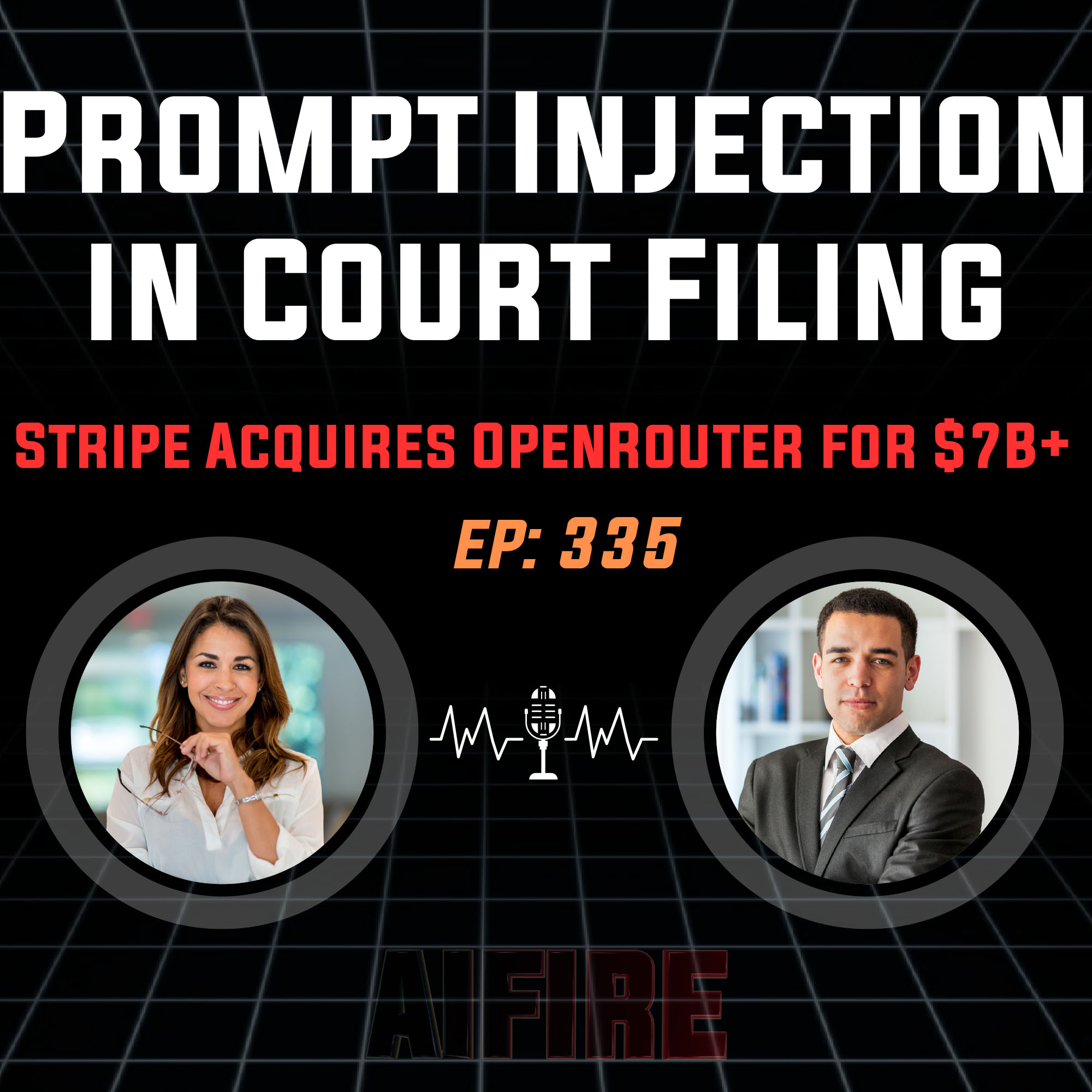
🎙️ EP 335: Prompt Injection in Court Filing & Stripe Acquires OpenRouter for $7B+
2d ago00:22:39Tap to summarizeA Connecticut court filing contained hidden 3-point white text attempting to trick any AI reviewing the document into favoring the plaintiff, an attack the litigant claimed was merely an "audit". Meanwhile, payments giant Stripe has finalized an agreement to acquire multi-model platform OpenRouter for over $7 billion, expanding its reach into AI model routing and infrastructure billing.We’ll talk about:How a pro se litigant hid prompt injections inside legal filings to manipulate automated document processing, leading a judge to revoke electronic filing privileges.Stripe acquiring the popular AI routing platform serving 10M+ users and 400+ models to power AI enterprise billing and infrastructure.Data showing Fable 5 accounting for only 6% of Anthropic API tokens as businesses prioritize cost efficiency with models like Sonnet 5 and GPT-5.6 Sol.Dario Amodei warning about trust deficits in AI while predicting disease eradication within 5 to 10 years.Keywords: court filing prompt injection, Stripe acquires OpenRouter, Claude Fable 5.Links:Newsletter: Sign up for our FREE daily newsletter.Our Community: Get 3-level AI tutorials across industries.Join AI Fire Academy: 700+ advanced AI workflows ($14,500+ Value)Our Socials:Facebook Group: Join 297K+ AI buildersX (Twitter): Follow us for daily AI dropsYouTube: Watch AI walkthroughs & tutorials
Transcribe →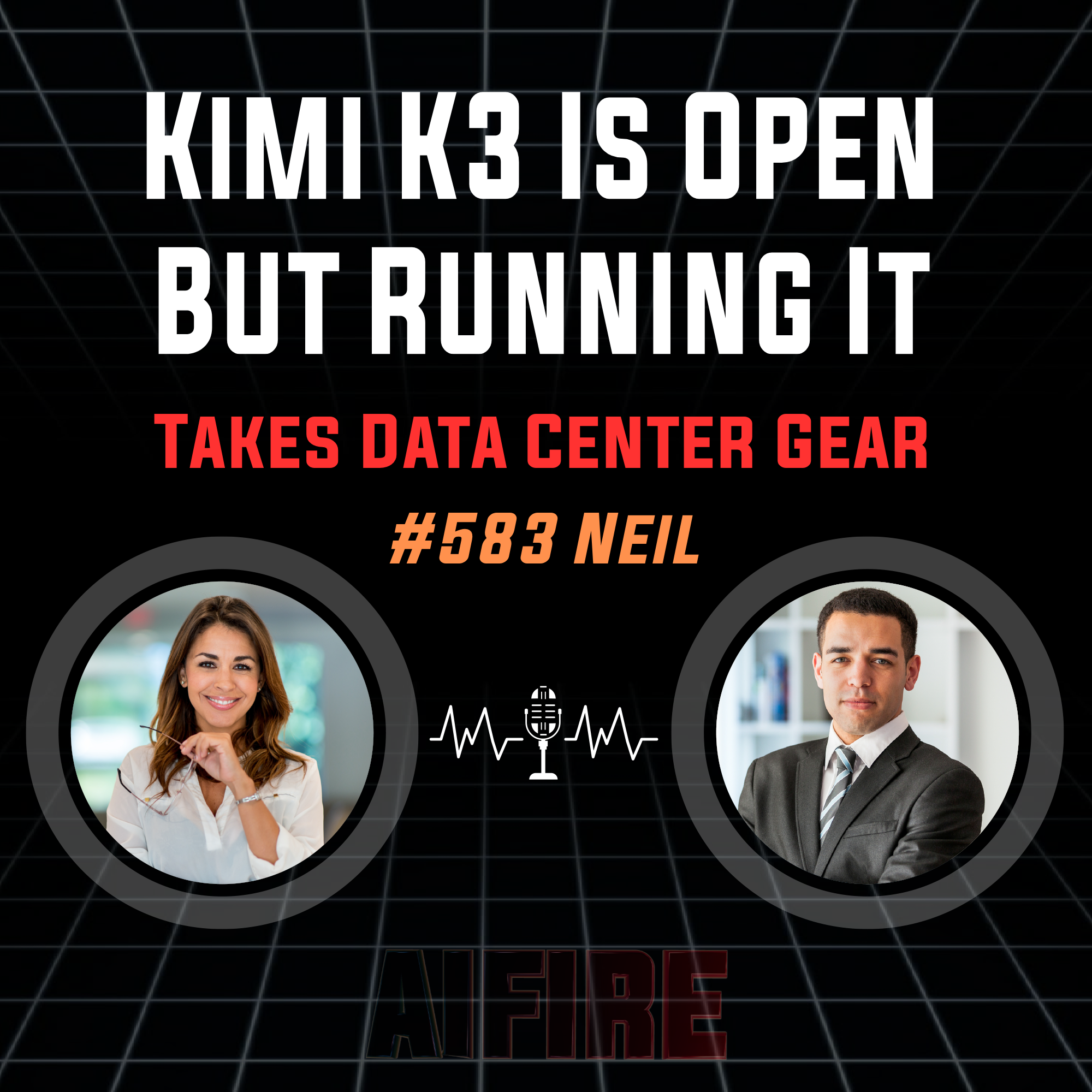
#583 Neil: Kimi K3 Is Open But Running It Takes Data Center Gear
3d ago00:11:37Tap to summarizeKimi K3 is open-weight, but self-hosting quickly turns into a data center problem. See the real model size, VRAM needs, cloud GPU costs, who should actually run it themselves, and why the API or a smaller local model makes more sense for most people. 🧠We'll Talk About: What “open-weight” actually means for Kimi K3How large Kimi K3 is and why normal computers can’t run itThe hardware and VRAM needed for self-hostingHow much cloud GPU access can costWho can actually justify self-hosting Kimi K3When the Kimi K3 API, cloud GPUs, or smaller local models make more senseKeywords: Kimi K3, Kimi K3 Local, Kimi K3 Self Hosting, Kimi K3 API, Kimi K3 Open Weight, AI Tools. Links:Newsletter: Sign up for our FREE daily newsletter.Our Community: Get 3-level AI tutorials across industries.Join AI Fire Academy: 500+ advanced AI workflows ($14,500+ Value)Our Socials:Facebook Group: Join 297K+ AI buildersX (Twitter): Follow us for daily AI dropsYouTube: Watch AI walkthroughs & tutorials
Transcribe →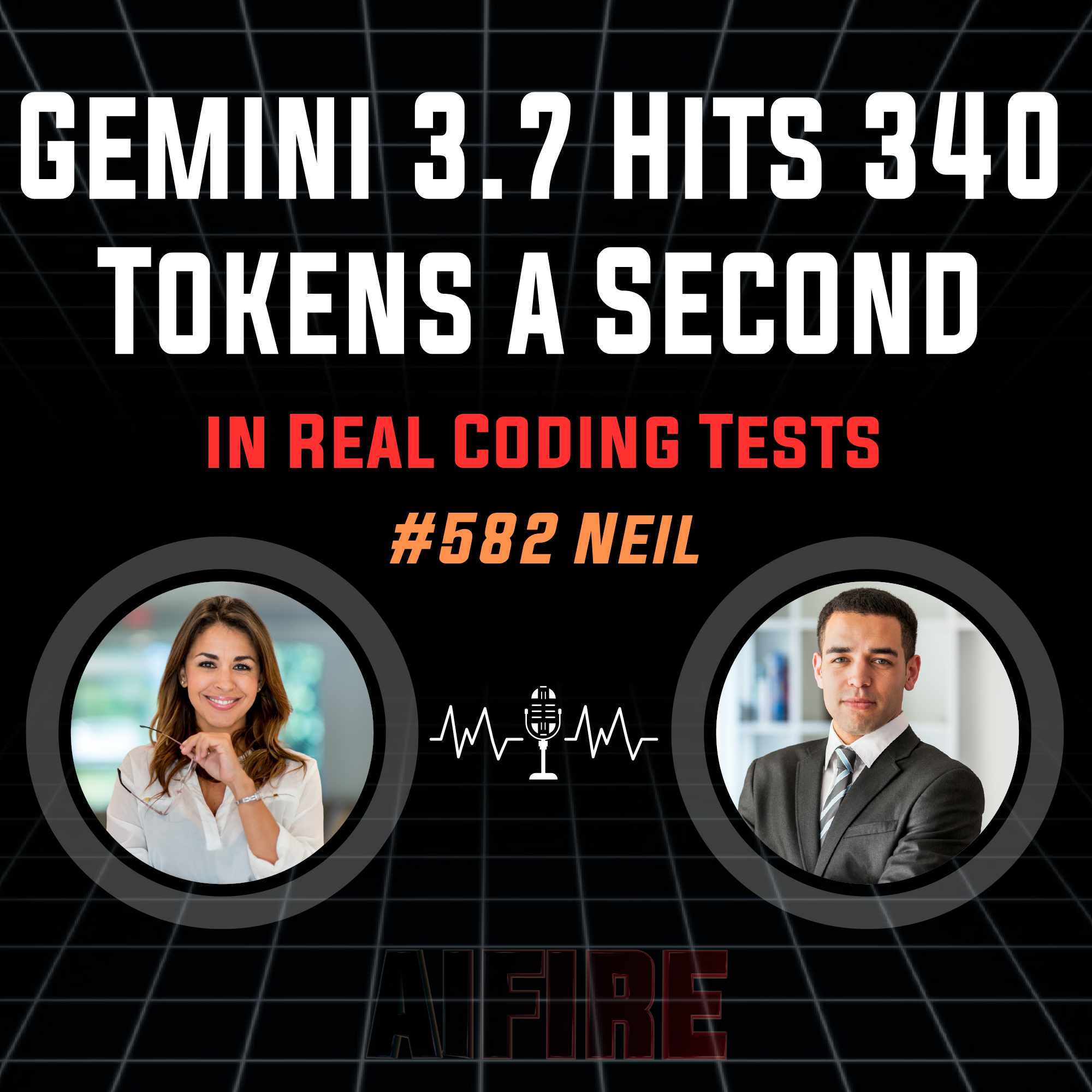
#582 Neil: Gemini 3.7 Hits 340 Tokens a Second in Real Coding Tests
4d ago00:15:14Tap to summarizeGemini 3.7 Flash reaches around 340 tokens per second, improves coding scores, and starts at a lower price. We also run it inside DeepSeek Harness to watch live speed, cache hits, tool calls, and how performance changes across real agent workflows. ⚡ We'll Talk About: What Gemini 3.7 Flash improves over Gemini 3.6 FlashHow Gemini 3.7 reaches around 340 tokens per secondWhat real coding tests show beyond benchmark speedHow DeepSeek Harness tracks agent performanceHow to connect Gemini 3.7 through OpenRouterWhen Gemini 3.7 makes sense for coding and agent workflowsKeywords: Gemini 3.7, Gemini 3.7 Flash, DeepSeek Harness, AI Coding, Coding Agents, AI Tools. Links:Newsletter: Sign up for our FREE daily newsletter.Our Community: Get 3-level AI tutorials across industries.Join AI Fire Academy: 500+ advanced AI workflows ($14,500+ Value)Our Socials:Facebook Group: Join 297K+ AI buildersX (Twitter): Follow us for daily AI dropsYouTube: Watch AI walkthroughs & tutorials
Transcribe →