← Airlines Confidential Podcast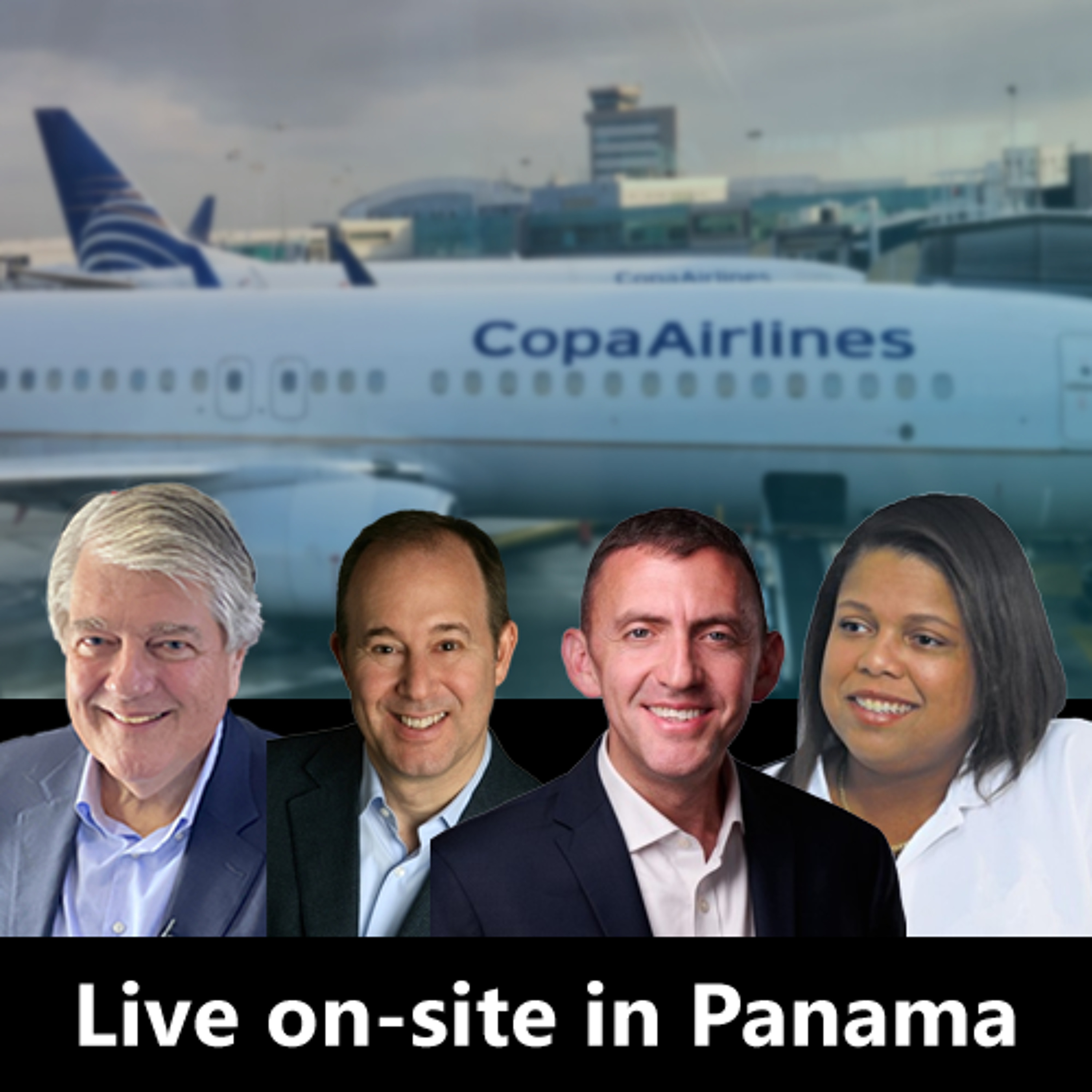
Airlines Confidential Podcast
337 - From Panama: Focus on Copa Airlines: Robert Carey, EVP, / Deniece Nicholas Holness, Dir, System Operations
01:30:01
Scott McCartney & Guest Co-Host Henry Hardeveldt …
Loading summary
Transcript174 lines
- [00:04]
Scott McCartney
Airlines confidential with Scott McCartney is made possible with support from RTX, Collins Aerospace, Pratt and Whitney and Raytheon. Connecting and protecting our world. RTX.com infinity flight the leader in Cadet Academy flight training programs infinityflight.com Ontario International Airport in Southern California SoCal so Easy flyontario.com the executive MBA in aviation at the University of Colorado Denver Business UCDenver. EDU and by Cirium, the world's most trusted source of Aviation Analytics. Cirium.com we also welcome your business support. Contact us at airlinesconfidential.com
- [00:57]
welcome to a special edition of Airlines confidential. I'm Scott McCartney and this week we are going to bring you an extended conversation with two experienced airline leaders from COPA Airlines. Co host Henry Harteveld and I were
- [01:12]
Henry Harteveld
in Panama this past week because we're both members of Cirium's on time Performance Advisory Board.
- [01:19]
Scott McCartney
Henry and I along with the rest
- [01:21]
Henry Harteveld
of the Cirium Advisory Board and had the chance to talk in detail with Coppa and I think listeners will enjoy the discussion. So welcome back Henry and welcome back to Dallas as well.
- [01:32]
Scott McCartney
Well, thank you, Scott. Yes, and for listeners who are wondering about the welcome back to Dallas, I just moved back a few weeks ago to Dallas where I lived earlier and it's very good to be back here. We want to discuss this week a bit of other news. This is the first week of the de spirited airline industry. It's been an interesting week, maybe even a bit hearten to see how the industry has stepped up as it has after the shutdown of a major airline like Spirit Airlines offered reasonable fares or what they claim to be reasonable fares. There's been discussion online about that to Spirit ticket holders. But what was especially heartening to me is several airlines in their press releases stated that they were recruiting and encouraged Spirit Airlines employees to apply for potential jobs. And in fact, United Airlines even said that they'd received more than 300 applications from former Spirit employees for open positions at United. So you know, here's hoping that the folks at Spirit who want to continue their careers in the airline business have the opportunity to do so. You know, there certainly was some travel news rather about stranded travelers and disruptions, although that has died down the discussion of what does the industry look like post Spirit? Is there room for low fare carriers? What happens to prices continues. But you know, the industry overall seems to have digested the news fairly well and we are starting to see airlines announce their plans to enter into Spirit Airlines or former Spirit Airlines markets and routes.
- [03:13]
Yeah, it's a, you know, it's been really interesting this past week to watch it. And you know, it's always been in
- [03:20]
Henry Harteveld
this industry, if there's demand for seats, there will be an airline somewhere that'll, that'll want to meet that demand. May not be as much demand because fares are probably going to be higher. Right.
- [03:32]
Scott McCartney
But I still think it's overall going
- [03:37]
Henry Harteveld
to be good for the industry to have more rationalization in capacity.
- [03:44]
Scott McCartney
One of the things I'm fascinated about
- [03:46]
Henry Harteveld
with all of this are the challenges of dealing with 100 or so Spirit airplanes scattered around the U.S. i flew back through Fort Lauderdale. There are a bunch of them still sitting there, although I think many have already been moved to storage. But there's a big problem here. Spirit and creditors made some interesting filings in bankruptcy court this past week. One major issue is that a lot of the airplanes don't have the correct engines on the correct aircraft. It's the correct aircraft for, for flying the airplane. It's just not the engine that's owned by the leasing company. Airlines swap engines all the time, right? One engine needs an overhaul or a major repair or new fan blades from Pratt Whitney. It often gets removed and swapped out in some cases if there's a spare engine available. No reason the airplane needs to be grounded for however long that engine issue is going to take. So here's an example. A couple examples. One, a320 owned by Carlisle Aviation Partners was sitting in Las Vegas at the time of the Spirit court filing last week. Its number one engine was in Orlando, while engine number two was at a maintenance overhaul shop somewhere else. Another, Carlisle A320 was parked in Pensacola, Florida and its number one engine was in Chicago and the number two was on an airplane in Newark. A plane parked at Pittsburgh International Airport has one of its proper engines in Las Vegas and the other at LaGuardia. So you get the idea. This is a huge jigsaw puzzle that's going to be expensive to put together. The unsecured creditors committee said in a filing last week that, quote, only a handful of the debtors, that Spirit, the debtors leased aircraft currently have their assigned engines installed and the majority of the debtors engines are intermingled between owned and leased aircraft. Swapping these engines to ensure that each leased aircraft is paired with the correct engine before it is returned and that owned engines are reinstalled on the correct owned aircraft before they are sold will require substantial coordination among the debtors, the debtor and possession lenders, and the aircraft equipment lessors, end of the quote. I could shorten that Henry I think with this good luck, this is going to take a lot to resolve. Planes are already being ferried to storage facilities in California and Arizona, and I suspect for many of them, the best solution to this engine matching problem problem would be to get the proper engines ferried to the same storage facility and do the swaps there. I'm sure there are other solutions that they'll undertake and multiply the engine issues by a big number for all the many, many, many other issues there will be in trying to essentially bury what's left of Spirit Airlines.
- [07:06]
Scott McCartney
Scott I actually find this fascinating because I think it's something that unless you are intimately involved with aircraft ownership and fleet and maintenance, you may not realize that engines are routinely and logically swapped between aircraft to keep the airline operating. And so I feel badly for Spirit, for the debtor, for the trustees of the estate, the and everybody else has got to put this back together. It's really complex. I'm sure someone out there saying, well, AI can figure it out and maybe it can, but I suspect this is going to take months to do and it will certainly be expensive. How expensive for this we don't know, but Spirit has already asked for a wind down budget of $217 million, which is a lot of money.
- [08:01]
Henry Harteveld
Yeah.
- [08:02]
Scott McCartney
And by the way, for listeners who may not be familiar, you might think, well, it's an engine that works on the airplane. What's the difference?
- [08:10]
Henry Harteveld
And the difference is every engine has a different number of hours accumulated on it and maybe at a different place in its maintenance cycle. And so there's a different value. And I suppose some of this may be saying, well, hey, you and I, lessor A and lessor B, we're going to trade engines and yours is younger and further from a heavy maintenance check than my engine, so it's worth more. So we'll compensate each other with cash and keep the engines. I don't know if that'll happen, but even if it's the same engine, it's got different value based on its use and its maintenance record.
- [08:52]
Scott McCartney
Right. And look, some lessors may want the original engines to be with the plane for whatever the reasons are, and some may be more flexible. It will be interesting to see how this, this shakes out. Scott there's some other news to discuss and it is related to on time performance in a way, something that we just spent the past week discussing in depth at the Cirium Advisory Board for the on time performance report. It involves Delta Airlines, which has had its own complicated logistical issues during the past week involving crew scheduling. There are a number different allegations about what's been going on. Whether it is a cruise scheduling system or some frustrations between pilots and management, some if you will, negotiating or perhaps contract playing around, whatever you want to call it, ahead of some contract negotiations between Delta's pilots and the airline. But the result was a lot of cancellations. Hundreds of Delta flights were canceled. And Delta is an airline that historically doesn't like to cancel flights. They have prided themselves on being on time and in fact they have routinely been cited by Cirium as an on time leader. And the airline had to apologize a whole lot to a whole lot of its passengers. This could be the first shot between labor and management in negotiations for a new pilot contract. The negotiations opened last month in April. However, what we know is that Delta pilots are not picking up extra trips as they normally do, whether these are pre scheduled or last minute. The Airline Pilots association says this is a cruise scheduling system problem, that it's not keeping up. I have read that pilots are willing to pick up trips, but because the contract they may accept it. But if a more senior pilot wants to take a trip, they have that right. So in fact the airline even ends up paying multiple pilots to operate a single flight. It sounds like it's very messy. It's very unlike Delta that we know at least from the outside. What we do know though is that Delta's on time, performance and reliability are suffering. It's affecting its passengers and it's not good for anybody who's involved in it.
- [11:11]
Yeah, I think this really bears watching to see if labor tensions are growing
- [11:17]
Henry Harteveld
and also technology issues inside Delta. Right. It's not the first time. And you had shared with me this is a new system that's not functioning well when there are operational challenges like storms and going into summer, my goodness, that's when you need the system to be able to recover quickly from storms. So I think Delta's got a big problem here to fix. Remember too, Delta CFO Dan Janke is moving over to become chief operating officer, presumably as part of his grooming to be the next CEO. So a big test for the new operating officer. And don't forget, Delta as you talked about, has been known for its reliability and that's been an important marketing advantage, particularly with business customers. But Delta's had a couple of bad stretches here with the operation, including the crowdstrike debacle. So all bears watching closely.
- [12:21]
Scott McCartney
Another thing Henry, I think bears watching
- [12:23]
Henry Harteveld
closely is Frontier Airlines financial results. Frontier reported a first quarter net loss of $272 million last week. That includes a non recurring charge of $139 million for early lease termination on 24 A320neo aircraft. That was all previously announced. The Frontier was going to pare down the number of aircraft in its fleet. The results, the financial results were better than expected. And Frontier said it expects unit revenue to be 20% bigger than a year ago. In the current quarter, about 3% to 5% of that unit revenue growth will come from picking up Spirit Airlines traffic. Frontier set but skies are not all blue and clear for Frontier. It still expects to lose money in the current quarter, which is usually a pretty strong period for airlines at the start of the summer travel season. And one continuing issue for Frontier really is aircraft utilization.
- [13:32]
Scott McCartney
In the just completed quarter, aircraft on
- [13:34]
Henry Harteveld
average flew only eight and a half hours per day and that was down sharply from from a year earlier. 8.5 hours a day is just too low for a low cost carrier. You need to get more out of the airplanes to keep keep your costs low. Another curiosity, while fare revenue per passenger was up 21%, that was a bit more than $9 per ticket. So very nice for the airline. Total ancillary revenue per passenger was down. And total revenue per passenger, you add it all together, came in only 2% higher. As Frontier tries to sell more premium seating and other perks. It looks like it's just getting baked into the fare rather than the ancillary revenue and not resulting in a whole lot of additional revenue. Now maybe that changes going forward as they get more opportunities out there for customers to buy up, but only a
- [14:38]
Scott McCartney
2% increase so far. That's a concern.
- [14:41]
Henry Harteveld
And by the way, Chasm unit cost was up 22% excluding fuel. Including fuel cost per available seat mile were up 35%.
- [14:55]
Scott McCartney
Yeah, Scott, one thing that I look at with Frontier because they have done it so well, is how much money do they generate per passenger in ancillary revenue. In the past they have had as much as maybe even more than $75 per passenger in previous quarters. This quarter it was $65.24 per passenger. That is down 9% from the $71.72 for the first quarter of 2025. And when you consider, by the way, that of course you've got inflation that you've got to factor in, that is probably more than a 9% cut in terms of real constant dollars. This is a sign to me that Frontier's core customers are hurting. I don't think enough people appear to be engaging with the airline in some of their upsells and maybe some of their so called premium port products that they are trying to sell. You know, I think this is definitely, especially against a chasm increase, a chasm X of increase of 22%. This is something that is, is creating concern in, in my mind anyway.
- [16:10]
Yeah, yeah, no, it's, it's one thing to say, well, well, costs are up because of fuel. Yeah, yeah, they're up 35%, but take
- [16:18]
Henry Harteveld
out the fuel and they're up 22%.
- [16:20]
Robert Carey
Right.
- [16:20]
Scott McCartney
That's an alarming thing.
- [16:22]
Henry Harteveld
That is alarming. And, and I hear what you're saying about the Frontier customer. You know, it's, it's one thing if you say, okay, well, we used to sell them, you know, seat assignments and other stuff that boosted the ancillary revenue and now we're going to roll that into a, a fair package. You get a bundle and, and so, yeah, that revenue, I mean, I don't, it doesn't really matter what you count it. Right, right. So the revenue gets rolled into the fair. But the bottom line was the total, total revenue, no matter what you call it, revenue per passenger came in only 2% higher. And that's, maybe the new strategy is not working so well. We don't know.
- [17:03]
Scott McCartney
Scott. There was another interesting development this week. Palm Beach County, Florida approved a trademark deal allowing the renaming of Palm Beach International Airport after President Donald J. Trump. The commission gave the okay to the agreement in a 4 to 3 vote following a contentious debate. The measure also gave a thumbs up to a new logo for the airport with Trump's name and an image resembling the presidential seal. The new airport logo, which was recommended by the Trump Organization, has an eagle holding two olive branches. It also features a crest shield over the bird's body with stars and stripes. Apparently the Palm Beach International Airport gets to sell, well, Palm beach gets to sell Trump International Airport swag at the airport. Only the Trump Organization gets to sell the airport branded merchandise online and off site. And the licensing deal requires the airport to pick a vendor to provide any branded merchandise from a list of pre approved vendors that the Trump Organization has vetted, or at least says it has vetted and approved. You know, this, this is unusual. And again, we've never seen a merchandising deal like this before. Perhaps because most airports aren't named after living individuals. But this just is, you know, the, the business terms of this are what are causing a lot of discussions in the airport community.
- [18:38]
Yeah, I Wonder if Mayor LaGuardia's family want a piece of the action.
- [18:46]
Henry Harteveld
Or the descendants of. I think it was Foster Dulles.
- [18:51]
Scott McCartney
Yeah.
- [18:52]
Henry Harteveld
Or General o'. Hare. Whoever. I don't know. Fascinating. I'm curious to see too, if they're trying to change the airport code from, from PBI to djt. And that's a, that's an ICAO thing. Right. That.
- [19:11]
Scott McCartney
That takes some effort.
- [19:13]
So, I mean, it may involve ICAO and iata, but it certainly is very unusual. Even when you do have name changes, rarely do you have a code change for the airport.
- [19:25]
Henry Harteveld
Right.
- [19:25]
Scott McCartney
The one that comes to mind is, you know, when Idlewild was renamed after President Kennedy following his assassination, they did change the code from IDL to jfk. But that's, I think the only airport code I can recall having changed as a result of a name change.
- [19:45]
Yeah, I can't remember. Was Stapleton Den.
- [19:49]
Yes, it was.
- [19:50]
Henry Harteveld
Yeah, it was.
- [19:51]
Scott McCartney
Yeah.
- [19:52]
Henry Harteveld
All right, on that note, time now to thank our sponsors for making this podcast possible. We want to thank RTX for its longtime sponsorship of Airlines Confidential. RTX rallies more than 180,000 innovators around a powerful vision to create a safer, more connected world. With industry leading tools and technology, the RTX global team works across market leading businesses, Collins Aerospace, Pratt and Whitney and Raytheon to drive progress for generations to come together. RTX pushes the boundaries of known science and finds new ways to connect and protect us, our world. Visit rtx.com to learn more. In addition, we want to thank Infinity Flight Academy. The path to the flight deck starts long before a pilot reaches the airlines. At Infinity Flight Academy, they're proud to serve as a flight training partner for the American Airlines Cadet Academy, helping prepare the next generation of professional airline pilots. Infinity Flight Academy's training is structured, standardized and built around the discipline today's airlines expect from day one. For future pilots pursuing a career at the highest level, Infiniti Flight Academy is proud to be part of that journey. Infinity Flight Academy training tomorrow's airline pilots through the American Airlines Cadet Academy.
- [21:14]
Scott McCartney
In addition, we would like to thank Cirium. Cirium offers the most accurate and precise data and analytics to enable airlines to optimize their planning, operations and passenger services. The right intelligence drives operational efficiencies, enables airlines and airports to predict market shifts, and helps airlines respond quickly to maximize revenue, manage costs and seize commercial opportunity. Please visit Cirium C I R I U m dot com for more information. And that leads us right into our next segment.
- [21:49]
Before we start in Panama, I want
- [21:51]
Henry Harteveld
to remind listeners that we had copa's legendary CEO Pedro Heilbronn on The podcast last year Pedro told us there's a gun in a glass box outside his
- [22:02]
Scott McCartney
office door and a sign saying break
- [22:05]
Henry Harteveld
the glass and use the gun if Pedro ever wants to order widebody aircraft. As listeners will hear, Robert Carey has already taken note of that important Coppa principle.
- [22:18]
Robert Carey
So here we go.
- [22:20]
Scott McCartney
We have a very special treat for listeners this week. I'm in Panama City, Panama, along with co host Henry Harteveld and the rest of the Cirium On Time Performance Advisory Board. The board is holding its annual meeting in Panama in recognition of copa's perennial on time excellence. Copa has earned Cirium's recognition as Latin America's most on time airline for more than a decade. We have two of copa's top executives, both fascinating airline leaders and other members of the Cirium Advisory Board who will be jumping in with questions as the conversation goes on. We're going to start with Robert Carey, Coppa's Executive Vice President who is in charge of commercial operations, cargo and Coppa's LCC Wingo. Robert has had as global and complete an airline career as I think anyone I know. He got a bachelor's degree from Arizona State University, went to work at Delta Airlines, then got an MBA at Harvard University. After Harvard, he spent more than a decade at McKinsey Co. Working with more than 25 airlines around the globe as a partner leading the airline practice. From McKinsey he went to EasyJet and rose to Chief Commercial and Customer Officer. Then he was president of Wizz Air for three years before leaving Europe and moving to Panama for for Copa. Robert, thanks so much for joining us and congratulations again on Coppa's 2025 Excellence in the Cirium rankings. It's not easy. It's a tremendous achievement and I think we're all fascinated to learn more about the airline. But let's start learning more about you with as you know, as a listener, our Ben Baldanza question, how did you get into this crazy business?
- [24:05]
Robert Carey
Yeah, great. First of all, let me say thank you so much Scott for having me on today. And Henry, looking forward to this. As you said, I'm a listener. So when the opportunity came up I was super excited and yes, I was well prepared for the first question coming today. No, so, so to the Ben question. Look, I've always loved commercial planes ever since I was a little, little kid. You know, when I was growing up, my dad was in sales. He used to travel all over the US and I remember going at like 8 or 9 years old to the travel agency to buy book tickets and I Learned, let's say, some legitimate and maybe some less legitimate ways to book tickets at that time, and then quickly got into. I took over booking all his reservations from there, had some other fun stories afterwards, and then really got my start in the industry, as you said. I went to undergrad at Arizona State. Bill Franke was a CEO at America west, which was headquartered in Tempe, where Arizona State was. And my second year of college, I sent him a letter reminding him how great a school he had in town and he should hire some more people. And that led to my first internship in crew scheduling.
- [25:06]
Scott McCartney
No kidding.
- [25:07]
Robert Carey
So that's how I got started in the industry.
- [25:09]
Scott McCartney
Wow, That's a great story. Awesome.
- [25:11]
Robert Carey
Yeah, no, it was fun. It was fun. It was an interesting way to get started. I mean, I spent most of the summer working on crew rest and crew connection delays and building some models out for America West. But I was in this back room. America west was testing a preferential bidding system at the time, and it was in the back room with basically two pilots and a crew scheduler who are testing the system. So, I mean, it's a real insider way to get started in the industry.
- [25:36]
Scott McCartney
Yeah, yeah. As I said, as complete an airline career as anyone I know.
- [25:40]
Robert Carey
Yeah, it was great. It was great.
- [25:42]
Co-host/Interviewer (possibly Scott McCartney or Henry Harteveld)
Robert, Last year your CEO Pedro Heilbronn joined Airlines Confidential. And since then, the airline has announced yet another year of industry leading profitability and operational excellence. The operating margin was 22.6%, and the net margin and a very, very impressive 18.6%. The airline's on time performance for 2025 was 90.75%. So almost 91% on time, highest of any carrier in the Americas, second best in the world. That is impressive. How do you make that happen? Because you are flying into a lot of congested airports. You are flying into some airports that may not be as well developed. You've got air traffic management issues, you've got challenges, like all airlines with aircraft deliveries, fuel, et cetera, et cetera. How do you make it happen?
- [26:36]
Robert Carey
So I'll apologize to the listeners in advance that unfortunately they're not going to get a whole lot of, let's say, new things we've done in the last year since Pedro was on. I mean, we have a pretty focused business model. It's pretty straightforward. And, you know, we like to joke we're a little boring because we keep repeating the same things over and over and over. But I mean, if you look at it, what's driving our success? I mean, we have a great location Here in Panama, we can reach basically almost all of north and South America, as I like to joke. Basically we can serve everybody except the penguins. They're, they're a little bit far away, but, you know, we're really at the center in what we can fly. You know, we serve also a lot of markets that without us would not be able to have flights. And you know, we had the number of, on these, 80% of our ONDs have less than 20 passengers per day. So that's really a key driver of what enabled us to serve a lot of other markets that others can't. And underlying all of that is low unit costs. I mean, we keep a real focus on this. If you go back and look over the last 10, 15 years, we've continually been driving our costs down. Call it a 0.2, 0.3 cents on the Casimax basis every, you know, call it three years or so, and we have another target. We're going to keep going there. So that's, you know, underlying it. And, you know, but with all that kind of the two groups we say have to be in there. You've got the passengers, you know, we have a, as you said, we got an on time, basically every time flight policy. And Denise is going to be on later to talk more about how we manage that and how all the employees of COPA really deliver that every day. But not only the on time, we also have a great product on board business class on every flight, really a full service product. And the second piece of that is, I think the employees, I mean, you look at the employees here, everybody. I've been at COPA now a little over a year. Everybody is so committed to delivering every day on time for our passengers, a really great service. We spend a lot in making sure we train and develop that talent. And I think that's really what drives the success year after year.
- [28:33]
Scott McCartney
So talk a little bit more about the employees and the culture. I'm curious. You've seen employee groups at airlines around the world. What's different here, or maybe a different way to look at that is, what do you think is the most important employee aspect of a successful airline?
- [28:51]
Robert Carey
Yeah, it's as you say. Yes, I've seen quite a few different types of employee groups around the world. I mean, I think what makes COPA really special and what you see out of all the employees here each and every day is with results like that being delivered year after year, year in many places, I think you would get kind of a, almost a complacency of kind of, you know, we're good already. We don't need to do much more. But, you know, every single day, every meeting, every flight, every interaction, you know, the mindset is all about what can we do to get better? You know, what's that next little step we can do to keep making sure we deliver more and keep getting better? And I've been amazed by that when I've come down. I mean, that'd be, you know, point one, I'd say, and I think point two is you look at it, and I like to joke when I go into meetings that I'm the new guy. And it's very apparent when everybody introduces. I've been here 10 years, 15 years, 20. I mean, everybody stays at COPA a really long time. And so the memory and the knowledge that exists in the airline of how to deliver results day after day, year after year, and what works and what doesn't work, and that commitment to excellence is there. And so I'm really, really, really the new guy in every meeting that I go into, because I'm barely into my first year of service of the island. I think those two elements are core to what we do. Everybody is so committed to that, let's say, delivering the best for the passenger each and every day.
- [30:11]
Co-host/Interviewer (possibly Scott McCartney or Henry Harteveld)
Robert, I actually want to build on that, if I may, because it's not easy to find people who are dedicated. And Doug Parker once said working in the airline business is a noble profession, and I agree with him on that. And so to attract and keep people for 10, for 15 years longer is impressive. How does COPA do this? Because I'm sure there are some people like, oh, I could go to work for this other airline. It's larger, or I could whatever. Or another industry and make more money, whatever it might be.
- [30:43]
Robert Carey
Yeah, no, I mean, it's a very true point. And I think, you know, I was just. As you were saying that right now, I was also thinking back to, I think it was the podcast, like, two weeks ago, where you were talking about, again, the. The type of talent and people that are drawn into this industry and just kind of the how that makes it exciting for everybody. And I think, you know, what. What we focus on quite a bit and how we deliver that is one we really try to make sure we're giving everybody an exciting opportunity. We're giving them the tools to see, you know, we. And you can think about in different groups. So you think about, you know, our pilots, our flight attendants, our mechanics. You know, we've built academies. We bring them in, we guarantee them a job at the end of the training, they come in and then have a full career here in Panama, you know, and we, I think you can, you could talk to them too. I think we, we do our best to make sure we're treating them fairly. They have a, you know, good quality job and, you know, good benefits and, you know, get to work for one of the leading airlines of the world delivering that service. So I think, you know, that that is one element of the air equation and I think the second element, if you, then look, you know, as well, we've got representative kind of the, the executive team here as well. You know, you think about how that works. And what we really try to bring each and every day is, you know, again, we have a committed place. We're, you know, continuing to grow. It's a challenge each and every day. We've got a whole lot of things, you know, new exciting things to go after and everybody's really empowered to go out and make change happen in their area. And for me, that's core to making it someplace exciting to come to every day. Combine that with the fact that the airline industry never ceases to give you a new challenge. I think, you know, every few weeks that it keeps it an exciting place, you know, versus other industries.
- [32:22]
Scott McCartney
So Copa's big announcement last week was an order of 60 additional 737 Max aircraft. You're an all 737 operator. You already fly to 88 destinations in 32 countries from the one hub. Clearly right in the middle of the Americas, you've got a fleet of 115 737s. Tell us a bit about the growth strategy. Where do those new aircraft go? And I'm really curious about, I mean, you mentioned the penguins, which you need a wide body aircraft to get to those penguins or maybe just to get to Europe or Asia. But is that ever in the future?
- [33:01]
Robert Carey
Well, I think when Pedro was on last year, he mentioned the gun we have sitting outside in a glass case. Case in the executive floor, right?
- [33:07]
Scott McCartney
Yes.
- [33:07]
Robert Carey
So that gun is still there. So the wide body, the wide bodies are not coming anytime soon. We're going to stick to what we know how to do, which is the narrow bodies. I mean, look, I mean, if you look at it, there's still a lot of growth for us to go after. And we're very excited, you know, we're excited to make the announcement together with Boeing and GE CFM on continuing to grow with the Max family. You know, you look at the growth potential we've got, you know, in the last 18 months we've added in 13 new markets, combination of new and restarted markets that we brought back online. So that's, you know, a lot of exciting growth. We have a list of new destinations. You can imagine there's a long, long list, but there's 30 markets that are in our short list that we feel, you know, if we, we could probably start service to each of these markets tomorrow if we wanted to. It's a question of bringing them online and making sure we're not overexposed on growth. You know, we've got, also got a lot of growth to even fill in our network. I mean part of the benefit of the hub is that additional frequencies and you know, we've got some, I think off top of my head is something like 2/3 of our markets have two or less frequencies per day. So again you've got a lot of opportunities of just growing the connectivity, filling in service and connecting the dots of what we have to offer. And that's going to be the core platform of what we use this new order to go do is really keep expanding inside the Americas, connecting those dots that, that our hub here in Panama, the hub of the Americas can do.
- [34:30]
Scott McCartney
So let me just as a follow on to that. So I flew here from Austin, which I was totally fascinated with that market because it's a, it's a growing market in the US Very much a business oriented market, but one that's not dominated by any particular hub airline. You also fly to Raleigh, Durham, you fly to Boston, you fly to Baltimore, Washington, I think you fly to your partners with United and Star alliance. So you fly to their hubs as well. But this, this idea of flying to basically spoke cities where you don't have any feed but plenty of people who are looking to make a connection to somewhere in, in Latin America. Talk about growing those cities that seem to be, would be non traditional for a Latin American carrier to be serving.
- [35:28]
Robert Carey
Yeah, you mentioned, I mean, yeah, in the last couple of years we bought online in the U.S. baltimore, Austin, Raleigh, we brought on San Diego last year. You know, all kind of unique points and we do the same to the south as well. So for example, we brought online last year Salta and Tucuman and in Argentina, which again I'm guessing, you know, are not the traditional points you would have expected us to be adding into the network. You know, it's really interesting when you go into these new markets and what you see, I mean part of the value of what we can bring in is exactly this point. These are markets that before would have had to then fly to a traditional hub, you know, in one of the big hubs in the US Connect over there to fly most likely down to another big city in South America and then connect on to the whatever final destination they want to go to. You know, the value and the power of the Panama hub of the Americas is, you know, we can connect Austin with Salta. And okay, maybe there's only two passengers a week that are going between Austin and Salta, but they're going to naturally fly on Copa. Again, you know, the other one we had, we fly to Manta and Ecuador, which I'll admit I never even heard of until I got here to Copa. And we're basically the only ones going in to Manta. And that's because again, we can connect in, in markets that others can't. And so that, that's a huge part of what we bring into these, these communities. When we add in the service, you know, of course we're going to pick up some volume of flows and some of these. So obviously there's people going from Austin down to Sao Paulo that, you know, we're an equally good choice then with going over Atlanta or going over Miami. And so we're going to have some of that, that, that mix in there as well. But really, you know, that's, that's, that's the growth. What we really try to target is where can we bring those new OND flows online that are really going to be unique to Copa.
- [37:10]
Co-host/Interviewer (possibly Scott McCartney or Henry Harteveld)
I'm curious, of the 60 planes, how many are allocated for net new growth and how many are for replacement for older planes that simply may be nearing the end of their useful lives because they're just older, less fuel efficient aircraft?
- [37:26]
Robert Carey
We don't know yet for sure. I think if you look at it, it gives us a lot of potential of growth. Right now we're planning most of it as incremental growth, to be actually, to be clear. So, you know, I think it'd give us a growth rate of continuing around 7%, a little more than 7% per year. Of course, as we're seeing right now, this is an industry that never ceases to surprise you. And part of what is our philosophy is you plan one scenario, you always have the downside scenario in mind too. So part of the flexibility we have is of course, if we get into the 2000 and 30s when the planes are coming and you know, something changes in the market and we don't need to grow quite that much, we have flexibility on aircraft, we can be retiring A return, because, as you point out, we'll have a large component of the fleet that is still the 800s, the NGS, which are very reliable plane. We're super happy with them, but if something changes, we can kind of temper that growth down a bit as well. So for now, we're assuming all growth forward, but flexibility, if needed, to react to the situation. That something will be different by then. I just can't tell you what yet.
- [38:27]
Unidentified On Time Performance Board Member
Okay.
- [38:28]
Co-host/Interviewer (possibly Scott McCartney or Henry Harteveld)
And I heard you about the message about wide bodies and especially the part about the gun, but what about a smaller plane, whether it's the A220 or the E2 to help you get into the markets where either the runways may not be adequate for the 737 or the market demand just isn't there, or maybe even time of day to give you more flexibility to grow, you know,
- [38:53]
Robert Carey
into even more of the Americas. Exactly. We used to have a second fleet type, so we had the E190s up until the pandemic. We exited them from the fleet during the pandemic as part of a simplification and cost reduction move. And, you know, to date, we obviously keep looking at the smaller gauges as well. We haven't seen enough. Enough of a, let's say, opportunity that it would make sense to really add in that extra cost and complexity into our operating model. But, you know, it's. Let's say, I don't think we're going to get out the gun necessarily on that one, but it is a big step to add back in that complexity. And, you know, I think probably in the spirit of, you know, Ben Baldanza and stuff, you know, keeping one simple fleet type and having that commonality, so far, we've been able to serve all the markets we want, and we have enough growth that we don't need to add in that complexity to make it work.
- [39:45]
Scott McCartney
Sounds like there's not a gun on the wall, but there is a knife in the kitchen that's ready.
- [39:51]
Robert Carey
To be clear, COPA is a very peaceful place. I just want to make that. You know, I'm a little worried that when I, you know, future recruiting pitches are going to be impacted.
- [40:01]
Scott McCartney
So I want to ask about a couple of, you know, the recent events of the industry. How are higher oil prices impacting you? And I'm also curious about the collapse of Spirit Airlines, which at one time had a large network in Latin America. Certainly shrunk over the years. But has. Has that created any opportunity for you?
- [40:24]
Robert Carey
Yeah, I mean, look, so. So diving right into the fun stuff of of today. I mean, you know, obviously fuel prices are having an impact on us right now. You know, we're seeing changes by the week, so. Or by the day actually right now, depending on what the news is out there. So last week I think fuel was up almost double. This week it's down by the time the podcast airs. I'm not even going to try to predict where the fuel is going to be, but we feel the pain, so to speak, the pain at the pump like everybody else. We're not hedged like most of our competitors in the region. I mean, the good news is all our fuel comes from the Americas. So we're not really worried about any sort of supply issue. But it is a real cost. And I think what we're trying to do really is, and where we're focusing is doing everything we can to take all controllable costs, any controllable costs we can attack. We're going after, and not at the expense of a product or expense of the customer experience, but more efficiencies and other elements we can run that maybe we're on a list of things to go do now, kind of come to the top of the list so we can do our best to keep the cost low and make sure we're giving the best possible prices to, to our passengers. And then on the other one, on Spirit, as you mentioned with the news of, of the week, I mean, Spirit was a, was a relevant player. You know, they, if you look at the overlap, they were about, you know, in kind of coppa terms, overlapping. About 10% of our OND's in the win last winter, they're down about 5%. Was our projection going to be for this summer? So, you know, call it in the high, high single digits. That said, you know, they were really focused on a part of the market that was not the largest component for us. I mean, they kind of had two core overlapping areas with us coming down from, let's say, the east coast of the US Especially into Central America and the east coast kind of into that northern South American range. East coast to Central America is not a large. I mean, it's a flow for us, but it's not the largest of flows. And they had price levels that were well below probably what made sense for the market. So I think they, they, let's say they were less. They were picking up a different customer segment than what we were putting in the plane. And then going into kind of the northern South America part, they were a relevant competitor. We had very competitive business with them, but we Expect there's still a lot of players in the market. I mean, JetBlue has already announced replacement flying in a couple markets in Colombia. Avianga has put in some additional flying. So I think it's less capacity. But like typically happens, that's getting backfilled pretty quickly.
- [42:50]
Co-host/Interviewer (possibly Scott McCartney or Henry Harteveld)
Yeah, Robert, Last month Copa announced it's going to start adding Starlink WI fi later this year.
- [42:56]
Henry Harteveld
Yep.
- [42:57]
Co-host/Interviewer (possibly Scott McCartney or Henry Harteveld)
What else is coming from a passenger experience standpoint?
- [43:01]
Robert Carey
Yeah, look, we're pretty excited about getting Starlink. We're going to be the first ones with high speed WI fi in Latin America. So everyone can listen to the podcast on the plane. That'll be ramping up this year towards we'll have the fleet done by end of the year, basically fully done by end of the year. It's going to be a big step. It's something obviously we'd been looking at for a long time and finally we felt the service was out of place and the economics were making sense that we could make this work. So pretty excited to bring that online. I think in terms of other part of innovation we have as well. We have our dreams cabin that we call it, which is on 32 of our Max 9 aircraft and that's basically a flatbed business class product that we bring. We're going to have some more growth of that coming towards the next few years. So we're excited to bring that on as we see more potential for that. We're actually the only ones in the region who have an actual business class on every flight with a dedicated seat product and that we're going to keep going with. We have our Economy plus product which we call Economy extra. We see more growth potential of how we can bring that in. That's again, it's in every flight but we see more opportunity of how we can really bring that to market and the service we can deliver over there Then I think a lot of the other innovations you're going to see coming from us, we made a big transformation on our distribution model over the last few years that's really allowed us to grow our direct relationship with customers. And so what we're pretty excited about is the potential that can bring in new products, new offerings both on board and before and after the flight that before were much more limited. So that'll be new offerings we can bring to customers there.
- [44:33]
Co-host/Interviewer (possibly Scott McCartney or Henry Harteveld)
So you're talking about like the modern airline retailing.
- [44:36]
Robert Carey
Yeah, exactly, exactly. Well and even beyond that we've brought some pretty unique products that we can now market more effectively. So for example, we're pretty excited that everybody's down here in Panama. We've seen a lot of tourism growth. One of the drivers is we've created a Panama stopover program that before, we had to rely on going through our travel agent partners, which were good partners in doing it. But it's a lot harder to get that message out as opposed to when you can put it in the booking flow and directly offer that out to customers when they're booking their tickets. As you know, a unique option of what they can do when they come through Panama.
- [45:11]
Scott McCartney
I was going to ask about tourism in Panama. My first time here, Charlie and I took the Panama Canal tour. We spent some time with monkeys
- [45:22]
Henry Harteveld
on
- [45:23]
Scott McCartney
the lake, had had a great time. It's a. It is a vibrant, incredible business center for the city. So is most of your local traffic. Business travel is most of it leisure. What's growing? How is Panama doing as a tourism destination?
- [45:41]
Robert Carey
Well, look, Panama is doing really well as a tourism destination overall. So if you look at it, last year, Panama had just over 2 million, about 2.3 million visitors, I think it is last year. That's a record number for Panama. It's up 11% year over year, and it's something like 20% higher than what it was pre pandemic. So, you know, Panama's booming on the tourism front. And. And as you said, I mean, there's a lot of attractions of what you can see over here. You've got a pretty unique biodiversity that sits over here, a lot of different cultures. You have the city. I mean, you got both, you know, oceans that you can go see literally in a day. You've got some great food options, you know, a lot of history. It's been fun for me kind of coming down. You know, I always grew up hearing about the Panama Canal and then actually to come and see it. And it's really impressive to go see. Yes, it is. You've got rain for it. I mean, I could keep going on, but this is not the tourism podcast. But you know, what we see kind of in our customer base. As I mentioned, we created the stopover program a few years ago, and it's taken off. We had 200,000 passengers last year, stopover in Panama. They can stop from anywhere from one to 15 days in their itinerary at no cost, and they get access to discounts and everything else while they're here. And that was 20% growth year over year just in that product alone. So, you know, I think the mix of customers we have coming through, we carry a lot of leisure customers, as you can imagine, going from South America up to the Caribbean, from North America, going down to South America. So that is. It's a large portion. We also have business and corporate traffic in there as well. And they like, really, that flexibility that they can kind of. It feels like you're getting an extra vacation for free when you book it. And, you know, that's. That's really the advantage of being here in Panama is it sits in the middle, you know, and is a new offer that we can give to them.
- [47:24]
Co-host/Interviewer (possibly Scott McCartney or Henry Harteveld)
One thing that's impressed me about COPA is your use of technology. I've had the chance to interview Julio Toro for some of my reports and on stage at different conferences. And you guys are really at the forefront of a lot of things when it comes to how you're using technology. You referenced modern airline retailing a moment ago. You are certainly doing a lot of good things with distribution. I'm just curious, how are you using technology? Whether it's to reduce cost, to give yourselves a greater competitive advantage. I just spent 35 years living in California. I'm legally obligated to ask you about artificial intelligence. You know, how are you.
- [48:02]
Robert Carey
Yeah, it's a requirement for your driver's license.
- [48:05]
Co-host/Interviewer (possibly Scott McCartney or Henry Harteveld)
It is, you know, but. But how are you using, whether it's AI or anything else, to improve the efficiency of the airline, to help you with your CASM X cost reductions? To better serve customers? To better serve employees.
- [48:22]
Scott McCartney
Yeah.
- [48:23]
Robert Carey
So, I mean, the way I'd put it is, I think, as you said, we've made a lot of improvements on what we're doing with technology. And that said, I would say we come with a fairly practical mindset of how we like to approach it. So we don't have a Skunk works division going somewhere that's kind of researching technology for the sake of technology. I think that's part of how we keep our costs super low. And when we're looking at the application of technology, we really think about it with, how is this going to create a benefit either for the airline directly, for the customers that we're carrying, could be for the employees. There has to be something that we're driving out of. We're not just putting it in because we think it's going to be useful. So you mentioned, if we look on the commercial side, we've done a whole lot as we've made the migration into the direct distribution. As I said, we're now doing 85, 90% of our customers. We have a direct relationship with either through coppa.com or through our own NDC channels. And that's really running on a platform of technology that Copa's probably built up over the last 10 years and bring a lot of that technology, you know, in house. How we're, how we're building about it and thinking about how we're bringing that to customers. And that, you know, gives a lot of flexibility. Now where, you know, we're looking at how can we use that to bring, as I said, new products online to our customer. I'm not going to say what, because I don't want to give that away to all of the, all my competitors who are listening in. But, you know, we have a pretty robust pipeline of what that's going to allow us to do. And, you know, at the same time, it's exciting because there is still so much we can go do with it. And if you look on the operations side, I think that's the other area we're diving into now as well. You know, there's been a lot of talk in the last few years of how AI, data and technology are really going to be able to help operations. And I think there is a lot of potential what IT can bring. I think you've heard a lot of ideas out there. I haven't seen a ton of, let's say, actual technology yet delivering to date in terms of tangible benefits. We think we're on the cusp of a few that will really enable us to help our customers. You know, a lot of that we've actually built in house. We have a great team that sits as part of Denise's group inside of our operations group that's looking at a lot of different topics, you know, be it from how do we think about, especially in this, you know, environment, fuel efficiency, you know, optimizing how we assign aircraft and react to delays in irregular operations. So, I mean, the range is pretty, pretty exciting. In addition, we run two events in the year. We have a hackathon where you. We actually get involved then with the community and bringing people in. And we also have an internal one we call the Data Heroes Challenge, which is, again, it's a great opportunity. We invite groups from all over COPA to apply and come with their ideas and then they get to work on it for a series of months of how they can bring new tools to light that are really going to help the obviously grounded in data as the core of it. Now, on the AI question that I think is now the, as you said, obligatory question you have to answer basically everywhere. I mean, look, we're looking at everybody. And I think what's been remarkable to us is the evolution that you've seen probably in the last six, nine months of capabilities here. And really, let's say practical applications, I think we're still pretty early on in what we're doing over here. There's a lot of applications of what we can go do with it. But, you know, we're kind of starting to look at it especially in, you know, again, commercial and operations both. We're going to be applications, you know, in the revenue management side is one application, you know, and how can we do more there? And then also in the operations side, you know, there's, we think, some real, real elements you could think through all the major buckets of, you know, airline operations with the aircraft, the crew efficiency that, you know, again, all really grounded though, in the fact that it's got to drive a tangible benefit. At the end of the day, we have, I think, very few idle resources sitting around, let's put it that way, that we can just, you know, put on random projects. So it's going to be really focused on where we can drive some real impact.
- [52:16]
Scott McCartney
So you've been a top executive in Europe, Latin America and also McKinsey in Atlanta for more than a decade. What's the one thing you've learned? What's the one thing that it takes for an airline to be successful?
- [52:33]
Henry Harteveld
Oh, wow.
- [52:34]
Robert Carey
One thing. I'm only looking at one thing. Exactly.
- [52:36]
Scott McCartney
Well, the one main thing.
- [52:37]
Robert Carey
Yeah, exactly, exactly.
- [52:38]
Scott McCartney
Or the two main things. Or, you know,
- [52:44]
Robert Carey
I'm going to cheat and go with two a little bit because, you know, I worked in consulting, we're known for having three. So just narrowing myself down to two is a step in the right direction. But, you know, that's how we reform. Yeah, exactly. I'm in the process of. Karin. No, I mean, I think, look, if I were to narrow down my two. Look, I fundamentally do believe that, that the foundation of almost every successful airline you look at in the industry has been cost. Now, there's various flavors of what cost means. It doesn't have to be that. It's not necessarily Ryanair or Wizz Air with an ultra low cost platform. I always remember Emirates was one that I used to, back in my consulting days. You'd look at a lot of Emirates especially would have really efficient fleet layouts and cost positions when they're going into markets where product wasn't the core differentiating factor. And they really, you know, had a focus on it. Southwest in the early days is another airline. You know, I learned a lot from. And I think almost every successful airline out there starts from a, you know, a competitive cost position. And that's. That's key in this industry because there are so many people who choose on price. And. And my second piece is going to be, let's say, my favorite airline growing up as. As a child was always Southwest. And I remember, you know, in. In the fun stories, I, once, when I was in high school, actually invited Herb Kelleher to dinner. I said he had to bring the peanuts, but we ended up meeting them for lunch instead one time.
- [54:09]
Scott McCartney
But he brought the Wild Turkey right for you.
- [54:13]
Robert Carey
I was still a little young for the Wild Turkey at that point.
- [54:17]
Scott McCartney
That's amazing
- [54:20]
Robert Carey
what I took away and why I thought Southwest was so amazing. The second element, I'd say, of success is you can't lose sight of the people that sit at the core of this industry. And the people, in my mind are the customers and the passengers. Right? And what is so critical about that is anybody can put a plane out there and fly every day. It's a question of having the fleet and having operation, model, et cetera. But to be successful in this industry, you got to get passengers on that plane each and every day. So you've got to treat them fairly. You've got to give them a product that they actually want to buy and that they want to fly on, and they're going to keep coming back to you trip after trip. And that's about connecting with people and giving them what they want. Maybe not always giving them exactly what they want, but at least what they're going to want to pay for on the plane. And then with employees. I mean, again, you go back to the successful airlines. Almost every successful airline out there has had a strong relationship with their employees. They're working together, they're creating a career path, creating opportunities, really giving growth. And they rely on their employees to deliver to their customers day after day after day. Because, again, you know, I sit in an Office, but the 20 million passengers a year who are flying with Copa, really, the service they're getting is given by all the employees that are in there. You know, especially you think about the ground crew that give the service at the airport. The flight attendants are with them for, you know, three hours each time. They're going to be the ones differentiate. And so that's having that strong relationship, and making sure they're empowered is key. And, you know, that's there's. There's no secret, and there's a reason why I came down here to Copa. And that's because, you know, I really see that as some of the key driving factors. And personally, I think Copa brings a lot of that.
- [55:56]
Scott McCartney
It's fascinating. And how was lunch with Herb?
- [56:00]
Robert Carey
Well, it was true Southwest fashion. It was a brown bag lunch down in Dallas. I had invited him to my house for dinner. He apparently couldn't come to Chicago at the time, but we met in Dallas. We had a lunch and you know, again, in this mindset of service, again afterwards I was on the flight, afterwards, I flew back through Houston, Dallas, Houston, then Houston back to Chicago. And Herb happened to be on the same flight after the lunch. And I always remember, you know, he got up and he was the one passing out the peanuts on the plane. And, you know, that again, that embodies, I think, again, the spirit of really at the end of the, you know, what makes this model successful is the people.
- [56:34]
Henry Harteveld
Wow.
- [56:35]
Scott McCartney
Great. So before we bring in Denise, does the board have questions? Others have questions.
- [56:44]
Mike Malik
Hi, this is Mike Malik, chief industry officer of Cirium. I have a question for you. You were at ULCC and the low cost carrier. You now are at a full service airline. What have you brought to this full service airline and what surprised you about copa?
- [57:02]
Robert Carey
Yep, thanks, Mike. Well, look, I think it's a two way street when you come into an organization. I think, as you said, I've spent the last seven years in a cost focused environment and with varying degrees, let's say of how much, let's say what services are being provided on top. And I think that cost discipline is now firmly ingrained into my DNA. As I said, I think a little bit earlier, it's not always that it has to be at the lowest possible cost, the absolute lowest cost. It's about making sure you have a competitive cost position, you know, having that mindset and challenging with some new ideas and new approaches because I think all airlines can learn from each other in the industry and what they're doing. So I think the team would probably agree if you were to ask them that. Yes, I've challenged them on a few things and it's good now. They've challenged me as well on quite a few things. And I think, you know, that's part of the beauty of this place. And part of my belief is, you know, just like it's great when you mix cultures in the world, it's great when you mix cultures in an airline. You can get to really great answers that way and new ideas that, that, you know, as I think about some of the things, you know, we've Looked at over the past year, even at copa, are again, kind of blending together different ideas of, of what can be success in the airline industry.
- [58:14]
Luis Felipe de Oliveira
Thank you, Robert. Luis Felipe de Oliveira, I'm one of the board members of ITP and Cirium. My question to you is regarding a little bit of regulatory framework. You, you used to run airlines in Europe that you have a lot of freedom to fly to one place to the other. How you feel the difference here in Latin America with the different countries, different approach and, and how you can make that route to be successful with all this challenge that you face here in the region.
- [58:43]
Robert Carey
Yep. Thank you, Lis. Yeah, it's, it's, it's definitely different operating environment. It's been, you know, part of the, the, let's say, fun of coming into a new geography is learning that whole piece. I mean, I think the good news is from a traffic rights perspective, Latin America has moved quite a bit along from where it was, you know, even five, 10 years ago, you know, and yeah, there's still, you know, some limitations of what we can go do. And obviously we would love. I think we have a. Our belief is pretty much in an open framework is best. So there's still some room to go, but I think it's getting a lot better in what we can do. You know, I think taxes are still pretty high in the region and, you know, especially if you think about the challenges of stimulating new traffic, you know, when, you know, I'm surprised even when I go in and look at the prices of tickets, just how much of a component taxes still play in the region. And that, you know, that does limit the ability to stimulate and create new travel demand. So that, and then, you know, probably the third element I'd throw in is again, the customer regulation framework is, let's just say, widely different across the region. And you've got some. On one extreme, probably you put Brazil on one end of the extreme, you're well familiar with that one. And then you've got other markets probably now maybe you'd put us. Seems to be a little bit on the other extreme right now in where it is. And that's, look, each country obviously thinks about their market in a different way. Part of what we have to do is adapt to that environment, make sure we're being a good citizen in each place we operate.
- [60:10]
Co-host/Interviewer (possibly Scott McCartney or Henry Harteveld)
What about airplane? What about airport costs in Latin America? How are they?
- [60:14]
Robert Carey
Yeah, so it's not quite the same, let's say freedom you have. When you're looking at this, you know, coming from European low Cost especially, that's a big lever to look at. We don't have, let's say, the same flexibility going here. And you know, in fairness as well, it's very different when we're COPA coming in with, you know, kind of a new maybe daily flight into a market versus you are Ryanair Wiz or EasyJet coming in with a three aircraft base of, of operations.
- [60:40]
Luis Felipe de Oliveira
Right.
- [60:40]
Robert Carey
The scale for the airport is going to be very different. So the degrees of freedom are less over here. There's probably room to innovate more. It's a different environment.
- [60:48]
Scott McCartney
All right, maybe another question.
- [60:51]
Alex de Guenten
Hi, Alex de Guenten, also on the on time performance board of Ciri. You've joined COPA now over a year ago. You've joined Jos Explained and Pedro has explained very well how successful this airline has been over the last many years. This program is called Airline Confidential. Can you tell us something a little bit more personal confidential about joining probably the longest running leader in the airline industry today, Pedro Halbrom, and working with him, anything, surprises, positive, anything you want to share in public?
- [61:31]
Robert Carey
I was a little worried when you were going to go with this question. Alex was more on the you tell me something confidential about the COPA business ball. And that was going to be the easy answer. I was just going to like, no, no, look, it was a fun process. It was a long process, as you can imagine. Anybody who knows kind of Pedro and Copa, it's a very, we're a very detail oriented airline, I'd put it that way. And so it was a long process. I think the part I would say that was kind of one of the bigger questions for myself coming in. I mean, I came down, when I came down for my first interview was the first time I'd really visited Panama. I joked with Pedro that I got here the first night. I went actually to the fish market, the Mercado de Moriscos, for dinner the first night, because why not? Everyone said, you went there without any Spanish. And I said, yeah, it was fine. We made it work. But, you know, and it was a great place. So the location was easy. The culture of Copa, you know, the people I met, I didn't meet that many. I met a lot, you know, obviously. Um, but it was great. The, the biggest question for me actually was coming in and really thinking about, how am I going to be able to create an impact in this place. I remember talking with my wife when we were thinking about it and I remember telling her, you know, normally when you come in, you kind of have this like, you have airline, you've kind of identified where the things where you can improve. But I mean with the results of copa, I kind of joked with her, I said, you know, I think job one is going to come in and don't mess anything up when I come in, which is a little different than normally when you go in. And and I do obviously have my ideas, as I mentioned earlier, of how I think I can help cope and help grow success. But that was for me one of the biggest questions coming in, which is not the usual question you have to do. As you said, Pedro's a very successful leader and he's been here running the airline for quite a while. That yeah, job one is don't mess it up. And it was a very different mindset coming in. But it's been great being here.
- [63:14]
Scott McCartney
Awesome. Robert, thank you so much.
- [63:15]
Robert Carey
Thank you.
- [63:16]
Scott McCartney
This has really been wonderful.
- [63:17]
Robert Carey
Thank you. Scott thank you.
- [63:18]
Scott McCartney
Henry.
- [63:22]
Henry Harteveld
Let's pause a moment to thank Ontario International Airport, which is celebrating a decade of local control, for its sponsorship of Airlines Confidential. Thanks to public support, the local community reclaimed ont revived it as a vital gateway in Southern California and ensured the airport is ready to soar even higher in the years to come. Visit flyontario.com 1010 to learn the story and find out how you can join the year long celebration of how a decade of local control has turned Ontario into one of California's fastest growing and most economical airports.
- [64:03]
Scott McCartney
We would also like to thank the Executive MBA in Aviation at the University of Colorado Denver where the syllabus for the aviation history course is being rewritten this week. The Executive MBA in Aviation at CU Denver is the first degree of its kind in the world. It's taught by industry experts, including our own wonderful Mr. McCartney, and is designed for ambitious leaders from across the aviation ecosystem. With classes located at Denver International Airport and week long residencies in Washington, D.C. d.C. And at airports around the world, students experience a hybrid flexible course structure that balances in person and online classes without career interruption. For more information, please Visit business ucdenver.edu to learn more.
- [64:55]
And let's now bring in Denise and learn more about coppa's operation. Denise Nicholas Holness, who runs coppa's Operations center, joins us now. She's done planning and scheduling, scheduling and contract negotiations and a host of other duties in her 15 years as Copa. Denise is a part time professor at the Industrial Engineering School in Panama. She's a native Panamanian whose career at COPA has all been in flight operations. She has an MBA from NK Business School and an executive certificate from mit. Welcome to Airlines Confidential. Denise.
- [65:32]
Denise Nicholas Holness
Hi. Thank you. It's my pleasure.
- [65:34]
Scott McCartney
So question to you, how did you get into this crazy business?
- [65:40]
Denise Nicholas Holness
Well, when I got out of the mba, I worked in the countryside in an agribusiness group and then I wanted to come back to the city and COPA offered the job as the admin manager for flight ups. So that's how I started in the airline. Then I did cruise scheduling, as you said, for almost five years. And then I came to the OCC as the senior manager for planning and contingency and then I started as the director two years ago.
- [66:06]
Co-host/Interviewer (possibly Scott McCartney or Henry Harteveld)
So Denise Coppa has won the CRM on time performance in Latin America for more than a decade. That's really impressive. What is the most important rule to run an operation? An on time operation, one that is almost 91% on time. What's the biggest lesson you've learned during your time at the occ?
- [66:28]
Denise Nicholas Holness
So this as this is a confidential podcast, I'm supposed to give you some secrets. So we have a secret sauce. I'll say and I'll say there are three main things. There's not just one thing. The first is detailed planning and alignment. This starts with the commercial planning team. You know, the schedule design, you guys know about the industry and you work in an airline. You know, scale design is critical and it's more critical when you have a hub with six banks. So that's very important. And also you need to have very aligned the maintenance, planning and scheduling the lines within that schedule. You know, also that block time design is very important. And then you need to take into consideration all the turnaround times and have enough, you know, buffer so you can recover during the day. So that's how you, whenever you have an issue, you can, you know, turn it back. And then you need to have all the areas aligned on how to plan the resources and also the airport and the authorities. As you know, Panama's airport also received the prize of the most wanted airport of its size. So it's important for them to plan the resources and have everything in place, you know, to help cope, to make it possible also. So that's the first thing. The second thing is execution. We have our operational priorities and we're all aligned on that, which is basically safety, comfort, on time, performance and efficiency and a lot of drive from the people. Robert mentioned it. It's something cultural. It's as if you have like copper blood and everyone in the operation is delivering in and out every day, like everybody wants to save the flight to connect the passengers, to make it happen, to make it possible. And you know, we celebrate like those small events on every bank. Like it's like every flight we have more than 400 flights per day. So we assure that every flight gets out safely and on time. And that's like, you know, something to celebrate. So it's part of a culture. The third thing is obsessive follow up. I will said that we're obsessive. There's no way you can be like okay, let's make it light. We follow up everything, most of it live. Like we know after the first bank how it went, then after the second bank and then by midday, you know, like okay, it was a heavy morning, then we need to step up for the afternoon and everybody gets together and it's like okay, let's do it. So it's very important to have obsessive follow up during the day. And then tomorrow in the morning we will check out like okay, what happened yesterday and what we're going to do different today and then what we're going to keep improving. So it's part of that obsessive and that culture of the being better every day, delivering. And now that Robert mentioned, so talk
- [69:07]
Scott McCartney
a little more about the consistency because copa's run an on time operation for so long and, and it's not with foreign flights a day. It's not just about generous block time. You're a very profitable airline as, as well. And Robert talked about some of the cost cutting that you, you're trying to do. So I'm, I'm curious how your both consistent, reliable and how you're finding ways to cut costs right now.
- [69:37]
Denise Nicholas Holness
So it's very important. As you said at block times we have a very thorough process and actually we try to reduce block times every day. We have some optimizations model, we take part of the academic model and then do our own tweaks considering the realities that we have here and considering that we have realities or in our hub and we have realities in all other main stations that we operate. So I will say we try to find efficiencies from design as I said so from the block times perspective we try to find efficiencies. And the other thing that helps us a lot is that we have everything mapped out. So whenever we are executing we have our turnaround maps, we have procedures, we have go to persons so we know what to do. We have a lot of tools that help people out to make decisions at the right time and then you know, start again some minutes here and Quick turnarounds and, you know, get it back on track. So it's part of having everything as standardized as possible and as well designed as possible.
- [70:39]
Scott McCartney
Sounds like really tremendous management that goes into this.
- [70:43]
Denise Nicholas Holness
Yes, it takes a lot of people. And it's also, I will say again that it's part of, you know, this philosophy of 1% better every day. And it comes from Pedro all the way down to, you know, the guys in the airport. Everyone is very focused on delivering to our customers, delivering on time, safely, and very focused on if we don't. If we don't save minutes here, then what we're going to do later to recover.
- [71:09]
Co-host/Interviewer (possibly Scott McCartney or Henry Harteveld)
So, Denise, with the hub in Panama City in Central America, what are some of the challenges that you face? Is it weather whether it's hurricanes or something else, or air traffic control management and not just here, but across your network to keep you as on time and reliable as the airline has been?
- [71:27]
Denise Nicholas Holness
Yeah, I will say we have two kind of challenges. The ones that we can control and the ones we can't. So, as you said, weather every time, you know, it depends if it's a nina or nino year. Like, it's gonna be worse in the raining here in Panama. It just started when it starts raining. We have some seasons where even the airport close for 20 minutes, 30 minutes, something like that. So heavy raining here is a thing, and we can control it. We don't have good forecasts here in Panama, but we do try to make the most out of what we have. And then the hurricane season, yes, is the same. We can control it, but we plan accordingly. And every time you see any news, like from Dominican Republic or Jamaica, that when they have hurricanes, you see, like Copa is maybe the first one operating back, because we tried to come. We were committed with our customers and we tried to make it for them if it's safe to operate. We go back the other kind of weather issues that we had last year in the Northeast, you remember, it was very heavy, but all the operators there also have it. Then we have some special regions, as Robert said. We serve a lot of cities where there's not a lot of help. You know, we serve to secondary cities in Colombia, but we also serve to secondary cities in Argentina. We served in Montevideo, so there's a lot of fog there. Sometimes rain, sometimes you can anticipate. So weather is a big thing. There's something that we can control, but we try to make the most of it with the predictions that we have. And the other thing, as you say, yes, we have ATC as The industry grows and COPA grows, we need more people. And it's like experienced, talented and dedicated people. So it's not only getting the people to Copa, is also getting people in ATC, in the different ATCs around the region. And as you know, even in the US there's a shortage of talent on those dedicated jobs for aerospace and airlines. So it's very important to count with the people. So that's something that, you know, is part of a trend. And the other thing is infrastructure in general. You know, some of the airports where we operate and have all the things that we would like to have, but you know, we keep working with the authorities and the local governments just to see if we can get more of them. So it's going to be easier to operate them there. But you know, we, we make the most we can with the ones we can control and the ones we can't.
- [73:41]
Scott McCartney
And that part of it's fascinating to me because you operate in so many countries and to run an on time operation, especially at some of these smaller airports, where have there been specific things you needed to station in different airports or make sure the fire station is fully, fully staffed or what goes into maintaining the operational integrity across all these borders.
- [74:09]
Denise Nicholas Holness
So I can give you some examples. For example, Montevideo is just finishing the ILS installation and a couple of years ago when it was the fog season, we could have out of a month, maybe 15 or 12 days where we have diversions because it couldn't predict the fog and how dense it was going to be. And then we were going to land and it was impossible and we needed to go to the alternate airport. So that's a, you know, success story because they understood that, you know, if you want to have an international carrier getting to your country and connecting through the hub of the Americas, you need to have some more infrastructure to avoid diversions and delays. The other is, you know, in Venezuela, for example, now we operate to five destinations in Venezuela. Some of them need to not, we need to work with them because some of them don't have enough infrastructure to get fuel there. So we work together. We're gonna explain like, hey, if we, if you didn't have the fuel there, then we need to restrict the flight because of the payload. You need to have the tankering and you need to restrict the flight. So the idea is to work together and then, you know, make them understand, like if you get this done, you're gonna get more for your people because more people can get into the plan and you can find, you know, X amount of other examples in Colombia there are places where you don't get enough information, meteorological information like Kukuda. And then we try to call the guy and say like hey, how you think he's going to look tonight? And then you develop this, you know, relationship just to make sure that you get the information you need to operate safely and on time. So some, some part of it is like a formal way and like a, for like you get what you need and others you just figure it out and you know, try to make the best out of it. Always safe and always on time.
- [75:48]
Scott McCartney
Wow.
- [75:50]
Co-host/Interviewer (possibly Scott McCartney or Henry Harteveld)
So what about again, how are you guys using technology to keep the airline running on time to change the op center and the control of the airline? Are you using AI? Are you using other types of technologies that are able to help you be more efficient?
- [76:10]
Denise Nicholas Holness
So as most of the, you know, OCCs in the world, we have a couple of legacy systems, we have, you know, new technologies for a couple of things. But our ops, like our OPS control system is a legacy system. Actually it's aims. I will say that what we're trying to build is and you know, around that a couple of tools that will help us to make agile decisions and then to execute them within the system and get to the other systems. I will say it's very important to have optimizers within the occ. We have a team, as Robert said, that is dedicated to develop analytics and tools to run the airline more efficiently. So basically they take the problem and they try to produce a couple of things. If it's a visualizer, if it's an optimizer or anything else that they can do that we can, that we can use in advance. I will say we are just building an environment around, you know, just to make decisions in a more agile way. As we operate a six man hub operation here from Panama and we have aircraft sub fleet, as Robert said, we have the dream sub fleet that is dedicated to some markets and then we have the other planes that we send to the other market. So we have a lot of complexity so we try to build things that are made to measure to our own reality. We are using AI for a couple of things. We're trying to predict our delays and we're trying to make that get embed in our system so we can in advance know like okay, maybe this file is going to be delayed, what we can do in advance, have a quick turnaround, et cetera. But I will say it's not that easy when you have a lot of complexity and everybody wants to sell AI but most of the people who know AI don't know the airline business. So that's why we're trying on our own way and we're getting like small things get into our systems and get an advantage.
- [77:59]
Co-host/Interviewer (possibly Scott McCartney or Henry Harteveld)
What about the person to person collaboration within the occ? It sounds like that still matters a great deal between the different teams.
- [78:06]
Denise Nicholas Holness
Yeah, definitely, that's key. We have well, one quarter of a floor OCC in our headquarters in Costa del Este. And we have almost every SOC has it like a central area where you have the leaders of all the areas and they collaborate and they make the decisions together and they make sure that everybody knows what's going on. And hey, what's going to happen with this plane? Are you going to be able to make it with the crew? What else is going to happen? This plane is going to be ready and then we're going to get out before the curfew. So there are a couple of things that you know that happen in the OCC that there's no way you can do just by teams because you have a lot of people talking to you. So person to person communication is key and we're working in other tools also to make it possible with the agents in the airport because you have the coordination within the occ, you have the coordination with the hub control center where they are taking care of the turnaround on, taking care of all the people in the airport. But then when you have to communicate massively like hey, this is the game plan, you can get it lost in the trenches. So yeah, person to person communication is key but you need to get the help with teams or any other tool to get to more people the same information at the same time. Yep.
- [79:21]
Scott McCartney
All right, how about some questions from the on time board?
- [79:25]
Luis Felipe de Oliveira
Hi Denise, Luis Felipe from AC One Time Performance Board. I really fascinated about your career, you know, and fascinated about the hub that COPPA creates here that I every time when I travel around the world I always used to mention the Panama hub, Dubai hub, Singapore hub, not in the size but in the same infrastructure in the same way that you approach the socioeconomic development of the people that you serve here. And talking about that, you mentioned that you, you are Panamanian, you come from the, the technical university and I know COPPA has a lot of employees that comes from the same university as you are, you know, and that brings a lot of employment for the people here and developer people here. I don't know if you can talk a little bit more about this connection with the local communities and how we can Bring people from here to work and support the copper's development.
- [80:21]
Denise Nicholas Holness
Yeah, so Panama is a 4 million people country. So we're a very small country. And we were talking about that yesterday during dinner. We are a very small country country. So imagine a 4 million people country that connects more than 70, 17 million people. So I will say there's good education in Panama, but nothing can prepare you to be at the number one airline of Latin America, top two in the world. So it's part of people gets the education and then we try to hire them once they get out and teach them, you know, and make them grow with the company, because it's an evolution. When I arrived here, we have maybe half of the planes or less than half of the planes that we have now. So you keep just growing. So the other thing is we have some of the academies, as Robert said, for pilots, for technicians, for flight attendants. So that gives an opportunity to other group, you know, that want to go on that line. And for engineers, as me, you know, there are plenty of positions, not only in the operation, but in other areas of, of copa. And most of them start, you know, maybe first job or second job. They have some, some, you know, some experience and they get the most out of it because COPPA has a growing vision and a growing culture like your boss is going to help you to grow and the environment. In copa, we have courses, there are academies, there are a lot of things. So you can take advantage in that and make your own path and, you know, just try to make, to keep growing. And there are always opportunities to jump from one area to another. You can start your career like in commercial, then come to the upside, or start in maintenance and then go to finance. You're not limited. So I think that's very important. And a lot of people takes advantage of that and have their own story.
- [82:05]
Scott McCartney
And I'm fascinated with your story because there's a shortage of senior women in the airline industry worldwide and certainly a shortage of women running operations centers. And how has that been for you, particularly, you know, in a Latin culture?
- [82:24]
Denise Nicholas Holness
So I will say, and I will say the same. I was born and raised in Panama, but my grandma always told me, like you, you can do whatever you want. So I, I wasn't limited since I was a kid. And when I arrived to copa, to flight ups, it was just me, me and another lady. But I never felt any kind of, you know, limitation, rejection, nothing. You know, COPA is a company where you can have your own opportunities. You create them and you just go through it. So I will say you need to just, you know, do what you want and be clear on your, you know, dreams for you. Like, okay, I want to get there. I'm going to make it. And just don't mess with anyone and, you know, go through your path because. Yeah, because sometimes it's like, okay, I'm a woman, then I need to do. No, you don't need to do nothing. You just follow your dreams, go through it. And every time you're in a room full of men, just don't try to be another man or be more like them. Just be more like you. You know, that's. That's the most important thing I will say.
- [83:24]
Henry Harteveld
Great.
- [83:25]
Scott McCartney
Well said.
- [83:25]
Henry Harteveld
All right, other questions.
- [83:28]
Mike Malik
Hi, Denise, it's Mike Malik again. I have a question for you about motivation, and I need your secret sauce. How do you keep people who deliver on OTP motivated day in, day out? There's other airlines who have different incentive schemes, etc. But what is your secret?
- [83:47]
Denise Nicholas Holness
So COPPA has something called Minuto and here that we read every day, like, it's like the pump of the day. And operationally, with all the operational teams, we connect to teams every morning and we say like, okay, this is the, the game plan for today. And it's like a little pump. And then every time we do our daily call, there's also like a little pump. So you keep, like, pumping people little by little and making sure that everybody understands, like, hey, this is a new day. Maybe drained yesterday, but today we're coming back and we have a lot of communication through teams and we make sure we share that vibe. You know, it's. It's more than. Not all the days are going to be perfect, but you need to be consistent and every day on watering the plant. So it's an everyday job of making sure you set the pump. And if you don't tell us, someone from your team will take care of it and make sure that everybody shares up of being there and, you know, let's do it, let's bring it on and let's come back. Yeah,
- [84:46]
Unidentified On Time Performance Board Member
hi, it's Willy Bolter here. I'm one of the members of the OTP board. I'm going to ask a slightly kind of detailed question in a way, but traditionally in occs around airlines, there's always a little bit of tension between the sort of solid operations guys and the maintenance and engineering side because you get issues like aircraft coming, laid out of maintenance and stuff like that. And I just wonder, did you find that over the years with Cobra and What have you done to sort of really get the teams working so efficiently together? Because Obviously you're achieving 90% on time. So it might, it's certainly working with you. And you seem to have overcome those sort of interdepartmental tensions which you know, exist in many airlines.
- [85:40]
Denise Nicholas Holness
So I won't tell you there's no tension. It is, especially when they don't meet the ETR's or when you have like four or five aircraft out of service and it's raining and you know, you have tensions. So there is tension. As I mentioned, we always keep the focus on our operational priorities. If the plane is not ready and it's not safe to operate, we won't operate. We will delay the flight, but we'll keep pushing, you know, with, with that thing in mind, like, okay, are we going to leave this 150 passengers tonight in Panama? Can we make anything different? Can you push a little bit more? So there's always that additional push and challenge to the areas, but always keeping in mind, like we're not going to operate if it's not safe and if it's not comfortable for the passengers. You know, that we keep that in mind. And every, every time we make a decision, we, you know, we circle back to those priorities and we make sure that we push a little bit but understand the limitation and then, you know, assess. Okay. What we can do and what's best for the customers.
- [86:42]
Scott McCartney
Awesome. Do we have one more?
- [86:45]
Alex de Guenten
Thank you. Hi, Alex. Again, you've obviously done extremely well on, on time performance. A lot of airlines have had a lot of challenges with supply chain being aircraft, being maintenance, mean parts. Are you over that? Are you still having some of those issues? Are you not? What are they and what are you working on?
- [87:07]
Denise Nicholas Holness
Well, you know, since pandemic everything has been complicated and then the tariffs and now the oil prices. So we do have some issues. It's not over the occ. It's mainly below maintenance. We do have some issues with sourcing, but, you know, we manage it out and basically we try to do the best we can with the options we have. But I won't say we have like big issues like, okay, we need to park this plane because we can't find a spare or something. No, we're not on that point. And we have a very good team at the tech ops group that takes care of it and make sure they, you know, they have good contacts and they can save some things for us. And, you know, we make it work day in, day out.
- [87:53]
Scott McCartney
Yeah, well, Denise, this has been Fascinating. Robert, this has been wonderful. An incredible opportunity. On time Advisory board in Cirium. Thank you so much, Henry. Thank you. As always, just a delight. Wonderful to learn more about COPA and hear all you're doing and how you're doing it. So a real treat for Airlines Confidential. Thank you all very much.
- [88:20]
Denise Nicholas Holness
Thank you both.
- [88:25]
Scott McCartney
And we will be right back with a few other thoughts in just a moment.
- [88:30]
Promotional support provided by the Ultimate Avgeek website, thearchive.net, a vast collection of airline memorabilia, timetables, route maps, rare cabin and airport photos, special flights and more, all@theairchive.net, the hub of air transport history.
- [88:46]
Thanks so much, Robert and Denise and
- [88:48]
Henry Harteveld
everyone at COPA for a fantastic session. There's a lot we can all learn from this small airline operating with excellence throughout the Americas. And I think we learned a lot about the challenges that COPA faces operating in some difficult environments and certainly difficult weather. So I hope listeners enjoyed this special opportunity to really dig into the airline's philosophy and business practice.
- [89:16]
Scott McCartney
Well, that's all for another edition of Airlines Confidential. Thank you so much, Henry, for all
- [89:22]
Henry Harteveld
your help from both Central America and from North America. Thanks again to Cirium and to COPA and to all of you for listening, the listeners that really have made this podcast the highlight that it is.
- [89:35]
Scott McCartney
I really want to thank the listeners and I'll be back with more next week.
- [89:40]
Thank you, Scott, for allowing me to co host with you this week. It was great to spend time with you in Panama and good to be on the podcast with you this week. I hope everyone has a great week and I look forward to being with you again in a few weeks. Scott.
- [89:55]
So long, everyone.
- [89:57]
This podcast is produced by mass media infousmedia.net.