← Alan Watts Being in the Way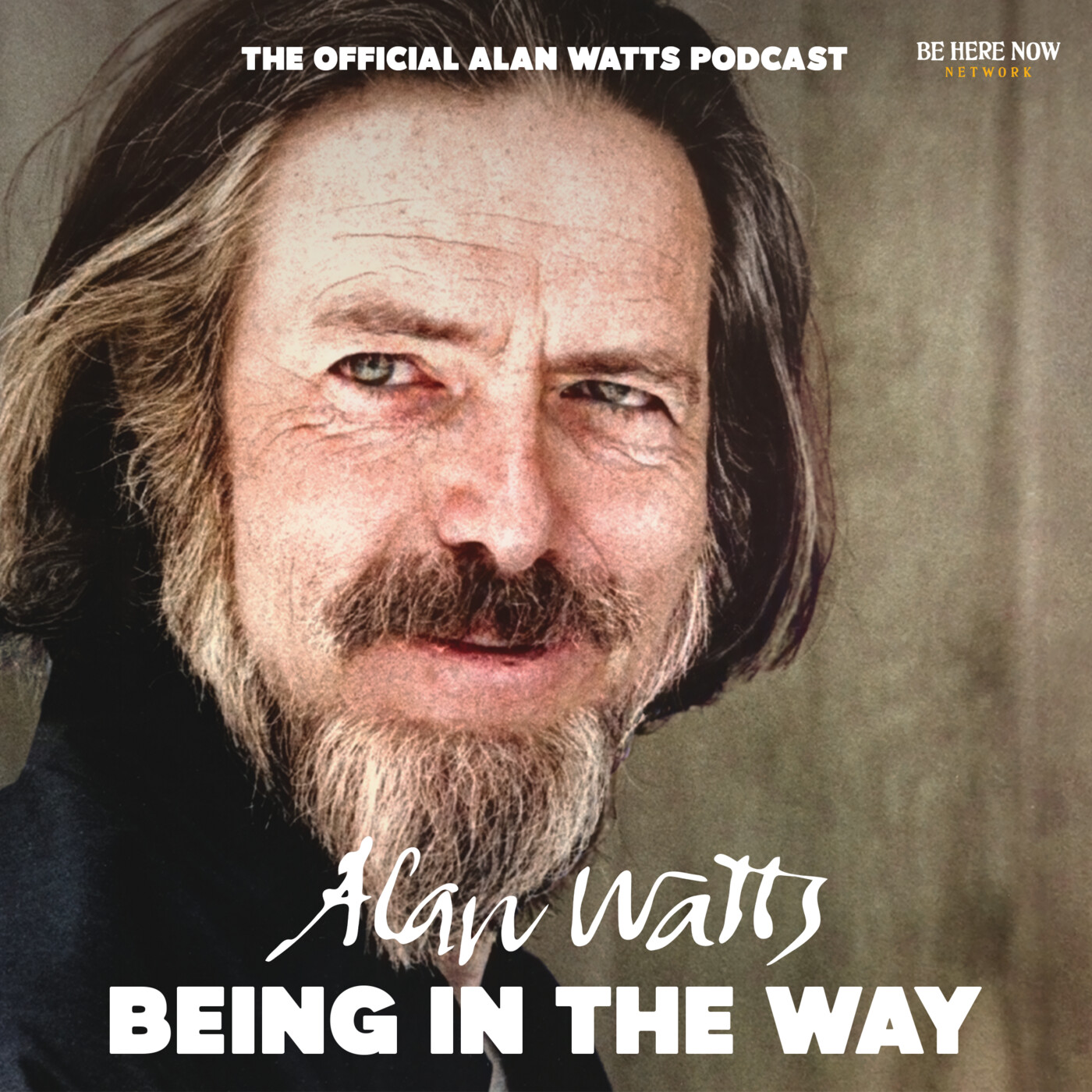
Loading summary
Transcript6 lines
- [00:03]
A
This episode is sponsored by BetterHelp. As the calendar turns to February, it's like love is in the air. The month is full of flowers, candy, stuffed animals, and of course, lots of talk about dating and relationships. Sometimes it can feel like everyone has their love lives together except for you. The truth is that almost everybody is still figuring it out. The path of love isn't easy. No matter if you're married, dating, single, or just focusing on yourself, therapy can help you find your way and see more clearly where you want to be. With over 30,000 therapists, BetterHelp is the world's largest online therapy platform, having served more than 6 million people globally. Plus, they do the initial matching work for you so you can focus on your therapy goals. If you aren't happy with your match, you can switch to a different therapist at any time, sign up and get 10% off@betterhelp.com Alan that's better. H E L P.com Alan.
- [01:25]
B
Because after all, what would you do if you were God? If you were what? There is the Self. In the Upanishads, the basic text of Hinduism, one of them starts out saying, in the beginning was the self, and looking around it said, I am. And thus it is that everyone to this day, when asked, who is there, says it is I. For if you were God, and in the sense that you knew everything, that you were completely transparent to yourself through and through, you would be bored.
- [02:12]
C
Welcome to being in the Way. I'm your host, Mark Watts, and this is the the Alan Watts Podcast. And we've been listening to my father talk about the dreaming of the world. And this theme, in which the world is seen as the dream of the divine, is taken from Hindu mythology. And he brings in the idea of technology. What if we had a magical device that could give us any dream we like? And interestingly enough, of course, we're a long way from the dial telephone he mentions. We do have that push button device known as a computer. We now can, through technology, create imagined versions of reality fairly quickly and easily, but the question of whether they are ultimately fulfilling is wide open at this point. My favorite moment in this is when he suggests that what we need is a big push button surprise. And perhaps we end up sitting around here listening to this podcast. It's a wonderful piece, and the next one is very charismatic and fun. He explores similar themes. This is about the cosmic drama. Again, a mention of the game of hide and seek, but he takes it further after beginning with the four fundamental philosophical questions. And the point is that if the World is indeed a divine dream. Don't we all already have a seat at the table? And so thank you for joining us today. Alan Watts on Dreaming the World.
- [03:49]
B
After long consideration, I have come to the conclusion that there are four fundamental philosophical questions which have been debated for as long as we know anything about intellectual history. The first one is who started it? The second is, are we going to make it? The third is where are we going to put it? The fourth is who's going to clean up? But when you consider all of these together, they prompt a fifth question, which is perhaps more fundamental than all of these. Is it serious? And when we say to the doctor about someone we love who is in some ghastly kind of sickness, doctor, is it serious? That means, is the person in danger of his life? Because it is almost the fundamental supposition of Western thought, at any rate, that life is serious, that we have an obligation to survive, and that there is therefore something shameful about dying. Life, in other words, is not a game. If it is a game. The first rule of this game is that this game is serious. I remember some years ago counseling a woman much older than myself who was afraid of dying. And she wanted to know why she was afraid. She couldn't figure it out. And we had a long discussion, and she was clear that it wasn't the idea of being annihilated, and she'd really outgrown her childhood fears of hell. She didn't really, wasn't really terrified by the pain of death. But she said, do you know, I finally realize, I think, what it is. I'm afraid of what people are going to say. They're going to stay at the funeral. I can see them all there. Poor old Gert, she couldn't make it. Because, you see, we all labor under this obligation to live. And this comes from our earliest training in childhood, where we are taught that we must live. And it comes about in very odd ways. We run into a basic confusion about the meaning of the word must. And the confusion is as to whether this word expresses a state of affairs and a condition that is, or whether it's a precept, a commandment. In order to be human, you must have a head. That's obviously not a precept. Nobody ever attempted to have a head. But when a mother says to a child, darling, you must go to sleep. It's for your health, this is taken by the child as a commandment. And so the child tries to go to sleep, which is an infallible method of staying wide awake. So likewise, you must have a bowel movement every morning after breakfast. This, too is taken as a commandment instead of simply a condition of being healthy. The worst one of all is the commandment, you must love me not, darling, of course, because I say so. But I would only want you to do it if you really want to. Now, that is one of the most discoborating, subversive things that you can ever say to another human being. You must love me. In other words, I command you to do something which will be acceptable only if you do it voluntarily. And so imagine it how often this happens when one spouse says to the other, darling, do you really love me? What answer are you looking for? I'm trying my very best to do so. Oh, dear me, no. You want the spouse to say, darling, I can't help loving you. I love you so much I could eat you. I'm out of my mind about you. In other words, you want them to express a state of affairs which is, as a matter of fact, anything but voluntary. You want the person who loves you to say that they love you in the same way as they exist. They didn't ask to exist. They can't help it. And there it is, for better or for worse. And that is one of the basic paradoxes in which we all get tied up, and it's called, been christened by the ethnologist Gregory Bateson, the Double Bind. And we're always being tied up in this thing. And the first rule of this game is that it's not a game. The supposition of this drama is that it's not a play. Of course, every great actor will try to put that over on you. You know that here stands the proscenium arch when there's a performance going on. And that what happens on the stage is in jest, is in play, it isn't somehow real. And yet the actor is going to use all the skill that he has to convince you that what's going on the stage is real life. He wants you on the edge of your seats with anxiety. He wants you crying, he wants you laughing, because he's taken you in completely. Now, the Indian Hindu theory of the cosmos is precisely this, that the universe is a play, a dramatic act which they call Leela, whence our word lilt Lila means play or sport. And the universe is looked upon as the playfulness of the Godhead who is playing a game of hide and seek with himself. And that every so often he pretends that he's not himself and that he's all of us, not only the human beings, but the animal beings, the angelical beings, the diabolical beings, the vegetable beings, the mineral beings, every kind of being that there is, he hides from himself in these forms. And then, after 4,320,000 years, which is the basic reckoning unit of the ingoings and the outgoings of the cosmic game, the supreme self, the which than which there is no witcher, wakes up and discovers who he is after all. And that's great, what a relief, because in the end, the thing becomes a nightmare, it becomes a tragedy, and the universe finally blows up in the awful awfuls, just as it does for each of us individually when we die. But there, behind the great show, is the actor. And this idea is of course, fundamental to all the conventions of the stage, because the whole notion of the stage, of the drama, is that the actor comes out not as himself, but as a Persona. And the word Persona in Latin means that through which the sound passes and refers specifically to that mask worn by actors in classical drama, a mask with a mouth shaped in the form of a megaphone so that it would project the sound in an open air theater. And so, at the beginning of a play, the dramatis personae is the list of masks that are to be worn by the actors. And by a curious inversion of the meaning of words, the word person has come to mean not the mask, but the real thing. Harry Emerson Fosdick wrote a book called how to Be a Real Person that is correctly styled how to be a real fake. In other words, how to be a good actor. But it disquiets us, doesn't it, the idea that the whole world might be a big act. We are also, in social life, a bit disquieted when we get into the company of stage people, people in showbiz, because we are not sure whether in real life they are still acting. Who are you? That's the great question. One of the most magnificent Indian sages of modern times, Sri Ramana, always faced people with this question. When people came to him and said, oh, Master, who was I in my past incarnation? Will I be reincarnated again? Etc, etc. He always used to say, who is it that asks, who are you? And he asked this question, I've got a photograph of this man. I never met him, but I know lots of people who did. And he has a funny look in his eyes, a curious twinkle. And you can feel those eyes from the very photograph going right through you. Not with judgment, not with condemnation, but with a kind of a wicked, humane Twinkle. In other words, it says, listen, buddy, don't fool me. I know who you are. And you say, who, me? Why, I'm just little me. I'm not a very important person. I'm just a poor little human, like in Haussmann's verse. I, a stranger and afraid in a world I never made. The teacher looks at you and says, old Shiva, don't give me that stuff. I know who you are in your million masks. And you look out and say, I'm just poor little me. That's the technique, you see, of the awakeners, the people who in Hindu, the Hindu world are called gurus, the so called spiritual teachers who kid us out of our egocentricity. Egocentricity being the predicament wherein the universe and all that is beyond the universe identifies itself with a particular role or part that it's playing in the game. Now, in our culture, you just mustn't get mixed up with that kind of thinking. I've been thinking for a long time what is really taboo in our culture and a good many other cultures besides. But it used to be sex. But sex isn't taboo anymore. You could buy books on sex anywhere. Any child can find out all about it. It's the easiest thing in the world. There's a slight flavor of taboo hanging over it from the older generations, but it isn't a serious taboo anymore. Not since Freud. You know, there's two ages, BF and af. And in AF sex is no longer taboo. What is taboo? There's always something. The real taboo is what the Hindus call in their immortal phrase, tattvam asi, which means that art thou you lurking behind the mask of being an impermanent human person, are really responsible for the whole thing. But if anybody claims that in our culture, we put them straight away into an asylum. That is the very hallmark of insanity. But in India, if somebody suddenly wakes up one morning and says, my goodness, I'm God, everybody says instead of you're crazy or blasphemous, they say, congratulations, at last you found out. But of course, you see, they have a rather different idea of God from ours. Our popular idea of God, quite aside from any of the ideas of the more profound theologians, our popular idea of God is that he is the master technician who has created this universe in much the same way that an engineer creates a machine, a carpenter makes a table, or a potter makes a pot. And he knows how he does it. So anybody who says I'm God, we immediately challenge him with technical questions. If you are God, how did you create the universe in six days. All sorts of questions like that. But you see, the Hindu's God does not need to know in words how he does what he does in exactly the same way that you don't know how you grow your hair, you just do it. And after all, can you know how to do a thing better than by just doing it? You may have a physiologist knowledge of how you open and close your hands, but that doesn't enable you to open and close them any better than anyone else. Unless of course, you've got a wrecked hand and you need a physiologist to put it back in shape. But in the ordinary way of things, you know how to think because you think, but you don't know how you think. You don't understand all the intricacies of the nervous system underlying the process of thought. You just do it. So like the centipede who can manipulate a hundred legs without having to think how to move each one. So the Hindus conceive the Godhead not as a technician, but as a cosmic centipede who is wiggling all of us like so many legs. That's why the Hindu gods have many arms. There's one Buddhist divinity with 1000 arms. And. But this thing doesn't have to stop to think how it's done. That would be inefficient, because thinking is a process of concentrating your attention on what is called one thing. That is to say, one think at a time. And that won't do at all for the regulation of complex processes. That's why we are now so fatigued with thinking that we're getting computers to do it for us. Because computers can think of ever so many things at once, and that's where they have the advantage of us. So a Hindu therefore feels no kind of blasphemy or inconsistency or insanity in suddenly realizing that, that he is basically what there is. That you aren't directly aware of this, of course, just in the same way that you are not directly aware of your brain structure, nor are you aware of the incredibly subtle interconnected system of relationships, balances, networks, whereby your brain is part and parcel of the whole physical universe and exists with it in the same kind of togetherness as a front exists with a back. So in this sense, you see, we are all something that everything is doing. Every wave is the ocean waving, the whole ocean waving, announcing its presence. So in the same way, each one of us is a waving of all that there is, saying, yoo hoo, here I am only it comes and it goes. All waves come and go. They have their ups and their downs and we have our ups and our downs. When we are up, then we suddenly see John Doe. When we are down, there's just a corpse. Then, whoops, it comes up again as Mary Smith. And whoops, it goes down. And so it goes, like the sparks in the soot on the back of the fireplace. In and out, in and out, in and out. Everyone different than the one before and yet somehow the same. Now, in, as I said, in the Hindu view of the cosmology, this is a drama. And that means its basic spirit is playful. It is a game. But the difficulty that we have in understanding this idea is that we don't distinguish between the many connotations of the word play or game. A lot of people say to me, when I produce this idea, do you mean it's only a game, that all this is somehow therefore trivial? And I say, no, look, when you go to listen to a great pianist play the Beethoven sonatas, you are actually going to an entertainment. You pay entertainment tax to get in. But you wouldn't say, would you, that this was mere entertainment. There is something about music which is beautifully illustrative of the point that I'm making, because music is sheer and total play. The highest music that both west and east have produced has no meaning beyond itself. That is to say, Mozart sonatas do not imitate the sound of charging horses, tinkling brooks or screeching factories. They convey no social message. They are pure delight in complex orders of sound, almost mathematical. And you see, music is purposeless in the sense that it has no direction. It is not designed to arrive somewhere. I mean, if the point of music or of any musical composition were to arrive, that is to say, to reach the finale, the best conductors would be those who got there the fastest. And in the same way with the dance. The dance is a high and lofty art. It is not mere entertainment. But when we dance, we do not dance with the object of reaching a particular position on the floor. You see, we could go straight there and cut out the dance. In music and in dancing, the point of it is always the going along of it in a kind of continuing present. Now, what about the world? Let's take a look at nature. Is this a musical thing or is it a compulsively purposive thing? Look around at the creatures, the vast variety of insects, the amazing multiplicity of plant forms of bacteria. Look at the stars, the nebulae at night. This tremendous prodigality, this profusion of energy. If we ask the question, what is it all for? I think this is the wrong question. It sort of doesn't need that question. It answers itself. Just as when you listen to music, you don't ask, do you? What does this mean? You. You just dig the sound. You swing with it. And so in exactly the same way, the world may be seen in all the multiplicity of its creatures as fabulous. G.K. chesterton once made a very profound remark when he said, it's one thing to wonder at a fabulous creature like a gorgon or griffin that doesn't exist, but it is of a much higher order to wonder at a rhinoceros, a creature that does exist and looks as if it doesn't. Now, you see, there are people with engineering mentalities. I don't want to insult any engineers present in the audience, but what I will call a certain kind of engineering mentality that has an explanation for everything, namely, that butterflies have those big eyes on their wings as a kind of survival dodge, that chameleons change color in order to affect something or other. Or they have another way round of putting the same point, which is that because certain butterflies had eyes on their wings, they frightened the birds more than other kinds of butterflies and therefore survived. Everything, in other words, is nature is approached from the standpoint of an efficiency expert. And the idea is that there is an instinct to survive. This is the same old compulsion I was talking about. You must go on surviving. But actually things don't live in order to survive, because surviving and living are the same thing. You survive until you don't, and that's that. It seems to me altogether more rational to look upon this amazing profusion of existence as poetic and musical and therefore as playful. But in order to be a good play, it has to have an element and a subordinate element of seriousness in it. That is to say, we can't have a good stage play without introducing a villain. And the villain has to be convincingly played. There has to be a real big act, and everybody gets afraid of that villain. That's absolutely essential. So in the same way, there has to seem about life an element, a very convincing element indeed, of the ultimately tragic. Only the big question is, is it so? Put it in another way, is the universe a system in which there can occur an irretrievable mistake, as indeed the Christians have conceived in the idea of eternal damnation? That is one of the most extraordinary ideas ever hatched out of the brain of man, that there might be the possibility of things going wrong forever and Ever and ever. Well, the Hindus, of course, when they look at that idea and realize that the Christians hatched up this ghastly possibility to scare themselves with, they rather applaud, they say, the Christ. They see that a Christian soul in peril of everlasting damnation is actually the Supreme Lord playing this part. They think, now he's really scared the wits out of himself. And this is the most marvelous performance in the whole thing. The suspense of that is a great dramatic moment. But the Hindu has that funny look. Which says, Well, now we've got to get to the bottom of this. And I want to really. I'm a little diffident about this because I don't want to insult anyone's intelligence. But I do want to give you what should be called the first lesson, what your mother should have told you before you learned about 1, 2, 3 and ABC. There is something underneath all that. There's something much deeper. And it's, of course, about black and white. But now let me introduce it by asking you to consider all your senses as forms of one sense. Basically a sort of sense of touch. Because seeing is touching at a distance. Our eyes are so sensitive that they can touch light. Our ears are so sensitive that they can touch vibrations of air. Our fingertips are less sensitive. In Western civilization, our noses are almost insensitive. But these are all forms of response to touch, whether they be rather solid things like tables and rocks, or whether they be very subtle things like tiny particles in the air or light waves. So when your senses are touched, they go off and on. Either there's something there or there isn't. Now, when you consider, for example, the phenomenon of sound, there isn't actually such a thing as pure sound. When you hear a sound, a note being sung, you are actually hearing a vibration. You are hearing sound, silence, oscillating. Because it is the alternation of sound and silence that impresses us. This is so with almost all contacts. If you have a delightful girl sitting next to you and you want to make your presence known to her, and you put your hand on her knee and you leave it there, she will cease to notice it. But if you gently pat her on the knee, she'll know you're still there. Because you come and you go. Now you see it, now you don't. So all physical. All physical manifestations are, in this sense, vibratory. They are pulses. Light is a pulse. And the most solid rock is also a pulse. And you can't put your finger through it for the same reason that you can't put your finger through an electric fan. When it's revolving, it's going too fast. So this table is going so fast that I can't. Darn it. Philosophers are always using tables to illustrate something because they speak in classrooms. Gets a little boring. But still it resists because it's going so fast. On, off, on off, on off, on off, on, off. So you see, this is the process, the nature of a wave you can't have. There is not such a thing in nature as half a wave. A wave, that is to say, which has only a crest and no trough. To get a wave, you have to have a crest and a trough at the very least. So the up and the down go together. Likewise, therefore, the black and the white. So what we call existence is being, non being. So therefore, to be or not to be is not the question. To be and not to be are inseparable companions, just like Tweedledum and Tweedledee, who incidentally agreed to have a battle. So between all these explicit differences like the top and the bottom, the up and the down, front and the back, the light and the dark, explicit differences have behind them an implicit unity. That is to say, they are always found together. There is, as it were, a conspiracy under the surface to look as different as possible. And yet to be one, it takes one to produce difference. Because, you see, you don't know what you mean by difference unless you know what you mean by unity. You don't know what you mean by is unless you know what you mean by isn't. You know, there is a match booklet in this hand and there isn't one in this hand. Abstract from that and you get the idea of being and non being, but they go together. Now, the whole joke that's been played on you by you, of course, is that they don't go together. That, in other words, black might win. That seems very persuasive. After all, when one looks at existence, you realize it's quite an effort, a lot of energy going on. Wouldn't it have been so much easier for there not to have been anything at all? Once you get that idea, existence becomes odd. And so also, when you think about death, what would it be like to go to sleep and never wake up? That thought always makes us intellectually dizzy. And it makes you think about birth. The funny event of waking up after never having gone to sleep. There's something distinctly spooky about that. But you see, this is all part of it. That the black side has to be real, genuine black. So that the white side can be real, genuine white. And it must always seem as if whenever black turns up, that's going to be the end. And this is the conspiracy. So when you've got the game, uh oh, black might win, you have to play the next game, which is, uh oh, white must win. And so we start it all out, the battle between the sides. And from this battle come all the complexities of human culture. Just out of black and white. Look how complicated we can make them. The game of heads and tails is one of the very simplest forms. Will it be heads? Will it be tails? That gets boring. We make it more complicated. We make them into dice, we make them into checkers. More complicated still. Chess, that's all based on black and white. But how elegant, even color emerges finally from black and white. Analyze our composite structure down to its final terms and we seem to turn up to be something like a newspaper photograph, you know, black and white dots that stand away from them and they seem to be light and shadow. The pointilly painters saw this, that we are all this buzzing little on, off, yes, no, yes, no, yes, no, yes, no, yes, no, yes, no, yes, no. Every neuron is either firing or not firing. Yes, no, yes, no, yes, no. And out of this multiplicity of yes and no, look at this. But it all depends on this little joke, see, that we forget somehow that yes and no go together. A person who understands that, you see, is a sort of initiate. He's been let in behind the scenes. He's what you would call a person who's very far in. There are a lot of. Most of us are very far out. Actually, the person you might call a square is the most far out person there is. Because he really believes that black might win, that white must win. He's completely bamboozled. He's altogether forgotten the secret. So he's way, way out. Lost as lost can get. But how brave, how magnificent. But so that he doesn't go off his head altogether. There are always in society some far in people. They're what are called the esoteric people as compared with the exoteric people. And the far in people are rather cagey. They don't give the show away too easily. Now, you might say you're not being very far in. You're explaining to us what the joke is. And you really shouldn't do that. Because if we knew that it was all all right and that the whole thing was a joke, what would happen to our incentives? Now I feel I can say all this quite safely because very few people will believe it. Because it's very difficult to believe. The other position that Black might win is marvelously persuasive. So maybe in this audience there might be a few people who would understand. And then our anxiety is, will such people stop the show? Will they suddenly become inert, be enemies of progress, or become, frankly, immoral? Because, you know, you want to obliterate someone. And after all, they're not serious. They're just a mask of God, which is the same as you are. You can just push them out of the way. Doesn't matter. Will they get like that? Well, there's always a gamble, you see. The whole thing is a gamble. And there's always danger. Every good thing in this world is dangerous. The moment you teach a child how to walk, you give it the capacity to kick its mother. The moment you have fire to warm yourself and to cook with, you have the possibility of destruction. There is no way around danger. So, of course, a person who was, in the highest sense of the word, disenchanted, you see that it's a marvelous word because it has a positive meaning as well as the usual negative one. To be enchanted is to be spellbound, to be fascinated like a chicken with its nose on a chalk line. So the actor who is really involved in playing the world is fascinated. He's enchanted by his own spell. Spell in the beginning was the word you see, the chant. So to be disenchanted is to suddenly recover from a state of auto hypnosis, to wake up. That's why a Buddha means, from the Sanskrit word bud, to waken, to be awakened. A Buddha is one who has woken up and who knows? My goodness, it's all a dream. But what a magnificent dream. Beautiful. See, A great work of art. Art in the highest sense. Maya, as the Hindus call the world, as well as Leela, Maya means very roughly illusion. But it means a lot more besides. It means magic, it means art. It means creative power. It means construction from a root word, mater, to lay down the foundations of a building. Hence our word, meter, measure, metric, And also matter. Does it matter? Means, does it put on a good show? Does it amount to something? Is it a convincing illusion? Illusion likewise connected with the Latin ludary, to play. But you see, we have a culture in which words like play, illusion and so on have a bad connotation. We don't want to get with an illusion. And we want, in the end to know, I wonder if we really do want this, that at least God is serious. Now, look, if I say to you I love you and supposing I say this in a very personal way to a particular individual, the person I say that to turns around to me and says, are you serious? I say, no, no, no indeed, but I am sincere. This is a commitment. It's a rash commitment. It's the height of rashness, but it's therefore not serious. Kaiserning, in his South American meditations, makes the point that a man of spirit is above all a man lacking in seriousness. He as a man of courage plays with his life. And to quote GK Chesterton again, he said, the angels fly because they take themselves lightly, are much more so than the Lord of the angels. I mean, just let me put this in anthropomorphic terms, because there's an important thing about talking about God in anthropomorphic terms. A nobody takes it too seriously. B, it puts things vividly in ways that escape more abstract intellectual language. I mean, when all those angels and saints are around the throne of God in heaven forever and ever, what sort of a show do you want to be going on? Is everybody going to look at each other and weep? Are they going to stare into the eye of the Lord and say. Dante in the Paradiso describes the hymn of the angels, and he says, it is like the laughter of the universe. In other words, they sing Alleluia, Alleluia, Alleluia. What the devil does that mean? It doesn't mean anything, except it's a kind of celestial whoopee. So you see, what I'm pointing out is this, that even in the tradition of the most serious religion that there is, the one that really takes life seriously, because there's the possibility of ultimate tragedy. Even in this most serious religion, its mythological forms, its symbology gives a little tweak to give away the show. Just as in those Hindu images of Shiva the destroyer aspect of the divinity when he is dancing the Tandava, the dance that he dances at the end of the cycle when the whole universe is destroyed, he's shown with ten arms and fierce aspect. And in his nine of his arms he has bells and thunderbolts and clubs and knives. But one arm is, in this gesture, the hand palm outwards, fingers up. It means, don't be afraid. This is a big act. So you see, the notion of the world as playful is, I think you may agree, the only finally workable and rational solution to our predicament. There is always, of course, the chance that it might not be. There is indeed the chance that you may wake up to find yourself everlastingly damp, or that you may never wake up at all. I don't know what that would mean, except nobody would ever know whether it was serious or wasn't. But it seems to me that there are certain metaphysical systems, some of which are good gambles and some of which are not. Because a great deal of the problems of life resolve themselves to the question, what are good game rules? Ethical questions have to be decided this way. Aesthetic questions and questions of simple political organization. Now you can obviously see, can't you, that a social order in which nobody trusts anybody else is not set up as a going game. If everybody is spying on his next door neighbor, and if we have a big brother who's got a kind of television outlet and a mic in every room, everybody's bugged. And that's no game because the poor old big brother can't even take a walk in the park. He's got to sit there watching everybody. The Hindus worked this out in a book called the Arthur Shastra, where it is a manual of operations for the perfect tyrant. And it gives minute instructions. How to hedge himself in with rings like the rings of a spider's web. How he gets the different ranks of his courtiers and advisors. He puts them all at enmity with each other so that they will all spy on each other and all report on each other. And then right in the center, he lives in the super protected room where he has guards, but other guards watching those guards. And he has a secret exit out from the middle that goes somewhere down to the river where he's got a fast speedboat waiting. And on the way out there's a keystone he can pull and make the whole palace collapse. Now here is a man living in perpetual paranoia. He can't even sleep. He has to have some violet taste his food for him to be sure it isn't poisoned. He's the maximum non trust. And this is a non workable system. You cannot throw a ball unless you're willing to let go of it. So in exactly this way, game rules have to have play in them. That is to say, they have to be. A good game has to involve a wonderful balance of chance and skill, randomness and order. Then it has a chance of going on. I was discussing tossing a coin. That's a very boring game. Tic tac toe is a pretty boring game because if you know how to play it, anyone who starts wins. So it reduces itself to tossing coins. On the other extreme, three dimensional chess is much too complicated for most people to keep track of and they lose themselves in the tangles of it. But somehow in the middle, games like poker, bridge, chess, even go marvelously intriguing. People can get fascinated. You know how it is. Once you become a chess buff, you can't let go. You go on and on and on and on. Well, that's what we call the instinct for survival. You know, the moth game, the bee game, the bird game, the man game. You can't let go. It's fascinating. So we're all human buffs. A universe that man saw that peoples just as an apple tree. Apples. And the apple tree. Apple serves to go on appling because appling is great. So is treeing. But you can see different forms of trees and different forms of animals in the same way as you get the difference between mazurka, waltz, Charleston, twist, rumba or sonata, fugue, partita or mahjong, chess, dominoes, it's all like that. The question is to find out the most fascinating thing. See, if you play chess, which can become a game of pure skill, with the element of chance almost eliminated when a real champion is concerned, it ceases to be fun after a while, unless you have an opponent who is a little bit unpredictable. The whole point of it is that you cannot quite figure out the other person's skill. And that introduces an element of chance. But if a game is pure chance, the fun goes out of it, unless you're out of your mind and think that there is a serious chance you might win. So it's in looking for that strange balance that we find a clue to what it's all about. The question is simply fundamentally, do you have the nerve to follow that through? Can you look black night death in the face and say, well, I really do know you're the other side of white. You come on pretty fierce, but that's your nature. And that anxiety which constantly asks the question, to be or not to be, and therefore trembles between them will in the end turn into laughter, the same trembling. But it knows that to be and not to be are inseparable twins.
- [54:40]
C
Thank you for joining us today for a talk on dreaming the world. This particular talk is from the Ways of Liberation series, and you can find this in its entirety on the Alan Watts.org website. And in future weeks, we will be featuring other talks from this series and also from the Way Beyond Seeking series on Taoism. This podcast is brought to you in conjunction with the Ram Dass Be Here now podcast network. And our theme music is by Zakir Hussain, courtesy of Moment Records. Thank you for joining us today for a talk on dreaming the world.
- [55:40]
A
What we now call Mindfulness is rooted in a convergence of ancient disciplines, traditions refined and practiced for centuries before reaching modern Western audiences. On Tuesday, March 3, join Krishna Das, one of the most recognized voices of bhakti chanting in the west, and Buddhist teacher David Nikturn for a free online conversation about these spiritual paths, their shared roots, and how they intersect in contemporary spiritual practice. We'll also discuss the upcoming dharmamoon Mindfulness Meditation Teacher Training program, offering an overview of the training, a chance to meet the teachers, ask questions, and see if it might be the right fit for you. Visit dharmamoon.com heart for more info and to reserve your spot for the free online event with David Nichtern and Krishna Das.