← All-In with Chamath, Jason, Sacks & Friedberg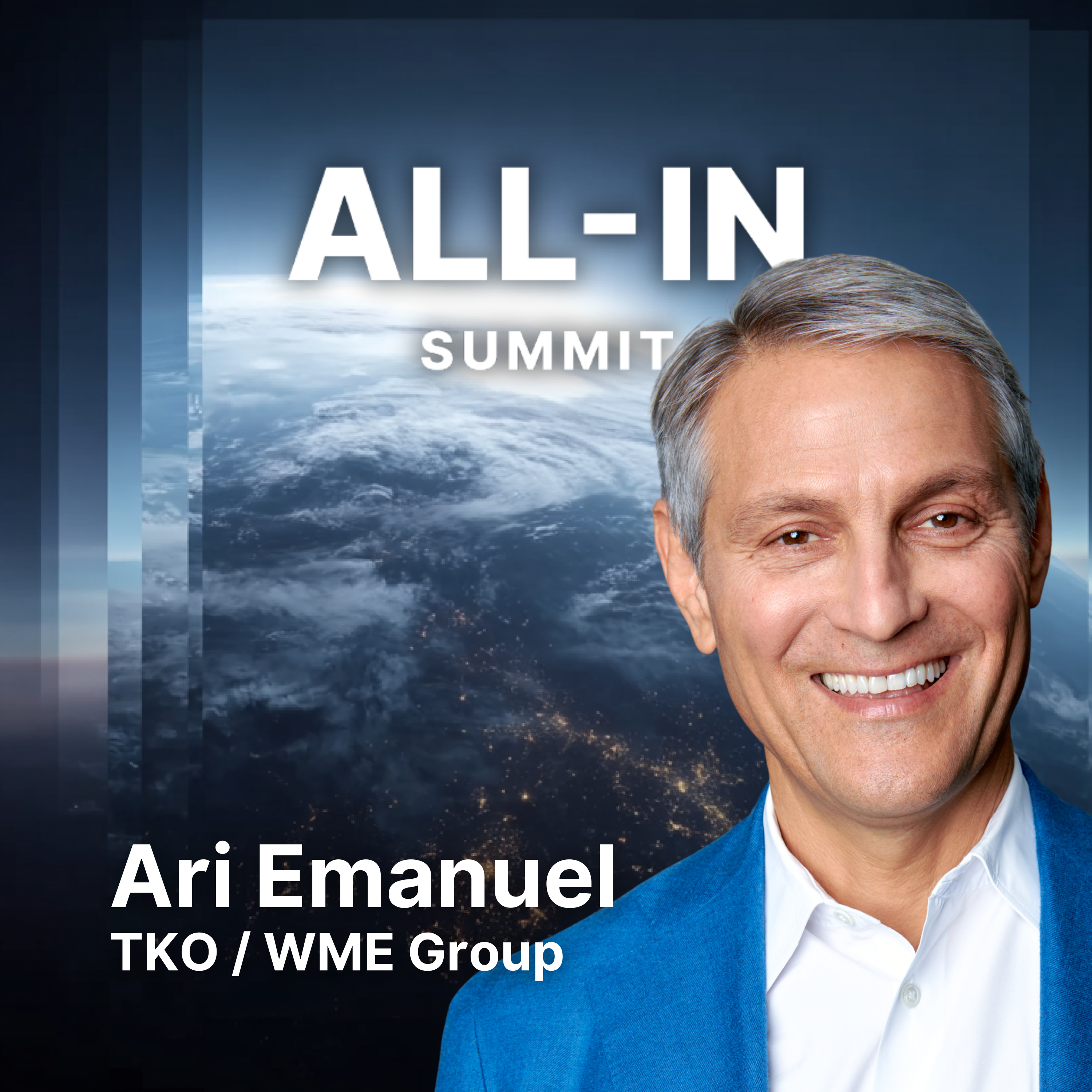
All-In with Chamath, Jason, Sacks & Friedberg
Ari Emanuel on the Future of Entertainment: Hollywood, AI, Creator Economy, YouTube vs Netflix
00:27:25
Loading summary
Transcript160 lines
- [00:05]
Ari Emanuel
Ari Emanuel, the newest kingpin of Combat Sports, one of Hollywood's biggest power brokers.
- [00:10]
It's everywhere from the boardroom to, you know, even politics.
- [00:14]
Interviewer 1
There was another figure named Ari Gold that many people thought was named after you.
- [00:18]
Ari Emanuel
The straight talking dealmaker has a reputation for getting what he wants.
- [00:22]
Interviewer 1
I'm back and you're fired.
- [00:23]
Ari Emanuel
Emanuel has worked tirelessly to transform Endeavor into a multi billion dollar behemoth.
- [00:30]
Interviewer 1
Ladies and gentlemen, please welcome Ari Emmanuel.
- [00:40]
Interviewer 2
Thank you. Hey, welcome.
- [00:43]
Ari Emanuel
When's the last time we saw each other?
- [00:44]
Interviewer 1
At that dinner?
- [00:45]
Interviewer 2
Exactly.
- [00:46]
Ari Emanuel
Yeah.
- [00:46]
Interviewer 3
Did you see that panel?
- [00:48]
Ari Emanuel
Yeah.
- [00:50]
Interviewer 3
You know Alex?
- [00:51]
Ari Emanuel
Yeah, I know Al. Yeah, I think he's great. I love this book.
- [00:56]
Interviewer 2
Yeah, the book is incredible. Yeah.
- [00:57]
Interviewer 1
So what's your take on what?
- [01:00]
Ari Emanuel
We just had a lot to cover there on my take.
- [01:03]
Interviewer 2
Well, let's start at the beginning. Ari, you have had an incredible arc. You've built an incredible business and recently you've had the opportunity to merge a bunch of assets and just the thing has just taken a life of its own. Can you maybe walk us through the last four or five years of the evolution of Endeavor and your process of first leaving, building a business, then scaling it up and just all of that action? The TikTok of it all.
- [01:30]
Ari Emanuel
So March 29, when I first came here, I was making 15 cents a mile. When I moved to LA, went to work at CAA, et cetera, then started the company March 29 on my birthday, 30, almost 31 years ago, had this idea about where content was going from George Gilder who wrote this book, like for television and said there's going to be infinite distribution and then content's going to be really, really valuable and there's going to be many forms of content. And so we kind of went out and started growing the business and trying to get into every sector of the business. Made a two horse race with when we quote, unquote, merged with William Morris. I think one of my best deals, actually, that merger. And then when Teddy Forsman passed away, bought IMG with Silverlake, who had come into the company. And then we were in sports and then we realized it was all in the representation business and then realized that because of what we built, the infrastructure we built in the global scale we had in the production and representation, we could start owning some of the assets as opposed to just representing them and kind of put them through our filters and kind of create more value. And so the first thing we did is we bought this company called Professional Bull Riley that was, I think, making $3 million a year. In profit. We turned it into a really nice business. It's still growing. And then because of that, and we had negotiated, you know, we negotiated every day against networks and studios. The UFC came up and we said, okay, let's take a big swing. The funny thing is, when we bought img, they say we overpaid. It was the cheapest sports acquisition ever happened. And definitely when we bought ufc, they were like, at four point at the.
- [03:36]
Interviewer 2
Time, it looked incredibly expensive. Yeah.
- [03:38]
Ari Emanuel
And all we had to do is kind of make a broadcast deal that then took the multiple down from 20 times to kind of under 10. We then thought we could take all those assets. My big mistake here. A conglomerate.
- [03:51]
Interviewer 2
Yeah.
- [03:51]
Ari Emanuel
The marketplace just didn't understand it. And so we tried to take it public. Right before COVID failed. I didn't realize how hard it was to go back out. Finally got it back public. We kind of rolled all of the UFC into endeavor, and. And we still weren't getting any value. Vince said yes, and we merged the assets. A pure play was in sports. Sports entertainment was a better conversation with the street.
- [04:20]
Interviewer 2
I mean, when you started, we had the traditional cable networks, then we had cable. It was a very hierarchical and easy to understand hierarchy. And then you have the streamers. And now this afternoon we'll have Neil Mohan from YouTube. Then you have characters like the Mr. Beast of the world who can go direct. So it's very chaotic.
- [04:40]
Ari Emanuel
No, it's actually just back to George Gilder.
- [04:42]
Interviewer 2
It's back to George Gilder.
- [04:43]
Ari Emanuel
There's infinite distribution, many forms of content. People consume podcasts, people consume stuff on Instagram and TikTok. People consume stuff now on the streamers. And I don't believe that traditional business is going away for a long time because a lot of us sports guys have. The NFL, the NBA has still sold stuff there, plus also sold it to the Amazons of the world. And so you just have a vast kind of map of where distribution is.
- [05:17]
Interviewer 2
So distribution has gotten vast. But a lot of people would say, some people would say the kinds of content has gotten a little ossified, calcified, rigid, maybe.
- [05:27]
Ari Emanuel
What does that mean?
- [05:27]
Interviewer 2
Meaning, like, you know, you don't see, like the broad swath of the content that you would see maybe 15, 20 years ago. People.
- [05:34]
Ari Emanuel
I think there's more content now.
- [05:35]
Interviewer 2
But do you see people taking creative risk the way that they used to before?
- [05:39]
Ari Emanuel
I don't know. I think. I think. I think I can't get enough content. I don't think. I don't know about you. There's Going to be more content than there's ever been. I think there's incredible voices out there. I think the content that's being made is it. There's a vast majority, and I think it's really incredible. I do. Yeah.
- [05:57]
Interviewer 1
Ari, what do you think of podcasts and the general movement of top talent, Megan Tucker, you guys okay? Sure, we're a little bit behind them, but the ability for them to be independent and not affiliated with the network, this is something we have not seen in the industry. There were gatekeepers. You used to have to get packaged, represented, and now, you know, people come to us all the time with different opportunities to join different networks. I won't talk about any specifics, but we've decided, well, why would we need them?
- [06:30]
Ari Emanuel
You need to be independent.
- [06:30]
Interviewer 1
Yeah. Why would we need them if we have this amazing audience?
- [06:34]
Ari Emanuel
The funny thing is, I think the podcasting business is going to turn into the syndication business that used to be on the broadcast and the station groups.
- [06:40]
Interviewer 2
So Oprah was the behemoth King World kind of thing.
- [06:43]
Ari Emanuel
Oprah was the behemoth, and then Dr. Phil and Dr. Oz. She launched a bunch of them. You'll probably see that reincarnated through people with podcasts if they want to.
- [06:53]
Interviewer 3
We saw that at Barstool.
- [06:54]
Ari Emanuel
Yeah.
- [06:55]
Interviewer 1
So you're saying you will become the.
- [06:57]
Ari Emanuel
Next cable slash syndication model through this, through the multiple channels.
- [07:01]
Interviewer 1
So we should be a network and we should develop talent.
- [07:04]
Ari Emanuel
Yeah. You need some representation, guys.
- [07:07]
Interviewer 3
Here's what the problem is, Ari.
- [07:08]
Interviewer 1
It's like a lot of the representation, to be totally honest, sucks. We don't. Yeah. And we would only consider a peer, you know, relationship with somebody who has done it before at a high level. If you know anybody.
- [07:21]
Ari Emanuel
Yeah, I don't.
- [07:22]
Interviewer 1
You don't.
- [07:23]
Ari Emanuel
Well, Ari, anybody Good? I don't know.
- [07:25]
Interviewer 3
One of the things we're talking about you, Ari.
- [07:26]
Interviewer 2
Yeah.
- [07:27]
Interviewer 3
One of the things that I've noticed has become a common kind of thread with these big independents is they move from what used to be kind of commercial ad placements to sponsor deals where they got one sponsor to eventually owning their own business.
- [07:39]
Ari Emanuel
Correct.
- [07:40]
Interviewer 3
And the value there is so much greater because the multiple. You get a multiple on revenue, you don't just get advertising the marketing line.
- [07:46]
Ari Emanuel
Right.
- [07:46]
Interviewer 3
You know, Tucker has his Alps product, which J. Cal, fortunately is not on today. No, please don't put it on.
- [07:53]
Interviewer 1
You're saying use the promo code. All in.
- [07:55]
Interviewer 3
Well, Jimmy's got his chocolate bar company. Is that the future, do you think, for monetization for the big independents? Is that they actually own the equity in what historically have just been sponsors for them. And that's where the value is.
- [08:07]
Ari Emanuel
Well, you're going to own the equity in your podcast, right? And then a lot of people and we started this business, I don't know, about 10 years ago, we started at WMU called Talent Ventures, where a lot of musicians, actors started. Because, you know, with the broadcast networks and cable channels ratings going down, you know, manufacturers had to get to the audience. And so they used to do it through commercials. When that rating went down, they started then giving equity or people started launching a lot of different products. Sometimes it was alcohol, sometimes perfume, sometimes it was food, et cetera. That will now start happening with people like you other podcasters.
- [08:50]
Interviewer 1
Gwyneth Paltrow has done an exceptional job.
- [08:52]
Ari Emanuel
That's just a natural evolution because of where broadcast television is and cable television is. Manufacturers are going to have to get to an audience. You guys have a very big loyal audience. This events and things that you do over the air products will come to you. You will make the decision, are you taking the sponsorship dollar or are you taking the ownership dollar? And that's just evaluating the economics and whether you believe in the product. There's a lot of things that go into that.
- [09:21]
Interviewer 3
Yeah.
- [09:21]
Interviewer 2
Ari, how much of your time are you spending trying to figure out where all these next gen AI tools either help you, give you maybe operating leverage to actually go and be even more creative on the content versus maybe disrupt some of the legacy folks you've worked with.
- [09:38]
Ari Emanuel
You know, we have a whole program being set up at TKO and William Morris about kind of how AI can help us on the production side. There's a whole nother that the studios are doing and our clients are doing. You know, I have, I've made a decision. I don't know enough about AI. I'm not smart enough to know enough about it. I made a decision that live content is where I'm going to sit. I'm really good at that. I'm really good at monetizing that. So we have a pure play sports, sports entertainment business I just launched which will launch in October. Kind of what I believe is the next kind of live events business. You have our sports business, you have Live Nation and Michael Rapinoe is an incredible. That's pure play music. And I think there's when we were a public company, now we're a private company. We had 700 events inside Endeavor. I have. It will be completed in first week in October. Bought a lot of those, raised about $2 billion and I'm going to go pure play in events because I think it's the opposite if you have AI over there. The opposite bet on AI is not data centers.
- [10:50]
Interviewer 2
Humans want connection.
- [10:51]
Interviewer 1
We keep going back to live.
- [10:53]
Ari Emanuel
And I think it's kind of like a four day work week now. Probably going down to three. I was seeing Elon and seeing the robots. Probably three day work week for full employment. They're going to be a lot of free time. We definitely all need connections as we can see right here. And so my whole thesis is live. And I think on the William Morris side, which is incredible, there's only two representation business. William Morris is the biggest one of all of them. And there's going to be more room for companies.
- [11:19]
Interviewer 2
I want to slow down and double click into this.
- [11:21]
Ari Emanuel
Just wait.
- [11:21]
Interviewer 2
So we work Monday through Friday, Saturday.
- [11:25]
Ari Emanuel
I don't think a lot of people work Monday through Friday anymore.
- [11:27]
Interviewer 2
But I'm saying like, yeah, we used to Monday through Friday, Saturday you're schlepping the kids to soccer. Sunday you get a rest day, watch some football, then rinse and repeat. That's all a lie now that's going away.
- [11:36]
Ari Emanuel
No, no, no. Right now, drive times, average drive times in America, 11 to 4. So people are doing their chores 11 to 4, doing their stuff that they have to do on the weekends. In the morning or in the afternoon. They have their mobile phones. They're doing their stuff. Thursday, hotel bookings are way up, way up.
- [11:55]
Interviewer 1
So three day weekends.
- [11:56]
Ari Emanuel
Three day weekends. I'm shocked what this is from back there. You should start drinking coffee because if you just look at the data, we're at four day work weeks now. I think it's going to three day.
- [12:09]
Interviewer 1
Work weeks, which means more time for entertainment. More entertainment is your key piece to it, Sacks. You wanted to get in.
- [12:15]
Interviewer 4
Well, I was going to spill on something Chamas said, which is you have so many different things you're involved in. How do you decide how to prioritize your time? Because you could be helping William Morris clients. Representation could be a never ending job by itself. You've got tko. You could be looking for new acquisitions. How do you decide how to spend your time?
- [12:33]
Ari Emanuel
Thank God I have ADHD. Listen, actually this Friday is two years since we did the merger at TKO. We merged at I think $100 and then went down 79. Anybody says they don't look at their stock price, I look at it every like 19 times a day. Yesterday we hit 200. We're doing, I think everything we said we were going to do with regard to kind of streamlining the two businesses, integrating them. We brought over in February, PBR on location and img, which kind of fills out the suite of what we do at TKO for everybody that wants sports. We've made our broadcasting deals, and we're just kind of powering away at what that, you know, focused on what we have to do.
- [13:22]
Interviewer 4
Are you personally at this point, just kind of out of representation?
- [13:25]
Ari Emanuel
No, no, no.
- [13:26]
Interviewer 4
Or do you dip down sometimes and help clients? How do you see that?
- [13:29]
Ari Emanuel
You know, being in the representation business, whether it be Marty Scorsese or Dwayne Johnson or Mark Wahlberg or Peter Burr or a whole host of my clients, Aaron Sorg enables me to make the deals over at TKO, because I'm in the conversation with YouTube, Amazon, Netflix, all the people I need to be in business. And I do that. The running of that business now, because I'm not in. Like, you didn't call this person back. I don't do that anymore. But in the representation of my clients and the clients of the agency, I'm in it every day because it does help the other businesses.
- [14:08]
Interviewer 1
Which platform are you the most obsessed with? YouTube, Netflix, all. Okay, but which one, if you have a client, do you think is the most important over the next five or.
- [14:19]
Ari Emanuel
10 years, who's going to pay them the most amount of money and creatively enable them to do what they want?
- [14:23]
Interviewer 3
Well, Ari, let me ask you a question. This is a really important question. I was going to ask this of Neil as well. I've heard from a number of folks that have historically done production on Netflix that they want to move to YouTube because Netflix like the margins compressed. And so they're offering and. No, that's not true. Okay, that's not true. And so I've heard a lot of folks say, well, if I go independent, I have unlimited upside. If I publish on YouTube, I just need financing. Is there an emerging world?
- [14:48]
Ari Emanuel
Listen, those are different. It depends on where you're at. If it's a YouTuber, right?
- [14:55]
Interviewer 3
And they want to scale up and.
- [14:56]
Ari Emanuel
They want to scale up and they have X amount, they'll probably start on YouTube or start on. Or start at Facebook or start on Twitter. Once they get to a certain level, they'll make a decision. Do they have a product that's right for a half hour or an hour on Netflix or a feature film that's different from what YouTube's business plan is? And Neil will talk to you about that. So again, you can't generalize that competition.
- [15:23]
Interviewer 3
Are you seeing A burgeoning of income, independent financing for production that would go out on YouTube, like where folks are saying, I just need production financing. Find me some partners, and then.
- [15:33]
Ari Emanuel
You mean it for a YouTuber.
- [15:34]
Interviewer 3
For YouTubers, yeah. Sometimes that's not something you're seeing kind of scale up right now.
- [15:38]
Ari Emanuel
I'm definitely not in that space. You know, David said, that's not something I do see. There's people in my company that do that. We have a whole division for YouTubers, et cetera, podcasting. That's a whole group that we've started. It's very successful right now.
- [15:54]
Interviewer 1
Ari. There was a time when the dream of content creators was being able to own their ip. Netflix came in and said, hey, we'll pay you much more, but you don't get to own the Simpsons anymore. You don't get to own this IP yet.
- [16:07]
Ari Emanuel
Well, remember the syndication model as broadcast television started to fade away as this. But there was a. At the beginning, there was a third window, which was Netflix. Now the cable and the station group window has kind of dissipated a little bit. Right. But when you still. When you make a deal at a broadcaster smaller now, you do have a bidding war between Netflix, whether it be if you're at NBC. Peacock. We just finished a big. We're finishing up a big deal for the Office, which started on broadcast. The new stuff they're buying out. Yes.
- [16:42]
Interviewer 1
Yeah. So you don't have this opportunity to do what the Simpsons did, to do what south park did, to do what Seinville did. But you yourself, I don't know.
- [16:52]
Ari Emanuel
The last deal I just made for South Park's pretty good for the guys.
- [16:54]
Interviewer 1
No, I know, but that seems to be the last generation to get that. This new generation seems to be just giving their IP over to Netflix. You yourself are saying, I want to own the ip, and you're choosing to buy them. So what is your advice to the client? Because they can't become billionaires if they don't own ip.
- [17:14]
Ari Emanuel
So there's a client. There's a client by the name of Noah Holly just had the Alien Earth show that it premiered at Disney. He did Fargo also. Incredibly talented guy. I just signed him. Right. He's going to make a new deal. Now. Back in the day, Greg Daniels or Larry David or Aaron Sorkin or Jim Brooks, clients made an unbelievable amount of money.
- [17:42]
Interviewer 1
Jim did well.
- [17:43]
Ari Emanuel
All of those people I said did very, very, very well. Yes, he will not make as much money as they did in syndication, but he will do very, very, very well. So if you're really talented and you have success, you will do really well. And when it gets re. Aired and resold, he'll do very, very well. It's not. If you have a show that goes into syndication and it gets $6 million an episode, you can't make five, $600 million anymore, but you can make tens of millions more than that. But you can make. You can do very, very well.
- [18:18]
Interviewer 1
You were.
- [18:20]
Ari Emanuel
I mean, I'm not crying.
- [18:21]
Interviewer 1
You're famous for fighting hard. In fact, there was an iconic character created on Entourage for that.
- [18:27]
Ari Emanuel
Yeah.
- [18:29]
Interviewer 1
Which was your favorite fight? Is it Sherry Azoff? Was it Justin Baldoni? Mike Ovitz? Which did you get the most pleasure fighting with of all these iconic fights?
- [18:39]
Ari Emanuel
You know, like I just said, all. No, I mean, when you're at the beginning of your career 30 years ago, and you do not have the ability to change price, and you have. At the time, you had William Morris, icm, uta, caa, and you're the fifth. And you have to fight really hard because people just think you're a chump.
- [19:07]
Interviewer 2
Right.
- [19:07]
Ari Emanuel
And I don't. When people don't think because I'm dyslexic. I remember growing up, anybody that thought I was stupid, they touched the third rail. And so when you were growing up in this business and everybody thinks, oh, you're just pushover. I'm not good There any chance?
- [19:27]
Interviewer 1
No, but this is. And this is a serious question, bringing Entourage back. Why hasn't this happened? We love this. We grew up on it. How many people want to see the reunion? You're the guy who can make it happen. I'm friends with Adrian Grenier. I talk to him all the time about it, and he says, not my choice.
- [19:44]
Ari Emanuel
Are you guys having David Zaslav on this, on this panel? No, I think you guys should call him.
- [19:49]
Interviewer 1
Is he holding the strings?
- [19:50]
Ari Emanuel
Well, yeah, they. Hbo. Hbo.
- [19:53]
Interviewer 1
But you're Ari. You could go and just tell them to do it.
- [19:56]
Interviewer 4
Let's help that deal happen, please. On Competition, was Michael Ovitz a mentor to you or a competitor?
- [20:02]
Ari Emanuel
I worked for Mike. I was in the mail room then. I was on a desk. He was, you know, he was incredible. And you. He kind of changed the business before him was Lou Wasserman. They would be on Mount Rushmore. I think Mike did so many things right. I mean, he was a visionary for that. The one thing, when I was a young guy looking at it and looking back at it, you know, he started. He took coke. I think it was from Gray Advertising at the time. I Think it was Gray. And I always said to myself at the time, like, he had so much currency at the time, why didn't he buy Gray Advertising? And he could have changed the dynamic of the agency. He could either take it public. And so that went. And then I was at this company called Intertalent. They got bought by icm. ICM had the greatest agents, and it just was bad management. And then we started the firm, and I just said, you know, I'm not going to have a bad culture like icm, and when the opportunity comes, I'm going to go for assets that I could own and change kind of the dynamic of what an agency and what representation and what.
- [21:10]
Interviewer 4
And that's what no one had done before, is think in terms of equity. Are there any assets that you don't own that you wish you did? Or would you like to buy a studio? Would you like to buy sports teams?
- [21:19]
Ari Emanuel
I don't want to buy a studio. I don't want to buy a sports team.
- [21:21]
Interviewer 4
Okay.
- [21:22]
Ari Emanuel
I just started this company. I raised about $2 billion. I'm going to start this big events company. So my plate's really full. I'm loving life right now. And, yeah, I mean, TKO is in a great place right now with all the deals we made. We have a great partner in David Ellison. And you saw what happened at the VMAs, where our thought process. They put it on MTV, they put it on CBS, and they put it on streaming, the largest audience they ever got. That's going to be the same thing for the ufc. And now Bob Iger and Jimmy Potara are going to launch the WWE on espn. I think it's going to be incredible for that asset.
- [22:02]
Interviewer 2
Do you think that all sports.
- [22:04]
Ari Emanuel
There's nothing left right now.
- [22:06]
Interviewer 1
Right.
- [22:06]
Ari Emanuel
We're launching. You know, we have a big fight this weekend, the Canelo fight with Netflix, So we're in good place.
- [22:14]
Interviewer 2
Ari, do you think that all sports continue to do well in the future, or will some sports have to adapt for, you know, the fact that kids have a shorter attention span, they just need faster action. Like what happens to things like baseball, what happens to the. Maybe the slower, more prolonged sports?
- [22:29]
Ari Emanuel
You know, I think everybody's going to have to adapt. The thing I like about our sport is, like the ufc, it's fast bull riding, eight seconds. You know, you get it. You can watch it on your phone. WWE is family entertainment, and all of them are. Both the UFC and the WWE are huge global brands. I think all of them. Except, you know, I had a conversation With Roger Goodell yesterday, I was like, how many storylines can you get? It was an unbelievable week, except for Monday night when the Bears lost. But I think a bunch of them are going to have to adapt, and I think for some of them, pricing is going to have to come down because I don't think the US Domestic market is the right place for them as it relates to hockey and baseball. The big ones, they've done an incredible job adapting to the kind of new environment.
- [23:24]
Interviewer 2
I think baseball's cut like 40 minutes off of the average game.
- [23:26]
Ari Emanuel
They really incredible what they've done. They've always been innovative. When they launch, Bam. And they've been ahead of the curve.
- [23:33]
Interviewer 1
So what do you think about international markets? Obviously, India and China, huge markets. The NBA has done an exceptional job. They're probably going to have something in Europe. The Knicks, my Knicks, which are going to win the chip this year. They're going to be playing in Abu Dhabi. Their preseason games. How do you view the internationalization of these live events?
- [23:51]
Ari Emanuel
I mean, just look at that Brazil game for the NFL. Incredible. Look at what baseball did when they launched the Dodgers and the Cubs in Japan. Everybody's realizing the value that can happen now. We just had a UFC event in Shanghai, which we have a facility in the PI. We're going to Abu Dhabi. We've always, in ours been international. It's a requirement for continued growth in the sports that you have to go international.
- [24:18]
Interviewer 2
Sorry.
- [24:18]
Ari Emanuel
All of them are going to adapt a little bit and try and figure that out.
- [24:21]
Interviewer 2
I want to shift and ask a personal question. You come from an incredible family. Your brother Zeke is an incredible doctor. Your brother Rahm worked at the White House, was mayor of Chicago.
- [24:29]
Ari Emanuel
You're incredible ambassador. Japan.
- [24:30]
Interviewer 2
Ambassador to Japan now. Yeah. You're an incredible entrepreneur and businessman. Is there a competitiveness. Has there ever been competitiveness amongst the three of you as you guys, why.
- [24:39]
Ari Emanuel
Do you think one's in Chicago, one's in Washington, one's in LA cities, when they come together, like, they can explode. Yeah. I mean, really? Yeah.
- [24:49]
Interviewer 1
Where did it come.
- [24:50]
Interviewer 3
Where did it.
- [24:51]
Interviewer 1
Wait, but where did it come from?
- [24:52]
Ari Emanuel
Let me just tell you something. I'm winning.
- [24:55]
Interviewer 1
Where did it come from? And who did. Who did mom love most?
- [24:59]
Ari Emanuel
You know, my mom says this all the time. My Rom used to say, you don't love me as much as you love Zeke. Zeke is the doctor and the vice provost at Penn. And she turns to him and she says to all of us, she goes, I hate you all equally. Ah, that's my point.
- [25:16]
Interviewer 1
That's where it comes from. Still trying to get Mom's love. I got it.
- [25:20]
Interviewer 2
And what about your long term. You have a long term friendship with one of our besties, Elon.
- [25:25]
Ari Emanuel
How did that evolve after 9 11, I gave up my Ferrari. I bought a Prius. Didn't really like the Prius. I was looking for a better car. I read the article that he's launching. I just call him. He picks up, comes in the office. I say, I have to have one of these cars. I think I got number 11. I still own it, the first model. And he and I have just been friends ever since. I just actually, on Tuesday, I went up to see the robots because I want to do a UFC fight with his robots. And the robots, meaning robots versus Robots. Yeah. I think it'd be incredible.
- [26:05]
Interviewer 1
Yes.
- [26:06]
Ari Emanuel
And I saw what he's creating. The man's a genius. The hand is incredible. Their ability to kind of. He had one. He showed me one that was kicking and boxing. And when he talks about it, he talks about, you know, there's probably about 100 million people in the United States that actually are working bodies. When you have a Robot, it occupies five people, works 24 hours a day, and there's no HR, there's no issues. He says he goes through all the numbers and it's an incredible argument. And I think he'll be able to produce a million of them. It's going to be really profitable.
- [26:49]
Interviewer 1
And they're going to cost a dollar an hour to operate.
- [26:51]
Ari Emanuel
When I saw what the hand was doing, I think it was the third or fourth generation.
- [26:56]
Interviewer 1
Yeah.
- [26:57]
Ari Emanuel
I was like, it's incredible. And now the movement and the charging that he's got down, it's really. He's a special human being in that capacity.
- [27:05]
Interviewer 2
Really special. He really is an American treasure. Ladies and gentlemen, Ari Manuel.
- [27:10]
Ari Emanuel
Amazing.
- [27:11]
Interviewer 1
Thank you.
- [27:11]
Interviewer 2
Thanks, bro. Great to see you. Thank you.
- [27:13]
Interviewer 3
Thank you. Bye.
- [27:15]
Interviewer 2
Bye. Thanks.
- [27:16]
Interviewer 1
Don't crush it. Wow.