← All-In with Chamath, Jason, Sacks & Friedberg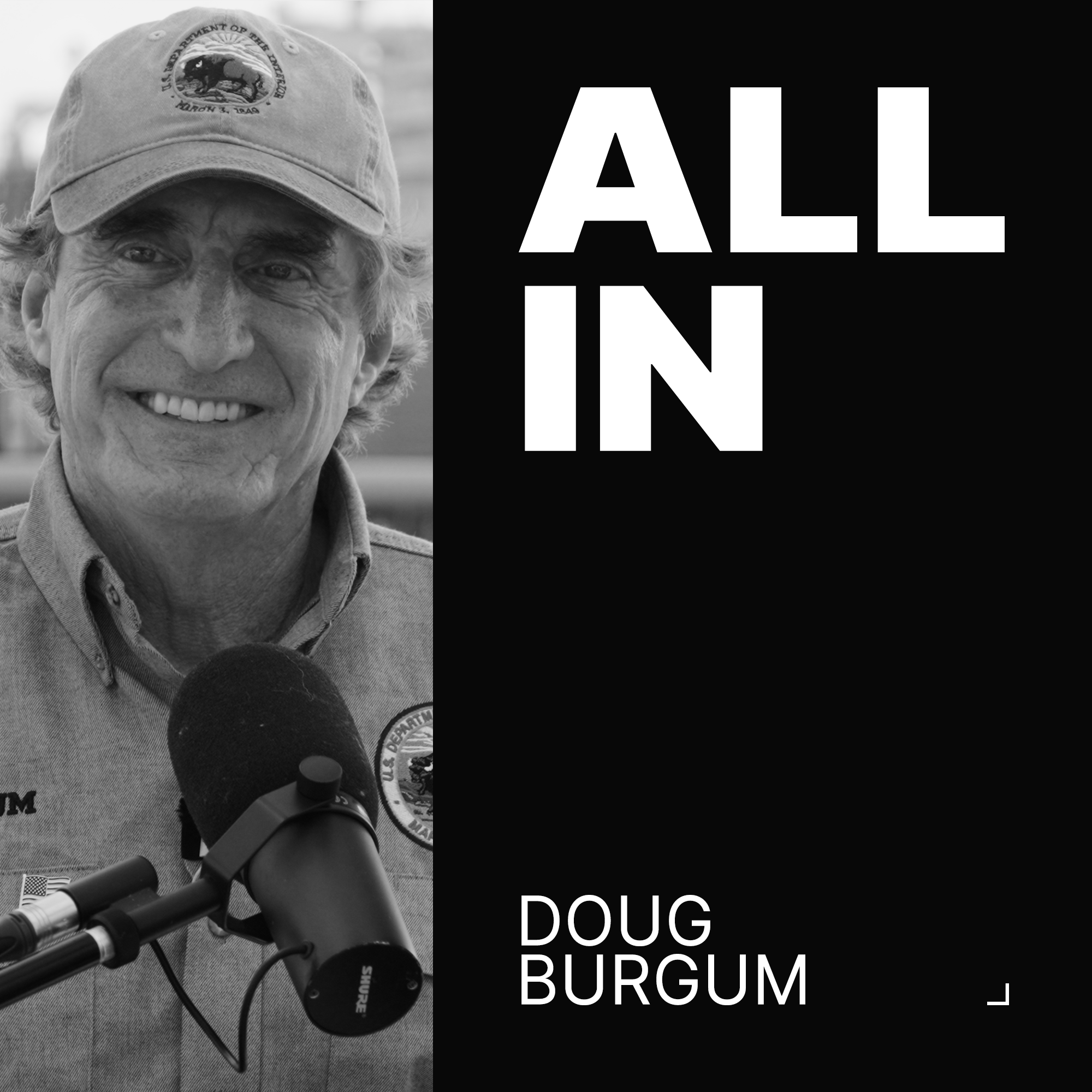
All-In with Chamath, Jason, Sacks & Friedberg
Doug Burgum, Secretary of the Interior | All-In DC
00:51:37
(0:00) David Friedberg introduces Secretary Doug Burgum (2:11) Burgum's background and how it led to his role in the administration (10:56) The state of American energy and how we got here (22:32) America's energy emergency: AI, unlocking potential,...
Loading summary
Transcript90 lines
- [00:02]
A
We're here on the Celsius Galway in Sabine Pass just outside of Beaumont, Texas with the Secretary of the Interior, Doug Burgum. The crew is giving us a tour. This is an amazing export facility, the largest in the United States, second largest in the world. We're going to talk with the secretary in a minute about American energy independence and the role that this company, this facility and this process plays. So excited to have the conversation with the secretary. What'd you think?
- [00:38]
B
Well, he's fantastic. But to be on a brand new ship like this is pretty special. Brand spanking like this is the first cargo it's taking. This is like not even out of the showroom. Brand new. I mean, look at that. Those are spotless.
- [00:52]
A
Yeah. This was definitely coordinated for you. I have a suspicion.
- [00:55]
B
But it's beautiful.
- [00:56]
A
I think they coordinated for you, David. Yeah, right.
- [00:59]
B
They heard you were coming, Doug.
- [01:00]
A
They were saying in 2008 this facility was basically bankrupt.
- [01:04]
B
Yes.
- [01:05]
A
And this has been a development project since about 2012. And it went from practically nothing to the largest LNG exporter in the world in 13 years. In 13 years.
- [01:15]
B
And prior to that when it was originally built. Because this is before the amazing miracle of the whole shale revolution in our country. Without that, this was being built as a LNG import facility. That was the original thing. We're going to have to import LNG to America now. LNG is the number two dollar export on the all time list for the country. It's the second most highest dollar value we export. We went from being like, oh, we're going to run out of oil and gas to today we're energy independent on a net basis and we're on our path towards becoming energy dominant. All right, besties.
- [01:56]
A
I think that was another epic discussion. People love the interviews.
- [02:00]
B
I could hear him talk for hours.
- [02:01]
A
Absolutely.
- [02:02]
B
We crushed your questions in a minute.
- [02:04]
A
We are giving people ground truth to.
- [02:06]
B
Underwrite your own opinion.
- [02:07]
A
What'd you guys think? That was fun.
- [02:09]
B
That was great. I'm doing all in.
- [02:11]
A
Welcome to the all in interview here today with Secretary Doug Burgum, the 55th Secretary of the Interior of the United States of America. We are here in beautiful Sabine Pass in Louisiana today at the Cheniere LNG facility. It's been an amazing tour this afternoon. It's a little bit windy, but it's still a beautiful afternoon. Thanks for joining me today, Doug.
- [02:31]
B
David, it's great to be with you. Thank you for coming down and seeing this amazing facility.
- [02:35]
A
So we just took a great tour here. Why were you here today? And what are we checking out?
- [02:39]
B
Well, I think President Trump, one of his core goals, if we talk about energy dominance, which is beyond energy independence, it's not just a slogan. It's really about how do we have the power to power AI in America, how do we power the remanufacturing in America, and then how do we sell energy to our friends and allies so that they don't have to buy it from our adversaries? And what you and I had a chance to see today is the largest LNG export facility in America, the second largest in the world.
- [03:06]
A
Yeah, I was struck. I didn't really realize how quickly this facility grew up. Just about a dozen years ago, there was nothing really going on here. And now it's the second largest export facility of methane in the world. And methane is seeing a massive surgeons around the world because it has a lower carbon footprint. There's demand, it's transportable. So there's a lot of reasons why there's a massive growing market for liquefied natural gas or methane.
- [03:32]
B
Absolutely. And part of the amazing energy transformation that I think is not fully appreciated by most Americans is when this plant began in the early 2000s, it was meant to be an LNG import facility. America was running out of oil and gas, and they said, wait, we got to be ready to start importing it just to meet our needs. Well, along comes the shale gas revolution again, driven by technology. That technology of horizontal drilling, that ability to fractionate rock and get oil and gas out of places that people thought was just impossible that we would ever be retrieving those resources from those hard rock shale locations. And so then this thing, after the financial crisis turned around and began its life as an export facility. And now, as you say, the only one larger in the world is in the Middle East.
- [04:21]
A
So I want to go back a little bit and how you ended up in the seat, how you ended up not just being the Secretary of the Interior, but you're also the chair of the National Energy Dominance Council. I really want to talk about the importance. I talk about it on the podcast a lot about the importance of growing energy production in this country. But you're a tech entrepreneur who is from North Dakota, became governor of the state. And I'd love for you to just do your highlights. How you ended up there, what you did with respect to energy, and also how that translated into a surplus of jobs and economic prosperity for that state.
- [04:56]
B
It's been quite a journey, you know, starting out in a town of 300 people in North Dakota with all Gravel streets and no computers. To end up having an opportunity to be part of a software startup, you know, grow that business, take it public, have a great run as a public company, get acquired in an all stock deal by Microsoft. Stayed there for seven years, you know, helping grow Microsoft from 40,000 people to, to 90,000 people. And there was 2,000 of us at Great Plains when we got acquired. There was 1200 in Fargo, 400 rest of North America, 400 rest of the world. We've become this improbable global software company coming from the Great Plains. And then when I left Microsoft to presumably spend more time with kids, retire, that was an epic fail. Ended up in two more startups within six months, was involved in three more software IPOs and dozens of other businesses, and I mean software businesses. And then in 2016, at a time when we were having an energy collapse in prices, there was an open seat for governor. And I threw my hat in the ring and we were down 69,10 in the polls in January. The primary was in June. Catherine, who became the first lady, was like, oh, we've got a great life. Why would we get into politics? Why would we get into that? And I assured her that we had no chance of winning. She didn't have to ever worry about being first lady, but this would be fun for six months to create some competition. But we ended up winning that primary and then went on got. It was a good year for outsiders. So we took office in North Dakota. You start middle of December. So about 36 days ahead of President Trump. We were sworn in, had four amazing years working with President Trump as a governor. There was a win behind our back and then second term, we got reelected by the largest margin in the country of any race. But then I was serving as a governor under the Biden administration and in a state where we'd become, we're rapidly becoming a very resource rich state. We had climbed to being the number two oil producer in the country. We had tremendous coal resources, incredible agriculture resources in ranching. And the Biden administration really was having a war on. And whether it was timber, grazing, oil and gas, coal, critical minerals, I mean, anything that had to do with extraction, there was a regulatory battle going on. And I would have to say that a part of me not just became frustrated, I became very concerned about the future of the country. And that led to, you know, jumping at the national level and saying, hey, we've got to have a policy because if we don't have energy security, we're not going to have national security. And that's what really drove the sort of us sitting here right now today.
- [07:45]
A
So you ran for president, you ran for the Republican nomination against President Trump and others, and then obviously President Trump got that nomination. Did you keep in touch with him after that? And how did you kind of work with his staff and his office as he was moving his campaign forward?
- [08:01]
B
Well, we were in touch because, you know, we knew each other as a governor would know a president.
- [08:06]
A
Right.
- [08:06]
B
But I was never really running against President Trump. And I think the record shows that I was really running against these horrifically dangerous and unsound unsafe policies of the Biden administration, which are almost too numerous to enumerate. When I Left office last December 15th, just December 15th of 2024, as governor, I was involved in 30 lawsuits against the Biden administration, many of them including against the agency, the bureaus that I'm now leading, because the regulatory regime was such that it wasn't about regulating oil and gas, it was about eliminating oil and gas from America. And if there was some sort of false God around climate ideology that was being chased, it was like, oh, if we stop the supply coming from the US we're going to somehow save the planet. But there was no reduction of demand. The demand was just being filled by Iran, Venezuela, Russia, and they were funding wars against us. So, I mean, I thought it was the closest thing to insanity that I'd ever seen. And so when, when we, when we dropped out very quickly, I was the first of any of the other candidates to endorse President Trump and. And then spent last year campaigning for him.
- [09:21]
A
Yeah. And then there was, can I say this, some rumors that you might have been in the running for vice president, but you obviously stayed close with the president and his staff and found your way into this role. How did that process go for you? How did you end up in this role that you had?
- [09:34]
B
Well, it's a. I love what I'm doing and I love the role because, of course, as a Western governor, we have all the things that Interior has. As governor of North Dakota, which is a jam packed, fun job, you've got your chairman of the land Board. And just being governor, well, then, you know, dealing with land and minerals and all the leasing and all the issues with the energy industry. You're also the head of the Water Commission. Interior has the Bureau of Reclamation, which is the second largest hydroelectric producer in the country, and manages, you know, the miracle of irrigation that Theodore Roosevelt came up with. We wouldn't have agriculture in Arizona or California without that. And then Bureau of Indian affairs is part of interior. And that's something I had a lot of experience with and all the challenges that we face in terms of healthcare and education on the tribal areas. So across the whole realm of interior, everything that I had in North Dakota is part of my job today, except one thing, and that's offshore oil production. Because North Dakota, as you would know, is the center of North America. So if you're afraid of sharks, you should move to North Dakota because literally it is the furthest place in North America from any ocean. So we had no offshore. But today, earlier today, I had a chance to get on my first offshore platform and see the innovation and entrepreneurship there. That's again now providing about 16% of the oil for the America.
- [10:58]
A
So I mean, let's talk about the energy problem, the energy opportunity. Before we do, I think 50% of the potential audience of this conversation tune out and say, this is evil, there's good and there's bad. This is bad. Exploitation of natural resources, extraction of natural resources damages the planet, ruins the environment, puts carbon in the atmosphere, drives climate change. And they won't listen to any conversation about the pragmatism of energy security and the importance energy plays in prosperity. Taking people out of poverty, raising them up, raising living standards, and giving access to things around the world that every individual wants, which is more prosperity. And one statistic I always quote is that if you go back 500 plus years, you can see and there's all these studies that have tried to understand energy production versus gdp, which translates to prosperity per capita. And there's a linear relationship. The more energy that's produced, the more, the higher the GDP per capita. And that's what we see around the world in developing markets today. So I guess maybe you could just take a moment to talk to those folks, share a little bit about your perspective of the relationship between taking care of the environment and the planet and the importance of energy demand and energy security before we get into the things that are going on.
- [12:21]
B
Well, I think you're spot on. I mean, human flourishing depends on. And I think if you're talking about access for everyone, just take a look. I mean, we could have as many as 800 million people on the planet, you know, shy of a billion that don't have access to electricity and they need more energy. Now with AI coming, the demand for power is going to go up, the demand for advanced manufacturing. So we're not in any kind of energy transition. We're in an area where we need energy addition. And if we want human flourishing if we want to reach our planet's fullest potential, and if we want to take care of. Of our environment, which we can do all these things at the same time, even that requires energy. I mean, if you're worried about water sources, well, desalination, which we can do, requires a lot of energy. Transportation of goods requires energy. So whether it's the clothes on your back, the food on your table, the transportation drive, there's an energy component to all of that. And electrifying stuff doesn't change. It just changes the source of the. We still need to create the electricity. So I feel like that if anybody is concerned about the environment, they should want to have it. Every ounce of a liquid fuel and every electron produced in the United States, because if you compare us to any other country, we produce it cleaner, safer, smarter, and healthier than anyone else. And I learned in North Dakota over those eight years as governor, where we were always on the top of the list of cleanest water, cleanest air, best soil health, all of these things that we were able to achieve, and we were going up the charts in terms of energy production. These things go hand in hand. It's not either or. It's a plus when you can do both.
- [14:00]
A
And we were just talking to this crew on board the ship we just visited. They're on their way to Taiwan and they go to Japan. And so if we can produce liquid methane in this country with a lower carbon footprint, then that methane might be produced elsewhere, which is the case. We have cleaner methods for production, and that demand exists regardless of whether or not the United States produces it. It's important that the United States take advantage of the opportunity to produce it cleaner, more safely, and with a lower footprint and build economic prosperity for us as exporters.
- [14:31]
B
Yes, absolutely. I mean, so the net formula that you've just described is the more energy that's produced in the United States, the better it is for the globe and the better it is for American prosperity. And I would say it's not just for the globe environmentally, it's also for. For peace. It's not just prosperity at home, but literally the two proxy wars that we've been involved in with Russia after Russia invaded Ukraine and after Iran funding 24 different terror groups. They were funding those wars against us with their oil and gas sales. And so if we can replace their customers with US Sources, they have less revenue, they have less funding, literally to fund terrorism. So it is prosperity at home, peace abroad. It's nothing short of that.
- [15:11]
A
So let's talk about the energy demand equation. The US is forecasted to increase its electricity production capacity from 1 to 2 terawatts by 2040, 15 years from now. During that same period of time, China is going to go from 3 to 8 terawatts. And that China forecast by the way, excludes any of the Gen 4 nuclear reactors, the new hydroelectric facilities and the new thorium, or if that ever scales, that they're considering rolling out in addition to what they've already planned to roll out. So in the next 15 years, China is adding 5Americas in electricity production capacity. And if everything gets automated, factories are automated, AI becomes the great accelerant of the global economy. China is hugely advantaged relative to where we sit today. What do we need to do about it?
- [15:56]
B
Well, this is the. If you were to ask me what's the thing that keeps me awake at night, this is the issue and it's so thrilling and refreshing that you understand the scale, the magnitude and the importance of this. The AI arms race which is really driven by access to electricity. And China last year brought on 94 and a half gigawatts of coal powered electricity. One gigawatt is Denver. So they brought on 94 Denver just last year. That's more than all we have today for all of California. And all of New York is less than 94. So they added a New York and a California worth of electricity last year just from coal. They're still getting 60% of their baseload from coal. And people stop listening when they hear the word coal. But coal from an electricity standpoint, thermal coal is fantastic baseload. It has all the characteristics to allow you to maintain amperage and voltage to keep a system going. And I think we just saw in Spain they were celebrating on April 12th of this past month that they'd shut down their last coal plant. And then a week after that they were celebrating the fact that they had their first day of 100% renewables on their system. And then the next week they were global news story because people were trapped in subways, all airline flights canceled, hospitals were panicking with lack of power because they had a rolling blackout and grid failure because it just defies physics. You can't run an electrical grid with just intermittent power. You cannot run with something that is based in intermittent is the definition of solar or wind because the sun doesn't shine at night and the wind doesn't blow every day and you can have it. And so in America we became dangerously close to that. Right now we've got parts of our country that are at risk for those same kind of what I'll call the Biden brownouts and blackouts to happen. Because we over subsidized the intermittent and we overregulated all of the baseload in an idea to, quote, save the planet. And all we're doing is potentially putting our own country at risk.
- [17:57]
A
So it was regulatory action that's been taken. And I've got to imagine it's not just the Biden administration. This has to go back because this is in 35 years in this country, we only added 0.6 terawatts of electricity production capacity to the grid. What's gone on in this country that's made it so hard for us to operate more efficiently in terms of adding new energy capacity to the grid? Is it regulatory only or are there capital, social and other reasons that this has become a challenge for us?
- [18:25]
B
Well, the regulatory attack was a whole of government, so it did attack the formation of capital. I mean, you came up with regulatory rules that made it impossible for baseload power from fossil fuels, even, you know, get a permit. Well, if you can't get a permit, then you can't get access to capital, you can't get access to insurance. And then you had, you know, protests and social media and everybody going online saying, oh, we've got to exit from all this. And the same phenomena happened in Germany. I think it's very clear right now that a lot of that, a lot of what I call the social media driven concerns were part of psyops operations from places like Russia. I mean, it was Russia's great advantage to get Germany to shut down nuclear, to shut down all their coal production. And hey, we have a solution. Just buy all your natural gas from us. So Germany spent a half a trillion dollars, $500 billion on the, quote, air quotes transition to green energy. They were transitioning to wind and Solar. Half a trillion $500 billion. They today produce 20% less electricity. And that electricity cost three times as much as it did before they began the transition. And now we have the war with Russia invading Ukraine, what are they doing? They were scrambling to try to reopen coal plants. They were scrambling to try to get back in the nuclear game. They were saying, wow, we overshot the mark. We went too far again, highly subsidizing, intermittent sources. And so it's like, I think part of the awakening that is occurring right now is that if the greatest existential threat to the planet and to America is not one degree of climate change in the year 2100, because guess what? Innovation will solve any challenges that we have with climate change, with innovation. And we won't have innovation without electricity. And actually losing the AI arms race to China is the real threat.
- [20:14]
A
I do agree with you. I'll be declarative on this because a lot of people ask me. I started a company called the Climate Corporation. We talked a lot about climate change. I believe deeply in a lot of the climate science, but I also believe more deeply that innovation will solve a lot of the challenges that may arise. And there's a whole series of solutions that are developing and we can talk a little bit about some of those longer term solutions that ultimately yield to unlimited free, scalable energy production. And when that happens, you know, all bets are off.
- [20:45]
B
Some of that could be.
- [20:45]
A
And we have line of sight to that.
- [20:46]
B
Yeah. And some of that could be coming in the next decade. It doesn't help us today because today we've got to shore it up. And I think one thing that, you know, having spent 30 years in tech, we never used more than 1% of the nation's electrical production. And it was because computers were getting more tech. Yeah, tech industry, the tech industry. Tech industry. We used 1% and no one paid any attention. And the tech industry didn't pay any attention to power generation because they didn't have to, because PCs got more efficient, software got more efficient. And then America was rich. Everyone was buying appliances that were more efficient. So there wasn't ever really a demand curve on electricity. But then today with AI, the demand curve is just flying in the face. And when I was at SARA Week, which is the biggest energy conclave, when I was speaking to the group, I said, there's something different here this year. And what's different is the five biggest tech companies in America showed up at that conference with $300 billion of CapEx. You know, the big ones have got 75 billion, 75 billion a piece, you know, for the top ones on that chart. And I'll reflect back to not that long ago, a couple decades ago. I was a corporate officer at Microsoft for seven years. I never went to a CAPEX meeting.
- [21:59]
A
Right.
- [21:59]
B
Somebody said, well, weren't you invited? I said, no, there were no CAPEX meetings. You know, we hired salespeople and software developers. And if we needed an office in Singapore or Munich, we rented it, leased it. And so there was no capex. And now they showed up at that conference and I had speak to all the executives and said, look, these guys aren't here trying to sell you software, they're your Biggest customers, they need power and they will do anything. And the regulated power providers and some in the industry, I've just have never seen a demand curve. So it's like a collision between high tech and the power generation in America. And coming from that, we've got to figure out a way to break through this.
- [22:34]
A
We just got back from dc. There was this Hill and Valley forum this week. Every single speech, every single talk, every conversation in the hallways was all about the energy demand coming from AI I don't think the public realizes, I don't think the broad business community realizes how energy hungry AI is and how this is going to ramp up like no one's ever seen in history. And by the way, we haven't yet seen, seen the ramp up of robotics and automation. There's going to be a breakthrough in the next year or two that's going to unleash this additional demand curve. We're going to have 100 million robots in the United States that are all electrified. They all got to get charged up. That power has got to come from somewhere. So this feels like a massive challenge for America, like going to the moon fighting World War II in Europe. A Manhattan Project style set of solutions are needed to address this. What is this council that you're leading, the National Energy Dominance Council doing? What are kind of the top three things that you think unlock the energy potential in the United States and meet the demand curve that's kind of tidal waving its way across this country right now?
- [23:43]
B
Well, I'd say that the good news is that we have a President of the United States that understands this. And that's why on day one in office, he declared an energy emergency. Some folks that aren't familiar with what you've just described, this awareness that we're facing a crisis, were questioning whether we had an energy emergency. But as you've just described, we have a huge one. Relative to our grid, grid stability, we don't have enough power to win the AI arms race. And AI arms race means without that we lose the defense battle. Because it's not just robotics in manufacturing. If we're going to have a golden dome, if we're going to have any ability to defend ourselves from hypersonics or you know, protect our fleet around the ocean, not to have them all wiped out in the first hour of a conflict. We have to have AI both from targeting and a defense standpoint. So you can't separate defense from AI anymore either. So this is, it's mission critical. So with that, with that energy emergency, then we have to pull out all stops. So back to nedc, which, by the way, for those that are easy to remember, it's like acdc, it's nedc. And then we could even have a little lightning bolt in the logo.
- [24:53]
A
I don't know if you're going to get there, Doug.
- [24:55]
B
You know, T shirt. Have T shirts with the thing.
- [24:56]
A
I actually might make that T shirt for you.
- [24:58]
B
I mean, I think it's. You guys sell swag on this podcast. I think that's going to be the new one, new bestseller anyway, with the.
- [25:05]
A
You could sell that swag. You know, we could fund a new energy program.
- [25:08]
B
There we go. With the. We're not an organization. We're like a small tiger team. And think of it more like a governor's economic development. Super, super team. President Trump is asking us to find things that are critical to the infrastructure, where they're running into roadblocks, and then help them. I'm gonna say white glove, concierge service, help them get the permit, help them get started. The capital is there. It's often a regulatory thing that's stopping, you know, like natural gas getting into New England. We've got, I mean, we're never gonna build an AI data center in New York or in New England if the price of natural gas is three times higher than it is in Pennsylvania. And yet they're still campaigning on, hey, we blocked this natural gas pipeline, you know, I mean, everybody in Pennsylvania loves that because they'll get all the data centers, they'll get all the advanced manufacturing. I mean, we've got, you know, in Arizona, you've got, you know, the TSMC plant coming there. That's going to require enormous amounts of power. People want to put data centers there, and yet their utility is just shutting down a coal plant. And it's like, okay, how are you going to power this stuff? So one of the goals we have is don't shut down any more baseload, preserve what we have and help, you know, get other. Get new sources of power permitted.
- [26:21]
A
Does that include nuclear? Some of the reactor shutdowns that are planned.
- [26:24]
B
Yeah, we got to keep everything going and we got to go fast on the small modular nuclear and. But again, that's really kind of in the2030s. So that's in our next. It's in the important, but it's a little less urgent. We need to fast track all that stuff long term. That's where the solutions will likely lie. But in between now, 2025 and 2030, a lot of it's going to come back to LNG, because the fastest thing we can get online for more electricity generation is LNG power plants.
- [26:52]
A
LNG power plants. So that's number one. I mean, just to frame things up for folks, you know, you mentioned the city of Denver utilizes about 1 gigawatt of electricity, a standard Gen 2 scaled nuclear reactor facilities producing about a gigawatt. And these small modular reactors, these SMRs as they're called, that China now has demonstrated, 5 megawatts. They can be small, they can be located in an office complex or in a downtown area of a city. And they're designed to have redundant systems for safety and not having meltdowns and so on. Talk a little bit about the opportunity for nuclear. You know, you're saying the2030s, meanwhile China's got several hundred that they're in construction on. There's clearly technology available today. Uranium is not hard to get. We have a lot of it. Thorium is not hard to get. We have an incredible amount of thorium. Those are the two fuel sources. Why can't we move faster with nuclear? What's the holdback? And why is the US so different than China in being able to scale up nuclear?
- [27:50]
B
A big difference is again, back to the regulatory environment. I mean, the regulatory environment on nuclear has been so burdensome in terms of adding to the cost and the timeframe and bring it on. And then when that cost was put onto a utility and then utility felt they had to put that back on the rate, on the, on their, on the, the ratepayers, their consumer customers, there was in some ways a revolt. And it wasn't safety related. It was like, oh, you want nuclear? But now my electricity is going to cost twice as much. I'm not for that. So we have to be able to get that regulatory regime down and allow them to go faster. And of course on the SMRs, once that design gets approved, we should be able to have essentially like a manufacturing where we regulate the design. The design is proven and proved out. As long as the manufacturing plant is producing that same design, then we don't have to do this. Stick built, show up. You know, you work for a week, the inspector shows up, oh, this is off by, you know, one millimeter. You got to redo it. I mean, some of that is where you end up with doubling of cost. I mean, you can't. I mean, some of the projects that have just been completed, you know, that took, you know, close to two decades on nuclear and then had doubled the cost and doubled the time, you know, that's that's not economically sustainable. So part of it is we've got to streamline the process. But these smaller amounts, they can be daisy chained. They could be great solutions. And then the other piece which you love about having the small mock nuclear is we can spend money on power generation as opposed to money on transmission because transmission is also. It's really hard to build a transmission line in this country because whether it's a linear infrastructure which includes natural gas pipelines, CO2 pipelines, oil and gas pipelines, or transmission lines, those would become the focal point for protests because if they have any Nexus, an 1100 mile long pipeline could have one mile that touches federal ground. That is where the protest is going to occur.
- [29:42]
A
So going back to your deregulatory action, can you do that in the seat that you're in? Who can take that deregulatory action? Do you need Congress to get involved?
- [29:52]
B
I've got a great partner, Chris Wright, incredibly talented, arguably the most qualified Secretary of energy we've ever had leading that effort because the Department of Energy has got most of the responsibility related to nuclear because they also are in charge of our nuclear stockpile. I mean for the military, I mean DOE has got direct defense responsibilities and as part of that we've also got the 15 national labs and there's been great work that's happening in Los Alamos and Scandia. I mean, you know, you go around the whole country and we've got an incredibly talented group of people and the research dollars have been flowing, but we've got to get some of that commercialized and out to the public. So but again, you think of it literally as a Manhattan Project. These were the places where we did the Manhattan Project. When you think of Los Alamos and others. So we've got to mobilize these government agencies to help us on the current, the current crisis we're facing, which is this energy emergency.
- [30:48]
A
We should talk to Chris Wright.
- [30:50]
B
Yes, you should.
- [30:50]
A
And then what's your point of view on the timeline for the SMRs? Do you think it's 2035, 2030, when you have that approved design and you stamp them out, is it 2040 or is it still.
- [31:00]
B
Well, the fun thing, when we meet with all of these people in the nuclear industry, if you were doing this five years ago, you'd have been talking to regulated utilities. Today you can talk to venture funded startups and there's at least 10 that are out there today that are chasing new designs. There's people that are chasing not just fission, but fusion and so all of that is exciting. And if you think about our, think of us having an air base in Alaska. I mean think of being able to daisy chain some SMRs there and not having to build transmission. I mean the applications for the, the military purposes and for other. And then if you have distributed, it's harder for the enemy to knock out your power source because it's not all sitting in one spot.
- [31:40]
A
Do you think America has a risk tolerance problem? My view is we've gotten so wealthy and comfortable and we have such prosperity in this nation, just like what happened in Europe. You eventually say I don't want to take any risk anymore. And everything gets regulated to the point that you don't want to have any damage or hurt or downside. Like this is the whole thing with self driving cars. Elon just put out a tweet saying he's seeing one car crash every 5 million miles or something on self driving versus 1 million miles when there's not self driving on. So it's a safer technology. But the focal point is if it's new technology and it causes any harm or any loss, it's worse. Versus looking at the calculus of the whole, have we lost that ability as a country? And how do we grade in leadership to rethink a risk taking America again?
- [32:27]
B
Well, I don't know if we've lost it or it's just the enumeracy of being selective about what industry or what form of transportation. Because on the automobile side again, we'll track this year between 38 and 40,000 deaths on highways in America. Half of those are because of impaired driving, either from people texting or impaired drug or alcohol use. And apparently everybody's okay with that because, you know, we lose 100 people a day and there's never a story about it. I mean more than 100 people a day. But you know, if you lose 70, you lose 70 people in the first airline crash in 12 years in America. And we're still talking about it three months later because somehow that is news. And people dying on highways is not in a nuclear. It's the same thing. I actually checked on this because of course we've had no deaths from anything related to nuclear power in our country. Yeah. In the, in since inception. But the, the best I can find on the federal safety statistics is there's about 37 people that have died from getting angry at vending machines and then pounding on them. And then they tip over and fall on them, literally. And they, and they crush them.
- [33:38]
A
Where do you find that stuff?
- [33:39]
B
Yeah, you just go, go search online. But it's, it's out there, I think. But I mean, it's like, so, so it's like if you're, if you're afraid of nuclear, then take a wide burden. If you see a vending machine, steer clear of it. And they're the same thing. I mean, when I was campaigning for President Trump and I said I was pro nuclear, and someone said, well, oh, really? But would you live near one? Would you raise your family near one? And I said, well, I would. And they said, well, how can you say that? I said, well, I raised them on a farm in North Dakota, and our farm was near a road. And they said, what do you mean, a road?
- [34:12]
A
I said, it's more risky than a nuclear power plant.
- [34:15]
B
Yeah, it's like way more. I said, when the kids were out, if they were out on a, you know, going to a dance at high school on Friday night, I was worried about them. Not on the road, not about anything else.
- [34:24]
A
Okay. So the crisis that we're in from energy is not the only crisis America face. We're facing a debt and deficit crisis that's going to challenge this nation in ways we've never been challenged before. 38 trillion of debt, $6.75 trillion budget, $2 trillion deficit. The numbers are staggering. It's frightening. There's a lot of economic studies that show you can't tax more than 18% of GDP or else you lose GDP. We're at that point. You've talked a lot about America's balance sheet as a way to unlock opportunity to grow GDP and grow our way out of this deficit debt problem. Talk a little bit about what you mean when you say America's balance sheet, and what does that entail?
- [35:03]
B
Well, first of all, I love, David, the way you're framing it, and I would just add, you know, that $2 trillion deficit means that in the last year, the Biden administration. Two thousand billion. Two thousand billion more was spent than came in. And coming in, we have other ways to bring money in other than taxes. And how is that possible? Well, it's because of America's balance sheet. Our balance sheet isn't just the financial assets. It includes the fact that just within interior alone, there's 500 million acres of surface land within. Throw in US Forest Service, add another 200 million.
- [35:38]
A
That's like nearly a third of US land.
- [35:40]
B
Yes. And then we have 700 million acres of subsurface, sometimes continuous and some discontinuous. But we own all these minerals that are Underground, then There's about between 2 and a half and 3 billion acres of offshore that contain critical minerals and oil and gas minerals. All of that is under the federal purview. If Interior was a standalone company, it would have the largest balance sheet in the world by so far. I mean, you know, Saudi Aramco wouldn't even come close. And then you say, okay, well, that's if you have this, we all know about the $38 trillion in debt. It gets hammered all the time. It's used in campaign things. But I was, you know, even at the Hill and Valley Conference this week, I, without asking the audience, okay, how many, you know, how many know the 38 trillion? Everybody. How many of you know what our balance sheet on the asset side is? Well, nobody knows because none of the senators know because we haven't calculated. But we're working in the Trump administration to try to come up with that number. And one estimate this week is we think just on public land alone, there may be $8 trillion of coal resources. And I know coal is sometimes, you know, it's a dirty word. It is. But, you know, we need to also remember that if we're going to have steel in this country, and we need, and we all agree we need to have a steel industry, we need to have for defense, we need to have it for advanced manufacturing. We also need to have a shipping industry that comes back to our country. You need steel for that. Well, guess what you'd make steel out of. Well, part of it you make it out of. You need coke. And coke comes from a certain kind of metallurgical coal. So if we kill the coal industry, you can't have a steel industry unless we're going to have somebody ship metallurgical coal to us. In the coal resources around our country, the coal is also filled up with the critical and rare earth minerals that we need to go in this battle with China, particularly now with China just in weeks ago, putting on export controls on a number of minerals that we need for doing things like, you know, batteries that we need for electric motors for, whether it's cars or home drills or rockets, missiles, I mean, the magnets that are at risk now because we became so dependent on China. So when you take a look at this balance sheet, you know, we need it for defense, we need it for national security. But Theodore Roosevelt, who was instrumental in putting away these hundreds of millions of acres in the original intention that said this was there for the benefit and use of the American people. And he also said very explicitly that Conservation meant sustainable use, not just preservation. We saw what happened following the extremism that landed around the spotted owl, which is, oh, we've got to stop. Not just the harvesting of certain old growth timbers. It killed the timber industry in America. And when we killed it back in the 1990s, then. And it's never come back, and now what's happening 30 years later? Because those timber companies that would get a lease from the federal government, they would have the responsibility for going in and thinning and cleaning and responsibly managing that, and they would send a check to the federal government. We'd have revenue instead of revenue today. We have expense. We burn more board feet of lumber in this country every year right now than we are harvesting because of, because of the wildfire, because of uncontrolled wildfires. And then the uncontrolled wildfires are some of our biggest emitters. You know, in terms of CO2, you burn a tree, it releases the carbon. So again, the folks that wanted to, you know, reduce emissions, save the planet, you know, help the wildlife, we're actually doing the opposite of that. So we have to get back in the business of, you know, grazing our lands, managing our forest, developing our resources and our critical minerals getting back, we have to mine again in this country. Mining can't be. If we want to be a strong country, we've got to do that. And of course, oil and gas, you do all of those things that I just named, all of those involve selling a lease to a private company. They send a check and then they develop the resource, and then they send us a royalty. The little company that I just met with this morning out on the platform on the Gulf of America, in its inception, this is a company with 450 people. They have sent $1.2 billion to the US treasury over the life of their company. You know, show me a tech company that's done that.
- [39:52]
A
I mean, impossible for a lease to access that resource.
- [39:55]
B
Well, the lease, and they lease it up front. So they write a check up front to have the opportunity to take the risk. They take all the risks. They build the platform, they hire the people, they do the seismic. They figure it out. And if they hit a dry hole, it's all on them, taxpayer nothing. But if they score, then they pay us a royalty. And what do we use that for? We use it for, you know, we use it for paying down the deficit and the debt, but we also use it for coastal restoration. You know, along this beautiful Gulf, you go coastal restoration. With that, the dollars go back to the States. The largest funder of coastal restoration in this country is the oil and gas industry, you know, here in the Gulf. So again, like I said, if you've driven on an interstate highway in your life or if you've gone to a public school, you should send a thank you note to the natural resource industries because they were helping to pay for that. But what's happened if there's $100 trillion on the balance sheet, just say that. And you're a finance tech venture guy, you could say, okay, we'll allow the federal government to be the worst. You guys can have a 1% return on your natural assets. That would be $1 trillion. Okay? Last year, Interior brought in 22 billion. So we're off by a factor of 50 from having bad performance on getting a return on investment for the American people.
- [41:12]
A
I guess the assets only count if you can access them, utilize them, monetize them. We all know from a finance perspective, there's goodwill that could sit on an asset line and doesn't mean anything. At the end of the day, if you can't monetize it, it's not worth much. So how do you think about the target you're going after? Is it a trillion? And then when do you develop and deliver a plan to the American people that says, guys, here's our target, here's when we're going to get there? Do you think about it that way?
- [41:38]
B
We don't have a target yet because we don't even know what the base unused resource is. I mean, we're trying to get our hands around, you know, what is our timber worth? What is our oil and gas? And that goes back to the core mission of the U.S. geologic Survey. Its original core mission was to map. So when we say it's map, baby, map, because then that can tell you where you're supposed to mine, baby mine, where you're supposed to drill, baby drill. But getting back to the mapping and working with the private sector, who's outstripped? I mean, ground penetrating radar is a new advancement that's more accurate than seismic and less intrusive. And we need to really understand what America's balance sheet is. And some of that's going to take some work for us to get out there and really survey it. And then when we have that, that's public domain, publish that information and that'll help the private sector steer where they should put their resources to help develop this.
- [42:28]
A
Let's talk about mining. The United States used to mine. You and I had a dinner a Couple weeks ago you gave me a statistic which I had heard before, which is we only graduate 200 people and degrees in mining today. Why did we stop mining? Why did we stop developing our own natural resources and shift to a model where we're buying dependent and now have critical supply chain dependencies? What happened in the United States?
- [42:53]
B
Well, I think there was, there was some, you know, our country was a powerful and great miner. And it was. When you think back to, you know, Even the early 1900s, you think about where we were, you know, what we were doing in gold and silver. And then through World War II and even up into the 1980s, we were still very strong as a mining country in a mining industry. And then there were some environmental issues that environmental awareness. You had some Superfund sites. And it just became one of the focal points of the attack of hay. Then it sort of was all of a sudden all mining was bad as opposed to one operator in one location that maybe wasn't maintained. Right. And so then I think whether it was young people choosing careers or whether it was press, whatever, but then the regulatory environment piled on in a heavy way to the point that, you know, it's just amazing. One of the resolution copper, we're just in the process now of issuing them a permit. It's taken about three months here in the Trump administration. They started this process over 29 years ago.
- [43:55]
A
Wow.
- [43:55]
B
I mean this has gone three decade long saga to open up a copper mine. And guess what? We need copper more than we've ever needed before. I mean it's part of, you know, every electric motor. It's a part of all of the advanced stuff that we're building. And so I mean it's thrilling that we're going to open a copper mine in America. And then some of the mines that have barely hung on but are still going, whether it's gold or silver or others uranium in some cases along with that mining process, there are critical minerals that are adjacent. I mean we can add a critical minerals refining because it's not just that we aren't mining those raw materials. China has got the corner on the refining, not just mine to refine. So when they're in the Congo in Africa pulling out those research rich minerals, they're bringing those back to China. We've got examples of companies in America that were mining in America, but there was no process. They were sending the to China and China was doing the refining. Well now we're literally in a war around these critical minerals which we need for defense. And we don't have a stockpile. So part of what we're concerned with right now and said, how do we get capital flowing back to mining? How do we start building stockpiles in America? The way we have the Strategic Petroleum Reserve across the top 20 most important critical minerals. And then how do we de risk it if someone's going to get into mining? And do we need like a sovereign risk insurance? But not because you're working overseas, because you're working here, because the next administration may use an EO to wipe out your mine. And so again, giving capital providers the confidence that if somehow they're regulated out of business, they'll get compensated through an insurance program.
- [45:34]
A
And what about in your role, administering the epa, looking out for environmental standards, protecting our environment, protecting our communities. There were toxic Superfund sites. What's the thinking from your point of view on making sure that we're doing this in a clean way and how important that is in this calculus?
- [45:50]
B
Well, Lee Zeldin, our EPA administrator, is also a key part of the Energy Dominance Council, as is about half of the Cabinet. I mean, we've got Howard Lutnig, Scott Besant, brook Rollins from AG with U.S. forest Service. There's literally about half the Cabinet. Transportation. Sean Duffy's on there. Everybody's, you know, part of this team of trying to solve this larger complex thing. But I would say that the one thing we forget about when we often there's these national discussions, which is that every state also has a regulatory environment. And in my time as governor, one thing I learned was that there was, I never met a bureaucrat from D.C. that cared more about the land, the water, the soil, health or the air in our state than the people that lived there and the people that worked for our own deq. And so when people say, oh, you know, we're reducing headcount at the epa, the world's going to fall apart. No, we have two issues with regulation. One is the overreach, which is you have people going beyond the law on their original charter and regulating things, you know, regulate when they're supposed to be regulating water. And I need and a water permit should be about turbidity and temperature. And is the fish in this area going to be affected as opposed to, oh, we're not giving this permit because we're worried about climate change, because the thing in your pipe is natural gas. I mean, that's a real example. That's how Cuomo knocked out a permit. That was way beyond what the law said. I mean, if there was an issue with how the company was crossing a watercourse, like 38,000 other LNG crossings of watercourses in America. If there's a real problem, then tell them that, and they'll horizontally direct drill it 50ft below the bottom of the river. It'll never touch the river. And give them a permit. Instead, they'd be like, no, there's no permit because we're concerned about climate change. That's overreach. But the overlap that occurs every day is that the federal government infrastructure is overlapping with the states, and there isn't a need to do both of those things. And you might go to PATH for two years, three years, and get your federal permit and then find out, oh, a state like New York is not going to provide it, or you might get a permit in six months in a state that's. That can efficiently do permitting and get all the work done and take care of everything, and then find out that the federal government's going to sit on it for an entire presidential term because they're ideologically opposed. When we do that to ourselves, then we have no chance against a country like China that is focused on an outcome which is they're going to achieve prosperity, they're going to achieve all of their environmental goals by having the power to have all the solutions, as opposed to the environment we have now, which restricts that innovation.
- [48:29]
A
President Trump's just finished his hundred days in office. Are you glad you took the job? What's been most surprising for you since you've been in the role?
- [48:38]
B
Well, I'm having a blast, and I'm thrilled to be in this position where we can have an impact. You know, you get up every day and it's a little bit like the old, you know, World War II. You know, Marines in the Pacific would say, you know, we're in a foxhole. We're in a foxhole, we're on a beach. The bad news is, you know, we're surrounded. The good news is we can attack in any direction. And so every day you can get up and go make a difference in people's lives. And that's for anybody that's in tech or anybody that's listening, you know, that poo poo's public service. They ought to really think about the fact. I mean, we need people that are, as Teddy Roosevelt said, that are willing to get in the arena, because in these jobs that are really purposeful, you can make a difference for a lot of people thing. But what's surprising about the job was I knew that from a tech standpoint, because I lived through it eight years in North Dakota, where state government wasn't up to speed on just basic technology and basic business systems and all the things that reduce productivity and create, I would say, agony for state or federal employees. I mean, we asked them to do mind numbing and soul sucking work for like 20% of their time because we haven't given them the basic tools that everybody in the private sector has had. And so it's not like that anybody's bad, a bad people. But you could get rid of 20% of this, of the quote work by just bringing in the tools that are there. I mean, you could have 20% less people, then the people would have a more meaningful, more purposeful job, more productive. Yeah, all of those things. And so what I thought was it can't be worse than it was in North Dakota. And then I got into the, at least in the Department of Interior. And we are further behind. I mean, we're going to, you know, this is the land of, you know, decommissioning mainframes. And then we could just, you know, take them straight to the Smithsonian to the 1980s exhibit.
- [50:26]
A
I had dinner with a couple CIOs, CTOs that are, that have now been put in the government and the stories are incredible. Totally echo what you, what you're saying. Secretary Burgum, thank you for this opportunity to join you here on this beautiful day. I really appreciate the work you're doing. It's fantastic to hear that there's someone in the administration with your perspective, your experience doing this work. And so I just want to say thank you.
- [50:48]
B
And David, I want to return that. I want to thank you and all your compatriots at all in because you're really allowing an opportunity for America to have a dialogue that goes deeper than the sound bite. And I think that all of you may underestimate the impact that all in has had. I know that you're influencing policy. You're helping people understand the complexity and both the opportunities and the threats of big things that really matter to all Americans. And thank you for being so well informed. And thanks for coming all the way down here to Louisiana to share this beautiful day on the coast.
- [51:23]
A
Thanks, Doug.
- [51:24]
B
Thank you.