← All-In with Chamath, Jason, Sacks & Friedberg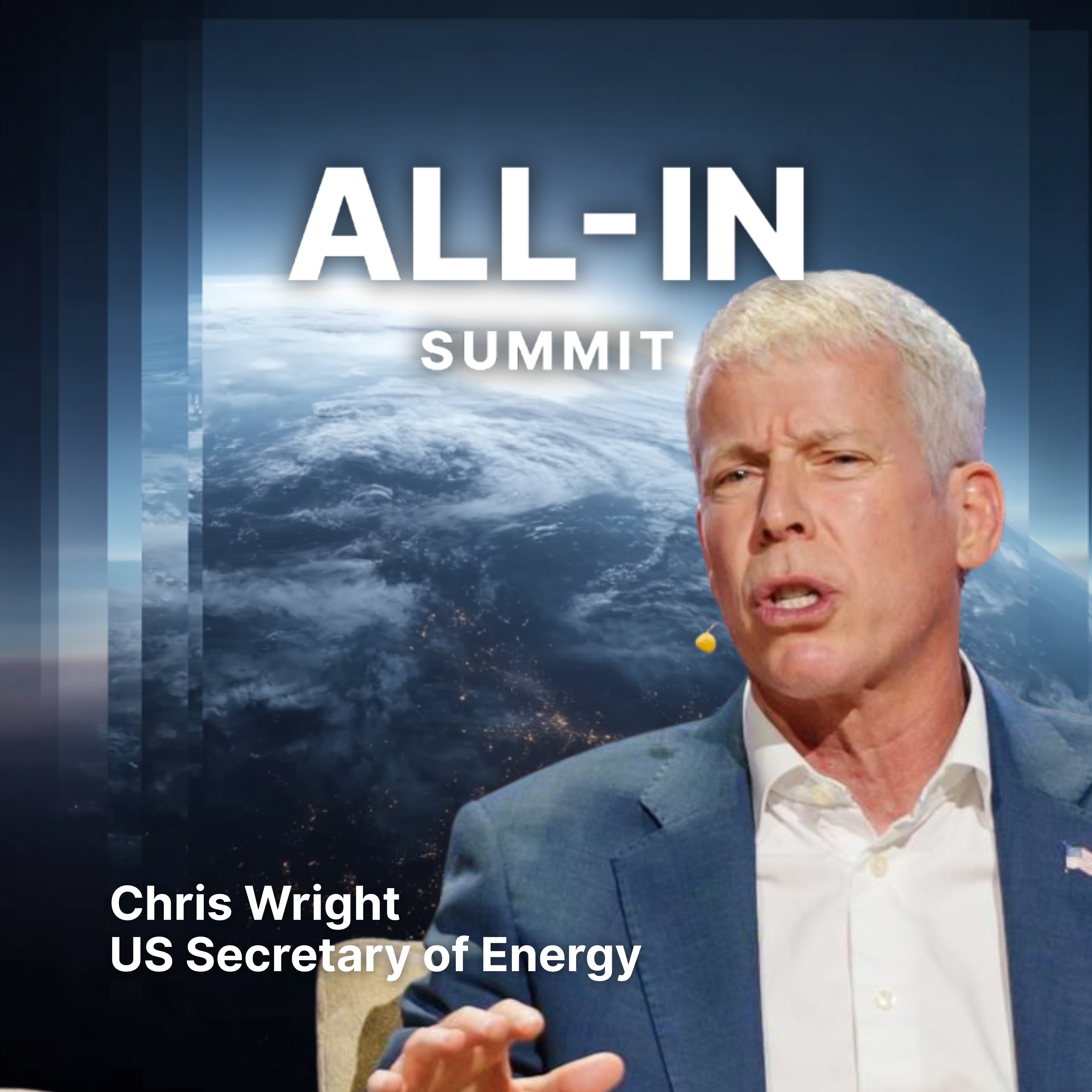
All-In with Chamath, Jason, Sacks & Friedberg
Energy Secretary Chris Wright on the Future of American Energy | All-In Summit 2025
00:30:36
(0:00) Introducing Secretary Wright (1:09) Nuclear, China’s approach (4:02) Increasing energy output, how the climate change complex slowed us down, problems with solar and wind (11:32) Debating renewables vs nat gas and coal (18:40) Chamath’s...
Loading summary
Transcript115 lines
- [00:00]
Chris Wright
Frack, frack, frack. And drill, baby, drill. He's all in on bringing common sense back to energy. More energy is better than less energy.
- [00:11]
Jason Calacanis
The US Oil industry has become more productive than ever.
- [00:14]
Chris Wright
The long talked about nuclear renaissance is finally going to happen. Unleash American energy, American entrepreneurship, American innovation. Ladies and gentlemen, please welcome the United States Secretary of Energy, Chris Wright.
- [00:36]
Chamath Palihapitiya
There he is, my man.
- [00:38]
Chris Wright
Good to see you.
- [00:39]
Chamath Palihapitiya
Round two. Let's go, let's go.
- [00:42]
Chris Wright
Awesome.
- [00:42]
Chamath Palihapitiya
Good to see you.
- [00:44]
Chris Wright
Wow.
- [00:44]
Chamath Palihapitiya
Well, thanks for putting up with us again. I know that the last time was such a joy for you.
- [00:50]
Chris Wright
That is a joy.
- [00:51]
Chamath Palihapitiya
It was a joy. For those of you who missed it, J Cal decided to turn our very short panel into a debate about batteries and.
- [00:59]
Jason Calacanis
No, it was solar.
- [01:00]
Chamath Palihapitiya
Solar. Well, the solar. He's like, just throw some batteries on the solar and then it works great. What do you mean, like? Okay, but thank you for being here yesterday. We were talking about the panel and Chamav said, why are we talking about nuclear? It's not even real. We shouldn't be doing this. Which I think's a real.
- [01:15]
Jason Calacanis
Let me be clear, nuclear is small. It's interesting, but it's the pimple on the dog's ass.
- [01:22]
Chamath Palihapitiya
And so I just want to give you a statistic and get you to respond to the future state of nuclear in this country. It's, I think about 4000 bucks a kilogram for enriched uranium to go into a nuclear power plant, to have a gigawatt. Nuclear power plant is only burning 3 to 4 million bucks. Sorry, it's only burning about 3 to 4 million of electricity per day for 12,000 bucks of fuel, of uranium fuel. So the incredible production capacity of nuclear is like unmatched with any other energy source. Why does it take so long? And why does it then cost billions of dollars? And you know, when I can turn 12,000 bucks of fuel into $4 million of electricity. What's going on in the structural challenges with scalability of nuclear, particularly in the United States, and why is it not a real path to kind of scalable energy production in this country for us right now?
- [02:17]
Chris Wright
I mean, it will be in the long run for the reason you just said. The greatest energy density. That's the key thing. If you can get a lot out of a little that's got running room. But nuclear involves something people can't see and they can't understand. And therefore it's easy to scare people about. So nuclear really has been a victim of fear in our world. It's the safest form of energy production we've ever seen for amount of energy it's produced and the amount of negative impacts. But people think it's the scariest and the most dangerous. So if you make it very long, very bureaucratic to permit things, if you make it so that therefore you've got to so over design and so over engineer everything, it's so hard to permit enrichment. So you make everything expensive and you make everything move slow and then you.
- [03:06]
David Sacks
Have other energy sources that turn on.
- [03:08]
Chris Wright
And off and you pay people a lot to build those things. That also erodes the economics of nuclear, of something that's reliable. So we, meaning the government, has killed nuclear over the last four generations and the goal of the Trump administration is to reverse that strangulation of nuclear and let it fly again. But you're right, it'll take some time, Chris.
- [03:28]
Interviewer/Moderator
Maybe.
- [03:29]
Chamath Palihapitiya
Sorry, let me just make one. What is China doing differently?
- [03:34]
Chris Wright
I hate to say it, but just more rational, you know, China is they're worried about if nuclear accident happens and it injures people, makes them sick, then they're going to look bad, that's going to kill them. But their design criterion are just for human safety, not for getting the environmental groups off them or doubling down because someone else will be mad at them. So they're just pragmatic. They're building reactors faster and therefore cheaper and they got 20 plus under construction right now.
- [04:03]
Jason Calacanis
Chris, let's break down the challenge as the world needs an infinite amount of electrons and an infinite amount of heat.
- [04:11]
Chamath Palihapitiya
Fair.
- [04:12]
Interviewer/Moderator
Yes.
- [04:13]
Jason Calacanis
Why don't you just ground people on where we get those things today and you know, like what percentage comes from coal, what percentage comes from nat gas, what percentage comes from nuclear globally, just so that we can maybe figure out where we need to go and how.
- [04:26]
Elon Musk
Do we get this more of this stuff now?
- [04:29]
Chamath Palihapitiya
Yeah.
- [04:30]
Chris Wright
So in 1973, and I use that year because that's the Yom Kippur war, that's when oil prices tripled. Later in the decade, they doubled again in the Iranian revolution. So we said we gotta get off oil and gas. So in 1973, oil, gas and coal provided 85% of global energy. And last year, 2024, 85% of global energy. And they've continued to grow over that 50 years, natural gas has grown 3% compound annual growth rate coal 2% oil, 1%. Oil is the most expensive and most flexible. Coal is cheapest if you don't have infrastructure. Natural gas can be the cheapest if you have infrastructure. So it's growing the fastest.
- [05:13]
David Sacks
Natural gas is the fastest growing energy source.
- [05:16]
Chris Wright
So that's 85% from hydrocarbons, 4% from nuclear. Used to be 6 year 2000 and today 3%. A little less than 3% of total energy comes from wind, solar and batteries. Hydro is in there, geothermals in there.
- [05:33]
David Sacks
The biggest component I didn't mention is.
- [05:36]
Chris Wright
Traditional biomass burning wood. That is twice the total global energy of wind, solar and batteries combined. 2 billion people still cook their daily meals and heat their homes burning wood indoors. 2 to 3 million easily preventable deaths a year to switch out that wood burning and, and liberation of women with just a simple propane stove.
- [06:02]
Jason Calacanis
There was a chart that got a lot of distribution on X over the weekend, which was just the rise in electricity prices in the United States. And can you sort of explain why that's happening and how we get around it so that it doesn't sort of trigger inflation and other kind of like pernicious things that we don't want to see?
- [06:27]
Chris Wright
It is a huge challenge. It's a meaningful part of the reason why President Trump got elected. Energy. It's the sector of the economy that enables everything else. If you get energy wrong, everything hurts. And particularly for low income people. So look, the backbone of our electricity grid has been coal and hydro. Those are the two electricity sources we started with. Then oil got added. We used to get a lot of electricity from oil. Very little today except in Puerto Rico or Hawaii because oil is flexible and you can transport it more easily. So today the backbone of our electricity grid has been coal, hydro, natural gas and nuclear. Today Natural gas is 43% of our electricity. Nuclear is about 20%. Coal was over 50, but now it's only about 15 or 16%. Together they're 80% of US electric. Actually when you put in hydro, they're about 83% of US electricity. And for 100 years we had a declining inflation adjusted price of electricity. Just an infrastructure for our country. It boomed in the 60s and 70s as people got air conditioning for the first time. Drove up electricity demand a lot. And then about Obama administration really launched it. But this sort of overwrought and I think irrational fear of climate change, it wasn't a rational. Let's look at the math and the trade offs. It was just sort of a reason politicians could do things. So we started to spend a huge amount of money to subsidize the building of what are called zero carbon. Of course they're nothing of the sort, but they are lower carbon electricity sources. Wind and solar, they're all made out of hydrocarbons made with hydrocarbons, maintained and installed with hydrocarbons. But I call them derivative energy production sources than them. But think about that. If you add on to the electricity grid a bunch of sources that sometimes provide electricity and sometimes don't, what's the value of that? Like, are there any customers for electricity? You turn on your light switch and it'll turn on when the wind starts blowing or the sun comes from out of the cloud. And then in the middle of the football game, the sun went behind a cloud and the football game will turn off. You're in the middle of a surgery and those things go off. So of course there's no customers for that. But if you put them on a grid that has these sort of reliable, dispatchable resources, what do they have to do now? They have to turn up and down as the wind blows or the sun shines. So peak demand for electricity is what a grid is designed for, right? When it's really cold in a winter evening when everyone comes home to work, if electricity goes out and stays out that night, thousands of people will die. Texas had 200 plus deaths just a few years ago with an electricity outage. So you have to design the grid to heat at peak demand. So at peak demand in the wintertime is in the evening and it's cold and it's cold because a high pressure system and air masses come down from the north and sits there. So there's no wind during a high pressure system and it's in the evening, so there's no sun. So you're not getting any electricity for wind or solar at inauguration day back east, at peak demand, we get 2 to 3% from wind, solar and batteries. The traditional grid has to supply everything and that's at peak demand. So if you have traditional sources that can supply peak demand, of course they can supply it every other time.
- [10:09]
Jason Calacanis
Is that why the utilities keep raising the prices? It's just the complexity of servicing all of this and building all of this.
- [10:15]
David Sacks
Because you're adding new sources on and.
- [10:18]
Chris Wright
You have to build new transmission lines.
- [10:20]
David Sacks
And you've got to operate the traditional sources in a more complicated fashion.
- [10:25]
Chris Wright
And when the wind blows, what happens when the wind blows? Nuclear power plants operate relatively steady coal plants. You can turn up and down, but slowly. So when the wind starts to blow, natural gas turns down a little bit, you generate a little less electricity. To balance out the increased wind power, the government pays that wind power producer 4 cents a kilowatt hour in a subsidy to pay it. That's straight from the federal government to the provider of that wind power. The utility pays something for that wind power. The avoided cost is when you burn a little bit less natural gas. If you're In Texas, that's 2 cents for 1 kilowatt hours worth of gas. If you're in New England, that could be 3 or 4 cents of avoided cost. That's less than the government subsidy to produce that, let alone the utility or my former home state of Colorado where they have additional subsidies and mandates that we must get our electricity or some percent of our electricity from these other sources. But if you're not dispatchable, you're not adding to the peak capacity of a grid. You're, you're just a parasite. Parasites are expensive.
- [11:32]
Interviewer/Moderator
Let me ask you a little bit about China. 2024, they've installed two to three times the amount of solar that America did per capita. They also have 33 nuclear power plants under construction, 200 planned, your administration, David included. You keep talking about clean, beautiful coal. You keep dissing solar and batteries and wind and deriding it like you just did. What does China. You keep talking about natgas and clean, beautiful coal. What does China understand that you don't? So great and tell me how beautiful and clean the coal is and how terrible and ugly these windmills are. Please explain to us what we're missing.
- [12:16]
Chris Wright
Well, of course, coal has been the.
- [12:17]
David Sacks
Biggest source of global electricity for 125 years. That's as long as we have good data and it will be for decades more. So I know you don't like it, but it's not going away. It's by far and away the biggest source of electricity in China. And they built 100 coal plants last year. They built capacity more than almost every country in the world has new capacity. So they do build a lot of wind and solar. It's still a very small percent of their energy, just like it is here. But they have an awesome industry of exporting those products around the world. They're over, they're over 80% of the solar. No, they don't export much coal at all. Actually, they export solar.
- [12:53]
Chris Wright
Right?
- [12:54]
David Sacks
All of their 80% of the solar supply chain.
- [12:57]
Interviewer/Moderator
And think about this, is that why you guys are down on it, that we would have to buy the solar panels from them? Because it seems like you're looking backwards and China's looking forward. That's where the disconnect is coming for me.
- [13:09]
Chris Wright
But there's no there.
- [13:10]
Interviewer/Moderator
There's no there in solar and batteries. So Elon Musk has it completely wrong.
- [13:15]
David Sacks
He has a wildly exaggerated view of where solar and batteries will go.
- [13:20]
Chris Wright
And if we could make a bet.
- [13:21]
David Sacks
50 years out, I'll make a bet solar never gets to 10% of global energy. Solar has a future. And so after 30 years of subsidies, maybe it should fly on its own. As an energy source, it has roles. There's remote power in the United Arab Emirates. They're building a firm 1 gigawatt solar, 8 gigawatts of panels and a ton of batteries. They've got great sun resources, they have low cost labor. They can build things there. Solar has a role, but we've had this inflated role that somehow the world is going to run on solar panels. There's no math that shows that will ever happen. And China doesn't believe it for a moment.
- [13:58]
Interviewer/Moderator
But think about why they're installing three times as many as us per capita then. And why are they so effective at installing nuclear power plants? This is what I'm, I don't know if you're gaslighting us, no pun intended, like, and this is just like a Trump MAGA thing where we have to dis natural sources, but do you really want to dig coal out and burn it and pollute the environment that we're giving to our kids?
- [14:21]
David Sacks
I want energy to better human lives and the cost and reliability of electricity and energy sources. The other thing we should say, electricity delivers 20% of global energy. Wrap the panel in a, wrap the whole planet in a solar panel. You got 20% of energy delivered. Where's the other 80% going to come from? It's process heat, its transportation fuels, to run jets, to run ships. That's not going to come from solar ever.
- [14:48]
Chamath Palihapitiya
Let me ask, maybe we can just get. And I'll follow up on Jason's question. One of the challenges with natural gas, which is actually methane, is that as a greenhouse gas, methane is roughly call it 80 times more heat capacitive than CO2. So one of the pushbacks on nat gas historically has been if there's even 1% leakage in the supply lines, it's worse than coal or oil or some other sort of hydrocarbon based fuel source. Even though if you have no leakage, it's better, it has probably what, half or something of the footprint. But importantly, what's the administration's view on putting carbon into the atmosphere as a cost to society? And I don't ask that in an antagonistic way because I met with a foreign minister from a European nation the other day a couple weeks ago and the whole delegation, this was a big Topic like, what is the difference between our point of view, which they have no carbon in the atmosphere, spend all the money to keep that from happening, and our point of view, and I just asked for, like, help level set a little bit on what's the point of view on where carbon goes in the atmosphere over time and how important it is to mitigate that.
- [15:57]
Chris Wright
So like everything else, it's about looking at the facts and the numbers and the data.
- [16:02]
David Sacks
We don't want to be cute like China, and of course, I think you misunderstand China's plan for wind and solar.
- [16:07]
Chris Wright
But we want to look at the facts. How big of a deal is climate change today? It is a real physical phenomenon. We've raised atmospheric CO2 concentration by 50% from burning hydrocarbons from developing a modern world. It's a real thing. It absorbs infrared radiation, it's contributed to some warming. But if you look at the math and the economics of it, it's just not even close to the top 10 problem in the world today. If you look at the Intergovernmental Panel on Climate Change economics projections to the end of this century, nobody knows what the world's going to look like in the end of the century. But think of the Intergovernmental Panel on Climate Change. These are the people that are dedicating their lives to work on climate change. Their estimates range from 0.2 to maybe 3.4percent reduction in per capita income at the end of this century. So that's in 75 years. We might lose a couple months. We might lose a year of economic growth in 75 years. That's a bummer. It's not. Nothing but compared to 2 to 3 million people dying simply because they don't have a clean cooking stove. And of course, the political movement that's too focused on climate change has been against lending or bringing any capital to the developing world so that they can live longer, healthier lives. They can get clean cooking stoves, they can get industry. So the administration is humans first. The previous administration, climate change was first energy was a subset of climate change. Human lives were a subset of energy. For this administration, it's the opposite. Humans first. Energy is the great enabler of human quality of life. And climate change should play the appropriate role. It does.
- [17:55]
Interviewer/Moderator
Hold on, let me just bring Chamath in for a second here, because I think maybe to level set this, it felt like obviously Al Gore and the climate change movement were completely wrong. We're not sitting in three feet of water right now. It was overblown. But you agree that it exists.
- [18:15]
Chamath Palihapitiya
I've never heard J Cal face we.
- [18:16]
Interviewer/Moderator
Should be concerned about. But I just call Boston strikes chamath.
- [18:21]
Chris Wright
You.
- [18:23]
Interviewer/Moderator
You are invested heavily in solar. You were just talking this weekend about your batteries and batteries and solar. So when is what we're hearing here just politics? And like one group went too far left, this group is going too far.
- [18:37]
Elon Musk
And then you actually believe what I agree with Chris. Let me give you my framework.
- [18:42]
Jason Calacanis
First of all, energy in my opinion is not a climate change issue. Energy is a national security issue.
- [18:49]
Elon Musk
So the reason why. And everybody cherry picks a chart. Let me show this little nuclear chart going up into the right for China. Wake up people. China has no access to natural resources. The reason they do everything. The real accurate chart, if you want to be on top of this issue, is what are they investing in? They're investing in every form of energy production. Why? Because if push comes to shove in the future, China cannot be reliant on anybody for energy. It is the same in the United States. Okay, so that's number one. That's why they're investing in everything. So it's, it's inaccurate to cherry pick the thing that helps you reinforce your bias. This is why I find nuclear such a kind of a dead end conversation.
- [19:31]
Jason Calacanis
Boring.
- [19:31]
Elon Musk
The real conversation is the strategic gameplay.
- [19:34]
Jason Calacanis
Of what's happening on the field. That's number one.
- [19:36]
Elon Musk
Number two, in the United States, my fundamental belief is that the utilities are broken because no matter how cheap you make the making of the energy, and I really don't care how you make it, you have to spend an inordinate amount of money transmitting it and distributing it. And all of that indirection is what the average consumer pays. So if you are smart, eventually you will say to yourself, I'll just make it myself.
- [20:06]
Interviewer/Moderator
Yes.
- [20:07]
Elon Musk
And that doesn't have to compete with Chris's vision because what Chris has to do is enable the broader framework for industry, for manufacturing, for transportation. We can't do that. My belief is that the largest utility in the United States will be a distributed utility of homeowners complimentary with Chris.
- [20:28]
Interviewer/Moderator
And that means solar and batteries at home. Because you're obviously not putting.
- [20:30]
Elon Musk
Yes, because you're not going to put a nuclear reactor on your daughter's bed. Who's going to do that? So let's not having this. Actually nobody's going to do that. Friedberg is an investment in a small modular nuclear gen 4 and it's going to go in my doc. When you put it under your daughter's bed, call me and Jake, let me.
- [20:47]
Chris Wright
Let me come back on that.
- [20:48]
David Sacks
I'm not anti solar.
- [20:49]
Chris Wright
I sound that way constantly.
- [20:51]
David Sacks
I just talk the numbers of it. I worked in solar energy. I bought thousands of solar energy panels to power instruments remotely. I've supported money to bring them to Africa to charge cell phones and bring lights. I'm for all energy sources that better human lives. But I'm for math. I'm for looking at numbers.
- [21:08]
Elon Musk
And by the way, as a person that's in the solar and storage business, I also like the math. The math before was perturbed. It was uneconomic. You have a lot of people, homeowners that are going to suffer because they have all of these solar projects that they put on their homes by the shadiest of companies that were subsidized by buy these things. So as a competitor in the market, the first thing I applauded was get these stupid subsidies away. Let the best companies compete. Yes, let us win.
- [21:36]
Chris Wright
Yeah.
- [21:37]
Chamath Palihapitiya
Secretary, let me.
- [21:39]
David Sacks
Exactly.
- [21:40]
Chamath Palihapitiya
Let me just change the topic for a minute. The Department of Energy, in addition to being responsible for progressing energy production in the United States and our infrastructure, is also the facilitator, the administrator of all of our national labs. And these labs do some of the most important pure research in the world. We have the world's first cyclotron up at Lawrence Berkeley lab where I used to work. For a few years. I've worked at a DOE lab we have obviously at Lawrence Livermore, Los Alamos. I mean, there's labs all over the country that are doing peer research that create fundamental breakthroughs that ultimately lead to industrial success for America. This administration's published out of the omb massive budget cuts to some of this research. How do you address that topic as the Secretary of Energy, how do you facilitate conversation with the White House? And how do you view the importance of this research in the United States?
- [22:35]
Chris Wright
Yes. So the 17 national labs we have across the country, most of them created soon after World War II. Their original use was the Manhattan Project. Win World War II and develop an atomic bomb before Nazi Germany. The greatest group science ever done, simply phenomenal. I love the 17 national labs around our country. I'm passionate about their value for our country, for their value for the human spirit, what it means to try to probe, to understand what's fundamental about nature. What is dark matter? How do neutrinos really behave? We don't have commercial applications for those in the next five or 10 years. I take that back. We do have a neutrino application, but I don't believe you have to have immediate commercial applications for the science to be worth doing at our labs. They are gems. They are places of scientific discovery. Tons of innovations we use today, MRI machines, those came out of work done at our national labs. So, yes, I came to Washington. We were collecting a dollar in taxes and spending $1.40 for every dollar in taxes. That is a train wreck. I am passionate about shrinking government expenditures. In the one big, beautiful bill, we cut over $500 billion of subsidies for energy technologies. I wanted to cut the full 1 trillion, all of them. Not successful in that. But this much smaller amount of money, around $10 billion we spend every year for these 17 national labs. I've been a passionate defender of to stop cuts to that. And I think I will succeed at that. I will succeed at that.
- [24:15]
Chamath Palihapitiya
That's great to hear.
- [24:15]
Chris Wright
These are critically important.
- [24:17]
Chamath Palihapitiya
And you have members in Congress that support you in that representation.
- [24:21]
Chris Wright
Absolutely. And of course, across the administration, you come in, you want to cut everything. I get it. All I'm doing is in my little narrow area of science, technology and nuclear weapons is saying, let's be smart and thoughtful about what we should cut and what we should grow.
- [24:36]
Jason Calacanis
Chris, very narrow question. Oh, sorry, Sachs, go ahead.
- [24:40]
Guest Questioner
So let's talk about AI data centers for a second. So we know that there's this huge infrastructure investment happening. I think it's been estimated that we're going to need, I don't know, at least dozens of gigawatts of new energy to power these data centers just over the next several years. How are we going to do that? Where is that going to come from? How do you avoid the increase in residential rates because of that?
- [24:59]
Chris Wright
A huge challenge. And David, this problem is going to keep getting worse. We saw retail electricity prices rose 25% during the Biden administration. Wholesale electricity prices rose far more than that, over 50%. So we have done great damage to our electricity grid in the dialogue we were just having.
- [25:19]
David Sacks
Not that I don't like those technologies.
- [25:21]
Chris Wright
I don't like expensive electricity. It's a challenge. The fastest growing energy source in the world and the fastest solution we have to power data centers is natural gas. Just by far the cheapest, fastest. Of course, we have supply chain issues with turbines there, but people are ramping up capacity to build those. There's simpler things we can do. There's environmental regulations that peaker gas turbines, they're only allowed to run a certain number of hours. I mean, hours in a year. Oh, that's what they're permitted for. We have a natural gas generator, we can burn more gas and generate more electricity cheaply. And we're not going to do it because. Because we had some climate regs that limited that we can fix problems like that. There's also a bunch of backup generators, not just at data centers but elsewhere around the world that can't sell electricity into the grid. They don't have air permits to be regular providers. We don't need more electrons. We need more electrons. We only need more electrons a few hours a year. At peak demand, we have slack capacity 98% of the time, huge amount in our grid. So what we need is how from existing assets can you hit that peak capacity? We're going to change some regulations. So all those backup generators, when we hit those peak hours, we're going to turn on those diesel generators or those natural gas generators. Know the climate isn't going to collapse because we ran diesel generators for a few hours. But it's going to allow us to have gigawatts more of firm electric generating capacity on the grid we have today.
- [26:49]
Jason Calacanis
Chris, can you explain to us how much flexibility can you have on federal lands for just you and the Trump administration and maybe subsequent administrations who are in charge to control this without the involvement of state and local actors and all of these other third party organizations to slow these things down?
- [27:10]
Elon Musk
So if it is the case that.
- [27:11]
Jason Calacanis
You want to build a nuclear reactor.
- [27:13]
Elon Musk
Is it possible to just do it with federal approval?
- [27:16]
Jason Calacanis
Is there any way, on federal land or some other way where you can find an avenue to do this without all these other folks gumming up the system and slowing things down?
- [27:23]
Chris Wright
We will have new next generation small modular reactors critical next year. Our goal is by July 4th and.
- [27:30]
David Sacks
I think we will beat that.
- [27:31]
Interviewer/Moderator
But you'll have an operational small modular by July next year.
- [27:37]
David Sacks
By July of next year it will not be selling electricity into the grid. It will be running on federal land at the Idaho National Laboratory. It'll be demonstrating it can sell electricity. It will be permitted by doe, but we're working hand in hand with NRC as well. So we will see commercial reactors break ground. Actually many before then. But nuclear is going to move at a faster pace than it has before.
- [28:00]
Chris Wright
But back to David's question. Seventeen national labs have a ton of land on them. We sent out an RFP who wants to build data centers on our lab on our lab land.
- [28:10]
David Sacks
We'll permit them quickly.
- [28:11]
Chris Wright
We'll help you get energy. 3 Responses to that Every large data center developer, everyone will partner with us to build data centers quickly on Land we have, infrastructure we have because we must win the AI race. We have the capital, we have the.
- [28:29]
Interviewer/Moderator
People, and that means it will not impact consumers electrical costs.
- [28:34]
Chamath Palihapitiya
That's a key piece of what an amazing transition from the Manhattan Project to operating data centers on the Department of Energy labs. But let me ask one more question, because this has come up. Every time we go to D.C. we hear doge. It's dogetet. There's a conversation that happens. Can you tell us a little bit about DOGE in the Department of Energy? Is it still around, and if so, what are the team members working on and what's the impact you're seeing?
- [29:00]
Chris Wright
We have a fantastic crew of teammates. Some of them came as part of the original DOGE program, so it's just been rebranded. But this idea of getting smart technical and financial patriots who are leaving their jobs and leaving their careers to come work with us, that is as strong and thriving as ever. I and the country have benefited enormously from the, you could call them, DOGE alum that are at the DOE today, that are looking through our labs, that are working with us in every process, everything we're doing. How can it be better? I am, I'm touched by the patriotism of people that are walking away mid career or taking a hiatus mid career, like David Sacks. But David's a perfect example of that. So many people are doing that because.
- [29:49]
David Sacks
They believe in this country.
- [29:51]
Chris Wright
They believe about bringing common sense back. And again, people think I'm this crazy guy who denies climate change. Of course, nothing of the sort. I've been writing and talking about climate change for 20 years. I just want it treated rationally as a trade off. Everything in life is a trade off. That is the attitude that pervades, does that pervades all these people coming to Washington who had never been in Washington before. I'm an entrepreneur my whole life.
- [30:16]
David Sacks
I never heard of secondary politics.
- [30:18]
Interviewer/Moderator
We appreciate you engaging the dialogue and you're a true bestie in the all in sense of the word. Ladies and gentlemen, give it up for Chris Wright.
- [30:26]
Chamath Palihapitiya
Thank you.
- [30:28]
Chris Wright
Thank you.
- [30:30]
Interviewer/Moderator
That's great.
- [30:34]
Chris Wright
Very much appreciate the dialogue.