← All-In with Chamath, Jason, Sacks & Friedberg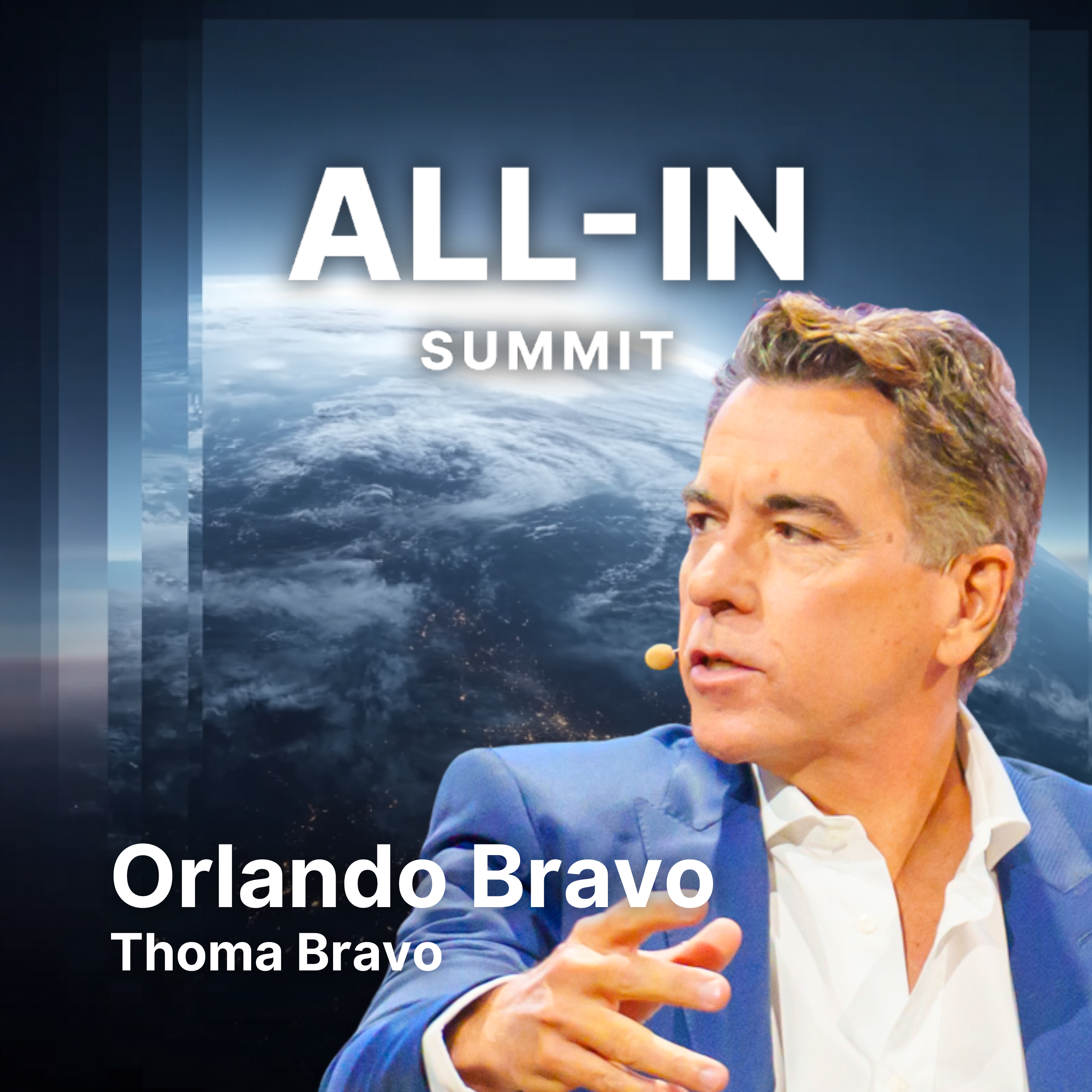
All-In with Chamath, Jason, Sacks & Friedberg
How Orlando Bravo Built One of the Most Successful Firms in Private Equity
00:28:57
(0:00) Introducing Orlando Bravo (1:53) Orlando’s history, Puerto Rico origins, how he got into private equity (7:10) How he runs Thoma Bravo: small team, outward facing, mentorship, patience in fundraising (9:01) Role of PE in the American economy,...
Loading summary
Transcript70 lines
- [00:02]
A
With one of the best track records.
- [00:04]
B
In private Equity, Bravo manages $179 billion in assets.
- [00:08]
C
Coma. Bravo has grown at a blistering pace.
- [00:11]
A
Last year, the firm returned over $13 billion to investors. In 2019, Orlando became the first Puerto.
- [00:17]
D
Rico born billionaire private equity firms, the good ones definitely beat the public markets. We are in the business of turning great innovators into great businesses.
- [00:31]
A
Ladies and gentlemen, please welcome Tullima Bravo's Orlando Bravo. Nice to see you. Thanks for coming.
- [00:46]
D
How are you?
- [00:48]
C
David, Good to see you.
- [00:50]
B
For those that don't know, let me just do a couple of data points and then we'll just jump into the story because Orlando has it in.
- [00:57]
C
Wait Chamath. Are we seriously going to ignore whatever virtue signaling JCAL is doing over here? What's this virtue signal you got going on?
- [01:04]
B
What are you doing right now?
- [01:05]
A
This isn't virtuous. This is my bestie. Tulsi gave me an official scarf from her office for my wife and I stole it from my wife. So I'm wearing it.
- [01:16]
B
And you probably didn't see it yesterday, but Jason was run over by the Director of National Intelligence, Tulsi Gabbard yesterday. He was so tilted. She was walking through the Russia hoax. He was so tilted he had his phone googling and grokking trying to get and. And all he could come up with is this. And literally in this tone, what about Paul Manafort? And nobody knew what that meant.
- [01:41]
A
Nobody knows who he is, including her. Okay, so why do you got to beat up on adjacent so much? You should be nice to him. He is a university. Sorry, continue.
- [01:54]
B
Orlando has an incredibly inspiring story, but let me just set the backdrop of what Thoma Bravo is. Thoma Bravo started in 2008. So what is that 17 years now? And now has just a little under 200 billion, which is incredible. But here are the two stats that stun me. In June, you raised $34.4 billion in basically like a set of fund vehicles, which is. I want to understand how that is even possible. And then you basically have owned now or 500 companies and many of the big software companies that we probably interact with and have to deal with. But before we get into all those details, I think what's inspiring is you are a child of Puerto Rico, a small town in Puerto Rico. And I've texted you this before, but I just wanted you to tell everybody. How does a guy, and I'm saying this in a nice way from literally the middle of nowhere get here? How does that happen? Your parents, your Family, how does that happen?
- [02:54]
D
Well, by the way, thanks so much for having me. And I'm not sure how we're supposed to talk about serious stuff and private equity when we have this, but you persevere. I got this look that touches my heart that you asked that question, because when Hurricane Maria hit Puerto Rico, kind of everything stopped for me because my best friends are there, my family's there, cousins, my whole upbringing. I got there on a plane the day after.
- [03:25]
B
And where were you at the time?
- [03:26]
D
I was in San Francisco and we had gotten a message from Puerto Rico saying there's some shelters, particularly one that was really close to my hometown of Mayaguez, that had only two days supply of food and water. And there were all these kids and everything else, and the government of Puerto Rico, they had trouble so serving these towns. So we said, we'll go from San Francisco and bring you a bunch of food and water and we'll be there tomorrow. And they actually showed up. When I landed three of my friends that I hadn't seen in a while, my best high school friends, one of them asked me, oh, now you're doing all this business stuff. How did that happen? And I said, well, the odds are one of us had to get lucky. Out of everybody here, one. I mean, there's some odds to that.
- [04:11]
B
But was that something like your parents gave you, where they're like, you have to go, you have to do something, or.
- [04:16]
D
Yes. Now, at every turn I tell you this, how exactly I got here, I've never created anything new, but I always had my mom, who was a Cuban immigrant. And for her just me staying there, it didn't feel right to her. She was always, you know, she would put me in positions where I would always have to be. Traveling to San Juan to play tennis, the sport of tennis, individual. Then if I did well. I remember I played my first turn when I was 10 years old in Caracas, Venezuela, and I saw wealth back then. Caracas, Venezuela in 1982 was quite a place. And you played in this fancy club. And then you go, if I do really well, I get to play in Florida. So she was always, always kind of giving me a roadmap for that. I was lucky that I wasn't that good to go pro so that I went into business. But then the same thing at work. I had the two best mentors. And the only thing I give myself credit for is at a young age I really listened, I had discipline, and I would kind of take it all in.
- [05:15]
B
You are also the beneficiary of an incredible mentor. And there is these great stories. Yesterday we heard Vlad tried to get a job at Climate Corp. Couldn't started. Robin Hood, famously my HR lead at Facebook, introduced me to her then boyfriend, Ben Silberman. We interviewed Ben. We ended up not hiring him. He immediately started Pinterest. And when you graduated from Stanford, you only got one job offer from like a three person firm basically. Do you want to tell us about that story?
- [05:45]
D
Yeah. In 1997, there was not much private equity. And the venture business, you didn't hire a lot of people. It was also small. Now I want to add this to the story. I got one interview with one of the largest private equity firms at the time. The head of the firm spent time with me. Very, very nice guy. But you know what he said? And this is 1997. There's not much opportunity in our industry anymore and the industry is taken now. Our firm is multiples bigger than they are. And the same thing will happen in the future. For the few of you that may be interested in private equity, you'll come by and create a firm and the American spirit and entrepreneurialism and being at the right place at the right time. Because we started doing software and it's hard not to do well if you started doing software back then and had all this wind behind your back. So I couldn't get a job. There weren't many. And then Carl Thoma hired me. And at the end of the process, it's interesting, there were a few private equity firms that kind of opened up a position for me to do Latin American private equity. And I'm like, no, I've spent too much time in the south, the money's in the north. I want to do US buyout tech. That's what I wanted to do. And Carl was great. He said, if you want to do tech, that's not something we do, but start looking at it and we'll help you.
- [07:11]
B
And so just tell us about how the decisions you've made now to build this business. How many people do you have? How do you run 200 billion effectively? How do you raise 34? What do you tell people to raise 34 billion? I don't even comprehend that.
- [07:25]
D
I think you do. Come on. You guys have done pretty well. I appreciate that, but it's okay. So we have, we are very, very focused on keeping the team very small. So we have about 230 people at Thoma Bravo within the organization. The reason is if you have too big of a team, you become internally focused and start dreaming about Conversations internally. And as I always say, the deal's not in the office, the company's not in the office and the buyer of your company is not in the office. So you always have to be outward facing. The second thing is I got the benefit and so did my senior partners of incredible mentorship. I can tell you so many stories about Carl Thomas spending time with me in 1998 on the deal we were going to lose. And I would be like, why did you spend all that time with the CEO and me on his kitchen table? He wanted to teach me how to sell. He to, wanted, he wanted to teach me how to do a deal. And that was just incredible. So if we have too many of those, we can't touch the next generation leadership. So that is part of our philosophy. Now. How do we raise that money? Look, our first deal, it's always been one step at a time. Our first deal was 50 million. The second deal was 100 million enterprise value. The third was Datatel at 250 million. We didn't buy a company in Silicon Valley until 2010. That was SonicWall, that we paid 550 million in intake private and that was our first foray into real cyber in higher growth businesses. So one little step at a time. There was a time that we couldn't raise a billion dollars, but now we have enough of a following that people trust.
- [09:02]
B
What is the role of private equity in the US economy, do you think? What is the role that it should play?
- [09:08]
D
I think it's a great change agent. It's a business in a way similar to venture, where what matters is the returns that you put up. You have incredible alignment with the sources of capital. They give you the money and if you make the return, you can stay in business. And if they give you the money and you don't make the return, no matter how big we may be, we slowly lose that and we're out of business. That alignment is so important because you're such a big change agent to companies. These software companies are not meant to be owned by the same group for 30 or 40 years. Management gets tired. It's exhausting to run, it's exhausting to be a CRO. And the more they trade hands, you have somebody with maybe a new idea, maybe a perspective and maybe a perspective that was right for the company at that time. And that buyer, like private equity, can assume it'd be super entrepreneurial and try to do something special.
- [10:03]
A
So Orlando though, just building on that, clearly has alignment with the investors. But maybe you could talk a little Bit about the broader alignment with society jobs. The reputation of PE sometimes is a bit too cutthroat. And if you hear, oh, a PE affirm, bought my favorite brand, or our firm got bought by our startup, got bought by a PE firm, it's like, okay, they're going to cut half the people and there's going to be layoffs. Or maybe this brand is going to get saddled with debt and absolutely gutted for parts. So what's fair or unfair about that sort of PR crisis? Maybe there is with PE that is.
- [10:40]
D
100% fair in the 80s, 90s and maybe early 2000s. Private equity has nothing to do with that. Now about 50% of the private equity deal volume is in technology. We do that. We're very narrow. We only do software. If you look at any software deal we've done in the last 12, 13 years after SAS became irreversible in 05, yeah, you're paying seven to eight times revenue and the financing on seven to eight times revenues, maybe two turns of revenue. So you're putting in five to six turns of equity in the company. 30% debt, 70% equity. If you're not building and growing that business, especially if it's big, nobody's going to buy it from you. It used to be that for those old school deals, if you look at the return, 2/3 of the return will come today from the cash flow of the business, from your yield and a little bit in the terminal value, it's flipped about 2/3 or more is terminal value appreciation and you make very little.
- [11:38]
B
So you're a growth investor on your yield.
- [11:40]
D
We really are. We have to transfer to that. Because look, the lucky thing we had was after I personally made a lot of mistakes. 97 to the Internet bubble bursting, Carl Thomas was going to fire me. And this is also true. He talked about it in his 70th birthday and he gave me another chance and I said, okay, I'm not good at what we were doing then. I'm going to go for existing management, really established companies and software. In 2000, you could buy recurring revenue in software cheaper than in all the other categories that private equity liked. Think about radio, cable, whatever, outdoor advertising, anything. So the partnership said, sure, let's try it. Let's try it with something small. At that time you could buy cheap. But what happened is in 2010, after the financial crisis, most of our competitors that were doing those deals, and it was heavily competitive then for these smaller transactions, they left the business because now software became super expensive. So there's A but we said chamath. But then we said, oh, instead of complaining that we cannot do what we were doing before, because everything changes now. We have the wherewithal to buy the best and the number one. So let's go for the number one player that can grow.
- [12:54]
B
So you started doing a lot of these SaaS deals in 2010. When you sit there with your partners in 2025, is there a risk of SaaS being cannibalized from within by AI, or how it can just be rebuilt in different ways? How do you underwrite it today, which is different from how you would have underwritten it in 2010?
- [13:16]
D
Our investors don't love to hear this, because for our investors, especially the large institutions, that's our market. Those are our people that have backed us for a long time. Besides good returns, they need consistency and predictability. They would rather have us do what we were doing in 2002 in these deals. And why can't you just keep doing the same thing? It all changes. One is there is a big risk of AI in this business in a big, big way. There's so many verticals that are going to get disrupted. There are so many areas that are very confusing and you don't want to touch. So it limits the space significantly. Even if you believe what we believe, which is in the enterprise, it's going to take a while. Because we always say technology is evolutionary, not revolutionary, because our customers are buying this stuff for cost. They want the roi and you need to see the plan and everything else. But one is there's a big disruption of that. So now there's all these areas we don't get into, and we have to keep learning and updating ourselves. That's a lot of work that the young people in the firm as well will have to do. But we have another equally big or even bigger challenge, which is, if you look at our trajectory, it's not like one day we woke up and said, oh, we can do a $10 billion deal. No, we started 50 that trajectory. In 2010, we did $3 billion deals in a row. We bought Blue Code, we took it private. Deltec, we took private. We bought Digital Insight from Intuit. When those worked, then we did a $2.5 billion deal that became Dynatrace. That was Compuare. Then when that worked, we did a five and a half billion dollar deal, which DINA was here yesterday. That was the business that we sold to Nasdaq. And that worked. But now we're doing $10 billion deals. We have to sell those for 25 to make money.
- [15:08]
B
Wow.
- [15:09]
D
Our alternative here, what we have to underwrite is an IPO at a big discount to the comps when we paid a 30% premium to the comps to buy that company in the first place. So we kind of start 50% in the hole to do that. So you have to.
- [15:24]
B
Anyway, I wanted to ask you this question because I asked a friend of mine about you and he was competing with you to get the Boeing business and you bought the Boeing avionics business recently for ten and a half billion, which I think all of us care about because hopefully it'll improve flight safety and all of that other stuff. But we can talk about that in one second. But he said Orlando is incredibly difficult to compete with because he's so ready to buy the thing he wants to buy. And he doesn't really nickel and dime at the edges. It's like, let's find a fair price and we'll just transact. And it makes it very hard for everybody else to compete with. When you get that conviction, are you just willing to just basically put that much money on the line and say, we're going to figure this out?
- [16:04]
D
We are.
- [16:04]
C
That's sort of Warren Buffett's mentality, isn't it, that he already knows all the companies, he knows which ones he wants to buy and when they come up that he doesn't nickel and dime, he just quickly works out a deal. Is that a mentality that you have?
- [16:17]
D
100%? It all fits together with having a small team. We also have a small portfolio. So in every fund we'll buy 10 to 12 companies. We strive for the two core competencies that we try to have. One is buy the best and operate the best and just focus on that in a three to four year time frame for our funds, for investing our funds. We cannot say with a straight face that there are 30 of the greatest companies that were available to be bought at that time.
- [16:48]
A
Right.
- [16:49]
D
So that's exactly. And two, we cannot say with a straight face that we can try to influence management with everything we learned from an incredible mentor. If we had a portfolio of 30, that's as much as we can handle. So we have to go for it. Now, I do want to add that what I love about the private equity business, one of the items is that those deals, because the decisions that you make with your partners an hour before the bid is really, really important. It's really telling, well, can you take.
- [17:19]
B
Us behind the TikTok of this Boeing asset? I think it's Like a. It touches all of us, even if most of us don't understand that it even existed actually.
- [17:26]
D
Well, it basically runs. Maybe you cannot fly an airplane right. Without Jeppes in and. And its system. And the way the deal started, we called the CEO of Boeing, actually sent him an email saying, hey, we could buy this division and we're paying these good prices. So there was some interest. The process started and There were about 15 private equity groups, all excellent groups, involved in the deal.
- [17:51]
C
Why would Boeing want to sell its avionics business? I guess maybe start with that.
- [17:56]
A
Yeah, it seems pretty core.
- [17:58]
D
It's a good business and I'm happy that they decided that. So you're saying that was a bad decision. We'll take it.
- [18:09]
A
Fair enough. I wanted to ask you a question about.
- [18:13]
C
Could we get the answer to that though. What is the strategic rationale for Boeing to want to sell its avionics business? Is the idea that other plane manufacturers can then use that avionics system?
- [18:23]
B
I'll give my answer and maybe you can. I think Boeing is in this incredibly difficult position where there's a lot of diffuse things that were happening inside of the business and they had to make a real rationalization. What are the few things we can be good at? So one of our friends, Brian Yutko, was put in charge of new plane development. I think you can guess what's going to happen there. That's a clear strategic bet. Getting the 737 or the Max program back online, that was a clear bet. But when you do that, you have all kinds of debt and stuff that you just need to clean out and sometimes you have to sell. And by the way, you are right, your instincts are right because my friends who called me basically said this is the GEM asset inside of Boeing. I mean, he's being very gracious by not so. Yeah, but Jepsen is this thing that everybody uses, United, Delta, everybody needs this information to fly accurately. And it was Boeing's business and now it's Orlando's business.
- [19:19]
D
Okay, so it's our funds business. I wish it was your fund's business, Orlando.
- [19:26]
A
We don't buy stuff. We're generally year zero, year one two investors who help build things. But Sax and I got to watch our friend Elon by Twitter and that was quite eye opening. It was also the first thing that I think he ever bought in a major way like that. What is the playbook for coming into one of these technology companies and you have, like you said, tired management. Maybe the people who are still staying at this company are the ones who couldn't find other work or maybe weren't as ambitious. What's it like? Day zero, day one, day two, when you get in there, what's the playbook? What's 1, 2, 3? We got to do these things in the first 30 days.
- [20:05]
D
It's almost always the same. We try to buy companies, and Jefferson is a. A tweener in that because their margins were about 25%. But we feel that business can be running like a Denzel that we sold to NASDAQ for 50% plus running it like a software company and making the right investments. The playbook is this. You meet with a company, usually a public company, that trades for a revenue multiple because they're not that profitable. And our mentality is we try to turn what we call a good innovator into a good business. We have all these meetings with management, and after we listen a lot to them, we come back to them and we put together a plan with them to cut cost. So there is that element, because you have to get in the game with a certain level of fundamental earnings to be able to afford the deal. You basically are. What we're trying to do is turn a revenue multiple. Day one, say we buy it for six or seven times to an EBITDA multiple in day four. If that company grew 20% and you achieve a 50% margin, you've done that. And then you say, what are the comps? What is this thing worth? Is it a 20pe? A 25pe? A 20pe is about 15 times EBITDA. You could double your asset value without the benefit of that, at 30% leverage, which you pay down a bit, and that's how you create your return. So we talk to management very openly during the process, even before we won the deal, even if they're not going to like us, et cetera. And we say, hey, can we put together a plan where you can make the right investment decisions, but can you cut 15% of the cost of the company at closing the deal in private equity? Talk about the change agent. If you don't do that at closing in private equity, why are you going to shock the employees afterwards? Years two, three, four, the deal. Since everybody's thinking there's a new owner that's going to provide change, gives you the opportunity for immediate change. Now, as my mentor, Marcel Bernard, used to say, he was the greatest operator I've ever met. 35 years at Motorola, running different divisions, and that was an exceptional school of management. No matter how profitable you are, you can always cut 10%. No matter how unprofitable you are, it's difficult to cut more than 20% because you have to change the way people make decisions, the way management interacts, et cetera.
- [22:17]
A
How do you evaluate the talent stack? That was something that actually David was exceptional at. During the Twitter acquisition. We sat there in a room and he said, well, who's exceptional at their job? And then Elon said, and who's absolutely critical for this business? And I just walked up to the whiteboard and I drew four quadrants. Exceptional, essential. And then there was this sort of exceptional, but not essential. And we then had a playbook.
- [22:45]
C
Elon proved that you could cut 85% of Twitter and it would still work just fine.
- [22:50]
A
And all the journalists were like, Twitter's going to go down any day now. And then they were like, every day they would write the same story. Twitter went down and be like, oh no, you lost your Internet connection on your phone. And they'd be like, no, it's not coming up. And it's like, yeah, yeah, re put the WI fi password in and it never went down. It was pretty crazy. But how do you assess talent when you're coming into one of these legacy businesses? You know, 10 years, 20 years into.
- [23:17]
D
The business, history tells you a lot of that. So you're trying to identify not everybody's good at everything. And it starts with a leader. If the leader is good, everything is good. If the leader is not good, nothing is good. You don't want to work around them to deal with sales and product and stuff because nothing is going on. Now what does a good leader mean? There's so many judgments that come in. Is a company hitting bookings? Is it missing? Are they good at customer service? What's their retention? How do they make decisions, decisions? What we look for overall, because nobody's perfect, is to back what they're good at. We love to do add on acquisitions for our company. So the reason we like to take out the cost once is the rest is about bookings, growth and add ons. We don't want to revisit margin too much. We want profitable growth going forward. Let's be done with that and then let's go forward. The leader can stand up in front of the entire employee base and said, we needed to do this. This deal probably gave us the courage to do what we need to do do. Let's go build the business. But we look at a leader and we say if they're open minded, if they care about numbers and if they have the following of their employees and customers and really know the business. That is something that we really, really, really try to work with. With all the changes we make, we've been pretty contrarian in the industry because we first try to make them with the existing people and sometimes, you know, we make a mistake on that and they change their mind. But we to try, try to do that.
- [24:38]
A
Before you do a deal, what's the secret to figuring out how good the asset is? Do you go talk to customers? Backdoor references? Do you go find the employees who quit and started companies and interview them? Like, there's gotta be some tricks to assess a company before you even let them know you're interested in them. What are those tricks?
- [24:56]
D
All of that. All of that. Now, we've usually owned a competitor or a partner to the company as well, and we've usually known him for a long time. Like, we recently announced that we were doing the dayforce deal for 12.5 billion. My partner, Holden Spade met with the CEO of Day Force in 2008. And we tracked that company for so long watching patience. When does it miss? When does it hit its numbers and everything else? You also, once you sign them up or are in a process where the company's giving you all their raw data, you have so much information to make those choices. For example, a company cannot say that it has really, really good product if its gross margins on support are very low. We can bring technology people to assess that and we have that on our team. And they look at the architecture and the talent and everything else. But then you go, how come your support calls are so high?
- [25:54]
B
It's a bad product.
- [25:55]
D
Yeah, it all fits together. We have great retention, great margins on support. It's like, for example, take support. Many people look to offshore support and now maybe AI would get on that and there's no need for that. What we say is eliminate the reason for the call altogether because there's nothing you can do in product. So we're evaluating all that.
- [26:16]
B
We love it.
- [26:17]
D
We geek out over it.
- [26:18]
B
There's a handful of PE firms, obviously, that are now linchpins of the capital markets. Blackstone, Apollo, kkr, Carlyle. They're public, they are multi strat. They're huge pillars. And I mean, you've built an incredible business. You have the credibility to do it. Is there an impetus to do it? Is there an impetus to kind of grow beyond that technology focus? And if not, how do you stay in your knitting? Because how do you do that? Where does the discipline come from?
- [26:48]
D
Look, I think we are very pure to our investor base and our colleagues, the two of them at the same time. What I say matters to them is the return. So what matters for us to grow the business is get the money, get the deal, improve the deal. Going public does not help any of those things for us. That's number one. Two is we're really. I'm just so grateful, I really, really am, for my mentors. I mean, Carl Thoma gave me and my partners the company, and he mentored us. So we want to do the same thing for the next generation. And we actually feel we'll make more money by investing behind the next generation when that time comes than by going public and having a great day and a great multiple. And then what? So so far, we're just going to stay where we are.
- [27:39]
A
As we wrap, I just want to ask you a question about Puerto Rico again, where we started. You're the first Puerto Rican billionaire. I understand it's just a number, obviously, but should Puerto rico become the 51st state? You know, we have Trump talking about Greenland, whatever. You know, we have these ambitions. The people of Puerto Rico seem to want to have a deeper relationship with America. It seems profoundly unfair that they're in this, you know, sort of middle state.
- [28:08]
D
Yeah. It's such a divided place. The turnouts in elections in Puerto Rico when I was a kid used to be like 90%. It's a whole festival in the island when elections happen between the party that wants the status quo and the party that wants statehood. Now, the party that wants statehood has grown quite a bit, and some of the tax incentives of being kind of in this commonwealth status have gone away. I'm going to say something I've never said before, and I do believe it'll be better for political. We're going to be a state if the US Would allow that.
- [28:38]
A
I'm for it. I'm here for it.
- [28:40]
B
Ladies and gentlemen, Orlando Bravo. Thanks, man. Wow. Thank you.
- [28:46]
D
Incredible, huh? I'll talk to you soon.
- [28:48]
C
Great job.
- [28:49]
B
Thank you. Yeah, amazing.