← All-In with Chamath, Jason, Sacks & Friedberg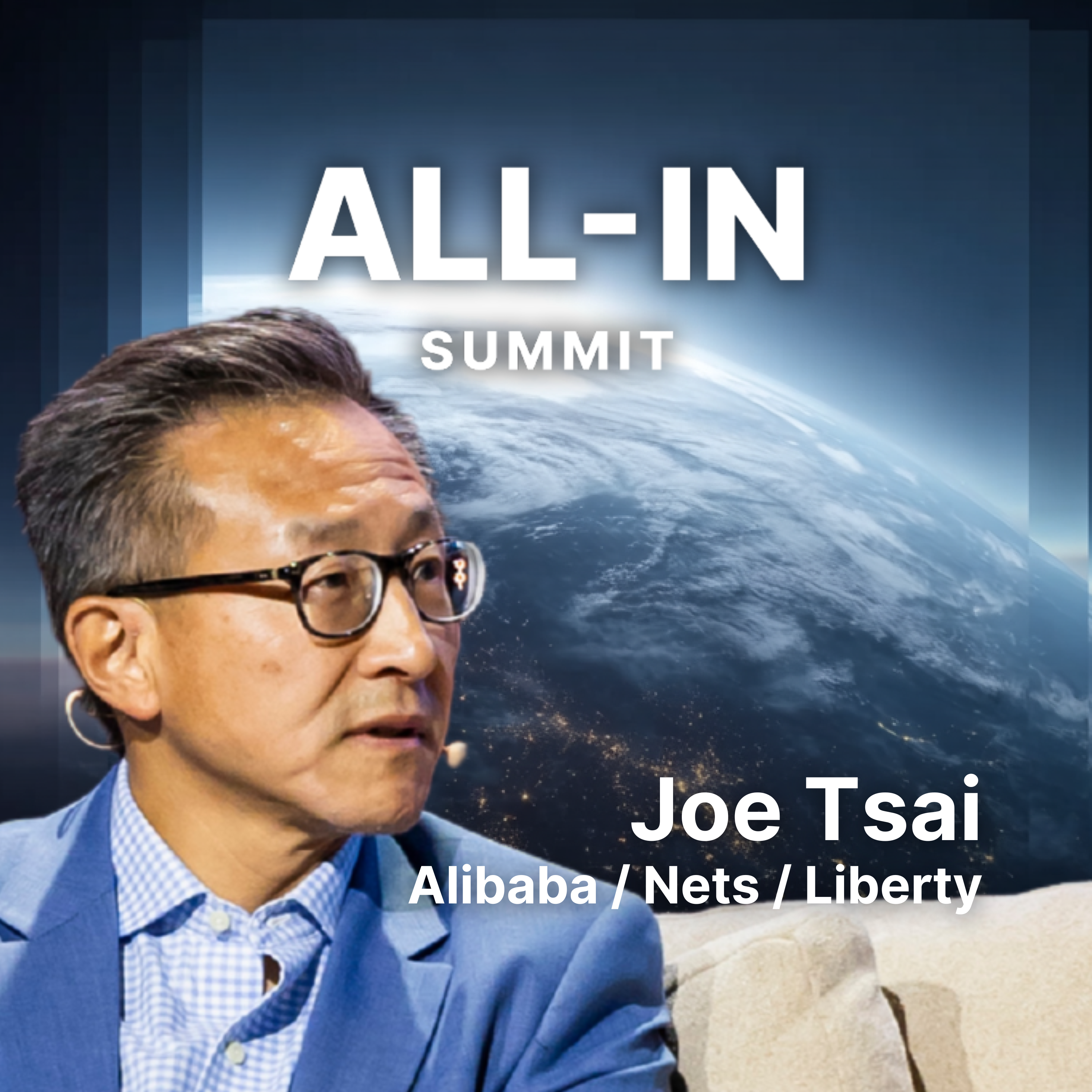
All-In with Chamath, Jason, Sacks & Friedberg
Joe Tsai on US-China Rivalry, AI's Future, Owning the Nets/Liberty, Caitlin Clark's Major Impact
00:27:07
(0:00) Introducing Joe Tsai (0:49) Owning the Nets and Liberty, Caitlin Clark’s impact on the WNBA, does the NBA need fixing? (6:07) Alibaba origins, China’s pullback on capitalism (10:10) US vs China rivalry: the AI race, are we destined for...
Loading summary
Transcript86 lines
- [00:02]
Chamath Palihapitiya
For people who don't know who he is, please give us an introduction to Joe Stott.
- [00:06]
Joe Tsai
He's the owner of the Nets, and he's now chairman of Alibaba. We like innovation from the bottom up.
- [00:12]
Chamath Palihapitiya
Alibaba just dropped their secret weapon. Quinn 2.5, max.
- [00:16]
Joe Tsai
Alibaba surged 14.5% overnight, beat estimates on nearly every metric.
- [00:20]
Chamath Palihapitiya
A massive rally alone this year, adding about 100 billion to the stock's value.
- [00:25]
Joe Tsai
You have to have a growth mindset when you compete.
- [00:30]
Chamath Palihapitiya
Ladies and gentlemen, please welcome Joe Psy. Hey, my man. Good to see you.
- [00:44]
Joe Tsai
Good to see you.
- [00:44]
David
See you, brother Joe, how are you? Good to see you.
- [00:47]
Joe Tsai
David, how are you?
- [00:50]
Chamath Palihapitiya
The Brooklyn Nets.
- [00:52]
Joe Tsai
Brooklyn Nets.
- [00:53]
Chamath Palihapitiya
Brooklyn.
- [00:53]
Joe Tsai
And the New York Liberty.
- [00:55]
David
And the New York Liberty. Exactly.
- [00:56]
Joe Tsai
So the.
- [00:57]
Chamath Palihapitiya
Not easy running a team, is it?
- [00:58]
Joe Tsai
It's not easy at all.
- [01:01]
Chamath Palihapitiya
Not easy at all.
- [01:03]
Joe Tsai
Because a basketball, any professional team, is both a business and also it's an institution. You need to keep the fan base happy. So there's sort of this church and state element. It's almost like running a news organization.
- [01:18]
Chamath Palihapitiya
Yeah, there it is.
- [01:19]
David
Can we maybe start with the wnba? And we can shift to business and we can shift to basketball, But I think Caitlin Clark is out for the season, and there's just been a lot of controversy and attention that the WNBA is getting. What has it done right? What has it done wrong? Has the league been doing enough to protect her as a. As a star in the face of the league? It's been a. Almost a microcosm for just a social discussion. Do you want to just talk about that as what you see?
- [01:43]
Joe Tsai
Caitlin Clark definitely had an effect on the wnba. All the metrics went up. So this was last season, Right. When she first came into the league from college. And we've seen all of our metrics from viewership, ticket sales, sponsorship, everything went up, like, almost 4x4x4x. Right.
- [02:06]
David
I mean, that's incredible.
- [02:08]
Joe Tsai
That's incredible. So the economic impact that she's made to the league is extraordinary.
- [02:14]
David
Undeniable.
- [02:15]
Joe Tsai
Undeniable. But because of who she is, you know, she's a little bit of a different kind of player. You know, she's a point guard. She's a smaller player. The knock on her was, was she going to be able to withstand the physicality of the league? And she's proven that she's able to do that. Unfortunately, there's been. I think it's always good to have rivalries. Right. You know, she has this rivalry with Angel Reese that dated back to college, but some People would like to pit it as a kind of a racial thing or is it this or that? I think we need to look past that and just look at the skill set that's being brought into the league now. We have so many great college players. I mean, the rookie of the year potential candidate is Sonia Citron. Have you ever heard of her before she came into the league? I mean, she. I think she just broke the record for the highest 3 point shooting percentage in the league. So, you know, you see tremendous amount of talent and I think you ask, what have they done? Right. I think it's a matter of just a confluence of good things coming into the league.
- [03:33]
David
And what about the NBA? So you guys did just an enormous.
- [03:37]
Joe Tsai
Just let me. But the one thing that's really changed that is prior to the Caitlin Clark season, your average fan base that watches espn, basically you guys are not watching women's basketball. Maybe some of them follow college, but certainly not the wnba. But now your average ESPN fan base, they are watching the mainstream sports fan base, are watching wba.
- [04:05]
Chamath Palihapitiya
I think she's a. I have an observation about this. And you and I are old school basketball heads. You know, watching, having watched the 80s and 90s and Patrick and Charles Barkley, it's more physical. They're tougher in the WNBA. And every time LeBron goes up and he gets fouled, oh, and he's just, ugh, he's flopping all over the place.
- [04:23]
David
How does he do it?
- [04:24]
Chamath Palihapitiya
Oh, you know, it's a foul.
- [04:26]
David
It's a foul.
- [04:27]
Chamath Palihapitiya
So maybe you could comment on LeBron being like.
- [04:29]
David
Or just generally the NBA product.
- [04:31]
Chamath Palihapitiya
Yeah, the NBA product. And then they're so tough and they're throwing each other around. It's a better game.
- [04:38]
Joe Tsai
The NBA product is great. I don't think it's fair to compare whether the men's league is less physical than the women's league or one, the other. I mean, they're both very physical. I mean, if you are sitting there on the floor, you are watching physicality and also athleticism, right? But the game has, you know, the NBA has this committee called the competition committee. So I got put on the competition committee. They call me and they say, joe, we want to be on the competition committee. It's about rules about what is this transition take foul. So the committee is, every season they make these tweak changes. They make changes to reffing to make the product better. When I got the call, I'm like, you want me to sit on the committee with Jason Kidd, Chris Paul and Coach K. Like, what do I know about basketball that can, you know, really be smarter than that? But. But what I've seen is, I've said to Adam Silver, the competition committee should be called the product committee because that is the product the fans see on the floor. If you change, let's say, if you change the three point line, that is a product decision.
- [05:52]
Chamath Palihapitiya
Should they? Is it?
- [05:54]
Joe Tsai
I don't think so. I don't think so.
- [05:56]
Chamath Palihapitiya
When you watch the Boston Celtics throw up 40 threes in a game, you think it's a good product?
- [06:01]
Joe Tsai
I think it's a great product because there are 18 different ways you can throw up 43s in a game.
- [06:06]
David
Okay, let's transition to Alibaba for a second. It's an incredible journey, you and Jack, Ma. And the whole story has. I mean, it's written in books and there's just tremendous lore. But can you take us back to your mindset? I mean, I think we've heard it's well documented, Jack's mindset. But how you got involved, what you were thinking in that moment, the risk you were taking.
- [06:29]
Joe Tsai
I was just mesmerized by Jack's personality. People see the public side of Jack, which is very charismatic, but what I saw was he was able to instill faith in people. I mean, when I walked into his apartment, there were like 12 to 15 sort of very young people, roughly, you know, students that were just coming out of college. And Jack was kind of the teacher that's 10 years older and he's able to communicate, he's able to paint a very strong vision. That was the part that I really signed on to. His ability to lead is an amazing ability. And, you know, he's a teacher by training. He taught at Zhejiang University. He taught English, actually. You know, teachers in a way, make natural leaders because A, you have to communicate well and B, you can identify talent. I think a lot of teachers love to see their students and say, oh, this kid is going to do really well. So they write a recommendation, they do whatever. And also teachers have enough humility that they're willing. They're very happy if their students go off and then they come back and become more successful than they are. And in building a company, you need to be able to accommodate all sorts of people that are smarter than you are. And that's really important.
- [07:54]
David
There was a phase, I guess, in the maybe the early 2010s, where it was a lot of it felt like tremendous freewheeling capitalism in China, where there was just a Cambrian explosion of incredible entrepreneurs. Yourself and Jack and all these others. Pony. And then I think almost starting with the anti po it things changed a little bit. Can you walk us through the dynamics of how that changed? And then I think it all kind of leads to, you know, a lot of foreign direct investment into the Chinese ecosystem has changed pretty dramatically. Just give us a sense of what has happened over that arc that you've been in it, working in it, observing it.
- [08:31]
Joe Tsai
Alibaba has been around for 26 years. I would say the first 15 years were it was a complete free market kind of, you know, way of growth. And we built a lot of business organically. And then we went into a phase where there was extreme competition. Everybody wanted to do e commerce. Why? It's because if you have traffic online, e commerce was the best way to monetize your traffic. And today, in today's market, we have five or six very, very strong competitors, including the. The parent company of TikTok ByteDance, they are doing e commerce. They're not known as an e commerce company, but they are one of our fiercest competitors. So there's a. You go through a period of extreme competition. Then the government felt that this sector has gotten out of line a little bit. First there's too much competition, and then there are some platforms that have exhibited monopolistic behavior. So then there was a, you know, people may call it a crackdown, whatever. More regulations came in. Regulations. Some of the regulations are very good, actually. They protected privacy, anti monopoly type regulation. And now we kind of are in a new normal where we are. We believe that the regulatory environment is more predictable. We know what the red lines are and we know where to go, where not to go. And it's actually made a better operating environment because of the predictability of it.
- [10:11]
Chamath Palihapitiya
On a geopolitical level. It seems to be the rhetoric in the United States. What they keep drilling into Americans is to look at China as an existential threat to America, that we're rivals, that we cannot operate and lead the world to prosperity. What do you think?
- [10:32]
Joe Tsai
I don't agree with that view of the world. I'd be interested in your view, David.
- [10:38]
Chamath Palihapitiya
I mean, I don't believe in it either. I don't know why this has to be. The only dialogue we have is that we are bitter rivals.
- [10:47]
Joe Tsai
I mean, look at this. I think I can understand why sitting here in America, you look at the rise of China over the last 20 years, 25 years, China has become strong in terms of manufacturing. That's why it's such an export juggernaut. It has become, because of the economic development, it's, you know, China has become a technology juggernaut as well. And the fear is, well, all that stuff, economic strength and technology strength is going to flow into military strength and that becomes kind of a national security issue. I understand that, I get it. But I think it's. These are the two largest economies in the world and I think you just need to take a step back and say, well, yeah, on the one hand we should compete with China, right? That's fine. The hyperscalers companies compete with the Chinese Internet companies globally. But then on the other hand, there is just so many trouble spots in the world that. Did President Trump say that he stopped seven wars? Right?
- [11:56]
David
Yeah.
- [11:56]
Joe Tsai
Okay, well, China didn't start any of them. China has not started a war in the last how many years? You know, 30 years, 40 years? I think China was part of the Korean War, maybe the Vietnam War, but that was a long time ago in history. So in a way, China, you know, if you observe the behavior of the Chinese people and the Chinese state, it's a very peaceful nation. China cares about its own economic development, they care about the well being of its citizens. And I think there's a lot of friction in the course of competition where China feels that the United States is trying to contain China and stop the rise of China economically.
- [12:45]
David
Just speaking about the welfare of its citizens, you mentioned ByteDance. I think it was reported ByteDance revenue just passed Meta's revenue. I mean, it's a juggernaut, it's a.
- [12:55]
Joe Tsai
Private company, so I don't know. You're telling.
- [12:56]
David
Yeah, they actually release it. But one of the core products, TikTok, it's a fundamentally different product here than in China. And because of that regulation and a focus on the welfare of its citizens, there's like strict rules in terms of the content and the curation and the algorithms. Whereas here, you know, it's like cat videos and like, you know, all kinds of nonsense. Although now I notice that TikTok put a stem section inside of TikTok in the American product. For whatever reason, there's a wherewithal that China has to think about its citizenry like that. And I'm just curious, how do we embrace more of that principle? Because that sort of gets lost in this situation. Such a good question.
- [13:39]
Chamath Palihapitiya
What can we learn from China?
- [13:40]
David
Yeah, yeah. What should we be doing more of that China does?
- [13:44]
Joe Tsai
Well, first, education. I mean, you have an extremely highly educated population and you know, you talk to every Chinese parent, they want their kids to take the college entrance exam and, and get into the best universities. If they want to send their kids away to school, they want to go to the Ivy League or Stanford, all that. So I think the emphasis on education, I think there are some structural issues here in the United States like the teachers union that is getting in the way. But there are no teachers unions in China. So.
- [14:24]
David
So David, what's your.
- [14:27]
Chamath Palihapitiya
David, I'm curious looking at this, not in any official capacity, but kind of the same question Chamath and I are sort of probing about here. What is your take on America and China succeeding together and are we destined to be in conflict with this country forever or is there a path forward with our incredible, amazing dynamic? President Trump?
- [14:54]
John Mearsheimer
Well, I think, you know, Professor Mearsheimer explained it at all in Summit last year that the US And China are in a high tech competition, they're in a security competition, economic competition. And the reason is because China's become rich and powerful and the United States does not tolerate peer competitors. We want to be the number one country. We want to be the most powerful country. The balance of power is to some degree a zero sum game, economics or not, but power is. And the history of the United States is we want to be number one and we don't like having pure competitors. And I mean, that's the bottom line now. I mean, there are good reasons for this. We live in anarchic world, meaning there's no higher authority. If you get in trouble in the global system, you can't call 911. And so countries privilege their survival over all their considerations. And the way to survive in the international system is to be powerful. And you measure your power based on the gap between you and the next most powerful country. And I think that 20 years ago China wasn't seen as a threat because it wasn't rich and powerful, but now it is. And I think that's what's led to a much more hawkish environment in Washington. And I can't disagree with all of it because I think it's very important that the United States win the AI race. We don't want China, for example, to dominate in AI or in chips. We want the as Americans, we want the United States to be the most powerful country. Now if I were Chinese, I would want China to be the most powerful country. And I don't have any resentment towards Chinese people who want their country the most powerful country. So there's no animosity in saying this, but I want the US to be the most powerful country. And you know, in my little Part of the world. That means winning the AI race.
- [16:35]
Joe Tsai
Can I respond to that?
- [16:38]
John Mearsheimer
Yeah, yeah.
- [16:40]
Joe Tsai
I think it's really important that the, as an, you know, you, as a patriotic American, you want America to win. But I think when it comes to AI, there's no such thing as winning the race. I think it's a long marathon. And you know, you could just see by these model companies, every week there's a model that's leading, but then the next week another model overtakes them. Right. So, and the other thing is, it's AI is one of those. We haven't figured out what is the business model is, but in our business, in E commerce, we have a marketplace model with network dynamics. But I'm not sure if the development of models has those network effects. That means winner take all. Right. So I don't think AI is a winner take all field. I think what my definition of winning is not who comes up with the strongest AI model, but who can adopt it faster. I think people here in the United States, a lot of resources should go into adoption and diffusion of the technology as opposed to just plowing. I mean, literally, each of the hyperscaler companies, each of them is investing something like $80 billion a year. But I think if you look at China, a couple things are going on. Number one, China has espoused open source. And second, a lot of the companies, including ourselves, have launched models that are smaller. You know, not the trillion parameter models, but you know, we have a model that's 1.7 billion parameters, another that's 4, another that's 8 billion for like mobile devices and laptops. So with these types of development, I think it's more conducive to faster adoption. You want AI to proliferate. So now, you know, you look at China, you know, I'm not saying China technologically is winning in the model war, but in terms of the actual application and also people benefiting from AI, it is made a lot of development. I've seen a survey of Chinese firms last year, only 8% have are using AI were using AI in their business. Now that number is approaching half, 50%. So the adoption rate has been fairly fast. And I think that the two countries, AI is such an important element of life, it's almost like air. Right. And why would any one country say we have sole claim to air? There's so many things that AI can do that could in medicine, in biology. I think there's a lot of room for cooperation.
- [19:48]
David
Sure. One of the key questions that everybody asks when we talk About AI and whether you spin your own models, which you do, which you've done a good job and some people just take them off the shelf. Is the actual net impact in the operations of the business, does it change the number of people you hire? At what level? Does it change it, does it change the efficiency? Does it change the way you think about certain jobs? What's the practical application that it's doing for you guys on the ground inside of Alibaba?
- [20:15]
Joe Tsai
Yeah, it's definitely made our operations more efficient so we actually can. Don't have to hire as many people. I'm on this sort of mission to write our quarterly earnings release with AI and maybe just meaning have a model, right? Yeah, yeah. And, and also put AI on the, on the analyst conference call, see if people can, you know, tell the difference. But anyway, then, then they'll get rid of everybody in the finance department. But the, the most, the biggest impact AI has made is with our, we incorporate AI into all of our consumer facing apps. So we're in E commerce, we're in maps, we, we have a food delivery business. And once you infuse AI, the consumer have a massively better experience and that generate more user base for us. So we are seeing the impact from the uplift. On the revenue side is the workforce.
- [21:20]
David
Then naturally trading as more and more of the workload is.
- [21:23]
Joe Tsai
Yeah. We haven't announced any layoffs because of AI. But I think, you know, I keep asking our engineering leads about how, how much of the code is written by AI today. I think the answer I get is all over the map. Depending on which department you make you, you ask. But I think it's maybe 30% at this point.
- [21:47]
David
Already.
- [21:48]
Joe Tsai
Yeah, already I'm doing kind of a weighted average of different. Yeah.
- [21:54]
David
Alibaba is an enormous business. It's in so many countries around the world. How do you build a culture? How do you manage like just the insanity of having so many employees, so many needs, so many issues. How do you deal with it?
- [22:08]
Joe Tsai
Focus. So I came into the chair, you know, I was sort of kind of phasing out. I was focused on the Brooklyn Nets. Then about a year and a half ago, I came back into the chairmanship of the company. The first thing I said is we can't talk about our company as being in six different businesses. It's just too confusing. We're in two businesses, E commerce and cloud computing with an AI element in it. Those are our two businesses core business. And so having that focus was absolutely crucial to get our people, our teams to focus and execute.
- [22:44]
David
Maybe end with just forecast for the season.
- [22:50]
Joe Tsai
The whole league or just the Brooklyn Nets?
- [22:52]
David
Maybe just the Nets.
- [22:54]
Joe Tsai
Well, I have to say we're in a rebuilding year.
- [22:59]
Chamath Palihapitiya
You have a lot of picks.
- [23:00]
Joe Tsai
We spent all of our picks we picked. We have five first round draft picks this past summer. We have one pick in 2026 and we hope to get a good pick. So you can, you can predict what kind of strategy we will use for the season. But we have a very young team.
- [23:19]
Chamath Palihapitiya
We were talking to Dara on the last panel on how China's a bit different in how it looks at autonomy, self driving. There are tests going on there, but they want to also make sure that there is tranquility and peace in the country and people don't lose those jobs, those driver jobs. And so what's the climate in China? What do the Chinese working class think when they see self driving cars and they see tens of millions of people employed as drivers? There have been protests already in Wuhan and protests in China are a very rare thing. Based on what I know, I could be wrong. I have a superficial knowledge, obviously you have a deep knowledge. What can you tell us a little bit about how, you know, the government and the people of China think of this incredible revolution and the impact on jobs?
- [24:10]
Joe Tsai
I think the government is all in embracing it. And in fact the government just a few weeks ago launched a kind of an AI plus policy. And they say in 2030, which is five years from now, they want to see 90% penetration of AI agents and devices and things like that in society. That's what the government has publicly officially said. Just an all in, just, just, just all in. There's really not a lot of talk about people AI replacing human jobs. Maybe there's isolated incidents, but in general there is an anxiety about jobs. China graduates about 10 million college graduates every year. And today if you look at the youth unemployment rate, which is age between 16 and 24, including graduates, it's 18%. It's actually quite high. So there's a lot of anxiety about that. Partly it's because the economy is. Even though the overall conditions of the, of the Chinese economy is pretty good in terms of infrastructure, access to energy and all those things. But there is still a malaise right now because China has gone through the last four or five years of property slump. Everybody's average home prices are down like 30%. So there's a very negative wealth effect and that's still lingering.
- [25:49]
John Mearsheimer
Just quickly. Is there any fear of AGI in China? You know what I mean by that, that out of control superintelligence, is that a fear or is that just an American thing?
- [26:02]
Joe Tsai
People in government don't talk about it too much because they believe that they could control it better, maybe better than in a, you know, society here in the US but there are some lingering fears. But you know, I was just listening to Demis about, you know, he's predicting 5 to 10 years, but if he's saying 5 to 10 years, I think AGI is probably 20 years from now. And it's because the emphasis is on the word general. You have to be able to your AI has to be able to generalize and apply principles to scenarios that you've never seen before. Right?
- [26:52]
David
Joe, thank you very, very much. Great to see you.
- [26:55]
Joe Tsai
Thank you.
- [26:57]
David
Thank you.
- [26:58]
Joe Tsai
Thank you.
- [26:59]
David
Thank you, Joe. Pleasure. Thank you. Fantastic. Thank you, brother.