← All-In with Chamath, Jason, Sacks & Friedberg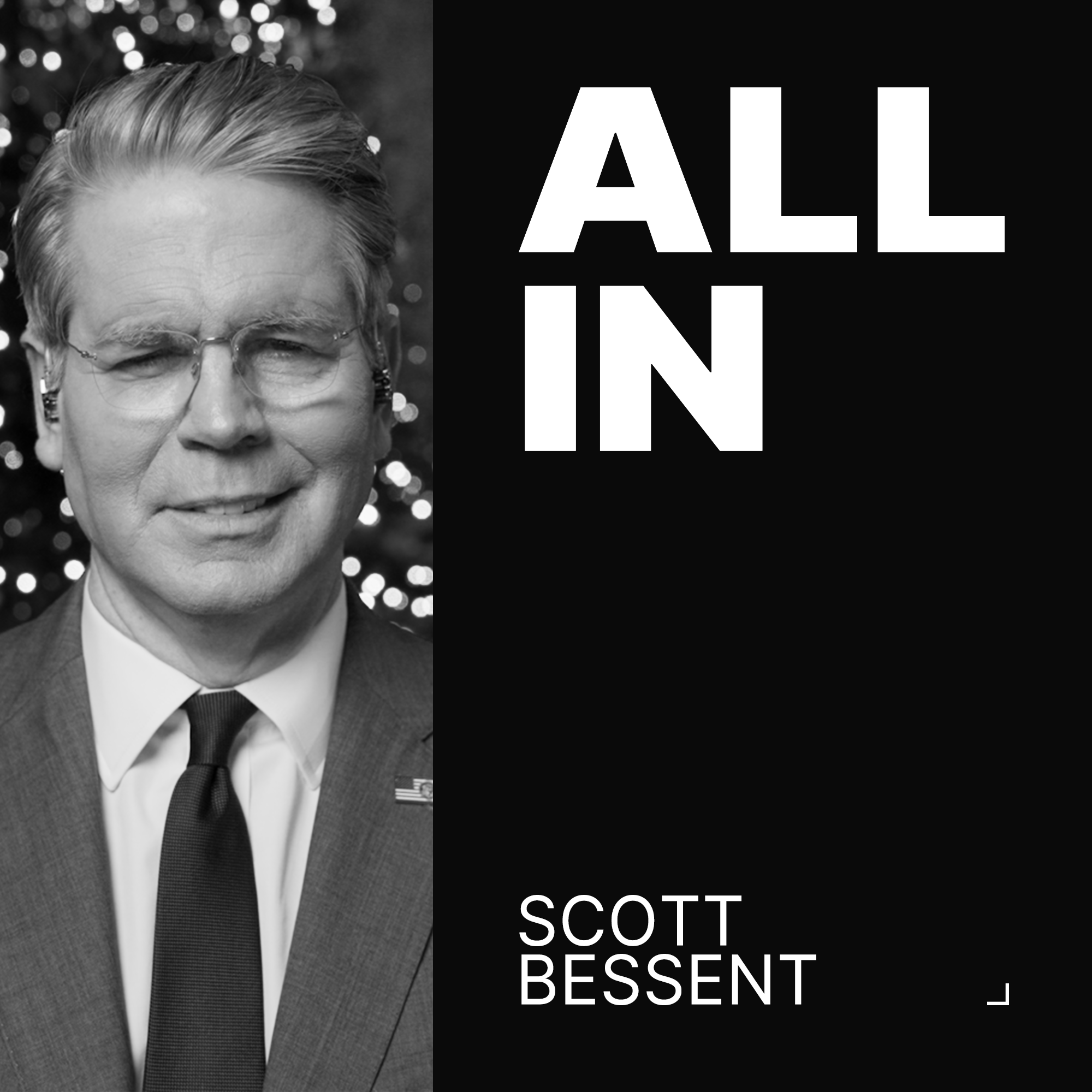
All-In with Chamath, Jason, Sacks & Friedberg
Scott Bessent: Fixing the Fed, Tariffs for National Security, Solving Affordability in 2026
00:56:58
Loading summary
Transcript63 lines
- [00:00]
A
Secretary Besant, welcome back to all in. We appreciate you taking the time to catch up with us and provide this first year in review. We're excited to have you here and hear how things are going and what's ahead regarding the fiscal condition of the US Government, the economic condition of the US Economy, including how things are going for Wall street and Main Street. And finally, we'd like to broadly discuss some of the administration's policies, decisions and how they're playing out or will play out from your point of view. I'll start us off and maybe to catch up on our last conversation, one of the things that I've cared deeply about and which you shared an objective around is getting the budget deficit below 3% of GDP. I'd love to hear from your point of view how that's going and how things are looking for fiscal year 26, the actions that have been taken and what you think is ahead for that.
- [00:55]
B
Good to be with you. Happy to review the year. Talk about next year. There's a lot going on. I would categorize 2025. We had some important victories, some important policy announcements, some important movement. But as I described it, 2025 was setting the table and especially on the economy. I think the feast and the banquet is going to be in 2026. To start with, the budget deficit, we didn't get much credit because it came out during the shutdown. The US fiscal year is on September 30th. We had a slight fiscal contraction for the year. Wasn't much, but much better than the 2.0 trillion that was estimated. We came down from about 1.8 trillion to 1.78. So a contraction nonetheless for the calendar year. We're making great progress. And just to put it in context, Biden administration, they blew things out trying to get Vice President Harris elected in the fourth quarter. So last year, 2024, 40% of the government spending occurred in the fourth quarter as they had the unsuccessful or their unsuccessful attempt to convince voters that they weren't in a world of hurt. I forecast that we will have approximately a 200 to 300 billion fiscal contraction for the calendar year, which is between 0.71% of GDP. We're going to end the year with nominal growth close to 6%. So we will be bringing down the deficit to GDP. I believe it peaked 6.8% for the calendar year, previous year, and we're going to be in the mid fives. So it's a very good start on an important journey. And I've said that I would by the time President Trump leaves office that we would like to have something with a three in front of it, which will stabilize the deficit to gdp, which is the important number, and enable us to start paying down debt.
- [03:13]
C
Scott, it seems like the tariffs have had an enormously positive impact. It's given you a lot of tools in the toolbox to work with. Why do you think so many people got it wrong? A lot of people I'm sure that you've known and worked with in your prior life as a hedge fund manager. What did they get wrong? What did they miss that you were able to see?
- [03:38]
B
Well, a couple of things, I think. People didn't have an open mind. They became the Trump tariffs, which immediately a large cohort, whether it was government officials, industry people, the general population, because President Trump wanted to do it, it must be bad. I said the other day, President Trump cured cancer, but it caused dandruff. Then people would say, well, you know, President Trump has caused a dandruff epidemic. And look, there's a lot of orthodoxy that hasn't worked. If we look back early 2000s, letting China into the global trading system, that they would become more like us. And there was a point, and I'm somewhat sympathetic to the people who believe that. But by 2013, when Xi Jinping came in and great writers like Elizabeth Economy, who had been of that view reversed and said, he's a different kind of cat, it's no longer going to be Chinese policies with capitalist tendencies. It's just going to go back to hard communism, Leninism. And I just think that it was a failure of imagination. I've said several times, people, and maybe we'll talk about it today, when people ask me, what are you looking for in a Fed chair, it's someone with an open mind. If we go Back to the 1990s, Alan Greenspan did a magnificent job because he had an open mind that the Internet office modernization boom was going to create a productivity bonanza for the U.S. economy. And he let the economy. He let it rip. And we had an incredible economy paid down a tremendous amount of debt that by 1998, 1999, with a combination of Clinton administration having gotten religion, Newt Gingrich and his policies, there was talk at the end of the 90s that there might not be enough government debt to meet the needs of the financial system, which is the opposite of what we have now. So again, I would. Part of it was just anything the president does must be wrong. Part of it was a failure of imagination. There's some very good Studies coming out now that are showing why everyone has been wrong, that the measurement problems on the increase in goods prices. There's a study from, not a friend of the administration, the San Francisco Fed, with 150 years of data, I would refer everyone to that, that shows that tariffs do not cause inflation, that they're actually disinflationary. So has anybody read that study, Scott?
- [06:39]
A
Has that been, I would say, a part of the conversation in the administration now that there is this new revenue stream for the federal government, there's an opportunity to cut taxes and cut other sources of revenue for the federal government, and that could potentially accelerate the economy. But balancing that question against the importance of cutting the deficit, how do you think about the balance between using tariffs as a mechanism for reducing the tax burden on the economy versus using the tariffs as an incremental revenue source for the federal government to start to reduce the deficit and pay down the debt eventually?
- [07:18]
B
David Before I answer that, another thing I want to go back to is President Trump and one of the reasons for the success of the tariff policy. I'll give you two reasons. One is that President Trump has used them for national security. So the tariff policy has become part of national security. He was able to use the tariffs to negotiate trade deals. When he ratcheted up some of the tariff levels to 35, 49, 50%, even 145 with the Chinese, it brings people to the table. In the spring, the president put fentanyl tariffs on Mexico, Canada, China. They've all come to the table to help and partner with the US Government to end this scourge on our people. We're seeing fentanyl deaths drop because of the good efforts of China. We made a good faith move and decreased their fentanyl tariffs by half, down to 10%. So that's been national security. Same thing on October 8, when Beijing announced that they were going to put a worldwide export license on any product that had 0.01% of Chinese rare earths in it, which would have ground the Western trading system to a halt. President Trump was able to threaten 100% tariff and the Chinese immediately came to the table. The other thing that I would say, so that's all national security. The other thing that I would say that people missed, that I was convinced of, is that the Chinese business model is based on volume, it's based on employment, it's based on a five year plan. And I think everyone neglected the idea that despite the tariffs, the Chinese were going to keep producing, that it's one of these. They may lose a dollar on every product, but they make up for it in volume.
- [09:17]
C
Can we forecast these tariffs through 28, or do you think that we have to have moments where whether it's the Supreme Court who's opining on one body of language versus another may change your course? But do you feel confident that we can forecast these revenues now out through the balance of President Trump's term?
- [09:39]
B
Well, I think that, I think the revenues are a combination of revenues. So the, the ultimate goal of tariffs, the revenue collection, I think of, in a way, is a payback for the imbalances that have gone on over the years. But over time, the real idea is to balance trade and reshore manufacturing and bring our economy into balance with our trading partners. So what should happen is over time, tariff income will come down and US Tax receipts will come up, whether it's from factory jobs or more manufacturing and through higher payroll taxes. So we will start off at this very high level, then we will rebalance and come up. So I think it's difficult to know the timing. We know the direction, we know the destination, but the timing is difficult. On tariffs versus increased domestic tax revenues, what I can say is when I got into the investment business in the 1980s, there was always a focus on trade and how much were we making in the US and again, that everything made outside of the US Is a decrease in US gdp. So as we bring it back, I think we're going to start looking more at the content of trade versus domestic manufacturing as a component of GDP acceleration.
- [11:13]
D
As we wrap tariffs. We have a Supreme Court ruling coming in January. What happens if that goes against the administration?
- [11:22]
B
Well, I don't think it's against the administration. I actually think it's against the American people. And it will be again, as I said, it will be a hit to national security. And the revenues aren't the focus here. The revenues aren't the focus. The revenues can be replaced. But all the things that President Trump has been able to do using tariffs on the national security side will be, will be jeopardized.
- [11:50]
D
Would you be able to just work with Congress on them? That seems to how the Constitution seems to be how the Constitution was designed is that the Congress would have this authority, so why not just work with them? Is that the fallback plan?
- [12:02]
B
Why would you say Congress would have what authority?
- [12:06]
D
Well, the Constitution has tariff control, so that's at least my understanding of the U.S. constitution. And I think that's why there's a Supreme Court case, correct?
- [12:16]
B
Well, we'll see. The President has the right under IPA for licenses. We've also seen. It was. I was at the Supreme Court. And for your viewers, a bucket list event should be going to see a Supreme Court hearing. It is in terms of any institution that is the closest to what our framers designed and jumped into business in 1789. It is probably. It is surely the closest to. To what you would have seen at the court. They're very convivial with each other.
- [12:58]
D
Yeah, I listened to it. It's quite compelling content. Yeah.
- [13:01]
B
Yeah. And to be there in person, not my political leanings, but Justice Kagan was just an intellect of towering impressiveness. I came away thinking, I am glad that Justice Alito is not my father.
- [13:19]
C
Because.
- [13:22]
B
He is smart, he is bombastic. And when he got the knife into a couple of the plaintiffs in a line of questioning. And he moves it around quite a bit. But one line of questioning in this that one of the plaintiffs agreed on was so. And it was either from Justice Alita or Justice Kavanaugh was you were telling this court that the president of the United states can do 100% embargo, but he cannot put on a 1% tariff. And the plaintiff said yes.
- [14:00]
A
Yeah. And that ruling is coming out in a few months.
- [14:02]
D
It's January or February. Expectation.
- [14:04]
B
Yeah, January or February. And, Jason, to your question, I don't know what the ruling is going to be. My guess is everyone, I think that framing is very important in any issue. And I think the framing thus far has been very poor because it's viewed as 01. It's up, down. And my guess is it will be more nuanced. Having been in the room, for instance, I think many in the media were at a different hearing than I was at. So when Justice Barrett. Conway Barrett said, if we undo this, it'll be a mess. That was viewed as just. It will be a mess. As opposed to. I believe she was actually leaning toward looking for a reason not to undo it because it would. The refund. She was referring to the refunds. The president has absolute ability or the executive branch has absolute ability through 301s, 232s and something called 122 to raise revenue on trade. So using the IEPA is not a stretch of that authority.
- [15:20]
D
Okay. So I think the question, and I really appreciate the introspection here on year one and the optimism for year two. Wall street, the tech industry, we've absolutely loved the results in year one. My portfolio has surged. So that's fantastic. Thank you. Probably beyond my expectation, but Main street is particularly displeased with the Trump administration's first year. Your net approval rating is the lowest on two key issues. Inflation net approval rating down about 30% on average since the summer, and on the economy, 18% net negative. And so this is quite paradoxical, obviously, since Trump was elected and considered historically very strong on those two specific issues. So my question to you is, are the American people wrong? Or maybe did President Trump set expectations too high during the election, or do you just need more time to execute and you're asking the American people humbly to give you more time?
- [16:18]
B
Well, I think it's C because as Vice President Vance has said, we didn't get here overnight. We inherited a mess. And I think 2026 is going to be a very good year for the American people, for Main Street. And what we are not going to do is a which is what the Biden administration did and many commentators, whether it was Greg Epp in the Wall Street Journal, the toxic Paul Krugman who seems to have been booted from the New York Times and is relegated to substack, or the former vice chair of the Fed, Alan Blinder. And they said, oh, no, you don't understand how good you have it. Eat your grit, drink your grog, have your bread, peasants. We'll give you a little more that. It's a vibe session and we're going to explain to you why you have it really good. We understand that the American people are hurting. And I think the way to think about it is there is a price level that things appreciated to during the Biden administration. Then there is the inflation level. The price level has gotten very high. I think cumulative CPI during the Biden administration was 21, 22%. There's a wall street firm called Strategus Research. They do something called the Common Man Index. And it is what do working families need? Gasoline insurance, the autos mostly used cars, rent, staples. And that appreciated by about 35%. So people are seething over the high price level. And as we saw in the inflation print this week, inflation is starting to turn down. And affordability, affordability is two parts. It is getting the price under control. Some things we can decrease. Gasoline is coming down substantially. I would expect that it would come down much more. Oil is down substantially. Gasoline follows it with a lag. Rents are down. And we are now seeing the effects of what 10 to 20 million undocumented people coming into the country did for rents. This mass unfettered immigration for D and C rent levels was through the roof. There's a Study from Wharton that shows that 1 1% of population increase in a city leads to 1% rent. So we can see why rent went up. That if the migrants are going home we are now seeing rents are down about 5%. I think that trend will continue again the inflation numbers are starting to roll down. I think that they will. And then the other side is real incomes which I think are starting to accelerate. Real incomes are about up about 1.8% since President Trump took office. And that's back to the Main street question.
- [19:24]
D
So just one quick follow up there and I'll give it back to my compatriots. We need more time. This is not a one year project. It's going to take two or three years and we're not going to gaslight you. And the numbers are looking good. On that note we had the shutdown October numbers were not complete. There's a bunch of reports now and hand wringing over those numbers. I think maybe you could address it which is the BLS filled in a lot of the non survey data sources with some zeros and potentially the criticism now or the concern on Wall street and from analysts is that maybe this 2.7 number is over optimistic. Maybe you could address people's concerns. And can we trust you with the numbers I think is what Wall Street's saying.
- [20:10]
B
Well again it's amazing when a good number comes out then it switches to that. And Jason, just let me tell you, every Wall street predictor in Bloomberg was wrong. So what do you do when you're wrong? You blame the measurement, you blame the data. And there's always a lot of imputed data in any of these numbers. That's why we get revisions. And and I was looking at the numbers and paradoxically the two things that I think are coming down the fastest which are rent also it's known as the owner owner occupied funding or owner occupied rent that was actually up on the month. I believe it is turned negative. And then the other thing that was up was energy and gasoline which we can is an observable event that those prices have decreased substantially from September October. So I actually think it was a pretty accurate number.
- [21:16]
D
So you've checked into that the BLS numbers from October, you feel confident they put those placeholders, they put those assumptions incorrectly. You feel confident in that.
- [21:25]
B
Look, the BLS is problematic. We've seen that the whole time. I have no reason to believe that this is any less robust than any other data series. And I would say with rent, with Energy that those are very large components that have turned down substantially that actually recorded a gain for that measurement period.
- [21:49]
C
Just to build on that, we had people on our team go and run our own analysis, both using interpolation and other data points, and we get to exactly Scott's numbers and frankly on the margin, sometimes slightly better. So I think the trend is very much what you and Kevin Hassett have been talking about in the last couple days.
- [22:10]
B
And gentlemen, I would also point you to Fed Governor Stephen Myron, who came from cea. He'll be going back to CEA probably in February or March, delivered a very robust speech at Columbia. It was either a week or two ago. And he made some very interesting measurement points on inflation. So one piece of the inflation component is financial services. And that goes up based on whether the stock market's up.
- [22:41]
C
That's right.
- [22:42]
B
When in fact portfolio management costs have come down, that it is showing an increase in costs. So back to Jason's question on bls. How robust are the numbers? I think there are a lot of changes that could be adjusted to give us a better picture.
- [23:01]
C
Let's stay on the affordability topic. And I would like to go to this essay you wrote, which is incredible. The Fed's New Gain of Function Monetary Policy, which you wrote in the International Economy. We'll link to this article. A lot of it goes to how the Fed in many ways has exacerbated the sense of inequality and the actual factual inequality. But before I ask you that narrow question, Scott, can you help our viewers just take a step back and give us a little bit of historical context on the Fed itself. So we had a central bank in the 1700s. In the 1800s, Andrew Jackson got rid of it. It came back in the early 1900s when we established it then versus what it's doing today. And you studied this carefully. Can you help us understand and contrast and compare how it started versus how it's going?
- [23:54]
B
Sure. So Fed was created in 1913 as a response to the panic of 1907, which most people don't know about. It made the crash of 29 look like a day at the beach.
- [24:05]
C
Knickerbocker crisis.
- [24:06]
B
Yeah, the Knickerbocker crisis. And just a domino effect within the financial system. There was no central bank. Bank of England is a very old central bank and had been functioning well. JP Morgan actually had to personally step in in the crisis. And it was deemed that there should be a mechanism for the government to be able to either wind down, provide liquidity and have a greater control in the economy rather than private operators for Much of its history, treasury had a seat at the table on the Federal Reserve. Post World War II that stopped. And then if we look at more recent history, what happened after the great financial crisis, we saw this paralysis in the economy. I think a huge part of it, which has been part of my regulatory agenda here at treasury this year through the Financial Stability Oversight Council is undoing the poorly thought out crisis legislation. But what the crisis legislation did and look after financial I studied and taught at Yale the history of financial crises. There's always retribution. And you go from a lax regulatory regime to an over constricted regulatory regime. So coming out of the traumatic GFC for 10 years we had this over constricted regulatory regime where the Fed was deemed to be the only game in town. Imagine one example would be a home in North Florida that sold for $500,000 in 2006. All of a sudden people are handing the keys back. It is now $150,000. Great buy, great affordability. But because of the new financial regulation and the incentives, the banks were in some cases rightly taken to the woodshed for bad behavior. But there was no incentive to give credit at the bottom. So what happened? The asset owners, people with money were able to accumulate assets. We saw very poor growth during the period during the Obama administration. And the Fed kept rates low for very long. But what the Fed engaged in, starting I believe was October 6th, excuse me, March 6th or March 8th, 2009 was the Fed began what we call QE or large scale asset purchases. They went in the market, started buying long bonds. And the theory of the case there is you create liquidity, you take safe assets out of the market, long duration safe assets. And then the people who receive that money would buy more risky assets. Ben Bernanke famously said when he was asked what's the purpose of qe? He told everyone go buy equities. Well, not everyone could buy equities. So we ended up with this two tier economy where either you were an asset holder or you weren't. And the Fed probably kept or definitely kept QE going for too long. I called the Fed the engine of inequality. And someone said to me, would you believe that the Fed is responsible for economic equality in the system? And I said absolutely not. That is not one of their mandates. But they shouldn't be exacerbating it. And they were the leading cause of it. There's a fantastic book by a. I know Karen Petterou very well. She's Senator left to maybe Hart.
- [28:05]
C
Yeah, not your politics for sure.
- [28:07]
B
Not my Politics. But her book, the Fed the Engine.
- [28:09]
C
Her book is excellent.
- [28:10]
B
Yeah, Engine of inequality. So we just kept pushing up these asset prices and then we got Covid and markets became disorderly and the Fed did exactly what it should do. It came in, it stabilized the markets, but for some reason they decided that they needed to continue this QE right up until I think February or March of 2023. And they were in essence financing this massive debt increase 7 trillion that we saw during that period. So it's a long way of saying the central bank has become much more involved in the economy. I think a lot of people don't understand. We've gone from what used to be fairly straightforward rate setting mechanism to now we have kind of this three headed beast at the Fed or this very complex calculus that I don't think anyone really understands, myself included. You have rate setting policy, you have balance sheet policy. So the Fed has a very big balance sheet now. And then you have regulatory.
- [29:23]
C
Well, there's a part of your article which was stunning to me where you describe how the budget of the Fed works and effectively when you understand that there's a part of the Fed which acts like a hedge fund and effectively is taking risk and, and the revenues that they generate are used to subsidize their operations. Can you explain that for folks? Because I didn't fully realize that that was happening.
- [29:46]
B
Yeah, well again the Fed should make money. Fed typically used to make money and would remit money back to the Treasury. Back to David's question on the budget deficit. The Fed was sending back about 0.3% of GDP through we have seigniorage which is the float on the currency. There are other operations. But then they started QE and no one told the Fed that you're not supposed to buy high. So they paid a high price for bonds, low interest rates and their arbitrage. The Fed's losing about $100 billion a.
- [30:28]
A
Year now if you look at one of the key drivers of Main Street's satisfaction with their economic standing, it's the price of debt, the ability for them to buy a home, to buy a car, to extend their lives. And we've got the 10 year treasury sitting I think 4, 2 to 46 right now in terms of the rate. And I guess this may be a question that brings in two other issues, the fiscal issue and the economic issue. Is that a reflection of the state of the fiscal affairs of the federal government? The state of the economy, both or the state of markets selling off bonds. And doesn't the Fed have an important role to play in bringing those rates down and making rates accessible for Main Street?
- [31:14]
B
Well, I think what the Fed did, unfortunately, they took modern monetary theory from. I say they went from MMT modern monetary theory to MMP modern monetary practice. So the Biden administration issued all this debt and the Fed bought it. And there's a very good study from MIT that's come out that shows in a way that only PhDs at MIT can be very precise, 42% of the great inflation was caused by the budget deficit. Another 17% was caused by the increase in inflation expectations, which I think you could tie back to that. So you've got almost 60%, David, that was caused by the spending of the inflation. And I think, again, to go back to my earlier point, I think what we're not getting credit for here is that if we can stabilize the budget deficit, even bring it down, that that will contribute to disinflation. If I think about central bank credibility in my career, probably Post World War II, no central bank had more credibility than the Bundesbank up until the advent of the euro. But they controlled the German, they worked with the German government, and they would work with each other, hand in hand. The Bundesbank would say, if you give us the fiscal control, if you give us, if you are not prolific, if you give us the reasonable fiscal balance, we will work with you. We will foam the Runway to allow you to decrease spending, we will decrease interest rates. And I think that's something we could be doing here.
- [33:00]
D
I'm glad that you too are confused by the Fed's actions, Secretary Bessen, because I read your article. And while I understand the mandate to get to 2% inflation, why it's 2%, not 3, I'm curious about your take on that because I did a little historical archaeology. I understand somebody in New Zealand came up with the 2 target, as opposed to 2.5 or 1.5 or 3. Let's put that aside for a second. The thing that I think most Americans don't understand, and the second mandate, full employment, robust employment, that seems pretty easy to understand for all of us. But this qualitative easing and how they purchase and which assets they purchase and why seems to have a massively distorting effect on the economy, at least according to your essay and some of the other sources you cite in this essay, which we have in the notes for people to read, what should we be doing this qualify this QE at all? If you had your druthers and you could just, you know, swipe A pen here and clean this up, would you? Just get rid of the QE portion of what they're doing. And how do they pick, like how do you pick whose corporate debt you buy? You know, are you buying in videos and Ubers and Google's because those are great companies or Microsoft's or are you buying Fords or struggling companies or struggling airlines? How are those decisions made and should the American people be buying those things and why?
- [34:24]
B
Yeah, so there's a lot to unpack there that absolutely. Large scale asset purchases should be part of the so called central bank toolkit. But I think if we go back and look at Covid, which was a real test, the bank of England had the best model. The markets became unhinged, they stepped in for a period, I can't remember whether it was 30, 60 or 90 days, they stabilized markets and they were the buyer of last resort, which is classic theory for what a central bank's supposed to do. They're supposed to provide what liquidity. They're supposed to open a window where financial institutions can pledge collateral and do it that way. And I'll just point out that when the bond yields were quite high, the Fed did buy quite a bit and they would actually have a large profit if they stopped during that period. Instead they continued on when we were near these, the zero bound. And what we've ended up with here is they push the asset price up, the interest rates were low, many people couldn't buy a house during COVID But now the interest rate has normalized and we're just in a much more normal period for interest rates. But we're not in a normal period for asset prices because so many people still have the 3% mortgages from COVID And back to your question on what should the Fed buy? Traditionally the Fed, since large scale asset purchases began in 2009, they just bought government bonds. They choose the duration. They switched during COVID because look, there were estimates we were going to have a 20, 30, 40% GDP decrease. So they were buying indices of high yield bonds, of corporate bonds to stabilize the market. I think what you're alluding to, Jason, is also during that period in conjunction with treasury, there were bailouts. And that's done by a facility that is negotiated between the Fed and the treasury called a 133 facility. And you identify strategic industries that may be struggling. It would not have behooved anyone for the airline industry to go belly up because of a virus that turned out to be quite transitory. So again, I think these are emergency powers I think they should have them in emergency, but I think the duration went on much, much too long.
- [37:20]
A
If you're now in the bond sales game, Secretary Besant, I mean, you've been on the other side of the market, but now you're selling the bonds. What do you see in terms of appetite for US Bonds? Has China disappeared? Are they still selling down? Are there other buyers emerging? And how does broader capital markets look to US Debt in this moment?
- [37:42]
B
Well, it's like John Maynard Keynes said, a lot, a lot of economics is a beauty pageant. You're just picking who do you think is going to win. And the US Became the worldwide winner last year. We had the best performing bond market, best performing market since 2020. And I think that was for a combination of reasons. One was the fiscal progress we made. And everyone went from tariffs, they were a doomsday machine to maybe tariffs are taking us to the promised land in terms of fiscal paydown. And I also think inflation expectations have remained well anchored. Back to Jason's question, why 2%? We've chosen 2%, and I think it's very difficult to do a midair refueling or to call an audible on 2 when you're above 2, because then it looks like when you're above a level you will always fudge upward. So I think there is a very robust conversation to get back. Once we are back to two, which I think will be in sight, then we can have a discussion. Is it much smarter to have a range? What drives me crazy, the economy, the markets are biology. They're not math, they're not physics, they're nonlinearities. They're very complex systems. They're mutations in the system. And this idea that we can have this decimal point certainty is just absurd. So I believe that once we re anchor to the target, then we could talk about a range and we could decide whether the range is from 2.5 to 1.5. Is it from 1 to 3? But I think it's very difficult to re anchor until you meet the target and maintain credibility.
- [39:58]
C
Maybe as we wrap up on the Fed, can you give us a sense of the candidates that are being interviewed right now by President Trump? Kevin Warsh, Kevin Hassett, Waller, Chris Waller and Rick Reid. Chris Waller, Rick Reid, how do you think each of those will try to reshape the Fed more in this constrained mode that you're advocating for?
- [40:18]
B
Well, I think many of them have already come out and said that they do want to shrink it, both as the footprint of the institution and the economy, but shrink the institution Itself, the Fed does not. As we talked about earlier, the Fed does not rely on appropriations. The Fed just prints its own money and has its own budget. And as I talked about in the article, it has its own police force. It has its own own. You know, we've seen the big cost overruns at the building here in D.C. if treasury, we're looking at new buildings for the Mint or the Bureau of Engraving. If we had that kind of cost overrun, I can guarantee you that I would be up in Capitol Hill getting a well deserved earful.
- [41:10]
C
Yeah, you'd be pilloried.
- [41:11]
B
Yeah, so. But each one of them has talked about moving back toward the more traditional Fed role, moving into the. Just getting the Fed back into the background. It wasn't meant that the market and the economy and the American people were supposed to hinge on every word. It was supposed to be a predictable process. I think many of them have talked about getting rid of this so called dot plot, the summary of economic projections. They've talked about what should we do with the regional banks? No one's talking about getting rid of them or the regional bank presidents. But should each one of the regional banks have a specialty? Go back to a center of excellence. Why do we have so many overlapping functions? I can tell you, for me, as someone who's an economic historian, the interview process has been fantastic because I got to interview 11 of the most knowledgeable people on economics, the Fed monetary policy one time, I got to interview five another time, and I'll be with four of them with the President. So I think I understand probably better than just about anybody in the country what needs to be done. And everyone wants to see a smaller footprint and more predictability from what's going on.
- [42:45]
D
So what happens in 2026 for Main Street? What can you promise them? What can you not promise them? What is out of your control? Because we talk a lot about, hey, the speed limit and mortgage rates, but you can't, in your position, correct me if I'm wrong, have a dramatic impact on the supply of homes, as one example. And so whatever you put the rates at, it could just drive the prices of those homes up if we lower rates too quickly. And then we have another situation like the great financial crisis where people are overbidding the remaining housing stock. So what can you actually promise to the American people will happen in 2026 on Main Street? We know Wall Street's going to be fine. And these American entrepreneurs and these companies are firing on all cylinders. Fantastic. Lots of regulations taken out of the way. But what can Main street expect from the administration in 2026?
- [43:39]
B
Jason, two things is one, there's nothing I can promise because there's always a degree of uncertainty. But one of the things that we've been doing here at treasury when we talk about loosening the financial regulations, that.
- [43:56]
A
The.
- [43:58]
B
Companies that suffered the most under these regulations were the small banks. So we have seen small and community banks disappear at an alarming rate. About half of them have disappeared since the gfc. So what I can promise is that the regulatory regime for those banks is being loosened and is the saying that there's three, eight banks in the US that are too big to fail, that the policies since the GFC were too small to succeed. And we are doing everything to unleash the lending capability of these banks. Their profitability will enable them to be part of their communities to lend more. 70%, I think I do the statistics. 70% of ag lending, 30, 40% of real estate lending, 40% of small business lending are from these Main street lenders. So I can tell you there's going to be a bigger availability of credit. I can tell you that we are not going to blow out the budget deficit and cause you will not see an MIT study that says that the Trump 2.0 caused inflation through the budget deficit. And I can also tell you that we are working to increase working wages. In President Trump's first term, hourly workers did better than supervisory workers. Bottom 50% of households had a better increase in net, bigger increase in net worth in the top 10%. So, you know, we are trying to level the playing field.
- [45:43]
A
Secretary Besant, this is a, I would say, conservative administration. And if you look at the kind of economic policy of traditional conservative administrations, you would not assume that the administration would lead the federal government to make large investments in the private industry or to participate meaningfully in in the economy, as we are seeing with some of the deals that have been done over the last couple of months where the administration has taken equity stakes in key industries and key businesses and also has concurrently provided either regulatory unlock or some sort of trade participation. Can you just comment on what some people are calling state capitalism? Is this, from your view, a set of strategic interests, or is this a permanent shift in how the government plays a role in the economy? And how does that make sense from a free market perspective?
- [46:42]
B
David I think it goes back to the idea that pure unfettered free trade was not fair trade. When you have competitors, whether China, Vietnam, some others, sometimes in Europe, that have high subsidies, then like this idea that perfect Ricardian equivalence exists, doesn't. And we can see by these distortions that developed these huge capital pools that have developed because of the imbalances. So that's one point. But that's trade policy. But on the other side there's national security policy. And the only good thing I can say about COVID is it woke us up to the national security, took us out of this paradigm that elongated free flowing supply chains, wherever they may be, were the best, that the most smoothly functioning was desirable. Well, it turns out that the most efficient is not always the safest, the most robust or the soundest. And we saw that during COVID we discovered that the Chinese became unreliable suppliers. India and some of the other countries, they acted, surprise, surprise in their national interest. So if you look at the industries where we are taking stakes and moving forward, we we've identified five to eight strategic industries where the US we have to have endogenous production or at least adjacent to us in North America or this hemisphere. And I think of it as it's the kind of thing that you would have seen during World War II. And we are in an economic war and we do not want it to become a kinetic war, but we have to be prepared if it could. But when we think about huge amount, 80, 90% of the precursor chemicals that go into US pharmaceuticals are made overseas, majority in China or India. Semiconductors. In my life, I believe that the greatest economic threat to the world economy, to the US Economy, more than the Arab oil embargo that I lived through in the 70s when I lined up with my parents at the pump to do odd even days because of the oil embargo. The biggest threat is that 97% of the upper level precision chip manufacturer, the advanced chip manufacturers, is made in Taiwan. And we need to bring a portion of that back to the U.S. same for steel, same for shipbuilding, same for pharmaceuticals. So the interventions are all in those areas.
- [49:57]
C
Scott, as we wrap, I'd like to go back to one topic you spoke about at the beginning, which is you've had to overcome a lot of Biden era difficulty and a lot of the groundwork, as you said, will be seen in 26 and beyond. And I just want to give you a final moment to talk about those in two buckets. Bucket number one is there's a lot of tax cuts that will hit starting January 1st. And I think it would be good for people to understand what's coming. And then bucket number two, there's been this incredible movement and energy around Trump accounts. And you even spoke about this yesterday, about the value of compounding and teaching people the financial literacy to understand what's possible for all these kids. And I just want to give you a chance to talk about those two.
- [50:39]
B
Topics as we wrap a couple points here. What we are going to see next year that if you think about the signature parts of the tax bill, I think that the powerful, the most powerful parts had the immediate expensing for American business, permanent for equipment and then four or five year window for factories. So we are seeing already seeing a capex boom. So 2025 was a capex boom. I think that is going to accelerate with all the trade deals we've done. I was just but six weeks ago in my hometown of Charleston, South Carolina, Boeing, the largest employer there is increasing their plant by 50% for the Dreamliners result of the trade deals. But it's also part of the tax deal. So we're going to continue seeing this capex boom that turns into employment boom. On the other side for working Americans, the president I led the administration's team up on the Hill in terms of what was non negotiable for the President. And a lot of traditional Republicans didn't like his campaign promises to working Americans and the president never yielded on those. So no tax on tips, no tax on overtime, no tax on Social Security deductibility of auto loans for American made cars. So the bill was done on July 4th. It's retroactive to the beginning of the year for working Americans, retroactive to January 20th for corporates. So working Americans, I also have the honor of being the IRS commissioner and I can see that we're going to have a gigantic refund year in the first quarter because no one changed their working Americans did not change their withholding. So I think households could see depending on the number of workers, 1,000, $2,000 refunds. They will change their withholding schedule at the beginning of the year and they will get an automatic increase in real wages. So I think that's going to be a very, I think that's going to be a very powerful combo of corporate and individuals. And then these Trump accounts I believe are a game changer. And I think this will end up more than what he did for defense, more than he did for strategic industries. When we look back in 50 years, I think this administration will have saved or created the idea that everyone is an equity owner, that everyone has a stake in the market. Right now about 38% of Americans do not own equities either directly or through some kind of a 401k or something. So by giving every child $1,000 at birth for these accounts, we are going to increase financial literacy. We're going to increase people's optimism in the market here at treasury. We're going to do a dramatic amount of financial literacy, financial education. We're going to push that out to the schools. And I think this idea of every American learning that money can make money for them, that we will close the gap over time. We'll go from 38% not owning equities. If this continues, hopefully that can be zero. And everybody gets a stake in American prosperity, the American innovation that you all do. And I think it is going to. When I look at the polling for young people, in terms of their view of socialism, their view of capitalism, I think that this is going to make every man, Huey Long said every man a king. I think this is going to make the man and woman a market participant. And I think it's fantastic. I began the announcement the other day. I said, I've talked about parallel prosperity, Wall street and Main Street. This is the biggest merger in history because it is merging Main street and Wall Street. I grew up in a small town in South Carolina. The only thing I knew about Wall street was something bad had happened in 1929. I was fortunate, went to Yale and then went to New York. But you shouldn't have to have that path. That if you want to stay in your hometown but participate in the market and learn a lot about it, this is the ultimate program for that. And what we're doing is parents, family members, employers can add $5,000. Philanthropist like Susan and Michael Dell are going to put in $6.25 billion to top up the accounts. And then we're up to probably 20 states that are going to also top up the accounts. Employers, we've got credit card companies, banks that are already on board. And you're just going to keep pushing more money into these accounts. Americans are the most generous people in the history of the world. We have never had a direct way to get rid of the friction of philanthropy and give money directly to American children.
- [56:21]
C
Yeah.
- [56:22]
D
Fantastic on that.
- [56:23]
A
Real watershed moment. Secretary Bessant, we appreciate your leadership and your service and for spending the time with us here today. You've been open and articulate as always, and we thank you for that. We appreciate it. For chamath Jason, this is the the all in podcast. And thank you, Secretary Bessant.
- [56:42]
B
Good. Well, it's an honor to serve the American people. So thank you all.