← All-In with Chamath, Jason, Sacks & Friedberg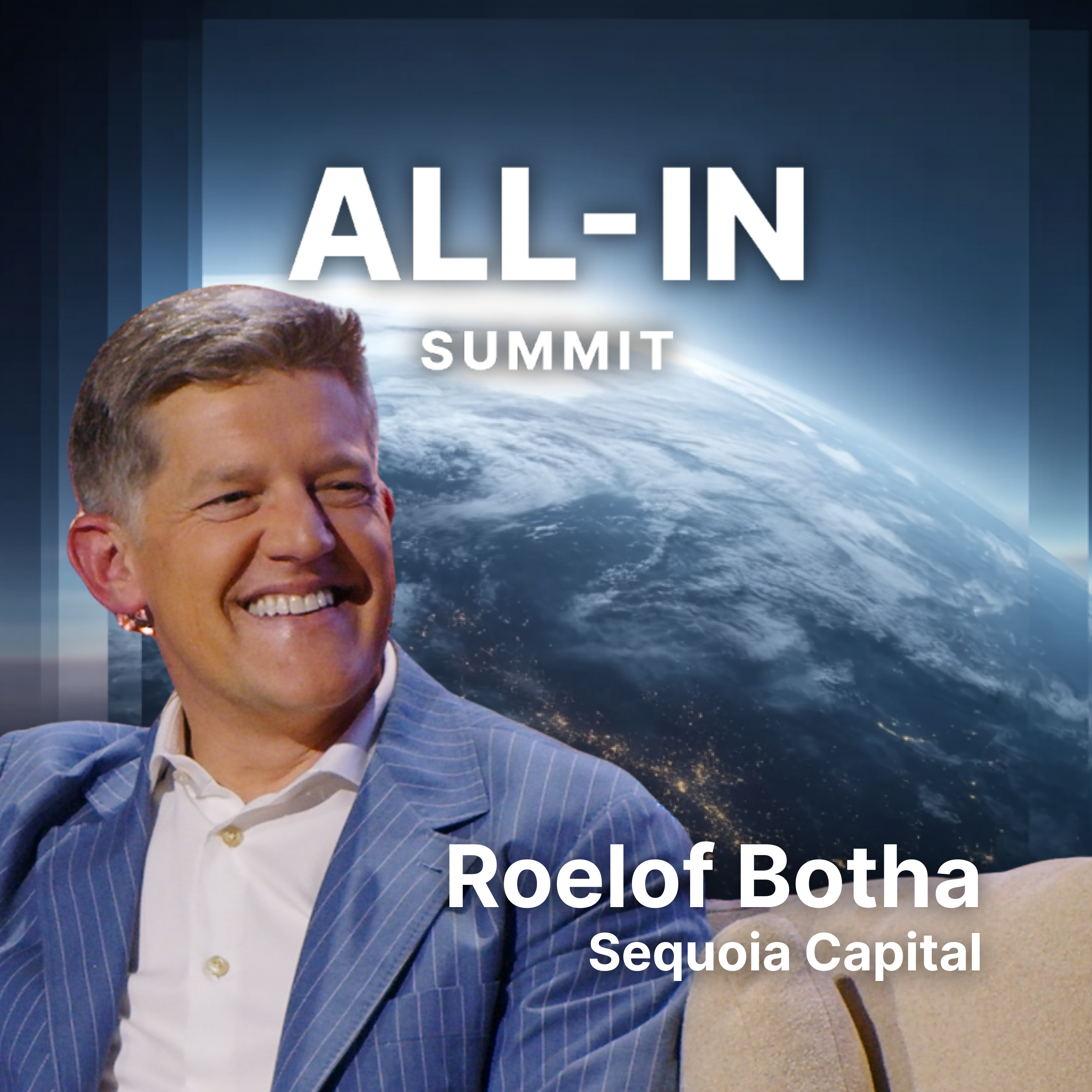
All-In with Chamath, Jason, Sacks & Friedberg
Sequoia’s Roelof Botha: Why Venture Capital is Broken & How Great Companies Are Built
00:27:57
(0:00) Introducing Roelof Botha (1:08) Sequoia’s Scout program and its best-performing funds ever (3:38) State of Venture Capital: Why it’s broken, too much capital, not enough great companies (9:01) Why Sequoia separated from its China business,...
Loading summary
Transcript145 lines
- [00:02]
A
Sequoia is the most sought after name in the venture capital business. The firm has made over a thousand investments now worth in the trillions in public market value.
- [00:11]
B
There's a list of five VCs who I think can really transform a company. And you're one of those five.
- [00:17]
A
When I joined Sequoia, it was clear that if I wanted to make it as a partner, you needed to produce meaningful games.
- [00:24]
B
YouTube, Instagram square. This is a list of amazing, amazing startups.
- [00:29]
A
Our ambition is to build a partnership that endures. And that means we need to leave it in a better place than we found it.
- [00:36]
B
Ladies and gentlemen, please welcome Sequoia Capital's Roloff Botha.
- [00:46]
C
See ya. How are you?
- [00:48]
A
Good to see you.
- [00:50]
D
Welcome, Roloff.
- [00:52]
B
This question, what's that?
- [00:54]
A
Where did Sax go get the pee pee?
- [00:57]
B
He had to make a wee wee.
- [01:00]
A
Come on.
- [01:00]
D
Yeah, exactly. You guys did work together for 25.
- [01:04]
A
Years ago and he just abandons us right now.
- [01:07]
B
He's had enough of you. Everybody wants to know who's your favorite Sequoia Scout of all time? Let's go through it.
- [01:17]
A
Jason Gallicanis.
- [01:20]
B
It is hilarious when you think about it. You came to me, gosh, 15 years ago and you said, I have an idea for a program. It's called Sequoia Scouts. We'd like to have you go around and invest in some companies and no.
- [01:37]
A
Good deed shall go unpunished.
- [01:39]
B
Absolutely. Created a monster. But that program, sorry, before you ask.
- [01:43]
C
Your question, how far are you going to insert your head up Roloff's ass?
- [01:49]
B
We sat him that far away for a reason.
- [01:51]
C
I mean, sorry, bro. Jesus Christ. Good, Go on with your question.
- [01:57]
B
Let me land the question.
- [01:58]
C
What's your question?
- [02:00]
B
That program had some. That first cohort of individuals wound up being a pretty interesting group of folks. Maybe you could tell everybody just a little bit about that program you conceived of and then who were some of the first folks in it and the.
- [02:18]
A
First investments we conceived of this program, as you mentioned in 2010 when we launched it. And the idea was that there were a bunch of contemporary founders who had very interesting access to up and coming founders who were turning to them for advice, but these founders didn't yet have money. At the point that you became a Scout, you didn't have the net worth you have now where you could write a check on your own. And so we thought it would be a great program for us to provide the capital for founders like yourself to be able to invest in those companies and hopefully we would get an introduction to those companies for us to be able to make an investment too. So you were in that program, you helped us with the investment in Uber. Sam Altman was in that group as well. He helped with an investment in a little company called Stripe.
- [02:58]
B
They did.
- [02:58]
A
Okay, so at this point, that fund is a 26x fund at this point.
- [03:03]
B
Wow, that's up there in the.
- [03:05]
A
It's pretty good.
- [03:06]
B
What's the best fund in the history of Sequoia? Was it the Google fund? The WhatsApp fund? Which one has the highest multiple in history?
- [03:13]
A
The highest multiple in history is.
- [03:19]
C
I.
- [03:19]
A
Think Venture 12, which has Airbnb, Dropbox, Natera, Admob and a couple of other companies. And then Venture 13, which is the fund right after that has Stripe and Square, now called Block, MongoDB and a bunch of other companies. So those were both north of 20x funds.
- [03:39]
C
Tell us about the venture industry, actually. So we're at a point in the cycle where there's been a lot of specialization, both maybe at the stage level, at the sector level. There's been all kinds of experimentation and approaches in strategy. Can you just level set on what you've learned and what the industries learn and where we are?
- [03:58]
A
I'm glad you called it an industry, not an asset class. I listened to one of the shows you guys had recently and I think there's a huge problem with the venture industry that there's too much money. You guys have talked about this before. Venture industry as a whole invests right now between 150 to 200 billion dollars a year was the last numbers I saw. If you think about reasonable assumptions for returns, let's just say 12% per annum net, which isn't great. Might as well invest in an index fund. The math basically implies that you need 3 1/2 to 4x funds to make that math work over a reasonable time frame. So if you're investing, let's just say $200 billion a year, the industry needs to give back 7,800 billion a year. VCs don't own 100% of the company last time I checked. So that means that the aggregate exit value is north of a trillion a year. So Figma went public recently. They're worth 25, 26 billion dollars. You need 40 figmas a year for the industry to make the returns work, which means that they don't. So in my opinion, investing in venture is a return free risk. You shouldn't. They're basically only about 20 companies.
- [05:06]
B
You said return return free risk.
- [05:09]
A
Exactly. If you look at every single Decade, there are only about 20 companies that end up getting exit values north of a billion dollars. Actual IPOs or MAs north of a billion. Not the paper write ups. Only 20 companies. More money doesn't create more great ideas or more great founders. So I think there is way too much money in the industry. The industry does provide a lot of value. It provides some of the know how for entrepreneurs to succeed and obviously leads to job creation and all the attendant benefits for America. But there is too much money and too many people want to be investors.
- [05:40]
C
How does the money get level set then and right sized for what is needed?
- [05:45]
A
I've been wondering that for 20 years. This problem is a problem 20 years ago. It is only 100%.
- [05:50]
C
Well, it's an incredibly sexy asset class. I mean, look, Jason writes a best selling book. It doesn't, you know, dissuade people. It incentivizes more people to say, oh, I can try this, I'll be like it. I mean it's just a self fulfilling prophecy. The more successes there are, there's just.
- [06:04]
A
A yeah, everybody wants to go to Vegas and strike it rich. It doesn't happen. That's part of the dynamic is that you get a firm that has one success in their fund and then they attract more capital because people think it's repeatable and it's not.
- [06:17]
D
And you don't know that till fund three or four. Like often they raise fund three before they've even, they've raised fund two, three.
- [06:24]
C
Four and five before even fund one is really fully distributed. So what could change for one of the things that I thought was transparency, but nobody wants to publish their returns. You could publish your returns. I publish my returns, but I'm not taking outside capital. But would that help? Is it working with people like Cambridge so that these things become more public and more understood? It seems like there's an education element here that's missing on behalf of the industry to the potential LPs.
- [06:53]
A
I think people will still hide behind the J curve effect and they'll say, yeah, my fund is only at 1.5x right now, but it's only four years in and you know the winners are going to emerge. And so I think this, this hope springs eternal dynamic and such a long time period of gestation before the companies get realized that I don't think that will change that dynamic.
- [07:12]
C
Unfortunately, there's also been this really interesting effect where it's been this industrialization of venture capital, I will call it. So if you look at the organization that Andreessen has built the organization that General Catalyst has built, it's about this girthiness right across many different things. How has Sequoia reacted when they've seen those movements? And I'm sure you've had to sit down as a partnership and say, are we matching this? Are we copying this? Are we going to do the same thing? Are we doing something different?
- [07:39]
A
That is a great question. The industry has changed a lot since I got into venture just over 20 years ago. If you go back to the proverbial 1990s venture firm, it was, you know, a dozen people sitting around a table making investment decisions with very lightweight staff. And it was much more of a cottage industry. I think the industry is professionalized and really the founders are the ones who benefited from it because all these firms have built larger operating teams to be able to help those founders with talent, with go to market. And so I think it's really helping founders. That's probably the main takeaway I have from that. We've decided to not build as big an organization. Most of the operating teams we have at Sequoia help us. So we have about as many developers at Sequoia as we have investors, and they're building products for us so that we are much more effective and productive than we might have been 20 years ago.
- [08:26]
C
What's an example of that that they're building for you?
- [08:29]
A
So, you know, on my phone I can pull up an app that I. If you give me any company name, I'll be able to tell you who my team last met it, how we rated it. I'll give you data on what's happening with their hiring, how many vouched employees they have, how good do we think their engineering team is based on their history, their academic profiles, etc. All this information is at my fingertips. If we get back business plan submissions, we have an AI system that will summarize it for me so that I get a very quick read on the company, a quick summarization of the quality of the team, and a very quick analysis of the competitive dynamics and the other companies I should consider alongside them. So these are just small examples of the things we do.
- [09:02]
B
We just had Joe Tsai on. We're talking a bit about the relationship between America and China. You had a fabulous business in China for two decades, I believe, with Neil, and it did absolutely fantastic. But then the government of the United States said, hey, we cannot as venture capitalists, invest in China anymore. So what's your take on the opportunity in China? Will that return and just the experience you had with all those incredible hits at the time.
- [09:34]
A
When we first went into China, it was 2007, I think the World was Flat was the moniker at the time. China gained admission to the World Trade Organization in, I think, 2001, and we all believed that it would integrate into the global economy. That premise proved wrong. And so we had a period where it was really interesting to be able to share knowledge and share ideas and sort of figure out how we can build a globally interconnected set of systems and companies. And life just got too hard for that, honestly. And we saw just more division between the two countries. So we embarked on global separation just over two years ago. And what used to be Sequoia China is now an independent business called Hongshan. And they're off to the races. I think there's a real challenge in China right now. Some static got recently. In 2018, there were 51,000 companies started in China. In 2023, just 1200.
- [10:31]
C
Wow.
- [10:31]
D
How many?
- [10:32]
A
1200? You had a 98% reduction in the number of companies founded in China. Because if you're an entrepreneur in China, why would you want to start a company when the government regulations are so uncertain? Which, by the way, is an interesting warning sign for me. For us in America, as we think about AI policy and AI regulation, the more uncertainty we create for founders, the more difficult it is for them to actually take that risk, take that leap to start a business. But Chinese entrepreneurship is. So you see many Chinese entrepreneurs now operating in Latin America, they moved to Singapore, they're in Japan, they're moving to Europe. I mean, you can't repress that spirit.
- [11:06]
D
Roloff.
- [11:07]
C
There's an interesting dynamic that I observed, which is you have the early, early stage venture companies who've had an incredible track record. You guys benchmark Khosla. And then what happens is you have these late stage firms, but many of the companies that they fund need so much money that the late stage firms can't service them. So you have to go direct. You go right to Saudi, you go right to the Qataris, you go right to the Emiratis, you go right to Norway. You know, these sovereign wealth funds that are writing these big checks. And so it creates this really weird dynamic where you almost become this kind of glorified placement agent, almost. So there's this part of the curve and then there's all this money that goes over here. How do you adapt the business in the face of that dynamic?
- [11:51]
A
Well, we stick to our knitting. The funds we operate today, our seed venture and growth funds today are no bigger than they were five, six, seven years ago. We, we realized that there's money to be made for some people writing very large checks and very late stage companies. But our aspiration is to be the number one investment manager for our limited partners. We literally want to be the best net IRR and net multiple for RLP's. And we're not interested in maximizing fees or maximizing share of industry value creation. That's the game we've chosen to play.
- [12:26]
C
And so there's no path where Sequoia, for example, tries to go public or take the, you know, that's like, it's just not in the strategy of the business.
- [12:35]
A
No, actually we've structured ourselves to be a private partnership in perpetuity to the extent possible under California law. We have the sense of stewardship. At Shokohe, you have to leave the partnership in a better place than you found it. Don Valentine didn't call it Valentine Ventures when he started it. He, he handed the partnership over to a next generation with Mike Moritz and Doug Leone and Jim Goetz and you know, we're now part of a third generation, our team currently running the partnership. We didn't have to pay to get the partnership from the previous generation and nor will we charge the next generation. That's our motto.
- [13:06]
D
How would you describe the culture that's driven the success? Roloff. So when you select partners, what do you look for? How do you value those partners, how do you assess the performance of those partners? And how do you guys operate? That kind of defines the culture.
- [13:23]
A
So I think probably the most important characteristic we look for is an insatiable curiosity in the individual. We look for people who are extremely driven, but they need to have a heart of gold. So one of the things we talk about at Sequoia is we cherish individualism and teamwork. You need an individual to be able to have a keen insight and propose an investment. But you've got to work with a team and that the whole teamwork aspect is really important for us. So we make investment decisions. At Sequoia, it's a consensus decision, which blew my mind when I first got there.
- [13:53]
C
Meaning everybody has to agree.
- [13:55]
A
Everybody has to agree.
- [13:56]
C
So if one person says no, it doesn't happen.
- [13:58]
A
Correct.
- [13:59]
D
So one person can veto an investment.
- [14:01]
A
Correct.
- [14:02]
D
And that happens often.
- [14:03]
C
Or it has.
- [14:05]
A
Sometimes it was a good decision and sometimes not.
- [14:07]
B
What's the worst.
- [14:08]
D
What do the statistics tell you?
- [14:09]
B
What's the worst thing? Somebody killed.
- [14:13]
A
Oh, geez.
- [14:14]
C
It's okay.
- [14:15]
B
We're all friends here.
- [14:16]
C
What Is that list called.
- [14:17]
B
When you have that, you would call it your anti portfolio.
- [14:19]
C
Anti portfolio.
- [14:20]
B
But in this case somebody.
- [14:23]
D
It wasn't just an anti portfolio. It's like everyone agreed we should do it except the one. Yeah.
- [14:28]
A
And so you think about that responsibility and it weighs on people but it means that you need to show up with your best game every single day. And you know, part of what we've done is we look at the vote distribution these days and look if somebody shows up and everybody's really positive, there are a bunch of people that are eight nines out of 10 and there's one person who clearly woke up in a bad mood and is a three. You know, at some point that person will probably say listen, maybe I just don't get it. This actually happened to me. We listened to a company in late November. This company is thriving right now. They're in the Spiti Sachs isn't here because this company's benefiting from stablecoins with the genius act that he helped put in place is really benefiting from that. And I didn't quite get this company at the time and I was the only person who was below the line and I said listen, there's something I'm missing in this particular company. I think we should proceed with the investment even though my intuition walking in was that we shouldn't. And I'm really glad that we proceeded.
- [15:20]
D
So can you tell us about the holding company transition that you underwent and the role of being a venture capitalist and making an exit decision? So we did this conversation on the show a few weeks ago, pulled up some analysis. The biggest winners continue to compound as public companies. 99% of the returns are as a public company or whatever it is. So it looks like an amazing exit goes public. But that's not the end of the value creation. True compounders compound for decades, especially founders are still in the seat. Amazon Nvidia was a Sequoia investment. I think Google, I mean these are multi trillion dollar companies that if you guys held your position to today, I'm assuming things would look a little bit different.
- [16:01]
A
It would, yes. So we backed a bunch of very interesting companies over our 50 years. The companies in which we were private investors when they were little companies today account for over 30% of the total value of the NASDAQ.
- [16:16]
C
Wow.
- [16:17]
B
There's no other over 30%.
- [16:18]
A
Over 30% of the combined value of the NASDAQ. Apple, Nvidia, Apple, Cisco, Nvidia, Google, Palo Alto Network ServiceNow. I mean the list goes on pretty, pretty good. So One of the things we realized, what you're alluding to is in 2022, we launched something called the Sequoia Capital Fund. And so we realized that the great companies continue to compound. As you talked about in that episode. It was an excellent episode, obviously. And by the way, even in more recent memory, if you look at the last 10ish years, Palo Alto, ServiceNow, HubSpot, MongoDB, these companies have all been 10x ers as public companies. And so we've realized that when we distributed shares prematurely to LPs, they don't know any better because they run a big endowment. They suddenly get $5 million worth of company ABC, they don't know any better, they sell the shares. So what we've decided to do is for the companies that we believe have the ability to compound longer term, we have a different fund structure. And so 6 12, 18 months after the IPO, we can move those shares into this fund called the Sequoia Capital Fund. And this now becomes the vehicle through which we fund all our next underlying investment vehicles. Now, to give you a sense, since we launched this three and a half years ago, we've accumulated another 6.7 billion in gains by doing nothing except being patient. $6.7 billion in gains that our LPs would not have seen if we had just distributed those shares outright.
- [17:40]
C
Yeah, you're making a moan. He's moaning.
- [17:43]
D
I like it. I'm getting, I'm getting, getting warm and emotional. But what is, what is the. So the counterargument is, as a public company, you as venture capitalists who are excellent at interrogating early stage technology, early stage metrics, founder personalities, all the things that might make a good venture capital investor, maybe as a public company, quarter to quarter, are they growing 12%, 14%? There's a different analytical skill set some might argue like, you know, that belongs in that investment domain and frankly, very hard to beat the indices doing that. What's the argument to be made to the counter, and why would you counter that argument?
- [18:22]
A
So one of the things for us is that, I mean, in most of these cases, we were involved with these companies literally at inception. Palo Alto Networks was incubated inside our office with one founder and my partner, Jim Gates. So we've known these companies since the earliest of days. Why should that relationship end at the ipo? And in most of these cases, as you pointed out, the founders are still there and there's so much more innovation taking place. Jack Dorsey's. One of Jack Dorsey's favorite quotes to me Was companies have multiple founding moments. And so when you're in a company where the founder keeps reinventing the business, in a company like Square, half the revenue today comes from a product called Cash App that hadn't launched for the first five years in the company's life. And so if you can find these companies, these special companies with the founders keep pushing the boundary on innovation and they are relentless, then it works.
- [19:14]
D
Google buying YouTube.
- [19:16]
A
Don't remind me.
- [19:18]
D
Do you think it would have been the same? Would YouTube still have had the same outcome if it wasn't acquired?
- [19:23]
B
And to be clear, Ruloff wrote in his first year or two at the company the deal memo to invest in YouTube and it got bought for $1.6 billion in the standalone business, today would be worth 400, 500 billion.
- [19:37]
D
And then Google then invested quite significantly in infrastructure and enabling scalability and building out a team, building out an ad revenue system, et cetera. We've got Neil here tomorrow to talk about the current state of YouTube. But do you think it could have taken the same? It's hard to say.
- [19:54]
A
Hard to say. I think a lot of credit should go to Google for the way that they managed YouTube after the acquisition, both in the resources that provided the leadership and they've enabled it to thrive.
- [20:04]
D
So one of my favorite things that Peter Thiel says is when an acquisition like this happens, one side was orders of magnitude off. Like it was just a zero or it was 100 more than what they paid. Something is always off anyway.
- [20:20]
B
Don Valentine, the founder of the firm, drew a four quadrant chart at one point to explain the founders that perform extremely well in terms of returns. Maybe you could explain that to the audience.
- [20:34]
A
Yes. Don pulled me aside in the early days when I joined Sequoia, and he said, two by two matrix people are exceptional. Not exceptional. Easy to get along with, not so easy to get along with. Roelof, we normally make money in one of those four quadrants. Your job is to figure out which one.
- [20:55]
B
And it's the exceptional people who are.
- [20:57]
A
Not so easy to get along with.
- [21:00]
B
So then let's talk about the next generation.
- [21:02]
C
Sorry, can we just double click on that? Why do you think that is?
- [21:06]
A
These people change the world. They don't take no for an answer. Right.
- [21:10]
C
Why does that make them hard to get along with, per se?
- [21:12]
A
Well, I think he was, he was saying that a little bit tongue in cheek. Right. But this is a guy who backed Steve Jobs. When Steve would walk around Sandhill Road without shoes, he'd come back from a trip to India, allegedly. He didn't smell too great and he was unusual and nobody wanted to back him. And, you know, Don wanted to find these underdogs, these unknown Atari. Well, apparently some of the Atari board meetings took place in hot tubs.
- [21:36]
B
Yes.
- [21:38]
A
By the way, that's how we got to Steve, because Steve had worked at Atari. That's how Don got the introduction to Steve. So. So I think part of the point he was trying to make is don't look for the people that, you know, went to all the right schools and wear the right clothes, all the conventional stuff. Founders are unconventional. These people change the world. I mean, most of us encounter challenges every single day and we accommodate. You know, this thing isn't quite to your liking. You adapt. Founders don't. Founders see things and go, hmm, I think the world can look different. And then they go and try to fix it. They just don't take no for an answer.
- [22:09]
B
So let's fast forward to your two mentors, Michael Moritz and Doug Leone. Two very different characters when the story gets told. Maybe a rivalry there between the two of them. What did you learn from each?
- [22:22]
A
Sure. From Doug. I learned heart.
- [22:26]
B
Unpack it.
- [22:26]
A
Doug has an incredible heart.
- [22:29]
B
When did you see that most? What was the moment that's coming to your mind right now that you probably shouldn't talk about?
- [22:36]
A
Well, I'll give you two examples. One was in 2009 when I was in a funk. I nearly quit the business.
- [22:42]
B
I didn't know this really well.
- [22:44]
A
We'd had. The YouTube was a great success and I felt very good about that. And then in venture, after a few years, you walk through the valley of despair and you start to realize the things you should have invested in that you didn't. And the lemons start to drop. The things that you did invest in that are not working out. So yes, there was the one great quick exit, but then a bunch of other things. And I was really having a lot of self doubt. And Doug showed up at my house with a homemade pesto jar. And he didn't need to. It was on a Saturday afternoon. He knocks on my door, who's this person at my house? And he just wanted to tell me that he was there to support me through this dark period. That was one example. Another one was when my son was in hospital and Doug showed up. Didn't have to. That meant a lot to me and Michael. Michael's imagination. Michael just has an unbelievable ability to imagine how a company can succeed. And when I've thought about my mistakes as an investor, by the Way every single time it comes down to a failure of imagination that I didn't think big enough. I didn't think about how this company could progress from where they were. You first introduced me to Twitter 2007. I have the emails before smartphones launched and it was an SMS app. I got tired of getting all your I'm having cappuccino messages on Twitter at the time, I remember.
- [24:03]
C
On your BlackBerry.
- [24:04]
B
Yeah.
- [24:04]
A
And I didn't quite imagine that it could be what it is today. And so that to me was an example. I remember an early meeting with Yelp, with Jeremy Stoppelman and Max Levchin in our offices. And yeah, I mean, Yelp hadn't launched a web app that were going to be an email, email newsletter thing. And Michael in this meeting said, I imagine that one day restaurants will put a Yelp sticker in the window just like a Zagat or a Michelin star. And he saw that.
- [24:30]
D
He saw that, he saw that.
- [24:32]
A
I mean, 10 years before that became a reality. He had the imagination to think about that. That to me is amazing.
- [24:37]
C
So now Doug is still there and Mike has transitioned out. Is that what is.
- [24:41]
A
Yes, Michael has transitioned out completely. Doug has stepped back from day to day investing. So he's no longer in partner meetings routine, but he continues to serve on several boards.
- [24:49]
D
And you're in charge.
- [24:51]
A
I'm the leader of a team and I think it's more like being captain of the team. We play team sport. We play team sport at Sequoia and, you know, we are equal partners and, you know, it's.
- [25:02]
C
Was it hard to see those two guys go, just seeing how legendary they.
- [25:05]
A
Were to succeed them?
- [25:08]
C
No. Well, both to succeed them, but also just to see them walk out the door. Like, is there a tendency to want to keep them around as long as possible?
- [25:13]
A
I understand the question. Well, firstly, it is very hard to succeed. I think every single person at Sequoia feels this enormous burden and responsibility to try to match the performance that we've been known for. But we have this great generational transition at Sequoia. So Michael stepped back from day to day activity in 2012 and he was. Moritz did in 2012. Michael stepped back. He had personal health reasons and he stepped back. He continued to served on the boards that he was on. And we, we had him for another decade where I would ask him for advice, you know, as we were going through global separation that we talked about earlier, I would ask Doug and Michael, you know, what do you think? Should we, what should we be doing here? Do you have advice for me. And so it's a way we have this benefit of intergenerational knowledge transfer. Doug was on a call earlier today. Actually, we had a difficult conversation. I wanted his input on an important question. And it's not because he has the authority to tell me what to do. It's because I seek out his advice.
- [26:08]
D
You were investing in traditional software, Internet services for years, and then a couple of years ago, you started investing in some life sciences. Does life sciences kind of work as a venture investment today? And what's been the challenge in biotech and life sciences investing generally over the last few years? There's a lot of notoriety about the collapse of the market. And even Dave Ricks today was saying most public biotech companies are trading below cash. What's your observations on the business model, what you've seen, the types of businesses you've invested in there?
- [26:38]
A
So the business we invested in that has done really well is a company called Natera. And we made a seed investment of a million dollars in 2007 in this company.
- [26:47]
D
20 billion now, right? Market cap.
- [26:48]
A
22 billion dollars.
- [26:49]
C
Market cap.
- [26:50]
A
It was a million dollars. Two people with a very raw idea. And today they're the leading provider of prenatal test testing, oncology, recurrence monitoring, organ transplant rejection testing. And so that company's been a huge success. Diagnostics, genetic diagnostics, there's been a huge success. And you think about the dividend we're still collecting from the human genome project 25 years ago. It's incredible. And you've obviously seen that in some of the businesses that you've helped build as well. We did make an investment in a company called Bridge Bio, which is helping with rare genetic disease drug development. But other than that, I think we just don't have the expertise for biotech. You know, we don't have any md.
- [27:25]
D
But there are still winners.
- [27:26]
A
There are still winners, but we have no MD PhDs on our team at Sequoia. And I think, you know, it's very dangerous when people think that your success in one domain just naturally makes you gives you the right to compete in other domains. I think I have tremendous respect for the people who understand that. I do not.
- [27:41]
C
I learned that one the hard way.
- [27:45]
B
Ladies and gentlemen, Roloff.
- [27:47]
C
Thank you. Thank you.
- [27:51]
A
Thanks, man. Thank you so much.
- [27:53]
C
Thank you, sir.
- [27:54]
B
I appreciate you coming out.
- [27:55]
D
Thanks.