← All-In with Chamath, Jason, Sacks & Friedberg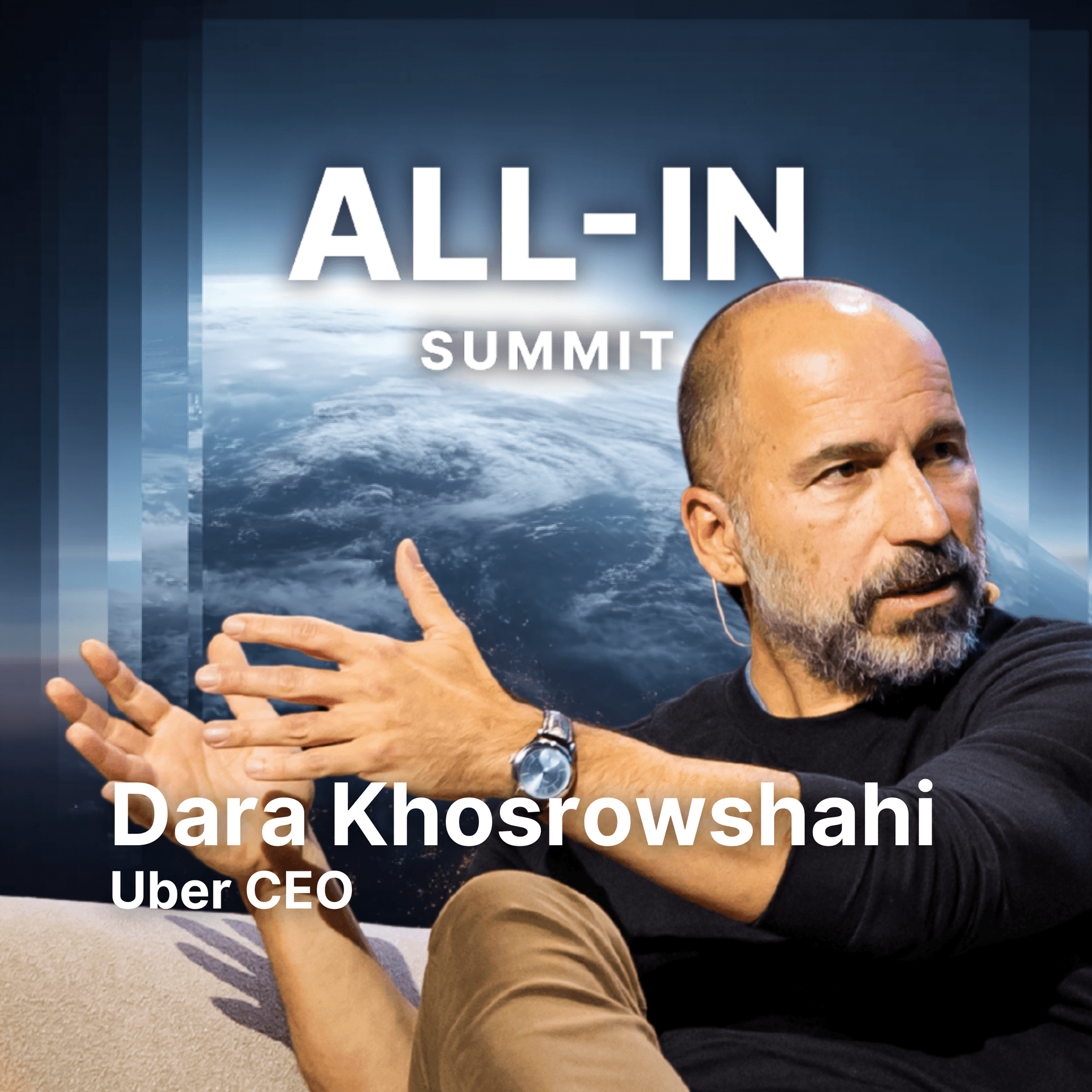
All-In with Chamath, Jason, Sacks & Friedberg
Uber CEO Dara Khosrowshahi on self-driving's future, changing business model, job displacement
00:25:38
Loading summary
Transcript65 lines
- [00:02]
A
The driving force behind one of America's most influential companies.
- [00:06]
B
Record high today for Uber.
- [00:07]
A
100% up last year. Waymo and Uber have announced a partnership. When you have a CEO that's done what Dara has done, you set the.
- [00:14]
B
Bar higher and higher.
- [00:16]
A
The impact we have on society is significant. We hope to keep building on that impact going forward, and I'm quite optimistic about what the future is going to bring.
- [00:25]
B
Ladies and gentlemen, please welcome Uber CEO Dara Khazarshahi. All right, Dara, I wasn't sure if you were aware, but I was an early investor in Uber.
- [00:49]
A
I've heard you say it once or.
- [00:51]
B
Twice, and I'm curious how my investment's doing.
- [00:54]
A
I don't know. Okay, based on today, today's looking pretty good.
- [00:58]
B
So autonomy is the discussion I think everybody wants to have in the timeline. How many partners does Uber have in Autonomy today?
- [01:10]
A
So we have over 20 partners across both Mobility and the delivery business. I'd say mobility now is in the field as we speak. Obviously, we've got a partnership with Waymo, who is, I think, the best of the best in Atlanta and Austin. But there are a number of other players that we are partnered with, a number of Chinese players. Autonomy in China is hitting the big time, and a lot of these companies that want to expand outside of China we're partnering with. And then in the US Even in the second half of this year, we will have a couple of partnerships kind of hit the road in Texas and then in Europe and the rest of the world. So you will see we've announced a bunch of partnerships. We're doing a ton of work with these partners. You'll see these cars hit the road with safety drivers eventually, and the safety drivers will come out this year. And then especially going into next year, we're going to have significant number of cars on the road.
- [02:07]
B
How many people in China have level four, no safety driver today? And what's your assessment of those companies and their safety record? It's a different market, obviously.
- [02:20]
A
So there are Baidu, Weride, Pony are all on the road today. No safety driver. We are partners with all of them. Their capabilities are amazing. You can imagine driving in China in these big cities is quite a complex undertaking. They take safety just as seriously as the Western companies do. So I think their safety record is excellent. Ultimately, we think autonomous can be both superhuman in terms of safety and can save millions of lives over the course of time on the road and over a period of time, as the cost of especially the hardware stack comes down, we Think that it can bring the cost of mobility down and make mobility on demand available to many, many more people than it is now. So it's going to be a very big kind of market expander for us.
- [03:12]
C
That was the debate, Dara, that maybe kind of exploded a little bit on X between you and Elon, where you guys, I mean, very respectfully, just debating the pros and the cons, maybe just set it up for the folks in the audience. The difference between Elon's approach and the Waymo approach and maybe the relative pros and cons as you see it.
- [03:31]
A
Yeah, I mean, I think they're the ones building the cars. So I'm to some extent a very, very, very interested bystander. But the way that I put it is Elon's approach depends on excellent software to do a bunch of the heavy lifting in that. There are some, you know, early on, whenever you're building product, there may be some cheat codes that you undertake. So, for example, you could call it cheat codes or, you know, good engineering. Some of the things you see in early systems is. One is camera, radar, lidar, so multiple sensors, sensors redundancy on the sensor stack to make sure that your perception algos are seeing the world as it really is. Elon is doing camera only. Tougher on the software, cheaper for the hardware. Okay. Second, I would say big difference is many of the players use HD maps. And what HD maps do is, is essentially you map out an area so that it's much easier for the software to determine what are permanent aspects of a certain view. You know, the lines on the road, traffic lights, et cetera. Because of the HD maps, it's very, very easy for that piece of software to determine what's permanent and then what's impermanent, vehicles, people, etc. So it makes the job of the software much easier to figure out what's going on and then determine what to do. Elon's approach doesn't depend on HD maps, and again, it makes the job of solver harder. And then the other, I would say, significant factor is the compute. So when you look at the compute and many of the other players, the compute in terms of flops and memory, et cetera, in the back of the car. Car is pretty expensive, pretty extensive. And I think Tesla's approach is with a much tighter compute stack.
- [05:36]
C
Do you see a world where you try to pour your distribution into all those solutions, assuming that everybody's amenable to working with you and it meets your threshold for what you're looking for? Yeah, I think safety or cost or.
- [05:49]
A
Exactly, I'd say safety comes number one. So we have a certain safety case that we want to make sure that our partners adhere to or exceed and sorry, just about.
- [05:57]
C
Is that an eval or is that like, is that certain rates that they have to publish to you or how do they demonstrate to you?
- [06:04]
A
It's the technical approach and the eval together. And listen, it is a dialogue, right? Because different people take different approaches to safety. We want to make sure that showing up on the Uber platform, it is as safe as safe can be on. Our definition of safety is multiple times safer than a human being, which is achievable. Waymo is showing that it's achievable. Many of the Chinese players are showing that it's achievable as well. So if it meets our safety criteria and the economics are attractive and the economics, as the cost of hardware comes down, you know, LIDAR was 20, 30,000 bucks a pop, like five, six years ago. Now solid state LIDAR is 300 to 500 bucks a pop. So the cost of hardware is coming way down. It is going to need to continue to come down because these cars are very expensive. Then we'll do business with them. We want to be the platform and we want to essentially help the entire AV ecosystem thrive. And we think there's enough economics for the network player to have a great business and the software providers and the vehicle owners to have a great business. And then obviously there's fleet operations in terms of housing the cars, recharging the cars, you know, all of the kind of in the world work that's necessary as well.
- [07:27]
C
When you, you're going to get to a tipping point, I'm going to assume in driver miles, let's say where one of the most interesting things that I've thought of is could you tell a city how it should actually be designed for optimal traffic?
- [07:44]
A
So we work, I wouldn't say for optimal traffic. I think theoretically it's possible, but you know, or even stop lights or something. Google could, there are lots of other players who can help with that, but we're certainly helping cities in terms of where you should put charging infrastructure, for example, parking drop offs, et cetera, to help traffic flows. I think we can be a partner for cities and we do have a small operation where essentially we offer data for free for cities to embark on city planning, so to speak.
- [08:17]
C
Do they take it?
- [08:19]
A
Some do. Some do. Some of the more sophisticated cities take it. But I wouldn't call it a big part of Our business.
- [08:25]
D
So Dara, I want to ask you about the business model impact of basically robo taxis or self driving in the old world. Uber's network effect was a marketplace effect where you connected drivers and riders and if you had the most geographic density in an area then you could promise riders faster pickups and the drivers got higher utilization. And that was a very powerful network effect. But we're moving into a new world where anyone who has a fleet of self driving cars in theory could just make them available to the public and start competing. How do you see that impacting your mode? And do you have to go from being an asset light business to now owning all these cars and deploying them? And is that a good thing or a bad thing for your business?
- [09:14]
A
What do you think about this? I think that the same economics apply, right? Which is if we have that fleet owner is not going to have as many vehicles available in a certain market than let's say a network like ours. And we will have a hybrid network. We're going to have humans and autonomous cars together and that's going to continue for a while. The autonomous machines aren't going to replace all humans, at least for the foreseeable future. So for us, if you're part of our network, you are going to get more requests than the player who is doing a standalone because we already have the demand, the request is going to come from much closer. So instead of pickup who is 15 minutes away for a 10 minute ride, you are going to get a pickup that is three minutes away for a 10 minute ride. So the utilization in terms of the revenue generating miles as a percentage of total miles driven is much, much higher on our network. So the player that you know, if you have fleet player A who's going direct standalone, fleet player B who's working with us, fleet player B will have much more business, will have many more miles that are creating revenue as a percentage of the total miles driven. And as a result, each of their cars are going to get much more revenue per car per day than the fleet player who isn't working with us. So I mean that ultimately is, you know, even if you, if you think about Uber Eats, right, there's this drama which is, hey, do you go direct only or do you work with a marketplace? And the fact is every major food player, McDonald's has a direct channel, but they have a box and they want that box to create as much revenue as possible. So they have a direct channel and they work through our marketplace doordash marketplace, other marketplaces as well, because that's how you drive utilization. So I think that most of these players, there are going to be some players like a Waymo, like a Tesla, who can build their direct channel. But we think if they want to drive maximum economics out of these really expensive cars, for now, they're going to also want to work with us.
- [11:22]
D
Do you think you will need to buy and deploy your own fleets or can you rely purely on third party fleet owners?
- [11:31]
A
So I think that there's going to. Ultimately, if you look at the end state, I think all of these cars are going to be financeable. So if you look again in the hotel business, I used to be in the travel business, a Hilton or a Marriott, who's the brand, doesn't own any of their hotels. Those hotels are owned by financial only players. And I think 10 years down the line there are these things called REITs, real estate investment trusts. You're going to have fleets, you're going to have financial owners that own big fleets of cars that are on our network, maybe on other networks.
- [12:02]
C
The new Hertz, the new Enterprise kind.
- [12:04]
A
Of a thing, I'd say it's going to be more financial players. So it's not, you know, Hertz and Enterprise are operators. These are going to be like pure financial stones of the world and they own fleets and they're just trying to monetize those fleets as much as possible. That's the end state. Between now and the end state. We will take balance sheet risk because we can sign up. We know exactly how much revenue a car can produce in said market because cars are already producing revenue. So we can sign up for the revenue. We will prove out the business model, we'll use our balance sheet to prove out the business model. And then at some point the whole thing's going to get financialized and we'll be able to take it off balance sheet.
- [12:47]
D
Is Waymo willing to work with you?
- [12:49]
A
Waymo is working with us now in Austin and Atlanta. Okay, so in Austin, Atlanta, if you're using Uber, you can be picked up with a Waymo. Our customers love it.
- [13:01]
C
Is it the driverless aspect of it that they love or, you know, they're.
- [13:06]
A
So the privacy that you get, I think one is they're new cars, they're really nice cars. Yeah, it's kind of fricking cool.
- [13:12]
C
Yeah.
- [13:14]
A
And you do have privacy in that car as well. So I think the combination of it works out really well. We see customers who experience the product, they rate it really highly, they use it again. And so it's Just an absolute dynamic product.
- [13:31]
C
So we've mostly only spoken about the XY axis. And we have a couple of our friends who've built businesses that are trying to launch these evtol businesses. Some of our other friends who are experimenting with small drone delivery. Tell us where all of those things play in your infrastructure going forward.
- [13:49]
A
So we're absolutely believer in evtol, we're an investor in Joby, and we are going to work with them as those vehicles become available. We know that there are some other vehicles, but I think that the kind of Z axis, if you want to call that, makes a ton of sense. Listen, in cities of the world, essentially they have built in the third dimension because there's only so much that you can expand, you know, in the X and Y dimension. So businesses have expanded in the third dimension, residences have expanded in the third dimension, but our transportation infrastructure has only expanded in two dimensions.
- [14:28]
C
Right.
- [14:29]
A
So it's no wonder that traffic just keeps getting worse and worse and worse because that third dimension isn't available. So we are absolutely believers in both EVTOLs and drone delivery. Now, I think on the delivery side, there are two areas that we're working on. One is sidewalk robots. It's easier tech to develop.
- [14:52]
C
Explain what that is. A sidewalk robot.
- [14:54]
A
So sidewalk robots, there are some of them in LA and Santa Monica, they are autonomous vehicles that drive on the sidewalks. They drive pretty slowly, they're very, very safe, they look kind of cute. And they're appropriate for deliveries that are a mile or less long. So deliveries in a tight space. And so there's a certain addressable market for us in deliveries where those sidewalk robots work. And we're working with serve cardigan, a number of other players in the US in Japan, in a number of other markets. Then on the other side there's drone delivery. And drone delivery is appropriate for markets where they're more spread out, suburban, no high rises, et cetera. Those two together we think can cover 50 plus percent of our delivery, Tam, so to speak. But then there's another 50% that we're going to have to work on in terms of the first and last mile coming out of the restaurant and then getting the food into your apartment as well. Humans take care of their own first and last mile. But you need something to take care of the first and last mile of the food. That's where the challenge is going to come in. And we're working with a number of players to see how we can get that first and last mile for food.
- [16:10]
B
I want to talk to you for a minute, if I may, about the balance sheet. One of the great early insights we had at Uber was around profitability and the press. And the narrative was, oh, Uber could never be profitable. And I would talk to TK about it and William and all the Josh in New York, and they're like, yeah, we could flip it at any moment in time to $2 more a ride. We would lose no rides, and it would be wildly profitable. And in fact, under your stewardship, Uber has become a money printing machine to the point at which you announced a $20 billion stock buyback.
- [16:45]
A
Yes.
- [16:46]
B
And I saw it and I said, wow, this is just incredible.
- [16:49]
A
However, did you tweet about it by chance?
- [16:51]
B
I might have. Once in a while I'll retweet you and give you a little shine. But I did have this thought that. And I had Chris from Neuro on the program, and you have this great partnership to put 20,000 lucids on the road.
- [17:07]
C
Wrong podcast.
- [17:08]
B
Go on the other podcast. And so I'm wondering how you think about the war chest, the money printing machine and deployment of that asset. How do you decide $20 billion stock buyback versus putting 300 million into Neuro? Or we had Travis on the podcast and he said he's had many opportunities to look at things like Pony, which has been in the press, and it would be pretty great to have the original founder maybe, I don't know, you've got a couple of billion laying around and maybe help him have Pony come to the West. So how do you think about deploying that capital in order to continue to grow from where are we at? 1% of rides globally are ride sharing.
- [17:50]
A
Approximately a little more, but it's between 1 and 2%. It's a very low number.
- [17:53]
B
It's clear it's going to go to 20 with autonomy. And so if we all believe that, and that's obvious, is that the best use of the capital, how do you make that decision?
- [18:02]
A
So I think the good news for us is it's not either or we can walk and chew gum at the same time. In the past 12 months, we've had over eight and a half billion of cash flow. The business is growing, you know, top line, 18%, bottom line, 35%. So that cash flow is going to grow by a lot over the next three to five years. And we announced the 20 billion buyback because in looking forward to areas in which we could invest aggressively, for example, in av, because we should, because it's an enormous opportunity, whether it's vehicles or fleets Et cetera. We are very comfortable that we've got enough capital to be super aggressive there appropriately and at the same time buy back our stock. There's a great company we know of, management team can get a little better, but they're okay and we think it's a great deal. So it's not an either or, it's an and for us and we're lucky to be in that position at this point.
- [18:59]
C
You have a very big business in Uber Eats. Yes, it competes with folks like DoorDash. When Travis was on the pod a few weeks ago, maybe a month ago, he talked about sort of the robotization of food and all of that. Can you just talk to us about your vision of where all of that stuff goes to?
- [19:19]
A
So we actually work with Travis and his cloud kitchens business. He's also built a restaurant tech business in Otter as well. And I do think that you are, you know, any food business that is not deep in delivery is going to lose share, period for the foreseeable future. So every single player, food player, grocery player, even now, retail player, has to get into delivery and has to get into on demand delivery. Otherwise they're kind of missing the most attractive segment of consumers out there. And I think as the cost of labor is going up, all of these businesses are building, are investing increasingly in roboticization. It's not something that we are getting into, but as more food, healthy food, delicious food becomes more available, lower prices, then our delivery business kind of will benefit a lot.
- [20:18]
C
I'm hearing consistently from you, and you can just tell me if this is wrong, that you are becoming increasingly an asset, light, highly liquid distribution network. Like you have this incredible network effect. You have these hundreds of millions, maybe approaching a billion users and you can just pour them into all of these things.
- [20:36]
A
We are essentially, we bring demand to the assets that are driving the movement of people and things and food and grocery, and these are all asset heavy businesses. So the next incremental piece of demand that comes from our network is incredibly valuable for them and we can do so staying largely capital light. At the same time, to the extent that I can use my capital to invest in the AV ecosystem or fleets, et cetera, we can also do that.
- [21:05]
B
There's one company that wants to go on its own. A friend of ours runs it. I think that you probably have had some conversations, obviously publicly you have. What's the best pitch to elon to put 100,000 robo taxis into the Uber fleet while still doing his own? Because his app is doing spectacularly well and the pilots are doing well, so he'll obviously figure it out. But what's your best pitch to him to joining the Uber network?
- [21:31]
A
I think, listen, the pitch is simple, which is if you're looking to maximize the revenue of those robo taxis today, today we are your ticket to the maximization of that revenue. To the extent that you're looking to have these fleets owned by people, kind of the digital shepherds, which is an amazing vision that Elon has. To the extent that those owners are not able to monetize their assets on the Uber network, they will under monetize. And if there's a competitor who is offering those vehicles to be on the Uber network, the monetization of those vehicles are going to be superior and those digital shepherds are going to go elsewhere. So I think that is the pitch. And again, Elon is, you know, he kind of believes in full stack.
- [22:16]
B
Yes.
- [22:17]
A
And he's proven it. And I think that this market is large enough for there to be multiple winners, clearly. But in the end, to the extent that, you know, we would love to partner with them, but at this point they're looking to go it alone. And I think the market is large enough to carry a number of winners in this.
- [22:33]
B
I ask you a tough question about humans. I was talking to Will Barnes who ran originally Los Angeles and then half of the country for Travis, and Will Barnes had a pretty amazing insight which was in the early days we had humans protesting humans competing for the taxi drivers versus the rideshare drivers. In China, in Wuhan, in fact, there's been a lot of civil unrest and they're talking about limiting the number of licenses for self driving cars because of the disruption that would happen if young men who have those jobs are not able to have a job. And we saw the waymos get called to their death here in Los Angeles and that was a pretty clear message as well. How do you think about that group of people losing their jobs? These drivers who built the Uber network, who built lyft, who built DoorDash and China's overwhelming concern about this because these are robots taking human jobs. And there's an, there's a lot of discussion about this and I think maybe in the tech industry we don't talk about it head on.
- [23:36]
A
I think, listen, it's a big issue for AI in general and job displacement. You see it with younger graduates as well. I think for us, at least for the next five years, the number of robot cars coming onto the platform are not going to be displacing people because the platform is just growing so quickly that we can very easily take that demand and there is a natural turnover of our driver base. So in a market like in Austin or other markets in which we're launching autonomous, we will turn down the driver recruitment machine so the robots can come in and the drivers who are currently driving in the platform can make as much money. So Austin drivers now are making as much or more money than they were before we introduced Waymo. So I think for the next five to seven years, we're going to have more human drivers and delivery people, just because we're going so quickly. But I think 10 to 15 years from now, this is going to be a real issue. And Jason, I don't have a neat answer for it. Now we're finding other kinds of work. We've got drivers and couriers labeling, AI labels and looking. We have a whole Uber AI solutions business. So we're essentially one way to look at Uber is we are a platform for work and transportation as a first kind of work. And now we're expanding into other kinds of on demand work as well, to be able to adjust the kind of work available to people who want to earn our own platform. But I think long term, this is a big, big societal question that we're going to have to struggle with and lots of others are going to struggle with too.
- [25:20]
B
Absolutely.
- [25:22]
C
All right, thank you very much.
- [25:23]
A
Thank you. Really appreciate it.
- [25:30]
B
Crushed it. Thank you, my brother.