← All-In with Chamath, Jason, Sacks & Friedberg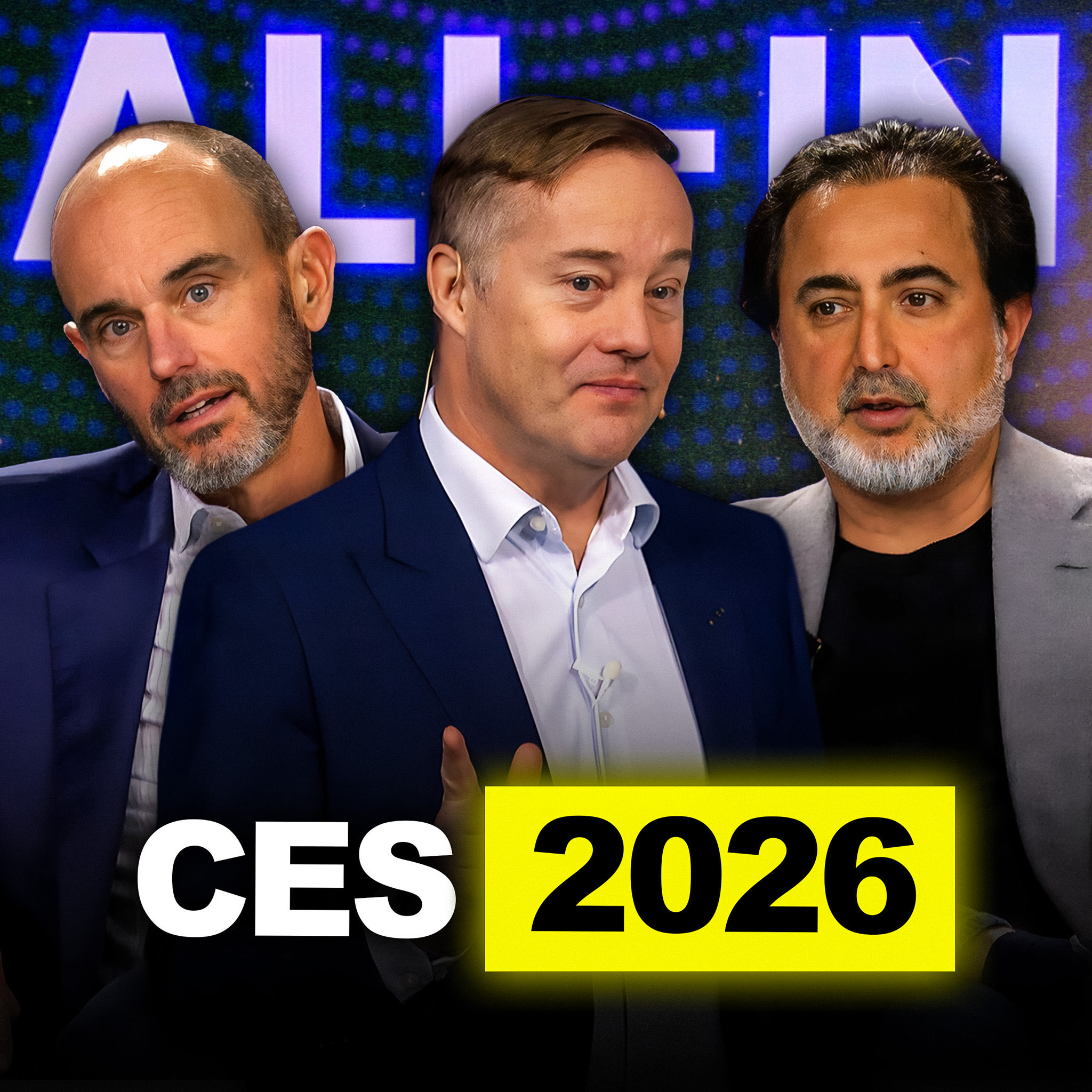
All-In with Chamath, Jason, Sacks & Friedberg
Why AI will dwarf every tech revolution before it: robots, manufacturing, AR glasses from CES 2026
00:51:22
Loading summary
Transcript140 lines
- [00:06]
A
Thanks for coming out, everybody. We're going to have a great full contact, super hardcore discussion about the future, specifically around AI, which I think is the most important theme not only of CES 2026 as we've seen, with all the incredible gadgets, chips being launched, self driving, but it's going to be the most important transformation of our lifetimes. I think everything we've seen over the last 30 years of technology, from the PC revolution to cloud computing to the Internet, mobile, all of that is going to be dwarfed in comparison to the impact that AI is going to have on society. If you're here at ces, you know that you're here for that reason. And we've got two amazing guests who are going to join us to have this debate. And additionally, I've brought my box, a box filled with all the ghosts and gadgets of Christmas past. And we're going to go through those at the end of our discussion. But here's a quick video of our guests who will be joining me today.
- [01:09]
B
From boardrooms to the White house and.
- [01:11]
C
Beyond, McKinsey's influence in business is virtually unparalleled. It's one of the largest and most influential consulting firms in the world. Enterprise can move faster than any of us expected, which is good news because these problems aren't going to be the problems of the next generation. They're going to be the problems of our leadership generation. Making this system of government better on both efficiency and effectiveness is key for economic growth and for national defense. We also think that some of the private sector insights that we have brought to the public sector can drive innovation. Our next guest leads venture capital firm General cattle. With 40 billion in assets under management as of mid year.
- [01:50]
B
Our aspirations in venture capital is to be the best seed firm in the world. The decisions we're making, the companies we're building are going to impact the world centuries to come. Ladies and gentlemen, please welcome Bob Sternfels and Hamant Taneja. All right, gentlemen, welcome.
- [02:14]
A
All right team, let's do it, let's do it. So we're here at CES 2026. It's really interesting to watch this conference, get this new life breathed into it. We had this period during COVID when CES obviously had to take a pause and we were wondering in Silicon Valley, hey, is anybody going to show up at ces? Is it still relevant? Do people care? And now look at this. This is one of the largest ones ever. And everybody's here. I saw Lisa from amd, Jensen from Nvidia, Uber Neuro Waymo. The change is amazing. I think maybe to start, you spent a career at McKinsey trying to accelerate change. And in venture capital, Hemont, you know, literally building these businesses from the seed stage. On how do you look at the pace of innovation and change in this past two years since ChatGPT was launched compared to the first 30 years of our careers? We're all of a certain Gen X age. Compare the last two or three years to the 30 before it. Yeah.
- [03:26]
C
Well, first, Jason. Thanks. And it's great to be up here with you guys. And, yeah, I would just say this week is amazing. I think there's over 150,000 folks here this week. And you talk about CES being back. I think CES is back. And that's great, right? And with all of these things happening, I think there is such a premium on folks from different perspectives getting together, because that's where new ideas are created. And my big hope and why we're here is when you mix and mingle with different folks, you come up with new things, and the world needs new things. And what I love is you mentioned a lot of the tech leaders. What's exciting for this is I think everybody sees tech as part of the equation. And so when I look at the folks here in ces, you see not only the technology leaders, the investors, but you see folks from almost every industry vertical that are here now because they know that technology doesn't sit on the side. It's central to everything we do. And I get to your question. Look, I think we're moving it at literally warp speed now. It's just night and day different. It's almost a, you know, D.C. aD type of thing when you can see the change of pace. And I haven't met a CEO yet that isn't talking about how do I get my organization moving faster. It's quite frankly, less about strategy, it's more about organizational speed.
- [04:47]
A
Hey, man, how does this feel compared to our first, you know, couple of decades where companies would take two or three years to release a product, and now companies are releasing products in two or three weeks. Two or three months.
- [05:02]
B
Yeah. So, look, the world has completely changed, right? We've often said this is peak ambiguity. You have massive geopolitical change. You have an incredible amount of change around every country trying to drive strategic autonomy in different industries. And all those dynamics keep changing alliances, the new world order, everything. And underneath that, our tool of implementation as technology that keeps changing. So what the technologies can build today versus what the LLMs could do. Let's say two years ago or November 22nd, let's say when ChatGPT came about, is fundamentally different. So what are you building towards as to what the world's gonna look like so you can have enduring value? And then what are you building with where the technologies you're using aren't gonna obsolesce and destroy your value proposition over time? It's just all kinds of change. And so it's a really dynamic time. And the other thing you will see is, you know, we invested in Stripe in 2010 and it became a, you know, $100 billion company. Let's say 12, 13 years later. You look at Anthropic, which we're also investors in, that goes from $60 billion last year to, you know, a couple hundred billion dollars. And by the way, with good economic progress, these are not pie in the sky valuation. They're based on actual growth of the business. Well, that goes back to your point, which is the compression of how fast value can create when code self writes and access to distributions change. So fundamentally it's just really exciting and I think it's going to accelerate from here.
- [06:30]
A
This was one of the statistics we would look at in venture capital. Hey, how long does it take this company to get to 100 million in revenue? How long does it take to get to a billion in revenue? Unpack Anthropic and that journey. Because this company's revenue and you have OpenAI, obviously they're contemporary, trending towards $20 billion in revenue a year. Where's Anthropic at and what's the revenue mix? Where does the revenue come from?
- [06:56]
B
Well, look, so Anthropic builds language models. It's got some of the best models out there. A couple of companies that are doing a good job of that. And then they've got cloud on top, which is to me the essence of transforming the engineering department of enterprise. Right. And that's a killer application where everybody's now using these tools. So that business, when we invested was doing about $880 million, which was a 10x growth from the year before, 10x year over year, 10x growth the year before. And then this last year they announced this, they're growing another 10x or more. And so when you look at that, and we invested at the $60 billion valuation, assuming it's going to be like 3x growth from there, because those are staggering numbers and it does 10x, can't predict it, but to see adoption is so fast. And so you look at that and say, so we Ended up investing at 8, 9, $10 billion kind of run rate business at 60 billion. That's the cheapest deal that got done last year in venture capital on a financial space. So we just have to get our head around what does scale really mean and are we in the business of creating what we used to think was like can we create dega coins? Now we're talking about can we create trillion dollar companies. Right? I mean that's not a pie in the sky idea. With Anthropic and OpenAI and a couple others games changed scale of technology is fundamentally different in what it can do.
- [08:14]
A
Bob, what's behind this massive revenue ramp? Because you get to see all the incumbent businesses, you get to see the elite businesses that are growing, you know, two or three times x each year. You also get to see the ones that are struggling. And then you see these large numbers and 10x your growth. What's driving this in your mind and is it sustainable? I mean that's the other question.
- [08:40]
C
I hate to give you the classic consultant answer, but I do think it depends and I think we're at a tipping point this year and I'll tell you why. I think what's underpinning this 10x and 10x. We work with most of the large enterprise in the world across all industry verticals and what we have seen is a huge uptake of leveraging these technologies like anthropic. We're leveraging anthropic. And so large enterprise is using technology at a scale and rate that they haven't before. And if you look at it spend as a percent of revenue, et cetera, all this stuff has gone up and I think that is propelling the 10x to 10x. The conundrum is, and it's been widely.
- [09:22]
A
Written about.
- [09:24]
C
Realizing enterprise at scale value in non technology companies is proving harder than people think.
- [09:30]
A
Got it. So in plain English that means, hey, you've got a travel company, there's somebody deploying AI and you're watching what's happening at Tesla or Google and they're getting these phenomenal results. But maybe that legacy business is having a harder time achieving those results.
- [09:47]
C
I'll make it even simpler. Typical non tech CEO might say, hey Bob, do I listen to my CFO or my CIO right now? Right? CFO is saying we spent all this money, why do we need to be the fast adopter? I'm not seeing the ROI yet. Can we pause CIO saying are you fricking crazy? This is the moment that if we don't, we'll be disrupted, we think. Now, I will say the shining part is I think there's a path where you bring those two together as allies and you say, yeah, but let's rethink this. Get out of pilot purgatory. Really think the reorganization, all this stuff. There is a path. But I think right now most CEOs are getting torn a bit between do I listen to my CFO or do I listen to my cio?
- [10:27]
A
And I think this is a really good jump off point amount of your strategy at General Catalyst. You and I have known each other for a long time use really a long time. Decades. And you always prided yourself on being the great seed fund. We're going to. We're going to get to these companies when they're $10 million and 10 people and put that first check in. But then I saw this news item go by a month ago that you raised 9 billion. And then I see you're buying companies. So are you out of the seed business and now doing random acts of private equity? What's going on here? Explain to me the strategy in General Catalyst.
- [11:05]
B
How much time do we have? So look, I would say we very much view ourselves as a venture capital firm, AmeriCorps and a seed venture capital firm. Our core, because our true north From for the 25 years we've been around has been meeting founders where they are. And what that means is essentially help them navigate ambiguity in the past when they're sort of beginning and the business isn't clear all the way to figuring out how to scale in the complex markets that they go into. So everything we've done has been in that context of creating these catalysts, the flexible capital they need, the policy capabilities they need, the market access they need, and those sort of relationships globally to actually build a nearing company. So that hasn't changed. So why did we go acquire a health system in Ohio? It was a nonprofit we worked with. The attorney general converted it. And I say this, by the way, with a great sense of responsibility because that's a community in Akron, Ohio, that we take care of. So that hospital has to continue operations in all the dimensions it takes care of with people. Well, we bought it to actually have a place where we can work with our founders and transform with AI, create abundance and resilience for this health system so you can take care of the people a lot better. And if we did that, then we can go do that for the other hundreds of systems across the country and be able to do that. So some of it is that's market access. It's very hard for healthcare startups to go deploy successfully at scale in these systems. We are going to go show how we're going to actually go on the ground, we're do with them and show the world how so it can transform the health system. Your other point about sort of buying companies, we look at that as there's a lot of workforce transformation happening. Bob and I talk a lot about this. I think work fundamentally in these companies is going to change. So if you're a call center in an emerging country today, just a declining asset value because you know it's going to be displaced with AI. So we look at that and say, well, but those are customers on the other side. If we bought that as a piece of the puzzle to work with an early stage founder to learn how to quickly accelerate adoption of AI into the call center space and serve these customers and scale a lot faster. The compressed value creation we're talking about, that is a new playbook. So this is not about trying to be pe, this is about acquiring businesses in PE that actually have declining value but have important customers that need to be served and help them get to that AI transformation that Bob's talking about faster by getting our founders in there.
- [13:39]
A
This is extraordinary, Bob, when you think about it, just so the audience can put their head around this venture capitalist used to back founders to then be the barbarians at the gate to try to take on these big industries. Now these big industries in some cases are in significant decline, struggling and the venture capitalists are coming in and saying we'll just buy the castle, open the drawbridge. We're going to buy it so that we can take our startups and accelerate whether it's healthcare financial services or customer support and outsourcing, business process outsourcing. And essentially we don't care about that business economically necessarily as much as we care about it for access to that customer base. Running McKinsey, this is a playbook that is like coming out of the future in a time capsule and saying we're going to just upend the entire ecosystem.
- [14:34]
C
Yeah, yeah. I mean it's. I just gave a talk at a university and was, was talking to some potential folks to, to join us and I said, look, I'm jealous, I'm jealous of all of you because you have a lot more time to do what we do than I do and you're doing it at a time where it's going to be a lot more exciting because if you just link this and Hemant, what I love is and effectively, you're creating a new asset class. This is not private equity. This is about how do you transform incumbent entities into something different. Private equity typically optimizes an existing asset class at a certain scale. This is about transformation. So you think of large existing enterprise and I think you have a choice, you have a choice of transform or die. And so there's this wonderful moment, but because of some of the incumbent advantages, I wouldn't say that it's predetermined which way you're going to go. You can actually do this quite quickly. And I think you're showing the power of private capital can actually do this.
- [15:40]
B
So we've talked a lot about this, right? So one of the things, when you think about transforming a large enterprise, what do you really need? You need a few pieces. One is you need data infrastructure that can ready you for the enterprise. You need the models adapted to you. And then you actually need a new model for how the workforce is going to function because you have agents and humans. And there is a massive change management exercise. So a lot of our partnership has been about sort of figuring out, okay, what is that new model going to be to transform these businesses and what does that mean when you get on the ground? You look at department by department, take hr. How do you drive transformation of healthcare and how you take care of your people? That process is horrible today. And we have a business called Transparent that goes and essentially creates abundance in that regard. This uses AI. So you have direct access agentically to all kinds of healthcare services. Take care of yourself and then be able to be routed whether you need a surgery or you need to have cancer therapy or mental health, and do it in a way that it's seamless, cost effective, and helps enterprises take control of your cost structure. You need coding to fundamentally transform. That's what anthropic does. There are companies working on transforming the call centers. There are companies working on transforming your sales and marketing. But then when you have these technologies in there, how are the actual people going to do their work in concert with these agentic capabilities? That is a whole new model. And you know, you guys are inventing, I'll talk about that. Because there's a lot of innovation that needs to happen in that whole sort of workforce transformation that I think is ultimately where rubber is going to meet the road, on how quickly teams embrace it, customers embrace it, and we can actually diffuse AI into these businesses.
- [17:16]
A
Bob, you've had to deal with this internally at your organization. What's the right size and what happens when a Piece of technology takes a career and takes out the first five years. What happens to an organization when you just basically gut the first five years of development? And this is why some people in the economy are looking at AI and they're scared and they're looking at AI and saying, is this gonna benefit me, my family, my kids who are graduating from school, this technology? And I think management consulting is the perfect place to look at it. Tell me honestly, the first couple of years you're training up one of these really smart kids to write up, you know, reports and do analysis that can be done with AI today. Perfectly. Close to perfectly, yeah.
- [18:10]
C
So I'll give you a couple stats. First on us, then more general. 25 squared and 40,000 and 25,000. What do I mean by that? So let's look at McKinsey as a bit of an incubator. The 25 squared is we're simultaneously doing two things at the same time. So we have client facing folks, which most of you in the audience would know and think about. When you think about a McKinsey consultant, we're growing that body at 25% next year. 25%. Unprecedented number of new hires because the work is changing. They're not doing the stuff that you talked about. We saved, we looked at it. We saved 1.5 million hours in search and synthesis last year. But we're dividending that to solve more complicated problems and do different things. You guys are probably sick of McKinsey charts out there. You know, we have agents that do this. They just gave you 2.5 million of them in the last six months. I want to get rid of charts, but the consultants are doing different things. We're adding 25% to that body.
- [19:13]
A
So they're moving up the stack.
- [19:14]
C
They're moving up the stack and doing these more complicated problems at the same time. Though about half our firm are non client facing folks. We're down 25% in that group with 10% increase in output. And so simultaneously, and I know this is hard also particularly for folks to get, we're going to be adding and shrinking simultaneously with the two halves.
- [19:37]
A
And this has never happened in the history of the firm.
- [19:40]
C
Our model has always been synonymous. That growth only occurs when with total headcount growth now it's actually splitting. We can grow in this part, the client facing side, and we can shrink in this part and have aggregate growth in total. And that's, you know, that's a new paradigm and a new dynamic.
- [19:57]
A
We're seeing this in Venture. You and I were around for the days where you give a team $3 million and they would come back in 18 months having spent it on data centers and building a team of 20 people, 30 people. Then we'd see the first version of the product 18 months later and then 3 billion now. Yeah, it's. But it's insane just how much more is getting done with less. And so do we worry about society and our industry's ability to communicate to society this change because if you were to tell an average business executive 10 years ago, prepare to hire 25% more people on this side of the business and cut 25% on this side of the business in the same 18 month period, their head would explode. What? Why? How come? It doesn't make any sense. And then young people are graduating and they're sending out 100, 200 resumes, getting no job offers. We were sitting here 10 years ago, every graduate from a decent school was like, I have an Uber, a Coinbase and a Google offer, which one should I take for 150k? And those offers just aren't there. So how do we communicate better as an industry? And, and then what's the advice to young people coming into the workforce?
- [21:14]
B
Yeah, look, every company, I'll just say Silicon Valley, but broadly in the tech industry, in the startup industry, what was it? Essentially it looks like a C corp with a bunch of engineers. But in the world where code self writes, what is that next level innovation? What are these companies actually going to do? I think that's ultimately the transition we're going through in what does innovation actually mean? It's going to be less about being able to write code. FAT is much more going to be about systemically how do we adopt this into the world and capabilities. To your point about ambiguity in the opening, because we don't know about the capabilities of these technologies or how the world's shaping up, there's a lot of ambiguity. So to me, the companies that do really well and the way we guide the founders, a lot of it is become iterative, constantly change, constantly move forward as opposed to what used to be before was become precise, find this narrow edge, create your growth loop and go build a company. Now it's like constantly iterate and in order to have the customers give you the license to iterate, comes down to trust and relationships. So founders that are very good at engaging with customers, building trusting relationships and say, hey, we're going to go figure this out together. We know how to leverage this technology, but we don't really know where it leads. And what the possibilities are, will we co create? And so the advice I always give is it's all about radical collaboration in this next phase. We got to figure this out together where different stakeholders that all touch the system are figuring out what this means to them and then what it means in terms of the overall optimization and the transformation that we can do with it.
- [22:46]
C
You know one maybe exciting part to this because I think you framed it as you're a graduate and how do you get into the workforce and is it getting tougher? And we did a little bit of work. That said, what kind of skills are folks going to need in an AI infused world? From an employer's point of view, less the startup, but you're more an at scale enterprise. What can the models not do? Therefore what skills will humans play? The work isn't done, but came back with three key ideas. What can the models not do? Aspire, set the right aspiration. Do you go to low earth orbit? Do you go to the moon? Do you go to Mars? That's a uniquely human capability. So how do you look for the skills about aspiring and getting others to believe in the aspiration?
- [23:36]
A
So leadership and goal setting, Human, human judgment. Right.
- [23:41]
C
And we've seen a lot around in this room evals, but there's no right and wrong in these models. And so how do you set the right parameters, the architecture based on firm values, based on societal norms, whatever. How do you build the skills to set what the right parameters are? And then finally true creativity. The models are inference models, the next most likely step, how do you think about orthogonal stuff? And so some of the work we've been doing with large enterprises, if you believe in some of that, it can take you back to challenging some of your assumptions on where you look for talent. It actually means that where you went to school matters a lot less. And so do you start looking for raw intrinsics? Can you widen the base? Can you actually look at. Let's take a tech background, not which university you graduated from, but what does your GitHub profile look like. Let's actually get to the content. And could that actually start meaning that a wider set of people can enter the workforce with different pathways?
- [24:41]
B
One of the things you said that really resonates is around creativity because. But when we were going to college, it was all about learn how to solve problems really well. And now in a world where we have this technology that can solve problems for us, it really is about asking the right questions. It's like going back to that Socratic dialogue. It is about Creativity and who can imagine best what the world's going to look like and then leverage these technologies to go shape the world towards that. To your point, about vision and teaching our kids, I get this question a lot about, what do you want? How do you want your kids growing up? It's like learning how to ask the right questions versus solving how to, you know, work on hard problems is. It's a very different mindset. And it is about curiosity and kind of back to being kids when you're growing up, it is about channeling your curiosity. Can we actually rethink our pedagogy in a way that we can develop this next generation to be more that than. It's 8 o' clock on Wednesday morning and I'm going to factor polynomials because I'm in seventh grade, which is what our system looks like today.
- [25:39]
A
Yeah. The advice I've been giving to young people is, there's nobody coming for you. There is no training program. You have to make that for yourself. And do not go in through the front door with a resume. Just email the CEO of the company and redesign their landing page and say, these are the three things that I think could be better. And I saw you speak on this podcast. I think your company's incredible. I would love to come work there. And I did this spec work. Now people are like, why should I do free work to get a job to prove you actually have a skill that is meaningful. You're not going to be able to get into a training program. So many folks now in corporate America, especially the people who are onboarding people, are just like hiring somebody and training them is going to take longer than building an agent. I can build an agent. Young people coming into the workforce I have to train are annoying. Setting up an agent who just does the work is easy. That's the game on the field right now that people don't want to talk about, which means to stand out, you're going to have to show chutzpah, you're going to have to show drive, you're going to have to show passion. And what college is doing that? What college is teaching that? What course is that?
- [26:48]
C
Look, I think there's a massive gap in resilience.
- [26:52]
A
Yes.
- [26:53]
C
You know, resilience. Because what you've got under that is you're going to get knocked down.
- [26:57]
A
You're going to. Yeah.
- [26:57]
C
The question is, do you get back up? And how do you get back up? And I think the educational system today doesn't necessarily build institutional or individual capability and resilience.
- [27:08]
A
If we could wave a magic wand. Just to go off on a complete tangent here. What should the education system look like in 2026 because you're buying businesses. You have one in healthcare. That's one of the three hardest businesses to make change in. Historically. The other two here in America that have the most regulation, are the most expensive and are the hardest, and that Americans are suffering under the most are housing and education. Those are the three big ones. When I run for president, that's going to be my platform is those three. I'm going to solve those three. But go ahead and solve education for us right now. And are you going to buy a college next? Transform and transform.
- [27:47]
B
Basically buying all the businesses that make no money. Is that where we're going? I would say.
- [27:51]
A
Oh, the businesses that are the most.
- [27:53]
B
Yeah, but the ones that need to endure for the longest, actually that's the way I look at it. So here's the thing about education. This idea that we spend 22 years learning and then we spend 40 years working is a broken idea if the learning of technology and the development of technology is going to be so dynamic. So what about going from a four year college to a lifelong college, which is actually your relationship with learning is that it's a lifelong skilling and reskilling kind of an experience. We've talked about this before as well. I mean there's a lot. There's some innovative college presidents that are thinking about that, which is first of all, better business, better lifetime value if you're a college and you actually have a client or a student for perpetuity versus paying you for four years. And much more useful for us to be able to go and have that capability and constantly learn what these technologies are doing and how the workforce is evolving and how to stay ahead in terms of where the opportunity is. So learning has to become much more fluid and we need to become a community of lifelong learners as we adapt to a world where AI is being diffusing through us over the years.
- [28:59]
C
And I would just add. I'm with you on this. And the system built close to 700 years ago was designed around a high fixed cost libraries and professors to then take you out for a finite period of time to learn. And then effectively you're set off into the workforce if you start to think about the half life of skills getting shorter and shorter. And we've done some work at our Global Institute that said, for an employer, the return on investment that you give an employee in terms of skills has shrunk by about half over the last 30 years used to be about 7 years return, it's less than 4 years. So about 3.6 years now return. And that's only getting shorter and shorter as things change. So if you believe that, I think you start to pivot to are we teaching people to continue to learn new things as opposed to master a particular subject? Do you have that ability? One of the things that we've now indexed on, and I mentioned this, 40,000 and 25,000, that is the number of humans we have and the number of personalized agents we have as of last week in McKinsey. And I think we'll be at parity before the end, by the end of this year.
- [30:09]
A
So you're literally deploying agents that can do a full 360 degree trusted job function.
- [30:16]
C
Absolutely.
- [30:17]
A
Where is it working really well and where is it not working well?
- [30:21]
C
It works when you have a specific domain area that you know ultimately where value can be created. So for us, that's in structured problem solving, it's in around search and synthesis, it's around more effective communication, these types of domain areas. But where I was going with this, so the skill is, are you skilling people to actually become superhuman by leveraging agents?
- [30:47]
A
Right.
- [30:48]
C
That becomes a skill. And I don't think we're actually equipping that right now. It's a bit more random or sometimes actually excluded in the classroom as opposed to embracing it and figuring out how do you actually take advantage.
- [31:01]
A
It's almost like we're, we need to train people to go from being part of the orchestra to everybody being the conductor and everybody having their own orchestra of agents working for them. And you know, I always look to startups because they're resource constrained. And I was at a dinner in Singapore and I had a dozen founders there and I said, has anybody, you know, hired anybody in the last, you know, 60 days? They all raised their hands. And then I said, okay, how many of you have an HR person who wrote the job description? Nobody raises hand. I said, how many of you typed into an LLM write a job description for this? All 12 hands go up. So now you think just HR, the entire blocking and tackling of it has been writing the job description, sorting through the resume. So then I asked the next question, which was, how did you sort through the resumes coming in? And then they said half of them had built agents to sort through the resumes and stack rank them using AI. And I said, whoa, holy cow. Like this is like the typing pool, the mail room, the photo for those of you who are under 40 years old. We had a room which is called the typing pool. Then we had one called the mail room where packages came in, messengers, all those went away. That floor of the building got redeployed. And I think that's what we're going to see like the HR department, the legal department, all getting compressed. Really interesting.
- [32:24]
B
It's already happening. And I think as we think about our own transformation for our own business, we basically say every department needs to have AI teammates. Now are those AI teammates like the co pilot or pilot? Can you fully empower them to do stuff or are they giving you efficiency? That depends on how well the technology works, how complex the problem is, how severe the problem is. So like in healthcare, for example, if it's life and death decisions, you want humans making those today because that technology isn't as reliable. So I think sort of having a framework, but saying every one of your departments is going to have these AI agents. If you're not doing that, then you're not preparing yourself for this next phase. And that's a lot of what you're seeing. You're already going to be one to one. That's enormous ratio.
- [33:07]
C
Well, but the problem I think, Jason, that you alluded to earlier in this, there's all this potential, but folks aren't thinking through the dynamic implications in their enterprise model versus the static. So the static might be, hey, there's all these departments. I can apply this, I'll radically shrink it. I'll reduce the number of layers in an organization. I may slow hiring on the inbound. To your point, the dynamic is okay, but what does your company look like in five years time? And what I often ask a CEO is okay, you're doing all this stuff, what's the pathway to your job? How does somebody get to your job? In the org of the future, you had a pathway. It's not going to be that same pathway. But if you don't hire inbound folks, you can't continually laterally bring in a CEO.
- [33:52]
A
It's literally like taking the the bottom four rungs off the ladder to save money today.
- [33:57]
C
How do you.
- [33:58]
A
Everybody's jumping up, trying to get in the organization. It's like, well, we don't have a path there. You're going to have to be really thoughtful about making that investment. And it feels like the first two years of AI were about cutting jobs. And we really need to think about, hey, it's not just about efficiency, it's about opportunity.
- [34:12]
C
What's that other 25%?
- [34:14]
B
Right.
- [34:15]
C
That's what I think we got to lean into.
- [34:16]
A
Let's take a little diversion here before.
- [34:18]
C
I open my box at the Black Box.
- [34:21]
A
My box here. Of all the great CES innovations over the last 20 years. Physical AI. We've been talking here very cerebrally about what's happening in enterprises, what's happening in software. But you have self driving is probably the theme. I would, I would dub 2026 CES as self driving CES. I will dub 2027 as robotics, humanoid robotics specifically. We're starting. Obviously people are showing off all these incredible robots here, but I think consumers will be experiencing them in 27. But consumers are experiencing this year self driving. Neuro and Lucid have an incredible product. Zoox has been here. Obviously Elon's doing great things with Robo Taxi. Feels like he's closing in on a solution and getting very close. Waymo obviously is leading the pack. But then you also have Baidu Alibaba, we ride pony. This is a global race. What will the world look like in 2026 in terms of self driving and then any second and third order impacts of those and then do the same for robotics.
- [35:26]
B
If you go around the world today, right, you, you go to Europe, you go to the Middle east where you know there's a, there is focus on interesting luxury products, there's a market for it BYD and a lot of these Chinese companies are actually penetrating deeply everywhere because these, these capabilities, these companies have all the features and functionality and they're really low cost. And so one thing is that the, the, the dynamic of the auto industry and European auto makers are all very dejected because they don't know how they're going to compete with the US has innovation, self driving innovation which allows you to say the next generation of winning automotive companies will take advantage of this platform shift. US has a technology, but it doesn't have the manufacturing capabilities to actually say can you actually make it as cost effectively as a Chinese maker is going to be. So it's not as easy to figure out how the world order on automotive is going to shift around the world. And so part of the physical AI and the use of AI in manufacturing is to figure out how do you design and manufacture products, next generation products right here in the US in a way that mimics the cost advantages of China so that then our innovation can encourage the data for us to be the global leaders yet again in this next phase. So we have a company rebuild manufacturing that's focusing on this. For example, there's a lot of focus that needs to get on that. Because if it's self driving and it's not cost effective, yeah, some of us will buy it. But it's never going to be a mainstream product because cost has, I mean there's a reserve price that really shifts the demand patterns around automotive. And you probably have good data on this as well. We should talk about that. But we got to get the AI right and we got to get the manufacturing costs right as well.
- [37:12]
C
Now I think that there's a massive coming down the cost curve on this. I'm with you, Jason. I think we're going to see literally over the next 12 to 24 months a massive transformation. I think the race is afoot. The race is afoot between let's say a western stack and a Chinese stack on this and then in rest of world. It'll be interesting as a battleground to see where that plays out. And you and I were talking a little bit about this. I think that is a massive trend. I think a larger trend will be the trend to robotics and not just for human interaction, but in manufacturing. And when you think about the challenges that the western world faces. So take the U.S. i was talking to the CEO of one of the large contract manufacturers and she has 50,000 job openings right now for US manufacturing jobs in America that she can't fill. And our demographics aren't getting better on this front. Germany is even worse situation.
- [38:10]
A
Yeah. Japan, Germany, like another level.
- [38:14]
C
And I think the only way that you build resilient supply chains at the cost point that you're talking about is it's going to be robotics at the heart. And this race I think is wide open. Korea leads the way in robots. Per worker, they're about 1 to 10 right now. Germany and China are tied at second and the US then is a distant third. And so there's a real race. You talked about the autonomy thing. I would actually jump to the robotics thing and wonder how one of the.
- [38:42]
B
Issues in robotics is. So when you build the LLMs, you could dump them in the cloud, experiment with something called ChatGPT and becomes pervasive. If you have good robotics models, what's next? You don't have a hardware capability that's like an API infrastructure that diffuses those models fast. So there's a lot that needs to get built. So I actually think robotics will be slower than people think in terms of really taking hold. But it's essential to go lead in that if you're going to lead in manufacturing and therefore have that core advantage to play up the stack in industries like automotive, there's no other way to do it.
- [39:16]
A
Yeah, I don't want to, I don't want to name drop but I went two weeks, two Sundays ago I went to Tesla with Elon and I went and visited the Optimus lab. There were a large number of people working on a Sunday at 10am and I saw Optimus 3. I can tell you now, nobody will remember that Tesla ever made a car. They will only remember the Optimus and that he is going to make a billion of those. And it is going to be the most transformative technology product ever made in the history of humanity. Because what LLMs are going to enable those products to do is understand the world and then do things in the world that we don't want to do. I, I believe it'll be a one to one ratio of humans to optimists and I think he's already one. But I don't want to speak out of school. But I do have a box. We go to the box, have a box. And these are all really interesting technologies that we all got to see. How many people owned one of these? I mean Michael Douglas made this famous. Remember Wall street on the beach making trades. And there was an amazing. You will commercial. Remember the AT&T. You will commercial. And this was one of them. You'll be able to work remote from the beach. What is the equivalent of this today? What is the equivalent of this today? What do you think? You know, we're going to look back on this year and laugh @ in 30 years. This is something from the 80s. So I guess this is 30 years ago. What are we going to look at that we're all enamored with today that we'll kind of get a little guffaw out.
- [40:54]
C
Of. Well, you know what I'll. I'll tell you, by the way, I love it. It says California mobile phone on this. That was like the brand associated. And two, two memories come to mind for me on this one was envy because when I started only the most senior people could get one of these and I.
- [41:09]
A
Couldn'T.
- [41:09]
C
Right? Just like when you grabbed it like I want one of.
- [41:13]
A
Those. $4aminute. Three or four dollars a minute and some battery lasts about 30.
- [41:18]
C
Minutes. Some new associate doesn't get one of.
- [41:20]
B
These. Did.
- [41:20]
A
You. When did you have your first mobile.
- [41:22]
B
Phone? I'm too young for.
- [41:22]
A
This. Too young for that. You're such a liar. You had to start attack like me. That's.
- [41:28]
C
The. But the second, and this was made infamous was one of the Great things, unfortunately, great failures that we had. Was we did a project and it was. It was published a while ago for AT&T in the mid-80s. That said these things were never going to. To take off cell.
- [41:41]
A
Phones. Never going to really get going. So you can put it on the.
- [41:43]
B
Gym. I don't know why you burned me with this one, by the way. I wanted to remind like, something today, just to answer your question. Think about, like a lot of the eyeglass innovation that's happening. This was with your ears, the innovation we're trying to. With the eyes on how to intelligently navigate. I think that there's so many attempts that have now worked in the last three years. There we go. All.
- [42:00]
A
Right. It's a really good segue because here's Google.
- [42:02]
B
Glass. Here we.
- [42:03]
A
Go. Now, as ridiculous as I look right now, and I can hear here the cameras taking my picture, and you will not be spared because you'll be wearing them as well. I remember when Larry and Sergey started walking around with these. In fact, Larry, I was at a party and he came on the dance for these and I said, larry, take those off. All the girls are going to start dancing if you keep walking around with them. He goes, really? I was like, yeah, that's not how dancing works. But if you think about this product, why did they stop making this? They should have kept iterating. And this was AR before ar. You didn't get the right through.
- [42:36]
C
It ahead of its.
- [42:38]
A
Time. Go ahead and try it on, boss. There you go. And now, forever, you will also be in.
- [42:44]
B
Infamy. There you.
- [42:46]
C
Go. Your turn to do.
- [42:49]
B
It. All right, I'll do it. But by the way, the new ones aren't much better. The form factor is better, but the utility isn't there then. So when you look at it, today's version of this is what this.
- [43:00]
A
Was. Yes. Now here's one. This is a miniature version. I tried to get this, and if anybody can get me this, I'll pay $10,000 for it. Maybe $25,000. The Theranos one drop blood machine. This was like one of their.
- [43:14]
B
Chachkis.
- [43:15]
A
Ooh. But in. In truth, you're now in health care. This may have been a fraud, allegedly. In reality, she's in jail. I guess so. I don't want to. I mean, maybe there's a chance it was all, she's innocent. Who knows? I'll leave that possibility out there. Allegedly. But this, the promise of this captured people's imagination. A small amount of blood to get a lot of data back and in fact, in fairness to Elizabeth, she was able to do a couple of interesting tests with a small amount. This was a great product idea.
- [43:52]
B
Correct? Yes.
- [43:53]
A
Yes. Will somebody create that with AI in the next 10.
- [43:57]
B
Years? I think it's very likely because the challenge with this is how can you actually manufacture those nano devices where you can take really low volumes and be accurate and measure these things. Technology wasn't there. So when you're going back to our hardware manufacturing innovations, I think they will catch on to enable this. And you want this, you want this to be that you can have real time diagnostics, think about a modern physical and be much more preemptive about healthcare. Like pervasive effective capabilities like this. Design points will be useful for.
- [44:26]
A
That. And you have function, health, you have superpower now doing. I don't know if you guys use either of those products, but getting your blood work done every year, having a concierge talk to you about it for but $800 a year, $600 a year. Obviously consumer led healthcare and the Theranos.
- [44:42]
B
Vision. I think there's a growing movement around longevity. It's like become a cultural phenomenon. And so that's first of all the fact that consumers have propensity to pay. We have a company called Rove for example that focuses on GLP1s because there's our propensity. It drives innovation to create more products like this that are focused on keeping you.
- [44:59]
A
Healthy. How many people owned one of these? Raise your hand. All right. And how many people have three of these in their closet that they can't throw away? I mean the keyboard, this was the greatest product.
- [45:11]
B
Ever. So we, so I just started out of college. One of the very first apps that was non email on this, we wrote that and it was a merchant merchandising app for Red Bull so they could actually do inventory tracking in a store. And this was like, this is an amazing product. You know.
- [45:25]
C
The. I'm, I'm still faster on this keyboard.
- [45:28]
A
Right? I mean this was like for McKinsey. This was your.
- [45:32]
C
Cocaine. We, we had some, this was. And we had some very senior people even when we might, that wouldn't give.
- [45:39]
B
Up. I'd say the story, story. It just gives me anxiety. I used to, I, I grew up writing apps on this. And then in 2011 I moved to the Valley and I had my BlackBerry. I put on a table like this. I met with somebody who's a well known person in the Valley. We had a good conversation. At the end of it, he said, you still use a BlackBerry. I was like, yeah. He's like, stop doing that. You were judged in this meeting. I kid you.
- [46:02]
A
Not. Like, okay, well, I mean, just think.
- [46:04]
B
About. Want to touch it? You were. You were holding it.
- [46:07]
A
From. You just think about how many carpal tunnel surgeries this.
- [46:11]
B
Created. Oh.
- [46:12]
A
Absolutely. I mean, this was great for the economy. This is an interesting one. How many people owned Palm A Pilot? How many people own one of.
- [46:19]
B
These? Is it.
- [46:20]
A
Incredible? Right? And this one, I guess the antenna. No, the stylus isn't here. We got this off of ebay, thanks to my friends at ces. But you got to learn script. And you would be very good at, you know, spending at a party three or four minutes, typing in.
- [46:34]
C
Some. And you'd have to have your phone.
- [46:35]
A
Separately.
- [46:36]
C
Right. These are two different.
- [46:37]
A
Devices. And if you really want it to be like, have a lot of swagger and a lot of riz, you would have this on one side of your belt. I know you had this. You did have, didn't.
- [46:47]
C
You? You have to be.
- [46:48]
A
Equal. And the BlackBerry on the other side, that was like. You were like a.
- [46:51]
C
Gunslinger. And then in the early days when the BlackBerry didn't have the phone, then you had the phone too. So then you look like a utility.
- [46:57]
A
Guy. Hey, Mont, I know that in college you lost a lot of brain cells to this one. The first ad on the Internet was a banner ad for.
- [47:07]
B
Zima. Oh.
- [47:09]
A
Boy. How many people have had eczema? Oh, too.
- [47:12]
C
Many. These are.
- [47:13]
A
Headaches. This was the most repulsive drink in the world. We got an empty can of it. It's still available, I think in Sweden. I think there's one place that still has the license and produces this horrific.
- [47:25]
C
Beverage. But, you know, you look at all the carbonated stuff.
- [47:29]
A
Now. Like, I mean, I think version of this. White claw. Yeah, there you go. Yeah, I think that's that.
- [47:34]
C
Generations. You.
- [47:35]
B
Want? No.
- [47:36]
A
Thanks. I. I actually ran a marathon with one of these on my waist in New York City. The Sony.
- [47:45]
C
Discman. It didn't skip when you were.
- [47:47]
A
Running. You see, this is a very good point. I had the bad one that had 10. It had a 10 second buffer. This was elite at the time. Extra 50 bucks it would buffer 10 seconds. And then obviously the ipod came out. What do we think in terms of the limited capabilities but the inspiration of this will we look back on at this moment in time? In other words, a device that could go a thousand X in its capability, but providing the same similar functionality. In this case, being able to have portable.
- [48:24]
C
Music. That's interesting because you think of the Walkman before this, which was the cassette wooden skip that was durable, durable, advanced in technology and moving from analog to digital, but less durable, but better fidelity. Better fidelity. Transition to ipod, whatever that then solve both of the equations and it gets. You think, what are the transition technologies we're in right now? And one of the places I come back to is health wearables. So many different health wearables out there and they're all attacking the problem from slightly different angles. Some advances, but I think we're on the cusp. I go back to marrying this plus wearables to having more continuous monitoring and data. This might be the transition step.
- [49:10]
A
On between your eight sleep, your aura, your whoop, all of that, your blood work coming together and giving you customized.
- [49:17]
B
Medicine. I just think that's a better answer than I was going to.
- [49:19]
C
Give. What are you going to.
- [49:20]
B
Do? My answer is the LLM hallucinations. Because when you think about the intelligence, it's actually unreliable in a lot of ways. Just like the music was unreliable with this. And is that going to change.
- [49:31]
C
Fundamentally?
- [49:31]
A
That's. Well, that's pretty good. Last one. This was a very interesting device because for people who don't know, this one might have text messaging on it, but it used to just tell you the phone number of the person who text call back. So now if you were dating and you were in the dating pool and you got that text from that special number, you're like, oh, how many minutes before I call back? I gotta go find a pay phone and call back. But you used to be able to give a number. So after you page somebody you could put in a couple of digits code. So we started to have our own vernacular. 411-OR-911. You could apply, tend to your beep some numbers like maybe your location, etc. The street number you were on, etc. Really an interesting product in how we never got to turn off work that led to always on doom scrolling the never ending nature of, you know, our commitment to work. And in some ways now we're starting to see a reverse of that. People are buying phones. I understand a lot of millennials now are buying digital cameras so they can leave their phone at home and they're getting flip phones. So they've unbundled it. Really interesting. Any memories of the pager for.
- [50:47]
B
You? Yeah, well, first of all, you know they always say all the money has been in bundling and unbundling and that is happening. And I think it is about if you're going to say the equivalent of this, which is about how do we go back to human connection and engaging in person as opposed to trying to, you know, be lonely online, being fulfilled offline. That's probably the behavioral change that's going to happen. What, what enables that, I think, is probably there is some social engineering that's going to drive.
- [51:10]
A
That. All right. This has been an amazing hour. Well done. Gentlemen, big round of applause for our guests. Thank you so much for hosting us. It was.
- [51:19]
C
Incredible. Thank.
- [51:20]
A
You. You've been a great.
- [51:21]
C
Audience. Thank you for.