← All Of It with Alison Stewart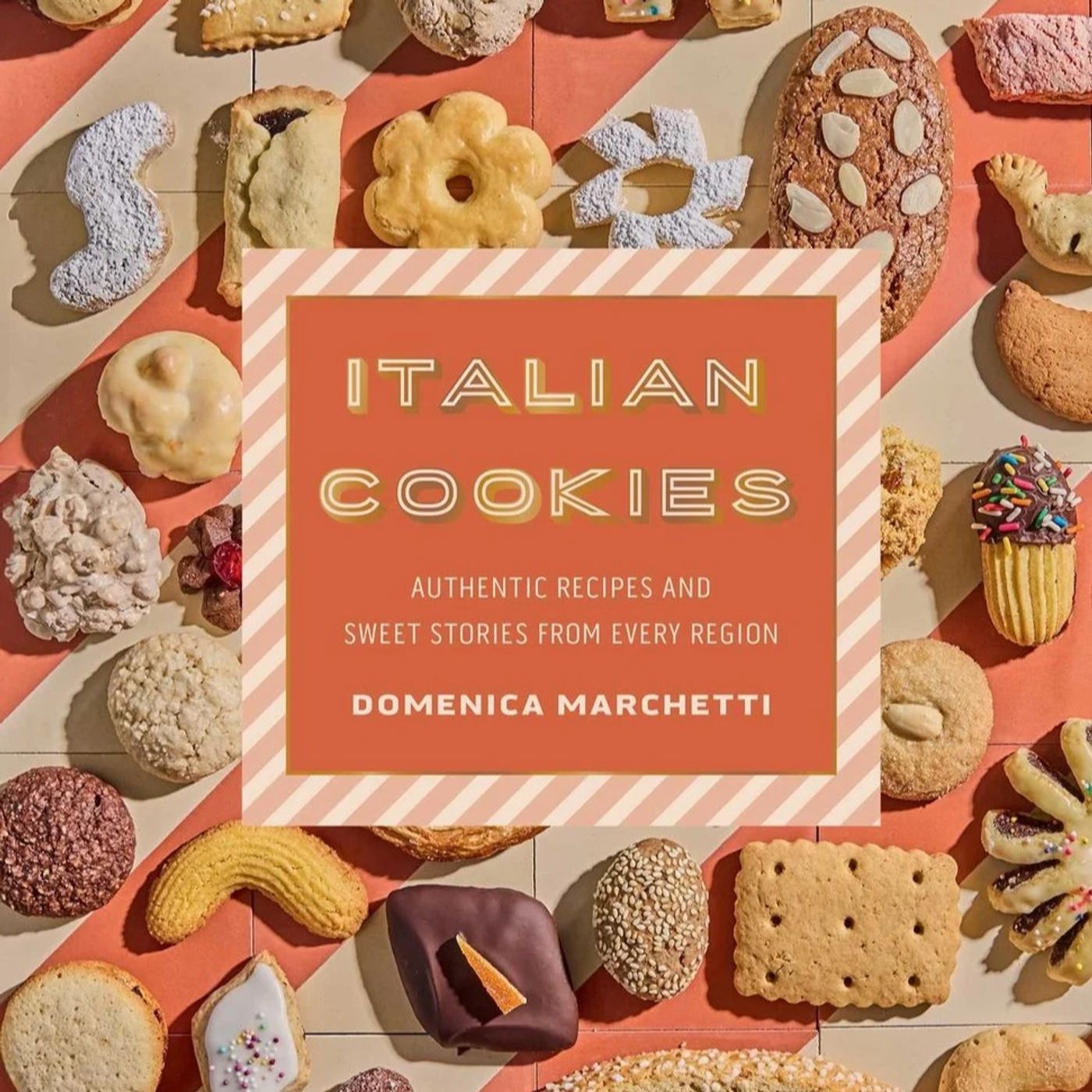
Loading summary
Transcript65 lines
- [00:00]
A
Foreign. This is all of it from wnyc. I'm Alison Stewart. This one is for all you nonnas and madres out there. Perhaps you'll be grabbing a celebratory box of Italian cookies from a local New York City bakery this weekend. That cookie is more than just a sweet. Italian cookies contain the history of the region they were created in. The dough is often almond based and contain all. Can contain all olive oil or even wine. And their names can be colorful like Ugly but Good Bread of the Dead or the eyes of St. Lucy Cookies, named for a third century martyr whose eyes were. Let's hold off on that story for just a moment. Joining me now is Domenica Marchetti. She is the author of the new cookbook Italian Authentic Recipes and Sweet Stories from Every Region. It's nice to meet you.
- [00:57]
B
So nice to be here. Thank you for having me.
- [00:59]
A
So you've written seven Italian cookbooks, including one devoted to biscotti. Why did you know you needed to expand on cookies?
- [01:06]
B
I didn't think I would be writing another cookie book. That first one, Ciao Biscotti, was just a little book about the classic twice baked cookie. But a few years ago I was in the city of Genoa, which is in Liguria, which is that kind of northwestern sweep of Italy along the Mediterranean. And I took a bite of a cookie from a bakery that I kind of fell in love with it. It's this plain flower shaped butter cookie and it just kind of melted in my mouth. It was very delicate and crumbly and dense but airy. And I just needed to know more about it. So I looked on the back of the package found where it came from, the city or the little town where it was produced. And I drove up into the hills behind Genoa and ended up in this little town. It's about a kilometer long. You drive in, you drive through the main street, you drive out. But in that town, there are about eight bakeries devoted to making this cookie. It's called the Canestrelletto di Toriglia and I've brought you some and I really want you to taste a cookie and you'll see what I mean. This is my rendition, but I learned that the cookie dates back. Thank you. They're very plain but pretty.
- [02:19]
A
I'm taking a picture. Continue on. Yeah.
- [02:22]
C
No.
- [02:22]
B
So I found out this whole history about this cookie. They date to the 15th century. And some years ago the town leaders decided they were going to capitalize on this cookie. They distribute it throughout Liguria. They have a festival that kind of honors it every June, you know, it brings hundreds of people to town. And you might know that a lot of Italian towns are struggling, especially those in the interior, people leaving for cities, for jobs, people leaving Italy for jobs. And so this cookie has kind of helped revive the economy of this pretty little town in the hills. And I thought that was such a wonderful story. And then I started looking around and realized that there are many, many cookie stories across Italy. And that was kind of the inspiration for the book.
- [03:11]
A
Is this a simple cookie to make?
- [03:13]
B
Yes, it actually is. It's got four ingredients. Butter, sugar, egg yolks, and flour. I like all of them, that's all. And just a little pinch of salt, which is my addition. A lot of cookies in Italy don't actually have salt in them, but what's special is the way you mix the ingredients together, and that is the technique of creaming the egg yolk and the sugar, rather. So in the US when we make cookies, we typically cream butter and sugar until it's fluffy. Here, you cream the eggs and the sugar until that's very light, and then you add the butter bit by bit, like you're making a buttercream, so it's very silky, and then you add the dry ingredients. So it's a very simple method once you know it, but it really contributes to this incredible texture of the cookies.
- [04:06]
D
I'm going to eat this now, please. Oh, my goodness. These are so delicate. And simple in the best way.
- [04:24]
B
Exactly. And that's what I loved about them, because they had this purity of flavor. No lemon zest, even, or no vanilla. Just the pure, simple, good ingredients.
- [04:36]
A
And I have made a mess everywhere.
- [04:37]
E
But that's powdered sugar.
- [04:39]
B
Yeah.
- [04:40]
A
We're talking to Domenico Marchetti, the author of Italian Cookies, Authentic Recipes and Sweet
- [04:45]
B
Stories from Every Region.
- [04:46]
A
You didn't hear me say that. Engineers. It's fine. Hey, listeners, do you have favorite Italian cookie? Is there a recipe that's become a tradition in your family?
- [04:54]
B
Call and tell us what it is.
- [04:55]
A
2124-3396-9221-2433. WNYC. Do Italian cooks think about cooking cookies differently than American cooks or chefs?
- [05:09]
B
I think so, possibly because there's such a history tied to them. And also one thing I discovered in researching the book is that, like all of Italian cooking and even Italian wine, the cookies of Italy are regional. They sort of are an expression of the land and what grows there. They're expression of the traditions of various regions. So that cookie that you just took a bite of is from the north And Alpine butter is a big ingredient. And soft wheat flour. Towards the east, where the Veneto is cornmeal, you'll find cornmeal in cookies because that's where corn grows. Farther south, olive oil starts to get introduced into the dough. And even wine, like you mentioned, which a lot of people don't realize, but wine is quite a common ingredient in the cookies of southern Italy, and it kind of contributes to their crunchiness and flakiness, but it also gives them this kind of underlying fruity flavor. But many of these are very old, traditional recipes that still persist today. And so in a lot of ways, they couldn't be more different than your typical American cookie, like a chocolate chip cookie. If you think of Italian cookies, you think of things like anise and nuts
- [06:28]
A
and lot of nuts, lots of hazelnuts,
- [06:31]
D
a lot of almond flour.
- [06:32]
B
Yes, exactly. And so, yes, in the. In Piedmont, those wonderful, crunchy, buttery hazelnuts. And then especially in Sicily and Sardinia, but all over Italy, almonds. And the almonds have, from Italy, especially from Sicily, have this distinct almond flavor. You get the sweetness and the bitterness. And if you bite into a Sicilian almond, you really start to understand what almond extract is. That kind of. It's a flavor I absolutely adore. I know it's not for everybody, but it's definitely for me.
- [07:05]
A
This text says, allison, the dough is ready and I'll be baking. I hope I pronounced this right.
- [07:11]
B
Bruta ma buoni, brutti mabuoni. Yes, very good.
- [07:16]
A
Making that tomorrow morning.
- [07:18]
B
That's fantastic. So those are the ugly but good cookies. And you find them throughout northern and central Italy. And the reason they're called ugly but good is because they've got coarsely chopped nuts and it's sort of a meringue dough. So it sort of cracks a bit in the oven and they look a bit craggy. I happen to think they're quite attractive, but when you bite it into them, they just have this crispiness and maybe they're a little bit soft in the center and they're very nut forward, and I just adore them.
- [07:50]
A
One baker you spoke to said that in Italy there is, quote, a cookie for every purpose. What's a good example?
- [07:57]
B
Oh, that's such a great question. And I'm going to go with you mentioned Day of the Dead. And there's a cookie, I'm going to find it here called pan de morti, Bread of the Dead. And this is. It's a nice spice cookie. It's from Lombardy. There's various versions, but this particular one in the book is from Lombardy, and it's got it. Actually, you start with different cookies. So you've got crushed amaretti and crushed caporale, which is like a ladyfinger type cookie. And then crushed amaretti, raisins, dried figs, you know, a little flour, cocoa powder, nutmeg, spices. And you bake these kind of oval. They're almost little cakes, and they're tender. And the purpose. On November 2, the day of the dead, people would bring these cookies to the cemetery. They would visit with their departed loved ones, and they would sort of, you know, share these cookies with each other with the intention of kind of sharing this meal with their, you know, their ancestors. And I really thought that was lovely. And you find these cookies throughout Lombardy in the fall. This especially in the area of Bergamo, which is beautiful city for anyone who's not been. But I just love the story connected to that. Just this making this special cookie to share with those who are no longer with us, you know, to spiritually share. Plus, they're really delicious.
- [09:30]
D
Let's talk to Susan in West Caldwell, New Jersey. Hi, Susan.
- [09:33]
A
Thanks for taking the time to call, all of it.
- [09:36]
F
Hi, how are you?
- [09:37]
G
Oh, this is fantastic. I was wondering if my grandmother. I'm in my 60s. My grandmother, who passed away long ago, was from Sicily. Her mother, who didn't speak English, used to talk about seeing Mount Etna. So that's the area they were from. My grandmother came here when she was about a year old. My dad has since passed away, which would have been my connection. My grandmother used to make a cookie around Thanksgiving and Christmas, and it was filled. It was probably like a hand pie kind of a thing, is how I would describe it. My father used to tell us that he bastardized the name, I hope that's okay to say. And he used to call it putsie, Dr. Putsi Datta. He knew as a child he wasn't saying it correctly. Well, we grew up calling it that, too. My question is, my sister and I have figured out how to recreate the filling, which was citrus fruits and cannoli nuts, canola nuts and chocolate chips and honey, she used as the binder. My grandmother. We remember the crust. We cannot get the crust right. And I'm trying to figure out if there was sort of a regional recipe.
- [10:56]
A
Oh, we think we found your answer. I think we have your answer in the book.
- [11:00]
B
Yes, I am familiar. And I think what your Nonna used to make is maybe a variation on a recipe that is in Italian cookies. And it's called either buccellati or cuccidati. And it's basically spiced fig and nut rolls. And so the filling is dried figs and walnuts, almonds. I have dates in my recipe, candied orange peel, you know, golden raisins, a little bit of chocolate, a little bit of jam. And you make this really sticky filling. And the dough is a basic, you know, flour, sugar, a little orange zest, butter or lard, if you really want to be traditional, and eggs. So it's kind of a classic cookie dough. And the way I make the cookies is to make these logs. You roll out the dough. You put like a. You fill it with this sticky filling, and then you roll the dough around it. So you've got this log and you can cut it into nuggets. Or you could, if you wanted to, you could make these pockets. You know, you could shape it differently. And then you bake them. And if you want, you can ice them with a little glaze and put sprinkles on them to make them more festive. But it sounds like what you're talking to that. And that is a very classic Sicilian cookie.
- [12:23]
D
We are talking to Domenica Marchetti, the author of Italian Authentic Recipes and Sweet Stories from every region. Listeners, do you have a favorite Italian cookie that you make? Is there a recipe that's become a tradition in your family?
- [12:37]
A
Tell us what it is.
- [12:38]
D
Give us a call at 2124-3396-9221-2433. WNYC. Let's talk about w dough. Pasta frola is sort of a short, crusty pastry. I took one semester of Italian.
- [12:54]
A
You're good. What is its texture?
- [12:57]
B
So pasta frola can have a variety of textures. It's the basic cookie dough. It's also used as a, you know, for tart shells. So it's the ingredients are simple. Flour, sugar, and it could be granulated sugar or powdered sugar, egg and egg yolk. So it's pretty egg yolk rich. And you can put a little bit of baking powder to give it some lift, but you don't necessarily have to do that. And in the book, I give the recipe for basic pasta frola and also chocolate pasta frola. It rolls out like a bolt of silk. It's very smooth. It can crack a little bit when you're folding it and shaping it, but. But it's very easy to pat back together. Now, depending on how you mix those ingredients. Remember I told you about the canestrelletti? That is a form of pasta frola, but because the ingredients are whipped so much. That's called pasta frola montata. So whipped pasta frola. And it gives you that sort of airy melt in your mouth texture. If you cream the butter and the sugar first and then add the eggs, then you get more of a classic, kind of maybe a little more dense pasta frola. You put a pinch of baking powder in it. And like I said, it's very versatile. You can use that master recipe for so many cookie doughs, but it's like a thumbprint. Everybody's kind of got their own version. So when I was writing the book, I decided to go with the version that either people gave me or that kind of went with a specific type of cookie to get the, you know, the texture that I was looking for. But it is a very ubiquitous cookie dough throughout Italy sometimes. Mostly it's made with butter, but there's a recipe from Sardinia in the book for ciambelina, and that is made with lard, because you see lard in baking in Sardinia. And so that has kind of a singular, flaky texture that lard lends to cookies and that underlying savoriness of lard.
- [15:03]
D
I love the chemistry of baking. That's the most fun part about it.
- [15:06]
B
It's fascinating. Yeah.
- [15:07]
D
Let's talk to Karen, who's calling from the Rockaways. Hey, Karen, thanks for taking the time to call, all of it.
- [15:14]
B
Hi.
- [15:14]
F
How are you today?
- [15:15]
G
Doing great.
- [15:17]
F
I just wanted to talk about a cookie that was tradition in our family, along with the fake cookies that you were just talking about. But my mother and aunts always made what we called meatball cookies, which were a spice chocolate cookie rolled in the shape of a meatball. And they were always my favorite. And so I just. I believe they are Sicilian, and that's really all I know about them.
- [15:55]
A
Well, thank you for sharing that family story. We appreciate it.
- [15:57]
B
Yeah. I'm curious as to whether there's a name to those cookies, because I'm not familiar with the cookies she's talking about. But that's the thing. You know, at a certain point, I started working on this book and gathering research, like way back in 2017 or 2018, when I first had that canestrelletto. And, of course, I grew up in an Italian family, so my mother used to bake Italian cookies. She was from Abruzzo, and she would make those pizzelle, those pretty waffle. But still, even after all these years of research, whenever I walk into an Italian bakery anywhere in the country in Italy, I kind of shield my eyes because I know, there's going to be cookies in there that are not in my book, because the diversity, the variety is so great. It is. You know, that's what sequels are for. Right. So I don't know specifically what cookie she was referring to, but I'm sure it exists somewhere in Sicily, if that's where she said that her grandmother, her mother was from. Yeah.
- [17:01]
A
What does adding olive oil do to dough?
- [17:04]
B
Well, for one thing, it adds fat in the same way that butter adds fat. And of course, in regions where olive oil is more common than butter, you would see that as a substitute for butter. So I would say anywhere from Tuscany and Umbria down towards the south, you do see olive oil in cookies. It does add a little bit of flavor. And of course, if you're using a more robust olive oil, the flavor will be more pronounced. But it also adds a kind of flakiness to the dough. And sometimes when you're rolling out the dough, there are several olive oil cookie recipes that require you to roll out the dough in ropes and then shape it into rings or twists. It can be a little fussy to work with because of that flakiness, but you just have to kind of show it who's boss and keep working it. And it's also a glossy dough. It's kind of nice to work with because it doesn't stick to the countertop, and it just produces a really kind of crispy and flaky cookie that's great for dunking, especially in wine. I love to dunk olive oil cookies in wine.
- [18:12]
A
For someone who's feeling a little intimidated but would like to try to make an Italian cookie, what recipe would you tell them to start with?
- [18:21]
B
I love this question, and I have just the recipe. I was just talking about dunking cookies. This is one of my favorite categories of Italian cookies. And if you haven't dunked a cookie in your morning coffee or in your evening wine, you are missing out. These are called biscotti da in Zuppo, which means cookies for dunking. And you don't need a mixer. You just need basically a whisk and a couple of bowls and your hands. And it's basically just sug eggs, olive oil, and a little bit of zest and vanilla extract for flavor, a little bit of milk, flour, baking powder and baking soda. And you mix the dough in the bowl. I put some chopped up bittersweet chocolate in it as well. And then you just roll it out or pinch off pieces of it and just roll them into big fingers and, you know, put them on the baking sheet and bake them. You don't need to roll out the dough and use cookie cutters or anything. It's all your hands, it's all. All unplugged and they come out beautifully cracked on top and quite crispy and crumbly. Just sturdy enough so that when you dunk them, they don't fall apart. And they're a really good first cookie to try if you're new at it.
- [19:31]
D
Tell me about the eyes of St. Lucy.
- [19:34]
B
Okay, I'm gonna mentioned it in the draw. I will try. I know I said sweet stories, but that's not one of them.
- [19:39]
A
That's okay. That's what life's about. Happy stories and other kinds.
- [19:44]
B
Yeah. So this is a cookie. And to celebrate St. Lucy, her feast day is on December 13th. And there are numerous stories associated with her. And they're all quite gruesome because she is said to have either had her eyes gouged out or gouged them out herself to prevent herself from being distracted to her devotion to her Christian faith by any would be suitors. But there is a bright side to this story as well. The Feast of St. Lucy is also known as the festival of Light. And according to legend, as part of her devotion to Christianity and to the poor, she would bring food to people hiding in the Roman catacombs. And she would wear a candlelit wreath on her head to light her way. And so these cookies are mini tarali, so little tiny rings. There's actually no sugar in the dough. It's a very old fashioned dough. It's got aniseed and a little bit of cinnamon. It's and white wine and then it's covered with this thick glaze which has a little bit of anise extract in it. And so that's where the sweetness comes from. But they're very pretty little cookies. And they're just kind of an old fashioned recipe that I was drawn to. And in spite of its gruesomeness, I was, you know, I was kind of drawn to the story as well.
- [21:10]
D
We have one quick question in a few minutes to answer it. My husband and I are traveling to Italy in June. Is there a particular cookie that's special to Venice?
- [21:19]
B
Oh, gosh, yes. There's a cookie called Busolai and that is an S cookie and that is actually from the island of Burano. And it was said to be made by fishermen's wives or sailors who were. Who were going off to sea and their wives would make these s cookies for them which were long keeping and so the sailors would take them on their voyages. So if you are in Venice, look for those. But there are many other cookies as well. I'm sure you'll find some that. That I don't even know about because there's so many.
- [21:51]
D
This text says, I love her remark. Dunking cookies and wine, of course. That's what you do.
- [21:57]
B
Absolutely.
- [21:58]
D
My guest has been Domenica Marchetti. The name of the book is Italian Cookies. Authentic recipes and sweet stories from every region. Thank you for the cookbook. Thank you for the beautiful cookies.
- [22:10]
B
Enjoy. Thank you for having me.
- [22:13]
E
1, 2. 1, 2, 3, 4. Gimme a break, give me a break, Break me off a piece of that Kit Kat bar Gimme a break, give me a break, Break me off a piece of that Kit Kat bar The chocolate crispy taste gonna make your day? And wherever you go you hear the people say Give me a break, give me a break Break me off a piece of that Kit Kat bar Have a break, have a Kit Kat.
- [22:42]
C
Hi, I'm Maggie Smith, poet and host of the Slowdown. Each weekday, I share a poem and a moment of reflection, helping you turn listening into a daily ritual. It's five minutes to slow down, pay attention, and begin the day with intention. Find it in your favorite podcast app and make the Slowdown your new daily poetry practice.