Loading summary
Transcript57 lines
- [00:00]
A
All of it is supported by Progressive Insurance. You chose to hit play on this podcast today. Smart Choice. Make another smart choice with Auto Quote Explorer to compare rates for multiple car insurance companies all at once. Try it@progressive.com Progressive Casualty Insurance Company and affiliates not available in all states or situations. Prices vary based on how you buy. WNYC Studios is supported by Odoo. When you buy business software from lots of vendors, the costs add up and it gets complicated and confusing. Odoo solves this. It's a single company that sells a suite of enterprise apps that handles everything from accounting to inventory to sales. Odoo is all connected on a single platform in a simple and affordable way. You can save money without missing out on the features you need. Check out Odoo at o d o o.com that's o d o o dot com.
- [01:02]
B
This is all of it on wnyc. I'm Alison Stewart. Coming up on the show tomorrow, we'll preview one of the musical highlights of New York City's Winter Jazz Fest and the jazz collective Freedom Riders will be on the lineup. They'll perform live in our studio. Now let's get this hour started with all the Walls Came Down. A year ago today, out of control wildfires tore through Southern California, including the wealth area of Pacific Palisades and the middle class neighborhood of Altadena. Altadena was hit especially hard. Over 909,000 structures were destroyed. 19 people lost their lives and thousands of people were displaced. To this day, many homeowners are stuck in kind of a limbo, navigating a maze of insurance and permits and threatened foreclosures. Someone who lost their home there is award winning filmmaker Andy Timiner. She was one of our first guests on this show. Back for her film Mapplethorpe. Andie put her skills to Documentary. Documentary. Excuse me. Andie put her skills by using documentary in the aftermath to make a short called all the Walls Came down which has been shortlisted for an Oscar. The film shines a light on the history of the neighborhood which has been historically black. In his history of redlining, it's the story of predatory real estate developers and reverse mortgages that have made rebuilding more complicated. But the community has resolved and found a way to stick together. Andy is with us now. Hi. And.
- [02:40]
C
Hi, how are you?
- [02:41]
B
Alison, it is so good to speak with you. And joining her is Heavenly Hughes, who is also featured in the film. She created My Tribe Rise with the purpose of bringing awareness to survivors of the fire, including finding resources to help rebuild. Hi Heavenly.
- [02:57]
A
Hello.
- [02:57]
D
Thank you so much for having us.
- [02:58]
B
And we wanted to let people know that the film will be screening at 9pm at the Roxy Cinema in Manhattan on Monday, January 12th. Andi, how did you end up in Altadena? How long did you live there?
- [03:12]
C
So I moved there from Pasadena right on the border of Altadena about 14, 15 now, 15 years ago. And it's really where I raised my son. I see all of this that happened as sort of a very violent closing of a chapter of sort of the time, precious time of life where I raised my son Joachim. And I just loved that neighborhood so, so much. It was magical, heavenly.
- [03:37]
B
What's your history with Altadena?
- [03:40]
D
50 years in Altadena. I've been in Altadena my entire life.
- [03:46]
B
What makes it so special, such a special community?
- [03:50]
C
Well, I can tell you, when I moved in, immediately I realized how diverse the neighborhood was and how great that was. There was a soul band around the corner that would rehearse every day and they became my good friends and played my 40th birthday party. And peacocks, wild peacocks would fly over the house and come walk, walking up the driveway with their little babies and dropping their feathers and. And yeah, I even had a wild bear just come into my swimming pool and take a bath one day. So it was just kind of this. A magical place where you could be close enough to LA to take care of business, but then when you came home, it was really home. And then all, all of a sudden, a year ago, it was just destroyed.
- [04:31]
E
Heavenly. What makes the area special for you?
- [04:36]
D
For me, being raised in Altadena, it was definitely the community where we were cared for as youngsters. In our community, we were cared for by our neighbors. We could go to any neighbor's house to have breakfast, lunch, dinner. They all knew our parents. So we always know that if we did anything that may be out of order, our parents would find out pretty quickly. It was definitely a very close knit community. I love my community. Yeah, just great memories growing up in Altadena.
- [05:10]
E
And you were in Europe when the fire happened. You found out that your house was gone via text. First of all, what were you working on and when did you realize that you were going to be affected by this fire?
- [05:26]
C
Yeah, so I was in Rome when the fire broke out and in Budapest when the house burned down. And we had. As we were boarding the plane to. We're filming a movie about the Holocaust. And as we were boarding the plane to go and look at potential locations for all of the dramatic scenes in Budapest, we Tried to evacuate seven animals, five humans. You know, it was a desperate mad dash. Refreshing. The Watch Duty app, constantly, all day long, sick to our stomachs. It never ever said that our house burned down even two days after I got that text message from my neighbor Randy, because there were no first responders there and there were no evacuation orders and there was no support. So that's how Watch Duty actually got their information. I found that out from the founder. But yeah, it was a very harrowing day for me in Europe and I felt very far away from my community, which, as Heavenly just noted, it was such a tight knit and amazing community. And that said, when the walls came down after this disaster, it became an even closer community. So that is the silver lining of the. But yeah, just total destruction and just everybody having to take care of it. I think that's part of why we came together is that everybody had to kind of carry each other through flames to get out and to save each other's pets. And, you know, it became very clear that we have to take care of each other when climate disaster strikes.
- [06:57]
E
Heavenly, where were you a year ago?
- [07:00]
D
Yeah, a year ago I was actually in Pasadena. I immediately started calling our neighbors. We started our organization, My Tribe Brides, in 2019, focusing on current events happening in our community and how we rapidly respond. So when I saw the fire starting there in Eaton Canyon, close to auntie's home, her mom's home, we started making calls to seniors because we just had a feeling that this was different than what we've experienced during the years in Altadena. We've seen fires throughout our life. We've never seen it come down the mountain, into the neighborhood, into our community, as we all experienced on that night. So that's what I started my night off, calling other community members to let them know to be prepared because this may be something that will change our life and it definitely has changed our entire life.
- [07:56]
E
Andy, when were you first able to get to your house?
- [08:00]
C
So, yes, I. The very next morning, Allison, after finding out the house burned down, we had an interview with a Holocaust survivor who I didn't feel I could cancel on in Vienna. And the company that I was and still making this film for, Legendary, of course, offered that, you know, your house just burned down. If you need to cancel the rest of the shoot, please do. But I couldn't cancel on Joseph and so I went to Joseph and it gave me such perspective that I just decided to continue the shoot because LA was burning. The National Guard had surrounded Altadena. My brother, who Lost his home a mile and a half south. Didn't know for a week whether his house would burn down or not. So there was no getting back to the neighborhood. So I just thought, you know what? Let me go ahead and create. Everything I've created pretty much is gone. Let's create this important film about the Nazis and the Holocaust and, like, and. And. And just keep going, you know. So we kept shooting, and we went to Italy, we shot, and then we went to New York and opened Dig Double X in New York. And all of New York just wrapped their arms around us. All our friends from the film world and the community there just started giving us clothing and whatever they could. And then we came back. And that gave me time to think, what are you going to do, Andy? What are you going to do right now? And it was like chaos and trauma and shock. But I thought, you know, what? If I don't film, I won't have any way to, like, tell a story. If there's a story to tell that's important for other people to hear. I don't know if there's a story worth telling here. And I certainly would never have made this film just about my loss of my home and my family's, you know, loss if I hadn't met Heavenly and, you know, connected with the Wormleys and understood the disparity that was happening in the wake of the fire and the strength of our community. And that story that needed telling, I don't think I would have made this film. But, yeah, I shot just in case there was a story to tell.
- [10:01]
B
I'm speaking with writer director Andi Timiner about her film all the Walls Came down about California's Eatin Fire and how it devastated Altadena. She's also joined Heavenly Hughes, a fellow resident and activist helping survivors of the fire. I want to play a clip from all the Walls Came Down. This is a film of Andie Ann, your wife, Morgan, who's a musician, and you're visiting the site that was your home.
- [10:27]
C
Let's listen. I'm horrified. It says unsafe, and it says it right there, you see, was like, my whole life. I loved it there. I'm still alive. But look at that.
- [10:41]
E
This is how we have to go home now.
- [10:42]
C
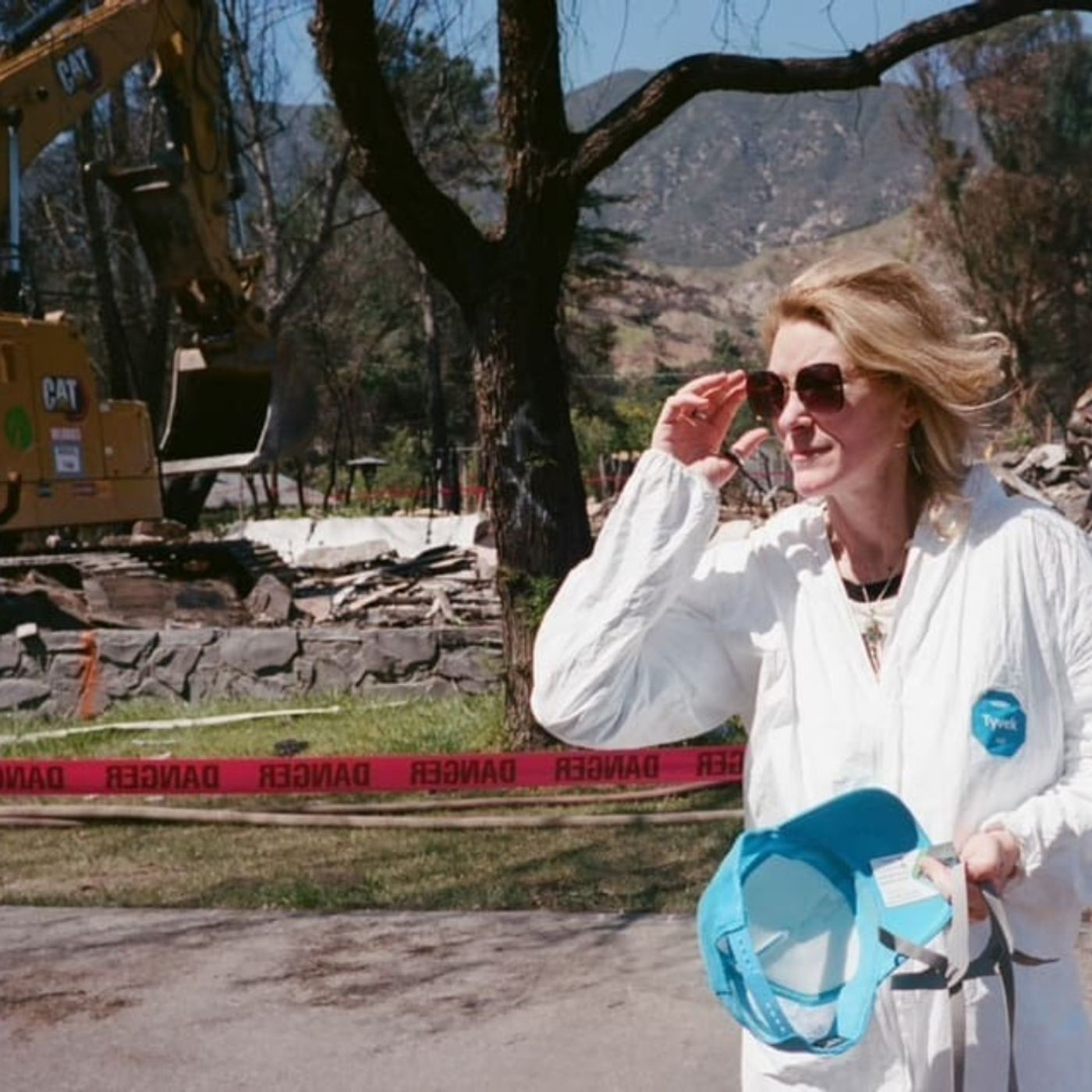
We're home in a hazmat outfit. There's no home here. I'm just so sorry for the town of Altadena, this beautiful place. This is Andy's movie, one of her movies.
- [11:00]
E
It might be Mapplethorpe. Eva.
- [11:03]
C
Oh, my God, is that my film? Everything just Gone. This is my boys, Rue, who grew up here. The thing that I'm saddest about is losing my son's cards to me. He would draw the highlights of our life together every year. They were beautiful. I had this really meaningful instrument right over here. It was right there.
- [11:26]
E
Here it is.
- [11:33]
C
W. I played it on all my records.
- [11:39]
E
It's called a hung.
- [11:49]
B
It's such a hard scene to watch. Andy.
- [11:52]
E
There's a scene in the film where.
- [11:53]
B
You'Re talking to your sister, who's a rabbi, and you say you feel bad because you're crying over things, and your sister says, that's not bad.
- [12:01]
E
That's not bad at all. How has this experience changed or not changed your connection to things?
- [12:09]
C
Well, I think, you know, my sister, she's the third film that she's been in of mine now, and she's like, andy, are you going to make a film that I'm not in? But she's so wise. You actually have her there in New York. Alison. Rabbi Rachel Timona of Congregation Beth Elohim. So she was calling me and my brother every day, pretty much grief counseling us. And I did feel this sense of disorientation and just immense loss. And I also felt really silly for that feeling. I just thought, you know, why am I crying over these things? But it was the things you can't replace. And I think, you know, it's the love letters and the cards from my son and the scrapbook of my father's history. You know, it's those things that are irreplaceable. The footage of my son as a child. Those are the things that I really am emotional about, even now. Even now, a year later. And. And I just, you know, I think Rachel was really wise, and that's why I included that in the film, because she says, you know, we surround ourselves by the things that reflect our values, and. And that's important. And anybody who says the spiritual and the material are not connected and that the material isn't spiritual is wrong. And so that's, I think, really interesting and important for survivors to hear today, a year later, because all of us are very, very are still grieving the loss of our homes, our town, and some of the priceless keepsakes that we had. You know, but that said, yes, I have a different relationship to it. You know, there was a. I moved to Joshua Tree with my wife, and right after we moved there, a fire broke out. And I was in LA in a meeting, and I got a text from my producer. Hey, there's a fire. In Joshua Tree. And I just took a deep breath and I thought, how do you feel right now, Andy? And I thought, whatever, burn it. You know, it's fine. Just take, take the stuff, you know, because it really, as the film shows, it really is human connection and love that is most important in our lives and that the fire didn't take from us.
- [14:17]
E
We're talking about the film all the Walls Came Down. After the break, we'll talk about how Altadena is not for sale. This is all of it.
- [14:36]
B
You're listening to all of it on wnyc. I'm Alison Stewart. I'm speaking with writer director Andi Timineur about her film all the Walls Came down about California's Eaton fire and how it devastated the historically black neighborhood of Altadena. We're also joined by Heavenly Hughes, a fellow resident and an activist helping surv survivors of the fire. Fire Heavenly. Some people wanted to leave, Some people wanted to rebuild their homes. And we see in the film a slogan that says, altadena is not for sale. What does that mean, Heavenly?
- [15:09]
D
Yes, Altadena is not for sale. We really want to be sure that that sentiment was settled in the spirit of our Altadena community. We want to. Because when you go through such a tragedy and have no way of knowing how you really navigate, we want to say first, this is a community that we have built. We are not going to allow for this fire, the vultures, like developers, to come and snatch our property away from us and force us out. So early on, we put that statement out, altadena is not for sale. It was first for us as survivors, as community to know that this is going to connect us. We have to stand strong and also remember that we built this community that we have invested into our own lives when it comes to generational wealth. And so we wanted to be sure that that message was something that we stood strong on. Now we know that there are community members who may not be able to resettle and come back to Altadena. And with that being said, we want our community to know, let's talk to one another. Let's buy within, buy and sell within our community. And that we even be the one who invite those who come into our. We want to keep a strong black and brown community in Altadena.
- [16:32]
E
Because Altadena isn't an incorporated city, it doesn't necessarily have its own representatives. Andi, how is that hampering progress?
- [16:43]
C
So we have this one county supervisor named Katherine Barger, and at the time that we're making the film, she is ignoring Heavenly and we even have it. But in a scene in the film, it's quite shocking and moving to see this scene. It really says a lot about the relationship that some elected officials can have with the community. And turning a deaf ear to a community when it's actually the people that they serve. And it was really something that I thought was very, very important to include in the film. You know, here they are opening a park right after the fire when people are sleeping in their cars and Heavenly's fighting for a moment of her time. And as in, you know, in reaction to the film, audiences have written letters and it's almost like a Hogwarts style campaign to the county supervisor. And she's really the only authority over Altadena because we're not incorporated. And she finally sat down with Heavenly recently. So that's good. But it's just the start, hopefully.
- [17:48]
E
Yeah. Katherine Barger's been making appearances all over because this is the anniversary. And this is a quote from an opinion piece that was posted yesterday on Pasadena Now. She wrote, when the Eaton fire destroyed those homes, it disrupted decades of stability and threatened the ability of families to pass the security on to the next generation. The loss of generational wealth in this community has weighed heavily on me. I have come to view helping families rebuild not simply as a policy objective, but as a moral charge. Recovery cannot come at a process that only the most financially secure are able to compete to complete. From the outset, I pushed Los Angeles county to move quickly. I focused on cutting red tape, waiving fees, delivering direct support. Heavenly, what is missing from that statement that you would like to add to her list?
- [18:35]
D
What is missing is the fact that we believe it was not sensitive to survivors to have such a display of celebration three months after the fire. That's what you're going to see in the film. All the walls came down. This was right after the fire. They're putting all millions and millions of dollars into. And we have to be culturally sensitive, we have to be sensitive to what survivors are experiencing. This is a catastrophe that we don't even know emotionally how this, how heavy this grievance is day by day by day. And so I really believe that at that moment she was not sensitive to the survivors and what they were experiencing because she didn't necessarily ignore just me. It was about 80 survivors out there who lived around the park, who, their homes were in ruin and ashes and saying, we need help, we need housing. And I feel like that's the part that was missing that moment. To address Your constituents directly.
- [19:48]
E
And I thought it was. It's interesting. It's part of the subtext of the film is how much generational wealth was lost. Lost?
- [19:56]
D
Yes.
- [19:57]
E
In the black community.
- [19:58]
D
Oh, oh, definitely. One of the examples are that many of the black homeowners who bought their homes back in the 50s, 60s and 70s, they owned their homes, so they did not have insurance. And so here it is. How do you replace that? Where is the money coming from to replace this generational wealth? That's what we knew. That's what we were taught. Buy property to create wealth for your community or for your family, for your next generation. And that has all been lost.
- [20:33]
E
You know, in the film. In the film and in articles around New York, there's been all these articles about how people are leaving LA and how the fires are a big part of it. Andy, how have the fires affected how you feel about living in California?
- [20:52]
C
Well, I really see the film in a lot of ways as a love letter to Los Angeles and to my community. You know, I really felt that it was important to include my own personal story because I have access to my own archives, and I was able to tell a very personal, intimate story that I think people in the Palisades and Malibu and so many people all over this city have, you know, are experiencing just immense grief. But specifically to Altadena. You know, I never really understood till I sat down with Heavenly and started attending my Tribe Rise rallies. You know, how unique our community was. I mean, we had the second largest black home ownership in the United States. 80% of black and brown families own their own homes. This is something that has been lost in a flash, and it cannot. We cannot let it happen. We cannot let what we've seen again and again and again in the wake of such disasters happen here in Altadena. And so Heavenly and I are really, you know, working together, partnered. And the film is really heralding a movement. It's become an anthem for the town. And we are trying very hard with a petition to stop the foreclosures, put a moratorium on the foreclosures until the power company pays, because they've accepted responsibility for it. We know they're going to have to pay everyone for the cost of their rebuild so all of these families will be able to stay. And Heavenly is desperately handing out bridge loans, raising money. And so that's what our film is really hoping to be able to help with. We've already helped with raising some money, but we really want to stop the foreclosures and see if we can't get the governor to push Southern California Edison to advance some portion of what they will owe now because we've reached a tipping point, Allison, where over 61% of the families that lost their homes a year ago today are facing a loss of housing in the next two months if we don't act now. So we have a second disaster looming. It's, it's quite, you know, it's, it's really, it's, it's quite an urgent moment, honestly.
- [23:07]
B
You want to give people the choice to stay. If they want to stay, they want.
- [23:12]
C
Many people want to stay. And I guess you asked me about how I feel about it. I want to stay, I want to rebuild because I raised my son in that beautiful place. I love my neighbors and I don't want it to just be a bunch of outside developers turning it into something else. So whether or not we as a family move back there, we want to build a beautiful home there and make sure it goes to an Altadena family if that's what they want. Or we might, or we might move in. But first we want to detoxify our land. We have to do a serious remediation and I think that is another call to action is that we need to really protect. And if you think about the wake of 911 and how many people have died, five times the amount than died actually on 9 11, we don't want to see that happen again in Altadena. So besides bridging families over, our other desperate thing is we need to get all of our land detoxified.
- [24:06]
E
Heavenly, how can people help?
- [24:09]
D
Yes, first off, please go to our website allthewallscamedown.com to sign the petition. And also we are asking those who can write letters to Supervisor Barker, write letters to Governor Newsom to write letters to the Attorney General because there also needs to be an investigation around how they left us out there without support. So please go to our website allthewallscamedown.com and there's information on exactly how you all can support. We need support with our bridge financing to help people pay for housing. I mean people are paying for rent and mortgage right now. So it's a very heavy time and funding is needed.
- [25:01]
E
The film is currently good.
- [25:03]
C
Oh, sorry. Heavenly and I released a video that went somewhat viral just this past week calling for Southern California Edison with a coalition of Altadena foundations and community organize organizers that Southern California Edison releases $200,000 of what they will owe to every family now so that the families can afford to stay on their generational land and also survive this year.
- [25:33]
E
The film is currently available to watch through the LA times ShortDocs latimes.com ShortDocs or if you're in New York, it will be screening at 9pm at Roxy Cinema in Manhattan on Monday, January 12. My guests have been Andi Timiner and Heavenly Hughes. Thank you for your time.
- [25:53]
C
Thank you so much.
- [25:54]
D
Thank you so much for having us.
- [25:56]
A
NYC now delivers the most up to date local news from WNYC and Gothamist every morning, midday and evening with three updates a day. Listeners get breaking news, top headlines and in depth coverage from across New York City by sponsoring programming like NYC Now. You'll reach our community of dedicated listeners with premium messaging and an uncluttered audio experience. Visit sponsorship.wnyc.org to get in touch and find out more.