← All Of It with Alison Stewart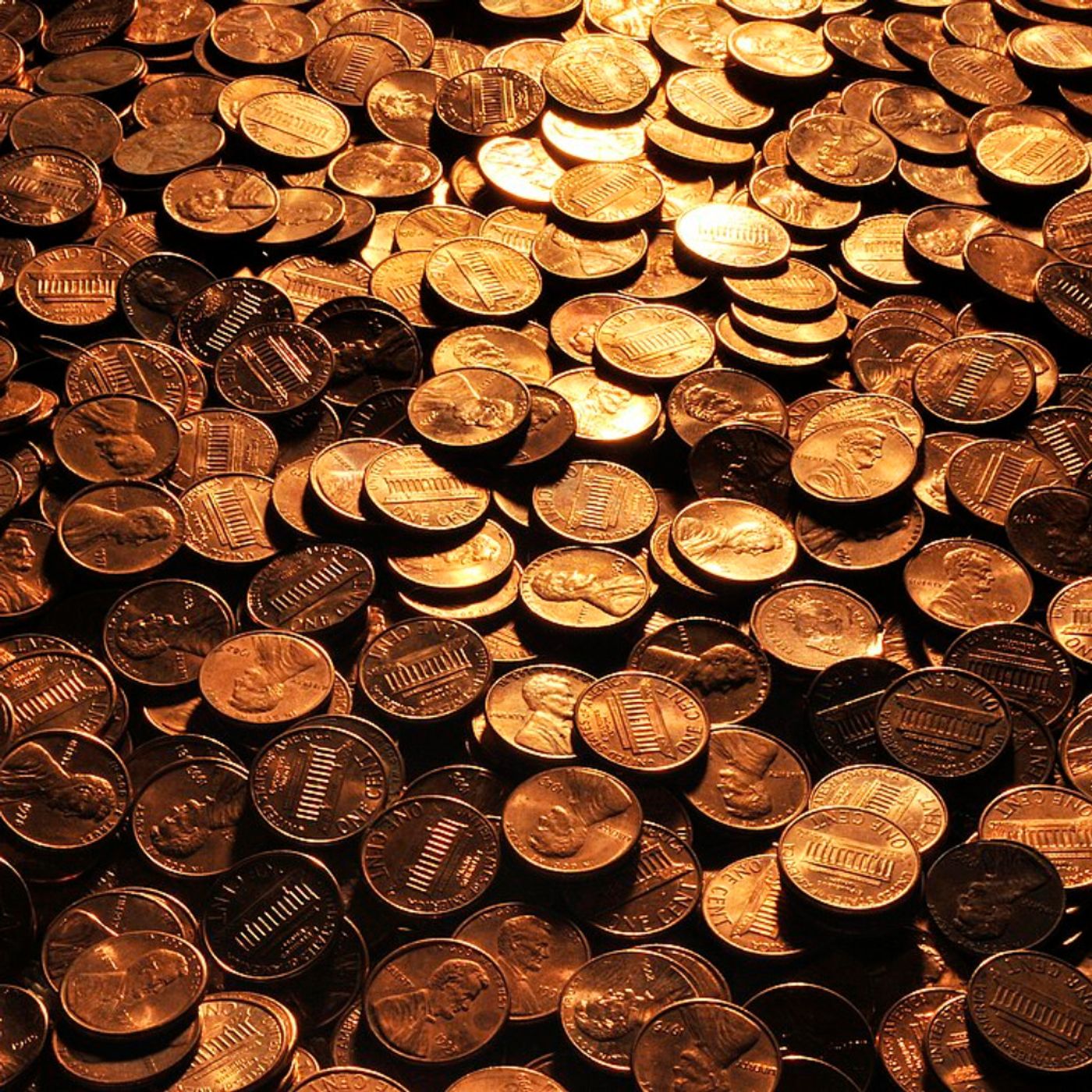
All Of It with Alison Stewart
As We Say Goodbye to the Penny, a Look Back at the History of Money
00:24:45
Loading summary
Transcript29 lines
- [00:08]
A
This is all of it. I'm Alison Stewart live from the WNYC studios in soho. Thank you for spending part of your day with us. I'm really grateful that you're here on today's show. The Beatles are back on the charts. We'll speak to the Rolling Stone editor, Rob Sheffield about the re release of their anthology, documentary and accompanying album and new material. And we'll talk about two collections from the Criterion Channel, first Hotels on Film, then a curation of black female filmmakers. And we'll take your calls on both. That's coming up. But let's get this started with money.
- [00:53]
On November 12, the final penny was minted here in the United States. The penny goes the way of the lira, the ruble, or for that matter, salt, which was used as currency or, or seashells, wampum was used by indigenous people. Currency throughout history has changed as humans move from bartering and trading to more complex financial Systems. Economist David McWilliams takes readers through a comprehensive global history of currency. In his new book, the History of Thus A Story of Humanity, David goes back thousands of years, the first archaeological signs of counting and currency, and takes you all the way through crypto in the 21st century. In the book he writes, money unlocks pleasure, puts a price on desire, art and creativity. It motivates us to strive, achieve, invent and take risks. Money also brings out humanity's darker side, invoking greed, envy, hatred, violence, and, of course, colonialism. Money is complex because humans are complex. The History of Money, A Story of Humanity is out now. Author and economist David McWilliams joins me now to discuss. Nice to meet you, David.
- [02:06]
B
Alison, how are you? Greetings from a wet and windy Dublin city.
- [02:11]
A
Why do you think it's important for people to understand the history of money, not just how money works?
- [02:17]
B
Because I tell you what, Alison, when we think about money, the vast majority of us don't really understand what it is. Can it run out, where it came from, what it does to us? We know that when we don't have it, we'd like to get our hands on some of it. And if we do have it, we don't want to necessarily lose it. But as an economist, I always felt, Alison, that economists don't really get the real magic, the alchemy, the chemistry of money, which is what it does to humanity. So as a result of that, I decided to write a book to try and locate money and our relationship with money against the background of human progress and civilization, which where did it start? Why did it Start when it did, why did we invent it, et cetera. And so that brings us all the way back, as you said in your lovely intro there, 5,000 years, maybe even 20,000 years. If you want to go back to the first evidence of a blockchain, that is a sort of a tally stick or a counting Mechanism, that's about 20,000 years ago in Africa, but where money, Allison, comes into its own and begins to look and feel and smell like the money that we use, and is in the Sumerian civilization, which is 5,000 years ago, about 3,000 years before Christ, in an area called Mesopotamia, which is now in southern Iraq, which is basically the very first evidence of human urban living. So I go back there and we take it from there, and it's a fascinating, fascinating story of money, humanity, innovation, striving, and, as you said, trying to understand the relationship between ourselves and this technology. This is what I say, is that money is an extraordinary social technology that humans invented while or during the period that we were becoming sedentary, domesticated, and beginning to be faced with much and much more what you would call complex issues day to day. So it's a. It's a fascinating story, and one that's one that I think we've got to liberate money from economists, even though I am not really. I'm absolutely serious. I'm absolutely serious, but liberated from the straitjacket of economics and throw it out there onto the street.
- [04:40]
A
What was something that you learned about the history of money, some detail that kind of blew your mind?
- [04:46]
B
Well, I think the main detail that blew my mind was I was trying to figure out, I think, you know, I was writing a chapter on money and the Greeks, right? And say, like, why did the Greeks. Why. Why did the civilization, the Greek civilization, why did they break the sort of intellectual glass ceiling? They come up with rationality, they came up with democracy, they came up with philosophy, they came up with logic, they came up with geometry, they came up with republicanism. Think about it. You know, I just heard you talking about the American Republic there in your news. The Greeks came up with all this in a really quick period of time, like about 200 years. I was trying to think, why did they do this and no other civilization before them do it? And it struck me that they were the very, very first monetized society. They were the first society to use you. We're talking about the pennies. They were the very first society to use silver coins. And they used them in an extraordinary way in the sense that they moved very Very quickly, from a society that was very primitive, barter, if you will, to a society that became more or less not unlike our own, where money was the organizational technology of the Greek world. And I thought, could that have been the impetus for the Greeks beginning to think the way they think or they thought? Did money have any impact on the Greek mind? And I think it did. I believe it did. And it's through the following way. When you have money, when you have coins in particular, so money in your back pocket or your toga. Your back toga. Right. Basically, what you're doing is you're becoming a numerical society, a precise society, a society that counts, a society. Then it's precise, begins to start to look for proof for things, begins to turn its back on superstition, begins to look towards science. This is very rudimentary stuff, very basic stuff. But I do think what you see, and this sparked the idea in me that where you see innovations in money, you see innovations in all sorts of other indicators, Alison, of what we would call human progress, human society, urban living, innovation, be they commercial, but much more interestingly, artistic innovation, as well as commercial innovation. So that was a sort of a spark that got me thinking about money, maybe in a different way to other people.
- [07:17]
A
When do we start seeing money as a symbol of wealth and power?
- [07:23]
B
Well, that's, again, fascinating. So money has always been. If we go right back to. So if you think of before we settled down, we were a nomadic race, a nomadic species, and money, wealth, possessions were not part of our background noise. Why? Because if you're a nomad, you can't carry things with you. Okay. You can't carry your wealth with you. So wealth and status and all the associated accruments begin to emerge when we begin to settle down. And so I think there is this pivotal moment. So for the first about 250,000 years of human existence, anthropologists described us as a pyrophyte species, which was a species whose progress, whose adaptation, whose success was defined by its relationship with a technology. And that foundational technology of the nomadic world was fire. Humans figured out how to use fire better than any other animals. I believe in the last 5,000 years, we have become a Pluto fight species. And that is a species that is constantly adapting to and being adapted by our relationship with another technology. And that technology, the Pluto bit, been money in Greek, is our relationship with money. So you begin to see this about 3,000 years before Christ. And as we know now, this has become the dominant narrative or a dominant narrative of societies, particularly in The United States, not so much over here in Europe, but particularly in the United States.
- [09:03]
A
My guest is economist and author David McWilliams. We're talking about his new book, the History of Money and A Story of Humanity. You know that there was a difference between dealing with money and dealing with finance. At one point, Europeans were just dealing with money, but Arab cultures were working with finance. What innovations allowed Arab cultures to almost pull ahead when it came to finance?
- [09:28]
B
This is a fascinating story. So it's the, basically, it's the mysterious and unbelievably important story of zero, of using zero. So if we go back, the Arabs introduced zero into Europe via the island that is Sicily in the south of Italy. We know it now to be the south of Italy. But in the medieval ages, prior to Italy existing, Sicily was the center of Mediterranean trade. But not just trading goods, trade in ideas, trade in education, trade in all sorts of cultural imperatives. So why did zero emerge there with Arab traders? And what happened was the Arabs got zero from the Persians. So when the Arabs conquered persia in about 600 AD, they found the Persians using mathematics, very, very evolved mathematics, what became known as algebra. And we know that everything with Al is an Arabic alcohol algebra algorithm. All these are Arabic derived words. Now why is that? It's because the Persians got zero, believe it not from the Indians. The Indians were using zero. Now, once you use zero rather than Roman numerals that we were used to using in Europe, you begin to be able to count in very large numbers. But more importantly, you be, you're able to do fractions, zero, you're able to do ratios, you're able to go minus numbers and plus numbers. Now all this might sound sort of a little bit academic until you realize in commerce this is absolutely crucial to have algebra and zero and to be able to express one thing as an expression of other things and one thing as a ratio of other things. Now what happened was European traders could not do mental arithmetic because we couldn't use fractions and ratios because we couldn't use zero. Arabs could use mental arithmetic. And as a result, Arab traders were much more dexterous, much quicker thinking, much cleverer, much better coming up with prices than their European neighbors. And the Europeans said, what do these people have? And at the time, amazingly, Europeans called zero and algebra and mental arithmetic Saracen magic. Because we couldn't understand how the Arabs could come up with these ratio so quickly in their head. So we thought somebody was speaking to them, that they were being informed by a magic. Now when you begin to do zero and understand zero, you can begin to understand.
- [12:09]
Fundamental balance sheets, number one, double entry bookkeeping, number two, basic accounting, number three. All these things are the software of commerce. If you think about the software of commerce, once you can understand these things, then you can begin to have very, very sophisticated commercial relationships. So ironically, when we sometimes think now that we, you hear people say, well, our Arabic culture is slightly backward and it's, you know, it's this, that and the other, it's stuck in the Middle Ages, you know, all these sort of, sort of inflammatory things which are said about Arabic culture. The Arabic Enlightenment, which was, was one of the most extraordinary periods of human intellectualism and of course the foundational, or maybe not the foundational, but the practical sign of that is the use of complicated mathematics which we now take for granted. But in the medieval ages were a completely, completely unusual revolutionary of thinking, of course, that then that software gave money an enormous potency and that's what allowed the spread of money during. Or that was one of the factors, not the only factor, one of the factors that contributed to the spread of what we would call the merchant class and the merchant class in Europe were the class that came up with the Renaissance, the class that came up with the Reformation, the class that came up with the Enlightenment. So there's a direct link between Sicily and 0 and Arab traders and the Enlightenment, which has largely defined everything up until the American Revolution and beyond.
- [13:46]
A
My guest is economist and author David McWilliams. We're talking about his new book, the History of a Story of Humanity. You brought me right up to the Revolutionary War. This is a big anniversary in the States, the start of the Revolutionary War, and you spend a chapter talking about revolution in America and Alexander Hamilton. So let's talk a little bit about currency during this time. The American Revolution was run on a currency called the continental. But it didn't really work very well. What made it ineffective?
- [14:14]
B
No, and I tell you, there's an old American expression which I don't think is used that often anymore. But when we used to watch American movies when I was a kid, something would be, God is. That's not worth a continental. Not worth a continental. Mean it's not worth anything. That was because the continental was the currency of George Washington's revolutionary states. And what it was was basically in effect, a piece of paper, an iou. And you forget when the American Revolution happened, the British took all their money out of America, right? So there was no money for the colonists. Whether you were getting small, small loans from the French, just To kind of make sure that the revolution stayed on side. Because obviously the French and the British had huge quarrels in North America. But what happens was the revolution ran out of money and it printed these Continentals. And of course, the more it printed, the more it had to have to pay. It had to pay soldiers in particular, had to buy ammunition in particular. So they printed this money and it gradually, but then very rapidly.
- [15:17]
Subdued itself or became subsumed by hyperinflation. So the currency ended up being worth nothing. Now, all revolutions need revolutionaries, but all revolutions need stabilizers, right? People who come in to stabilize the ship after the event. And that major stabilizer, it seems to me, in the American Revolution was Hamilton, Alexander Hamilton. So Hamilton comes in, he looks at what happened to the Continental. This is in 1792, 93. He's also looking across to Europe at revolutionary France, which has been consumed by also hyperinflation. Because what happens in a revolution is rich people get their money out. That's the quickest thing to go. Because the revolution is all about taking money off the rich people, right? So they get their money out and the currency collapses. And Hamilton realized, okay, if this American Revolution is going to succeed, we need to stabilize it. If we need to stabilize it, we need to stabilize it around a currency that works, number one. And number two, if the currency works, the patriots themselves will have a newfound confidence in the revolution and it will be a mutually reinforcing positive benefit. And that's where you get the American dollar, which comes in in the coinage act of 1793, written by the first treasury of Secretary of the treasury of the United States, Alexander Hamilton. And it's an amazing story of a guy who figured out a revolutionary guy. I mean, this is. This is the guy who was one of the great thinkers of the American Revolution. And it's interesting. There was a proposal to make New York City to change the name of New York into Hamiltonia. So popular was he just after the revolution. But what he realized was that America needs a stable currency around which you can build the foundations of a republic after the revolutionary expulsion of the British. And it is a fascinating story. It's so fascinating, it's amazing to think that he was murdered by the Vice.
- [17:30]
A
President right in our backyard.
- [17:33]
B
It's a crazy thing, isn't it? Only in America could the secretary of treasury get murdered by the vice president and the vice president still get away with it.
- [17:41]
A
I want to talk to you about the penny briefly.
- [17:45]
How did a coin like the penny begin to lose its value?
- [17:52]
B
Well, I tell You. The first thing is the penny in the United States was never really called a penny. One of the greatest, the most interesting things about the United States was that when the revolutionaries got in, they looked at the old British system of money, of which the penny was the foundational element, Right. And you had shillings and pounds, and they thought, that's far too British sounding. America was the first currency to introduce a metric currency. You introduced the dollar and the hundred cents and the dime, and all those sort of American.
- [18:31]
Denominations were actually a revolutionary act to say, we are no longer part of the imperial British world, and we will show that every day by having a dollar which is divided by a hundred, not in the old imperial system. So that's the first interesting thing. The second thing is that gradually, since the end of what's called the Bretton woods system in 1972, so we're making a little bit of a jump here.
- [19:01]
A
That's okay, I'm with you, Allison.
- [19:02]
B
Right. What you've had is the gradual debasement of all currencies against, for example, gold. So I'll just give you an example. When America left the gold standard in 1972, Richard Nixon, the dollar was about $40 an ounce to an ounce of gold. It's now 4,000 and rising. So that's the gradual debasement, gradual inflation that comes into a system. And over time, the lowest denomination, I. E. The penny itself, okay. Becomes increasingly worthless as a piece of coinage. And I think that's why on the 12th of December, the Federal Reserve decided to actually retire this tiny, tiny, unitary. And for many, many people, for many, many years, the sort of the first American coin. But again, what it is, is you've got two things going on. One is we're going towards a cashless economy. I was in New York not that long ago. You know, everybody's tapping everyone's digital. Your cash economy is beginning to disappear. So the reason that you would have pennies in your back pockets or dimes in your back pockets is disappearing. But also, and more importantly, that over time, what you're finding is the gradual debasement of. Of the currency is reducing the value of the tiniest little coin, which is kind of a shame because it's, It's, It's. It's more of a bit of history now than anything else.
- [20:42]
A
I want to ask you about crypto. What are your thoughts about crypto?
- [20:46]
B
It's the biggest scam ever foisted on the American public and the public in general. And the reason is very simple, is once you, when you realize that money is a public good, right? What gives the United States dollar its value is the fact that the United States dollar is the currency that the United States government requires you to pay taxes in. Okay? So that solders the currency onto the system. And the reason money is public is it's far too potent a weapon to be given over to the private sector. The essential promise of crypto is that we will replace public money like the US Dollar with, with private money tokens that are made up by tech Bros. And creatures like that. Okay, so that's the first creatures. Okay, that's not necessarily, that's not necessarily a very reassuring vista for the vast majority of the voting public of the United States or frankly, anywhere in the world. That's the first thing. The second thing is that crypto is a bet on Armageddon. You remember when it first came out, Bitcoin, etc, they were saying the world is going to end, the world is corrupt, Wall Street's the worst thing, Wall Street's corrupt. Etc, and now who's in bed with crypto? Big time. Wall Street. The very people that crypto was supposed to destroy. So I look at crypto as like, it's like a large residence committee. Do you know a residence committee is a lobby group? I think the crypto is a large lobby group on behalf of very wealthy people who print it, of exchanges that take a clip every time it's used, and of tech Bros. And what it's trying to do is it's trying to lobby the American regulatory system to undermine the very essence of American soft power, which is your US Dollar. Your US Dollar is much more important, much more powerful than the American military. The US Dollar is the sign of the United States around the world. And it's inconceivable to me that you would change that willingly for tokens that are effectively a tech bro with a printing press under his table. So I'm not surprised that you're seeing the wobble in crypto at the moment. Does that mean, Alison, that there's not a role for digital currencies, digital innovation in the area of money? Of course there is. But the idea that crypto will replace finance, replace currencies, replace the United States dollar is to me a.
- [23:30]
Rather malignant dream thought up by those people who believe in a sort of an Armageddonist world. And I don't think that the. That's the way we're going. We may well be going down a strange path, but it's not a path that will be made any more easy with the end of the dollar. If you just think we started with the idea that money is a technology, right? The history of humanity is the history of us. A clever ape using technology to solve problems. We are inveterate problem solvers. The problem with crypto is that typically humans see a problem, they find a solution, we move on. Crypto is a solution looking for a problem, rather than a problem looking for a solution. It's a solution looking for a problem. The problem, it says, is that the global monetary system, the American system, is entirely, entirely without use, not fit for purpose. They're the only people who believe that.
- [24:34]
A
My guest has been author and economist David McWilliams. His book is called the History of A Story of Humanity. Thank you for your time.
- [24:44]
B
Cheers, Allison. Take care.
- [24:46]
C
Since WNYC's first broadcast in 1924, we've been dedicated to creating the kind of content we know the world needs. In addition to this award winning reporting, your sponsorship also supports inspiring storytelling and extraordinary music that is free and accessible to all. To get in touch and find out more, visit sponsorship wnyc. Org.